Electrostaticヽ
ヽ 「aves in a Dusty Plasma
Y.NEJOH・
and H.YAMAGUCHIキ半Abstract
The temporal evolution of the dust grain― charge and the in■
uence of the ion density andtemperature on the nonlinear耶 ァ aves in a dusty plasma are investigated by numerical calculation
Our results are in good agreement郡/ith that of the experiment on the charging process of dust grains and dust― acoustic waves, The nonlinear structure of the dust― charge is exaHュ ined,and it is shown that the characteristics of the dust charge― number sensitively depend on the effects of the electrostatic potential,grain radius,ion density and temperature ltis found that the the nonlinear grain― charging sensitively depends on the ion to electron density ratio and the radius of the dust grain Nettl nndings of variable― charge dust grains in a dusty plasma are predicted
rゼυこ υο′
rs i simulation,glow discharge plasma,grain charge,、、 ア
avesI. Intoroduction
The increase of recent interest in plasmas containing charged, micrOmeter― sized dust particles has arisen not only from the increase of observations of such plasmas in space environments such as cometary tails,planetary rings,and the lo、 ver ionosphere of the Earthl 4, but also froni their presence in laboratory devices5‑7. In reality,the dust grains have variable―
charge and mass due to fragmentation and coalescence However, in studying collective erects inv。 lving charged dust grains in dusty plasmas one generally assumes that the dust particles behave like point charges. For lo、 v frequency nonlinear wave modes,the dust grains can be described as negative ions with large mass and large charge. Ion― and dust― acoustic
、 vave modes in dusty plasmas have been treated by several authors8‑1l we have suggested
that high―speed strea■
ling particles excite various kinds of nonlinear M〆aves in space12‑14. Dust grains are charged due to the local electron and ion currents,and its charge varies as a result of the change of the parameters such as the potential,densities,9チ θ Therefore,since the dust charge variation arects the characteristics of the collective motion of the plasma,the erect of the grain charge is of crucial importance in understanding dusty plasma Ⅵraves, Ho、 、 ‐ ever,not many theoretical works on the charging process of dust grains have been done in dusty plasmas.
In particular, the temporal evolution of the dust― charge has not been investigated in dusty plasrnas.
In this paper, wve focus our attention On the dust― charging on electrostatic waves in an
Accepted: 16 0ctober, 1998半
PrOfessor,Department of Electric Engineering** Research Associate,College of IIumanities and Science,Nihon University
―
‑ 85 ‑一The Bulletin of H I T V01 18
unmagnetized dusty plasma. It is therefore instructive to examine the e∬ ects of the dust charging and ion temperature in dusty plasmas. Our plasma model consists of Boltτ mann
distributed electrons,positive ions,and the negatively charged dust nuid obeying the nonlinear continuity and momentuni equations. ヽ 1/e derive a nOnhnear equation for variable― charge dust grains and the Sagdeev potential of electrostatic 、 vaves. ヽ lre sho、 v the dependence of the
grain― charging on the electrostatic pOtential,ion temperature and density. Our results show the existence of supersonic wvaves and inustrate the dependence of the dust― charge number On the parameters such as the potential,ion to electron density ratio and ion temperature.
In Sec.II,、 ve present a new nonhnear equation for variable― charge dust grains and derive the Sagdeev potential fronl the basic equations. In Sec.III,、 ve shO、 v the numerical results of the nonlinear equations obtained in the preceding section. It is shO、 vn that the grain― charge drasticaHy changes due to the physical parameters. The sirnulation results are compared、 vith the experilnental results15 seCtion Iヽ たis devoted to the concluding discussion.
II. Theory
ヽ ヽ re consider a conisionless, unmagnetized three component plasma consisting of Boltz̲
mann electrons Mrith a constant temperature 7ち
,、 var■ l ions having a temperature a and negatively charged,heavy,dust particles,and assume that lo、 v frequency electrostatic waves propagate in this system. The number density of the electron auid is assumed to be the Boltzmann distribution, %?=20exp(ゼ φ /娩), where %?,%0,ゼ and φ are the electron density, backgrOund electron density,the magnitude of electron charge and the electrostatic potential.
The continuity equation and the equation of rnotion for ions are described by,
等
+手(2)=α OD
得 十 υ
堤拿う 劣十
腸 等 十
抗 緋 =町
Qけ、 vhere%ぅ υら夕
%らγ and 7帝 denote the ion density,ion velocity,ion massゥ specinc heat ratio and ion temperature,respectively. Here,、
v‐e express Eq (lb)by the isOthermal equation of state.
For one dilnensional 10、 v frequency acoustic motions,、ve have the fono、
ving t、、 ア o equations for the cold dust grains,
∂
%ど+号 許(%じ υど )=0,
陽十 υ 偏 最 う ぞ ノ 」場署
=Q(2a)
(2b)
、 、here %」
,υど and 夕
%どrefer to the dust grain density, dust nuid velocity and grain mass, respectively.Here the dust charge variable oど =あ 免,where Zど is the charge number Of dust grains lneasured in units ofゼ
.The Poisson's equation is given as ′
軍摯
=旨(%?%ど十ろ
%ど). 0
ヽ
lre assume that the phase velocity of electrostatic ion Mraves is lo、v in comparison with the electron thermal velocity Charge neutralty at equilibrium requires that %ぢ 0==%0+η ど OZd,
M〆 here%J。 (%」 0)denOtes the equilibrium ion(duSt grain)density. In this systenl,the ordering,タ タ 2,
≫ η劣
>>夕729 holds,as is obtained in laboratory plasmas. Typical laboratory plasma frequencies are; 102 Hz: 105‑6Hz: 100 101■ z, and have roughly the same ordering as the mass ratios Thus,the inclusion of the mass ratios is equal to considering the motion of dust particles.
ヽ ヽ た e assume that the charge of the dust grain particles arises from plasma currents due to the electrons,ions and secondary electrons reaching the grain surface. In this case,the dust grain charge variable ζ υ どis deterHlined by the charge current balance equation16:
齢 +υ
場
)。」 =掛 島十亀 ⑭ where rs denOtes the secondary electron emission current. Assuming that the streaming velocities of the electrons and ions are much smaner than their thermal velocities,、 ve have the
folloⅥ 〆 ing expressions for the electron and ion currents for spherical grains of radius γ
:ん=ゼπム 8勁 の り
な の exp(号) 6D
and
島 =9Ж 8乳 激 うψ ttφ
,り1器 〉 6め
where O=O,ル
denotes the dust grain surface potential relative to the plasrna potential φ
lfthe ion streaming velocity υ O is much larger than the ion thermal velocity,the ion current is appro対 mately expressed as島 =σ
ノ7/2υ
。%」(1‑2ゼ 0/物
Jぞ′。2).At equilibrium,equatingん
十九十rs to zero we obtain the noating pOtentia1 0。 and the equilibriuln dust charge O。
=COo,Where Cdenotes the dust grain capacitance
ヽ ヽ re normalize an the physical quantities as follo、 vs. The densities are nOrmahzed by the background electron density %0. The space coordinate χ ,time ナ ,velocities and electrOstatic potential φ are nOrmalized by the electron Debye lengthス 」=(ε07Lル Og2)v2,the inverse ion plasma period
ωどI=(ε 02ど /%092)v2,the ion sound velocity('s=(a?/物
ど)ユ″,and駐ル,respectively, wvhere%聡 らεO and c are the ion mass,the permittivity of vacuum and the magnitude of electron charge,respectively.
In order to study the temporal and spacial evolution of the dust grain― charge in non―
stationary state,we obtain the equations
ηど=δ
ぢ/[1‑2φ
/1/2̲駒)]lP and%」 =[(δ
ど‑1)/Z』
/[1+2φ Z】
ル♂/2]I″
from(la,b)and(2a,b),respectively where埼=a海
聡.Here we used theboundary conditions,φ
→0,2,→
(δど‑1)/Z,,η
″ δど,υ
戸→0,υ
√→0,at
ξ=χ
―立レナ→∞From eq,(4),
M〆 e derive a nonlnear equation for the charge of dust grains as
―
‑ 87 ‑―The Bulletin of H I T V01 18
得十 υ
,お非
)α乃 =― exⅨ φ 十 房 免
)胸 く
攪1‑澁 )' ψ)
where μど =%ど /29,μ ど =吻 ど /%ぅ 伶
=覺海聡
,αZ」=σ O海ら
,α=σ 2//島 and the electron(iOn)current ん
(島)is nOrmalized by σπγ 2(8娩 iⅧ )12.We assume that the specinc heat ratio equals to l,and ち十島≫兆 Then,we can Obtain the solution of(6)by nurnerical calculation in the next section.
Integration of the Poisson's equation(3)、 vith the electron and ion densitiesヵ ι sチ カιコ T%ι Ъ gγ Lα ι で ノ ,(1/2)(∂ φわξ )2+7(δ
J,φ)=O The Sagdeev potential y(δ ど
,φ)becomes
Щ光の
=1‑explの十
X″2̲項1̲ 卜辞鈴 )ね ‐ )箸 ト 1+f争
1誘与
} (7)The oscillatory solution of the nonhnear electrostatic waves exists 、 vhen the foHo、 ving condition is satisned.Nonlinear ion waves exist only when 7(φ 〃 )≧ 0,where the maximum
potential φ〃 iS determined by φ〃
=(ッ/2̲身)/2.The ma虹 mum Mach number and,correspond―
ingly,the maximum amphtude of electrOstatic ion、 vaves signincantly depends on the parame―
tersが ,and攪
III. A silnulation on the temporal evolution of the dust grain― charge
ヽ ヽ re examine the numerical calculation of the nonlinear equations obtained in the preceding section ln the foHowing discussion,we assume that γ =10 71n,T?=leV,μ ぢ =1836 and μど =10 12 For example a dust grain Of radius l
μ m and mass density 2,000 kg/me has a mass〜 5×
10‑15 kg sO that μど ‑1012 1n Order to solve(6)、 ve use the rinite direrence method over the domains O≦ χ≦χ max.The initial boundary conditions are given by/(ナ =0,χ )=/(チ
,χ=0)=0,
ゝ ξ る箕 =0,at χ=χ
max.The result of an experirnent of a direct current glo、 ハ 〆discharge15 is summarized in Table l. In the calculation the author evaluated using the relation Zこ =@」 滋 that the dust― charge number Zど 〜 1,300,where the grain radius γ=0.4μ m and φ
=‑5.OV However,娩〜 1,300 is
considered to be under estimation,because one can derive乙 こ ‑1,390 by using the same value of γ and φ. Figure l is illustrated by using the experirnental results(「 rable l)as input parameters lt turns out that the the magnitude of the dust― charge increases、 vith tilne and space coordinate increasing,and thatttinaHy the charge does not change in the range ofチ )>88 μs and χ>1,47 μm. In this stationary state,覇 re obtain that the dust― charge Zα =1,422. This result coincides with that of the experiment骸 殉=1,390)within the range of a few percent.
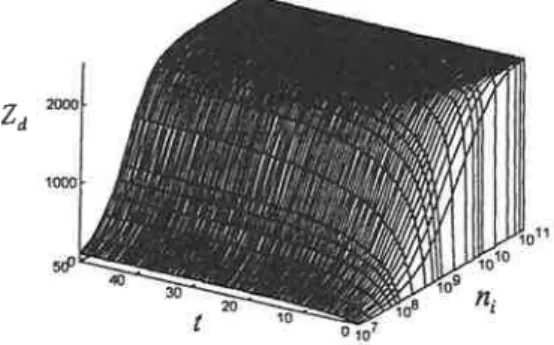
In order tO study the coHective erect of the dust― charge,、ve assume the input parameters as sho、 vn in Table 2. The temporal evolution of the dust― charge is plotted in Fig.2 as a function of the ion density As is discussed in previous studies, this erect occurs when the average intergrain distance′ (=η ど
lβ)becomes comparable to or less than the Debye lengthメ
D.Hence、 ve estimate′ and λど l at the ion density η」 =1015 rn 3 and ηじ=101l m 8, andヽ ve conarm
Table l Sunllnary of the results of the experi‐
ment of Thompson et al15 。 n the
grain― charge and dust―
acoustic wavesin a direct current glo、 v discharge (ヽ ェ plasma)
electron temperature ion temperature
ion density
lon mass娩
(eV)
4(eV)
%J(cm‑3)
物 ど
(g)
25 003
8× 10⁸
465×10 23 (dust particle)
temperature density
mass
radius
Tど (eV)
η」
(cm‑9)
″夕,ど
(g)
γ (cm)10
2× 10S 6× 10 13 4× 10 5
m m 々旬
Fig l The temporal and spacial evolution of the dust grain― charge̲
ヽ ヽ ア e
useμ
s andμ
m as the temporal unit and spacial unit, respectively The physical parameters used here are referred to Table lTable 2 The input physical parameters used for numerical calculation
(知Z plasma)
electron temperature ion temperature
ion density
lon mass(dust particle)
dust temperature
dust density dust mass dust radius
娩
(eV)舟
(eV)%:(cm 3)
,,つ
J(g) 10 01
1× 10⁹
465×10 23
T,(eV)
η
,(cm‑3)
,夕つど
(g)
γ (cm)
10
1× 10S 5× 10 12 1× 10⁴
―
‑ 89 ‑―The Bulletin of H I T, Vol 18
Z』