Profiles
journal or
publication title
The Journal of Kanda University of International Studies
number 29
page range 187‑206
year 2017‑03‑31
URL http://id.nii.ac.jp/1092/00001390/
The Journal of Kanda University of International Studies Vol. 29(2017)
English for Specific Purposes Project Leader Profiles
Kevin Knight
English for Specific Purposes Project Leader Profiles
Kevin Knight
Abstract
Knight (2015a) announces the creation of the ESP Project Leader Profiles, which are written for the professional development of ESP practitioners worldwide and published in the official blog of TESOL International Association. In a profile, the featured ESP project leader defines leadership and describes leadership communication in a successful ESP project. The profiles have their basis in the research of Knight (2015b) who conducted semi-structured interviews (Grindsted, 2001, 2005; Talmy, 2011) with 20 leaders in the public, private, and academic sectors in an exploration of the leadership conceptualization process. Following Knight (2015b), this paper explores with Scollon’s (2001) nexus analysis the co-construction of the profiles (as a nexus of practice) and argues that the profiles may be viewed as part of Knight’s (2015b) leadership conceptualization cycle.
ESP Project Leader Profiles
Kevin Knight, Kanda University of International Studies
1. Introduction/Background1
Nickerson (2012, p. 5) in a plenary speech advises teachers to interact with and learn from various professionals for the benefit of their students: “[It] is only through listening to [such professionals] that we will understand the communication knowledge
1 This paper is based in part on and replicates and adapts material from Knight (2015b, 2016, In press).
and skills that will ultimately lead to professional competence.” In agreement with Nickerson, I conducted semi-structured interviews with 20 leaders in the private, public, and academic sectors (Knight, 2015b). The datasets generated from the interviews were investigated with content, narative, and metaphor analyses. In addition, with the leaders’
permission, extracts from transcripts of the interviews were shared with the undergraduate students in my leadership seminars at Kanda University of International Studies (KUIS) in Japan. By drawing close to the 20 leaders through such research, teaching, and reflection (Schön, 1983), I could see and explore my personal conceptualization of leadership (as illustrated in Knight & Candlin, 2015) and my three-part leadership conceptualization cycle; i.e., experiencing leadership, reflecting on leadership, and framing leadership (Knight, 2015b). The leadership conceptualization cycle has influenced my research, conceptualization, and teaching of leadership.
The leadership conceptualization cycle may be similar to what Goby and Nickerson (2014, pp. 10-11) quote Ng, Van Dyne, and Ang (2009) as calling the four stages of experiential learning: “experience, reflect, conceptualize, experiment.” My experiential learning of leadership has included my research-related investigations of leadership discourse and my leadership roles at TESOL International Association. Those leadership roles in particular have provided me with the opportunity to experience leadership, reflect on leadership, conceptualize leadership, and experiment with leadership. In the light of the above, I will argue in this paper that the ESP Project Leader Profiles published in the official blog of TESOL International Association (i.e., the TESOL Blog) may be viewed as part of my leadership conceptualization cycle.
In my exploration of the ESP Project Leader Profiles in this paper, I consider the guiding questions of Scollon and Scollon (2004, pp. 173-175) for conducting a nexus analysis. These questions have their basis in critical discourse analysis (CDA),
How are social power interests produced [and reproduced] in this discourse?
What positions and alignments are participants taking up in relationship to each other, to the discourses in which they are involved, the places in which these discourses occur, and to the mediational means they are using, and the mediated actions which they are taking?
How are sociocultural or historical thought or cultural patterns [expressed] in the language and its genres and registers providing a template for the mediated actions of participants in the nexus of practice?
The creation of the profiles can be investigated as Scollon’s (2001) nexus of practice, and each blog post itself may be seen from a historical perspective as involving online interactions (i.e., mediated action) in which various stakeholders co-construct the profiles.
Accordingly, in this paper, I provide an account that illuminates the creation of the ESP Project Leader Profiles. In the next section, I start my account with an exploration of the relevance of TESOL International Association.
2. The Relevance of TESOL International Association
The relevance of TESOL International Association to the ESP Project Leader Profiles is implied in my abstract and bio for my presentation as a featured speaker at the Joint International Conference, ESP in Asia: Frontier and Advancement, The 8th International Conference on ESP in Asia & The 3rd International Symposium on Innovative Teaching and Research in ESP in Japan. (See Table 1.) The theme for which I was a featured speaker was ESP teacher development, and the title of my presentation was TESOL ESP Project Leader Profiles for Professional Development of ESP Practitioners Worldwide. The abstract in Table 1 provides an introduction to the ESP Project Leader Profiles.
Table 1. Abstract and bio for featured presentation at ESP conference
Abstract: TESOL International Association (or TESOL) based in the USA has over 11,000 members worldwide, and over 950 of those members belong to the English for Specific Purposes Interest Section (ESPIS). A former chair of the ESPIS became an official blogger on the subject of ESP in the TESOL Blog. (In 2015, the TESOL Blog had an average of more than 25,000 pageviews per month, in 215 countries.) In April of 2015, the ESP blogger launched the ESP Project Leader Profiles for the professional development of ESP practitioners worldwide. Each profile focuses on one ESP project leader. In a profile, the featured ESP project leader provides bio data and responds to the following two items: 1) Define leadership in your own words and 2) Tell me an ESP project success story. Focus on your communication as a leader in the project.
How did you communicate with stakeholders to make that project successful? The two questions are based on the research of Knight (2015) who conducted semi-structured interviews (Grindsted, 2005) with 20 leaders in the public, private, and academic sectors in an exploration of the leadership conceptualization process. The ESP project leaders in the profiles have included ESP practitioners in English for Occupational Purposes (EOP) and English for Academic Purposes (EAP), including Professor Jigang Cai and Professor Yilin Sun. The profiles have been described by one ESP project leader (Schwelle) as “a nice way to communicate what we do and offer practical, experience-based advice for fellow ESPers around the world.” The profiles are also a listed reference in the TESOL ELT Leadership Management Certificate Program Online. In his presentation, the speaker discusses the results of his analysis of the profiles (about 20) and focuses on conceptualizations of leadership of ESP practitioners and how communication is strategically used to achieve ESP project success.
Bio: Dr. Kevin Knight (PhD in Linguistics, MBA, MPIA) is an Associate Professor in the Department of International Communication (International Business Career major) of Kanda
University of International Studies in Chiba, Japan. In the English for Specific Purposes Interest Section (ESPIS) of TESOL International Association, he has served as chair, English in occupational settings (EOS) representative, and ESPIS community manager. He is currently co-editor of ESP News (the ESPIS newsletter). He was also a member of the Governance Review Task Force (GRTF) appointed by the TESOL board of directors. In addition, he has been a TESOL blogger in the area of English for Specific Purposes (ESP), and he recently completed the TESOL ELT Leadership Management Certificate Program Online. He has more than 30 years of professional experience working for private, public, and academic sector institutions including Sony and the Japan Patent Office. His doctoral research on leadership communication (i.e., discourse) as a basis for leadership development was under the supervision of Emeritus Professor Christopher Candlin and Dr. Alan Jones.
Table 1 highlights the reasons for my focus on “ESP and leadership” in the ESP Project Leader Profiles:
1. Technical competence in ESP and leadership based on my leadership roles in the ESPIS, my role as a TESOL ESP blogger, my professional experience in ESP, and my research of leadership discourse and ESP
2. The desire of ESPIS members for professional development of ESP practitioners through the sharing of professional experience
3. My recognition that ESP practitioners may also be project leaders
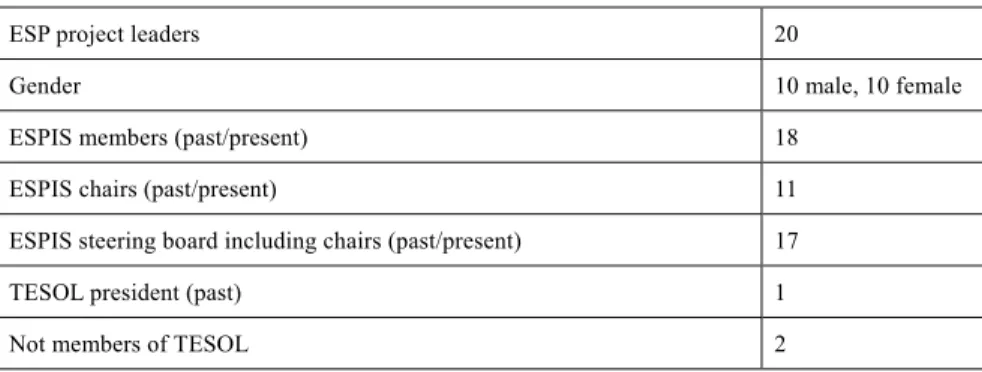
My activities as a leader in the ESPIS (in Table 1) contributed directly to the selection of the 20 ESP project leaders in the profiles (in Table 2); i.e., I was in positions on the ESPIS steering board that enabled me to build a professional network of ESPIS leaders.
Accordingly, I contacted these ESPIS leaders for participation in the ESP Project Leader Profiles when the project was announced in April 2015 (Knight, 2015a).
Table 2. Twenty (20) ESP project leaders
ESP project leaders 20
Gender 10 male, 10 female
ESPIS members (past/present) 18
ESPIS chairs (past/present) 11
ESPIS steering board including chairs (past/present) 17
TESOL president (past) 1
Not members of TESOL 2
In Table 2, the two ESP project leaders who were not members of TESOL were introduced to me by a former ESPIS chair. One of those two leaders I had already met at an ESP conference in Taiwan to which I had been invited by another former ESPIS chair.
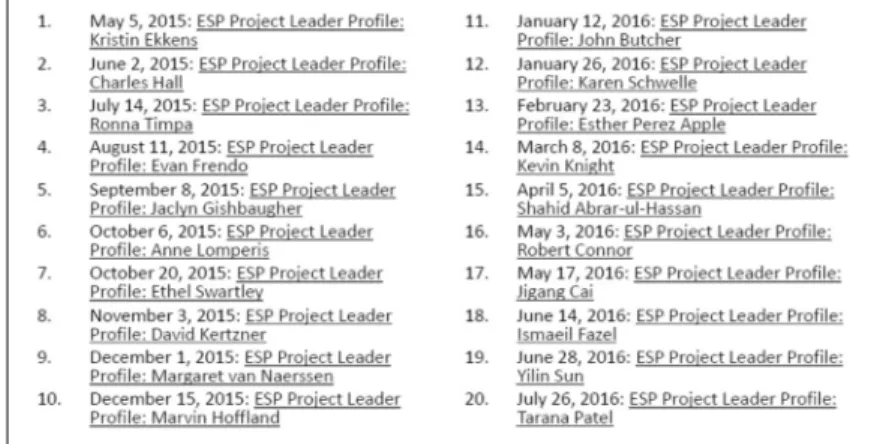
In addition to providing me with access to ESP project leaders, TESOL International Association made available to me the means for sharing the stories of the ESP project leaders; i.e., the TESOL Blog. As a TESOL official blogger with over 100 posts to date (http://blog.tesol.org/author/kknight/) and the responsibility to generate two blog posts a month, I was constantly seeking relevant material. It was Jaclyn Gishbaugher’s comments about the desire of ESP practitioners at the ESPIS open meeting at the 2015 TESOL convention in Toronto (where she was the ESPIS chair) that inspired me to create the profiles; specifically, the attendees wanted “regular profiles of ESP practitioners to share what people are up to and compare projects” (Knight, 2015a). Table 3 lists the ESP project leaders and the dates their profiles were published.
Table 3. ESP Project Leader Profiles (Knight, 2016, slide 4)
In summary, TESOL International Association made possible the creation of the ESP Project Leader Profiles. In the next section of this paper, I explore the two items (in Table 1) to which the ESP project leaders respond in the profiles.
3. The Perspective of ESP as Leadership2
Johns, Paltridge, and Belcher (2011, p. 1) conceptualize ESP as “providing leadership”:
English for Specific Purposes (ESP) has an established tradition that has undoubtedly provided leadership, as well as an intellectual “nudge,” for what is still generally called
“General English” or, more disparagingly, “English for No Obvious Reason.” As John Swales demonstrated in his 1988 ESP history (Episodes), developing an appropriate pedagogy for a specific group of learners has always been the goal of ESP practitioners.
Studying language, discourses, and contexts of use—as well as student needs, in the
2 This section is adapted in part from Knight (2015c).
broadest sense—and then applying these findings to the pedagogical practices, is what distinguishes ESP from other branches of applied linguistics and language teaching.
I see leadership in ESP because of its “obvious reason” (i.e., its focus on a vision). This point is clarified by the results of a word frequency analysis of the best practices of English for Occupational Purposes (EOP).
The EOP best practices appear in an ESP PowerPoint for practitioners and clients (Knight, Lomperis, van Naerssen, & Westerfield, 2010, slide 14). (See Table 4.)
Table 4. Best Practices in EOP
Best Practices were developed for the following areas by the TESOL Task Force on Standards for Workplace Language Training: Guidelines for Workplace Language Trainers (J. Friedenberg, A.
Lomperis, W. Martin, K. Westerfield & M. van Naerssen, 2000-2001).
1. Develop an effective, current strategic plan 2. Conduct effective marketing
3. Assess the client organization’s needs 4. Determine an appropriate program design 5. Develop a proposal and negotiate a contract
6. Identify and arrange program administration and staffing 7. Conduct an instructional needs assessment (INA) 8. Create an instructional design/curriculum 9. Select and develop appropriate training materials 10. Deliver training
11. Evaluate course(s) and program, and apply recommendations
A version of this content can be found in the 2003 TESOL publication Effective Practices in
Word frequency analyses (with NVivo 11 Pro software) of the words in the 11 items in Table 4 generated the word clouds in Figure 1 (based on exact words) and Figure 2 (based on similar words including generalizations). The size of the words in Figure 1 (or of the word groups in Figure 2) is based on word frequency (or on the number of words in a group in Figure 2).
Figure 1. EOP best practices (based on exact words)
Figure 2. EOP best practices (based on similar words including generalizations)
Figure 1 reflects that EOP best practices are concerned with “program development.”
Figure 2 emphasizes the word group “create,” which is significant to me as I had come to conceptualize leadership as an activity involving communication for the purpose of creation:
Leadership [is] a communication process consisting of two parts: 1) communicating to create a vision and 2) communicating to achieve a vision (Knight, 2013).
Leadership is making real a vision in collaboration with others (Knight and Candlin, 2015, p. 36).
Accordingly, I can see leadership in EOP best practices. Further, the two items (in Table 1 and below) in the ESP Project Leader Profiles were influenced by my conceptualizations of leadership.
1. Define leadership in your own words.
2. Tell me an ESP project success story. Focus on your communication as a leader in the project. How did you communicate with stakeholders to make that project successful?
The responses of the 20 ESP project leaders to the two items above are investigated in the following sections of this paper.
4. Contents of the Profiles
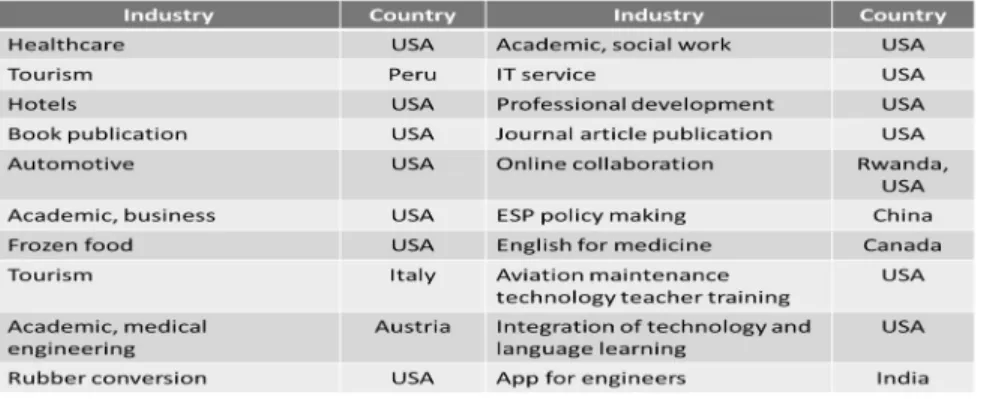
The projects described in the ESP Project Leader Profiles occurred in five continents: Africa, Asia, Europe, North America, and South America. (See Table 5.) In the future, there will be a total of six continents when the two profiles of ESP project leaders in Australia are published.
Table 5. ESP Projects (Knight, 2016)
The ESP project leaders were encouraged to read any previous profiles before writing their own. The 20 leaders were also free to choose the projects about which they wanted to write. In addition, one leader did not write about a specific project, and another leader wrote about two projects.
As in the previous section of this paper, word frequency analyses (with NVivo 11 Pro) of the definitions of leadership of the 20 ESP project leaders in their profiles generated the word clouds in Figure 3 (based on exact words) and Figure 4 (based on similar words including generalizations).
Figure 3. Definitions of leadership (based on exact words)
Figure 4. Definitions of leadership (based on similar words including generalizations)
Figure 3 portrays leadership in connection with ESP and vision, and Figure 4 reflects my conceptualization of leadership as involving communication (Knight, 2013).
In contrast with Figure 4 is a word cloud (Figure 5) of the definitions of leadership of 20 leaders in the public, private, and academic sectors (Knight, 2015b). (Figure 5 was generated by NVivo 10 and based on word frequency of similar words including generalizations.)
Figure 5. Definitions of leadership (Knight, 2015b)
Figure 5 reflects my conceptualization of leadership in Knight and Candlin (2015). The word cloud points to the 20 leaders taking action to unite stakeholders in order to achieve change.
Word frequency analyses (with NVivo 11 Pro) also illuminated the responses of the 20 ESP project leaders to the second item in the profile; i.e., an ESP project success story
Figure 6. Narratives of 20 ESP project leaders (based on exact words)
Figure 7. Narratives of 20 ESP project leaders (based on similar words including generalizations)
Reflected in Figures 6 and 7 are the ESP project leaders’ accounts of their ESP projects, which include needs analyses and ESP-related activities. A focus on needs analysis in such accounts might be expected in view of the publications of ESP scholars, including Abrar-ul-Hassan (2012, p. 6):
Needs analysis (also known as needs assessment)…is essential for an ESP course (Gimenez, 2009; Long, 2005; Yogman & Kalayni, 1996)….NA provides the basis (the what and how) for an ESP course, and the curricular procedures draw upon the analysis (Belcher, 2006; Johns & Price-Machado, 2001).
A needs analysis in the ESP Project Leader Profiles can also be viewed from a leadership and communication perspective. From such a perspective, the accounts of the ESP project leaders include the following three parts (Knight, 2016, slide 20):
1. The vision to be created
An ESP program, book, research article, government policy 2. Communication to create the vision
Obtaining stakeholder input in creating an ESP program; e.g., needs analysis 3. Communication to achieve the vision
Persuading stakeholders to support an ESP program that has been created
Conducting activities in the ESP program
Ongoing communication with stakeholders; e.g., student feedback and progress reports
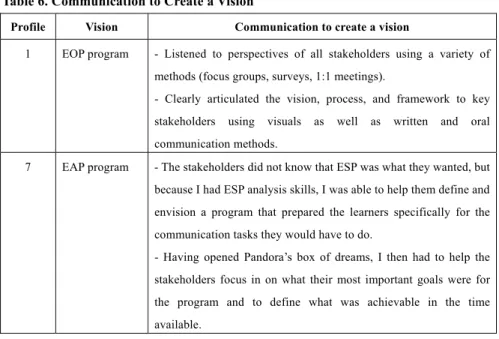
In view of the above, a needs analysis may fall under communication to create the vision (e.g., designing an ESP program). Ongoing needs assessment may also be a part of the communication to achieve the vision (e.g., conducting an ESP program). Examples of communication to create a vision and communication to achieve a vision appear in Tables 6 and 7.
Table 6. Communication to Create a Vision
Profile Vision Communication to create a vision
1 EOP program - Listened to perspectives of all stakeholders using a variety of methods (focus groups, surveys, 1:1 meetings).
- Clearly articulated the vision, process, and framework to key stakeholders using visuals as well as written and oral communication methods.
7 EAP program - The stakeholders did not know that ESP was what they wanted, but because I had ESP analysis skills, I was able to help them define and envision a program that prepared the learners specifically for the communication tasks they would have to do.
- Having opened Pandora’s box of dreams, I then had to help the stakeholders focus in on what their most important goals were for the program and to define what was achievable in the time available.
Table 7. Communication to Achieve a Vision
Profile Vision Communication to achieve a vision
12 EAP program “…we have maintained lines of communication with stakeholders…
Students: Students complete several short written reflections…which…help instructors know in what respects the ESP course is meeting students’ needs….
MSW Program Faculty and Administrators:…I sat in on the core course for two semesters to better understand the communication demands it places on students.…For the last several years, one or both ESP course instructors have attended meetings twice per year with all faculty teaching the core course in order to better understand their perspective on
international students’ challenges and successes….
Within the English Language Programs: …some important discussions about the course happen at the copy machine or on the walk from our offices to class. We also use a Dropbox-like service for instructors to share materials.”
17 ESP policy making
- I talked with the officials of Shanghai Municipal Education Commission about the significance of the paradigm shift, which will not only change the test-oriented CET programs but also help to establish Shanghai as the international hub of finance, commerce, technology, and transportation by producing graduates with strong competitiveness in the global marketplace.
- The communication led to the release of the framework as a government document in 2013, which requires that all Shanghai tertiary institutions should “equip students with English language skills to enable them to succeed in their academic studies and future careers.”
Exploring the ESP Project Leader Profiles from the two leadership discursive perspectives of communicating to create a vision and communicating to achieve a vision can provide valuable insights to ESP practitioners about how to achieve their own ESP visions. The value of the ESP Project Leader Profiles for all teachers and not only ESP practitioners was recognized with the inclusion of the profiles in TESOL’s ELT Leadership Management Certificate Program Online. (See Table 1.)
5. Discussion and Conclusions
In this paper, my account of the creation of the ESP Project Leader Profiles illuminates why and how the profiles were created. Further, the way in which the profiles
are a part of my leadership conceptualization cycle is clarified. Specifically, my conceptualizations of leadership (e.g., Knight, 2013; Knight & Candlin, 2015) contributed to the creation of the profiles.
In addition to having an impact on the creation of the profiles, my leadership conceptualization cycle has also influenced my curriculum development. My leadership research and curriculum development activities are recorded in The Leadership Connection Project website [https://leadershipconnectionproject.wordpress.com/] and include descriptions of and publications related to the following:
1. Kevin’s Company (a business consulting internship program) in the KUIS Career Education Center
2. English for Business Career (EBC) courses and Leadership seminars in the KUIS IC Dept. (IBC major)
3. Global leadership competition in the KUIS SALC
Two Leadership Communication courses (to be offered to all KUIS students in the future) have also been created and will be added to the website. The ESP Project Leader Profiles and other professional development projects are listed on the website now.
As stated in the first section of this paper, I have intended my research of leadership to be of benefit to my students, and the ESP Project Leader Profiles have not been an exception. From a professional communication perspective, the profiles are examples of how ESP practitioners can effectively communicate their accomplishments. In Knight (2014a), I argue that behavioral questions in a university career center manual reflect leadership conceptualized as a creative activity; e.g., “Give me an example of a time when you set a goal and were able to meet or achieve it” and “Give me an example of when you showed initiative and took the lead.” In Knight (2014a), I also quote from Liu
(2010, pp. 3-4) that experts consider leadership to be about “activity” and “change.” In view of such conceptualizations of leadership and interview questions, I see that the ESP Project Leader Profiles are a valuable resource for job interview training. By reading the profiles, my KUIS undergraduate students and Hello Work (unemployed and government sponsored) adult students (Knight, 2014b) can learn how to more effectively talk and write about their own leadership accomplishments for career success.
6. References
Abrar-ul-Hassan, S. (2012). State-of-the-art review: Revisiting the ins and outs of ESP practice.
Professional and Academic English, 39, 4-11.
Goby, V.P., & Nickerson, C. (2014). Accreditation and assessment of learning in the UAE. Quality Assurance in Education, 22(3).
Grindsted, A. (2001). The discursive organization of research interviews. Hermes, Journal of Linguistics, 27, 173-192.
Grindsted, A. (2005). Interactive resources used in semi-structured research interviewing. Journal of Pragmatics, 37, 1015-1035.
Johns, A., Paltridge, B., & Belcher, D. (2011). Introduction: New directions for ESP research. In D.
Belcher, A. Johns, & B. Paltridge (Eds.), New directions in English for specific purposes research, (pp. 1-4). Ann Arbor, Michigan: University of Michigan Press.
Knight, K. (2013). Looking at communication through a leadership lens. TESOL Blog. Alexandria, Virginia: TESOL International Association.
Knight, K. (2014a). ESP interview training: Identifying leadership. TESOL Blog. Alexandria, Virginia: TESOL International Association.
Knight, K. (2014b). Connecting career education, women, and TESOL leadership. TESOL Blog.
Alexandria, Virginia: TESOL International Association.
Knight, K. (2015a). ESP project leaders: Profiles & professional communication. TESOL Blog.
Alexandria, Virginia: TESOL International Association.
Knight, K. (2015b). Analysing the discourses of leadership as a basis for developing leadership communication skills in a second or foreign language. Sydney, Australia: Macquarie University.
Knight, K. (2015c). ESP best practices in view of leadership conceptualization. TESOL Blog.
Alexandria, Virginia: TESOL International Association.
Knight, K. (2016). TESOL ESP project leader profiles for professional development of ESP practitioners worldwide. [Featured presentation]. In Joint International Conference, ESP in Asia: Frontier and Advancement, The 8th International Conference on ESP in Asia & The 3rd International Symposium on Innovative Teaching and Research in ESP in Japan. Tokyo, Japan: UEC.
Knight, K. (In press). TESOL ESP project leader profiles for professional development of ESP practitioners worldwide. In Conference Proceedings of Joint International Conference, ESP in Asia: Frontier and Advancement, The 8th International Conference on ESP in Asia & The 3rd International Symposium on Innovative Teaching and Research in ESP in Japan. Tokyo, Japan: UEC.
Knight, K., & Candlin, C.N. (2015). Leadership discourse as basis and means for developing L2 students into future leaders. In P. Shrestha (Ed.), Current developments in English for academic and specific purposes: Local innovations and global perspectives (pp. 27-50).
Reading, UK: Garnet.
Knight, K., Lomperis, A. E., van Naerssen, M., & Westerfield, K. (2010). English for specific purposes: An overview for practitioners and clients (academic and corporate). PowerPoint presentation submitted to Alexandria, VA: TESOL Resource Center.
Ng, K. Y., Van Dyne, L., & Soon, A. (2009). From experience to experiential learning: Cultural intelligence as a learning capability for global leader development. Academy of Management Learning and Education, 8(4), 511-526.
Nickerson, C. (2014). Unity in diversity: The view from the (UAE) classroom. Language Teaching, FirstView, (6), 1-15. (Plenary speech published online by Cambridge University Press: 22 May 2012.)
Schön, D. (1983).The reflective practitioner: How professionals think in action. New York, NY:
Basic Books.
Scollon, R. (2001). Mediated discourse: The nexus of practice. London, UK: Routledge.
Scollon, R., & Scollon, S.W. (2004). Nexus analysis: Discourse and the emerging internet. London, UK: Routledge.
Talmy, S. (2011). The interview as collaborative achievement: Interaction, identity, and ideology in a speech event. Applied Linguistics, 32(1), 25-42.