Contemporary Ch'i/Ki Research in East Asian Countries: Implications to Communication Research
著者名(英) Jensen Chung, Kazuya Hara, Chungli Yang, Ji‑Myung Ryu
journal or
publication title
異文化コミュニケーション研究
volume 15
page range 41‑66
year 2003‑03
URL http://id.nii.ac.jp/1092/00000241/
asKUIS 著作権ポリシーを参照のこと
Contemporary Ch’i/Ki Research in East Asian Countries: Implications to
Communication Research
CHUNG Jensen, HARA Kazuya, YANG Chungli and RYU Ji-Myung
Although the concept of ch’i (ki) has been molded and applied to all aspects of lives and disciplines in East Asian cultures for thousands of years, it has been recently introduced to communication studies in the West. This essay compares ch’i/ki concepts and their studies in the cultures of China, Korea, Japan, and Taiwan. This study finds surpris- ing similarities across the cultures although there are stark differences in definitions across disciplines. Illustrated with recent theories and new directions in ch’i/ki research, this essay argues a promising potential for theorizing human communication based on ch’i/ki.
Keywords : Ch’i, ki, qi, communication, Asiacentric, communication theory
Communication behaviors, like other human behaviors, are influ- enced by philosophical roots of cultures in a particular communication context. Communication research, therefore, is naturally expected to yield culture-specific theories, methodologies, or at least, perspectives.
However, the field of contemporary communication studies, as pointed
out by Ishii (2001), has been dominated by U.S. Eurocentric scholar-
ship, which shows reluctance to accept Eastern thought, philosophy,
and assumptions concerning communication studies. In addition,
Ishii (2001) points out that the U.S. Eurocentric communication
scholarship has been dominated by the Cartesian philosophy based on
mind-matter dualism, mechanistic views of human beings and natural
beings, and the linear progressivism of science and technology. Meth-
odologically, this bias has resulted in the selection of trivial topics,
repetitive research, and a heavy reliance on quantitative measures and statistical tests (Chu, 1988). Communication scholars in the East also tend to unknowingly accept the “value-free” research methods in the name of scientism (Chen, 2002).
To deal with the problem of dominance by the Western perspec- tive, Dissanayake (1986) calls for the exploration of indigenous theo- retical concepts formulated in non-Western societies. Chan (2000) urges the development of indigenous theories because they are pivotal to the indigenous communication research. Miike (2002) takes up the calls and proposes a conceptual framework to lay the foundation for establishing an Asiacentric paradigm of communication theories. He formulates ontological, epistemological, and axiological assumptions, which are featured by three central themes: relationality, circularity, and harmony. Furthermore, Miike (2002) suggests three core communicative assumptions for an Asiacentric paradigm: 1) Communication takes place in contexts of multiple relationships across space and time; 2) Communication is perceptually and behaviorally both active and passive in a variety of contexts; and 3) Mutual adaptation is of central importance in harmonious communication processes.
The pioneering nature of Miike’s attempt to lay a cornerstone for the Asiacentric communication paradigm may eventually be celebrated as a milestone. His assumptions, however, have left some room for augmentation. “Asia” is a broad and vague geographical concept. In addition to Taoism, Buddhism, and Confucianism, there are other cultural roots in this continent to account for the common grounds or idiosyncrasies in Asiacentric communication paradigms. Many con- cepts will need to be introduced to make more inclusive theoretical paradigms. Among them, ch’i is a prominent one.
Ch’i,
気, (or ki, as spelled in Korea and Japan, and qi as spelled in
communist China) is one of the communication-relevant concepts
unique to East Asian cultures. In all East Asian cultures it is com-
monly understood and referred to as energy flow, either in human bodies, art works, natural environments, dwelling designs, furniture arrangements, or gravesite locations.
Ch’i/ki is a two-thousand-year-old concept and has been studied by many scholars in East Asia, including China, Japan, Korea, and Taiwan. Over the years it has been studied as part of cosmology and ontology. In recent years, ch’i/ki has been studied in connection with natural sciences, including physics and electronics. In the 1990’s, scholars in Japan and the United States started applying ch’i/ki study to understanding psychology and communication process. They have been making encouraging efforts to bridge the Eastern mystiques and the Western sciences. This study compares the ch’i/ki concept as understood in East Asian countries and to find some commonalities and implications to the studies of human communication. It is hoped that findings from this study will provide clues to rendering Asiacentric communication paradigms more solid and complete.
1. Philosophical Roots of Ch’i Studies
Although ch’i/ki has been studied in various fields such as calligra- phy, martial arts, fengshui, medicine and literary criticism, it is in philosophy that ch’i/ki established its roots and scholarly foundation.
Ch’i is an influential and complex concept in Chinese philosophy.
It is studied in ontology, cosmology, and the mind-nature theory.
The word “ch’i” first appeared in the writings on oracles in the Sang dynasty, referring to the ch’i of cloud, a kind of ch’i of the nature. It wasn’t until the era of Spring and Autumn (
春秋) and the era of Warrior States (
戰國) that scholars started to investigate the relation- ships between ch’i and human beings, the material world, and human personalities.
Some scholars argued that the concept of ch’i should be regarded as
a philosophical concept since it is a principle or rule of the operation in
the realm of phenomena, and it relates to human beings. The follow-
ing are delineations of ch’i as a philosophical concept.
As Cheng (1981) points out, understanding ch’i based on the origi- nal definition in I-Ching (
易經) can more accurately redefine the concepts and relations between “ch’i” and “li (reason).” Interpreting I-Ching, Cheng states that ch’i apparently refers to the order forming the natural phenomenon and the substance of shaping the form. In addition, the features of ch’i include an endless creativity and change- ability. Regardless of how complex its diversification and hierarchy are, the activity of ch’i constantly remains as an integral unit. It starts as an entity with the content of formless creativity and ends as an entity with the content of order and harmony. Its beginning and ending constitute another entity with more order, harmony, and dynamic for potential change. “Yin (
陰)” and “yang (
陽)” are the two fundamental states of activity of ch’i. Lo (1979) infers from I-Ching passages to define ch’i as the fundamental element of the universe.
Yi (2001) argues that although Lao Tzu (
老子) contributed only three sentences to the discussion of ch’i, the passages confer the status of philosophy to ch’i study. These sentences affirm the existence of ch’i as being materialistic and as the minimum unit of all things in the world. The three sentences are: “Focus ch’i to be as soft as babies,”
“Benefiting the living things is considered auspicious, and operating the ch’i with the mind renders strength,” and “All things in the world carry yin and embrace yang, and can reach harmony when coordinated with ch’i.” Chung (1993) considers ch’i in Lao Tzu as baby-like, containing lively and active vigor of life. Cheng (1993) defines ch’i in modern terms as a compound state of strength and energy. Chu (1986) made a very important comment on Lao Tzu’s pivotal role in defining ch’i: “Lao Tzu inherited I-Ching of the Chou dynasty and other classical literature to comprehend the process of transformation of all things in the universe. He inherited the old symbols of “—”
and “— —” and conceptualized them into “yin” and “yang.” With the
mutual action-reactions of yin and yang, ch’i is produced” (p. 18).
Chuang Tzu (
莊子, 369–286 BC) conferred philosophical status to the concept of ch’i. Based on Chuang Tzu’s thoughts, ch’i is a ubiquitous material, the arch-spore of human life and ever-changing of all things in the universe.
Mencius (
孟子, 372–279 BC), a prominent Confucian scholar dur- ing the era of Warrior States, made two major contributions to the evolution of the concept of ch’i. First was the delineation of the relationship between jih (
志) and ch’i. Jih is a will power and an intellectual state of the mind, while ch’i is the expression of the physical content and vitality of our body. Jih leads ch’i; the will power can influence vitality. Second, Mencius stressed the moral aspect of the ch’i and regarded righteousness as an essential compo- nent of nurturing the “righteous ch’i.”
Ting-shiang Wang (
王廷相, 1472–1544), an experientialist, inte- grated the Taoist concepts of nature and ch’i and pioneered the naturalism of ch’i. Zhai Zhang (
張載or
張 渠, 960–1126) is known as the first person that theorized ch’i in depth. He asserted “all those can be described exist, all those exist can be recognized, and all those recognizable have ch’i” (Liu, 2000, p. 6). Being recognizable is not necessarily being visible. “All those healthy, fluent, active, idle, and splendid are recognizable” (Liu, 2000, p. 12).
2.
Ch’i/Qi Studies in Contemporary ChinaCh’i/qi studies in contemporary China are mainly in two realms:
philosophy and qigong (
氣功, the function of ch’i on supernatural
abilities). The ch’i study in philosophy was motivated by the com-
munist ideology of materialism. One of the primary philosophical
foundations of communism is materialism, which argues for the sole
existence of materials and physical attributes and the non-existence of
non-material entities like minds or their attributes. Materialism stresses
the externally observable scientific methods to study human beings,
playing down the relationships between humans, and their minds or
egos. In this view, minds and psychological attributes will eventually bog down to complicated physical systems. Thus Dai-nien Zhang, in the 1930’s, argued that since ch’i is the fundamental unit of all things, all things are materials. In other words, the claim of the sole existence of ch’i can be equated to the claim of the sole existence of materials.
With the equation of ch’i to materials and materialism, ch’i study became one of the most “politically correct” fields of philosophy study after the Communist takeover of China. Due to this political con- nection, ch’i study received a great support in the field of philosophy. Dai-nien Zhang’s argument was refuted by Taiwanese ch’i scholars in recent years. This will be discussed in the later section of this essay when reporting ch’i research in Taiwan.
Ch’i study also received unusual support in Chinese qigong (
氣功, ch’i technique) research. Xieh-seng Chien, a Chinese American physi- cist who defected to China during the Cold War era, was fascinated by the mystique of Chinese ch’i practice. With his political clout, he urged the government to encourage the qigong research in the context of supernature study.
3. The Ki (
気) Concept: Ki Research in Japan
Since introduced from China, the concept of ch’i, known as ki in Japan, has played an important role in the discussion and study of health, emotions, intentions, public opinions, human relationships, and even martial arts. Japanese dictionaries contain many definitions of ki, such as spirit, temperament, awareness, or atmosphere. Many of them are closely related to human communication. In this section we will report the evolution of the meanings of ki, its perceived functions, and studies of ki related to communication research.
Historical Review of the Ki Concept in Japan
In the Nara (710–784 A.D.) and Heian (794–1185 A.D.) periods
(including the Yamato period), the word ki was read as iki or kokoro (Maebashi, Sato, and Kobayashi, 2000). In Nihonshoki (“Historical Record of Japan” written in 720 A.D.), ki (
気) was read as iki, kokorobae, shirushi, or ka, and referred to breath, force, symptom, or smelling, respectively (see Sakamoto, 1974). In the Heian period, ki’s pronunciation evolved to ke or ki and was commonly used. In the book, The Tale of Heike (1219 to 1222 A.D.), ke appears fre- quently and refers to one’s psychological and emotional state, illness, or symptoms of childbirth (see Takagi, 1959).
In modern times (from the Meiji era to the end of the Pacific War),
ki became a concept the Japanese commonly embraced as a function
of the mind and body or interpersonal relationships. Maebashi,
Sato, & Kobayashi (2000) classify ki in terms of the relationships
between the mind and the body and between two persons. The first
type of ki in his typology features the nature of inseparability of mind
and body. For example, the expression genki (
元気: healthy), byoki
(
病気: illness), kibun (
気分: one’s feelings) include both psychological
and physiological states. The second type of ki showcases the nature
of occasional mind-will incompatibility, indicating that ki does not
always work as the mind expects. Such expressions include ki ga
tsuyoi, kiga yowai (
気が強いor
弱い: brave or timid), or kisho (
気性:
temperament). The third type of ki indicates the nature of present-
ness. Ki sometimes does not show its independent subjectivity in a
person. Expressions standing for the psychological state of ki not
being related to one’s will include kimagure (
気まぐれ: a whim), ki no
mukumama (
気の向くまま: as one feels inclined to do), and ki ga
noranai (
気が乗らない: be reluctant to do). The fourth kind of ki
shows the nature of relationships between-subjects. The expressions
ki ga au or ki ga awanai (
気が合うor
気が合わない: whether one can get
along well with the other or not) shows that this type of ki cannot exist
without the other person.
Defining and Conceptualizing Ki in Contemporary Japan Obviously it is not an easy task to exhaust the definitions of ki.
Scholars have been trying to define it with some functional foci.
Shinmura (1991) defines ki from five aspects: 1) Ki as the basic component that fills the space between heaven and earth. Ki of this concept covers the occurrences of natural phenomena such as wind and rain, or heat and cold. 2) Ki as the energy of an impelling force of the life. 3) Ki as the state and work of the mind. This definition includes the spirit, motivation, energy, and emotion. 4) Ki as the atmosphere with which people feel surrounded. This ki serves as an unspoken assumption that people share a context when communicat- ing. 5) Ki as a specific taste and conspicuous characteristics which symbolizes a thing or an issue. As Hamano (1987 b) points out, Japanese people perceive ki as something ethereal rather than some- thing physical. Essentially, it can be concluded that the main idea of ki for Japanese people stands for their sensitivity to other’s feelings, and also refers to an altruistic feeling of pleasure.
Idiomatic Expressions Using Ki
Hara (2002) selects 57 idiomatic expressions with which “ki” is used as a main concept in a Japanese language dictionary. Based on his categories, a simple preliminary analysis shows that 37 definitions are related to one’s emotions, feelings and opinions (65%), 15 stand for the human relationship maintenance (26%), 2 cover health (4%), and 3 (5%) are used to express an atmosphere in a context. This result indicates that, in Japanese relational communication, ki mainly works as an element to evoke sensitivity to others and to smooth communica- tive atmosphere in a context where people share a passage of time.
Ki Related to Present-Day Japanese Communication Research
As reviewed above, the word ki delineates Japanese people’s feel-
ings, thoughts, and personality. Hamano (1987 a) analyzes how ki is
used to describe personality traits and found four factors. First, ki is a changeable material, which implies that our personality metaphori- cally has ki within it. Such expressions as kimamana (
気ままな: fickle) and kizewashii (
気ぜわしい: restless, fidgety) stand for one’s changeable emotion. Second, ki is attention to others. For ex- ample, ki wo tsukau (
気を使う, be sensitive to other’s feelings) is required for harmonious communication, and one’s personality is evaluated by the extent to which we pay attention to others. Third, ki is “radio waves” between people, a capacity of tuning into others is a measure to evaluate an individual’s. This implies one’s feeling of getting along with others (
気が合う: ki ga au or not) is the premise for successful communication. Fourth, ki is the quantity of psychic energy. Here, ki metaphorically stands for one’s willingness and motivation. The person who is mentally tough is said to be ki ga tsuyoi (
気が強い: strong ki), and the one who is timid is said to be ki ga yowai (
気が弱い: weak ki).
Subsequently, Hamano (1987 b) presents three types of ki in inter-
personal relationship: 1) Japanese people feel that ki appears as some-
thing alien to their egos and without their conscious awareness. This
indicates that Japanese people accept ki as something that is uncon-
trollable and cannot be rejected. For example, Ki is seen in such
idiomatic expressions as ki ga sumu (to be satisfied; to be calm) or ki ni
suru (to worry about; to be anxious about). These expressions show
that ki is regarded as something that exists in itself and comes from
somewhere other than the psychological field of the person. 2) Ki in
interpersonal relationships is the ki recognized in the presence of
another person. For example, ki ga au (to get on well with each
other) or ki-gane suru (to feel uneasy; to be shy) cannot be felt without
the existence of others. This type of ki is changeable depending on
the relationship with the other. 3) Ki is that which is ego-syntonic
and interchangeable with the word kokoro (personal psyche; mind; or
spirit). This type of ki is mostly found in ki as personality-trait
names.
In addition to ki studies at the interpersonal communication level, ki also is studied at the mass communication level. Ito (2002), for example, studies kuuki, defined as “social, political, and psychological pressures demanding compliance to a certain specific opinion, policy, or group decision and usually accompanied by threats and social sanction”. He specifies five conditions to be met in order for kuuki to be strong enough to exert influences. The five conditions are: 1) The majority opinion accounts for the majority in more than two of the three sectors: government, mass media, and the public. 2) The majority opinion accounts for the majority across the three sectors. 3) The majority opinion increases over time. 4) The intensity of the majority opinion is escalating. 5) The subject matter tends to stir up the “spirits” inherent in individuals such as basic values, norms, prejudices, antagonism, and loyalty to the collective or patriotism (Ito, 2002).
Brought together with the “interpersonal communication ki” re- viewed in this section, the “mass communication ki” introduced by Ito adds to the possibility of reaching a common principle, if not theory, of “ki communication.”
4.
Ki (氣) Research in Korea
A common understanding of ki (
氣) in Korea is reflected in the Korean language. The term ki in the Korean language is used to represent mental states, disease, emotions, natural phenomenon, per- sonalities, characteristics of body types, etc. (Kim, K., 1997). Many Korean idioms and expressions contain the term “ki.” For example, the Korean word for air is kyungki (
空氣), meaning “like empty but full of ki.” Daeki (
大氣) means “great ki” and refers to the atmosphere, implying that ki is ubiquitous. A person’s disposition, kigil (
氣質) refers to the unique character each person possesses.
Ki in Korean also refers to tangible objects, such as common cold,
kamki (
感氣). It is also described as a moving force that invigorates a person. When someone is full of energy in professional or personal settings, it is commonly said that he or she has good kisae (
氣勢).
Many ki-building practitioners and trainees in Korea believe that ki trainings can enhance one’s health and even the fate of one’s life (Kim, 1994).
The next section provides an overview of the Korean research on ki that has expanded its philosophical conceptualization to scientific explanations of ki. The review of literature on ki is mostly based on Kyu-Bin Kim’s (1997) comprehensive overview of current discus- sions on Korean ki concept. In the following, we offer a brief history of ki research. We will then review Kyu-Bin Kim’s discussion of research on ki in Korea.
A History of Ki Research in Korea
Korean interest in philosophical and scientific research on ki has increased since ki-training programs became popular nationally in the 1980s. During that period, a “ki boom” swept the country. Scholars attributed this boom to the public’s attention to Chinese artifacts and concepts as a result of Jung-Bin Kim’s famous novel, “Dahn (
丹)” and the establishment of diplomatic relations with China (Kim, K. 1997).
Ki-training centers were established, and articles and instructions written in Chinese or Japanese became available. The study on “ki philosophy” and “ki science” thus became popular (Kim, K. 1997).
Ki, however, is not new to Koreans. When Chinese Taoism was
introduced to Korea at the end of the Koguryo dynasty (B.C. 624), it
included the concept of ki in relation to spiritual training. Yet it was
understood more as a religion than a subject of scholarship and was
not as widely accepted as in the 1980s. Later in the Chosôn dynasty
(B.C. 1392–1910), Neung-Hwa Lee (historian, B.C. 1868–1945) in-
troduced the term Dahnhak (
丹學) in relation to ki in his book, The
History of Cho-sun Taoism (Kim, K. 1997). According to Ill-chi Lee,
president of the Korean Research Institute for New Human Science, Dahnhak refers to a study of ki for the purposes of mastering the balancing of mind and body. Thus, studies of Dahnhak in Korea are usually related to mind/body harmony training programs designed to promote the harmonious growth of individuals (Retrieved May 3, 2002 from http://www.healingsociety.org).
Public and academic interests in ki flourished in the 1990s. In the early 2000s, discussions on ki in the areas of philosophy, psychology, and mental science are more actively debated than ever before. Won- Kwang University, for example, announced the establishment of a new graduate school of ki. In addition, countless ki-related groups and training centers (providing ki training, breathing techniques, ki exercise, etc) train people to increase personal levels of ki. Among philosophical discussions on ki, academic efforts to interpret or rein- terpret the conceptualization of ki are noteworthy because they offer logical explanations of ki phenomena, which will be discussed in the following section.
Current Discussions on Ki in Korea
Kyo-Bin Kim (1994) identifies several areas of ki research that hold diverse but interdependent theoretical perspectives: first is the new science movement. Influential in this movement is Fritjof Capra, who placed modern biology and ecology under revisionist scrutiny in his well-known books, The Tao of Physics and The Web of Life. Capra (1990) argues for the need to view the universe as a unified system by incorporating Eastern philosophy into physics. Capra’s contention is based on the premise that the spirit-body and nature-human dichoto- mies that dominate Western philosophy for so long constrain the understanding of Western civilization. Scientists who support the
“new science” movement believe that as physics develops, a new way
of thinking is specially needed to deal with crises of contemporary
civilization. The philosophy of ki, as an element in the “new sci-
ence” movement, is mainly based on ki theories of Chang Hwoen-Gu (
張 渠, or
張載Zhang Zhai, using the Chinese pronunciation of his original name, 1020–1077), a Chinese philosopher of Taoism and Oriental medicine.
The main idea of ki in the “new science” movement is that ki is an attribute not of only material substance but also of human beings. This idea is used for studying physics, medicine, and neuroscience. For example, ki is incorporated into physics to bring a new understanding of relationships between protons and the structure of the universe. It is also used to explain the field theory that focuses on the interdepen- dence of substance and space. In medicine, studies were conducted to find effects of ki on human bodies. The Korea Research Institute of Jungshin Science is one of the major research organizations at- tempting to establish “ki science” by measuring auras of ki, investigat- ing life cycles of all living beings, and assessing the impact of ki trainings on brain functions.
These studies were not free, however, from traditional paradigms of Western science. According to Kim (1994), the “new science” move- ment has been criticized for viewing the universe holistically and has resulted in reinforcing traditional scientific theories, instead of reach- ing a new understanding of humanity and nature. Furthermore, the
“new science” movement emphasizes only selective aspects of Eastern and Western philosophies to prove the similarities between contempo- rary physics and Eastern philosophies. Their research disregards fundamental differences between the Eastern philosophy of ki and contemporary physics. In other words, their intent was merely to use ki to collaborate existing understandings rather than produce new ones.
The second approach to studying ki is to re-conceptualize tradi-
tional notions of ki through scientific and rational language relevant to
contemporary contexts. This effort is most common in the field of
philosophy and oriental medicine. In this approach, ki is pivotal in
describing nature and humanity. In fact, this approach resists the view of nature and human as separate. Scholars who support this approach recognize the limitations of studying ki in separate fields.
That is, ki studies in the philosophy discipline have focused only on developing abstract arguments while medical studies have lost the philosophical roots of ki in demonstrating experiences of ki in relation to treatments (Kim, 1994). Scholars who take this approach argue that the fields of philosophy and medicine should collaborate to find commonalities in the two disciplines and develop a theoretical frame- work and methodologies more appropriate in the contemporary set- tings.
Much remains undone in order to meet these challenges. The common assumption, even among scientists doing research on ki, is that medical research related to ki is not “science” due to its lack of theories that guide research or lack of scientific methods. Furthermore, medical research on ki has tended to focus more on miraculous effects of ki trainings rather than trying to develop a valid instrument to measure ki. Studies that attempt to incorporate philosophy and medical science into ki have been minimal. Research on ki in this approach needs many more discussions to understand how traditional Korean philosophers have changed their perspectives on ki, and its implications in current times.
The third approach to studying ki is to develop new paradigms
from traditional theories of ethics related to ki. Dong-Il Jo, professor
of Korean literature at Seoul National University, for example, con-
ducted historical analyses of Korean literature and used the notion of
ki to evaluate Korean literature. Specifically, he argues that the
notion of ki can be used to assess what literature accomplishes in terms
of ethics. In addition, he argues that literature resembles sounds,
and sounds are generated by ki. Good literature in his terms is
something that makes good and right sounds, which represent stored
ki (Jo, 2000). One of the strengths of this approach is its attempts to
resist Western world views and develop a theory that includes indig- enous Korean philosophies. One of its limitations, according to Kim, is that it neglects the differences among Korean philosophers such as Dae-Young Hong, Kyung-Duck Sue, and Han-Ki Choi in their views of ki. For example, Kyung-Duck Sue approaches ki ontologically, focusing on the existence of ki. Han-Ki Choi holds that every natural phenomenon, including birth, death or natural evolution, happens because of forces of ki. This approach is at the stage of questioning and challenging existing theories rather than developing a new way of thinking about ki.
The fourth approach to studying ki rejects logical explanations of the ki phenomenon. The major focus of this approach is on improv- ing personal health and spiritual peace. In this viewing of ki, the main goals of ki include personal experiences of ki in relation to achieving liberation and empowerment. Kim attributes this school of thought to Korea’s social changes since the 1980s. Desire for freedom and real democracy ran high in the late 1980s because the corrupted Korean government employed constant violence and coer- cion to maintain its power. Anger and anxiety, caused by the politi- cal situations, diverted people’s interests from what was happening in real life to achieving a sense of freedom from the study and practice of ki.
Kim’s review is not the only synthesis available on ki research in Korea. As discussed above, ki has been used to explain literally every phenomenon of Korean life, making it challenging to exhaust research on ki in various fields.
5.
Ch’i Studies in TaiwanCh’i not only plays a key role in the daily lives of people in Taiwan
as it does in mainland China, but also in the history of traditional
scholarship. Ch’i studies in this country can be categorized into the
following areas: 1) ch’i of nature, 2) ch’i of Chinese medicine, 3) ch’i in
religion, 4) ch’i of literary works, 5) ch’i in philosophy, 6) ch’i with regard to kinesiology, and 7) ch’i in supernatural power. Scholarly works on ch’i in Taiwan are mostly in philosophy, followed by literary criticism, physics and neuroscience similar to the “new science” stud- ied in Korea reported in the previous section.
“Literary ch’i (
文氣)” studies can be categorized according to ele- ments of the communication process: communicator ch’i and the messaging ch’i. Chang’s works (1976, 1994) provide the best ex- amples for the study of communicator ch’i. A major theme in Chang’s studies on literary ch’i (wen ch’i) is suitably summarized by him in a Chinese idiom of four characters: “
如其人(wen lu chi ren, articles are like their authors).” Worded differently, the extent or the kind of ch’i in the message reflects the ch’i of those of the author’s. Studying ch’i in certain written works, thus, can be conducted by studying the writer (communicator). Such studies would focus on how authors cultivate ch’i, and how authors’ academic backgrounds or life styles impact their literary ch’i. “Wen lu chi ren” appears to be a funda- mental assumption of literary ch’i.
Methods of cultivating ch’i include extensive reading, frequent scholarly discussion, broad travel, methodical health maintenance, and morally-based self-nurturing. According to major ch’i scholars, reading sages’ writing or other works with abundant ch’i would en- hance one’s ch’i. Visiting and discussing with learned scholars would broaden one’s vision and thus boost one’s ch’i. Touring vista points such as magnificent mountains and rivers would inspire one to de- velop grand ch’i. A strong or healthy physical body would provide a stamina base to generate powerful ch’i.
The second model of literary or written communication ch’i is the
message model, which represents the method of designing ideal ch’i in
writings. Strategies of fostering message ch’i essentially arrange mes-
sages to make the writing radiate with ch’i. Chu (1988) lists a
smorgasbord of messaging techniques, including wording, phrase and
sentence making, structuring or organizing of an article, etc.
The notion of studying ch’i from the perspective of communication was introduced to Taiwan early this century when a scholar from the United States spearheaded the study of literary ch’i as a study of written communication (Chung, 2002). According to his theory, literary ch’i is generated by pairing the yin and yang elements in a message. For example, antithesis creates ch’i by contrasting two opposites (represented by yin and yang) that give readers senses of excitement, amazement, or sentiment (Chung, 2002).
Communication study on ch’i in Taiwan is still in its budding stage. Nevertheless, the prolific ch’i study in philosophy over the past fifty years and the communication study boom in the late 1990’s provide a fertile ground for the future growth of “ch’i communication studies” in Taiwan.
6. Implications to Communication Research
The review of ch’i/ki studies yields some interesting comparisons among the different cultures in East Asia. It also provides implica- tions to studies of “ch’i/ki communication.” They are discussed as follows:
Comparisons of Ch’i/Ki Research in East Asia
A comparison of ch’i (ki) studies in China, Japan, Korea, and Taiwan reveals that these cultures share approximately the same conceptions about ch’i/ki, even though each culture developed its own ch’i/ki folk expressions. Except in Japan, political environment or ideologies have left imprints on the study of ch’i/ki. The identification of ch’i/ki with materialism in China fostered its ch’i/ki research, which made Taiwanese scholars cautious and reluctant to engage in it before Taiwan and Communist China initiated rapprochement in the 1990’s.
In Korea it is argued that political oppression drove people to seek a
mental refuge in ch’i/ki exercise and thus enhanced ch’i/ki research.
Although it was in China that the concept of ch’i/ki originated, Japan, Korea, China, and Taiwan respectively developed their own localized research both in themes and methods. Although ch’i/ki scholars in these countries dutifully study ch’i/ki as a sphere of phi- losophy, all but Japan have spent noteworthy efforts in studying ch’i/
ki as a field of qigong. The Chinese government once encouraged qigong, and Korea has had organizations promoting it. Korean schol- ars seem to have created a bandwagon effect toward scientific research of ch’i/ki, and there have been critical self-reviews on their scientific orientation.
Etymological methods seem to be uniquely favored by Japanese researchers on ch’i/ki (Hamano, 1987). Japan, the most advanced among these four countries in terms of tying ch’i/ki research to psychological and even interpersonal communication studies, cre- atively connects ch’i/ki functions to intrapersonal and interpersonal communication. When we treat literary criticism or rhetorical study as written communication, Taiwan has pioneered “ch’i/ki communica- tion” study. In summary, the ch’i/ki-based communication research has been budding in these countries and has laid solid cornerstones for the future ch’i/ki studies.
The definitions of ch’i/ki as previously described indicate similari-
ties among cultures or countries although there are stark differences
among scholarly fields. Shinmura’s (1991) five aspects of ki definition
cited in the Japanese ki section above point out the polysemy of the
term as applied to different fields. The term refers to concepts
ranging from being physical, physiological, psychological, kinesiologi-
cal, mythical, to metaphorical. From the Western or scientific point
of view, which tends to demand more exact definition of concepts,
ch’i/ki in these fields may refer to completely different concepts. For
example, ch’i/ki in medicine refers to an invisible energy flow through
meridian points in the human body as identified in acupuncture crafts,
while ch’i/ki in human relations can mean atmosphere or climate of
opinion. Nevertheless, the definitions for ch’i/ki terms in any one culture can be applied to others. Even across fields, ch’i/ki is com- monly regarded a result of the interaction of yin and yang. The comparison in this study presents a promising possibility for future developments of a united theory explaining all ch’i/ki phenomena. For the purpose of this study, we employ communication studies applying the ch’i/ki concept as examples.
Constructing Models of Ch’i/Ki-Based Communication One of the earliest and basic principles of ch’i theories is that ch’i/ki is generated by the interaction of yin and yang forces. This interac- tion serves as a logical starting point for establishing ch’i/ki-based theories. Some recent works by scholars in the U.S. illustrate the promising potential of such a direction. Chung & Busby (2002), for example, theorize the organizing process as consisting of at least three sets of yin and yang forces: management (the powerful yang force) vs.
employees (the relatively powerless yin force), superior vs. subordi- nate, and organization (the active yang) vs. its environment (the passive yin). The interplays of the opposing, yet complementary, forces produce ch’i/ki by means of communication. Chung & Busby (2002) employ this basic assumption to analyze organizational com- munication with naming strategies.
The yin-yang paradigm can also be applied to written communi-
cation. In traditional China, most writings were broadly considered
literary (
文) works. Ch’i studies on literary works are ch’i studies on
written communication. Literary criticism with respect to ch’i thus
constitutes a major component of ch’i literature relevant to written
communication. Several messaging methods for generating literary
ch’i demonstrate the interaction of the yin and yang forces. For
example, generating and enhancing ch’i in the Chinese spoken lan-
guage involves the interplay of vowels vs. consonants, “solid words (
實 字)” vs. “empty words (
字),” and throaty sounds vs. nasal sounds
(Chu, 1988). Here, vowels, the basic sounds, can be considered yin, and the consonants, the mobile sounds, the yang. The solid words, the primary words, are the yang, and the “empty words,” the auxiliary words, the yin. The throaty sounds or the compound sounds, are called yin sounds by Chinese literary scholars and nasal sounds or the clear sounds, the yang sounds. Yin and yang interact to generate ch’i.
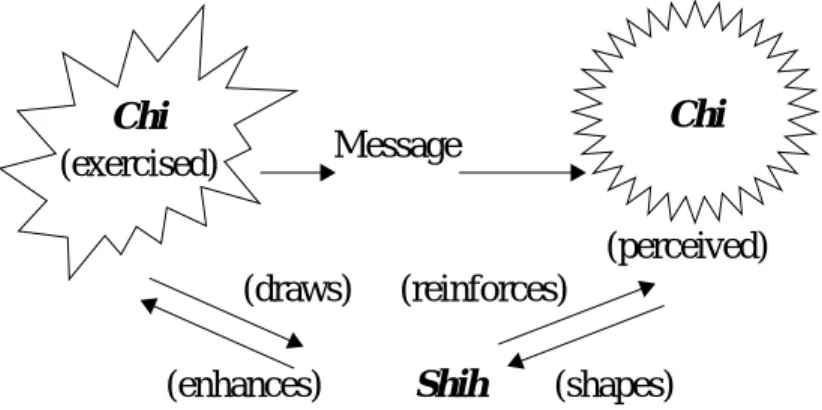
Another ch’i-based communication model does not specify the yin- yang interaction, but instead focuses on the interaction of ch’i and its sibling concept shih (
勢, or the strategic advantage in exercising ch’i, See Figure 1). Isaacson & Chung (2001) categorize four shih strate- gies that can boost ch’i: suck shih (
借勢, driving or riding shih), buck shih (
逆勢, going against the overwhelming shih), duck shih (
避勢, avoiding the unconquerable shih), and construct shih (
造勢, creating shih). Isaacson & Chung (2001) employ this model to analyze com- munication strategies during Bush and Gore’s 2000 election standoff over the Florida ballot counts.
Another ki-based communication model shows the potential of taking advantage of a certain existing Western theory. As is argued above, ki functions as a smoother in Japanese relational com-
Message Chi
Chi (exercised)
(draws) (reinforces)
(perceived)
(shapes) (enhances) Shih
Fig. 1. Process of Ch’i Communication
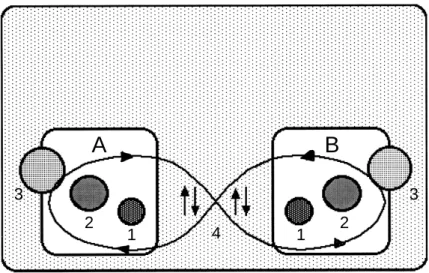
munication. Therefore, an interpersonal communication model can be constructed by describing how ki works in its contexts. This model analyzes the process that how ki emerges in one’s mind will create successful relational communication. The model is explained with the diagram as follows (Hara, 2002):
Fig. 2. Ki-Based Interpersonal Communication Model
First, ki, the energy flow directed toward maintaining an atmo- sphere between two persons, emerges in both person A and person B’s minds (indicated by the smallest and darkest circles 1). These cores of ki may grow to be more concrete (shown by each circle 2) because of considering the communication partner and the context. Ki will be seen as sensitive to the partner and the context with verbal usage or behavior (shown in each circle 3). Ki grows through the process (circles 1, 2, and 3) and will become the “aura” by which the context is filled with ki. The interaction process between both person A and person B (described with the two-way infinitive symbol 4) is in a state of “identity-in-unity.” This is based on Yoshikawa’s (1987) theory of
A B
1 1
2 2
3 3
4
the double-swing model of dialogical mode encounter and communi- cation. Yoshikawa’s theory posits a model indicating that both per- sons A and B are simultaneously independent and interdependent. He refers to the concept of dialogical relationship in Buber’s (1958) I and Thou model. In I-Thou relationship, each communicator treats the other as a whole, living and responding to subject or a Thou, and the relationship between I and Thou are not exclusively separated but are in essence related.
Based on the Buber’s philosophy of dialogue and Buddhist logic of soku, Yoshikawa (1987) develops the “double-swing model.” Yoshikawa states that when ki, the life energy, “flows out of each other” (p. 327), the infinite model works dynamically. In Hara’s ki-based interaction model, the degree of two communicators’ ki-based sensitivity (indi- cated by the up and down arrows close to the infinite mark 4) indicates how much ki should be appropriately expressed depending on the situation.
Risking the criticism that we are confined by the Western frame- work of conceptualizing, we would suggest that, as evidenced by the Japanese studies on ki, employing the Western models of human behavior theories may be an efficient approach to developing the East- West understanding and collaboration of the ki scholarship.
7. Conclusion
Okabe (1991) points out that the East-Asian study of communica-
tion and rhetoric “should profitably explicate the communicational
and rhetorical functions, potentialities, and mechanisms of the con-
cept ki from cultural perspectives so that they can further enrich the
theories of communication and rhetoric in the East” (p. 87). A con-
clusion from explorations presented in this essay should echo this
thought. As one of the pioneering endeavors, this study compared
the conceptualization process, research orientation, and research method
of ch’i/ki in various East-Asian countries. The ch’i/ki concept appar-
ently has an unlimited potential for contributing to communication research as an alternative conceptualization of the communication process. Since the late 1980’s in East Asia and in the United States, there have been discussions about localizing communication research or developing Asiacentric paradigms of communication theories. The indigenous field of ch’i/ki reviewed in this article should provide a more realistic example for envisioning the future of the Asian para- digm of communication research.
On the other hand, the accomplishments of Japanese scholars in bridging the interpersonal communication concepts with ki concepts demonstrate that the number of stumbling blocks in establishing the East-Asian model of communication would be reduced if we remain mindful of research results in the Western communication commu- nity and even in other disciplines. For example, the Western con- cept of “sublimity,” including mathematic sublimity and dynamic sublimity, is not only similar but also complementary to the Eastern theory of ch’i/ki (Roberts, 1970). Siu’s (1980) unusually in-depth exploration of ch’i within the context of Western science should also provide some helpful insight for the Korean debate on whether ki study should be free from traditional paradigms of Western science. In addition, Chung’s (1995, 1996, 2002) ch’i studies or discussions within the context of leadership communication, nonverbal communication, and organizational communication, may converge with Japanese stud- ies of interpersonal communication (Hamano, 1987; Hara, 2002) and Taiwanese accomplishments in the ch’i perspective of written commu- nication.
Above all, it is imperative to theorize ch’i/ki concepts and studies in
order to build a respectable discipline and to provide useful applica-
tions to other fields. Toward this end, we need more intensive
efforts in reviewing the philosophical roots of ch’i/ki study. For
example, since ch’i/ki is generated with the interaction between yin
and yang, a question that would naturally arise is: how is ch’i/ki in
certain communication activities generated in terms of yin and yang?
Or, worded differently, what are the yin and yang in certain commu- nication or communication contexts? We also need more interactions between the communication discipline and ch’i/ki studies. Obviously, ch’i/ki scholars in East-Asian countries can better shoulder the re- sponsibility of spearheading these drives.
References
Buber, M. (1958). I and thou (2nd ed.). New York: Scribner’s.
Capra, F. (1990). Rebuilding our thinking. Earth Island Journal, 5, 46.
Chan, M. (2000). Theory as pivot of indigenous studies and international scholarship. Communication Research Brief, 2, 1–3.
Chang, C. (1976). “中國 學批 上 “氣” 的 究” (The concept of ch’i in Chinese literary work). Dissertation of Taiwan University.
—— (1994). “ 氣論詮” (Interpreting the literary ch’i.) Taipei: Wu Nan.
Chen, S. (2002). Exploring the Chinese ethnography for communication studies. Mass Communication Research, 71, 1–16.
Cheng, C. (1981). “易經中的 ‘理’ 與 ‘氣’—對中國哲學中 ‘有’ 與 ‘無’ 的重 新考察” [Li and ch’i in I-ching: Revisiting “being” and “non-being” in Chinese philosophy]. Yu-shi Academics, 16 (4), 57.
Chu, G.C. (1988). In search of an Asian perspective of communication theory. In W. Dissanayake (Ed.), Communication Theory: The Asian Perspective of Communication Theory (pp. 204–210). Singapore: Asian Mass Communication Research and Information Center.
Chu, R. (1988). “ 氣與 章創作關係 究” [The study of the relationships between literary ch’i and literary works.] Taipei: Normal University Book- store.
Chu, W. (1986). “氣對於生命結構與活動所作詮釋之涵義” [Interpreting the structure and activities of life in terms of ch’i] Erhu, 12, 3, p. 16
Chung, J. (1995, November). Leadership persuasion and ch’i: A Chinese perspective. Paper presented at the annual convention of Speech Com- munication Association, San Antonio, Tex.
—— (1996, November). Nonverbal communication in Ch’i leadership.
Paper presented at the annual conference of Speech Communication Asso- ciation, San Diego, CA.
—— (2002, June). Ch’i communication theory and the localized com- munication research. Paper delivered at the annual conference of Chinese Communication Society, Taipei, Taiwan.
Chung, J & Busby, R. (2002). Naming strategies for organizational commu- nication: The chi-shih approach. Intercultural Communication Studies 6, 1, 77–95.
Chung, S. (1993). “莊子氣化論” [Ch’i Transformation of Chuang Tzu]. (pp. 1–
3). Taipei: Student Bookstore.
Dissanayake, W. (1986). The need for the study of Asian approaches to communication. Media Asia, 13 (1), 6–13.
Hamano, K. (1987 a). 性格表現用語に使われる “気” の研究 [A study of the word “ki” used in personality trait names] “心理学研究” [The Japanese Journal of Personality], 58 (5), 295–301.
—— (1987 b). Ki: A key concept for Japanese interpersonal relation- ships. Psychologia, 30, 101–112.
Hara, K. (2002). The Concept of “Ki” in Japanese Communication: An element to evoke harmonious communication air. Unpublished manu- script.
Isaacsson, R. & Chung, J. (2001, November). The Bush Vs. Gore Rhetoric Ensuing the 2000 Electoral Impasse: A Ch’i-Shih Analysis. Paper pre- sented at the annual conference of National Communication Association, Atlanta, GA.
Ishii, S. (2001). An emerging rationale for triworld communication studies from Buddhistic perspectives. Human Communication, 4 (1), 1–10.
Ito, Y. (2002). Climate of opinion, kuuki, and democracy. In W.B.
Gudykunst (Ed.), Communication Yearbook 26, (pp. 266–296). Mahwah, NJ: Lawrence Erlbaum Associates.
Jo, D. (2000). A history of Korean literature from a historical and a philo- sophical perspective, A Collection of Humanities Treatises, 43, 201–222.
Kim, J. (1997) Psychology of Ki. Seoul, Korea: Ewha University Press.
Kim, K. (1997). A Philosophical Understanding of Ki. Manuscript sub- mitted for publication.
—— (1994). New Paradigm: Ki. Korea: Kyung-Sang University Press.
Liu, Y. (2000). “理在氣中” [Li in ch’i]. Taipei: Wu-nan, p. 6 & 12.
Lo, G. (1979). “論氣” [On ch’i]. Fujen Academics., 8, 1–2.
Maebashi, K., Sato, K., & Kobayashi, H. (2000). “〈気〉の日本文化—中国、
韓国、日本” [Japanese culture of “ki”: The comparative analysis of China, Korea, and Japan]. Kyoto: Showa-do.
Miike, Y. (2002). Theorizing culture and communication in the Asian context: An assumptive foundation. Intercultural Communication Studies, 6 (1), 1–22.
Okabe, R. (1991). Intercultural assumption of communication and rhetori- cal theories: East and West. In F. Poyatos. (Ed.), Cross-cultural communi-
cation: East and West, 3 (pp. 71–93). Tainan, Taiwan: Department of Foreign Languages & Literature, National Cheng-kung University.
Roberts, W. (1970). On the Sublime. Cambridge: Cambridge University Press.
Sakamoto, T. (et al.). (Recension and annotation, 1978). “日本書紀 上・
下” [Nihonshoki: The first and second volumes]. Tokyo: Iwanami-shoten.
Shinmura, I. (ed.). (1991). “広辞苑” [Kojien] (4th ed.). Tokyo: Iwanami- shoten.
Siu, R.G.H. (1974). A New-Taoist Approach to Life. Cambridge, MA:
MIT Press.
Takagi, I. (et al.). (Recension and annotation, 1959). “平家物語 上・下” [The Tale of Heike: The first and second volumes]. Tokyo: Iwanami- shoten.
Yi, T. (2001). Studies of Ch’i Thoughts during the Early Chin Dynasty.
Unpublished master’s thesis, Kaoshung Normal University, Kaoshung, Taiwan.
Yoshikawa, J.M. (1987). The double-swing model of intercultural commu- nication between the East and West. In D.L. Kincaid (Ed.), Communica- tion Theory: Eastern and Western Perspectives (pp. 319–329). San Diego, CA: Academic Press.