
Exploration of Task Evaluation, Engagement, and
Vocabulary Acquisition of a One-Semester Extensive Reading
Satoko S
UZUKI*(Received November 9, 2020)
Abstract
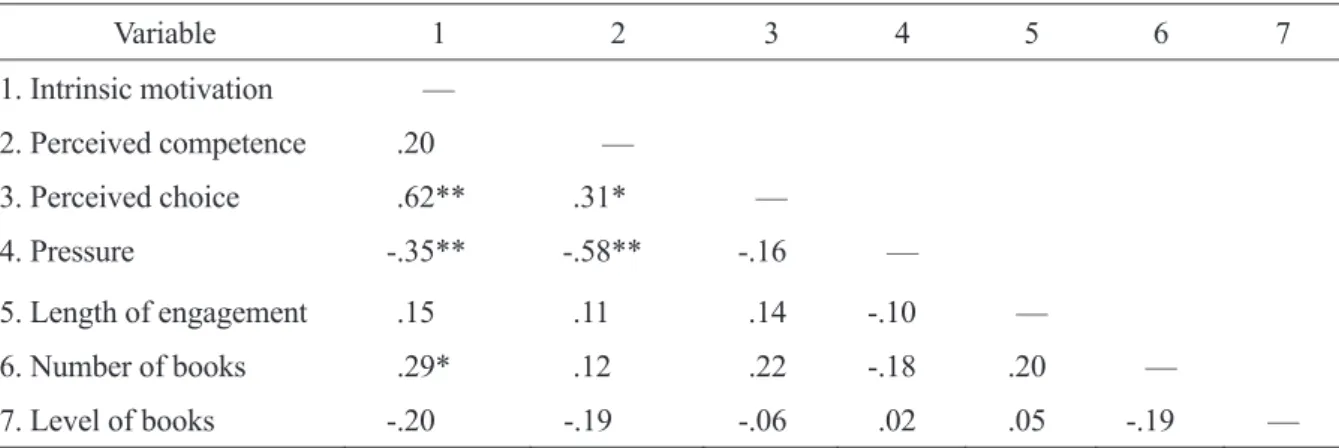
Extensive reading (ER) has numerous benefits for language learners and should be incorporated in language programs. When conducting ER outside of the classroom, however, engagement for ER depends on the students; thus, their motivation and autonomy are keys to success. This study was an exploration of ER homework in terms of task evaluation by 58 Japanese university students, the length of engagement, the number of books read, and vocabulary acquisition. Twenty-six Group 1 students and thirty-two Group 2 students were assigned to perform ER in 12 and 17 weeks, respectively. The results showed that although students were given a long deadline, they generally started engaging in ER in the second half of the semester, which resulted in reading several books in a short period of time (e.g, 4.5 books in 1.6 months). Students’ intrinsic motivation for ER was found to be positively related to perceived autonomy to choose which books and the number of books read.
However, with pressure to engage in ER, it was negatively related. Greater vocabulary acquisition occurred with Group 2 who had a longer deadline, though no statistically significant differences were found. Results indicated that students should be given plenty of time when conducting ER as homework in order to improve the quality of engagement, as it eventually influences intrinsic motivation positively and improves vocabulary acquisition.
Keywords: extensive reading, task motivation, vocabulary, autonomy
Introduction
Since ER has been found to have beneficial effects on reading comprehension, reading speed, and vocabulary knowledge (c.f., See Nakanishi, 2015 for reviews), second language acquisition researchers suggest the inclusion of ER in the language curriculum. Although its effectiveness is acknowledged by the authors, there is considerable variability in the aspects of ER regarding: what materials to read, the duration of ER, and where ER is held (in class or at home) (c.f., Waring & Mclean, 2015). Previous studies largely reported that ER were conducted in classrooms by instructors who advocate ER, wherein students perform ER instead of other classroom activities (replacement ER) and is, therefore, successfully implemented. However, replacement ER is usually difficult to conduct, considering the sizable amount of materials required to be covered within limited
*

![Table 6 Vocabulary test score improvement and group differences Group 1 (N =25) Group 2 (N = 30) Variables M (SD) 95% CI M (SD) 95% CI 1,000 word-frequency level improvement .28 (.84) [-.07, .63] .40 (.89) [.07, .73] 2,000 word-frequen](https://thumb-ap.123doks.com/thumbv2/123deta/6704610.2204659/8.892.106.802.403.653/table-vocabulary-improvement-differences-variables-frequency-improvement-frequen.webp)