How Pronunciation is Taught in English Textbooks Published in Japan
SUGIMOTO, Junko
UCHIDA, Yoko
Abstract Teaching pronunciation is challenging for Japanese teachers of English, and textbooks with useful pronunciation exercises and descriptions can greatly assist teachers. This paper analyzes English textbooks used in Japanese junior high schools to investigate the scope of pronunciation features, the nature of pronunciation exercises, and the type of English used as a pronunciation and listening model. An analysis of written materials reveals that most pronunciation exercises are of the
“controlled” type and most textbook series encompass both segments and suprasegmentals, with popular pronunciation features being phonics, consonants, linking, and the relation between tones and sentence types. In addition, an analysis of audio materials confirms the use of a considerably slow speech rate in textbooks, especially those targeting students in the first year, and predominant use of the North American accent. The findings suggest possible improvement for future textbooks, such as using more varieties of spoken English in audio materials, devising more communicative pronunciation activities, and incorporating more exercises on features that are reported to impact intelligibility, such as nucleus placement. An insufficient amount of explicit explanation of phonetic concepts and rules also implies that teachers are expected to possess the requisite knowledge and skills to make effective use of the textbooks as pronunciation teaching materials.
Introduction
With the increasing significance of English as a lingua franca of the global world, Japanese learners are expected to develop competence in the English language more than ever before. One of the responsibilities of Japanese teachers of English includes teaching students pronunciation to help them communicate in English with people from diverse L1 backgrounds. Effective pronunciation teaching takes place when various factors, such as teachers, learners, curriculum, and teaching materials, interact well. However, one problem that is often reported in teacher surveys is a lack of suitable materials for teaching pronunciation, which also leads to teachers’ reluctance to teach pronunciation(Macdonald, 2002). This paper analyzes both audio and written materials of Japanese junior high school textbooks to investigate the scope of pronunciation features, the nature of pronunciation exercises, and the type of English used as a pronunciation and listening model.
Significant Shifts and New Directions in Pronunciation Teaching Despite being an essential component of communication, pronunciation teaching has long been marginalized in the field of English education.
However, a large body of research has been conducted in the past few decades whose findings suggest a number of significant shifts and new directions in approaches to teaching pronunciation(Celce-Murcia, Brinton, & Goodwin, 2010; Derwing & Munro, 2015; Grant, 2014).
The first point is concerned with the goal of pronunciation teaching and learning. In the past, the goal of pronunciation was considered the attainment of native-like pronunciation, usually either General American or Received Pronunciation. Any trace of a learner’s native language that
results in deviation from the native-speaker model was regarded as an error that should be corrected. However, this goal is now considered not only unrealistic but also unnecessary. In light of the changing status of English as a lingua franca, most researchers agree that learners’ goal should be intelligible pronunciation(Derwing & Munro, 2005; Jenkins, 2000; Levis, 2005).
Secondly, whether to focus on segments or suprasegmentals has long been a topic of discussion. One study found that “primary stress” (i.e.
nucleus placement)affects intelligibility for native listeners(Hahn, 2004), and another found misplacement of lexical stress has a negative impact on intelligibility for both native and non-native listeners(Field, 2005). These findings have encouraged a shift of focus from segments to suprasegmentals in pronunciation teaching. In contrast, Jenkins(2000)
analyzed conversations among non-native speakers with different L1 backgrounds and proposed the Lingua Franca Core(phonetic features that impact intelligibility), in which she includes maintaining contrasts of vowel length and most consonants. Now, rather than treating segments and suprasegmentals separately, a good balance and interaction between the two are considered important(Celce-Murcia et al., 2010; Derwing &
Munro, 2015; Zielinski, 2015).
Another important point involves the nature of classroom activities.
“Many people’s objections to the teaching of phonology in language classes center on the non-communicative, mechanical nature of the activities”(Pennington, 1996, p. 224). Techniques often employed in pronunciation teaching, such as minimal-pair practice or listen-and-imitate drilling, were often criticized as non-communicative and sometimes boring to the learners. Recently, however, a number of resourceful pronunciation teaching materials have been published that offer various
ways to integrate pronunciation-related activities with other classroom activities and introduce techniques to make them more enjoyable and communicative(Celce-Murcia et al., 2010; Jones, 2016). An important question that should be addressed next is whether the above-mentioned significant shifts and findings are reflected in teaching materials.
Reviewing Previous Studies of Textbook Analyses
Textbook analyses have been conducted from different perspectives, including oral fluency(Rossiter, Derwing, Manimtim, & Thomson, 2010)
and cultural content(Shin, Eslami, & Chen, 2011). However, only a handful of studies have examined pronunciation. Burgess and Spencer
(2000)explored the phonetic features covered in five textbooks and pointed out that the lack of a pronunciation syllabus causes haphazard treatment of pronunciation. Another example is Derwing, Diepenbroek, and Foote(2012), who investigated ESL general-skills textbook series along with teachers’ manuals and found a considerable variation both across and within textbook series in terms of the quantity of pronunciation activities, aspects of pronunciation covered, and task types.
In Japan, Ueda and Otsuka(2010)investigated the junior high school textbooks that were approved in 2005 in the following six categories:
phonetic symbols, stress, intonation, connected speech phenomena, pause, and delivery. They reported that many of the basic pronunciation features are covered in most textbooks, but they show great variation in their descriptions and the amount of explicit instructions.
When analyzing audio materials, two variables need to be taken into account: accent and speech rate. A large number of empirical studies have been conducted on accent, speech rate, and their interaction
(Derwing & Munro, 2001; Tauroza & Allison, 1990; Yanagawa, 2016).
Important findings are that accented speech did not always interfere
with intelligibility or comprehensibility(Derwing & Munro, 2005), and that slow speech did not always enhance comprehension of non-native listening(Griffiths, 1990). However, to the best of our knowledge, there is no research study to date that has analyzed the audio materials accompanying textbooks.
English Classrooms and Textbooks in Japan
Turning now to English education in Japan, in a public junior high school, a typical Japanese learner starts taking an integrative English course, usually conducted by an English teacher who is a native speaker of Japanese with occasional assistance of Assistant Language Teachers
(ALTs), the majority of whom are from the Inner Circle. One notable characteristic is that most English classrooms in Japan are monolingual, which means the students have very limited exposure to a variety of Englishes. Along with English of the teachers and ALTs, audio materials that accompany the textbooks are the primary source of input for students.
With regard to textbooks, a total of six series are designed for an integrative English course in public junior high schools in Japan. One thing to note is that all are designed to comply with the Course of Study(i.e., the government’s curriculum guidelines)established by the Ministry of Education, Culture, Sports, Science and Technology(MEXT).
The latest version of the guidelines(MEXT, 2008)states that the following should be incorporated into the instruction of English sounds:
⒤ contemporary standard pronunciation, ⅱ pronunciation changes that result from the linking of words, ⅲ basics of stress patterns in words, phrases, and sentences, ⅳ basic sentence intonations, and ⅴ basic division of sentences. Also included are instruction in letter-to- sound correspondences, emphasis on English-Japanese differences, and
supplementary use of phonetic notation.
Research Objectives
The aim of this study is to explore how pronunciation is dealt with in Japanese junior high school textbooks. By exploring pronunciation features and activity types in written materials as well as accents and speech rate in audio materials, this paper addresses the following two research questions: ⒤ What aspects of pronunciation are covered and how are they presented in written materials? and ⅱ What type of English is used as a pronunciation and listening model in audio materials? Based on the findings, this paper discusses problems regarding the treatment of pronunciation in textbooks and offers suggestions for improvement.
The Current Study
Textbooks for AnalysisThe current study analyzed all six government-approved textbook series that were published in 2011 and used for the school years 2012–
2015. Each series consists of three volumes corresponding to the three grades. The following is the list of six textbook series with the title of the textbook followed by editors and publishers(in parentheses): Columbus 21(Togo, K., et al.; Mitsumura Tosho), New Crown(Takahashi, S., et al.;
Sanseido), New Horizon(Kasashima, J., Seki, N., et al.; Tokyo Shoseki), One World(Matsumoto, S., et al.; Kyoiku Shuppan), Sunshine(Matsuhata, K., Sano, M., et al.; Kairyudo), and Total English(Yada, H., Yoshida, K., et al.;
Gakko Tosho).
All six textbook series share a fairly similar structure. They are composed of a series of units(sometimes called lessons or programs), each of which consists of a reading passage(dialogue or monologue)
on a specific topic with new vocabulary items. Short sections on specific
aspects such as grammar, writing, or pronunciation often follow each unit. Each textbook series also introduces a group of characters, most of whom appear throughout the series. The main characters are Japanese students, and the stories in the reading passages proceed by having them interact with their teachers and classmates. They discuss topics such as the environment, technology, or culture. Audio CDs accompanying the written materials contain recordings of conversations, monologues, passages, and new vocabulary items in the textbooks. The target materials of the current study are 18 textbooks(six series × three grades)and their student audio CDs.
Procedure
Pronunciation features. To investigate which pronunciation features are covered in the textbook, the authors prepared a list of 25 labels. For example, the label Tone-sentence type is prepared for exercises referring to the relation between the tones and sentence types(e.g., using rising intonation on a yes-no question), and the label Phonics is prepared for demonstrations of letter-sound correspondences. Other labels include Vowels and Consonants, which were further assigned an additional label based on phonemes or contrasts that were presented. To take a few examples, for the distinction between the vowels in beat/bit, the label FLEECE-KIT was assigned using Standard Lexical Sets(Wells, 1982).
Likewise, word pairs such as light/write and sea/she were assigned the labels L-R and S-SH, respectively. The label katakana, a Japanese syllabary, was assigned for exercises or descriptions that make use of katakana. The labels were prepared based on the authors’ experience teaching phonetics, as well as on a phonetics textbook specifically written for Japanese learners(Takebayashi & Saito, 2008). The full list of labels is available in Appendix A.
Each author was responsible for analyzing three textbook series and collected and compiled a list of all the exercises and descriptions relevant to pronunciation in the textbooks. Textbooks introduce pronunciation exercises or descriptions in three different formats: margins at the bottom of pages, short columns which appear regularly in each or every other unit, or a one or two-page supplement. For each instance, the authors recorded the textbook information(grade, page, format)and the content. Each instance was then assigned the label of the respective pronunciation feature as in the examples below. After the authors completed the analysis of their three textbook series, a crosscheck was conducted to avoid oversight errors. The labeling was finalized after a short discussion between the authors when there was disagreement in the choice of label. During labeling, each author also took notes of any characteristics they noticed, and these were compared and incorporated in the analyses.
Activity types. An analysis of activity types in the written materials followed the same procedure as that of pronunciation features described above. This time, however, each instance was assigned one of the three labels: Controlled, Guided, or Free(see the examples below). Following previous studies(Baker, 2014; Brown, 2007; Pennington, 1996), controlled activities are defined as those in which teachers take control and students’ responses can be predicted(e.g., choral repetition, minimal- pair drilling, dictation, reading aloud, or dialogue practice). In contrast, free activities are more communicative activities in which students have more room for creativity, and their responses can be unpredictable and open-ended(e.g., role-playing, games, or discussion). Guided activities are those that fall between these two.
Example 1
Text info: Sunshine 1, p. 65; Margin at the bottom Content: Note the pronunciation of the
underlined vowels. work – girl – Thursday
Labels:
Vowels(NURSE)
Controlled
Example 2
Text info: One World 2, p. 32; Pronunciation column Content: Note the intonation of each sentence.
Who is that? ↘
How many books do you have? ↘ How many books do you have? ↘ What time do you come to school? ↘ What’s special about Green Park? ↘
(Original directions in Japanese; translated by the authors)
Labels:
Tone-sentence type Controlled
Accents. To investigate the English accents used in the audio materials, a follow-up test to the experiment carried out in Sugimoto and Uchida(2016)was conducted in this study. In the 2016 study, a total of 50 characters in six textbook series were listed and assigned a geographical label using Kachru’s three circles(1992). The distribution of 50 characters was as follows: 24 from the Inner Circle(US, 12; UK, 5;
Australia, 4; Canada, 3); 4 from the Outer Circle(India, 3; Singapore, 1);
and 22 from the Expanding Circle(Japan, 17; South Korea, 2; Cambodia, 1; China, 1; Germany, 1). Next, two native-speaker phoneticians(one American and one British)were asked to listen to the voice sample of each character and identify their accent. The American and British judges disagreed on three cases; both identified the three accents as North American, but the British judge further specified them as
American, whereas the American judge identified them as Canadian. For more details, see Sugimoto and Uchida(2016).
In an attempt to resolve disagreement, the current study conducted a follow-up test by recruiting a Canadian English speaker with knowledge of phonetics and phonology as the third judge. The Canadian judge listened to the three voice samples in question and two more files included as distractors and followed the same procedure as in the 2016 study to identify the accent.
Speech rate. The speech rate in audio materials was measured by counting syllables per minute(spm)(Tauroza & Allison, 1990).
In addition to the six Japanese textbook series, one textbook series published overseas was included to provide a baseline for comparison:
Get Ahead(2013, 2014; Quinn, R. et al.(Eds.); Oxford University Press).
This textbook series was selected due to its similarities with Japanese textbooks, such as consisting of three levels and being designed for CEFR A1 to B1 level students of English in Japan and other Asian countries. From each of the 21 textbooks(seven textbook series × three grades), eight short passages were selected for analysis. The average number of syllables in the passages1 was 62.6 for Grade 1, 100.8 for Grade 2, and 124.1 for Grade 3 textbooks. Speech rate is said to differ depending on speech styles(Tauroza & Allison, 1990), but both monologues and dialogues were included since both are planned and scripted discourse.
Results
Pronunciation FeaturesThis study first analyzed the scope of pronunciation features in each
1 The passages for measurement were selected from the mid to final units of the textbooks since those found towards the beginning tend to be too short, especially in the textbooks for students in the first year.
textbook series. For the sake of quantitative comparison, the occurrences of each pronunciation feature were simply tallied regardless of their length or content(Table 1). Note that a larger number of occurrences in a textbook does not necessarily mean a stronger emphasis on pronunciation, since each textbook series treats pronunciation in different ways, both qualitatively and quantitatively.
As in Table 1, five textbooks dealt with a wide range of pronunciation features(17 or more), although the number of occurrences greatly varied. The notable exception was Total English, which only included four pronunciation features: phonics, rhythm, linking, and tone-sentence type.
Table 1 highlights the five most frequent pronunciation features for each textbook series in bold, which shows that the main pronunciation foci overlap across textbook series; consonants and phonics are the most popular categories included in five textbook series. Vowels, linking, and tone-sentence type appear in four textbook series, and rhythm in two.
Others appear only in one textbook series: content-function word in Columbus 21, word stress, katakana, thought group, word ending in New Crown, and compound stress in New Horizon.
Table 1. Scope and Occurrences of Pronunciation Features by Textbook Series
Textbook
(n of features; occurrences)
Pronunciation features
(n of occurrences)
Columbus 21
(19; 150)
Tone-sentence type(29), Content-function word(24), Linking⒂, Consonants⒁, Vowels⑾,
Katakana⑽, Phonics⑻, Rhythm⑺, Thought group⑹, Consonant cluster, Nucleus placement⑸, Assimilation⑷, Compound stress, Other-stress⑶, Word ending⑵, Contraction, Elision, Word stress, Other⑴
New Crown
(18; 60)
Consonants⒂, Phonics⑹, Word stress, Katakana⑸, Thought group, Word ending⑷, Linking, Vowels, Other-intonation⑶, Tone-sentence type, Nucleus placement, Consonant cluster ⑵, Assimilation, Content-function words, Contraction, Word-phrase rhythm, Other-stress, Other⑴
New Horizon
(18; 171)
Vowels(37), Rhythm(34), Phonics(29), Consonants(26), Compound stress⒃, Other⑸, Katakana, Linking⑷, Word ending⑶, Assimilation, Contraction, Thought group,
Tone-sentence type⑵, Closed syllable, Nucleus placement, Other-intonation, Phonetic symbol, Word stress⑴
One World
(17; 95)
Tone-sentence type⒆, Phonics⒁, Vowels⒀, Consonants, Linking⑿,
Rhythm⑽, Consonant cluster⑷, Closed syllable⑵, Content-function word, Elision, Syllabic consonant, Thought group, Word ending, Word stress, Other-intonation, Other-stress, Other⑴
Sunshine (20; 187)
Vowels(35), Consonants(29), Tone-sentence type(27), Phonics⒆, Linking⒄,
Rhythm⒃, Word ending⑼, Thought group⑺, Assimilation⑹, Consonant cluster⑸,
Nucleus placement⑷, Content-function word, Katakana, Other-stress, Other⑵, Compound stress, Dictionary, Elision, Word stress, Other-intonation⑴
Total English
(4; 157)
Phonics(111), Rhythm(23), Linking(22), Tone-sentence type⑴
The following discussion concerns pronunciation features in broader categories. See also Sugimoto and Uchida(2015)for a preliminary report:
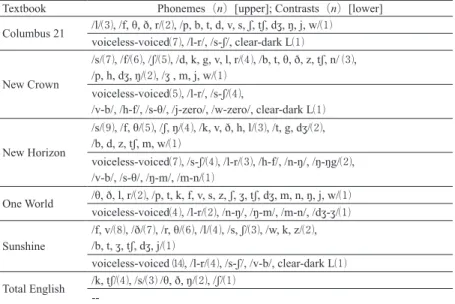
Vowels and consonants. The most frequent vowel contrasts covered were /oʊ-ɔː/(all except for Total English)and /uː-ʊ/(Columbus 21, New Horizon, One World, Sunshine). Weak vowels were treated less frequently compared to strong vowels, but four textbooks(Columbus 21, New Crown, New Horizon, One World)mentioned /ə/, and two textbooks(New Crown, New Horizon)introduced the contrast between strong and weak vowels. As for consonant contrasts, voiceless-voiced pairs appeared in all textbooks, /l-r/ in all except for Total English, and /s-ʃ/ in four(Columbus 21, New Crown, New Horizon, Sunshine). The explanation of allophones was rare; the difference between clear and dark /l/ was mentioned in three textbooks(Columbus 21, New Crown, Sunshine), but no textbook referred to t-tapping in General American. Only three textbooks(Columbus 21, New Crown, New Horizon)gave explicit articulatory description of segments. See Appendix B for the summary of all vowel and consonant labels.
Transcription and phonics. The use of phonetic symbols was very limited(only occurring in New Horizon). The introduction of katakana was found only in four textbooks(Columbus 21, New Crown, New Horizon, Sunshine). It was used for different purposes: one was to draw students’
attention to the difference between the pronunciation of loanwords in Japanese and the corresponding English words. Another exploitive example found in New Horizon was to use katakana to explain linking as in an‿egg(アネッグ)and sit‿down(スィッダウン). A consonant- vowel sequence in the former was transcribed as one kana letter, and the long closure in the latter was transcribed with a kana letter used for
a geminate. Instead of using phonetic symbols and katakana, phonics has been very popular as a teaching method to bridge letters and sounds and is employed in all the textbooks. However, in most textbooks, only sample words were listed with the explanation left to teachers(e.g., ea [iː]
tea, please, read; i-e [ai] like, five, rice Total English 1, pp. 27, 53).
Connected speech phenomena. Of the changes in pronunciation that occur in connected speech, linking is treated the most often, appearing in all the textbooks. The following three positions are particularly highlighted: a word-final consonant followed by a vowel, a word-final /n/
followed by a vowel, and coalescent assimilation(e.g., Let’s have‿a try!
/ Why don’t‿you join‿us? One World 2, p. 80). The second most favored type of pronunciation change seemed to be coalescent assimilation, introduced in four textbooks(Columbus 21, New Crown, New Horizon, Sunshine).
Stress and rhythm. Word stress was covered in all textbooks except for Total English. In addition to exercises of simply repeating words, two textbooks(New Crown, One World)employed pattern-matching exercises
(e.g., breakfast ●・, Japan ・ ● ). Other features related to stress, such as the relation between suffixes and stress, or stress shift, were rarely mentioned. As for rhythm, only two textbooks explicitly explained stress timing(Columbus 21, Sunshine). Four textbooks(Columbus 21, New Crown, One World, Sunshine)mentioned the distinction between content and function words, and all textbooks visually represented sentence rhythm using dots(e.g., What did you say? ●・・●).
Intonation. The majority of activities on intonation concerned the relationship between tones and sentence types: for example, the use of falling tone on wh-questions, declaratives, and imperatives, and rising tone on yes-no and echo questions. Three textbooks(New Crown, New Horizon,
One World)gave the rules explicitly, whereas the other three only gave examples and expected students to deduce the rules. All the textbooks except for Total English introduced the practice of dividing long sentences into thought groups by simply presenting sentences with boundary marks to show students where to pause, and only one textbook(New Horizon)mentioned that thought groups correspond to informational and grammatical units. The nucleus placement is another important aspect of intonation, but its treatment was also restricted. Four textbooks(Columbus 21, New Crown, New Horizon, Sunshine) included this feature, and only three(Columbus 21, New Horizon, Sunshine)explained that the nucleus corresponds to words that carry the most important information.
Activity Types
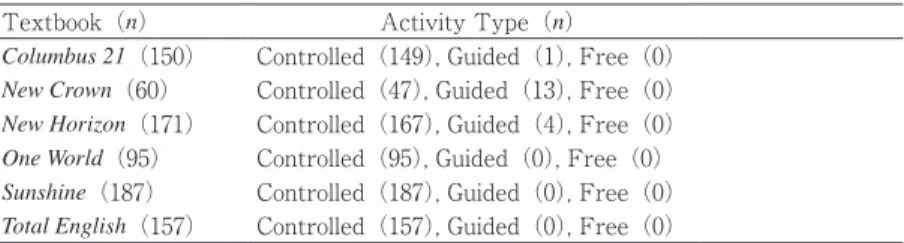
Secondly, this study analyzed how pronunciation is presented by assigning each a label for activity type. As summarized in Table 2, controlled activities were predominant in all textbook series. Guided activities were only found in three textbooks: 13 in New Crown, 4 in New Horizon, and 1 in Columbus 21. No free activities related to pronunciation were found in the six textbook series.
Table 2. Distribution of Pronunciation Exercises and Descriptions by Activity Type
Textbook(n) Activity Type(n)
Columbus 21(150) Controlled(149), Guided(1), Free(0)
New Crown(60) Controlled(47), Guided(13), Free(0)
New Horizon(171) Controlled(167), Guided(4), Free(0)
One World(95) Controlled(95), Guided(0), Free(0)
Sunshine(187) Controlled(187), Guided(0), Free(0)
Total English(157) Controlled(157), Guided(0), Free(0)
In the current analysis, the exercises in which the students’ answers
may vary and be unpredictable were all identified as a guided type.
There were a few instances of guided activities, and one was an activity that uses context to focus on suprasegmental features. Another example involved asking students to discover rules. In this case, teachers need to be prepared to respond to any explanation that students may come up with. The third instance was awareness-raising activities, asking the students to focus on the difference between English and Japanese. The following is one example, in which the students hear two pronunciations of the same word(one in English and the other with Japanese katakana pronunciation). All the words include the sequence of an alveolar fricative followed by a high front vowel, which is often palatalized and pronounced as [ɕ, ʑ] instead of [s, z] by learners as a result of applying a Japanese phonological rule:
Each word will be pronounced in two different ways. Which sounds more like English, and which part of the words sounds different? Discuss in pairs: busy, music, visitor, singer, Sydney, expensive. (Original directions in Japanese; translated by the authors; New Crown 3, p. 21)
The New Crown series included the largest number of guided activities, which were considered to have been designed carefully to make students recognize the characteristics of English pronunciation through the completion of activities.
Accents
With regard to the audio materials, the English accents used by the characters in the textbooks were analyzed. In the original study(Sugimoto
& Uchida, 2016), the accent identification by British and American judges of the 50 characters turned out to be almost unanimous, only showing disagreement in choosing American and Canadian accent in three cases.
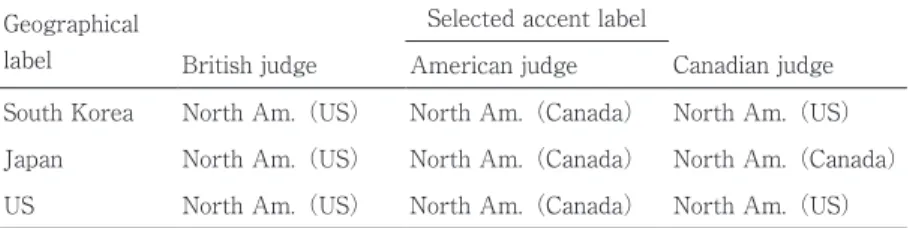
Together with the results of the British and American judges in the 2016 study, the results of the follow-up test in this study of the three cases by the Canadian judge are presented in Table 3.
Table 3. Results of the Follow-up Accent Identification Test Geographical
label
Selected accent label
British judge American judge Canadian judge South Korea North Am.(US) North Am.(Canada) North Am.(US)
Japan North Am.(US) North Am.(Canada) North Am.(Canada)
US North Am.(US) North Am.(Canada) North Am.(US)
The Canadian judge’s response was not always consistent with either of the two judges, suggesting the difficulty of distinguishing American and Canadian accents with a short sample. In this study, the authors decided to disregard the difference between the two accents based on the fact that they share similar characteristics(see Sugimoto & Uchida, 2016)and simply call both of them North American accent.
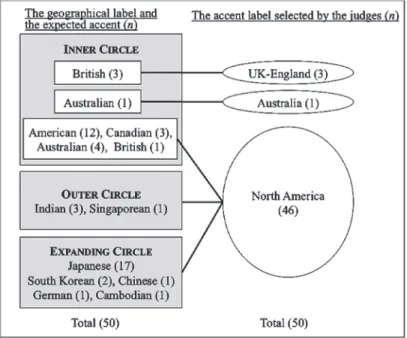
The results of the accent identification test are schematized as Figure 1 below.
Figure 1. Results of accent identification test. Adapted from Sugimoto and Uchida(2016, p. 87)
To sum up, 46 out of 50 characters were identified as having a North American accent regardless of the assigned geographical labels. All the US and Canadian characters and those from the Outer and Expanding Circles were judged to speak with a North American accent. Of the remaining four, three were assigned the accent label of UK-England, and one the label of Australia. All four were from Sunshine, which means Sunshine was the only textbook series that showed accent variation despite being restricted to the Inner Circle varieties.
Speech Rate
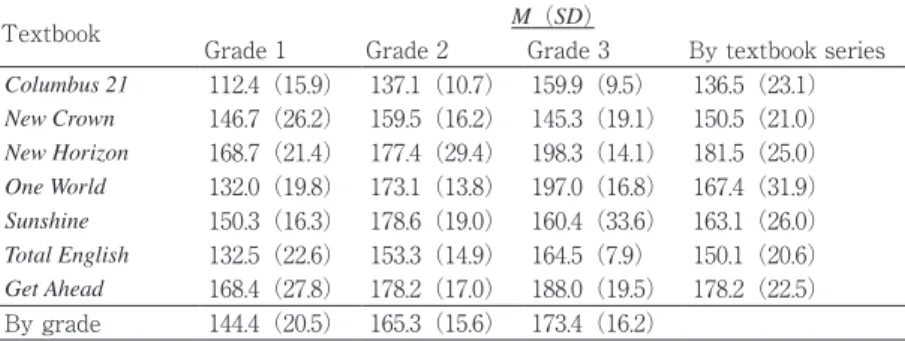
The audio materials were also analyzed in terms of speech rate. Table 4 shows the results of speech rate measurement of the seven textbook
series, each of which consists of three volumes. The range of the speech rate was 112 to 169 spm for Grade 1 textbooks, 137 to 179 spm for Grade 2 textbooks, and 145 to 198 spm for Grade 3 textbooks. With the exception of New Crown, the speech rate for Grade 1 textbooks was the lowest.
Table 4. Speech rate(spm)in Seven Textbook Series
Textbook M(SD)
Grade 1 Grade 2 Grade 3 By textbook series Columbus 21 112.4(15.9) 137.1(10.7) 159.9(9.5) 136.5(23.1)
New Crown 146.7(26.2) 159.5(16.2) 145.3(19.1) 150.5(21.0)
New Horizon 168.7(21.4) 177.4(29.4) 198.3(14.1) 181.5(25.0)
One World 132.0(19.8) 173.1(13.8) 197.0(16.8) 167.4(31.9)
Sunshine 150.3(16.3) 178.6(19.0) 160.4(33.6) 163.1(26.0)
Total English 132.5(22.6) 153.3(14.9) 164.5(7.9) 150.1(20.6)
Get Ahead 168.4(27.8) 178.2(17.0) 188.0(19.5) 178.2(22.5)
By grade 144.4(20.5) 165.3(15.6) 173.4(16.2)
A two-way ANOVA was conducted on the influence of two independent variables(textbook, grade)on the speech rate(spm).
Textbook included seven levels(Columbus 21, New Crown, New Horizon, One World, Sunshine, Total English, Get Ahead)and grade consisted of three
(1st, 2nd, 3rd). All effects were statistically significant at the p < .001 level. The main effect for textbook type yielded an F ratio of(6, 147)
= 16.4, p < .001, indicating a significant difference between the speech rate of textbooks. The main effect for grade yielded an F ratio of
(2, 147)= 32.17, p < .001, indicating a significant difference between grades. The interaction effect was also significant: F(12, 147)= 3.24, p < .001(see Figure 2).
Figure 2. Speech rate of audio materials in seven textbook series(C21 = Columbus 21, NC = New Crown, NH = New Horizon, OW = One World, SS = Sunshine, TE = Total English, GA = Get Ahead).
As for grades, the speech rate significantly increased from Grade 1 to Grade 2, and from Grade 2 to Grade 3 textbooks. Among the seven textbook series, the speech rate of New Horizon was significantly faster than Columbus 21, New Crown, Sunshine, and Total English, and that of Get Ahead was also significantly faster than Columbus 21, New Crown, and Total English. In contrast, the speech rate of Columbus 21 was significantly slower than that of New Horizon, One World, Sunshine, and Get Ahead. When focusing on Grade 1 textbooks, both New Horizon and Get Ahead had a significantly faster speech rate than Columbus 21, One World, and Total English, whereas Columbus 21 had a significantly slower speech rate than New Crown, New Horizon, Sunshine, and Get Ahead. All differences were statistically significant at the p < .05 level.
Discussion
Research Question 1: What Aspects of Pronunciation are Covered and How are they Presented in Written Materials?
The analysis of written textbook materials revealed that phonics, consonants, linking, and the relation between tones and sentence types were the most frequently covered pronunciation features across textbook series. Note that both segments and suprasegmentals are included.
Segments were mostly dealt with in two ways. As observed in all six textbook series, one is to use phonics and direct learners’ attention to the correspondence between spelling and pronunciation. The other is to highlight vowel and consonant pairs that are known to be problematic for Japanese learners such as /oʊ-ɔː/ and /l-r/. Error prediction based on contrastive analysis has long been the only strategy to prioritize vowel and consonant contrasts that should be taught. However, incorporating the idea of functional load may also be useful, since segmental errors with high functional load are detrimental to intelligibility(Derwing et al., 2012; Munro & Derwing, 2006). For example, in these textbooks the pair /uː-ʊ/ appeared more often than /iː-ɪ/ even though the latter carries a higher functional load.2 Other examples of vowel and consonant contrasts that are not covered in many textbooks but carry high functional loads and should be given more attention are /æ-ʌ/, /æ-ɑ/, /ʌ-ɑ/, and /h-f/
(Brown, 1991; Catford, 1987).
With regard to suprasegmentals, many previous studies tended to focus on the dichotomy of segments and suprasegmentals or broad categories such as rhythm and intonation. Instead, in this study we prepared more detailed labels for rhythm and intonation that enabled us
2 Following Munro and Derwing(2006), high functional load in this paper refers to vowel and consonant pairs with 6−10 in Brown’s(1991)and 51−100% in Catford’s(1987)ranking, whereas low functional load refers to those under rank 5 and under 50%.
to pinpoint possible missing areas of pronunciation in Japanese textbooks.
One example is nucleus placement. Compared to the relation between tones and sentence types, which seems to be the most popular approach to teach intonation, teaching nucleus placement may require more knowledge and practical training: first, understanding the distinction between content and function words, applying the rule to individual sentences, making a decision on the place of a nucleus by taking the context into account, and finally pronouncing the correct placement of nucleus with the appropriate use of pitch movement. Despite its difficulty in teaching, the importance of nucleus placement should not be overlooked, given the fact that it is reported to contribute to intelligibility
(Hahn, 2004; Jenkins, 2000).
Another characteristic observed was a lack of explicit information.
This means that teachers are required to possess both pertinent knowledge and skills to effectively use textbooks as pronunciation teaching materials. To take one example, although the term “syllable”
is never mentioned in the textbooks, many textbooks introduce the pattern-matching exercises of word stress or sentence rhythm using dots that correspond to syllables(e.g., guitar・●, Nice to meet you ●・●・).
Syllables are said to be a difficult concept for students to comprehend
(Couper, 2006), and possibly for non-native teachers as well. However, without the knowledge of syllables, teachers cannot successfully guide students through these activities or create similar ones themselves.
With regard to the activity type, the most dominant was controlled activities. Most exercises only ask the students to simply listen, repeat, and/or practice, and there were only a limited number of guided activities and no free activities that solely target pronunciation. Despite often being criticized for not being communicative, controlled techniques
should not be dismissed since they are reported to have a positive effect on habit-formation and the development of intelligibility(Baker, 2014; Jenkins, 2000). Nevertheless, inclusion of a range of activity types is important, and as Brown(2007)suggested, it is possible to make exercises communicative even for beginners. Awareness-raising or rule- discovering activities found in New Crown series offer good examples of guided activities that help make pronunciation-related exercises communicative and enhance active participation of learners. In the present study, free activities specifically targeting pronunciation were not found. It should be interesting to investigate how much attention is paid towards pronunciation during classroom speaking activities such as presentation, role-playing, or discussion.
Research Question 2: What Type of English is Used as a Pronunciation and Listening Model in Audio Materials?
The analysis of the audio materials revealed that very little accent variation is used in the Japanese junior high school textbooks. Although the written textbooks try to introduce the diversity of English users by having characters of various cultural backgrounds, their audio materials fail to present students with accent variation. The predominance of the North American accent may also imply that the goal of pronunciation should be a native-like accent, which may be misleading considering the status of English as a lingua franca. Teachers should beware of the risk of confusing learners, especially at such an early stage in their learning, by exposing their students to a variety of listening materials in terms of speech rate, accent, and style(Field, 2008). However, at the same time we should acknowledge the fact that exposure to a variety of accents also brings benefits, such as nurturing positive attitudes towards different accents and building confidence in one’s own pronunciation
(Walker, 2010). Offering the opportunity to be exposed to different types of English in class may be especially important for Japanese learners, who often lack such opportunities both inside and outside the classroom.
The present study also found that, despite some variation among textbooks, the speech rate of the audio materials of Japanese textbooks seems to be fairly slow. A conclusive decision cannot be drawn as to the exact rate that should be used in the materials targeting beginners, since there are no clear guidelines for such a standard. However, the slowest rate employed was slower than the rate of 116 spm3 that was reported to be detrimental to comprehension even for non-native listeners(Griffiths, 1990). Despite being beginners, Japanese junior high school students may need to have more experience listening to a faster rate of speech similar to what they will encounter in real life. The measurement of speech rates in this study only used syllables per minute, but the overall speech rate is also affected by both pauses(their position, length, and frequency)
and articulation rate. Pauses will help listeners process information, but a slow articulation rate may have a negative influence. It will be interesting to find out whether the slow speech rate found is the result of frequent insertion of pauses or slow articulation rate.
Suggestions for Improvement of Future Textbooks on Pronunciation The findings of the current study point to possible ways to improve pronunciation exercises and descriptions in the future textbooks.
Suggestions include selecting segmental focus using a functional load principle in addition to contrastive analysis, more inclusion of practice on nucleus placement, and incorporation of a wider range of pronunciation activities, such as those which are more communicative or help raise
3 Griffiths(1990)used words per minute and syllables per second instead of spm. The speech rate here in spm is calculated based on syllables per second.
learner awareness. As for pronunciation and listening models in audio materials, the Japanese students are currently exposed to only one type of speech: slow North American accent. In future audio materials for textbooks, we suggest including more varieties of Englishes, in terms of both accents and speech rate. In particular, introducing a model of accented but intelligible non-native English pronunciation(Murphy, 2014)may be a good first step to make Japanese learners aware of the diversity of English use in the real world.
Limitations and Conclusion
The present study conducted analyses of English textbooks, both written and audio materials, on the coverage of phonetic features, nature of activity types, accent variation, and speech rate. Textbooks for Japanese public schools are revised every four years, and the new editions have been in use starting from academic year 2016. We will need to see whether the shortcomings found in the present analysis of 2012-2015 versions are revised in the latest editions. Although the nature of the current study may be merely historical, thorough analyses of both written and audio materials have shown directions towards future improvement of the textbooks.
The textbook analyses also helped us to identify possible missing areas regarding pronunciation teaching in Japan, but only partially. The use of textbooks in the classroom is decided by each teacher, and by responding to learners’ needs teachers “make decisions concerning the selection from the textbook of what is appropriate, and the extension/exploitation, adaptation and supplementation of this as necessary”(McGrath, 2003, p.
12). To grasp the full picture of pronunciation teaching in Japan, other methodologies such as class observations or teacher/student surveys
should be adopted in combination with textbook analysis.
In Japan, English education is spreading to the elementary level, and development of helpful, learner/teacher-friendly pronunciation teaching materials that incorporate recent research findings are awaited at all levels.
References
Baker, A.(2014). Exploring teachers’ knowledge of second language pronunciation techniques: Teacher cognitions, observed classroom practices, and student perceptions. TESOL Quarterly, 48, 136-163.
Brown, A.(1991). Functional load and the teaching of pronunciation. In A.
Brown(Ed.), Teaching English pronunciation(pp. 221-224). London:
Routledge.
Brown, H. D.(2007). Teaching by principles: An interactive approach to language pedagogy(3rd ed.). White Plains, NY: Pearson.
Burgess, J., & Spencer, S.(2000). Phonology and pronunciation in integrated language teaching and teacher education. System, 28, 191- 215.
Catford, J. C.(1987). Phonetics and the teaching of pronunciation: A systemic description of English phonology. In J. Morley(Ed.), Current perspectives on pronunciation(pp. 87-100). Washington, D.C.:
TESOL.
Celce-Murcia, M., Brinton, D. M., Goodwin, J. M.,(with Griner, B.).(2010).
Teaching pronunciation: A course book and reference guide(2nd ed.).
New York: Cambridge University Press.
Couper, G.(2006). The short and long-term effects of pronunciation instruction. Prospect, 21⑴, 46-66.
Derwing, T. M., Diepenbroek, L. G., & Foote, J. A.(2012). How well do
general-skills ESL textbooks address pronunciation? TESL Canada Journal, 30⑴, 22-44.
Derwing, T. M., & Munro, M. J.(2001). What speaking rates do non- native listeners prefer? Applied Linguistics, 22, 324-337.
Derwing, T. M., & Munro, M. J.(2005). Second language accent and pronunciation teaching: A research-based approach. TESOL Quarterly, 39, 379-397.
Derwing, T. M., & Munro M. J.(2015). Pronunciation fundamentals.
Amsterdam: John Benjamins Publishing Company.
Field, J.(2005). Intelligibility and the listener: The role of lexical stress.
TESOL Quarterly, 39, 399-423.
Field, J.(2008). Listening in the language classroom. Cambridge: Cambridge University Press.
Grant, L.(Ed.).(2014). Pronunciation myths: Applying second language research to classroom teaching. Ann Arbor: University of Michigan Press.
Griffiths, R.(1990). Speech rate and NNS comprehension: A preliminary study in time-benefit analysis. Language Learning, 40, 311-336.
Hahn, L.(2004). Primary stress and intelligibility: Research to motivate the teaching of suprasegmentals. TESOL Quarterly, 38, 201-223.
Jenkins, J.(2000). The phonology of English as an international language: New models, new norms, new goals. Oxford: Oxford University Press.
Jones, T.(2016). Pronunciation in the classroom: The overlooked essential.
Alexandria: TESOL Press.
Kachru, B. B.(1992). Teaching World Englishes. In B. B. Kachru(Ed.), The other tongue: English across cultures(2nd ed., pp. 355-365). Urbana:
University of Illinois Press.
Levis, J. M.(2005). Changing contexts and shifting paradigms in
pronunciation teaching. TESOL Quarterly, 39, 369-377.
Macdonald, S.(2002). Pronunciation: Views and practices of reluctant teachers. Prospect, 17⑶, 1-22.
McGrath, I.(2003). Materials evaluation and design for language teaching.
Edinburgh: Edinburgh University Press.
Ministry of Education, Culture, Sports, Science and Technology.(2008).
Chugakko gakushu shido yoryo kaisetsu: Gaikokugo [A commentary on the government curriculum guidelines of junior high schools:
foreign language]. Retrieved on 31 March 2016, from http://www.
mext.go.jp/component/a_menu/education/ micro_detail/__icsFiles/
afieldfile/ 2011/01/05/1234912_010_1.pdf
Munro, M. J., & Derwing, T. M.(2006). The functional load principle in ESL pronunciation instruction: An exploratory study. System, 34, 520- 531. doi:10.1016/j.system.2006.09.004
Murphy, J. M.(2014). Teacher training programs provide adequate preparation in how to teach pronunciation. In L. Grant(Ed.), Pronunciation myths(pp. 188-224). Ann Arbor: University of Michigan Press
Pennington, M. C.(1996). Phonology in English language teaching: An international approach. Harlow: Longman.
Rossiter, M. J., Derwing, T. M., Manimtim, L. G., & Thomson, R. I.(2010).
Oral fluency: The neglected component in the communicative language classroom. The Canadian Modern Language Review, 66⑷, 583- 606. doi:10.3138/cmlr.66.4.583
Shin, J., Eslami, Z. R., & Chen, W. C.(2011). Presentation of local and international culture in current international English-language teaching textbooks. Language, Culture and Curriculum, 24⑶, 253-268.
Sugimoto, J., & Uchida, Y.(2015). An analysis of Japanese junior high
school textbooks as pronunciation teaching materials. Proceedings of the Phonetics Teaching and Learning Conference, 91-95.
Sugimoto, J., & Uchida, Y.(2016). A variety of English accents used in teaching materials targeting Japanese learners. Proceedings of ISAPh2016: Diversity in applied phonetics, 85-89.
Takebayashi, S., & Saito, H.(2008). Shinsoban eigo onseigaku nyumon [Introduction to English phonetics, new edition]. Tokyo: Taishukan Shoten.
Tauroza, S., & Allison, D.(1990). Speech rates in British English. Applied Linguistics, 11⑴, 90-105.
Ueda, H., & Otsuka, T.(2010). Hatsuonto onseino shikumini shotenwo ateta chugakko eigo kyokasho bunseki: Inputno kisowo kosatsusuru [An analysis of pronunciation instruction in Japanese junior high school English textbooks: Indications from the early stage of input].
Osaka Gakuin Daigaku Kiyo, 7, 15-32.
Walker, R.(2010). Teaching the pronunciation of English as a lingua franca.
Oxford: Oxford University Press.
Wells, J. C.(1982). Accents of English I: An introduction. Cambridge:
Cambridge University Press.
Yanagawa, K.(2016). Examining the authenticity of the Center Listening Test: Speech rate, reduced forms, hesitation and fillers, and processing levels. JACET Journal, 60, 97-115.
Zielinski, B.(2015). The segmental/suprasegmental debate. In M. Reed,
& J. M. Levis(Eds.), The handbook of English pronunciation(pp. 397- 412). Malden: Wiley Blackwell.
Appendix A
Table A1. Twenty-five Labels for Pronunciation Features Categories
Labels(explanation)
Segments
1 . Vowels(See Table A2 for more detail.)
2 . Consonants(See Table A2 for more detail.)
Transcription/Phonics
3 . Katakana(any exercise/description using katakana)
4 . Phonetic symbol(any exercise/description using phonetic symbols)
5 . Dictionary(use of dictionary to check pronunciation)
6 . Phonics(spelling-pronunciation correspondences and/or rules)
Syllables
7 . Consonant cluster(word-initial/final consonant clusters)
8 . Closed syllable(word-final consonants)
9 . Syllabic consonant(syllabic consonants)
Connected speech phenomena
10. Linking(connecting words smoothly)
11. Elision(sounds that can be elided in connected speech)
12. Assimilation(pronunciation changes that occur in connected speech)
13. Contraction(contracted forms)
Stress
14. Word stress(word stress pattern)
15. Compound stress(compound stress pattern)
16. Other-stress(any other exercise/description related to word stress)
Rhythm
17. Rhythm(stress-timed rhythm)
18. Content-function word(distinction between content/function words)
19. Word-phrase rhythm(comparison of rhythm in words and phrases)
Intonation
20. Tone-sentence type(relation between tones and sentence types)
21. Nucleus placement(placement of nucleus within a tone unit)
22. Thought group(division of long sentences into thought groups)
23. Other-intonation(any other exercise/description related to intonation)
Other
24. Word ending(rule of pronouncing -e(s) or -ed suffixes)
25. Other(any other exercise/description that does not fit the above)
Table A2. Additional Labels for Vowels and Consonants
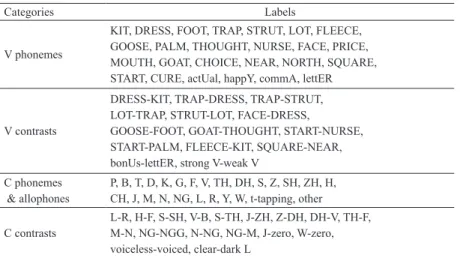
Categories Labels
V phonemes
KIT, DRESS, FOOT, TRAP, STRUT, LOT, FLEECE, GOOSE, PALM, THOUGHT, NURSE, FACE, PRICE, MOUTH, GOAT, CHOICE, NEAR, NORTH, SQUARE, START, CURE, actUal, happY, commA, lettER
V contrasts
DRESS-KIT, TRAP-DRESS, TRAP-STRUT, LOT-TRAP, STRUT-LOT, FACE-DRESS,
GOOSE-FOOT, GOAT-THOUGHT, START-NURSE, START-PALM, FLEECE-KIT, SQUARE-NEAR, bonUs-lettER, strong V-weak V
C phonemes & allophones
P, B, T, D, K, G, F, V, TH, DH, S, Z, SH, ZH, H, CH, J, M, N, NG, L, R, Y, W, t-tapping, other
C contrasts
L-R, H-F, S-SH, V-B, S-TH, J-ZH, Z-DH, DH-V, TH-F, M-N, NG-NGG, N-NG, NG-M, J-zero, W-zero, voiceless-voiced, clear-dark L
Appendix B
Table B1. Vowel Phonemes and Contrasts by Textbook Series
Textbook Phonemes(n)[upper]; Contrasts(n)[lower]
Columbus 21 /æ, oʊ/⑶, /ɔː/⑵, /e, ɪ, ɑ, iː, uː, ɚː, eɪ, aɪ, ɔɚ/⑴ /oʊ-ɔː/⑵, /uː-ʊ/⑴
New Crown
/oʊ/⑹, /iː, eɪ/⑸, /e, ʌ, uː, aɪ/⑷, /ɪ, æ, ɑ, ɔː, aʊ/⑶, /ʊ, ɚː, ɔɪ, i, ɚ/⑵, /ɑɚ, ɪɚ, ɔɚ, eɚ, u, ə/⑴ /oʊ-ɔː/⑴, strong V-weak V⑴
New Horizon
/oʊ/⒀, /iː/⑽, /e, ʌ, æ/⑼, /ɪ, ɚː/⑻, /ɔː/⑺,
/ɑ, eɪ/⑹, /uː, ɑɚ/⑸, /ʊ/⑷, /aɪ, aʊ, ɔɚ/⑵, /ɪɚ, eɚ, ʊɚ, i/⑴ /oʊ-ɔː/⑹, /ɑɚ-ɚː/, /iː-ɪ/⑷, /æ-ʌ/, /e-ɪ/⑶, /ʌ-ɑ/, /ɑ-æ/, /æ-e/⑵ /uː-ʊ/, /eɚ-ɪɚ/, /eɪ-e/, strong V-weak V⑴
One World
/ʊ, uː, aʊ, oʊ, ɪɚ/⑵,
/ɪ, e, ʌ, æ, ɑ, iː, ɔː, ɚː, eɪ, aɪ, ɑɚ, eɚ, ʊɚ, ə, ɚ/⑴ /uː-ʊ/⑵, /oʊ-ɔː/, /ʌ-ɑ/, /eɚ-ɪɚ/, /eɪ-e/, /ɑɚ-ɑː/, /ə-ɚ/⑴ Sunshine
/eɪ/⑾, /æ/⑺, /oʊ/⑹, /ʌ, ɑ, iː/⑸, /e, uː, ɔː/⑷, /ɚː, aɪ/⑶, /ɪ, ɑɚ/⑵, /ʊ, aʊ, ɪɚ, eɚ, u, ə/⑴
/ɑɚ-ɚː/, /æ-ʌ/, /ɑ-æ/⑵, /oʊ-ɔː/, /iː-ɪ/, /uː-ʊ/, /ʌ-ɑ/, /eɚ-ɪɚ/⑴ Total English
/iː/(25), /eɪ/(22), /aʊ/⒁, /oʊ/⑾, /aɪ/⑽, /uː, ɚ/⑺,
/ʊ, ʌ, ɔː, ɚː/⑹, /ɔɚ, ɑɚ/⑸, /ɪɚ/⑷, /e, ɑ, eɚ/⑶, /æ, i/⑵, /ɑː/⑴ --
Table B2. Consonant Phonemes and Contrasts by Textbook Series
Textbook Phonemes(n)[upper]; Contrasts(n)[lower]
Columbus 21 /l/⑶, /f, θ, ð, r/⑵, /p, b, t, d, v, s, ʃ, tʃ, dʒ, ŋ, j, w/⑴ voiceless-voiced⑺, /l-r/, /s-ʃ/, clear-dark L⑴ New Crown
/s/⑺, /f/⑹, /ʃ/⑸, /d, k, g, v, l, r/⑷, /b, t, θ, ð, z, tʃ, n/ ⑶, /p, h, dʒ, ŋ/⑵, /ʒ , m, j, w/⑴
voiceless-voiced⑸, /l-r/, /s-ʃ/⑷,
/v-b/, /h-f/, /s-θ/, /j-zero/, /w-zero/, clear-dark L⑴ New Horizon
/s/⑼, /f, θ/⑸, /ʃ, ŋ/⑷, /k, v, ð, h, l/⑶, /t, g, dʒ/⑵, /b, d, z, tʃ, m, w/⑴
voiceless-voiced⑺, /s-ʃ/⑷, /l-r/⑶, /h-f/, /n-ŋ/, /ŋ-ŋg/⑵, /v-b/, /s-θ/, /ŋ-m/, /m-n/⑴
One World /θ, ð, l, r/⑵, /p, t, k, f, v, s, z, ʃ, ʒ, tʃ, dʒ, m, n, ŋ, j, w/⑴ voiceless-voiced⑷, /l-r/⑵, /n-ŋ/, /ŋ-m/, /m-n/, /dʒ-ʒ/⑴ Sunshine
/f, v/⑻, /ð/⑺, /r, θ/⑹, /l/⑷, /s, ʃ/⑶, /w, k, z/⑵, /b, t, ʒ, tʃ, dʒ, j/⑴
voiceless-voiced ⒁, /l-r/⑷, /s-ʃ/, /v-b/, clear-dark L⑴ Total English /k, tʃ/⑷, /s/⑶ /θ, ð, ŋ/⑵, /ʃ/⑴
--