Changing Global Strategies through Business Development of Electronic
Component Companies into Asia
Hidetaka Kaiho Naoto Iwasaki
1. Introduction
In recent years, companies in NIES and Asian countries have rapidly gained a competitive edge in the global competition arena of consumer electronics industry. Nevertheless, international competencies of Japanese consumer electronic assemblers still show remarkable strength in the world market. In particular, we can say that the competition in the world consumer electronicsmarket is a competition which takes place only among Japanese electronic assemblers. And these component manufacturers support the Japanese electronic industry. Heretofore, researchers have pointed out that intimate
relationships between assemblers and component manufacturers in Japanese markets have fostered the assemblers' international core competencies in both the product development and production process.
Moreover, it has been further pointed out that the feature of their relationships is an affiliated subcontract relationship (so called Keiretsu).In other words, component manufacturers are subordinate to assemblers, and assemblers are always superior to component manufacturers in both scale and profit.
However, the performances of consumer electronics assemblers
−201−
are not actually higher than our expectations with regard to the operating profit on sales against these arguments; Compared with them, electronic component manufacturers gain higher earnings. In fact, we can find some blue chip companies in middle‑sized Japan‑
based component manufactures. For example, the performances of component companies such as Keyence, the 'fab‑less' sensor manufacture, and ROHM, the large ASIC manufacturer, have largely exceeded the earnings rate of consumer electronicsassemblers. These assemblers regard their component business as a profitable business.
Additionally, the comprehensive electronics manufactures, NEC, Fujitsu, Toshiba and Hitachi have earned the majority of their profits with the semiconductor memory business. Also, SHARP gained the equivalent extent of its profit with liquid crystal components. Sanyo Electric considers the electronic component business to be one of the main pillarsamong its businesses and earns profitswith its component businesses, mainly in batteries.These strategic components, such as semiconductors and liquid crystal products, bring comparatively high
Figure 1: Operating Profiton Sales ofJapanese ElestronicsCompanies
−202−
profits to the consumer electronic assemblers. Furthermore, it is noteworthy that the discrete electronic components such as capacitors and resistors whose unit prices are under 1 cent are a main source of profit for component companies. Thus, component manufacturing business is high profit business, compared with electronic appliance
assemblers.
However, we could not discuss both the strategic component business and the discrete component business from the same perspective, as each of them requires the development of alternate strategies. A strategic component business is mainly a part of a large comprehensive electronics assembler's businesses and the company intends to create synergy with differentiated consumer electronics businesses. On the other hand, a discrete component business is one of the main pillars of profit for a middle‑sized electronic component firm. That is to say, the methodology for formulating core competencies and for developing global strategies are completely different.
In the past, the major electronic assemblers was the focus of most researchers attention however, this research concentrates on component assemblers. In other words, the main discussions have not focused on electronic component firms and they tend to be treated as the peripheral subjects around large consumer electronics assemblers. At best, corporate strategies, especially global strategies of electronic component manufactures have only been discussed in terms of how to establish a cost advantage and to support large assemblers.
However, the global strategic behavior of component firms cannot be sufficiently explained by focusing soley on their attempt to gain competitive advantage on the basis of cost factors alone. In a
−203−
drastically changing environment with rapid economic growth in the Asian area, other factors are increasingly more relevant. That is to say, the global strategiclogic of the Japan‑based electronic component firms is changing with the expansion into Asia. Thus, we would like to consider the following research questions, based on interviews with middle‑sized electroniccomponent manufactures : 1) How have Japanese electronic component firms competed in
Japan? How have electronic component firms built their core competencies?
2) What methods do Japan‑based electroniccomponent manufacturers use in expanding their business in Asia? How do the Asian local
manufacturers rapid growth influence the strategic behavior of Japan‑based component manufacturers?
3) What kind of strategiclogic existsin the change of the strategic behavior of Japan‑based firms in Asia?
2. Current State and Problems
in the Japanese Electronic Component Industry The Japan ‑ based consumer electronics firms stilldemonstrate remarkable strength in the world market. Particularly with regard to the competition experienced in the Japanese domestic market for Audio Visual appliances (AV) which can be viewed as a microcosm of the world market. It has become apparent that some emerging companies in NIES countries are now entering into the Japanese market in order to reinforce their own global competitiveness.
As many researchers have pointed out, one of the sources of the Jflnan―based rnnsnmpr elprtrnnirvsassemblers' flnhal r.nmnetenrviesis
−204−
Figure 2 : Overseas Subsidiaries of Japanese Electronics Component Firms
the long‑term transactions with Japan‑based electronic component manufacturers Long‑term, stable transactions with consumer electronics assemblers as customers, are a prerequisite to survival for component firms. For them, they are required to satisfy the different needs of every division such as the R&D division, procurement division, and production division. The R&D division requires higher technologies for components because they influence the functions of end‑products.
The Production division demands speed and ease of production, in addition, the procurement division requests a stable and continuous supply at low prices. In the 1980s when the world market grew significantly and new technologies were demanded for electronic
components. Component companies have not previously had to experience a situation when they must both, develop new technologies and ensure that there is a stable product supply Therefore, they organized their own organization to quickly satisfy consumer
−205−
electronicsassemblers' needs.
Component firms have evolved through maintaining these multidimensional relationships with consumer electronic assemblers.
By means of maintaining and using the collaborative organization of component manufactures, consumer electronic assemblers have also established international competitiveness. Nonetheless, it is also true that the Japan‑based firms competitive position has been eroding since early 1990s. This has been caused by a rise in production cost in Japan, the appearance .of local Asian companies establishing price competitiveness in a global market, maturity of products such as TV and VCR and the rapid appreciation of the yen. Under such conditions, overseas production by Japanese consumer electronicsassemblers has accelerated expansion into Asia by component firms has rapidly increased regardless of the company size. As a result, there are 692 overseas local subsidiariesofthe Japan‑based component manufacturers around the world, and 530 of those corporations are located in the Asian area.
In addition concurrent engineering and cost management has influenced changes in the industry and is infiltratingassemblers' R&
D systems. It has been widely recognized that the 80% of the product's total costis determined in the design step, so that both divisionstaking charge of procurement and production have come to commit to R&D decision making it an initial step. In particular, cost reduction of electronic components is very important for consumer electronics assemblers because they account for about 50% of the total product cost of consumer products. This has activated the buying of a large amount of components at low prices by the batch order through the
−206−
IPO (International Procurement Office)in Singapore and Hong Kong, and to use "standardized components" which are accepted, as much as possible, by an in‑house "standardized component certificationcommittee".
Furthermore, the assemblers have launched overseas design in Asian countries for adapting local specifications and have begun to use "non‑
Japanese" local‑made components, so that they may pursue more drastic cost reduction. In other words, the Japan‑based consumer electronics assemblers have begun to reach for a further means of cost reduction through the standardization of electronic components. The
appearance and growth of Asian‑based local companies exactly suits such consumer electronics assemblers' behaviors. The economic growth of Asian countries in recent years have backed up the technological and economic growth of these emerging Asian local firms. They have already begun to display themselves as being the prime competitors to Japan‑based component firms in low‑priced electronic component markets where no technological entry barriers exist, even though they have not attained the same high level of competitiveness as the large
‑scale Japan‑based consumer electronics assemblers request.
The change of consumer electronics assemblers' needs, the increased number of Asian local manufactures, and their growth require the evolution of the global strategic logic of Japan‑based electroniccomponent manufactures. In the following section, we will examine how Japan‑
based electronic component companies have competed in the domestic market of Japan.
3. Competition in Japan
The critical noint of electronic component market competition in
一207−
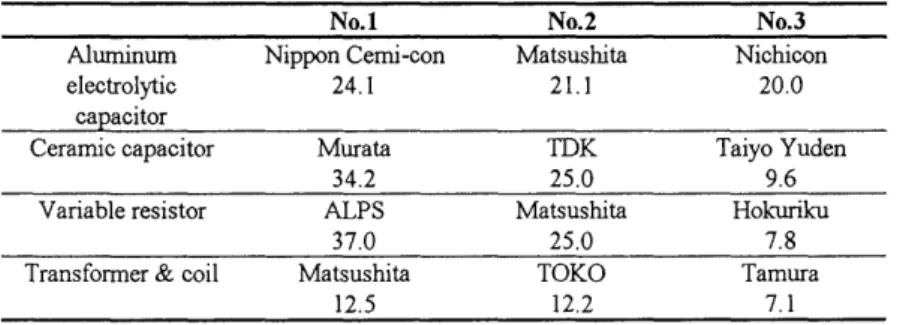
Japan is in the survival of the technological competition based on the product innovation and process innovation. That is to say, they must implement both process innovation (the pursuit of cost reduction) and product innovation (such as miniaturization, high‑frequency, energy conservation, and Surface Mount Technology). Certainly, it is not unusual that the manufacturers losing in the new technology development competition are naturally weeded out. Component manufacturers, who constantly face severe technological competition, focus on their main technology field, cutting peripheral technologies. Therefore, an oligopoly in each component market has emerged. For instance, in the aluminum electrolysis capacitor market, only some ten component firms have survived which posses the core technology (minute processing of aluminum foil)although more than 100 companies competed in the market around ten years ago.
In general, a typical pattern of the product development and standardization of electronic components can be explained as follows : One way for developing new technology is joint research. However, an assembler has many R&D themes in its new end‑product development, therefore component manufactures have complete control of new technology by developing discrete components rather than strategic components.
In this new technology development, when necessary, component firms invest in plants and equipment voluntarily. When new components are developed, the component manufacturers exclusively supply them to the assembler during a fixed period (forinstance, six months). Thereafter, the component manufacturer expands the sales of the component to other assemblers in many cases. The assembler which requested the rmw rnmnnnfint Hf>velonmpnt̲ never finds fault,with this behavior, hecanse
−208−
both of them equally receive the benefit of cost reduction through mass production. If the component sells well, it would be the de‑facto standard and the company would gain the first‑mover advantage. For instance, it is one example that Mitsumi dominates the CD‑ROM
market by establishing de‑facto standards of the equipment.
Table 1 : Market Share of Electronic Components in Japan (1995) (%)
It is not rare at all that the de‑facto standard of a component become one of the real standards, as is the case with JIS (Japan Industry Standard). However, such standardization is a double‑edged sword.
Certainly, standardization will broaden the business opportunities in addition to establishing the company's competitive position in the industry, because a component would be used by many customers. On the other hand, standardization may resultin a narrowing of the degree of freedom of technology development of components, and may invite competitors to the market as a result a rush tolow‑priced competition is led. The Japan‑based electronic component firms tend to avoid this kind of "evil cycle."Therefore, there are some cases in which companies do not agree to standardize. For example, in one of the mechanical components sectors, the top four companies tried to come together for
−209 −
agreement on a standard, but negotiations only resulted in delaying the decision on standardization for fear of new players coming into the game. That is, the standardization in electronic components brings about not only the extravagant competition among component firms, but also inferior bargaining power to the assemblers, so that companies might shorten their lives through their own actions.
As seen above, electronic component companies obstruct new entrants in their sector by intentionally controlling the speed of standardization, as well as maintaining their position by avoiding precise standardization and maintaining a degree of freedom for technology development.
In short, Japan‑based electronic component firms are competing for a new technological development as the main proposition, while maintaining a multidimensional relationship with consumer electronics assemblers. The meaning of the standard in the most electronic component markets is less important than in the end product market
Table 2 : StrategiesofJapanese Component Manufacturers
一210−
such as VCRs and PCs. There are actually many custom‑made components in connectors, power supplies, switches, etc. Even in a capacitor and a resistor, which have various industry standards, some state‑of‑the‑art chip capacitors do not have specificindustry standards.
Rather, they engage in new technology development competition with minimum standard. Thus, any Japan‑based electronic component manufacturers believe that even reinforcement of the core technology leads to long‑term survival in technology competition (see table 2).
4. Business Development in Asia and Changing Transactions
Business expansion into the Asian area by Japanese electronic component manufacturers can be mainly explained from two dimensions; transference of marketing bases and production bases.
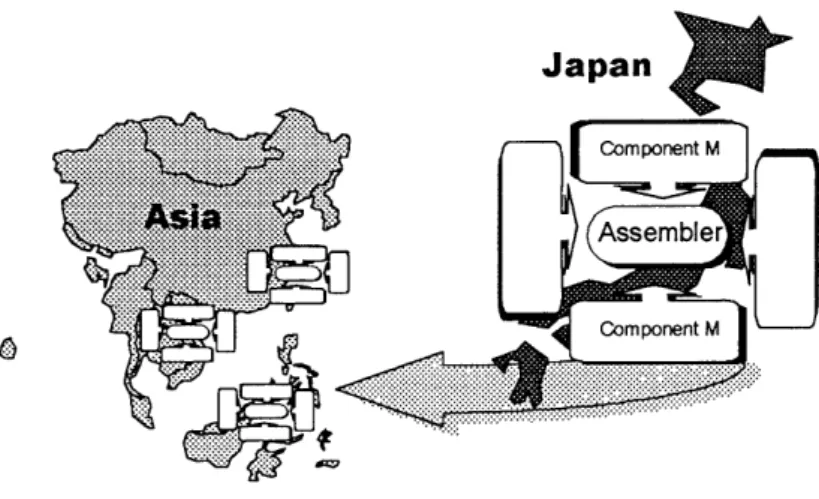
Full scale transference of marketing bases began with the setting up of sales subsidiaries in the Asian area in the early 1990s, following transference of production bases of their customers, the Japan‑based electronics appliance assemblers. According to consolidated financial data of Japanese component manufacturers, the overseas sales proportion particularly in Asia, is consistently increasing, when compared with the increased rate of the total amount of sales. This suggests that most components made in Asia are to Japan‑based customers. In sum, Japan‑based transaction structures have been transferred into Asia (see table 2).
On the other hand, in terms of transference of production bases, strategic differences can be seen according to characteristics of products;
material‑based electronics comnonents such as canacitors and resistors.
−211−
and assemble‑type electroniccomponents such as speakers, coils,micro‑
motors, switches and micro power sources. The former depends on material technology and the latter on processed technology.
The former, labor intensive ones preceded material‑based business in terms of overseas expansion. The component manufacturers positively transferred their production bases into Asia at their early business
stages, because labor cost was much cheaper than in Japan even in those days. Typical manufacturers are Mabuchi (micro‑motor), Toko (transformer),Nemic Lambda (micro power supply) and TEAC (FDD).
They attained an international competitive edge and captured a high market‑share allaround world, by putting into practice standardization and building concentrated production‑systems in low‑cost areas.
Mabuchi, for example, manufactures micro‑motors in China and has gained more than 60% of the world market share.
In contrast with these assembly‑type components, overseas production Figure 3 : Market Share ofElectronicComponents in Asia
−212−
of material‑based components manufacturers in Asia were relatively late. Most of them began to transfer production bases into the area in the 1990s, after their customers positivelycame into the area forlocal production of AV products. The regional difference of production cost is not very large in the case of the material‑based component industry, because it is a capital intensive and equipment‑oriented industry, also its source of value added is in the material technology and the internalization ofproduction equipment.
From the point of view of economies of scale, overseas production for electronics component business cannot be explained solely by the overseas production of customers' behaviors? Thus, establishing
concentrated mass‑production systems is very important for component businesses enjoying scale economies. Nevertheless, most component companies have tended to build their production bases near customers.
As a result, decision making in terms of components selectionsis still influenced by both production and procurement departments.
Figure 4 : TransferenceofCompetition Structure
−213−
As seen from these facts, the electronic component industry is subject to "made in market", which emphasize the closeness with consumer electronics assemblers. A main purpose of such strategic behaviors is to maintain the hitherto strength by keeping the multidimensional transactions with all divisions of the company. In sum, Japanese component manufacturers have maintained a technological competitive edge, through transferring such long‑range and stable relationships in Japan into Asia.
5. Appearance of Asia‑based Local Companies
For consumer electronics assemblers, the most important goals are to decrease the volumes and varieties of higher priced components such as are made in Japan, and to improve the extent of standards while maintaining the quality and reliability of the end products. These behaviors are intended to reduce total cost through positively utilizing components made by Asia‑based component companies. In the past two years, Japanese component manufacturers have faced keen competition with their Asian counterparts. And presently, Japanese companies are stilltaking advantage, but Asian locals are enhancing their strength, especially in the business field of low price products.
Although they have never had a competitive edge technologically and financially over their Japanese counterparts local Asian competitors have been able to develop their current strength through the introduction of production technology and equipment from advanced countries such as Japan, and improved it in compliance with market needs. They have also been innovative in their own production technology. By using
advanced production systems, they could produce to some extent
−214−
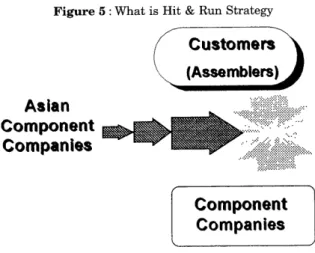
Figure 5 : What is Hit & Run Strategy
technologically advanced components. They are not of as advanced quality as those made by Japan‑based manufacturers, but available for some types of end products. Thus, one might say that this is a "hit and run strategy" that has been developed by these companies (see figure 5). On the process of this strategy, at first they supply a small volume of components requiring low level technology and quality, into as small a market which their Japanese competitors may ignore.
Then, through supplying a small volume of such components for the assembler intermittently, they create a chance to crack Japanese‑Japanese relationships based on long‑term and stable transactions. At the
early stage, few Japan‑based consumer electronics assemblers adopted components made by Asian locals. However, stable Japanese‑
Japanese relationships are gradually changing due to pressures for cost‑reduction and by refining international transaction systems through the establishment and extension of the IPO. Some Japan‑
based consumer electronics assemblers which actively promote the adontion of comnonents made bv Asian locals, organize oroiect teams
−215−
with the responsibility of looking for better local component manufactures.
The assemblers try to use the local‑based component company as a first‑source supplier and the Japanese counterpart becomes as a second‑
source supplier. Also, some assemblers educate and train local component manufacturers. Thus, some Japan‑based consumer electronics assemblers build their worldwide competitive advantage through positive adoption of components made by local‑based companies.
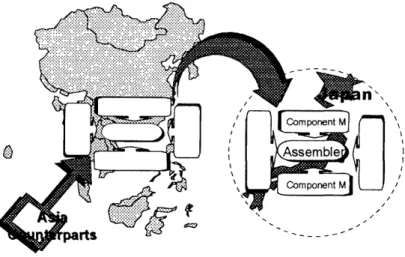
Figure 6 : Asian Locals Invading Japan based Transaction
In other words, Japan‑based component manufacturers, competing with other Japanese companies, supply higher‑priced products, because specifications of products are more sophisticated than consumer electronics assemblers require. Among Japanese vs. Japanese companies keen and over‑specification competition, Asian locals may enhance and attain their competitive advantage in a short time, thereby breaking the well established Japanese‑Japanese transaction relationship. Thus,
― 216 ―
the Asian locals may become powerful enemies of Japanese component manufacturers through the hit and run strategy in the near future (see figure 6) .
6. Brief Conclusion
The competition in the worldwide electronics industry has mainly developed in advanced countries' markets, and most of the players are Japan‑based companies. In the 1990s, however, Asian companies
which are pushed by a growing economy in Asia, are taking part in the competition, so called "mega‑competition". This, then, leads to the question of how Japan‑based component manufacturers are changing under such keen competition.
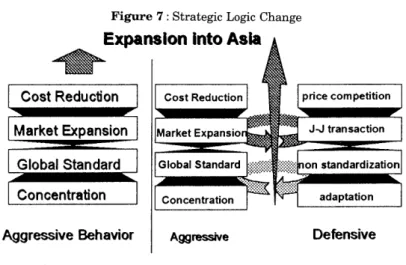
Japan‑based companies' behavior can be explained by factors that the Japanese component manufacturers have come into Asia, as a cost‑reduction strategy through cheaper labor cost and cheaper procurement, or as a strategic behavior caused by overseas expansion of Japan‑based consumer electronics assemblers. As mentioned before, however, for component, especially the material‑based components manufacturers, it is not enough to explain the recent changing global strategy by aggressive business logic of focusing on the economic principle or market expansion. Rather than such business logic, we should look for other types of business logic underlying these behaviors in mid‑1990s.
It is very clear that maintaining relationships with customers is the most important factor for component manufacturers. In fact, components manufacturers have entered into new forms of relationships with new customers as well as Japanese competitors, in order to maintain the nositive relationships with specific assemblers and in order
−217−
Figure 7 : Strategic Logic Change
to expand the market. A phenomenon which has previously been pointed out as being an incestuous Japanese transaction relationship.
In essence Japan‑based components manufacturers have intended to transfer and persevere within their own industrial structure,to maintain intimate transaction relationships and competitive structuresin Japan, and to defend their strategicbusiness domain and main their competitive advantage. The foundation of this business logic is to enhance their raison‑d'etre through transferring the Japanese business structure into the global market, thereby eluding the overabundant product
standardization and preceding technological competition (see figure7).
Asian component companies which adopt a hit and run strategy enhanced through product standardization and generalized technology, however, are intruding the Japan‑based companies' territoryin Asia, where Japanese style transaction relationships and competitive structures are transferred.As a result,the characteristicsand rules of competition in Asian electronics component business structures are changing. This causes many Japanese components manufacturers to
−218−
accelerate their entry into the Asian market. For Japan‑based component manufacturers whose raison‑d'etre is influenced by the existence of product standardization, the continuance of a relationship with customers itself is an indispensable factor. If Asian locals bring an intermittent
or impermanent relationship (spot delivery),not only in the Asian area, but into the Japanese market well, Japanese components manufacturers may experience distinct difficulties. In this way, rapidly increased expansion into the Asian market by Japanese component manufacturers may be explained as rational defensive strategic behavior.
Some Japanese assembly type of component manufacturers which developed their business in the Asian market, typically Mabuchi, captured their world‑wide market share through advancing product standardization thoroughly. However, the appearance and existence of Asian companies developing a hit and run strategy poses a threat for Japanese material‑based component companies, because they adopted a "standardization in the company but individual adaptation for customers" strategy, but not the product standardization strategy like assembly type of component manufacturers, for sustaining their raison‑
d'etre. Thus, it can be explained that recent hard‑hitting expansion into Asia by Japanese component manufacturers is led by both defensive reasons in addition to aggressive expansion.
As a director of one Japanese components manufacturer elaborated:
"The global competition in electronics industry is among Japanese companies now. We do not have to expand into Asia, if possible. We can survive while we maintain the status quo. Of course, we are improving process technologies and cutting costs.However, the counterparts with the hit and run strategy have broken the global competitive situation.
−219−
That is to say, they gradually destroyed and rebuilt the stable Japanese‑
Japanese relationships, while Japanese companies did not notice the changes. Therefore, even though we do not want to, we have no choice but to come into Asian area in order to lie in wait for unidentified competitors."
References
Bartlett C. A. and S. Ghoshal (1989), Managing across Borders:The Transnational Solution, Boston : Harvard Business School Press.
Electronics Industry Association of Japan (1996), Report on Electronics Industry in the ASEAN.
Hamel, G. and C. K. Prahalad (1994), Competing for the Future, Boston:
Harvard Business School Press.
Hobday, M. (1995), Innovation in East Asia, Edward Elgar Publishing.
Iwasaki, N. and H. Kaiho (1996), How Japanese Electronic Component Firms Evolved Turnaround Strategy, Competitive Intelligence Review, Vol. 7 (2), pp. 20‑35.
Iwasaki, N., H. Kaiho, and Todd. B. Neff(1995), Corporate Turnaround beyond Industrial Change;From Case Studies of Japanese Electronic Component Firms, Seijo University ECONOMIC PAPERS, 131, pp. 109‑143.
MacMillan, J. (1992), Games, Strategies, and Managers, New York: Oxford University Press.
Miller, D. and M‑J. Chen (1994), Sources and Consequences of Competitive Inertia: A Study of the U.S. Airline Industry, Administrative Science Quarterly, Vol. 39, pp. 1‑23.
Nomura Research Institute (1995), Evolving Japan‑based Companies in Asia, Zaikaikansoku (NRI monthly report: Tokyo), April 1995, pp. 2‑55.
Nonaka I. and H. Takeuchi (1995), Knowledge Creating Company, New York : Oxford University Press.
Porter, M. E. (1990), The Competitive Advantage of Nations, New York: The Free Press.
Teramoto Y., N. Iwasaki et al (1994), Global Strategy in the Japanese Semiconductor Industry, Campbell, N and F. Burton (ed.), Japanese
−220−
Multinationals, London ; Routledge
Yano Research Institute (1996), Reports of Market Share, Tokyo.
Acknowledgments
We gratefully acknowledge the suggestions and permissions made by Shinji Tsuji (Senior General manager, Manufacturing Administration Center, Omron),
Shuichi Shiraishi (Senior Project Manager, corporate Planning Office,Nippon Chemi‑Con Corpoaration), Masanori Jindo (Manager, Executive Corporate Planning Depertment, ALPS), and Dr. Gerry Gannon (senior Research Fellow, School of Management, Cranfiled University). This articleis based on a report presented at the Strategic Management Society, 16th Annual Conference in Phoenix, Arizona, USA on November 13th, 1996.
一221−