Article
Spurious Resultatives Revisited:
Predication Mismatch and Adverbial Modification*
Toru SUZUKI
Faculty of Literature and Social Sciences, Yamagata University 1. Introduction
In his typological analysis of resultatives, Washio (1997) points out that several peculiarities found in the type of resultative in (1) cannot be reduced to his dichotomy of “strong” resultatives such as The horses dragged the logs smooth/The joggers ran the pavement thin and “weak” resultatives such as Mary dyed her dress pink/I froze the ice cream hard.1
(1) a. He tied his shoelaces {tight/loose}.
b. He spread the butter {thick/thin}.
c. He cut the meat {thick/thin}.
The major characteristics of this type of resultative termed “spurious resultatives” are summarized as in (2), and the relevant points are illustrated by examples in (3-6):
(2) Characteristic properties of spurious resultatives (Washio 1997: 17)
(A) they involve an activity such that a particular manner of action directly leads to a particular state,
(B)itmakesnosignificantdifferenceiftheadjectiveistakenasspecifyingtheresultstateor specifying the manner of action so that, typically, the adjective can be replaced with the corresponding adverb with virtually no difference in meaning,
(C)they permit either one of the adjectives that form the antonym pair,
(D) the standard paraphrase (“x causes y to become z”) often fails, especially with one of the antonymous adjectives.
(3) a. He spread the butter thick/thickly.
b.≠Hecausedthebuttertobecomethickbyspreadingit.
(4) a. He spread the butter thin/thinly.
b.≠Hecausedthebuttertobecomethinbyspreadingit.
(5) a. He cut the meat thick/thickly.
山形大学人文学部研究年報 第14号(2017.2)69-104
b.≠Hecausedthemeattobecomethickbycuttingit.
(6) a. He cut the meat thin/?thinly.
b.≠Hecausedthemeattobecomethinbycuttingit.
Unfortunately, though, Washio (1997) merely suggests that the use of adjectives in spurious resultatives is somewhat “adverbial” in nature, leaving open the question of why their properties, as described in (2), are not found in normal resultatives (either“strong”or“weak”resultativesinhisclassification). The leading questiontobediscussedinthisarticleiswhetherspuriousresultativesarequalifiedforathirdindependent categorywithintheclassificationofresultatives.Thispaperwillclaimthatspuriousresultativesandweak resultatives in Washio’s (1997) sense can be unified under the same category, namely, under spurious resultatives, rather than under weak resultatives. In other words, I argue that the category of spurious resultatives is the larger, that it subsumes weak resultatives, and that they stand in stark contrast to true resultatives (to be characterized below), which roughly correspond to Washio’s (1997) strong resultatives.
The present article is organized as follows. In section 2, I examine Washio’s characterization of spurious resultativesandreformulatetheirpropertiesintermsofadverbialmodificationandpredicationmismatch.
In section 3, verbs that typically appear in spurious resultatives are discussed and characterized as verbs oftransformationconsistingoftwosubclasses,verbsofchangeinconfigurationandverbsofchangein shape/appearance, each focusing on a different aspect of change in transformation. Section 4 argues that, in terms of the function and interpretation of result phrases, spurious resultatives and weak resultatives canbeunified,withcertaindifferencesbetweenthetwocategoriesreducedtodifferentdispositionson a continuum of varied types of transformation. Section 5 looks into a type shifting analysis of Japanese spurious resultatives (Imoto 2009 among others), which I essentially adopt in analyzing their counterparts in English. In section 6, based on the extended characterization of spurious resultatives developed in this article, I reformulate the major resultative dichotomy of true resultatives vs. spurious resultatives. Section 7 discusses some consequences of the present study and section 8 concludes the discussion.
2. Revisiting spurious resultatives 2.1. Adverbial adjectives
In this section, I focus on two main features of spurious resultatives which serve to derive their adverbial characteristics as originally discussed in Washio (1997).
If spurious resultative phrases function as adverbials as in Washio (1997), they should be expected to behave like true adverbials in some syntactically and semantically relevant respects. One of the suggestive facts is that spurious resultative phrases are naturally put into the interrogative by using how-questions in contrast to true resultative phrases (the examples in (7) are from Horrocks and Stavrou (2003: 317)):
(7) a. How did s/he cut the onion? / thin What color did s/he paint the house? / red
b. How did s/he wipe the table? / *clean, vigorously Howdids/hebeatthemetal? /*flat,withahammer
These observations seem to suggest that the apparent adjectives thin in He cut the onion thin and red in She painted the house red are functionally comparable to the manner adverbs like quickly, slowly, and sloppily as opposed to “true” adjectives in She wiped the table clean and He beat the metal flat.
Anothersignificantfactabouttheiradverbialcharacteristhatadjectivesinspuriousresultativestypically seemtolargelyoverlapthelexicalclassof“adverbialadjectives”or“flatadverbs.”Theyassumeasingle common morphological form, whether they function as adjectives or adverbs. Thus, as shown in (8), adjectives of this class are often used as adverbs that modify verbal events or manner. The following examples are taken from Quirk et al. (1985: 407):2
(8) a. clean clothes; play the game clean b. a deep breath; live deep in the woods c. a flat country; I’m flat broke.
d. light weapons; She travels light.
Huddleston and Pullum (2002: 568) give a sample of adjective-adverb pairs of the same kind as shown in
(9):3
(9) clean,clear,dear,deep,direct,fine,first,flat,free,full,high,last,light,loud,low,mighty,plain, right, scarce, sharp, slow, sure, tight, wrong
This type ofadjective typically possesses a lexical opposite, together forming a non-complementary opposition where each member and its lexical opposite generally exist on a scale with a mid-interval left open to contextual interpretation (cf. Cruse 1980, 1986). Examples of such pairs include deep/shallow, long/short, fast/slow, wide/narrow, heavy/light, large/small, and thick/thin.4 From a psycholinguistic viewpoint they might be characterized as “most perceptually salient” core words which mark prototypical sensory perception such as size (long/short), weight (heavy/light), and color (Carter 2004: 115).
The existence of adverbial adjectives as a lexical class might suggest that at least some of the (spurious)
resultative adjectives can be analyzed potentially as adverbs, instead of true adjectives. In this connection, notealsothatsomeofsuchlexicalitemscanbefound,oftenincolloquialuse,asintensifyingmodifiers
to adjectives, PP locatives or verbs, something typical of adverbials. In the following examples, adverbial adjectives are shown in italics:
(10) a. She just stood there with her eyes wide open.
b. She was wide awake.
c. Volcanic eruptions spread dust high into the stratosphere.
d. He fell flat onthefloor.
e. The car stopped sharp.
Interestingly, these adverbial adjectives generally have derivationally related -ly adverbial forms and the two variants are often used interchangeably with certain semantic connotations, although subtle judgment on the differences between the two variants seems to suggest that there is a certain indeterminacy in the speaker’s choice (see Geuder 2000, Broccias 2004, 2008, 2011, Iwata 2006, and Levinson 2010; see also Quirk et al. 1985 and Huddleston and Pullum 2002). For example, Broccias (2008: 6, fn.4) argues that -ly adverbs seem to correlate with subjective/abstract properties and adjectives with objective/concrete properties (She fixed the car perfectly/#perfect), while Iwata (2006: 467) claims that the -ly adverbs can be used only when they elaborate the outcome of verbal actions (*The lake froze solidly/*He painted the wall redly). Both analyses are able to account for part of the relevant data in their own way, although there seem to be multiple factors involved in a complex fashion.
While admitting that there are certain semantic gounds for choice between the two, it seems to me for the present purposes rather pointless to pursue a reliable criterion for distinguishing between adjective and adverb status, since most of these lexical items are already listed in dictionaries as both adjectives and adverbs and speakers are not always consciously aware of which is which categorially. Furthermore, in English, unlike French for example, an explicit grammatical agreement system for adjectives has been lost and thus we do not have a principled way to distinguish the two categories in question when they appear in the same syntactic position in the same form, that is, without -ly. For these reasons, it seems to be too simplistic to regard bare adjective variants as adjectives and -ly variants as adverbs. Thus, in the present article, I take the middle ground where the categorial status of apparent adjectives without -ly can be either adjective or adverb as far as the context allows, leaving open the question of categorial distinction between the two and adopt the term “adverbial adjectives” to refer to the result phrases in spurious resultatives without implying that they are necessarily true adjectives in category.5
2.2. Predication mismatch
One of the most intriguing observations about spurious resultatives is that establishing a proper
predicative relationship between the theme object and the resultative phrase in spurious resultatives is often not straightforward (see Iwata 2006 and Levinson 2010). Although Washio (1997) does not go into detail about the reason why the standard causative paraphrase often fails in spurious resultatives, I suggest that this is because predication (= subject + predicate) does not always hold in spurious resultatives between an NP in object position and the resultative phrase. In the following examples (11-15), the (b)
-examplesareintendedtodescribethesituationsliterallyreflectingthepredicativerelationshipsembedded in the resultatives of the (a)-examples, while the (c)-examples are more appropriate descriptions of the events in the (a)-examples. Notice that in (11-15) the (b)-examples generally sound more deviant in comparison to the (c)-examples:
(11) a. He tied his shoelaces {tight/loose}.
b. His shoelaces are/became {tight/loose}.
c. The knots of his shoelaces are/became {tight/loose}.
(12) a. He spread the butter {thick/thin}.
b. *The butter is/became {thick/thin}.
c. The spread of butter is/became {thick/thin}.
(13) a. He cut the meat {thick/thin}.
b. *The meat is/became {thick/thin}.
c. The slices of the meat are/became {thick/thin}.
(14) a. He opened the window {wide/narrow}.
b. *The window is/became {wide/narrow}.
c. The opening of the window is/?became {wide/narrow}.
To illustrate the point further, consider (13a). When he cut the meat thick, it is not the meat itself, but rather each slice of it produced by the act of cutting that became thick. Thus, predicating directly the result phrase thick of the object the meat fails to capture the situation correctly. The same exposition applies to the other examples. What they share is a peculiar interpretation in which the host to be predicated by the result phrase should be construed as an entity “created” or “derived” from the original material through a process of change. In rhetorical terms, the process of change here shifts the reference of the theme argument from the original entity to its resultant product through synecdoche (based on part-whole relationship) or metonymy (based on adjacency). Thus, spurious resultatives can be characterized by a predication mismatch between the syntactically implicit, created entity and the result phrase that is only apparently predicated of the explicitly realized object. We might say, alternatively, that spurious result phrases are “non-predicative” in that they do not function as a true predicate in the strict sense of the term.
The following illustrates associated pairings of an expressed theme argument (= x) and a created entity (=
y) that remains implicit:
(15) a. tie the shoelaces {tight/loose}
[x = the shoelaces; y = knots (ties) of the shoelaces]
b. spread the butter {thin/thick}
[x = the butter; y = the spread (layer) of the butter]
c. cut the meat {thick/thin}
[x = the meat; y = a slice (cut) of the meat]
d. open the window {wide/narrow}
[x = the window; y = the opening of the window]
Nominalization of verbal events into an -ing form also shows a sharp contrast between true resultatives and spurious resultatives. The nominalized expressions in (16) that are derived from true resultatives are generally unacceptable, unlike those in (17) that are derived from spurious resultatives.
(16) a.*Thehammeringofthemetalwasflat.
b.*theflathammeringofthemetal c. *The wiping of the table was {clean/dry}.
d. *the {clean/dry} wiping of the table
(17) a. The cutting of the meat was {thick/thin}.
b. the {thick/thin} cut(ting) of the meat
c. The opening of the window was {wide/narrow}.
d. the {wide/narrow} opening of the window
The contrast also points to another related difference in the aspectual properties of the verbs involved:
verbs in the true resultatives in (16) are activity verbs, while those in the spurious resultatives are normally regarded as result verbs. The latter verbs are known to regularly yield two different readings in their nominalization, namely a “process” reading and a “result/product” reading (Grimshaw 1990). With the resultative predicate in (17a, c)andtheresultativemodifierin(17b, d), the preferred reading is clearly that of the “result/product” reading, where an entity created through a verbal activity is predicated of or modifiedbythespuriousresultativeadjective.Notethatthenominalizedexpressionsin(16), on the other hand, are generally unacceptable with a “result/product” reading in which the V-ing expression is supposed to be understood as a created entity.
The mismatch between the result phrase and its apparent host in spurious resultatives explains straightforwardly the unnaturalness of the paraphrase “cause X to become Y by V-ing,” since Y is not properly predicated of X in the semantics of spurious resultatives. The true host of Y is a created entity which is not explicitly realized in syntax but hidden in semantics.
Can we relate this mismatch in predication to the adverbial behavior of spurious result phrases? My tentative suggestion (to be elaborated shortly) is that spurious result phrases are forced to function adverbially because they fail to be structurally linked to a proper host. Although an adjective is generally predicatedofasubjectormodifiesanominalhead,theresultadjectiveinspuriousresultativesapparently fails to meet either of those functional requirements in their structural realization. Thus the only way these predicatescanfunctionisviaadverbialmodification.
Interestingly, Washio (1997) observes that in French, which is considered to lack in general the English type strong resultatives, spurious resultatives are possible when the adjectival result phrase does not show agreement with its semantic subject.
(18) a. J’ai noue les lacets de mes chaussures bien serre.
“I tied the laces of my shoes very tight.”
b. Hachez-les menu. (les = e.g., the onions)
“Cutthemfine(i.e.,intofinepieces).” (Washio 1997: 29)
In view of the fact that French is a language where explicit agreement on adjectives is normally required with the semantic subject, it is clear that the result phrases in (18) do not serve as true (grammatical)
predicates to their hosts. This also suggests that spurious resultatives are not just a minor category of resultatives showing certain irregularities, rather a legitimate construction in its own right within the typological study of language. We will return to this point in 5.1, where Japanese resultatives are discussed.
2.3. Spurious resultatives reformulated
In 2.1, we have seen that in modern English certain adjectives and adverbs have come to behave ambiguouslywithrespecttotheircategorystatus,inparticular,inVPfinalpositionimmediatelyfollowing a direct object or a verb (cf. Killie 2007). Although native speakers generally show certain preferences in choosing between the bare adjective form and the -ly adverbial form, due to their subtleties it still seems rather difficult to state explicitly the relevant criteria. I have also argued that predication mismatch in spuriousresultativesfurthermotivatestheadverbialmodificationreadingoftheadjectivesinquestion.I have also suggested that predication mismatch explains why the standard causative paraphrase does not seem to work in spurious resultatives: in the “X became Y” part of the paraphrase of spurious resultatives,
proper predication between X and Y often fails due to predication mismatch. As for the existence of antonym pairs in the result phrase, the manner orientation of the result phrase seems to be responsible, as Washio (1997) himself suggests. In other words, depending on how the verbal action is carried out, its effects on the theme argument can vary on the same scale of change. Thus we can reduce the tendency of having antonymous adjectives in spurious resultatives to their adverbial use and interpretation, which is in turn attributable to predication mismatch.
Viewed this way, the major characteristics of spurious resultatives noted in Washio’s original analysis can be traced back to predication mismatch in the interpretation of spurious resultatives along with ambiguity in the use and form of adverbial adjectives in modern English. Accordingly, I reformulate in (19)
the characteristics of spurious resultatives in terms of these two major features:
(19) (A)Adverbialmodification:
The result phrase in spurious resultatives has adverbial properties as shown typically by its alternation with -ly adverbs and the how-question test. One contributing factor is the historically accidental prevalence of “adverbial adjectives” in modern English. Adverbial modification correlates with the existence of antonymous pairs of resultative adjectives, since the result of a verbal action is crucially affected by how (in what manner) the action is done.
(B) Predication mismatch:
The result phrase in spurious resultatives functions “non-predicatively,” in that it often fails to be semantically predicated of its apparent host. Instead, it is more appropriately construed as describing the resultant property of a created or derived entity not realized explicitly in the syntactic structure. Causative paraphrase fails when, due to predication mismatch, proper predication does not hold between the created theme argument and the result phrase.
In the following discussion, I will further argue that the adverbial behavior of spurious result phrases in (A) derives from predication mismatch in (B).SpecificallyIclaimthatwhenpredicationmismatch occurs, type shifting by coercion (Jackendoff 2002, Pustejovsky 1995) is invoked in order to dissolve the semantictensionbetweenthepredicateanditsapparenthost.However,beforeIdiscussmorespecifically what kind of interpretive strategy is at work, let us take a closer look from an event-semantic point of view at what kind of verbs are involved in spurious resultatives.
3. Verbs of transformation: changes in configuration and shape/appearance
Consider what kind of verbs typically appear in spurious resultatives. The following examples (stripped to the bone for expository purposes) are intended to offer an overview of what types of resultatives are
generally regarded as spurious resultatives. They are compiled from various sources including the linguistic literature, the internet and dictionaries.
(20) Changeinconfiguration a.choptheparsleyfine b.clenchmyfistswhitetight
c. cut the meat thick d. hold her arms rigid
e. grind the coffee beans coarse f. pile the books high
g.rakethegravelflat h. slice the bread thin i. scrunch her eyes shut j. spread the butter thin k. stack the records high l. tie the shoelaces tight
(21) Change in shape/appearance a. bend the metal closed b.collapsetheboxflat
c. crush it shapeless d. dye her hair pink e. fold the blanket thick f. roll the notes thick
g. shrink the original story short h. squint her eyes narrow i. stretch her arms wide
Semantically speaking, changes described in these examples may be broadly categorized into two types:
changeinconfigurationin(20) and change in shape/appearance in (21). The former type can be further divided, in terms of two opposed directions of change, into “assembling” and “disassembling.” Although admittedly, the categorization of verbs involved is not always clearcut between the two types, the intuitive ideabehindthisclassificationisthattheverbaleventsinvolvedherealldenotesomekindofeventwhich transforms an entity, focusing to varying extents on the configuration or the shape/appearance of the themeargument.Changeinconfigurationismorespecificaboutrearrangingcomponentpartsofanentity,
separating something into parts (= disassembling) or bringing parts together to produce a larger entity (=
assembling). Change in shape/appearance, on the other hand, focuses on holistic change in the shape/
appearance of an entity.
The verbs that describe these types of event are largely characterized as verbs of transformation, changinganentityintoadifferentshape,appearance,orconfigurationtypicallythroughexertingvarious types of physical force. Thus, they can also be accompanied by a prepositional result phrase instead of an adjectival phrase, describing similar types of events of transformation more explicitly, as shown in (22):
(22) a. He tied his shoelaces into a knot.
b. He chopped parsley into pieces.
c. She rolled the notes into a roll.
d. She stacked the records into a tower.
e. She ground the coffee beans into powder.
Interestingly, the nominal complements to the PPs in (22)cannaturallyundergoadjectivalmodification by what appear to be spurious adjective phrases, which are italicized in the examples below:6
(23) a. He tied his shoelaces into a tight knot.
b. He chopped parsley into fine pieces.
c. She rolled the notes into a thick roll.
d. She stacked the records into a high tower.
e. She ground the coffee beans into coarse powder.
These examples suggest that these result adjectives used in spurious resultatives in (20─21) are not true predicates of the object of the verbs but are more appropriately understood as semantically modifying the resultant object which can have an alternative realization in PP as in (23).Compare the spurious resultative variants in (24):
(24) a. He tied his shoelaces tight.
b.Hechoppedparsleyfine.
c. She rolled the notes thick.
d. She stacked the records high.
e. She ground the coffee beans coarse.
Given the present characterization of the verbs under discussion as verbs of transformation specifying varioustypesofchangeinconfigurationandshape/appearance,astraightforwardaccountcanbeinvoked for predication mismatch between the theme argument and the result phrase as discussed in 2.2: the theme argument in this type of change event can often fail to retain its unity or integrity during the process of change. With verbs of assembling/disassembling, in particular, it is often the case that the original theme argument undergoes a process of change that transforms its material integrity in two ways: either putting different parts together into one whole through an assembling process (e.g. clenching, piling, stacking, tying), or taking a whole apart through a disassembling process (e.g. chopping, cutting, grinding, slicing). In either case, the referentiality ofan entity involved can be affected after transformation process through multiplying or decreasing the number of its constituent parts. If the result phrase as a predicate is supposed to refer to the state of an resultant entity, it is not unnatural to assume that the affected referentiality might hinder a proper predicative interpretation between the original theme entity and the result phrase which describes a resultant product. However, the same does not necessarily hold of the case of changes in shape/
appearance where the theme argument undergoes a significant change in its shape or appearance while retaining its basic constitutive property as far as its referential identity is concerned. For example, in the resultative expression collapsing the box flat, the referentiality of the box can remain the same after the process of collapsing, although its function as a box is normally lost. In this respect, predication mismatch canbeseentohavemorerelevancetotheeventsofchangeinconfigurationthanthoseofchangeinshape/
appearance.
Note also that it is not uncommon that the same verb can be seen as describing either a change in configurationorachangeinshape/appearancedependingoncontext.Forexample,theverbspread in she spread the cards flat on the table describes an act of disassembling while the same verb can be construed as an act of transformation in she spread the umbrella open. In other words, an event is seen as an instance ofchangeinconfigurationwhenthematerialunityofanentityislostintheprocessofchange,whileitis seen as an instance of change in shape/appearance when the unity is somehow held intact, even when it has gone through a noticeable change in its shape/appearance.7 In the next section, I will put forth a view that the category of verbs of transformation can be further extended to include a broader variety of verbs in the so-called weak resultatives.
4. Spurious resultatives and weak resultatives 4.1. How much are they really different?
Given the present characterization of spurious resultatives as formed around verbs of transformation thattypicallydescribeachangeinconfigurationorshape/appearance,thereadermightasktheobvious question whether spurious resultatives should be treated separately from the so-called weak resultatives
whosemainverbscanalsobemoreorlessclassifiedasverbsoftransformation.Inotherwords,onemay ask if it is really necessary to maintain the distinction between spurious resultatives and weak resultatives as originally suggested by Washio (1997). In fact, my answer to this question is that most of the change of state verbs attested in weak resultatives can be subsumed under the larger category of “verbs of transformation,”alongwithverbsofchangeinconfigurationandinshape/appearance.Iwillarguethat there are certain differences in degree, but not in kind, between them and consequently spurious resultatives andweakresultativesaretobegroupedtogetherinthegeneralclassificationofresultatives.
Consider some of the oft-cited cases of weak resultative in the literature.
(25) a. He broke the box open.
b. She froze the ice cream hard.
c. He melted the chocolate soft.
d. He burned the books to cinders.
e. She boiled the lobster pink.
f. He fried the potatoes crisp.
It seems clear that the examples in (25) share certain similarities with the spurious resultatives we have examined so far. They entail certain results that can be further specified by result phrases, which areinturnlicensedaslongastheyareconstruedasdescribingsomekindofadditionalspecificationto the entailed result of the verbal events. In this respect, the verbs in question can be largely classified into verbs of transformation in (21).Ifwearetodefinethesemanticsofverbsoftransformationmore precisely,itshouldinvolvesuchconceptualcategoriesasproperty,configuration,shape,color,andsizeas itssubcategories.Amongthem,propertyisthesuperordinateconceptwhichunifiesothersubcategories including“intrinsicproperty”whichIassumetorefertosomeinherentpropertyofanentitydefinedin terms of its unity or function at an abstract level. For example, an event of breaking not only physically damages an entity but also spoils its function as a result of the process of transformation. An event of melting or freezing normally changes the constitutive state of an entity, which can in turn lead to a change initsclassificationcategory(e.g. from ice to water and vice versa). Thus, I claim that verbs of change in intrinsic property, which typically serve as the semantic core of events denoted by weak resultatives, can be generally subsumed under verbs of transformation. The conceptual subcategories that are involved in the semanticsofverbsoftransformationaresummarizedinthefollowingfigure:
In fact, some scholars who acknowledge the existence of spurious-type resultatives regard the resultative instances of these verbs as a subtype of the resultatives which consists of the verb implyinga result and the result phrase further specifying it (Iwata 2006, Rapoport 1999 among others).According to Iwata (2006), for example, his Type B resultatives, which roughly correspond to weak resultatives in Washio (1997), cover the spurious type as well. In the following, despite the strong similarities to the prededing approaches
(Iwata 2006, Rapoport 1999), I will argue that “spurious resultatives,” instead of “weak resultatives” or
“Type B resultatives,” can be considered a better characterization of our object of study to be contrasted with “true resultatives” in section 6, where the notion of further specification in resultatives is further examined.
4.2. Manually controlled processes
Beforejumpingtotheconclusionthatspuriousresultativesandweakresultativescanbeunifiedintothe same class, however, let us explore some ideas hinted at by the fact that the verbs in the typical spurious resultatives in (20-21) and those in the weak resultatives in (25) are not perfectly homogeneous in their semantic properties. The former type of verbs do not normally yield intransitive variants with their agentive subjects suppressed: intransitivization is possible only when the theme argument is understood as a kind of natural object in motion, as in (26) and (27). On the other hand, the latter verbs, irrespective of the semantic type of the theme argument, participate in transitive/intransitive alternation fairly freely, as in (28).
(26) a. He spread the butter thin.
b. ??The butter spread thin.
c. The soil spread thin over ancient rocks.
(27) a. She piled the books high.
b. ??The books piled high.
c. The snow piled thick.
(28) a. The glass broke in pieces.
Figure 1: Conceptual categorization with verbs of transformation
change in property
intrinsic property shape appearance (color/size) configuration…
b. The ice cream froze hard.
c. The chocolate melted soft.
The change process expressed by the former class of verbs typically requires a responsible agent who has control over the process of change, while with the latter the relevant change is understood as being somehow internally caused once initiated. That is, this latter type of change is likely to progress on its own without aid of an agentive controller (cf. Levin and Rappaport Hovav 1995 for “internal causation”
vs. “external causation”).Thus,wemaysaythatchangeofconfigurationverbsarerelativelylessspecific about their outcome, while an agent’s involvement in their activities, such as manually controlled procedures,ismorestronglyspecified.Thisrelativelyhigherspecificityofagentivecontrolcontributesto their limited occurrence in intransitive forms such as (26c) and (27c).
4.3. Elasticity of types of change and underspecification of results
Viewed from a slightly different perspective, the two types of verb that appear in spurious resultatives and weak resultatives also differ in the degree of specificity of the result entailment. In spurious resultatives,verbsarenotalwaysspecificenoughabouttheirentailedresults,oratleast,itissometimes difficulttodeterminewhatkindofresultsareentailedbecauseoftheelasticityoftheverbalsemantics.
Put differently, it is often the case that the resultant situation is rather dynamically constructed from a combination of the verb, the theme argument and the result phrase. Consider the following cases:
(29) a. She piled the books high.
b. She piled the broken pieces (of the dish) into her hand.
c. They piled into a taxi.
d. The snow piled thick.
An act of piling usually means putting things up higher and higher in a vertical direction, but in some cases it can also mean moving things to the same place one by one with no implication of vertical growth.
In other words, in (29b-c), the cumulative effect of the successive procedures or minievents of piling is highlighted instead of a cumulative effect in an upward direction (29a).
The behavior of the verb spread is similar. In (30a), ‘the word’ goes through a disassembling process while, in (30b, c), the change simply concerns the holistic shape or appearance of an entity with no implication of disassembling.
(30) a. She spread the word in two halves. 8
b. She spread the umbrella open.
c. She spread the butter thick.
Thus,wemaysaythatthecoremeaningspecificationoftheverbspread,definableasawideningmotion ofthepartsofanentity,canbeexpressedeitherasachangeinconfigurationin(30a), or as a change in shape/appearance in (30b) and (30c).
As to how specifically results are implicated, verbs like pile and spread seem to behave slightly differentlyfromotherbonafideresultverbs,someofwhichwehavetermedverbsofchangeinintrinsic property in 4.1. To clarify the difference, let us employ the something is different about X test (Beavers 2011: 342) as an informative means to detect property change in the result entailment of verbs.
(31) a. John just cleaned/painted the bedroom, #but nothing is different about it.
b. John just destroyed/ate the cake, #but nothing is different about it.
When this test is applied to pile and spreadcases,theresultsaresomewhatdifficulttoevaluate.
(32) a. She just piled the books, (#)but nothing is different about them.
b. She just spread the cards, (#)but nothing is different about them.
As long as it deals with the inherent properties of the books or the cards, the statement nothing is different does not seem to contradict the former half of the sentence. In fact, Beavers also provides another related test for change of location, x is somewhere else, but again the results with the verbs pile and spread are notsobad,ifnotdefinitelyacceptable.Judgmentvaries,dependingonhownarrowlyoneconstruesthe relevant location where entities move.
(33) a. John just walked out of the room, #but he is not somewhere else.
b. She just piled the books, (#)but they are not somewhere else.
c. She just spread the cards, (#)but they are not somewhere else.
Consider another test for scalar change, X is more V-ed than Y (Levin 2008), by which the verbs in question generally fail to show a scalar change property:
(34) a. *The parsley is more chopped than the onions.
(cf.Theparsleyismorefinelychoppedthantheonions.)
b. *These books are more piled than those ones.
(cf. These books are piled higher than those ones.)
c. *These cards are more spread than those on the other table.
(cf. These cards are spread wider than those on the other table.)
Taken together, the results of those tests suggest that the typical verbs in spurious resultatives, verbs of changeinconfigurationandchangeinshape/appearance,maynotfullyqualifyasresultverbsinthatthey do not seem to entail any change that can be characterized by a distinct scalar notion. Intuitively, however, it still feels too strong to deny that some kind of directed change is involved in the events with these verbs.
In this connection, there is a plausible line of argument suggested by Rappaport Hovav and Levin’s
(2010) treatment of verbs such as brush, chop, comb, grind, and mow, which apparently constitute a potential counterexample to their analysis of manner/result complementarity in lexicalization. As they observe, these verbs normally require that the agent use a particular instrument (involving a specific manner) while also entailing a change in the theme as a result of the use of this instrument (involving a specificresult). They suggest the following:
(35) These verbs [brush, chop, comb, grind, and mow], then, specify changes in the entities denoted by both the subject and the object, but we argue that these changes are not scalar so that these verbs do not counterexemplify manner/result complementarity. They describe complex interactions between the entities denoted by their two arguments, so that the change in the object can be characterized only by concomitant reference to the subject’s activity.
(Rappaport Hovav and Levin 2010: 38)
Based on the insightful characterization by Rappaport Hovav and Levin, I assume that the “ambiguous”
verbs of this type share the duality of manner/result meaning in their lexical specification: their result entailmentisunderspecifiedtotheextentthatdirectedchangecannotbemeaningfullydefinedintermsof the notion of scale without reference to their respective manners, that is, how the subject acts during the process of change. This characterization of the semantics of verbs in question corresponds perfectly with our characterization of verbs in spurious resultatives as involving manually controlled process, which in turn explains their inclination to syntactically transitive realization.
Tosummarizeourobservationssofar,thepotentialtendencyofverbsofchangeinconfigurationand shape/appearancetosupportavarietyofresultphrasescanbeseenasreflectionoftheirsemanticelasticity.
Thesourceofthis,Isuggest,liesintheunderspecificationofresultentailmentinthelexicalsemantics of the verbs in question. Seen from a different perspective, they are likely not to fully specify their result
states only to be further substantiated with additional result expressions. In other words, they sometimes fail to behave like genuine result verbs, showing characteristics of “ambiguous” verbs in terms of manner/
result complementarity in the sense of Rappaport Hovav and Levin (2010). The manner component in verb semantics in this case directly conforms to one of their features already discussed, namely manually controlledprocess.Allthissuggeststhatverbsofchangeinconfigurationandverbsofchangeinshape/
appearanceareweakerinresultspecificationthanothermembersofverbsoftransformation.
However, I would rather not take this point too far about distinguishing between the two types of verbs, verbs in spurious resultatives and those in weak resultatives. I would rather argue that they cover a large part of events of transformation together sharing the same type of resultative interpretation in which the resultphraseessentiallyfunctionsasfurtherspecificationoftheverbmeanings.
Thereisadditionalevidencethatasimilarkindofelasticityinresultspecificationwithverbsofchangein configurationandverbsofchangeinshape/appearanceisalsoobservedoccasionallywithweakresultatives with verbs of change in intrinsic property.
(36) a. Mr. Gray […] smashed the headlight dark. (Stephen King, Dream Catcher: 460)
b. The wax is all gone from it. The dish has burnt dry. (Ben Watt, Patient: 29)
c. […] hotel rooms that freeze your eyebrows to the pillows […]
(David Lodge, Small World: 32)
Notice that in these examples, the result component of the verb meaning is somewhat “bleached” (cf.
Rappaport Hovav & Levin 2010) in that the verbs in (36) do not retain the literal sense of converting some entity into pieces, cinders or solid, but rather they only convey their manner-oriented senses of concomitant effects such as causing the loss of lighting function or giving a high degree of heat or extreme coldness.
As argued above, the elasticity observed with spurious resultative verbs (in particular, with verbs of changeinconfigurationandverbsofchangeinshape) comes from two sources: (A) agentive (manual)
control of the process of change, and (B)underspecificationoftheresulttypes.Infact,thesetwofeatures can be seen as two sides of the same coin: the existence of manual control during change events somehow seemstooffsetexplicitspecificationsoftheresultstate.Putdifferently,forsomeresultverbs,theresult specification can be left abstract and incomplete if the involvment of agentive controlthroughout the process is entailed to a certain degree.9
In terms of scalar change, partially ordered scales are very similar to two-point scales in that they are both very limited in the number of potential degrees ordered on a scale. In fact, this type of underspecificationiswidelysharedamongchangeofstateverbs,withtheexceptionofso-called degree
achievement verbs (e.g. cool, warm)whichareassociatedwithmorefine-grained multiple-point scales.
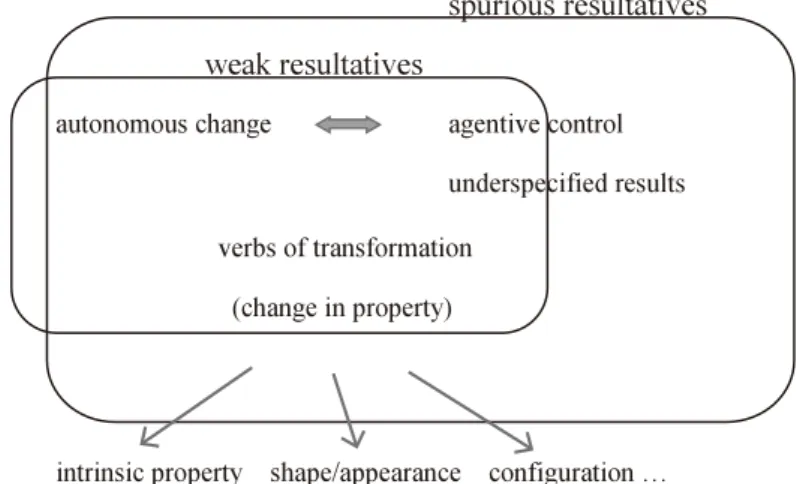
Note that, among verbs of transformation, predication mismatch is typically observed with verbs of changeinconfiguration,whileitisnotoftenthecasewithverbsofchangeinintrinsicproperty.Thisis probably because, unlike the former, the latter verbs do not always involve the loss of physical unity. In this respect, some change of state verbs found in weak resultatives, namely verbs of change in intrinsic property (e.g. break, burn, freeze, melt), are virtually indistinguishable from other verbs of transformation with respect to their choice of the result phrase. Therefore, I propose that verbs in spurious resulatives and weak resultatives can be placed on the continuum of various events of transformation: verbs of change in configurationgenerallyonthesideofphysicallyaffectedunityandverbsofchangeinintrinsicproperty on the other with other types of verb of change (in shape, appearance, etc.) in-between. Based on the conceptual categorization of transformation in Figure 1, the division of labor between the two types of resultatives in describing events of transformation can be schematically represented as follows:
Verbs of transformation generally covers various aspects of change in property, which can be divided into several conceptual subcategories such as intrinsic property, shape/appearance, and configuration. The various types of change in transformation often, if not always, involve the loss of unity in the part of the themeargument,whichcanhaveasignificantreflexinitsfunctionorreferentialidentity.Wheneventsof transformation are realized in resultative constructions, their semantic area is largely shared with two types of resultatives, namely weak resultatives and spurious resultatives, which are related with each other in a cline-likefashionpartlyoverlappingintheircoverageoftheconceptualfieldoftransformation:whilethe former tends to cover autonomous changes, the latter is more likely to deal with changes characterized by agentive control.
Figure 2: Division of labor between weak and spurious resultatives
Although the two types of resultatives have different orientations as to what type of change they most appropriately describe, this difference is also a matter of disposition where quite a few cases fall ambiguously between the two spheres. Thus, in my opinion, spurious resultatives and weak resultatives share the general semantics of the result phrase further specifying the result implied in the verb meaning.
In order to substantiate this idea we still need to clarify how the result phrase actually functions in further specifying the resultant state of transformation. With that in mind, let me digress a while in the next section to see what can be learned from Japanese (spurious) resultatives.
5. The view from Japanese (spurious) resultatives
5.1. A Type shifting analysis of Japanese (spurious) resultatives
In his seminal work on the typology of resultatives, Washio (1997) argues that Japanese has only weak resultatives (and spurious resultatives), but not strong resultatives, while in English both types of resultative are possible. His account of this typological difference is based on a hierarchy of patienthood, formulatedintermsofthestrengthofresultimplicationsinverbsemantics.Iwillnotgointothespecifics of Washio’s analysis of patienthood, but see Beavers (2011) who offers a concise recapitulation of the hierarchy and a possible reinterpretation of it within the affectedness hierarchy proposed by Beavers himself. Since Washio (1997), it has been widely assumed that Japanese is a language which is fairly restricted in its variety of resultative constructions compared to English-type languages with strong resultatives.
However, recent studies in Japanese linguistics (Imoto 2009, Miyakoshi 2009 among others) have cast some doubt on this limited view of resultatives in Japanese, suggesting that there is in fact a broader variety ofresultativeexpressionsthanassumedinthetraditionalliterature,someofwhichareexemplifiedbelow
(adapted from the previous studies including Imoto (2009) and Miyakoshi (2009) with English glossess by the present author.):10, 11
(37) a. Kanojo-ga kami-wo kirei-ni kitta.
She.NOM hair.ACC nicely cut.PAST ‘She cut her hair nice/lovely’
b. Kare-wa negi-wo naname-ni kitta.
He.NOM leek.ACC diagonally cut.PAST ‘He cut the leeks diagonally’
c. Kare-wa negi-wo taira-ni narabeta
He.NOM leek.ACC flat placeinorder.PAST ‘Hearrangedtheleeksflat’
d. Kanojo-wa huusen-wo ookiku hukuramaseta.
She.NOM baloon.ACC big blow.PAST ‘She blew the balloon big/large’
e. Kare-wa sashimi-wo ookiku kitta.
He.NOM rawfish.ACC big cut.PAST ‘Hecuttherawfishbig/large’
f. Ude-ga akaku hareta.
Arm.NOM red swell.PAST ‘My arm swelled red’
Imoto argues that although events in so-called spurious resultatives are typically understood as expressing transformations in which an entity undergoes a significant change to produce a created entity, this interpretationisnotinherentlyspecifiedintheverbalsemantics(since the verbs in question are mostly change of state verbs) but rather an emergent property derived by coercion (Jackendoff 2002, Pustejovsky 1995),morespecifically,typeshifingintheinterpretationoftheobjectnounphrase,asaconsequenceof adding the result phrase to the original verbal event, typically an event of transformation.
Abstracting away theoretical details for present purposes, Imoto’s (2009) analysis of Japanese resultative expressions can be recapitulated as follows:
(38) (A)ThefunctionoftheJapaneseresultphraseisadverbialmodificationtosome(potential)
facet of the verb semantics. Importantly, the categorial distinction between adjectives and adverbs essentially does not matter in the interpretation through type shifting. The result phraseisunderstoodasamodifiertotheverbphrasewithoutbeingpredicatedofahost noun phrase directly.12
(B) Coercion is at work to accommodate semantic incompatibility, when it arises, yielding a meaningful semantic interpretation between the verbal predicate (with its theme argument)
and the result phrase.13 By way of type shifting the result phrase can be semantically linked to a resultant object in a transformation event instead of the syntactically realized object.
More generally, “further specification” in cases like this can be regarded as a dynamic interpretive process of eliciting a relevant facet of events potentially compatible with the verb semantics.
Insomecases,semanticinterpretationutilizesstaticinformationlexicallyspecifiedintheverbmeaning;
in other cases, when the relevant facet of change is not fully predictable from the verb meaning coercion
is invoked to deal with the apparent semantic incompatibility. To illustrate how coercion works in such cases, consider the following examples with ooki-ku, -ku form of the adjective ookii (“big” or “large” in English): 14
(39) a. Kare-ga sashimi-wo ooki-ku kitta
He.NOM rawfish.ACClarge cut.PAST ‘Hecuttherawfishintolargeslices.’
b. Kanojo-ga kabin-wo ooki-ku watta
She.NOM vase.ACC large break.PAST ‘She broke the vase into larger pieces.’
c. Kare-ga te-wo ooki-ku hutta
He.NOM hand.ACC big wave.PAST ‘He waved his hand in a big motion.’
d. Kanojo-ga ooki-ku waratta
She.NOM big smile/laugh.PAST ‘She smiled a big smile/laughed in a loud voice.’
The expression ooki-ku normally refers to the size or volume of an entity in change especially when the effectofchangeisregardedasbeingofsomesignificance.However,whencombinedwithcertainverbs, the verbal activity and the semantics of ooki-ku may fail to fit together in a straightforward way. For example, (39a) cannnot be understood as an act of making something larger by cutting; in (39b), the act of waving his hand does not make it bigger; and in (39c), the act of laughing is not normally understood as involving an entity that becomes bigger as a result. Still, all these examples obtain natural readings:
in (39a), the event of cutting is reanalyzed as a transformation (disassembling) event where each piece of the resultant product can be described as “large” according to some contextual criterion; in (39b), the target of ooki-ku is shifted from the hand itself to its motion/trail; in (39c), without any apparent target ofmodificationbyooki-ku,theeffectofsmilingisconstruedasanabstractproducttobemodifiedina coerced reading.
AccordingtoImoto’stypeshiftinganalysis,“furtherspecification”inJapaneseresultativeexpressionsis regardedasnotjustaugmentingtheresultspecificationoftheverbsemanticswithadditionalinformation but rather prompting constructive process of adjustment in interpreting possible events. In order to achieve semantic coherence, type shifting requires a dynamic reinterpretation of the theme argument, generating different combinations of verbs, objects, and result phrases.
5.2. Adverbial modification as type shifting
I will argue that the basic insight of type shifting analysis of Japanese resultatives by Imoto (2009) can beextendedtoaccountforasignificantpartofelasticinterpretationofspuriousresultativesmoregenerally.
Let us turn again to spurious resultatives in English. We have discussed that English spurious resultatives have two major features when compared to normal resultatives: (A) predication mismatch and (B)
adverbialmodificationbytheresultphrase.Wehavearguedthatpredicationmismatchreflectsthegeneral semantics of events of transformation, mainly characterized by a change of properties such as change in configurationandchangeinshape/appearance,generallydenotinganeventwheretheunityofanentityis affected in some way or other in the process of change. We have also taken a less committed position on adverbialmodification:nosinglecriterionisassumedtodeterminethecategorialstatusofthemodifierifit realizes in a bare “adjective” form. Along this line of thinking, Imoto’s account of Japanese resultatives in which“furtherspecification”playsaconstructiveroleininterpretingeventscanbeextendedtocapturean important facet of predication mismatch in spurious resultatives in English.
As we have seen above, verbs in spurious resultatives, namely verbs of transformation, are often underspecified for their result entailment, tolerating different kinds of result phrase for different event types.Moreover,itisnotalwaysthecasethattheresultphraseisanalyzedasasimplemodificationof the implied result of verbal activities. Consider the following examples, one in Japanese and the other in English:
(40) a. Michi-ga siro-ku kawaita (Imoto 2009: 291)
Road.NOM white dry.PAST ‘The road dried white.’
b. Her breath exploded white.15
In (40a), the drying of the road does not imply a change in color, or for that matter, a change into white.
Likewise, in (40b), the explosion of her breath cannot be inherently linked in the verb semantics to its becoming white. Instead, in each of these examples, the addition of the result phrase white should be seen as an active trigger to derive a transformation event reading (yielding some entity in white). In other words, the reading “x becomes white as a result of x’s drying or exploding” is coerced in the context.
An advantage of the type shifting analysis of those resultatives is that it is not necessary to strictly determine the categorial status of result phrases, since type shifting by coercion is not a syntactic process by nature and the predicative interpretation to be obtained is only a makeshift in semantics involving various pragmatic factors. As one of the characteristic properties of spurious resultatives, it has already beenpointedoutthattheresultphrasefunctionsasadverbialmodificationinsteadoftruepredication.We