The effectiveness of hypnosis for patients with panic disorder (1) : Two case studies
Shinji KAWASHIMA 1) , Masahiko ICHIKI 2) , Shingo ONO 2) , Shigemasa KATAYAMA 3) Shigeru MATSUKI 4) , Makio IIMORI 3)
1) Department of Psychiatry, Tokyo Medical University Hachioji Medical Center
2) Department of Psychiatry, Tokyo Medical University Ibaraki Medical Center
3) Department of Psychiatry, Tokyo Medical University
4) Department of Clinical Psychology, Graduate School of Clinical Psychology, Kagoshima University
Abstract
Hypnosis has been used for treating panic disorder, and the authors have also experienced the cases in which recovery was assisted with use of hypnosis and used imaginal and interoceptive exposure after letting patients experience relaxation under hypnotic state. Also, considering the psychodynamics prominent in panic disorder, we helped patients who were able to verbalize their insight during hypnotherapy recognize their own psychody- namics with use of age regression. Even when patients did not verbalize, utilization of ideomotor activities based on symbolic meanings of the body and the space symbolism, while paying attention to their psychodynamics that pertain to the onset of their illness, seemed effective. In this paper, through the therapeutic courses of two cases with panic disorder, utilization of hypnosis tailored to individual patients and hypnotherapy with psychodynamic perspectives are discussed.
patients themselves showed interest in their own psycho- dynamics.
In this paper, the importance of sensitivity and flexibil- ity to the individual patients’ history of illness, life cycle 9) , expressions before hypnotic induction and reactions to suggestions, and improvisation of hypnotic technique from a psychodynamic perspective, especially age regression and use of ideomotor activities, are discussed.
Methodology 1) Subjects
The subjects of this study were recruited from patients who first visited the department of mental health at a single hospital in the period from December, 1, 2007 to November, 30, 2009, fulfilled the DSM - IV diagnostic criteria of panic disorder, agreed to participate in a randomized placebo - controlled trial of selective serotonin reuptake inhibitor, hypnotherapy and their J. Tokyo Med. Univ., 70 (3) : 341
-350, 2012
Introduction
The treatment guideline for panic disorder issued by American Psychiatric Association tends to disregard psychodynamic perspective 1) . In hypnotherapy for panic disorder and agoraphobia, hypnotic phenomena such as relaxation, age regression, age progression, post- hypnotic suggestion, self - hypnosis are utilized, and the use in adjunct with cognitive - behavioral therapy and psychodynamic therapy have been reported 2
-5) , but the evidence of its therapeutic effectiveness has not yet been established 6)7) . Some argue that the combination of cognitive - behavioral therapy and psychodynamic therapy is suggested 8) , and the authors (Matsuki, Kawashima) have used exposure therapy for patients with panic disor- der or agoraphobia under hypnotic state, and have encountered the cases in which psychodynamic etiology emerged during treatment and the ones in which the
Received February 20, 2012, Accepted June 16, 2012
Key words : Panic disorder, Hypnosis, Psychodynamics, ideomotor, Metaphorical processing
Corresponding author : Shinji Kawashima, Tatemachi 1163, Hachioji City, Tokyo 193
-0998, Japan.
TEL : 042
-665
-5611 (4401) FAX : 042
-665
-5639
( ) 2 combination (unpublished data). Two cases presented here were selected on the basis of presence of apparent psychodynamic involvement to the symptom presenta- tion, which became recognizable during hypnotic treat- ment. The consent was obtained from the patients in regards to publication of the course of their treatment, and details were modified in order to ensure confidential- ity.
2) Pharmacological therapy
Patients who received pharmacological treatment were provided with explanation about the effects, side effects and maintenance of the medication(s), in concordance with the guidelines of the American Psychiatric Associa- tion 1) . Kawashima was in charge of prescription. Two cases represented below received pharmachological treatment.
3) Hypnotherapy Protocol
Hypnotherapy was administered weekly after the ini- tial assessment, with each session lasting for 50 minutes and in the total of 9 sessions. Kawashima was in charge of psychoeducaion about panic disorder prior to introduc- ing to hypnotherapy, explaining the theory, effects, side effects of hypnotherapy, conducting the hypnotherapy and assessment of the illness. Hypnotherapy was administered in the same room as the one used for regu- lar outpatient visits, and the reclining seat was set for the patient.
In principle, in the first session (#1) of hypnotherapy, the patient was induced to let herself go into some relaxed situation after hypnotic induction, and was advised to maintain the comfortable experience of hyp- nosis. In #2 and later, after confirming the condition regarding the use of exposure therapy 10) , the patient was fully exposed to both these images and bodily sensa- tions 11) under hypnosis and then was suggested to relax. When some issues besides symptoms such as insight into psychodynamics were disclosed by the patient, it was dealt with under hypnosis. Spontaneous reactions observed during hypnosis were therapeutically utilized to the best extent possible. When accustomed to hypnosis sufficiently, the patient was taught self - hyp- nosis and was told to exercise it for 5 minutes every day as an assignment.
Hypnotherapy on the basis of psychodynamics and sym- bolic meaning exhibited in ideomotor activities assumed in cases of panic disorder
In recent decades, from the perspective of psychody- namics, the problem of attachment 12) or parental rearing behavior 13) are reported, and a bio - psycho - social model has been suggested as well 14) .
Although attempts to explore psychodynamics by observing ideomotor activities as determined by the ther- apist have been recorded 15)16) , spontaneous ideomotor
activities have not yet been discussed enough. The experiences of the authors (Matsuki, Kawashima) tell that, even when patients do not verbalize their insight, it is frequently possible for the therapist to infer some issues connected with psychodynamics from observed involuntary ideomotor responses. When these responses happen, parents or their equivalent in the patient’s child- hood are assumed by Matsuki’s method below. These two hypotheses are combined in order to explore the con- text in which the patient’s experience lies.
Matsuki 17) , from a perspective of mind - body monism 18) , argues that the mind state is reflected by the body, such as the difference of height of right and left shoulders or unbalanced form of walking or stand- ing. In return, suggestions such as “excess of tension goes away from your shoulders as you exhale” can acti- vate a symbolic process under hypnotic state in which the unconscious mind is predominant. The suggestion
“excess of tension goes away from your shoulders” could be accepted by the patient as the message to “get rid of the load from your shoulders,” a Japanese expression which means “take a load off of your mind”.
Matsuki 17) presented his theory that each finger has its own name and symbolic meaning, and they tend to surface under hypnosis. The unconscious has an aspect that is structured by the sound, that is, “significant” in French 19) . At the same time, “mi - wake structure” 20)21) in Japanese and the literal meaning of the primary metaphor 22) are thought to come up from the unconscious mind (for details, see Discussion). For instance, we all have learned that the thumbs are called “dad finger” and “mom finger,” and that the index finger is used when pointing at an object. The symbolic meanings of the fingers come to the surface under hypnotic state. For example, the ideomotor activities of a thumb and of an index finger that take place autonomously are often thought to sym- bolize a parent or its equivalent and a direction of one’s life, respectively. According to experiences of Matsuki, the thumbs symbolize not only a parent or its equivalent, but also it could be a boss if the patient is male, and activities of the fourth fingers and the little finger may be understood as a reference to assistance and the opposite - sex partner, respectively.
Furthermore, Matsuki 17) supports the space symbol-
ism. Koch 23) has placed the psychological basis of the
space symbolism in Jung and Adler, and the space sym-
bolism owes its beginning to graphology by Clepieux,
Jamin and Klages. According to the space interpreta-
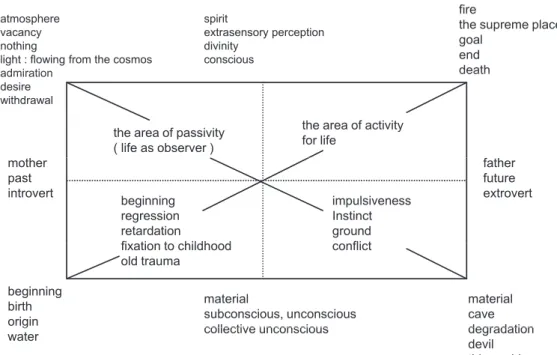
tion by Grünwald (Fig. 1), the left is interpreted as begin-
ning and supposed to express the past, the beginning,
birth, femininity and passivity, and the right is thought to
express the future, the end, death, masculinity and
activity ; the bottom expresses the unconscious, impul-
sivity and material, and the top pertains to the conscious,
rationality and spirit. The space symbolism is widely used in order to interpret the unconscious indicated in projective drawing tests, and Matsuki attempts to apply it to the bodily expressions.
In sum, the following hypotheses are assumed upon administering hypnotherapy : under hypnotic state, (1) the psychodynamics in the patient’s unconscious tends to surface ; (2) the psychodynamics are expressed through the spontaneous ideomotor activities of the body, espe- cially fingers, based on the symbolic meanings ; and (3) according to the space symbolism, ideomotor activities of the left fingers and right fingers are respectively thought to stand for the past and the future.
Results
Thirty - one patients visited the hospital during the study period, 8 of whom agreed to participate in the clini- cal trial, 7 entered the hypnotherapy and 6 implied psy- chodynamic influences on their symptom presenta- tion. Presented here are two cases that demonstrated recovery and verbalized their psychodynamics. The year X is used here to indicate the year in which they were first seen. The Case 1 had the DSM - IV diagnosis of panic disorder, and the Case 2 had panic disorder with agoraphobia.
<Case 1> Female, in her late 40s at her first visit.
Family history : The oldest of three siblings.
Psychiatric familial factors : Her father had dementia.
Medical history : No major illness.
Life history : Born and raised in the Kanto area. Her father was an office worker, her mother was a house- wife. After high school the patient had a clerical job,
and upon marriage she stopped working and had a son. Recently she had another job at a company that mainly performed chemical analysis, and currently lives with her husband.
History of current illness : In the year of X - 25 she developed insomnia immediately after her uncle’s death, and in addition developed panic attacks with palpitation, sweating, dyspnea, dizziness, and hot flushes, which remitted naturally in two weeks. In the year of X - 10 her mother suffered from cerebral infarction, and in the year of X - 5 her parents’ debt and her father’s dementia led to panic attacks which occurred once or twice per month. The panic symptoms were effectively treated with sleeping pills that were prescribed at a local clinic. In January of the year X she experienced several panic attacks per week and also had nightmares after her coworker mishandled dangerous chemicals. She came to department of mental health at the hospital, requesting non - pharmacological treatment.
Observation at first assessment : She was short and medium - built, appeared polite and sincere, smiled occa- sionally and spoke in a logical manner. She talked about the large amount of loan which her parents co - signed for their friend with expression of regret, and she attributed her own panic disorder to her father’s demen- tia. She exhibited anticipatory anxiety, but did not develop agoraphobia. Hypnotherapy was started with complementary use of paroxetine 10mg per day.
Course of hypnotherapy : #1 : She arrived on time, which implied her high expectation for hypnosis. The patient appeared cooperative but her facial expression and her voice seemed to lack energy. Since it was her
spirit
extrasensory perception divinity
conscious
fire the supreme place goal end
death atmosphere
vacancy nothing
light : flowing from the cosmos
admiration death
admiration desire withdrawal
the area of activity for life
the area of passivity ( life as observer ) mother
past introvert
father future extrovert beginning
regression retardation
fi ti t hildh d
impulsiveness Instinct ground fli t
material cave degradation beginning
birth origin
material
subconscious, unconscious collective unconscious fixation to childhood
old trauma conflict
degradation devil this world
water g collective unconscious
Fig. 1 Grünwald's space-symbolism schema 23)
( ) 4 first experience of hypnosis, she was asked to leave everything to the therapist, and naturalistic induction 24) was chosen. Her breath was smoothly stabilized and she appeared relaxed. The patient told that she saw “an ocean which reminds me of Okinawa.” The therapist suggested that she could see the ocean, the soft and ten- der sunshine can be felt on the body, the sea breeze gen- tly stokes her body, and the continuous sound of waves reaches to her ears, to which the patient nodded. The patient was given a posthypnotic suggestion 2) that she could retrieve this experience whenever she would like to, and after counting five hypnosis was lifted.
The patient smiled and mentioned that she felt refreshed, but the image she experienced was that of her mother’s attempt to commit suicide by entering an ocean with her brother on her mother’s back and the patient herself. She stated that she was reminded of the inci- dent probably because her mother’s cerebral infarction and her father’s dementia worsened her panic disor- der. The therapist showed empathy toward her experi- ence, and gave an assuring interpretation that it happened because the patient was getting ready to straight out the burden in her mind.
#2 : The patient appeared cheerful and confident with increased gestures of both hands, and gave an energetic impression which was absent in our first session. The patient stated that she could not accept her father’s dementia but she had come to be able to face her parents’
situation. The therapist and the patient agreed to work on her issue with her parents.
Because of the context of the treatment, namely “to face the parents,” hypnotic suggestion with the magnet hand induction 16) was chosen. Verbally the therapist suggested that “both hands face each other” and “the right hand and the left hand attracts each other,” thereby effectively inserting the phrase of “face”, “each other” in the suggestions and implying the meaning of “face the parents” while talking about the hands’ ideomotor activi- ties. The patient promptly closed her eyes. Her hands responded to the suggestion, and the finger tips of both hands began to touch each other in turn. The therapist then asked whether the hands would be left touched closely or left with some space in between. The patient left her palms untouched, and put them on her lap in the same figure. The therapist suggested that the hands would touch each other and exchange messages, that something that could not be produced by one hand would be produced between the hands, that the patient would receive it without hesitation, and the patient would listen to the messages sent by the body. The patient was given some time and then asked about the experience, and she answered, “I had thought I was alone, but the body told me that ‘I’m watching over you,” and I could feel my body” with her eyes closed.
After being awakened from hypnosis, the patient opened her eyes, and told that she felt good, that she could hear the message “I’m here for you” from her body, and that she realized that her mind ran so fast that her body could not catch up.
#3 : The patient appeared calm and told that she had not had panic attacks since her last visit. She said that a fear of death was provoked when she had an attack dur- ing her sleep, stating that “I get scared even though I know I’m not dying. The peak of anxiety passes by when I can tell myself that it would be okay even if I died.”
While the therapist was talking to the patient, he attempted conversation induction 9) , and she regressed to the point where she experienced her past experience of panic. She had the image that she was in the bathroom of her workplace and waiting for the attack to pass by without having anyone notice. The therapist responded by suggesting that she should be able to control the panic well, and as she could think that “it would be okay even if I died” the panic would weaken. After terminating hypnosis, the patient stated that “I should be able to stay calm and deal with panic attacks when I have them.”
#4 : The patient told that she could drive on a high- way, that she had a few incidents of palpitation which did not develop into major attacks, and that she was okay when she visited her office from which she was tempo- rarily taking a leave. We decided to start the exposure treatment with images of the accident in which her for- mer colleague mishandled a chemical, resulting in a small fire.
She was induced with arm drop technique 2)16) with her right arm, and as the therapist repeatedly used the word
“fit” as in “your right hand would fit where it fits,” her right hand was placed on her right lap. Her right shoul- der was noticeably higher than her left one. The thera- pist repeatedly suggested that as she exhaled the exces- sive tension would go away from her shoulders, which successfully resulted in a balanced height of her shoul- ders. Later she had an image of her workplace with toxic compounds in a bucket, so in order to facilitate exposure the therapist suggested that the worst idea came to her and she got tense. She seemed to have experi- enced exposure well. After hypnosis was terminated, the patient stated that she had had an overwhelming sense of responsibility and she was convinced that she would not have to take care of everything.
#5 : She showed many smiles, and despite occasional palpitations she appeared confident about herself. The therapist taught her self - hypnosis, and then administered exposure treatment.
#6 : She seemed to be suffering slightly, and stated
that she might be able to make the psychological origin
of her panic disorder clear. The therapist and the patient
agreed to explore the source of her panic symptoms with use of hypnosis.
The therapist induced her by telling her that she would be holding a big crystal ball 25) and she would be gazing at it (i.e. eye fixation induction 2)24) ). She soon closed her eyes. After the therapist suggested that some image would come up in the crystal ball in her hands so that she could regress to some significant memory, she told that her parents were not on good terms and she had to hold everything within herself all the time, and what had scared her most was not the fear of death per se but the fact that her husband had to call an ambulance. The therapist then asked her to go into the crystal ball, tell her child self what her current self could tell and do what her current self could do for her child self. The therapist also suggested that her child self would be really con- nected with her current self and her future self. Upon termination the patient cried, and verbalized her newly gained insight and emotion. The therapist appreciated her long - standing attentiveness to people around her, and she said “I will try to rely on people more.”
#7 : She seemed to be rather unhappy, and told that she was not sure about the decision which she had made to put her father in an institution. On the other hand, she felt supported by the words of her father’s doctor that
“what matters is how you will be able to let your father go the day he has to leave.” The therapist showed empa- thy, and agreed with the patient that the objective for the day would be to accept the words of her father’s doctor whole - heartedly.
After induction by the relaxation method 2)24) , age pro- gression 2) to the day of her father’s death was facili- tated. The therapist suggested that there had been things the patient could and could not do for her father, which was inevitable because she had had her own fam- ily, and that she had done her best in every situa- tion. The patient cried and frequently nodded. Fur- thermore, the therapist conveyed a message that her decision should be supported, even though it was an extremely difficult decision, to which she nodded as well. After hypnosis she mentioned that for years it had been difficult for her to accept her father’s dementia, she had been angry at him, and at the same time she had struggled to protect her own family. She looked ready to accept her father as he was with help of his doctor’s words.
#8 : Panic attacks had disappeared by this point. As she had schedule to return to work soon in April, she was age - progressed to that day and successfully experienced rehearsal.
#9 : She told that the three months in which she was taking a leave had been rather unstable, especially with her father entering the institution, but the past week has been very relaxing. Given that it was her last session,
she was encouraged to make use of an image where she was walking along the shore, occasionally looking back to confirm her foot prints, thereby reflecting on the out- come of the treatment through the symbolic process 2) . [Summary of Case 1] The emergence of her symp- toms dates back to 25 years ago, which soon amelio- rated. Deterioration of the symptoms can be attributed to her mother’s cerebral infarction 10 years ago, her father’s dementia 5 years ago, her parents’ debt, and the episode at her workplace, all of which together brought her to the hospital. She returned to work upon termina- tion of her hypnotherapy.
In #2, the message “I’m watching over you” from her own body can be understood as a voice of her ego state 2) which intended to help herself. The magnet hand induc- tion 2)16) was selected in order to support the context in which “the patient face her parents,” and further more it was expected that “mind and body” face each other and adjust to each other’s pace, and consequently that multi- ple messages 26) would be conveyed. The suggestion seemed to have been accepted, considering the patient’s report that “I could hear the message from my body that
‘I’m watching over you’.”
In #4 the right arm drop induction was selected accord- ing to the space - symbolism theory in which the right side is supposed to stand for the future, and the indirect sug- gestion that “the future would calm down” was expected to be effective. Expressions such as “excessive tension in the shoulder” and “release of tension from the shoul- der” respectively mean “get involved in something too much” and “be relaxed about the situation.” By the same token, assuming that under hypnosis the correlation between mind and body becomes recognizable, it can be expected that relaxation of the body leads to relaxation of the mind. Then fixing the balance of shoulders was expected to help with the balance of the patient’s mind.
In #6, the patient’s current self helping her child self was expected to be doubly therapeutic, in a sense that the ego state in her childhood would be healed and also that her current ego state would recover her self - efficacy through helping her child self.
In #7, when the patient spoke of the words of her father’s doctor, it was expected that age progression would be productive. Age progression is a progressive experience of the future, but in fact it is a projection of the feelings that the current self has.
<Case 2> Female, in her early 20s at her first visit.
Family history : The first of two siblings.
Psychiatric familial factors : Her mother suffered from depression, and her younger brother panic disorder.
Life history : Born and raised in the Kanto area.
Father was an office worker, mother was a housewife.
Went to a local high school and then moved onto an
occupational school related to medicine. Later became
( ) a nursing staff. Currently lives with her parents, grand- parents and brother.
History of current illness : Since the summer of X - 1 she felt her nursing job was stressful. In May of the year X her mother was suspected to suffer from angina, and she felt pressure that “I have to do something about it,” and in June panic symptoms such as palpitations, dif- ficulty in breathing, discomfort in the chest, nausea, diar- rhea and fear of death which were often treated at an emergency unit, but no abnormality was found according to medical tests. Later she developed anticipatory anxi- ety and agoraphobia, which forced her to be absent from work. She quit her job for the reason that she did not want to cause trouble to her coworkers. In July of the year X she was first seen at the hospital.
Observation at first assessment : She was short and medium - built, appeared innocent and lovable. She started hypnotherapy with 25 mg sertraline per day.
Course of hypnotherapy : #1 : After induction into a hypnotic state with the right arm drop induction, the ther- apist suggested that the place to relax would appear in the back of the eyelids. The patient had an image of “an ocean in Okinawa”, and the therapist encouraged the patient to explore the image and gain a full experience of it. #2 : During the past week since her last visit, the patient had 2 panic attacks and 4 occasions of limited - symptom attacks. When discussing the objective for the session, the patient stated that “I’d like to be able to do chores even when I’m tired because I have to,” with which the therapist disagreed, explaining that she should be resting when she felt tired. We finally agreed to con- duct exposure therapy by using age regression to the moment of an attack. The therapist communicated that her head seemed to be running too fast, leaving her body behind. The patient generally agreed. The magnet hand induction was attempted but the patients’ hands would not get any closer, so the therapist told that, while pacing 27) with her hands, it was not necessary to get her hands to touch right now, and sometimes it might be nec- essary to keep a distance. A story of two hedgehogs that kept each other warm with a distance not too short or long was provided. Then the patient seemed to let her fingers relax, and their tips touched each other. Later she responded to the suggestion to close her eyes, and her fingers stopped moving with the tips in touch but with some space left between her palms. In order to make use of this posture, the therapist suggested that sometimes a certain distance is important. Then the patient’s hands separated, and the right hand and left hand were placed on her right and left lap respectively.
Then the patient’s right and left thumbs showed ideo- motor activities 2)15)16) spontaneously. The therapist helped the patient notice her ideomotor activities by
pointing out that her both hands were touching some- thing new. Furthermore, the therapist suggested that the right and left hands had different roles, and that the peo- ple who had been looking after her would continue to do so in the future as well, before terminating hypno- sis. When the patient opened her eyes, she stated with a smile that “I was in hypnosis before I noticed.”, and expressed surprise.
#3 : The patient’s facial expression and clothes both gave a positive impression. She seemed well, and she spoke of her parents’ quarrels with a relaxed facial expression. The objective for the session was set to improve the current state even slightly. The magnet hand technique was chosen again. With attention to her relationship to her parents, multilevel suggestions were given while her hands continued to close and open alter- nately. The session progressed more or less like #2.
#4 : The patient claimed that she was doing better, but also stated that her panic disorder seemed to have some- thing to do with her ex - boyfriend who had committed suicide. She felt responsible for his suicide and expressed willingness to see him again if possible. The therapist decided to help her with age regression so that she would be able to see him in her image. After induc- ing into hypnosis by the left arm drop method, the patient said that she was seeing the man in a place like a church. The therapist repeatedly encouraged her to communicate all of her feelings to him and also to receive messages from him. The patient reported that “I could feel that he was pushing my back.” After hypnosis she mentioned that “I could see things which I didn’t before. I feel better with my feelings.”
#5 : The patient’s grandfather passed away and since then she had had nightmares. She reported that she had been afraid of the dark since the age of 4, which was associated with her memory of being often scolded and slapped by her father. After the therapist insisted that it would be important and beneficial for her to face them, the patient agreed to re - experience them under hypno- sis. After induction of hypnosis with the left arm drop method, as she expected the patient was age - regressed to age 4. As she had an image of her mother and grand- parents getting into a fight, the therapist said that it must be hard to see beloved ones fight against each other and feel powerless. The patient nodded to the therapist’s words and tears welled up in her eyes. After a while the therapist asked her whether there would be anything she could say or do for the 4 year - old self, and later the patient reported that the message from the current self to the 4 year - old self was conveyed. After termination the patient reported that “I got scolded by father often, but sometimes there were reasons,” which implied that she could gain a new perspective on her father.
#6 : Limited - symptom attacks occurred 5 times dur-
6
ing the past week, but she could spend the night time peacefully. As she had a plan to travel to a hot spring with her friend, exposure therapy was administered in order to rehearse the situation.
#7 : The patient reported that she had been busy with housework and events, and her father and partner com- mented that she was working too hard. The therapist advised that she should try to slow down and adjust to her body’s pace so that her own evaluation of herself would match that of her father and partner, and then induced to hypnosis with the magnet hand tech- nique. Her hands came closer as suggested and then touched to each other, and then they were placed on her lap with the palms upward and layered. As in #2 of the Case 1, suggestions about contact and cooperation of both hands were given, followed by ideomotor activities of her thumbs and index fingers. The patient was encouraged to pay attention to the ideomotor activi- ties. When hypnosis was lifted the patient told that the area around her chest and neck felt relaxed with a fresh expression of surprise.
#8 : The patient successfully completed the trip to the hot spring, which was discussed in #6. The patient was taught self - hypnosis.
#9 : As it was the last session, the patient expressed anxiety about completion of hypnotherapy and possible deterioration of her symptoms. The therapist attempted to arrange the hypnotherapy so that she would be able to receive the message that in the future things would grad- ually settle down. The therapist induced her into hyp- nosis with her right hand dropped, and after giving sug- gestions such as “at your own pace” and “things will settle down as they should,” further suggestions were given to convince her that her learning experience would lead her to the future as a river would reach the ocean.
[Summary of Case 2] The patient is suspected to have developed her symptoms due to the stress at work and her mother’s angina (not confirmed). Over the course of hypnotherapy her psychodynamic factors from her childhood came to the light, and despite the occa- sional symptom - limited attacks, she was able to maintain her routine. A few months after the completion of the hypnotherapy, she was able to open her own business for foot massage therapy.
Discussion
1) Hypnotherapy from the perspective of cooper- ative hypnosis
Cooperative hypnosis follows the principle of utiliza- tion, and the therapist is advised to pay attention to the patient’s perceived burden upon hypnotic induction and suggestions. Matsuki 28) used the arm drop technique for a patient with stuttering, and argued that the use of invol- untary muscles responsible for stuttering could be seen in
parallel with the involuntary downward movement of the arm, that the message that “involuntary muscles would involuntarily function well enough” would be conveyed, and that the experience of moving the arm downward smoothly led to the recovery from stuttering. As such, when the arm drop method is utilized to induce the patient into hypnosis, rather than “forcing the patient to drop his or her arm,” the therapist should aim to “observe the way the patient moves his or her arm, discover the symbolic meaning in parallel with symptoms, give sug- gestions in accordance with the movement of the arm, and to facilitate the patient’s realization.” Thus, upon administering the magnet hand technique, rather than forcing the patients to have their hands get close, sugges- tions were given so that the hidden meaning behind her hands’ movement would be recognized 17)28) .
In therapy everything is utilized from what the patient had already acquired, his or her words during the session, his or her body language, and his or her psychological readiness for recovery. The therapist accordingly tried to maintain empathy with the patients’ experience, and also to cooperate with the patient whenever the patient appeared to verbalize something. Examples of the effectively utilized comments and personal experiences are seen in a comment such as “it’s okay even if I died (Case 1, #3),” words of the doctor of the patient’s father (Case 1, #7), and the relationship with the deceased part- ner (Case 2, #4) and friend (Case 2, #6, 8). Patients’
individual and unique responses, like spontaneous hands’
movement, were tried to be utilized as many as possible for both of the patients.
2) Psychodynamic use of hypnotherapy and ideo- motor activities
The use of ideomotor activities by Matsuki as indi- cated in the methodology section is discussed below.
Matsuki adopted the mind - body theories by Merleau - Ponty 18) , Ichikawa 20) and Maruyama 21) , and the cognitive - unconscious theory by Lakoff et al 22) , and has practiced hypnotherapy from the perspective of the mind - body monism. Merleau - Ponty, from the perspective of
“intercorporeity,” pointed out that an objective being without a body is impossible. Our body, since birth, repeats trials and errors and consciously accumulates the learning experiences of body manipulation from walking to handling things, which, as complete acquisition is achieved, cease to be recognized and ultimately sink in the unconscious.
Body language can be seen as accumulated experi-
ences of body manipulation whose beginning dates back
to a point prior to language acquisition. In other words,
body language serves as a metaphor of its owner’s life
history. An infant does not experience him or herself as
distinct from the external world at birth, but experiences
of not getting fed from the mother as he or she wishes, or
( ) not being held comfortably for example helps him or her to gradually recognize the external world. There is an intimate relationship between bodily and linguistic devel- opment. Lacan 19) argued that an infant would come to recognize its own self as well as the external world 6 to 18 months after birth and called this period the mirror stage. He thought that recognition of the external world served a beginning of language acquisition, and a child would start to learn language rapidly. Also, Lacan believed that the unconscious consisted of the sound that meant a certain object (i.e. significant), rather than the object itself to be referred to by the sound (i.e. sig- nify). His conceptualization is incomplete in a sense that the unconscious has modalities other than auditory means, but it contains a critical aspect of the uncon- scious. For example, the word “kaji” (the sound, i.e.
significance) in Japanese is associated with “fire”,
“blacksmith” and “domestic chore” (the meaning, i.e.
signify), not because of the relationships between their meanings but simply because they share the same pronunciation. As such, words that share their signifi- cance often subtly activate multiple meanings and con- texts 17) .
An infant experiences the world mainly through the body, and as he or she accumulates the experiences the perceived world gets differentiated. In other words, the infant grasps the world through the body. Intercorpore- ity is conspicuous in infants, but understanding of the world based on bodily experiences does not cease even after language acquisition. Ichikawa 20) and Maruyama 21) called the cognitive structure of differentiation of the world through the body “mi - wake structure” and that through the language “koto - wake structure.” The word
“mi” “koto” “wake” in Japanese means body, language and function of differentiation, respectively.
Furthermore, Lakoff et al. 22) introduced the concept of
“cognitive unconscious,” and argued that the human expression is mostly based on the primary metaphor which assumes the body. The cognitive unconscious refers to the state in which most of thinking is executed in the unconscious. Primary metaphors can be seen realms that range from the space (“he is on the edge of fear”), time (“I cannot face the future”), action (“she got over the hardship”) to mind (“his idea does not have its feet on the ground”). Over the process of human devel- opment they become intertwined to compose complex metaphors, which helps to master our daily and collo- quial expressions.
The recognition of the world which initially begins with “mi - wake structure” and primary metaphor passes the mirror stage and then moves onto “koto - wake struc- ture” and complex metaphor, ultimately sinking into the unconscious. Under hypnosis one gets closer to the unconscious, and consequently closer to the attribution
of meaning according to “mi - wake structure” and pri- mary metaphor.
Erickson 29) , when once treating a patient with a malig- nant tumor, chose tomatoes as a familiar topic and uti- lized suggestions with words such as “comfortable”
“curiosity” “peace” “good feelings” in order to alleviate pain, and called it interspersal technique. The author, upon inducing into hypnosis, suggested that the hands would go “down” onto the lap while the arm drop method and that the hands were “cooperating” during the magnet hand technique 2)16), . The effectiveness of this technique can be attributed to the fact that the uncon- scious consists of what means the object (i.e.
significance=the sound) rather than what is meant by the word (i.e. signify=the content), which in cognitive sci- ence is called prime effect 30) .
Panic disorder and agoraphobia have been long thought to have a psychodynamic basis. Age regression and ideomotor activities were used in Case 1 in order to promote further insight as the patient exhibited a fair capacity for insight even before hypnosis.
In Case 2, not only was age regression utilized in order to help the patient get the insight, but also the context of the patient’s experience which was not directly observ- able was explored more skillfully than that of Case 1.
Since the unconscious mind is more dominant than the conscious under hypnotic state, the repressed emotions and meanings symbolized by the spontaneous ideomotor activities of the hands and fingers and by the space would be expected to come to surface at the same time. In #2, 3 and 5, when the ideomotor activity of both thumbs hap- pened involuntarily the patient was suggested that “the ones that had helped you would continue to do so in the future”, and when that of index fingers happened she was suggested that “the path that had been taken would lead you to the path ahead of you,” on an assumption that connecting the movement of the right and left hands would be effective. We aim to accumulate more verbal evidence in the future as we gain more experiences.
3) Ego state therapy 2)
In Case 1 and 2 both, their child self at their childhood emerged during age regression. This was understood as a rather premature state in which the unresolved issues were left in the unconscious, or another ego state which had been dissociated from their current self. The deceased partner that emerged in Case 2 appeared as another person, but indeed he was a projection of the patient’s own perspective, which had been disowned by the patient’s current ego state. To provide the immature ego state with a perspective of the current ego state and to have the perspective of someone who once supported one’s self support one’s current ego state again can be conceptualized as self - healing, and expected to increase the sense of self - efficacy.
8
Summary
1) The use of hypnosis for two cases of panic disor- der was discussed from a psychodynamic perspective.
2) Hypnotherapy has been practiced for patients with panic disorder, and the authors’ experiences supported that hypnotherapy was effective in symptom reduction.
3) Upon practicing hypnosis on patients, the thera- pists attempted to make use of the individuality of each patient for the therapy. It was shown to be important that the therapist remain sensitive and flexible to the patient’s state and needs throughout the hypnotherapy.
4) When treating patients with panic disorder, the authors experienced that often the patients themselves verbalized about their psychodynamic background, their psychodynamics were inferred from the ideomotor activ- ities of their hands and fingers, and their ego states came to the surface. It seemed to be therapeutic to administer hypnotherapy as incorporating the patient’s readiness and reactions into treatment.
Acknowledgements
The authors wish to thank Dr. Noboru Takaishi, Takai- shi Clinic, for his review of this manuscript and helpful suggestions. The authors are indebted to Dr. Chihiro Matsumoto, Department of Psychiatry of Tokyo Medical University, for her English assistance.
Reference
1) American Psychiatric Association : Practice guide- line for treatment of patients with panic disorder, 1998
2) Brown DP, Fromm Erika : Hypnotherapy and hypno- analysis. Lawrence Erlbaum Associates, Publishers, Hillsdale, London, 1986
3) Tilton P : Pseudo
-orientation in time in the treatment of agoraphobia. Am J Clin Hypn 25 : 267
-269, 1983
4) Bodden JL : Accessing state
-bound memories in the treatment of phobias : Two case studies. Am J Clin Hypn 34 : 24
-28, 1991
5) Schoenberger NE : Research on hypnosis as an adjunctive
-behavioral psychotherapy. Int J Clin Exp Hypn 48 : 154
-169, 2000
6) van Dyck R, Spinohoven P : Does preference for type of treatment matter ? : A study of exposure in vivo with or without hypnosis in the treatment of panic disorder with agoraphobia. Behav Modif 21 : 172
-186, 1997
7) Chambless DL, Ollendick TH : Empirically sup- ported psychological interventions : Controversies and evidence. Annu Rev Psychol 52 : 685
-716, 2001
8) Goldberg C : Cognitive process in panic disorder : An extension of current models. Psychol Rep
88 : 139
-159, 2001
9) Haley J : Uncommon therapy : The psychiatric tech- niques of Milton H Erickson MD. W.W. Norton and Company, Inc., New York, 1973
10) Andrews G, Creamer M, Crino R, Hunt C, Lampe L, Page A : The treatment of anxiety disorder (1) : Clinical guides and patient manuals. Cam- bridge University Press, 2002
11) Lee K, Noda Y, Nakano Y, Ogawa S, Kinoshita Y, Funayama T, Furukawa TA : Interoceptive hypersen- sitivity and interoceptive exposure in patients with panic disorder : Specificity and effectiveness. BMC P s y c h i a t r y 6 . 2 0 0 6 A u g 1 6 ; 6 : 3 2 d o i : 10.1186/1471
-244X
-6
-32
12) Frances A, Dunn P : The attachment
-autonomy con- flict in agoraphobia. Int J Psychoanal 56 : 435
-439, 1975
13) Someya T, Kitamura H, Uehara T, Sakado K, Kaiya H, Sin WT, Takahashi S : Panic disorder and perceived parental rearing behavior investigated by the Japanese version of the EMBU scale. Depress Anxiety 11 : 158
-162, 2000
14) Shear MK, Cooper AM, Klerman GL, Busch FN, Shapiro T : A psychodynamic model of panic disor- der. Am J Psychiatry 150 : 859
-866, 1993
15) Walsh BJ : Goldfinger : A framework for resolving affect using ideomotor questioning. Am J Clin Hypn 40 : 349
-359, 1997
16) Rossi EL : The symptom path to enlightenment : The new dynamics of self
-organization in hypnothe- rapy : An advanced manual for beginners. Palisades Gateway Publishing, Pacific Palisades, 1996
17) Kawashima S : The possibilities of hypnotherapy for panic disorder and agoraphobia : from the perspective of psychodynamics and neuroanatomy. (In Japanese) Jpn J Clin Hypn 11 : 28
-32, 2010 18) Merleau
-Ponty M : Le Visible et l'invisible : suivi de
notes de travail. Editions Gallimard, Paris, 1964 19) Lacan J : Ecrits. Editions du Seuil. 1966
20) Ichikawa H : The structure of “Mi”. (In Japanese) Koudan
-Sya, Publisher, Tokyo, 1993
21) Maruyama K : Life and Surplus. (In Japanese) Kawade
-Syobou, Publisher, Tokyo, 1987
22) Lakoff G, Johnson M : Philosophy in the flesh : The embodied mind and its challenge to western thought. Basic Books, New York, 1999
23) Koch K : Der Baumtest. Verlauf Hans Huber, Ber- lin, 1949
24) Hammond DC : Hypnotic induction & suggestion, revised. American Society of Clinical Hypnosis, Chicago, 1998
25) Erickson MH : Hypnotic approaches to ther- apy. Am J Clin Hypn 20 : 20
-35, 1977
26) Zeig JK : Teaching seminar with Milton H. Erickson.
The Milton H. Erickson Foundation, Phoenix, 1980 27) Bandler, R, Grinder, J : Patterns of the hypnotic tech-
niques of Milton H. Erickson, M.D., Vol. 1. Meta
( ) Publications, Cupertino, California, 1975
28) Matsuki S : The device for hypnotherapy : Utilization of trance as “therapeutic space”. The device for well
-done psychotherapy. (In Japanese) (Eds) Inui Y, Miyata K, Kongou
-Syuppan, Publisher, Tokyo, 175
-186. 2009
29) Erickson MH : The interspersal hypnotic technique
パニック障害に対する催眠療法の効果(1) : 2 症例の検討
川 嶋 新 二 1) 市 来 真 彦 2) 小 野 真 吾 2) 片 山 成 仁 3) 松 木 繁 4) 飯 森 眞喜雄 3)
1)
東京医科大学八王子医療センターメンタルヘルス科2)
東京医科大学茨城医療センターメンタルヘルス科3)
東京医科大学精神医学講座4)
鹿児島大学大学院臨床心理学研究科【要旨】 以前からパニック障害に対して催眠が利用されてきたが、筆者も催眠療法により回復していく症例を経 験し、一般に催眠状態下でリラクセーションを体験させた後にイメージ曝露を行ってきた。一方で精神力動を考慮し、
催眠療法の経過中に洞察について言語化する症例には年齢退行などを利用して精神力動への気付きを援助すること が治療的であった。また患者が言語化しなくても、発症のベースの精神力動を推察しつつ、特に身体の象徴的な意 味や空間象徴論をベースにして観念運動を利用していくことが有効と考えられた。本稿ではパニック障害の
2
症例 の治療経過を通して、症例に合わせた催眠の利用と、精神力動的な視点からの催眠療法について考察する。〈キーワード〉 パニック障害、催眠、精神力動、観念運動、象徴的・隠喩的プロセス