The Japanese Psychonomic Society
NII-Electronic Library Service
The JapanesePsychonomic Society
eneJmpanesefournatof Rs'.vchmtomicScience
2006,VoL 25,No.1,107-10S
Summaryof
Awarded
PresentationIP23
The
effect
of
haptic
information
on
vision
-Using
geometrical
patterns
with and withoutvisual
illusion-Keiko
OMoRI*i
**,Yuji
WADA***,
Yukio
ITsuKusHIMA*,
andKaoru
NoGucm*
Nihon
Uhiversit),*,
JaPan
Society
for
thePromotionof
Science**,
and IVdtionalFood Researchinstitute***
We investigated the effect of
haptic
information on visualillusions
and the appearance efsimple geometrical patterns without
figural
components which induce visualillusions,
ment
I
wasdesigned
to
examine the effect of haptic information on the visual illusionsof theHering and
Wundt
figures, The haptic stimuli with three differentcurvatures were made ofwooden board, The participants were asked to
judge
the apparent curvature of each testfigure,with or without
the
haptic stimuli,In
Experiment
II,the
participantsjudged
the apparentcurvature of each testfigurebut cornponents
inducing
visual illusions,with or without thehapticstimuli. Itwas
found
thatthe visual illusionswere biasedtowards thedirection
of the informationgiven by actively touching the
haptic
stimuli and thaL the visual perception of simple patternswithout any
inducing
components was not affected by actively touching.Key words: multisensory perception,haptic information,visual
illusion
Vision
provides perceptual properties such as $hapq size,and texturewhen we recognize an object.Simultaneously, we are able toknow the properties
'
of an object by touch. A question to
be
answered ishow
we organizeinformation'
from
thedifferent
sen-sory modalities, vision and touch, when we perceivean object, Ithas
been
demonstrated
that vision isgenerpllydominant over theother modalities
jn
inte-gration
of multisensory information(Rock
&
Harris,
1967),while a
few
case of haptic capture wasre-ported
(Ernst
&
Banks,
2002;
Gallace
&Spence,
2005). However, there exists strong evidence that
haptic
information
plays an important rolein
the people with restored sight(Torii
& Mochizuki,1992).
In the present study, we
investigated
the effect ofhaptie
information
on visualillusions,
and simplegeometrical patterns without figuralcomponents
in-ducing visual
illusions.
* Department of
Psychology,
GraduateSchool
of Literature and Social Sciences, Nihon
University,
3-25-40
Sakurajosui,
ku, Tokyo 156-8550
**
Research
Fellow ofJapan
Society
for the
Promotion
of Science,8Ichiban-cho,
ku,
Tokyo
102-8472***
National
AgricuLture
and FoodResearch
Organization,
2-1-12 KannodaL Tsukuba,Ibaraki305-1684
Experiment
I
Method
Participants
Seven
students who had normaltouch and vision participated
in
the experiment.
Apparatus
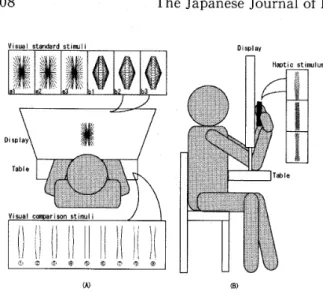
and Materials The visual standard stimuli were visual illusions,the Hering andWundt
figures.InFigure
1A,
each of thetwo vertical linesinthesevisual standard stimuli was physicallyconvex,
parallel,and concave lines.The visual comparison
stimuli consisted ofnine pairsof vertical lineswhich
changed incurvature
from
convex to concave lines(Figure
IA). Haptic stimuli were three differentshapes
(convex,
parallel,and concave) rnade ofwooden
board
(Figure
IB).Procedure
The
participants selected one of thevisual comparison stirnuli which seemed
to
matchthe vertical linesin the visual standard stimulus,
The
standard stimulus was presented on the displayina random order with or without haptic stirnulus
(Figure
1).
Results
and Discussion
The
participants'judgments
of the degrees ofap-parent curvature were expressed
in'terms
of PSEs.When an appar,ent curvature was
judged
asbeing
parallel
{the
comparion stimulus(D)
the PSE wasdesignated
as zero. The PSEs were positivevaluesThe Japanese Psychonomic Society
NII-Electronic Library Service
The JapanesePsychonomic Society
108
The
Japanese
Journal
ofPsychonomic
Science
VoL 25,No. 1Visual Etand-rd stitrul1
:1,1",,・1tttt/ttt・・1・za,'IEl,"'//-li"ttt/e
t/tttt/"''t'tt/.tti':t.tttttt.tL','
/epleyee
Teble Vlsual mi.t/.ca..ttttantttttttt.t..
rieonetithulit/t
ig,,.n.Ili,II'lll"li
t・l"-i,l#.:・;・l-1//・il・11/:1,1,l-lttt(.ml(.Iii)
,t,g,;-/#tal
ltlre,:l;1('ii)/1la.e OlspleweptioGtimulus Eble c" e)Figure
1.(A)
Front view{B)
Side
view,from 4to 1when the
judgment
was ranging fromthe
comparison stimuli
O
to@
respectively; and thePSEs were negative values
from
-1
to-4
when thejudgrnent
was rangingfrom
thecomparison stimuli(Q)
to(SD
respectively. To testtheeffect ef the hapticinformation
on thevisual illusion,thePSEsfor
each apparent curvature in the visualillusion
wereana-lyzed using a two-way ANOVA with visual illusions
and
haptie
information
(convex,
parallel,concave,and nonhaptic information) as main
factors,
Theanalysis of the Hering
figure
data
showed asig-nificant main effect of haptic information
[F(3,
18)=34,43,p<.OOI]. The analysis of the
Wundt
figure
data also showed a significant main effect of
haptic
information
[F(3,
18)=74.03,p<.OOI]. A significantmain effect of
haptic
information
implied that thehaptic
information
had influenceson theappearance of thevisual illusion.
Experiment
II
Method
Participants
Six
students who had normal touchand vision participatedinthe experirnent.
Apparatus
andMaterials
Three
pairsof verticallineswhich were physically convex, parallel, and
concave
lines
were used as the visual standard stim-uli. Inother words, they were simple geometrical patterns without figuralcomponentsinducing
thevisual illusionswhich were used inExperiment
I,
The
visual comparison stimuli and the hapticstimuliwere the same as inExperiment
L
Proeedure
The same as inExperimentL
Results and Discussion
The
judgments
of apparent curvature wereex-pressed
in
the same manner as inExperimentI.
To
testtheeffect of the haptic information on the geo-metrical patterns,PSEs
for
each apparent curvatureinthe geometrical patterns were analyzed using a
two-way
ANOVA
with thegeometrical pattern(con-vex. parallel,and concave) and
haptic
information(convex,
paralleL concave, and nonhaptic
inforrna-tion) as themain factors.The analysis showed thatthe main effect of haptic information was not sig-nificant, The result suggests thathapticinformation didnot alter the appearance of the simple geemetri-calpatterns,
General
Discussion
In
Experiment
L
visual illusionswere biasedto-ward thedirectionof theinformation given bytouch.
InExperiment
II,
however,
the visual perception ofsimple patterns which did not have any inducing
components was not affected
by
theinformation
given by touch. These results might beexplained by
thebptimal
integration
hypothesis':the interactionbetween
visual and hapticinformation mayfunction
as a maximum-likelihood estimationintegrator
thatminimizes variance inthe
final
estimate(Ernst
&
Banks,
2002).
If
thisis
thecase, theappearance of thevisual
il]usions
was more ambiguous than thatof thesirnple patterns.
To
perceive a stable world, ourvisual system should be organized multisensory
in-formationcomplementarily,
References
Ernst,M.
O.
&
Banks, M. S.(2002).
Humans integratevisual and
haptic
information
ina statisticallytimal
fashion.
AJdture,415,429-433.Gallace,
A,& Spence,C,(2005).
Examining
thernodal consequences of viewing the MUIIer-Lyer
illusion,Emperimen tal
Brain
Researuh,
162,490T496,Rock,I.& Harris,
C,
S,
(1967).
Vision and touch.Scien-tific
Amert'can,
216,
96-104.Torii,
S.
&
Mochizuki,
T,<1992).
R)nnation
of
visual'
Percoptzon
l:1bstQPerativelacalizationand discrimi-nationof
color and shapein
thecasesof
thetat(yblind.