Programming Language
Designs
to Support
Programming Methodologies
Hayashi, Tsunetoshi* 北海道大学大型計算機センター 林 恒俊 1. IntroductionIt becomes notunusual that alargenumberof large scalesoftwareshave been developed and
are
in continuoususe for a long periodoftime. To maintainsuch alarge scale software over its whole lfe cycle, it isindispensablefor its principles insolvingproblems and theirdescrip-tion in programs to be easily understood by programmers other than the author, and by
the author himselflong after the development as well. Proper programming methodologies
should be used to make programs understandable and readable. Structured programming, top-down programming, stepwise refinement, and bottom-up programming (software
com-ponents) are some of such programmingmethodologies which give programmers support to
write understandable programs. The analytical, or deductive, approach like top-down
pro-gramming seems to have more descriptive power than the synthetic, or inductive, approach
such as bottom-up programming. In the top-down approach, a program is developed in the
same wayas a programmer solves the problem by expanding it into subproblems. Then the subproblems are further divided over again until a partial program will emerge by itself as
a solution to each subproblem. This approachinherently coincide with the naturalworking
of human mind, so a program written in this wayoften becomes very understandable.
Using such a methodology, however, is not a sufficient condition for a program to
become understandable. There are lots of garbage programs without goto statement. A
programmer should obey the strict discipline of the programming methodology used and direct his way of thinking along its paradigm while writing his program. There should be
some software tool, or programming language, to support, or to enforce, such disciplnes.
It seems, however, there is slight discordance between the programming language de-signs, especially modern ones, and such top-down programming methodologies. The mod-ern design unwittingly supports the bottom-up approach rather than top-down one. This fact sometimes discourages a programmerto follow the analytical, or deductive, discipline.
Therefore we should reconsider the current design tendency of a programming language,
$and/or$ devise some
means
for coping with its defect.On the other hand, inthe bottom-up approach, severalfunctional program modulesare
prepared in advance, and they are used as building blocks with which a complete program is to be constructed. It is rather difficult to understand the total logic of a program by
induction onwhat its constituentmodules
are
doing. Itisdifficultas
welltoprepare requisite *Associate Professor, Hokkaido University Computing Center, Kita 11 Nishi 5, Kitaku,Sapporo, Hokkaido 060, Japan
functional program modules in advance, since we cannot know what module is necessary
until we are forced to use that module.
In addition, a programmusthave its precise documentationalong with itssource code.
The source code alone isinsufficient for a reader to become acquainted with the logicof the program, whateverdetailed comments are dispersed among the source code. Comments are
just comments and cannot be comparedwitha readabledocument. Itis ratherindispensable
than desirable that a descriptive program document should be written hand in hand with the source code development. And the tool should also encourage a programmer to write
documentation as well as the source code simultaneously.
In this paper, we would lke to give considerations on the design principles of a pro-gramminglanguage, or softwaretool, which inherently support programming methodologies and documentation.
2. Programming Methodology
vs.
Programming LanguageAs stated above, the modern programming language design does not necessarily support to write readable programs. The reasons are: (i) it does not help a programmer to write a program in top-down manner; (ii) the contextual distance between a definition and its reference sometimes grows very far, for example, a few tens of pages in a large program; (iii) it does not to help recording the problem solving steps. These are discussed in the
following.
There is a slight discrepancy among the natural textual orders of pieces of program ele-ments defined by a programminglanguage syntax and the top-down programming
method-ology. The program elements in this context are names ofvariables, procedures, labels, and so on.
Programming languages, especially modern ones, request that the the definition of a
name
should have been completed when that name is to be accessed. Forexample, inPas-cal [JW76], the names mustbe declared inthe orderlabel, constant,type,
var
followed by procedure and function. A variableto be accessed inthe program body mustbe declaredexplicitly in the
var
part. Even in the declaration part, a name representing a symbolicconstant in the type part must appear in the constant part. For some special case of
mutual recursion, which cannot meet aboveprinciple, Pascal provides special programming devices such as pointers $(\uparrow)$ withdeferred type and forward specification. This is also the
case for $C$ language as well as Ada [Ad83], where the declaration should precede reference
contextually. Ada also provides special programming devices: the specffication declaration and body definition; and incomplete type declaration.
This ordering isvery natural for compiling a source program. The definition and spec-ification of variables and subprograms are perfectly completed when they get referred to
later in their scope in the source code text. It simplifies the compiler design as well, as the wholesource program need not be kept in the memory all the time.
This ordering also helps to write a program in the bottom-up approach. The natural orderin$g$ of program elements written in this approach is “declaration to reference.“
Sub-programs
are
written as functional modules prior to their invocation. Variables should beOn the other hand, the natural ordering defined by the top-down approach is contrary to the above one. According to this approach, a higher, abstract level part of program
comes
first, then its lower,more concrete parts come next contextually, and so on. In otherwords, if we assume these parts
are
written assubprograms, reference to themprecedes theirdeclarations, as shown in (1).
program
{abstracted
action isinvoked}
the-action;
{here
abstracted action is furtherexpanded}
(1)procedure the-action; end
end
The specification forvariables should be also determined withrespect tothe requirement
emerged while expanding the problem. This implies the variable declaration should foUow,
or be parallel to their reference in a partial program. This ordering does not agree with
the current programming language. A programmer is always required to make conscious
effort to think in the other way than the paradigm a programming language defines while writing aprogram. in a sense, ratherclassic languages, Algol 60, $PL/I$
,
and even FORTRANare
superior to modem languages in this respect. In $PL/I$ and FORTRAN, the declarationsand the other statements can be intermixed freely. There is no restriction on the order of subprogramdefinitions in Algol 60either.
To ease the task to read a program, it is desirable that variables should be declared
contextually near to the placewhere they are most actively referred to as much as possible.
The programminglanguage design cannot meet this conditioneither, especiallyfor so-called
globalvariables. Variablescommon to several subprograms is to be declared globally, that is, outside to those procedures. They are put at the beginning ofa program. Then, several intervening subprograms tend to followfor a few pages. And, finally subprograms referring to those variables appear. A reader must turn pages several times when he is reading that
part of a program.
Tounderstand the problem solving logic of a program, it is indispensable to know how
it is developed in each step of top-down programming. A programming language also fails to meet for this condition in another point. A final program written in the top-down
ap-proach can hardly record the developing steps in itself. The only thing we can do is that the abstraction done in one step isreserved in the name ofasubprogram with explanation
in comments. This tends to developrather large number ofsubprograms, which makes bad
run-time efficiency. And explanation
in
comments tends to be of poor quality. Aprogram-ming language should provide some means to record such steps, other than subprogram
program
var
{global variables are declared
here}
global: $\cdots$
{interveneingprocedures several pages
long}
procedure $\cdots$ (2)
{a
globalvariable is accessedhere}
$globalarrow\cdots$ ;end end
3. Program Document
vs.
CommentsIn reading a program,there is somedifficultyinthe program representation itself. There are
severalrepresentations of a program written in some program language. Some of them are, for example, hardware representation and publishing representation. The hardware
repre-sentation is machine readable and used for storing programs in acomputer. The publishing
representation isforprinting source codes in apublication. Here, keywords, names, symbols
andoperators areprintedin different font stylesand aremutually distinguishable. This con-vention makes a program source code often very readable. The conversion ffom hardware represenation intopublishingformatcould be done automatically by asophisticated
pretty-printing (pretty-typesetting?) program. It is desirable that a language processor should
provide such facility, rather than using a separate software tool.
Although a program source code itself has some descriptive ability, it is insufficient to
give an acount of how the programis actually working. Informalexplanation sometimes
ex-cels formal description. Therefore, almost alllanguages are provided with additionalmeans
for explanation–comments–within their basic syntax. Comments are usually ignored by the processor, still they are parts of a source code and are subject to the source program
syntaxin general. in some language, aparticularcombinationofcharacters isnot permitted
in a comment, as it might terminate the comment in which it appears. Comments cannot
be unrestricted, full, free texts, they can be used only for simple explanation.
A programming language should provide a facility to write a (possibly fully typeset) document as well as source code description. Both ofthese should be done hand by hand
simultaneously. It might be better towrite a document with pieces ofprograms interspered than a programwith comments interspersed. A languageprocessor can be made to accept
such adocument and extract the source program codes. 4. The Case ofWEB
WEBlanguage [Kn83, Kn84] developed byKnuth can beseen as an examplewhich
can
fiU theconcept involved inWEB is cailedliterated programming. WEB is founded on Pascal language
and
$m$typsetting program, and used chiefly forwritingIffi
itself. TheWEB basic functionprovides
facihities to write a program in top-downmanner; to record refinement steps; andto
generate
a document along with a program source code. There are also some beUs andwhistles
added to the basic function.It is said that Pascal lacks sufficient functionalityforlarge scale systems programming.
The primary purpose ofWEB is to complementweak points and to enhance program
porta-bihtyof the basic language, Pascal. WEB is very successful with respect to its purpose, since
a good number oflarge scale programs are written in WEB, which have been transported to
many kinds of computers. The source code of $W$ itself is to be published [Kn85]. This shows the effectiveness ofWEB as an information communicating medium.
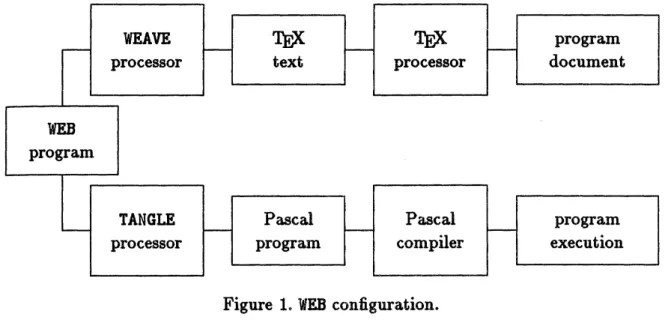
Figure 1. WEB configuration.
The basic design principles ofWEB are:
$\bullet$ A WEB
source
code looks like a document text with special mark-ups rather than aprogram source.
$\bullet$ The mark-ups discriminates the source text into several kinds of texts, for example,
document text, Pascal program text, module name and definition, macro definition,
indexin$g$ specification, etc.
$\bullet$ A WEB source code is divided to several pieces, or modules in $V\mathfrak{W}$ terminolgy, and a
module is the unit of programming. A module occupies at most one page when it is
typeset.
$\bullet$ A module consists of at most three parts: a document text part; a macro definition
part; and a Pascal program part, in this order.
$\bullet$ The Pascal program part maybe given a name, which is an arbitraIy text. Statements in the Pascal program part may refer to this name. This name serves as a
pseudo-instruction. The definition and reference to module names can be in any order.
$\bullet$ There are twoWEB processors, oneto translate aWEB source text into a Pascal program,
generates a Pascal program by replacing themodulenameswithits definitions.
with the same name arecollected and concatenated together. The latter, called WEAVE,
1
generates a
Iffi
source text, which $wiU$be then typeset as the program document.Using the module names, we can write a WEB source code in the top-down manner, and$|$
record the developing steps. At the abstract level, we can use a name instead of Pascal
statements, and then a module with that name is developed later. Global variables
can
be declared at several places by using the name attached to the module containing
var
statement, as shown in (3). The generated Pascal program looks ahnost the same as (2).
\langle global$variabIes$) $\equiv$
{a
module to define globalvariable}
$var\cdots$
(outer $module\rangle$ $\equiv$
{another
module in which module $\langle the_{arrow}action)$ isinvoked}
procedure
{
$the_{arrow}action$);end; (3)
(the $action\rangle$ $\equiv$
{here {
$the_{arrow}action\rangle$ isdefined}
{a
global variableisaccessed}
$globalarrow\cdots$ ;
(global$variables\rangle$ $+\equiv$
{globalvariables are to be
declared}
global: $\cdots$
There are some shortcomings or defects in WEB language. First, one must juggle with
three mutually muchdifferent languagesinwritingaWEB source code, namely,WEB language,
TEX
source language, and Pascal. Goodunderstanding ofthese languages are required. The number oflanguagesinvolved should be smallas much as possible. Second, the couplingbe-tween aWEBsource and generatedprogramis rather loose. Thisis because theWEBprocessors
are implemented aspreprocessors. There isnowaytoreflect the source module $organ\dot{w}$ation
to the generated program at run-time. The program must be executed independent to the source WEB program.
S.
Literated
Programming Language Design PrinciplesA
programming
languagesupporting top-down approach and documentationshould bede-signed to the following criteria. The language is called LLP (Language for Literated
Pro-gramming) tentatively. The LLP can establish itself as a new languagewith its own
proces-sors
and environment. It need not depend on some existing language.Segmentation TheLLPsourceprogram is divided into severalsegments. Eachsegment
represents a refinement step of the top-down programming activities. Not the syntactic
structure
of programming languages but the internal logic of a program should determinethe segmentation, and then refinement process. In other words, it must be made that, in the LLP, the syntactic and logical aspects of programming should be separately dealt with.
A segment may include program document text, partialprogramitself, orboth. A segment
should
not be too long andbetter not span over one page when formatted.No mark-ups The mark-ups arenot to be used for designatingthe document part and
program part of a segment. Instead, some means like shift/escape sequence may be used for this purpose. Or else, compiler directives like $\#$ lines in $C$ language may be employed.
This relieves a programmer from remembering superfluous subtleties. The point is that a
programmer should be able to handle the both text and program parts in the programming
languageframework.
Flexible intrasegmentstructure The program part and text part in a segment may beinterleavedinarbitrary order. TheWEB segment structure is ratherrigid: asegment must be constituted from the text part, macro definition, and program part in this order, where some parts may be omitted. This turns out to be rather inconvenient as related pieces of programs and variables declaration must be put in separate segments.
Segment naming convention Either a segment or each piece of program texts in a
segment may be given adequate name. The name can be any arbitrary text as in WEB. This
name serves as apseudo-code in the referring occurrence, and can be used as a lexical item
in a piece of program text. There should be some means to abbreviate a name when it is
appeared second time or later.
Name definition and reference The order of definition and reference of a name is arbitrary, moreover,a same namecouldbe defined atseveral places. Thismeans consecutive
pieces of program text are scattered among severalplaces.
Macro definition lt isdesirable the LLPprovides macro programming function.
How-ever, this mayberealized bythe namedsegment convention. It ismuchuseful that a named
segment could accept parameters which will be substituted for the formal arguments in the piece of program text. In this way, the module definition and
macro
definition in WEB can be unified.Overall consideration The source program incJuding both text and program parts
should be programming language-oriented rather than text-oriented. This is required for givingconciseandprecise explanationinthe program document. This pointisimportant for the batch-oriented implementation, where the formatted document and the
source
programThe programminglanguageofthe programpart canbe arbitrary asstated before. It maybe a completely original one designed to be best suited for the literated programming. It can
be a generic algorithmiclanguage, from which aprogram in anylanguage can be generated.
The LLP “TANGLE“ processor may handle such conversion. This point leaves much
&eedom
for the LLP design.
6. IMplementation as Programming
Environment
There are several conceivable ways to implement the LLP. For example, WEB employs con-ventional preprocessor implementation in the batch-oriented processing mode. WEB has two
processors, TANGLE and WEAVE, their functions are document preparation and program pre-processing respectively. Both ofthem run onthe same WEB source, but at the different time.
Therefore the program and its document are obtained separately. The TANGLE rearranges the source code by replacing segment nameswith theirdefinitions, and generates aprogram
which can be processed by a compiler. The WEAVE does virtually nothing but inserts direc-tivesforpretty-printing and generates the index and cross-reference. Theimplementationin
this waymakes the coupling between the source program preparation, generated program, and the program document rather loose. It is very important that we can settle only with the single source program preparation by strengthening the coupling.
We had better devise a means to strengthen the coupling to make the LLP a good
programming tool. The means may be (i) improving the LLP compiler in the batch mode processing; and (ii) implementingthe LLP inthe interactivemode processing
as
a program-ming environment.In the batch mode processing, a single compiler can be made to handle both parts of the LLP source input. The unified compiler, which may have processors such
as
given inthe above as itsphases, can bemade to accept the source program and generate a program
document and an object at the same time. In this way we may get along with the LLP
source program only.
The LLP will work best in the interactive processing mode, where only the program document need be prepared. Sufficient check $wiU$ be done over the source program by
combining the editting and syntactic processing. Neither mark-ups nor special LLP own
syntaxare required. The document wiil be printed as isshown on the screen. The program
can run in the interpretive/interactive execution, debugging and run-time profiling can be
made reflecting the source segment structure. A program may be generated as the final
result, which can be preserved for later batch mode compihing.
In this case, aproblem is that onlyone page of the program documentcan be displayed on the screen. This will become obstructive when developingalargescale program, where the number of related segments might grow large and they might span overseveral pages. The
semi-automated multi-segment access through the multiple window mechanism $wiU$ solve
the problem. Related segments can be accessed and displayed on the separate windows
automatically by referring to the symbolcross-reference and index database when editting asegment. Such database
can
becreated
and maintainedbythe interactive LLP processor.In asense, the LLPshould be implemented
as
a programmingenvironment in theinteractive
So far, we have discussed the relationship between programming language design and
pro-gramming
methodology, from the point of view of program understanding. The currentdesign of main-stream programming languages does not tend to support the programming
methodologies
adequatefor writingunderstandable programs. Inaddition,currentprogram-ming languages fail to support programming as documentationproccess.
We should devise some means, which we called the LLP, to fill the gap between the
programming
language and programming methodology. We presented the design criteria ofthe LLP, which are extracted from the experience in using the WEB language. Finally some
LLP
implementationtechniques are considered and their merits and demerits arediscussed.An
interactive
one implemented as a programming environment will be most desirable in this context.References
[JW76]
K. Jensen and N. Wirth, PASCAL User Manual and Report in Lecture Notes inComputer Science 18, Springer-Verlag (1976).
[Ad83] The Programming LanguageAda Reference Manual in Lecture Notesin Computer
Science 155, Springer-Verlag (1983).
[Kn83] D. E. Knuth, The WEB System ofStructured Documentation, CS-980, Stanford
University Computer Science Department (1983).
[Kn84] D. E. Knuth, “Literate Programming,“ Compu ter Journal 27 (1984), 97-111.
[Kn85] D. E. Knuth,
Zffl:
The Program, Addison-Wesley (1985).[Ha85a] T. Hayashi, “Literate Programming Considered
as
a Means of StepwiseRefine-ment,“ WGSF 13-6 (1985), (in Japanese).
[Ha85b] T. Hayashi, “A Structured Documentation Language for FORTRAN,” The 31st IPSJ Meeting $8Farrow 7$ (1985).