Some
Problems
in Formal
Language Theory
Known as Decidable are
Proved
EXPTIME
Complete
Takumi
Kasai*
and Shigeki
Iwata\dagger
Abstract
Some problems in formal language theory are considered and shown
deter-ministic exponential time complete. They include the problems for a given
context-free language$L$, a regular set $R$, a deterministic context-freelanguage
$L_{D}$, to determine whether $L\subset R$, and to determine whether $L_{D}\subset R$
.
1
INTRODUCTION
A number of complete problems for deterministic exponential time have been
pre-sented. Since Chandra and Stockmeyer [1] established the notion of alternation in 1976, many authors have shown complete problemsfordeterministic exponential time byusingofalternation. Mostofthese problemswere related to combionatorialgames. [2, 5, 6, 7, 8]
We consider in this paper several problems in the formal language theory and show that the problems are deterministic exponential time complete. They were already known as decidable. Let $L$ be a context-free language, $R$ a regular set, $L_{D}$
a deterministic context-freelanguage. The problems we consider include the ones to determine whether $L\subset R$, and whether $L_{D}\subset R$
.
Inorder toprove that the concernedproblems are deterministicexponential time hard, we use the pebble game problem [5], which was already shown complete for
deterministic exponential time, and we establish the polynomial-time reduction from the pebble game problem.
We write $\lambda$ to denote the empty string, and $|x|$ todenote the length of a string $x$
.
Let $\Sigma_{k}$ denote the set $\{[1,]_{1}, [2,]_{2}, \cdots, [k,]_{k}\}$
.
See [4] for definitions of deterministicfinite
automata(dfa) $M=(Q, \Sigma, \delta, q_{0}, F)$except that thetransitionfunction $\delta$isgivenby apartialfunctionfrom$Q\cross\Sigma$ to$Q$
.
See also [4]for definitions of nondeterministicfinite
automata (nfa), regular set,context-free
grammar (cfg),context-free
language(cfl), deterministic
context-free
language (dcfl), deterministic pushdown automaton(dpda), Turing machine, polynomial time, and polynomial-time reducibility.
The Dyck language $D_{k}$ of $k$ balanced parenthesisis the one generated by the cfg $G=(\{S\}, \Sigma_{k}, P, S)$, where $P$is the set ofproductions of the forms
$Sarrow SS|\lambda|[jS]_{i}(1\leq i\leq k)$
.
’Department of Computer Science, Universityof Electro-Communications, Chofu, Japan
For a cfg $G$, let $L(G)$ denotethe language generated by $G$, and for an automaton
or amachine$M,$ $L(M)$ denote the language accepted by $M$
.
Whenever we say (givena cfl $L,$ $\cdots$ , we
assume
that a cfg $G,$ $L(G)=L$, is given, and in particular when wesay (given a dcfl $L,$ $\cdots$ , a dpda $M,$ $L(M)=L$ is assumed. When we say “given a
regular set $R,$ $\cdots$ , it always means that an nfa$M,$ $L(M)=R$ is given.
EXPTIME is theclass ofsets accepted by $2^{n^{k}}$ timeboundeddeterministic Turing
machuines for some$k$
.
Alanguage $L$iscalledEXPTIME completeif$L$is inEXPTIME,and $L’$ is polynomial-time reducible to $L$ for any $L’$in EXPTIME.
A pebble game [5] is a quadruple $\mathcal{G}=(X, R, S,t)$ where:
(1) $X$ is a finuite set of nodes,
(2) $R\subset\{(x_{a}, x_{b}, x_{c})|x_{a}, x_{b}, x_{c}\in X,x_{a}\neq x_{b}, x_{b}\neq x_{c}, x_{c}\neq x_{a}\}$is called a
set of rules,
(3) $S$ is a subset of$X$, and
(4) $t\in X$ is called the terminal node.
At the beginning of a pebble game, pebbles are placed on all nodes of $S$, and we
call the placement the initial pebble-placement. A move of the game is as follows: if pebbles are placed on $x_{a},$ $x_{b}$, but not on $x_{c}$, and $(x_{a}, x_{b}, x_{c})\in R$, then
a
player canmove apebble from$x_{a}$ to$x_{c}$in his turn. The game isplayed by two players, and each
player alternately applies one of the rules of$\mathcal{G}$ to move a pebble. The winner is the
player who can first put a pebble on the terminal node, or who can make the other
player unable to move.
The first player has a
forced
win (or winning strategy) from a pebble-placement in $\mathcal{G}$ if there is a winning game-tree for the first player, whose root is labeled withthe pebble-placement. The winning game-tree of$\mathcal{G}$ for the first player (game-tree for
short) is the tree, nodes ofwhich are labeled with pebble-placements, or WIN, where
WIN means that the second player is already unable to move, thus the first player wins the game. Wesometimes confuse a nodeof the game-tree withits label. A level of anode in the tree is thelengthof the path fromthe root to the node. The level of the root is zero. A depth ofthe game-tree is the maximumlevel among the nodes of the tree. Any node $u$ ofthe even level in the tree is labeled with a pebble-placement
for the first player’s turn to move, and has exactly one child $v$, where $v$ is obtained
by an application of a rule of the game to $u$
.
Any non-leaf of the odd level is labeledwith a pebble-placement for the second player’s turn, and has exactly $m$ children,
where $m$is the number of the rulesof thegame. For $1\leq j\leq m$, the j-th child of$v$ is
labeled with a pebble-placement obtainedby an application ofthe j-th rule $r_{J}$ of the
game to $v$ if $r_{j}$ is applicable; and with WIN if $r_{j}$ is not applicable to $v$
.
Every leafof the game-tree is labeled either with WIN or with a pebble-placement in which the
first player wins.
The pebble game problem is, given a pebble game $\mathcal{G}$, to determine whether there
is a winning strategy for the first player from theinitial pebble-placement in $\mathcal{G}$
.
Theorem 1.1 [5] The pebble game problem is EXPTIME complete.
Example 1.1 Consider the following pebble game $\mathcal{G}=(X, R, S, x_{5})$, where $X=$
$\{x_{1}, x_{2}, x_{3}, x_{4}, x_{6}\},$ $S=\{x_{1}, x_{2}, x_{3}\},$ $R=\{r_{1}, r_{2},r_{3},r_{4}\}$) and $r_{1}=(x_{1}, x_{2}, x_{4}),$$r_{2}=$
begin
1) Let $G,$$L=L(G)$ be a cfg, andlet $M,$$R=L(M)$ be an nfa.
2) Constructa dfa M’such that L(M’) $=\Sigma^{*}-L(M)$
.
3) Construct the cfg G’ as in Lemma2.1such that L(G’) $=L(G)\cap L(M’)$.
4) Use polynomial time algorithm to determine whether $L(G’)=\phi$
.
5) If$L(G’)=\phi$ then L C $R$ else $L\not\subset R$
.
end
Fig. 2.1 Algorithm to determine whether $L\subset R$
If the first player applies $r_{1}$ to move a pebble from $x_{1}$ to $x_{4}$, the second player
then applies $r_{4}$ to move a pebble from$x_{2}$ to $x_{5}$ and the second player wins thegame.
Suppose that the first player first applies $r_{2}$ to move a pebble from $x_{2}$ to $x_{4}$
.
Thenthe only rule for the second player to apply is $r_{3}$ to move a pebble from $x_{3}$ to $x_{2}$
.
Then the first player applies $r_{4}$ to move a pebble from $x_{2}$ to $x_{6}$ and wins the game.
Thus the first player has aforced winin $\mathcal{G}$
.
2
COMPLETE
PROBLEMLemma 2.1 For a $cfgG$ and an $nfaM_{2}$ we can construct a $cfgG’$ such that$L(G’)=$
$L(G)\cap L(M)$ within polynomial time.
Proof.
Let$G=(V, \Sigma, P, S)$ and$M=(Q, \Sigma’, \delta, \{q_{0}\}, F)$.
Withoutloss ofgenerality, weassume that $\Sigma=\Sigma’$, and that $G$is in Chomsky normalform. Let $G’=(V’)\Sigma,$$P’,$$S’$),
$V’=\{[q,X,p]|q,p\in Q_{)}X\in V\}\cup\{S$‘$\}$
.
$P’$ contains$\{\begin{array}{l}[q,X,p][q,X,p]arrow aifX_{/}arrow_{\prime}a\in Pandp\in\delta(q,a)arrow[q,A,q][q,B,p]forq,p\in Q,a\in\SigmaifXarrow AB\in Pforq,q,p\in Q)\end{array}$
and $S‘arrow[q_{0}, S, q_{f}]$ for $q_{f}\in F$
.
Byinduction, we can prove that for $q,p\in Q,$$X\in V,$$w\in\Sigma^{*}$
$[q)X,p]\Rightarrow wG^{*}$ ifand only if $X\Rightarrow^{*}wG$ and$p\in\delta(q, w)$
.
Thus
$S’\Rightarrow G[q_{0}, S, q_{f}]\Rightarrow^{*}wG$ if and only if $S\Rightarrow^{*}wc$ and $q_{j}\in\delta(q_{0}, w)$
.
The number of productions in $G’$ is polynomial to the length of $G$ and $M$
.
Thusthe construction of $G’$ can be performed within polynomial time. $\square$
Next we present an algorithm in Fig.2.1 to determine whether $L\subset R$ for agiven
cfl $L$ and aregular set $R$
.
Lemma 2.2 Given a
cfl
$L$ and a regular set $R$, the algorithm shown in Fig.2.1de-termines whether $L\subset R$ within exponential time.
Proof.
In line(2), apply an usual algorithm, for example p.22 of[4],to obtain adfa$M_{1}$such that $L(M)=L(M_{1})$, and exchange the accepting states and the non-accepting
for the construction of $M’$ needs exponential time, since the number of states of $M_{1}$
is exponential compared with that of$M$
.
In line (4), apply the CYK algorithm [9] for example.
In total, our algorithm
runs
in exponential time to determine whether $L\subset R$.
$\square$
Consider the following problem $P_{1}$:
Given: a cfl $L$, and a regular set $R$
.
Todetermine whether: $L\subset R$.
Theorem 2.1 $P_{1}$ is EXPTIME complete.
Proof.
Since EXPTIME is closedunder complementation, it is sufficient to show thatthe problem $P_{1}’$:
Given: a cfl $L$, and aregular set $R$
.
Todetermine whether: $L\not\subset R$.
is EXPTIME complete, By Lemma 2.2, $P_{1}’$ is solvable within exponential time.
To show that $P_{1}’$ is EXPTIME hard, we establish that the pebble game problem
is polynomial-time reducible to $P_{1}’$
.
Let $\mathcal{G}=(X,\tilde{R}, S, x_{n})$ be a pebble game. We construct a cfg $G$ and an nfa $M$ within polynomial time such that there is a forcedwin for the first player in $\mathcal{G}$ ifand only if$L(G)\not\subset L(M)$
.
Priortothe construction of$M$, we construct dfa$sM_{1},$$M_{2},$$\cdots,$$M_{n}$, where $n$is the
number ofthe nodes of $\mathcal{G}$, such that there is a winning strategy for the first player
in $\mathcal{G}$ if and only if $L(G) \cap\bigcap_{j}^{n_{=1}}L(M_{i})\neq\phi$
.
Then we construct an nfa $M$, whichaccepts the complement of $\bigcap_{i=1}^{n}L(M_{i})$
.
Thus $L(G)\cap\cap^{n_{=1}}L(M_{i})\neq\phi$is equivalent to$L(G)\not\subset L(M)$
.
We will explain briefly how the simulation of$\mathcal{G}$ works in $G$ and $M_{1}$
)
$s$
.
Thederiva-tion of $G$ guesses a game-tree of $\mathcal{G}$, that is, what rules of $\mathcal{G}$ the first player applies
in order to win the game. For the first player’s turn to move in the game-tree, a derivation of $G$ guesses a rule which the first player applies to the pebble-placement,
while for the second player’s turn, derivations in $G$ guess for each rule whether the
rule is applicable to the coressponding pebble-placement. The purpose of $M_{i}’ s$ is to
examine whether the above guesses by $G$ are correct, and whether the derivation is
the one for the first player to win the game.
Assume that $X=\{x_{1}, x_{2}, \cdots, x_{n}\}$, and that $\tilde{R}=\{r_{1)}r_{2}, \cdots, r_{m}\}$
.
We write $\Sigma_{4m}=\{r_{j},\overline{r_{j)}}a_{j},\overline{a_{J}}, b_{j},\overline{b_{j}}, c_{j},\overline{c_{j}}|1\leq j\leq m\}$, where a symbol without bar and thesymbol with bar are intended to form a pair of balanced parenthesis in $\Sigma_{4m}$
.
Let$G=(\{U, W, V_{1}, V_{2}, \cdots, V_{m}\})\Sigma_{4m},$ $P,$$U$), where $P$ contains (1) $Warrow V_{1}V_{2}\cdots V_{m}$,
and for each rule $r_{i}=(x_{j1}, x_{j2}, x_{J^{3}}),$$1\leq j\leq m$ of $\tilde{R}$
, (2) $\{UUarrow r_{j}\overline{r_{j}}arrow r_{j^{\frac{W}{r_{j}}}}(j3\neq n)(j3=n)$
(3) $V_{i}arrow a_{j}\overline{a_{i}}|b_{j}\overline{b_{j}}|c_{j}\overline{c_{i}}$, and
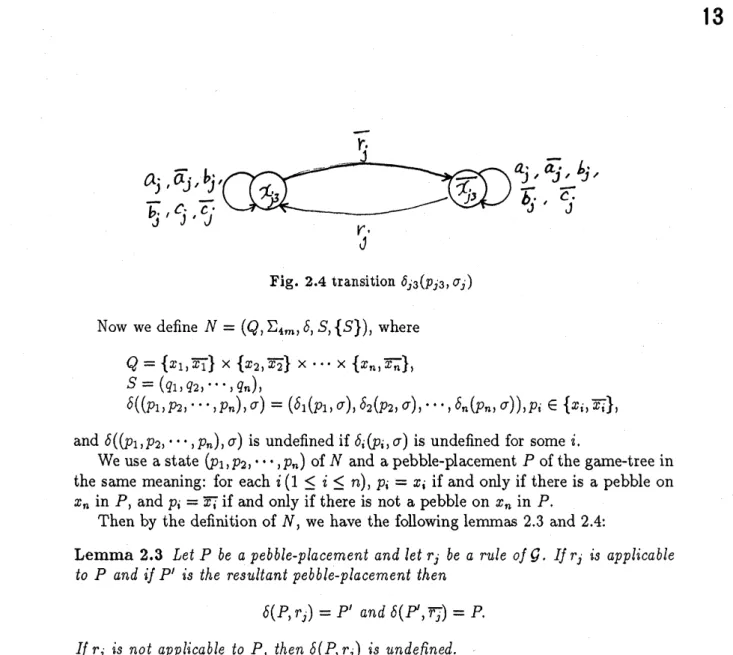
Fig. 2.2 transition $\delta_{j1}(p_{j1}, \sigma_{j})$
Fig. 2.3transition $\delta_{j2}(p_{j2}, \sigma_{j})$
The nonterminal $U$ is associated with a pebble-placement for thefirstplayer’s turn
to move, while $W$ is for the second player. $V_{j},$ $1\leq j\leq m$, means in the simulation
to guess an application of a rule $r_{j}\in\tilde{R}$ to the pebble-placement associated with $W$
.
The production rules in (2) are for the simulation of the first player in $\mathcal{G}$ to select
$r_{j}$ to move a pebble from $x_{j1}$ to $x_{j3}$
.
The production $Uarrow r_{j}W\overline{r_{i}}$is the one todenote that the first player applies $r_{j}$ and the next turn is the second player, while
$Uarrow r_{j}\overline{r_{i}}$ denotes for the first player to apply $r_{j}$ and wins to put a pebble on $x_{n}$
.
The productions (1),(3),(4) are for the second player’s move. (1) is to try every rule
$r_{1)}r_{2},$$\cdots,$$r_{m}$ as the second player’s move. (3) is to indicate that $r_{j}$ is not a proper
rule to make: if a pebble is not on $x_{g1}$ (is not on $x_{j2}$, is on $x_{j3}$)) then $V_{j}arrow a_{j}\overline{a_{j}}$
($V_{j}arrow b_{j}\overline{b_{j}},$ $V_{j}arrow c_{j}\overline{c_{j}}$
,
respectively) can be applied. (4) is to select $r_{j}$ to move.$V_{j}arrow r_{j}U\overline{r_{J}}$is to apply $r_{j}$ and the next turnis the first player.
For $1\leq i\leq n,$ $M_{i}$ keeps track of the existence of a pebble on $x_{i}$ in
$\mathcal{G}$
.
If thestate of $M$; is in $x_{i}(\overline{x_{i}})$ then it means that there is (there is not, respectively) a
pebble on $x_{j}$ in $\mathcal{G}$ Let $M_{i}=(\{x_{i)}\overline{x_{1}}\}, \Sigma_{4m}, \delta_{1}, q_{i}, \{q.\})$, and
$q_{i}=x$; for $x_{i}\in S$,
and $q_{i}=\overline{x_{j}}$for $x;\not\in S$
.
For each $i(1\leq i\leq n)$ and $j(1\leq j\leq m)$, let $\delta_{i}(p_{i}, \sigma_{j})$,$p_{1}\cdot\in\{x_{j},\overline{x_{j}}\},$ $\sigma_{j}\in\{r_{j},\overline{r_{j}}, a_{j},\overline{a_{j}}, b_{J’},b_{i}^{-}, c_{j},\overline{c_{j}}\}$, bethe following transition. Assumethat $r_{j}=(x_{j1}, x_{j2}, x_{j3})$ is a rule in $\tilde{R}$
.
If $i=j1$ then $\delta_{1}\cdot(p_{1}, \sigma_{i})$ is the transitions shown in Fig.2.2. If $i=j2$ then it
is shown in Fig.2.3, and if $i=j3$ then it is in Fig.2.4. If $i\not\in\{j1,j2,j3\}$ then
$\delta_{i}(p;, \sigma_{j})=p_{j}$ for each $p;\in\{x_{t)}\overline{x_{i}}\}$, and $\sigma_{j}\in\{r_{j},\overline{r_{j}}, a_{j},\overline{a_{j}}, b_{j},\overline{b_{j}}, c_{j},\overline{c_{j}}\}$. Note that
$\delta_{j1}(x_{j1}, a_{j}),$ $\delta_{j2}(x_{j2}, b_{j})$, and $\delta_{j3}(\overline{x_{j3}}, c_{j})$ are undefined. (See Fig’s 2.2, 2.3, and 2.4.)
The object of the construction of$M_{1},$ $M_{2},$$\cdots,$$M_{n}$ is to define a “product dfa” $N$ of
$M_{1},$ $M_{2},$$\cdots,$$M_{n}$, which is defined below. We consider $N$ as a tool for the proofof the
Fig. 2.4 transition $\delta_{j3}(p_{j3}, \sigma_{j})$
Now we define $N=(Q, \Sigma_{4m}, \delta, S, \{S\})$, where
$Q=\{x_{1},\overline{x_{1}}\}\cross\{x_{2},\overline{x_{2}}\}\cross\cdots\cross\{x_{n},\overline{x_{n}}\})$
$S=(q_{1}, q_{2}, \cdots, q_{n})$,
$\delta((p_{1},p_{2}, \cdots,p_{n}))\sigma)=(\delta_{1}(p_{1}, \sigma))\delta_{2}(p_{2}, \sigma),$ $\cdots,$$\delta_{n}(p_{n}, \sigma)))p;\in\{x_{t)}\overline{x_{1}\cdot}\})$
and $\delta((p_{1},p_{2}, \cdots,p_{n}), \sigma)$ is undefinedif$\delta_{i}(p_{1}\cdot, \sigma)$ is undefinedfor some $i$
.
Weuse astate $(p_{1},p_{2}, \cdots,p_{n})$ of$N$ and apebble-placement $P$ ofthe game-tree in
the same meaning: for each $i(1\leq i\leq n),$ $p_{j}=x_{j}$ ifand only if there is a pebble on
$x_{n}$ in $P$, and $p:=\overline{x_{i}}$ifand only ifthere is not a pebble on $x_{n}$ in $P$
.
Then by the definition of $N$
,
we have the following lemmas 2.3 and 2.4:Lemma 2.3 Let$P$ be a pebble-placement and let$r_{j}$ be a rule $of\mathcal{G}$
.
If
$r_{j}$ is applicableto $P$ and
if
$P$‘ is the resultant pebble-placement then$\delta(P, r_{j})=P’$ and $\delta(P,\overline{r_{i}})=P$
.
If
$r_{j}$ is not applicable to $P$,
then $\delta(P, r_{j})$ isundefined.
Proof.
Let $P=(p_{1},p_{2}, \cdots,p_{n})$ and let $r_{j}=(x_{j1}, x_{j2}, x_{g3})$.
Suppose that $r_{j}$ is notapplicable to $P$
.
Then either $pj1=\overline{x_{j1}}$ (there is not a pebble on $x_{j1}$), $p_{j2}=\overline{x_{j2}}$(a pebble is not on $x_{j2}$), or $pj3=x_{j3}$ (a pebble is on $x_{j3}$) holds. If$p_{j1}=\overline{x_{j1}}$ then
$\delta_{j1}(P41)r_{j})$ is undefined (see Fig.2.2), if$p_{j2}=\overline{x_{J^{2}}}$ then $\delta_{j2}(r)$ is undefined (see
Fig.2.3), and if$pj3=x$j3 then $\delta_{j3}(pj3, r_{J})$ is undefined (see Fig.2.4). Thus $\delta(P, r_{j})$ is
undefined.
Suppose that $r_{j}$ is applicable to $P$
.
Then $p_{j1}=x_{j1},$ $p_{j2}=x_{j2}$, and $p_{j3}=\overline{x_{j3}}$.
Thus
$p_{j1}=^{i_{\frac{)=}{x_{j1}}}},pj2\delta(rp_{1^{l}}\}^{p_{=^{2’}\overline{x_{j2}},p_{J}^{n_{3^{l}}’}}}$
and$p;’=p;,$$i\not\in\{j1, j2,j3\}$
.
Further we have $\delta((p_{1^{l}},p_{2’, )}p_{n^{l}}),\overline{r_{j}})=P$
.
$\square$Lemma 2.4 For anypebble-placement$P$ and any symbol$\sigma\in\{a_{j},\overline{a_{j}},$$b_{j_{J}}\overline{b_{j}},$$c_{j)}\overline{c_{j}}|1\leq$
$j\leq m\}$,
$\delta(P, \sigma)=P$ or it is
undefined.
Further, $r_{j}$ is not applicable to $P$
if
and onlyif
there is $w_{j}\in\{a_{j}\overline{a_{j}}, b_{j}\overline{b_{j)}}c_{j}\overline{c_{j}}\}$ suchProof.
For any $p;\in\{x;,\overline{x_{i}}\},$$1\leq i\leq n$, and $\sigma\in\{\overline{a_{j}}, \Gamma_{j},\overline{c_{j}}\},$$1\leq j\leq m$, we have$\delta_{i}(p;, \sigma)=p:$
.
(See$Fig’ s.2.2,2.3$,and2.4.) For any$\sigma\in\{a_{j}, b_{j}, c_{j}\}$, either$\delta_{i}(p;, \sigma)=p$:
or $\delta_{1}(p_{i}, \sigma)$ is undefined.
The necessary and sufficient condition that $\delta_{j}(p_{1}, a_{j})$ is undefined is that $i=j1$
and $p;=x_{j1}$, that is, there is a pebble on $x_{j1}$ in $P$
.
Likewise, the necessary andsufficient condition for $\delta_{j}(p_{j}, b_{i})$ to be undefined is that $i=j2$ and $Pi=x_{j2}$, that is,
a pebble is on $x_{j2}$ in $P$, and the necessary and sufficient condition for $\delta_{l}(p_{i}, c_{j})$ to be
undefined is that $i=j3$ and$p;=x_{j3}$, that is, a pebble is not on $x_{\gamma 3}$ in $P$
.
Thus, $r_{j}$is applicable to $P$ if and only ifnone of $\delta(P, a_{j}),$ $\delta(P, b_{j})$, nor $\delta(P, c_{j})$ aredefined.
$\square$
Note that $L(G)$ is asubset of $D_{4m}$
.
Further we can obtain the following lemma:Lemma 2.5 For any $\alpha\in D_{4m}$ and a pebble-placement $P$,
$\delta(P, \alpha)=P$ or it is
undefined.
Froof.
We can show the lemma by induction onI
$\alpha|$.
$\square$Lemma 2.6 The
first
player has a winning strategyfrom
a pebble-placement $P$if
and only
if
there is $w\in\Sigma_{4m^{*}}$ such that$U\Rightarrow*w$ and$\delta(P, w)=P$
.
Example 2.1 Before we prove the lemma, consider the pebble game $\mathcal{G}$ of Example
1.1. The cfg $G$ guesses the followingderivation:
$U\Rightarrow r_{2}W\overline{r_{2}}\Rightarrow r_{2}V_{1}V_{2}V_{3}V_{4}\overline{r_{2}}$
$\Rightarrow^{*}$ $r_{2}b_{1}\overline{b_{1}}a_{2}\overline{a_{2}}r_{3}U\overline{r_{3}}a_{4}\delta_{4}^{-}\overline{r_{2}}$
$\Rightarrow r_{2}b_{1}\overline{b_{1}}a_{2}\overline{a_{2}}r_{3}r_{4}\overline{r_{4}}\overline{r_{3}}a_{4}\overline{a_{4}r_{2}}$
.
Let $P_{0}=(x_{1},x_{2}, x_{3},\overline{x_{4}},\overline{x_{5}})$
.
$P_{0}$ is theinitial pebble-placement of$\mathcal{G}$.
Then$\delta(P_{0}, r_{2})=(x_{1},\overline{x_{2}}, x_{3}, x_{4)}\overline{x_{6}})=P_{1}$
.
$P_{1}$ is the resultant pebble-placement after
an
application of$r_{2}$ to $P_{0}$.
Since there is not a pebble on the second component $x_{2}$ of $r_{1},$ $r_{1}$ is not applicable
to $P_{1}$, and $\delta(P_{1},$$b_{1}b_{1}\neg=P_{1}$
.
Similarly, $r_{2}$ and $r_{4}$ are not applicable to $P_{1}$, since thereis not a pebble on the first component $x_{2}$ of $r_{2}$ and $r_{4}$
.
Thus $\delta(P_{1}, a_{2}\overline{a_{2}})=P_{1}$,
and$\delta(P_{1}, a_{4}\overline{a_{4}})=P_{1}$
.
Further$\delta(P_{1)}r_{3})=(x_{1}, x_{2},\overline{x_{3}}, x_{4},\overline{x_{5}})=P_{2}$, and
$\delta(P_{2}, r_{4})=(x_{1},\overline{x_{2}},\overline{x_{3}}, x_{4}, x_{6})=P_{3}$
.
$P_{2}$ is the pebble-placement after the second player applies
$r_{3}$ to $P_{1}$, and $P_{3}$ is the
pebble-placement after the firstplayer applies $r_{4}$ to $P_{2}$
.
The symbols $\overline{r_{4}},\overline{r_{3}},\overline{r_{2}}$are forbacktracking procedures. Thus we have
$\delta$($P_{3}$,F4) $=P_{2},$ $\delta(P_{2},\overline{r_{3}})=P_{1}$, and $\delta(P_{1},\overline{r_{2}})=P_{0}$
.
Proof.
(Only if): There is a game-tree, the root of which is $P$.
We will prove the“only if’) part by induction on the depth of the game-tree. Assume that the depth
of the tree is one. That is, the first player applies $r_{J}=(x_{j1}, x_{j2}, x_{j3})$ to put a pebble
on $x_{n}$, and$j3=n$
.
Then $U\Rightarrow r_{j}\overline{r_{J)}}$ and if $P$‘ is the resultant pebble-placement afterthe application of$r_{j}$ to $P$, then
$\delta(P, r_{j}\overline{r_{j}})=\delta(P’,\overline{r_{j}})=P$
by Lemma 2.3. Thus the “only if” part holds for the basis of the induction.
Assume that the depth of the tree is greater than one, that $r_{j}=(x_{j1}, x_{j2}, x_{j3})$ is
the first player’s rule to apply to $P$ and that $P$‘ is the resultant pebble-placement.
Prior to show the inductive step, we will show that foreach$j(1\leq j\leq m)$, there is $w_{j}\in D_{4m}$ such that
$(^{*})$ $V_{j}\Rightarrow^{*}w_{j},$$\delta(P’, w_{j})=P’$
.
If$r_{j}$ is not applicable to $P$
‘ then there is $w_{J}\in\{a_{j}\overline{a_{j}}, b_{j}\overline{b_{j}}, c_{J}\overline{c_{j}}\}$ which satisfies $(^{*})$ by
Lemma2,4.
Suppose that $r_{J}$ is applicableto $P’$, and that $P_{j’}$ is the pebble-placement afterthe
application of $r_{j}$ to $P’$
.
Since the first player has a winning strategy from $P_{j’}$, thereis $v_{j}\in\Sigma_{4m^{*}}$such that
$U\Rightarrow^{*}v_{J},$$\delta(P_{j’}, v_{j})=P_{J}’$
by the inductive hypothesis, If we put $w_{j}=r_{j}v_{j}\overline{r_{j}}$then $V_{j}\Rightarrow r_{j}U\overline{r_{j}}\Rightarrow^{*}r_{j}v_{j}\overline{r_{j}}=w_{j}$,
$\delta(P^{J},w_{j})=\delta(P_{j}^{l}, v_{j}\overline{r_{j}})=\delta(P_{j}’,\overline{r_{j}})=P’$
.
Thus $(^{*})$ holds in the inductive step. We have shown $(^{*})$
.
Therefore we have
$U\Rightarrow r_{j}W\overline{r_{j}}\Rightarrow r_{j}V_{1}\cdots V_{m}\overline{r_{j}}\Rightarrow^{*}r_{j}w_{1}\cdots w_{m}\overline{r_{j}}$, and
$\delta(P, r_{j}w_{1}\cdots w_{m}\overline{r_{j}})=\delta(P’, w_{1}\cdots w_{m}\overline{r_{j}})=\delta(P’,\overline{r_{j}})=P$
.
(If): We use induction on the number of steps of the derivation $U\Rightarrow^{*}w$
.
Assumethat the number of the steps is one, that is, $U\Rightarrow r_{J}\overline{r_{j}}=w$
.
Obviously thefirst playerhas a winning strategy from $P$
.
Assume that
$U\Rightarrow r_{j}W\overline{r_{j}}\Rightarrow r_{j}V_{1}\cdots V_{m}\overline{r_{j}}\Rightarrow^{*}r_{j}w_{1}\cdots w_{m}\overline{r_{j}}=w$,
$V_{j}\Rightarrow^{*}w_{j},$$(1\leq j\leq m)$
.
Since $\delta(P, w)=P,$ $\delta(P, r_{j})$ is defined. If $\delta(P, r_{j})=P’$, then $P’$ is the
pebble-placement after the application of$r_{j}$ to $P$, and$\delta(P’,\overline{r_{j}})=P$
.
By Lemma2.5 and by $\delta(P’, w_{1}\cdots w_{n})=P’$, we havefor every $j(1\leq j\leq m)$
.
If$w_{j}\in\{a_{j}\overline{a_{j}}, b_{j}b_{j}^{-},c_{j}\overline{c_{j}}\}$, then $r_{j}$ is not applicable to$P^{l}$ by
Lemma2.4. If$w_{j}\not\in\{a_{j}\overline{a_{j}}, b_{j}\overline{b_{j}}, c_{j}\overline{c_{j}}\}$
) then$r_{j}$ is applicable to $P’$ and $w_{j}$ is of the form $r_{j}v_{j}T_{J},$ $v_{j}\in D_{4m}$
.
Thus$V_{j}\Rightarrow r_{j}U\overline{r_{j}}\Rightarrow^{*}r_{j}v_{j}\overline{r_{j}}=w_{j}$, and $U\Rightarrow^{*}v_{j}$
.
If $\delta(P’, r_{j})=P_{j}’$ then $P_{j}’$ is the pebble-placement after the application of $r_{j}$ to $P’$,
and $\delta(P_{i}’, v_{j})=P_{j}’$
.
By the inductive hypothesis, $U\Rightarrow^{*}v_{j}$ and $\delta(P_{j}’, v_{j})=P_{j}’$ implythat the first player has a winning strategy from $P_{j}’$
.
Thus the first player can winthe game no matter what rule $r_{j}$ the second player may apply to $P’$
.
Therefore the lemmais proved. $\square$
By Lemma 2.6, the necessary and sufficient condition for the first player to have
awinning strategy fromthe initial pebble-placement in $\mathcal{G}$ is that there is $w\in\Sigma_{4m^{*}}$
such that $w\in L(G)\cap L(N))$ and the condition is also that $L(G) \cap\bigcap_{j}^{n_{=1}}L(M,)\neq\phi$
.
To complete the proof of the theorem, we have to construct $M$
.
It is clear thatwe can easily construct the dfa $M$; from $M_{i}$ which accepts $\Sigma_{4m^{*}}-L(M_{1}\cdot)$, the
com-plement of$L(M_{i})$
.
Now we consider an nfa $M$ such that $M$ accepts the complementof$\bigcap_{j}^{n_{=1}}L(M_{j})$
.
Since$\Sigma_{4m^{*}}-\bigcap_{i=1}^{n}L(M_{i})=\bigcup_{1=1}^{n}(\Sigma_{4m^{*}}-L(M_{j}))=\bigcup_{j=1}^{n}L(M_{j’})=L(M)$,
we can construct an nfa $M$ as the collection of $M_{1}’,$ $M_{2}’,$ $\cdots,$$M_{n}’$ together with the
initial state $q_{0}$ of $M$ by simply adding
$\lambda$-moves from
$q_{0}$ to each initial state of
$M_{1}’,$$M_{2}^{l},$
$\cdots,$$M_{n}$
.
The set of the accepting states of $M$ is the union of the onesof$M_{1}’,$ $M_{2}’,$$\cdots,$$M_{n}’$
.
Therefore, there is a winning strategy for the first player from the initial
pebble-placemene in $\mathcal{G}$ if and only if $L(G)\not\subset L(M)$
.
The constructions of $G$ and $M$ canbe performed within polynomial time. We note that $M$ can be constructed within
polynomial timesince $M$ is nondeterministic. Thus both $P_{1}’$ and $P_{1}$ are complete for
EXPTIME. $\square$
3
PROBLEMS
ON DCFL $S$We consider in this section some problems concerning dcfl’s. Theorem 3.1 The problem $P_{2}$:
Given: a regular set $R\subset\Sigma_{2}^{*}$
.
To determine whether: $D_{2}\subset R$
.
is EXPTIME complete.Proof.
To prove the theorem, it suffices to show that the following $P_{2}$‘:
Given: a regular set $R\subset\Sigma_{2}^{*}$
.
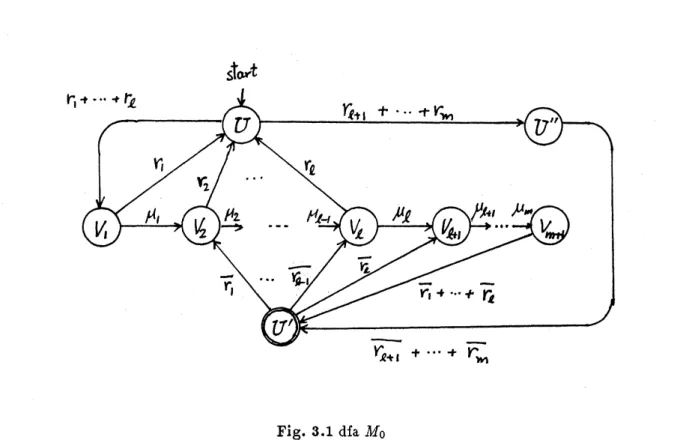
$sf_{\alpha rt}$
Fig. 3.1 dfa $M_{0}$
is EXPTIME complete. By Lemma 2.2, $P_{2}’$ is solvable within exponential time. We
show that the pebble game problem is polynomial time reducible to $P_{2}$
‘.
The proofproceeds similarly as in the one ofTheorem 2.1.
Let $\mathcal{G}=(X,\tilde{R}, S, x_{n})$ be a pebble game, $X=\{x_{1}, x_{2}, \cdots, x_{n}\},$ $|\tilde{R}|=m$
.
Let $G$be the cfg, let $M_{1},$ $M_{2},$$\cdots,$$M_{n}$ be the dfa’s, and let $M$ be the nfaconstructed in the
proof ofTheorem2.1. We have shown inthe preceeding proofthat the necessary and
sufficient condition for the first player having a forced win from the initial
pebble-placement in$\mathcal{G}$ is $L(G)\not\subset L(M)$, hence $L(G) \cap\bigcap_{j}^{n_{=1}}L(M_{j})\neq\phi$
.
We will construct adfa $M_{0}$ such that $L(G)=D_{4m}\cap L(M_{0})$
.
Lemma 3.1 There exist a $dfaM_{0}$ such that $L(G)=D_{4m}\cap L(M_{0})$
.
Proof.
Assume that $R_{1}$ is the set of rules of $\mathcal{G}$ to put a pebble not on$x_{n)}$ i.e., $R_{1}=\{r_{j}|r_{j}=(x_{j1}, x_{j2}, x_{j3}),j3\neq n\}$, and that $R_{2}$ is the set of rules to put a pebble
on $x_{n},$ $R_{2}=\{r_{j}|r_{j}=(x_{j1}, x_{j2}, x_{j3}),j3=n\}$
.
Without loss of generality, we may assume that $R_{1}=\{r_{1}, \cdots, r_{1}\}$ and $R_{2}=\{r_{1+1}, \cdots, r_{m}\}$.
We construct $M_{0}$, whichis shown in Fig.3.1, where the transition $r_{1}+\cdots+r_{1}$ from $U$ to $V_{1}$ stands for $\ell$
transitions by $r_{1)}\cdots,$$r_{1}$ from $U$ to $V_{1}$
.
(See Fig.$3.2(a).$) ‘Ttansitions by $\overline{r_{1}}+\cdots+\overline{r_{1)}}$ $r_{1+1}+\cdots+r_{m}$ and$\overline{r_{\ell+1}}+\cdots+\overline{r_{m}}$in Fig.3.1 aresimilar abbreviations. For $1\leq j\leq m$,let $\mu_{j}=a_{j}\overline{a_{j}}+b_{j}\overline{b_{j}}+c_{j}\overline{c_{j}}$
.
The transition by$\mu_{j}$ from $V_{j}$ to $V_{j+1}$ implies that either
$a_{j}\overline{a_{j}},$ $b_{j}\overline{b_{J}}$, or
$c_{j}\overline{c_{j}}$cau$s$es the transition from $V_{J}$ to $V_{j+1}$
.
(See Fig.$3.2(b).$)Let $\delta$ be the transition function of $M_{0}$
.
Recall that $D_{4m}$ is generated by $G’=$$(\{S\}, \Sigma_{4m}, P, S)$, where $P$ contains $Sarrow SS|\lambda|[;S]_{j}$ for $1\leq i\leq 4m$
.
It is clear that$L(G)\subset D_{4m}$ since any derivation in $G$ can be “mapped into” a derivation in $G’$ by
replacing $U,$$W,$$V_{1},$$\cdots,$$V_{m}$ by $S$
.
Thus in order to prove the lemma it suffices to show that for $\alpha\in D_{4m}$
$(\alpha)$ $cb)$
Fig. 3.2 abbreviations in Fig.3.1
for each$j(1\leq j\leq m),$ $V_{j}\Rightarrow^{*}\alpha G$ ifand only if $\delta(V_{j}, \alpha)=V_{j+1}$, $W\Rightarrow^{*}\alpha G$ ifand only if$\delta(V_{1}, \alpha)=V_{m+1}$
.
(Only if): Let us use induction on $|\alpha|$
.
If $|\alpha|\leq 2$, the cases are trivial. Consider$\alpha,$$|\alpha|=k>2,$ $ass$uming that the “only if” part holds for each $\beta\in D_{4m},$ $|\beta|<k$
.
Suppose $U\Rightarrow^{*}\alpha G$ Then the first step of the derivation should be $U\Rightarrow r_{j}W\overline{r_{j}}G$forsome $j(1\leq j\leq m)$, and $W\Rightarrow^{*}\beta G\in D_{4m},$ $\alpha=r_{j}\beta \mathcal{T}_{j},$ $|\beta|<k$
.
By the inductive hypothesis,wehave$\delta(V_{1}, \beta)=V_{m+1}$
.
Thus$\delta(U, \alpha)=\delta(U, r_{j}\beta T_{j})=\delta(V_{1}, ffi_{\overline{j}})=\delta(V_{m+1},\overline{r_{j}})=U’$.
The cases that $V_{j}\Rightarrow^{*}\alpha G$ and $W\Rightarrow\alpha G*$ can be similarly proved.
(If): By simpleinduction on $|\beta|,\beta\in D_{4m}-\{\lambda\}$, we can showthat
(i) $\delta(U, \beta)=U’$ or it is undefined, and
(ii) for each $j(1\leq j\leq m))\delta(V_{i},\beta)\in\{V_{j+1}, \cdots, V_{m+1}\}$ or it is undefined.
Again we will
use
induction on $|\alpha|$ to show the “if” part. If $|\alpha|\leq 2$ the proof isobvious. Consider $\alpha,$ $|\alpha|=k>2$, and assume that the (if‘ part holds for each $\beta$, $|\beta|<k$
.
Suppose $\delta(U, \alpha)=U^{l}$
.
If$\alpha=\alpha_{1}\alpha_{2}$ and if$\alpha_{1},$$\alpha_{2}\in D_{4m}-\{\lambda\}$, then $\delta(U, \alpha_{1})=U’$by (i). The transition from $U^{l}$ is made only by one of
$\overline{r_{1}},$$\cdots,$$\overline{r_{1}}$ and $\delta(U’, \alpha_{2})$ is
undefined. Thus $M_{0}$ does not accept $\alpha_{1}\alpha_{2}$
.
So $\alpha=r_{j}\beta\overline{r_{j}}$for some $j(1\leq j\leq\ell)$ and $\beta\in(D_{4m}-\{\lambda\})$.
Since $\delta(U,r_{j})=V_{1}$ and $\delta(V_{1},\beta T_{j})=U’$, we obtain $\delta(V_{1}, \beta)=V_{m+1}$.
By the inductive hypothesis wehave $W\Rightarrow^{*}\beta G$ Thus
$U\Rightarrow r_{j}W\overline{r_{j}}G\Rightarrow^{*}r_{j}\beta T_{j}=\alpha G$
Thecases $\delta(V_{1}, \alpha)=V_{i+1}$ and
6
$(V_{1)}\alpha)=V_{m+1}$ can be similarly proved. $\square$We define a homomorphism $h:\Sigma_{4m^{*}}arrow\Sigma_{2}^{*}$ as follows:
$h([j)=[1[2^{\{}$
$h(]_{i})=]_{2}^{i}]_{1}$
Assume that $\triangle=\{h([:), h(]_{i})|1\leq i\leq 4m\}$
.
Then the followinglemmaholds.Lemma 3.2 $h(D_{4m})=D_{2}\cap\triangle^{*}$
.
Proof.
Bythedefinitionof$h$and$D_{4m},$ $h(D_{4m})$isthelanguage, whichcanbe generatedby the cfg $(\{S\}, \Sigma_{2}, P, S)$, where $P$contains $Sarrow SS|\lambda|[1[_{2^{\{}}S]_{2^{\{}}]_{1}$ for $1\leq i\leq 4m$
.
Thus the lemma follows. $\square$
We will complete the proof ofTheorem 3.1. By the definition of $h$, for languages
$L,$$L^{(}C\Sigma_{4m^{*}}$, we have that $L=\phi$ if and only if $h(L)=\phi)$ and that $h(L\cap L’)=$
$h(L)\cap h(L’)$
.
Thus$L(G)\not\subset L(M)$ if and onlyif $D_{4m} \cap\bigcap_{j=0}^{n}L(M_{1}\cdot)\neq\phi$
if and onlyif $h(D_{4m}) \cap\bigcap_{=j0}^{n}h(L(M_{i}))\neq\phi$
.
It is easyto construct a dfa$\overline{M_{j}}$ such that $h(L(M_{i}))=L(\overline{M_{j}})$for $0\leq i\leq n$
.
Let $M_{n+1}^{-}$be the dfa, which accepts $\Delta^{*}$
.
Then,$L(G)\not\subset L(M)$ ifandonly if $D_{2} \cap\Delta^{*}\cap\bigcap_{i=0}^{n}L(\overline{M_{i}})\neq\phi$
ifand only if $D_{2} \cap\bigcap_{j=0}^{n+1}L(\overline{M_{i}})\neq\phi$.
We can construct an nfa $\overline{M}$
which $accept\underline{st}he$ complement of $\bigcap_{1=0}^{n+1}L(\overline{M_{1}})$ as in the
proof ofTheorem 2.1, since $\overline{M_{0}},\overline{M_{1}},$
$\cdots,$$M_{n+1}$ are deterministic. Thus,
$L(G)\not\subset L(M)$ if and ody if $D_{2}\not\subset L(\overline{M})$
.
Theconstructionof$\overline{M}$
can be performed within polynomial time. Therefore the proof
ofthe theorem is completed. $\square$
Corollary 3.1 For agiven regularset$R$ and
for
each$k\geq 2$, theproblem to determinewhether $D_{k}CR$ is EXPTIME complete.
Proof.
The problem can be solved within EXPTIME. Let $R$ be a regular set. Weprove that
$D_{2}\subset R$ if and only if $D_{k}\subset R\cup(\Sigma_{k}^{*}-\Sigma_{2}^{*})$
.
Assume that $D_{2}\subset R$, and that $w\in D_{k}$
.
If $w\in\Sigma_{2}^{*}$ then $w\in D_{2}$.
If $w\not\in\Sigma_{2}^{*}$ then$w\in\Sigma_{k}^{*}-\Sigma_{2}^{*}$
.
Thus $w\in R\cup(\Sigma_{k}^{*}-\Sigma_{2}^{*})$ and we obtain that $D_{k}\subset R\cup(\Sigma_{k}^{*}-\Sigma_{2}^{*})$.
Assume that $D_{k}\subset R\cup(\Sigma_{k}^{*}-\Sigma_{2}^{*})$, and $w\in D_{2}$
.
Since $w\in R\cup(\Sigma_{k}^{*}-\Sigma_{2}^{*})$ and $w\not\in\Sigma_{k}^{*}-\Sigma_{2}^{*}$, we obtain that $w\in R$.
Thus $D_{2}\subset R$.
As we can construct the nfa accepting $R\cup(\Sigma_{k}^{*}-\Sigma_{2}^{*})$ within polynomial time,
the corollary is proved. $o$
Open problem 1 The complexityof the problem to determine whether $D_{1}\subset R$
for agiven regular set $R$is remained open.
Corollary 3.2 The problem $P_{3}$:
Given: a
dcfl
$L$, and a regular set$R$.
To determine whether: L $CR$.
is EXPTIME complete.
Corollary 3.3 The problem $P_{4}$:
Given: a
dcfl
$L\subset\Sigma^{*}$, and a regular set $R\subset\Sigma^{*}$.
To determine whether: $L\cup R=\Sigma^{*}$
.
is EXPTIME complete.
Proof.
Let $M$ be adpdawhich accepts $L$.
Since $M$ is deterministic, we canconstructa dpda $M’$ such that $M’$ accepts $\Sigma^{*}-- L.$ (See $[4],p.238$
,
for example.) Then we canconstruct acfg $G$, which satisfie$sL(G)=L(M’)$
.
Since $L\cup R=\Sigma^{*}$ is equivalent to $L(G)\subset R$
,
and $G$ can be constructed withinpolynomial time, $P_{4}$ is EXPTIME complete by Corollary 3.2. $0$
Remark The problem to determine whether R $CL$ for a given regular set $R$ and a dcfl $L$ is solvable within polynomial time by constructing a cfg $G$ generating the
complement of $L$ and by applying the algorithm of Fig.2.1 to determine whether
$R\cap L(G)=\phi$, which is equivalent to $R\subset L$
.
Open $pro$blem 2 Let $L$ be adcfl and $R$be aregular set. Thefollowingproblems
are in EXPTIME, however, their complexities are open. (1) $R=L$?
(2) $L\subsetneq R$?
(3) $R\subsetneq L$?
REFERENCES
[1] A. K. Chandra and L. J. Stockmeyer, Alternation, Proceedings 17th Ann. IEEE Symp. on Found. ofComput. Sci. (1976), pp.151-174.
[2] A, S. Fraenkel, and D. Lichtenstein, Computing aperfectstrategy
for
n $\cross n$ chessrequires time exponential in n, J. Combinatorial Theory, 31(1981), pp.199-214.
[3] H. B. Hunt
m,
D. J. Rosenkrantz, and T. G. Szymanski, On the equivalence,containment, and covering problems
for
the regular andcontext-free
languages, J. Comput. System Sci., 12(1976), pp.222-268.[4] J. E. Hopcroft, and J. D. Ullman, Introduction to Automata Theory, Languages, and Computation, Addison-Wesley, Reading Mass., 1979.
[5] T. Kasai, A. Adachi,and S.Iwata, Classes
of
pebble games and complete problems,SIAM J. Comput., 8(1979), pp,578-586.
[7] J. M. Robson, N by N checkers is EXPTIME complete, SIAM J. Comput., 13(1984), pp.252-267.
[8] L. J. Stockmeyer, and A. K. Chandra, Provably
difficult
combinatorial games,SIAM J. Comput., 8(1979), pp.151-174.
[9] D. H. Younger, Recognition and parsing
of context-free
languages in time $n^{3}$,Inform. Contr., 10(1967), pp.189-208. 謝辞 1 岐阜べんなんて忘れてしまったであかんわ. 町田さん来年も開くまわししてちょ. 謝辞2 くに荘のおばさん, おっかなかったよ. 町田さん, 研究会しらいてくれてあんがと. またひてね.