INTRODUCTION
Methicillin - resistant Staphylococcus aureus (MRSA) strains account for!60% of S. aureus clini-cal isolates in Japan, Singapore, and Taiwan,!50% in Italy and Portugal, and 34% in the United States (1). MRSA isolates have an additional transpepti-dase, a 78 Kd class B penicillin - binding protein (PBP) named PBP 2"(PBP 2a), which has a de-creased affinity to β-lactams (2 -5). PBP 2a is en-coded by a mecA gene of unknown origin (6, 7). Usually, susceptible strains do not have the gene of this PBP (3). Although it is generally believed that PBP 2a is essential for conferring broad spectrum resistance to virtually all clinically used β-lactam
antibiotics (8 - 11) in S. aureus, the β-lactam (e.g., methicillin) MIC for resistant strains varies widely, from 3.1 μg to 1600 μg/ml.
Moreover, MRSA isolates with a low level of re-sistance show a peculiar, so - called heterogeneous expression of resistance. Our previous population analysis study of 20 MRSA strains using oxacillin revealed that three strains (20 22) were hetero -MRSA, exhibiting relatively low methicillin MICs, ranging from 256 to 128 μg/ml, while all the others were homo - MRSA (high - level methicillin MICs,
!1024 μg/ml) (12).
It was reported (13) that transposon mutants of MRSAs, despite the massive reductions in the mu-tants’ methicillin MIC, retained an intact mecA and its product, PBP 2a. The inserts were in genes in-volved in staphylococcal cell wall synthesis (13). In a report with heterogeneously resistant strains, cells with increased resistance levels present at low fre-quency (typically, 10- 4to 10-7) in the form of one or
more subpopulations, still produced normal amounts
ORIGINAL
No relationship exists between PBP 2a amounts
ex-pressed in different MRSA strains obtained clinically
and their -lactam MIC values
Md. Anowar Khasru Parvez
1, Hirofumi Shibata
1, Tatsuro Nakano
1, Shingo Niimi
2,
Nobuo Fujii
3, Naokatu Arakaki
1, and Tomihiko Higuti
1 1Department of Molecular Cell Biology and Medicine, Institute of Health Biosciences, the University of Tokushima Graduate School, Tokushima, Japan ;2
Division of Biological Chemistry and Biologicals, National Institute of Health Sciences, Tokyo, Japan ; and 3
Department of Media Design, Faculty of Human Life Sciences, Tokushima Bunri University, Tokushima, Japan
Abstract : After establishing a linear relationship between the amount of penicillin-binding protein (PBP) 2a and membrane proteins of methicillin-resistant
Staphylococ-cus aureus (MRSA) COL by dot-blot analysis using an antibody against PBP 2a, we
de-termined the PBP 2a quantities in membrane fractions prepared from 14 different MRSA cells. Methicillin-sensitive S. aureus ATCC 6538P was used as a quality control strain. The amounts of PBP 2a diverged among the strains, and no relationship to !-lactam MIC values were observed in the corresponding strains. J. Med. Invest. 55 : 246-253, August, 2008
Keywords : Methicillin-resistant Staphylococcus aureus (MRSA), Penicillin-binding protein (PBP) 2a,β-lactam
MIC values
Received for publication June 24, 2008 ; accepted July 4, 2008. Address correspondence and reprint requests to Tomihiko Higuti, Ph.D. Professor of Molecular Cell Biology and Medicine, Insti-tute of Health Biosciences, the University of Tokushima Gradu-ate School, Sho - machi, Tokushima 770 - 8505, Japan and Fax : +81 - 88 - 633 - 9550.
of PBP 2a (14).
However, there has been little study of low- and high-resistance phenotypes of the MRSA strains to β - lactams in relation to the organism - producing levels of PBP 2a. Indeed, we proposed a two - step model for the sequence of a high - level resistance mechanism of MRSA to β-lactams (12, 15). Since the ability to produce PBP 2a is essential for the methicillin resistance of S. aureus, it is conceivable that knowing the amount of PBP 2a produced by the strains of high - and low - resistance groups might aid in understanding PBP 2a’s role in resis-tance to β-lactam antibiotics. In this paper, we de-scribe a linear relationship between the protein amount of the MRSA COL (a reference strain) and the PBP 2a quantity by dot - blot analysis using an antibody against PBP 2a. Moreover, since the rela-tionship between PBP 2a amount and β-lactam MICs has not yet been well examined in the differ-ent clinical strains, this study aims to find out whether or not any correlation exists.
MATERIALS AND METHODS
S. aureus strains
Clinical strains of MRSA (strains 1 - 7, 9, 20 - 22) were kindly supplied by the late Dr. Toru Usui (Kyoto Microbiological Institute, Kyoto, Japan). Strain N315 and vancomycin (VCM) intermediate -resistance strains (VISA) Mu3 and Mu50 were kind gifts from Dr. Keiichi Hiramatsu (Juntendo University, Tokyo, Japan), and strain COL was from Dr. John J. Iandolo (University of Oklahoma Health Sciences Center, Tulsa, OK, USA). Methicillin -sensitive S. aureus (MSSA) ATCC 6538P was used as a reference strain. Some properties of the clini-cal strains used in the present study were deter-mined previously (12).
Drug susceptibility assay of bacterial isolates
Bacterial susceptibility to antibacterial agents was measured in vitro by employing a standard twofold plate-dilution method using BBLTMMueller--Hinton
II agar (Becton Dickinson, Franklin Lakes, NJ, USA) supplemented with 25 μg/ml of Ca2+, 50 μg/
ml of Mg2+, and 2% NaCl (CA--MHA) (12).
Follow-ing overnight incubation of test strains at 37!!in MHB, cultures were diluted with 0.85% NaCl, and then the bacteria (about 106CFU/ml) were applied
with an inoculator onto the surfaces of 10 ml agar layers containing the antibiotics. The plates were
incubated at 37!!for 48 h and were checked for antibacterial susceptibility. The MIC was recorded as the lowest concentration of the antibiotic that completely inhibited growth.
Dot - blotting for detection and quantification of PBP 2a followed by membrane protein preparation
For the detection of PBP 2a, an antibody against PBP 2a was prepared with a peptide of PBP 2a (16, 17) ; details of the procedure were described pre-viously (15). The strains of MRSA were incubated for 5 h at 37!! in a BBLTM Brain Heart Infusion
(BHI) broth (Becton Dickinson). The cells were subsequently harvested from the culture after wash-ing three times with washwash-ing buffer (50 mM Tris-HCl, pH 7.5, and 145 mM NaCl) by centrifugation at 4,500
!
g for 15 min at 6!!. Then the pellet wasresuspended in the same buffer, and 2.4 ml cell suspension was treated with 24 ml of lysis buffer containing 50 mM Tris - HCl (pH 7.5), 50 μg/ml lysostaphin (Sigma Chemical, St. Louis, MO, USA), 10 mg/ml DNase I (Roche Diagnostics, Indianapo-lis, IN, USA), 5 mM MgCl2, and 100 mM
phenyl-methylsulfonyl fluoride (PMSF ; Sigma Chemical) for 1 h at 37!!. After centrifugation at 45,000
!
g at6!!for 1 h, the precipitant was dissolved with 10 mM phosphate buffer, pH 7.0, containing 100 mM PMSF and diluted (1 : 25) with dilution buffer con-taining 10 mg/ml DNase I and 200 mM MgCl2.
Crude debris were removed by centrifugation at 4,500
!
g for 1 h at 6!!, and the resultant superna-tant was centrifuged at 45,000!
g at 6!!for 1 h.The precipitant was suspended with 10 mM phos-phate buffer, pH 7.0, containing 100 mM PMSF and purified by centrifugation at 45,000
!
g at 6!!for1 h. Finally the membrane fraction was dissolved with 50 μl of 10 mM phosphate buffer, pH 7.0. Pro-tein concentrations were determined using a col-orimetric method with bovine serum albumin as a standard (15, 18). To investigate the relationship between the PBP 2a amount and the membrane protein fractions, 0.2 μg, 0.5 μg, 1.0 μg, and 2.0 μg membrane fractions from MRSA COL (a reference strain) were transferred to nitrocellulose membrane (Bio - Rad Laboratories, Hercules, CA, USA) using the Bio Dot SF Microfiltration Apparatus (Bio -Rad) according to the manufacturer’s instructions. PBP 2a was identified by the chemiluminescence method as described with the ECL Plus Western Blotting kit (Amersham Biosciences, Piscataway, NJ, USA). Repeated experiments were done to con-firm the results.
To determine the PBP 2a quantities in mem-brane fractions of different MRSA clinical strains, 1.0 μg protein was used following the procedure described above with MSSA ATCC 6538P as a qual-ity control strain.
Statistical analysis
To assess the correlation between PBP 2a levels of the strains examined and the corresponding MICs of β-lactams, the Pearson correlation coeffi-cient was calculated by using a linear model with terms for the two variables.
RESULTS
Antibacterial activity
All of the MRSA strains examined in the present study were resistant to β-lactams (e.g., methicillin MIC, 64 -!1,024 μg/ml), but strain N315 showed a low MIC (8 μg/ml), which was close to those of β - lactam - susceptible strains. Using a PCR tech-nique, we confirmed that all the MRSA strains (100%), including N315, carried the mecA gene.
Detection and quantification of PBP 2a with dot-blot
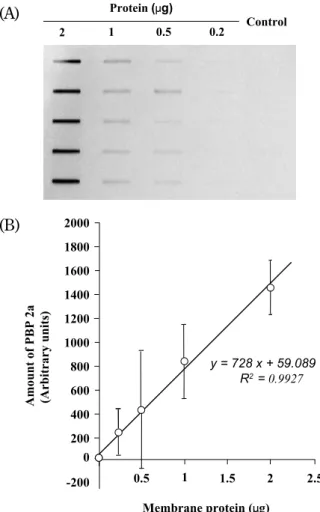
Based on the previous result that a single band (molecular mass, about 76 kD) was detected by means of sodium dodecyl sulfate - polyacrylamide gel electrophoresis of a membrane fraction of MRSA (10 μg of protein) followed by Western blot-ting analysis with the antibody against the peptide of PBP 2a (15), we conducted the study on detec-tion and quantificadetec-tion of PBP 2a with dot-blot. In the present work, PBP 2a was detected in all strains of MRSA examined, including pre - MRSA strain N315, with MSSA ATCC 6538P as a negative con-trol strain. For the quantification study, we first ex-amined the relationship between the PBP 2a amount and membrane proteins prepared from MRSA COL by dot - blot analysis using an antibody against PBP 2a.
As shown in Fig. 1, the relationship between PBP 2a and membrane proteins of MRSA COL was lin-ear. Hence, using immunoblotting we determined the PBP 2a quantities from membrane fractions prepared from the different clinical MRSA cells, with MSSA ATCC 6538P as a quality control strain. The PBP 2a amounts diverged among the strains (Fig. 2). The three heteroresistant clinical strains (20 - 22) had higher amounts than the
homoresis-tant clinical strains, except for strains 3 and 6. How-ever, it must be pointed out that the amounts of PBP 2a varied among the three heteroresistant strains (20 -22) (Fig. 2). In the present work, VISA strain Mu3 exhibited the highest levels of PBP 2a among the examined MRSA strains (Fig. 2).
As Fig. 3 clearly demonstrates, however, the re-sistant phenotypes of MRSA to β-lactams were un-related to the organism-producing level of PBP 2a. Strains N315 and 1 showed similar PBP 2a quanti-ties, although their respective methicillin MICs were 8 μg/ml and!1024 μg/ml. Among the ho-moresistant strain, MRSA 6 showed the highest value of the PBP 2a although its oxacillin and cephapirin MICs were 128 μg/ml and 64 μg/ml less than MICs of MRSA isolate 2 (512 μg/ml and 128 μg/ml respectively) (Fig. 3). However, the ce-fotaxime MIC was found to be higher (1024 μg/ml) (A)
(B)
Fig. 1. Immuno - blot analysis of PBP 2a in membrane frac-tion prepared from MRSA COL. Cell membrane proteins of MRSA COL were prepared, purified, and quantified as de-scribed in Materials and Methods. (A) Western blot analysis of different concentrations of proteins (0.2 μg, 0.5 μg, 1.0 μg, and 2.0 μg). PBP 2a was detected by the use of ECL Plus. The result shows five independent experiments. (B) A linear rela-tionship between the amount of PBP 2a and membrane frac-tion of MRSA COL.
(A) (B) (C)
Fig. 2. Amounts of PBP 2a in the cell membranes of different clinical strains of MRSA. (A) A typical demonstration of dot-blotting analysis of PBP 2a level. The membrane fractions of 6 strains of MRSA and MSSA (1 μg of protein) were applied. MSSA ATCC 6538P was employed as a quality control strain. The result shows five independent experiments. (B) Dot- blotting analysis of the membrane protein prepared from MRSA COL was used for the demonstration of the PBP 2a level of the other strain shown in (A). (C) Bar dia-gram of PBP 2a amounts of different MRSA strains obtained clinically with MSSA ATCC 6538P as a quality control strain.
(A) (B)
(C) (D)
Fig. 3. Relationship between PBP 2a levels and MIC values of oxacillin (A), methicillin (B), cephapirin (C), and or cefotaxime (D) of 13 different strains of MRSA.
in strain 6 than MRSA isolate of 2 (512 μg/ml). Discrepancy was also found with heteroresistant strain as shown in Fig. 3.
Statistical analysis
To assess the correlations between the PBP 2a levels of the strains examined and the correspond-ing MICs of β - lactams, we assumed a linear model with terms for the two variables and calculated the Pearson correlation coefficients for the drugs, with the exception of that for methicillin. The coefficients were - 0.677 for oxacillin, - 0.482 for cephapirin, and - 0.153 for cefotaxime. The corresponding probabil-ity values (p - values, two - tailed) were 0.011, 0.095, and 0.618, respectively. For the latter two drugs, the results of this study suggest that there are no linear relationships between the PBP 2a levels of the MRSA strains examined and the drugs’ MICs. However, in the case of oxacillin, the resulting p - value suggests that we could not exclude a lin-ear relationship between the PBP 2a levels and the drug MICs.
DISCUSSION
A wide range of β-lactam MICs from the level of MSSA to!4,000 μg/ml has been reported in clini-cal strains of MRSA, despite the fact that these MICs have an altered PBP 2a that β-lactam antibiotics do not inhibit at chemotherapeutic levels (9, 10, 14, 19). In the present study, the range of β - lactam resistance levels for MRSA also varied widely. For example, the MICs of oxacillin and cefotaxime were 64 μg/ml to 512 μg/ml and 32 μg/ml to 1024 μg/ml, respectively. On the basis of bacterial susceptibility to β-lactam antibiotics, methicillin-resistant S. aureus isolates could be classified into low - and high - resistance groups. Again, various phenotypic expressions of resistance (homogene-ous or heterogene(homogene-ous) have been reported in clini-cal isolates of MRSA (12, 20, 21). This leads to the question of whether or not PBP 2a production alone is related to the expression of high - level methicil-lin resistance in S. aureus. To answer this, we de-termined the amounts of PBP 2a in different MRSA isolates obtained clinically, following the procedure described in Materials and Methods.
Although Araj, et al. (22) reported that the reli-able detection of MRSA cannot be based solely on the detection of the mecA gene in S. aureus, the presence of clinical isolates examined in the
pre-sent study, previously classified as methicillin-resistant, were confirmed by the PCR finding that all of them carry the mecA gene, including strain N315 (12, 23, 24).
In the present study, we provide clear evidence with clinically isolated strains that there is no rela-tionship between PBP 2a amount and β-lactam MIC value. First, the amount of PBP 2a varied widely among the highly and homogeneously resistant strains 1 - 7 and 9 (methicillin MIC!1024 μg/ml). The PBP 2a quantities were higher in strains 3, 6, and 7 than in the others. Second, strains 20 -22 pro-duced significantly high amounts of PBP 2a, yet ex-hibited only low - level heterogeneous resistance. Comparing strains 20 and 22, we found that, even though the cephapirin MICs were the same (16 μg/ ml), the cellular amount of PBP 2a was much higher in the latter than in the former.
This is supported by the statistical analysis. For cephapirin and cefotaxime, the results of this study suggest that there are no linear relationships be-tween PBP 2a levels and drug MICs. Unfortunately, in the case of oxacillin, we failed to exclude a cer-tain correlation between the two variables. With re-spect to oxacillin, possibly as well as methicillin, the strains employed in this study were divided into two groups : those having drug MICs of 512 μg/ml (!1,024 μg/ml for methicillin) and those having drug MICs of less than that. Overall, this appears to fit to a significant inverse correlation between the two variables. On the other hand, the PBP 2a amounts of the members of both groups ranged from low to high levels, thus demonstrating no par-ticular relationship between the two parameters.
PBP 2a is encoded by the mecA gene, which is regulated by two upstream genes, mecR1 and mecI (25). They can express mecA constitutively, or they can use the β-lactamase regulatory genes, blaR1 and blaI , to optimally express mecA, since BlaR1 is a strong inducer of mecA whereas BlaI is a weak repressor (25 - 28). One report described that the uninduced amounts of PBP 2a from penicillinase -producing parents were lower than those for penicillinase - negative variants (29). In the present study, similar results were found with β-lactamase-nonproducing heteroresistant isolates (strains 20 - 22) that lack both regulatory genes mecRI/mecI and blaRI/blaI (12). In contrast with that report, we found that the β-lactamase -producing high-resistance clinical isolates exhibited relatively less PBP 2a, except for strain 1, a β-lactamase nonpro-ducing homoresistant strain with a lower amount
of cellular PBP 2a. However, strain 1 carried mecRI/
mecI regulatory genes, according to our previous
report (12).
The apparent noncorrelation between MIC and the amount of PBP 2a suggests that some other, unknown factor contributes to the increased MIC. According to Murakami, et al. (29) the existence of an unknown factor was suggested previously from the observation that heterogeneously resis-tant strains produced significant amounts of PBP 2a under conditions in which small fractions of bac-terial cells were resistant. In a study with trans-poson mutants of MRSAs selected for their re-duced resistance, the mutants retained an intact
mecA, and its product, PBP 2a, also remained
unaf-fected despite the massive reduction in the me-thicillin MIC of the mutants (13). Biochemical analy-sis of these mutants indicated that the inserts were in genes involved in staphylococcal cell wall syn-thesis (13). Ryffel, et al. (19) reported that the high - level resistance expressed by a minority popu-lation of methicillin - resistant staphylococci was due to one or more chromosomal mutations (chr*) lo-cated outside of mecA, the gene encoding PBP 2a. One of the most probable hypotheses to explain the mutation is that MRSA might acquire the ability to provide PBP 2a with sufficient quantities of the pre-cursors on the nascent cross wall of the staphylo-coccal cell (15).
Hanaki, et al. (30) reported that Mu3 and Mu50 strains produced three to five times the amount of PBP 2a than VCM - susceptible S. aureus strains with or without methicillin resistance. In our study, VISA strain Mu3 exhibited the highest levels of PBP 2a among the 14 strains examined (Fig. 2). VCM exerts its bactericidal effect by binding to D -alanyl - D - alanine (D -Ala - D - Ala) residues of pepti-doglycan and its precursor units, inhibiting cell wall peptidoglycan synthesis (31). It is commonly accepted that cell wall thickening is responsible for the VCM resistance of VCM - intermediate S.
aureus (VISA) strains (24, 32). Cui, et al. (31)
re-ported a strong positive correlation between VCM and reduced susceptibilities of VISA to daptomy-cin, and that this correlation is related to cell wall thickening and slower growth rates in comparison to VCM - susceptible S. aureus.
In MRSA, the incorporation of the peptidogly-can precursor into the growing peptidolgypeptidogly-can chain in the presence of a β-lactam is carried out by co-operation between the transpeptidase activity of PBP 2a (mecA) and the transglycosylase activity of PBP
2 (pbp2) (7, 33). The β-lactam ring mimics the D-Ala - D - D-Ala moiety of the normal peptidoglycan pre-cursors. PBP 2a has low affinity for the β-lactam ring of β-lactams (34). Thus, PBP 2a might have low affinity for D - Ala - D - Ala in the stem peptide of the precursor, suggesting that the protein would require substantial amounts of the precursor for proper functioning as a transpeptidase. Therefore, although PBP 2a is a key protein in MRSA, not only PBP 2a production but also the acquisition of other factors, such as an increased ability to supply the precursor, would be required to mediate β-l actam resistance in MRSA.
In conclusion, there is no direct relationship be-tween the amounts of PBP 2a expressed in MRSAs obtained clinically and MIC values of β-lactam. This finding is in good accord with the previously proposed two - step model for the development of high - level resistance to β-lactams in MRSA (12, 15, 35).
ACKNOWLEDGMENTS
One of the author (M. A. K. P) was granted for Japanese Government (Monbukagakusho) schol-arship from the Ministry of Education, Science, and Culture of Japan.
REFERENCES
1. Diekema DJ, Pfaller MA, Schmitz FJ,
Smayevsky J, Bell J, Jones RN, Beach M, SENTRY Participants Group : Survey of Infec-tions Due to Staphylococcus Species : Fre-quency of Occurrence and Antimicrobial Sus-ceptibility of Isolates Collected in the United States, Canada, Latin America, Europe, and the Western Pacific Region for the SENTRY An-timicrobial Surveillance Program, 1997-1999. Clin Infect Dis 32 : S114 - S132, 2001
2. Akcam FZ, Tinaz GB, Kaya O, Tigli A, Ture E, Hosoglu S : Evaluation of methicillin resistance by cefoxitin disk diffusion and PBP 2a latex agglutination test in mecA - positive
Staphylo-coccus aureus, and comparison of mecA with femA, femB , femX positivities. Microbiol Res.
doi : 10.1016/j.micres.2007.02.012. (Article in Press, 2007)
3. Song MD, Wachi M, Doi D, Ishino F,
penicillin - target protein in methicillin - resistant
Staphylococcus aureus by gene fusion. FEBS
Lett 221 : 167 - 171, 1987
4. Wu SW, de Lencastre H, Tomasz A : Recruit-ment of the mecA gene homologue of
Staphy-lococcus sciuri into a resistance determinant
and expression of the resistant phenotype in
Staphylococcus aureus. J Bacteriol 183 : 2417
-2424, 2001
5. Wu SW, de Lencastre H, Tomasz A : Expres-sion of high - level methicillin resistance in
Staphylococcus aureus from the Staphylococcus sciuri mec A homologue : role of mutation(s) in
the genetic background and in the coding region of mec A. Microb Drug Resist 11 : 215 -224, 2005
6. Fuda C, Suvorov M, Shi Q, Hesek D, Lee M, Mobashery S : Shared functional attributes be-tween the mecA gene product of
Staphylococ-cus sciuri and penicillin - binding protein 2a of
methicillin - resistant Staphylococcus aureus. Bio-chemistry 46 : 8050 - 8057, 2007
7. Goldstein F, Perutka J, Cuirolo A, Plata K, Faccone D, Morris J, Sournia A, Kitzis MD, Ly A, Archer G, Rosato AE : Identification and phenotypic characterization of a beta lactam -dependent, methicillin - resistant
Staphylococ-cus aureus strain. Antimicrob Agents
Che-mother 51 : 2514 - 2522, 2007
8. Goffin C, Ghuysen JM : Multimodular penicillin-binding proteins : an enigmatic family of orthologs and paralogs. Microbiol Mol Biol Rev 62 : 1079 - 1093, 1998
9. Hartman BJ, Tomasz A : Low affinity penicillin -binding protein associated with beta - lactam resistance in Staphylococcus aureus. J Bacte-riol 158 : 513 - 516, 1984
10. Reynolds PE, Brown DF : Penicillin - binding proteins of beta-lactam-resistant strains of
Staphylococcus aureus. Effect of growth
condi-tions. FEBS Lett 192 : 28 - 32, 1985
11. Palavecino E : Clinical, epidemiological, and laboratory aspects of methicillin - resistant
Staphylococcus aureus (MRSA) infections.
Methods Mol Biol 391 : 1 - 11, 2007
12. Shibata H, Shirakata C, Kawasaki H, Sato Y, Kuwahara T, Ohnishi Y, Arakaki N, Higuti T : Flavone markedly affects phenotypic expression of β-lactam resistance in methicillin-resistant
Staphylococcus aureus strains isolated clinically.
Biol Pharm Bull 26 : 1478 - 1483, 2003
13. Tomasz A : “The staphylococcal cell wall”. In :
Fischetti VA, Novick RP, Ferretti JJ, Portnoy DA, Rood JI, eds. Gram - positive pathogens. American Society for Microbiology, Washing-ton DC, 2000, pp. 463 - 470
14. Hartman BJ, Tomasz A : Expression of me-thicillin resistance in heterogeneous strains of
Staphylococcus aureus. Antimicrob Agents
Che-mother 29 : 85-92, 1986
15. Sato Y, Shibata H, Arakaki N, Higuti T : 6,7-Dihydroxyflavone dramatically intensifies the susceptibility of methicillin resistant or -sensitive Staphylococcus aureus to β-lactams. Antimicrob Agents Chemother 48 : 1357 - 1360, 2004
16. Sekiguchi K, Saito M, Yajima R : Detection of methicillin - resistant Staphylococcus aureus (MRSA) with antibodies against synthetic pep-tides derived from penicillin - binding protein 2!. Microbiol Immunol 39 : 545 - 550, 1995 17. Higuti T, Negama T, Takigawa M, Uchida J,
Yamane T, Asai T, Tani I, Oeda K, Shimizu M, Nakamura K, Ohkawa H : A hydrophobic pro-tein, chargerin II, purified from rat liver mito-chondria is encoded in the unidentified read-ing frame A6L of mitochondrial DNA. J Biol Chem 263 : 6772 - 6776, 1988
18. Oliver B, Wolfgang B, Gerhard P : Regulation of β-lactamase synthesis as a novel site of ac-tion for suppression of methicillin resistance in Staphylococcus aureus. Zentbl Bakteriol 285 : 413 - 430, 1997
19. Ryffel C, Strassle A, Kayser FH, Berger - Bächi B : Mechanisms of heteroresistance in me-thicillin - resistant Staphylococcus aureus. An-timicrob Agents Chemother 38 : 724 - 728, 1994 20. Kondo N, Kuwahara - arai K, Kuroda -murakami H, Tateda - suzuki E, Hiramatsu K : Eagle - type methicillin resistance : new phe-notype of high methicillin resistance under mec regulator gene control. Antimicrob Agents Che-mother 45 : 815 - 824, 2001
21. Tomasz A, Nachman S, Leaf H : Stable classes of phenotypic expression in methicillin - resis-tant clinical isolates of staphylococci. Antimi-crob Agents Chemother 35 : 124 - 129, 1991 22. Araj GF, Talhouk RS, Simaan CJ, Maasad MJ :
Discrepancies between mecA PCR and con-ventional tests used for detection of methicil-lin resistant Staphylococcus aureus. Int J An-timicrob Agents 11 : 47 - 52, 1999
23. Kuroda M, Ohta T, Uchiyama I, Baba T, Yuzawa H, Kobayashi I, Cui L, Oguchi A, Aoki
K, Nagai Y : Whole genome sequencing of methicillin - resistant Staphylococcus aureus. Lancet 357 : 1225 - 1240, 2001
24. Ohta T, Hirakawa H, Morikawa K, Maruyama A, Inose Y, Yamashita A, Oshima K, Kuroda M, Hattori M, Hiramatsu K, Kuhara S, Hayashi H : Nucleotide substitutions in Staphylococcus
aureus strains, Mu50, Mu3, and N315. DNA
Res 29 : 51 - 56, 2004
25. Hiramatsu K : Molecular evolution of MRSA. Microbiol Immunol 39 : 531 - 543, 1995
26. Ryffel C, Kayser FH, Berger - Bächi B : Corre-lation between reguCorre-lation of mecA transcrip-tion and expression of methicillin resistance in staphylococci. Antimicrob Agents Che-mother 36 : 25 - 31, 1992
27. Petinaki E, Arvaniti A, Bartzavali C, Dimitracopoulos G, Spiliopoulou I : Presence of mecA genes and overproduction of beta-lactamase in the expression of low - level me-thicillin resistance among staphylococci. Che-mother 48 : 174 - 181, 2002
28. McDougal LK, Thornsberry C : The role of beta-lactamase in staphylococcal resistance to penicillinase - resistant penicillins and cepha-losporins. J Clin Microbiol 23 : 832 - 839, 1986 29. Murakami K, Nomura K, Doi M, Yoshida T :
Production of low - affinity penicillin - binding protein by low and high - resistance groups of methicillin - resistant Staphylococcus aureus. An-timicrob Agents Chemother 31 : 1307 - 1311, 1987
30. Hanaki H, Kuwahara - Arai K, Boyle - Vavra S, Daum RS, Labischinski H, Hiramatsu K :
Acti-vated cell - wall synthesis is associated with vancomycin resistance in methicillin - resistant
Staphylococcus aureus clinical strains Mu3 and
Mu50. J Antimicrob Chemother 42 : 199 - 209, 1998
31. Cui L, Tominaga E, Neoh HM, Hiramatsu K : Correlation between reduced daptomycin sus-ceptibility and vancomycin resistance in van-comycin - intermediate Staphylococcus aureus. Antimicrob Agents Chemother 50 : 1079 - 1082, 2006
32. Cui L, Ma X, Sato K, Okuma K, Tenover FC, Mamizuka EM, Gemmell CG, Kim MN, Ploy M, El-Solh CN, Ferraz V, Hiramatsu K : Cell wall thickening is a common feature of vanco-mycin resistance in Staphylococcus aureus. J Clin Microbiol 41 : 5 - 14, 2003
33. Boyle - Vavra S, Yin S, Daum RS : The VraS/ VraR two - component regulatory system required for oxacillin resistance in community -acquired methicillin - resistant Staphylococcus
aureus. FEMS Microbiol Lett 262 : 163 - 171,
2006
34. Berger - Bächi B, Rohrer S : Factors influenc-ing methicillin resistance in staphylococci. Arch Microbiol 178 : 165 - 171, 2002
35. Sato Y, Shibata H, Arai T, Yamamoto A, Okimura Y, Arakaki N, Higuti T : Variation in synergistic activity by flavone and its related compounds on the increased susceptibility of various strains of methicillin - resistant
Staphy-lococcus aureus toβ - lactam antibiotics. Int J Antimicrob Agents 24 : 28 - 35, 2004