INTRODUCTION
Toll-like receptors (TLRs) that are expressed mainly on macrophages and dendritic cells (DCs), are recently identified receptor molecules that rec-ognize many types of pathogens in addition to host-derived proteins. Macrophages and DCs are not only primarily involved in innate immunity, but are also essential for establishment of adaptive im-munity as antigen-presenting cells (APCs). Thus,
TLR signaling promotes activation of an innate im-mune response, and then triggers antigen-specific adaptive immunity (1-4). In the immunotherapy against malignant diseases, it was suggested that the induction of tumor antigen-specific cytotoxic T lymphocytes (CTLs) is most important for elimi-nating tumor cells, and most immuno-oncologists have discussed how to induce adaptive immunity against cancer. However, the precedent activation of the innate immune system is essential for the subsequent induction of antigen-specific immunity. TLR-mediated activation of innate immunity should be important for the establishment of an effective anti-cancer immune response. Recently, several studies proposed the significance of TLR signaling in the induction of anti-cancer immunity. In this review,
REVIEW
Toll-like receptor signaling in anti-cancer immunity
Masato Okamoto and Mitsunobu Sato
Second Department of Oral and Maxillofacial Surgery, Tokushima University School of Dentistry, Tokushima, Japan
Abstract : It is important to augment the anti-cancer host response in cancer treatment. Recent studies suggested that the signaling via Toll-like receptors (TLRs) which are new-ly identified receptor molecules recognizing many pathogens, are involved in the induction of anti-cancer immunity. Seya et al. demonstrated that maturation of dendritic cells (DCs) and cytokine induction by the cell wall skeleton of Mycobacterium bovis bacillus Calmette-Guérin (BCG-CWS) are induced via both TLR2 and TLR4. Akira et al. discovered a new molecule of TLR family, TLR9, recognizing unmethylated bacterial CpG-DNA, whose clinical use is expected for cancer therapy as a potent inducer of a helper T cell 1 (Th1)-type T-cell response. TLR9-deficient mice did not show any responses to CpG-DNA, including Th 1 cytokine production and maturation of DCs. We have obtained two molecules, a lipoteichoic acid-related molecule isolated from streptococcal agent OK-432, and a plant-derived 55-kDa protein that can induce Th1 response and elicit a strong anti-cancer effect in vivo and
in vitro. Our basic experiments demonstrate that TLR4 signaling is intimately involved in
anti-cancer immunity induced by these immunopotentiators. Our clinical examination in oral cancer patients also suggests the requirement of both TLR4 and MD-2 in the OK-432-induced anti-cancer host response. Establishment and clinical use of the methodology for human cancer therapy by utilizing TLR signaling is greatly expected.
J. Med. Invest. 50 : 9-24, 2003
Keywords : anti-cancer immunity, Toll-like receptor (TLR), Bacterial CpG-DNA, OK-432, plant-derived protein
Received for publication January 6, 2003 ; accepted January 16, 2003.
Address correspondence and reprint requests to Dr. Masato Okamoto, D.D.S., Ph.D., Second Department of Oral and Maxillofacial Surgery, Tokushima University School of Dentistry, Kuramoto-cho, Tokushima 770-8504, Japan and Fax : +81-88-633-7462.
The Journal of Medical Investigation Vol. 50 2003 9
we present the recent progress of these studies including our investigation, focused on the involve-ment of TLR signaling in anti-cancer immunity.
TLRs, and their ligands
The toll gene controls dorsoventral pattern for-mation during the early embryonic development of
Drosophila melanogaster(5). Interestingly, toll par-ticipates in anti-microbial immune responses upon infection in adult Drosophila (6). Recently, several mammalian homologues of the Drosophila Toll re-ceptor protein (Toll-like rere-ceptors : TLRs) were iden-tified. TLRs are transmembrane proteins and rep-resent a newly recognized family of vertebrate pat-tern recognition receptors in the innate immune system. A prerequisite for the development of an effective host defense is the recognition of patho-gens. TLRs are involved in this first step (2-4).
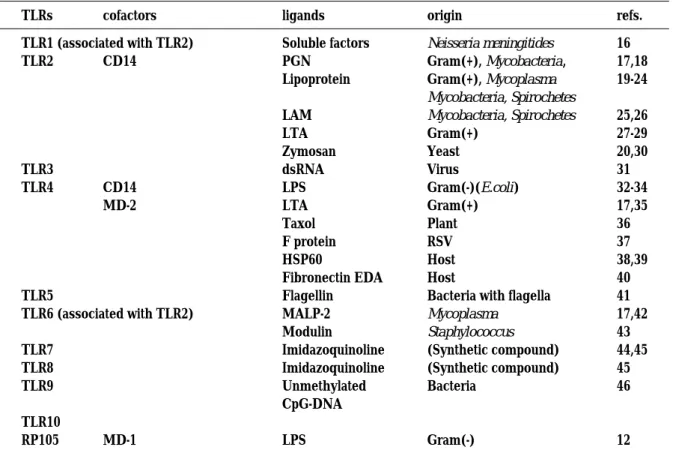
Eleven members of the TLR family (TLR1 to TLR10 and RP105)(7-12), co-factors (CD14, MD-1 and MD-2)(13-15) and their ligands have been reported (12, 16-46) as shown in Table 1. The well-characterized TLRs are TLR2, TLR4 and TLR9. TLR4 recognizes
Gram-negative bacteria-derived lipopolysaccharide (LPS)(32-34) as well as Gram-positive bacteria-derived lipoteichoic acid (LTA)(17, 35). It was also reported that TLR 4 mediates LPS-mimetic signal transduction by an anti-cancer agent Taxol, a plant-derived diterpene, in mice but not in humans (36). In addition, TLR4 recognizes host-derived proteins, heat shock pro-tein (HSP) 60 (38, 39) and fibronectin fragment (40). In the antigen recognition by TLR4, MD-2 plays an essential role. MD-2 is physically associ-ated with TLR4 on the cell surface and the TLR4/MD-2 complex confers responsiveness to bacterial compo-nents (15). TLR 2 recognizes peptidoglycan (PGN) (17, 18), lipoprotein (19-24) and lipoarabinomannan (LAM)(25, 26) derived from Gram-positive bacte-ria, mycobacteria or mycoplasma. Several studies reported that Gram-positive bacteria-derived LTA is recognized by TLR2 (27-29). TLR9 recognizes bacterial unmethylated CpG DNA and is the recep-tor that distinguishes bacterial DNA from self-DNA (46).
Subsequent to pathogen-associated molecular pattern engagement, TLRs initiate the signaling via sequential recruitment of myeloid differentia-tion protein (MyD) 88, IL-1R-associated kinase (IRAK) Table 1. TLRs and their ligands
TLRs cofactors ligands origin refs.
TLR1 (associated with TLR2) TLR2 TLR3 TLR4 TLR5 TLR6 (associated with TLR2) TLR7 TLR8 TLR9 TLR10 RP105 CD14 CD14 MD-2 MD-1 Soluble factors PGN Lipoprotein LAM LTA Zymosan dsRNA LPS LTA Taxol F protein HSP60 Fibronectin EDA Flagellin MALP-2 Modulin Imidazoquinoline Imidazoquinoline Unmethylated CpG-DNA LPS Neisseria meningitides Gram(+), Mycobacteria, Gram(+), Mycoplasma Mycobacteria, Spirochetes Mycobacteria, Spirochetes Gram(+) Yeast Virus Gram(-)(E.coli) Gram(+) Plant RSV Host Host
Bacteria with flagella Mycoplasma Staphylococcus (Synthetic compound) (Synthetic compound) Bacteria Gram(-) 16 17,18 19-24 25,26 27-29 20,30 31 32-34 17,35 36 37 38,39 40 41 17,42 43 44,45 45 46 12 PGN:peptidoglycan, LAM : lipoarabinomannan, LPS : lipopolysaccharide, LTA : lipoteichoic acid, ds : double-stranded, RSV : respiratory syncytical virus, HSP : heat shock protein, EDA : extra domain A, MALP-2 : mycoplasmal macrophage-activating lipopeptide-2 kDa
M. Okamoto et al. TLR signaling in anti-cancer immunity 10
and TNFR-associated factor (TRAF)6, which in turn activate downstream mediators such as nuclear factor (NF)-κB and mitogen-activated protein kinases (MAPKs) (47, 48). In addition, experiments using MyD88-deficient (MyD88-/-) mice revealed that TLR4 mediates the signaling in an MyD88-independent fashion in addition to an MyD88-dependent fash-ion (49). Recently, it was reported that newly iden-tified molecule, Toll-interleukin 1 receptor (TIR) domain-containing adapter protein (TIRAP), asso-ciates with TLR4, and manages MyD88-independent signal transduction (2, 50). On the other hand, Kawai
et al. reported that a transcription factor, interfer-on (IFN)-regulatory factor (IRF) 3, translocated into the nucleus in response to LPS in MyD88-/-mice
(51). It was strongly suggested that IRF3 activation contributes to the MyD88-independent pathway. However, it remains uncertain whether TIRAP is involved in IRF3 activation (Fig. 1). Furthermore, most recent studies have demonstrated findings strongly suggesting that TIRAP mediates the sig-naling via TLR1, TLR2 and TLR6 in addition to TLR4, and is involved not only in the MyD88-independent but also in the MyD88-dependent signaling path-way (52, 53). The downstream molecular events of TLRs are significant to determine what type(s) of host response(s) are induced against different kinds of, and different doses of pathogens. Progress of this clarification is strongly expected.
TLR-mediated signaling stimulates the maturation
Fig. 1. Ligands with anti-cancer effects and downstream signals of TLRs
of DCs, which migrate to the regional lymph nodes, where they stimulate T cells by presentation of antigen-major histocompatibility (MHC) complex in addition to costimulatory molecules such as CD80 and CD86. TLR signaling acts to trigger adaptive immunity by enhancing expression of MHC molecules in addition to these costimulatory molecules. Further-more, TLR signaling frequently enhances the pro-duction of IL-12, a major helper-T cell 1 (Th1)-inducing cytokine, on APCs (2-4, 54). Thus, it was strongly suggested that the DCs matured by TLR stimula-tion may induce T-cell differentiastimula-tion toward Th1 by presenting antigens to the T cells while promot-ing a Th 1-leadpromot-ing situation in the local environment. Therefore, it is possible that the ligands of TLRs are able to be effective immunoadjuvants for can-cer therapy. In the next sections, we review the re-cent progress focused on the TLR ligands as appli-cations for cancer therapy.
Involvement of TLR2, TLR4, and TLR9 in
anti-cancer immunity induced by the bacillus
´
Calmette-Guerin cell wall skeleton (BCG-CWS)
or unmethylated CpG-DNA
1) BCG-CWS-induced anti-cancer host response via TLR2 and TLR4
Heat-killed mycobacterial cells suspended in min-eral oil are potent immunoadjuvants to induce both cell-mediated and humoral immunity, and the CWS fraction of the cells of mycobacteria is the active immunoadjuvant component (55-58). It was reported that BCG-CWS enhances the cytotoxic activity of T cells and macrophages against cancer cells, and elicits an anti-tumor effect in mice and in rats bear-ing transplantable and authochthonous tumors (59, 60). Further, clinical trials with BCG-CWS were performed in patients with several types of malig-nancies, and it was demonstrated that BCG-CWS was effective in prolongation of survival of patients especially those with gastric cancer and lung can-cer (61-67).
Recently, Seya and his co-investigators reported findings strongly suggesting that BCG-CWS aug-ments the anti-cancer host response through TLR2 and TLR4 (Fig. 1). It was reported that BCG-CWS activates and matures DCs (58). Tsuji et al. reported that BCG-CWS induces tumor necrosis factor (TNF)-α secretion from DCs via both TLR2 and TLR4, and that the secreted TNF-αinduces the maturation of
DCs (68). The distribution profile of TLR2 and TLR4 matches the response profile of cells for BCG-CWS, and further investigation by Tsuji et al. suggested that the PGN portion of BCG -CWS is an active center for cytokine induction and DC ma-turation via Toll signaling (58). It was also reported that TLR2 mediates mycobacteria-induced proinflammatory signaling in macrophages (25). These findings strong-ly suggest that the signaling via TLRs is closestrong-ly involved in BCG-CWS-induced anti-tumor immunity. However, Azuma and Seya suggested that TLRs are not merely the receptor for establishment of the BCG-CWS-induced anti-tumor host response, and proposed the “two receptor theory”. Two types of receptors expressing on APCs, which consist of signal transducing receptor related to maturation and activation of APCs such as TLRs, and phagocytosis-related receptor to induce antigen presentation to T cells, may be essential for the establishment of antigen-specific, adaptive immunity, and BCG-CWS may augment the anti-tumor host response by activating both types of receptors (58, 69). As demonstrated previously, BCG-CWS consists of mycolic acid, arabinogalactan and PGN (57, 59, 70), and distinct portions may play significant roles in the binding and activation of the two receptors on macrophages and DCs. Identification of the phagocytosis receptor(s) is currently under investigation by Seya et al. (58). 2) Bacterial unmethylated CpG-DNA-induced host response via TLR9
The specific immunostimulatory effect of bacte-rial genomic DNA was first reported by Tokunaga
et al., who demonstrated that bacterial DNA acti-vates natural killer (NK) cells and induces IFN pro-duction in addition to tumor regression in some mouse models, but vertebrate DNA does not (71-73). In 1995, Krieg et al. demonstrated that CpG mo-tifs in bacterial DNA trigger direct B-cell activa-tion (74, 75). They also reported that CpG content and methylation distinguish vertebrate and bacte-rial DNAs. Genomic DNA from vertebrates but not from bacteria contains very few CpG dinucleotide motifs (76). Further, CpGs are commonly methyl-ated in vertebrates, while the CpGs are not meth-ylated in bacteria and viruses. This suggestes the possibility that the immune system may have evolved a defense mechanism based on the recognition of unmethylated CpG-DNAs, which could be a sign of foreign DNA (76).
The immune response of synthesized oligodeoxynucleotides (ODN) with CpG motifs was examined. Many studies
M. Okamoto et al. TLR signaling in anti-cancer immunity 12
demonstrated that unmethylated CpG-ODN strong-ly activates immunocompetent cells such as DCs, macrophages, NK cells, T cells, and B cells, and in-duces the Th1-like T-cell response including IFN-γ production and CTL induction, in in vitro and in vivo models (74). Roman et al. reported that co-injection of CpG-ODN with a protein antigen greatly enhances the T- and B-cell response to this antigen (77). Sig-nificantly, this response is strongly biased toward the generation of a Th1-dependent immunity with all its ramifications, for example a preference for IgG2immunoglobulin subclasses. It can be
expect-ed as an immunotherapeutic agent for cancer, aller-gy and infectious diseases as a potent Th1 induc-er. The efficacy of CpG-DNA in preventing or treat-ing tumor development or metastasis in mice has been examined in several experimental models. In CpG-DNA monotherapy, systemic or local admini-stration of CpG-DNA protected 80% of syngeneic C57BL/6 mice from a lethal challenge of B16 mela-noma. Further, SCID mice were also protected against tumor challenge by CpG-DNA, which suggests that neither B nor T cells are required (78). The poten-tial of the CpG-DNA as an adjuvant for cancer vac-cines was also examined. CpG-DNA-induced activa-tion of DCs creates a Th1-like cytokine and chemokine environment in the secondary lymphoid organs that promotes cross-priming with strong IFN-γ-secreting CTLs and antibody responses to peptides and pro-tein antigens derived from tumors, and elicits marked anti-tumor activity (79, 80). Despite its promising clinical use, the molecular mechanism by which CpG-DNA activates immune cells has remained unclear.
In 2000, Hemmi et al. discovered the receptor mol-ecule recognizing bacterial DNA (46). The identi-fied protein, TLR9, recognizes the unmethylated CpG motif in bacterial DNA, and mediates an innate im-mune response (Fig. 1). They generated TLR9-deficient (TLR9-/-) mice and examined the immune effect of CpG-ODN using those mice (46). TLR9-/- mice did not show any response to CpG-DNA, including proliferation of splenocytes, inflammatory cytokine production from macrophages and maturation of DCs. TLR9-/-mice showed resistance to the lethal effect of CpG DNA without any elevation of serum pro-inflammatory cytokine levels. The in vivo CpG-DNA-mediated Th1 response was also abol-ished in TLR9-/-mice. Thus, it was clarified that the signaling via TLR9 plays an important role in CpG-DNA-induced host response.
Early-stage clinical trials of CpG-DNA as an
immunotherapeutic agent for cancers and as an anti-allergic agent are currently on going, and pre-liminary findings from these trials appear to be en-couraging (81).
Involvement of TLR4/MD-2 signaling in anti-cancer
immunity induced by an LTA-related
mol-ecule, an effective component of OK-432,
or by a plant-derived 55-kDa protein
Recently, we obtained 2 molecules that can induce the Th1-dominant state and elicit an anti-cancer ef-fect. One is an LTA-related molecule isolated from a Streptococcus-derived anti-cancer agent OK-432, and another is a 55-kDa protein from Aeginetia indica
L(AIL), a parasitic plant, and we obtained findings strongly suggesting that these molecules enhance anti-cancer immunity via TLR4/MD-2 complex. In this section, we present the recent progress of our basic and translational research focused on the in-volvement of TLR4/MD-2 signaling in anti-cancer immunity induced by these molecules.
1) Isolation of an effective component responsible for OK-432-induced anti-cancer effect
OK-432, a penicillin-killed and lyophilized prepa-ration of a low-virulence strain (Su) of Streptococcus
pyogenes(group A) (Chugai Pharmaceutical Co., Ltd., Tokyo, Japan), was developed by Okamoto et al. in 1967 (82), and has been successfully used as an immunotherapeutic agent in many types of malig-nancies (83-87). We also reported that OK-432-based immunotherapy exhibits a marked therapeutic ef-fect in patients with oral squamous cell carcinoma (88, 89). Previous studies helped to clarify the cel-lular mechanism of OK-432-induced anti-cancer im-munity. Namely, OK-432 elicits anti-tumor effects by stimulating immunocompetent cells such as macrophages, T cells and NK cells, and by induc-ing multiple cytokines includinduc-ing IL-1, IL-2, IL-6, TNF-α, and IFN-γ(90-92). In addition, OK-432 in-duces IL-12 and polarizes the T-cell response to a Th1 dominant state (93). However, there has been limited progress in elucidating the molecular mecha-nism, i.e., in the identification of the effective mol-ecule(s) for inducing anti-cancer immunity in whole bacterial preparation OK-432 and their molecular target(s), such as receptors and signal transducers on immunocompetent cells. Recently, we succeed-ed in isolating the LTA-relatsucceed-ed molecule that is
most responsible for the anti-cancer effect of OK-432. This molecule designated as OK-PSA was isolated from a butanol extract of OK-432 using a CNBr-activated Sepharose 4B affinity column bound with the monoclonal antibody TS-2, which neutralizes the IFN-γ-inducing activity of OK-432 (94, 95). We previously reported that OK-PSA is a more potent inducer of Th1 cytokines and killer cell activities on human peripheral blood mononuclear cells (PBMCs) than original OK-432, and showed a marked anti-tumor activity in tumor-bearing mice (94, 96-101)
2) OK-PSA-induced anti-cancer immunity via TLR4 signaling
We examined the role of TLR4 in the anti-tumor effect of OK-PSA using C3H/HeJ mice in which TLR4 is mutated and its function is impaired (34). C3H/HeN mice, which have the wild-type TLR4 gene, were used as control animals. In in vitro ex-periments, the spleen cells derived from C3H/HeN and C3H/HeJ mice were stimulated with OK-PSA for 48 h, then the cytokines in the supernatants were measured. Although Th1-type cytokines such as IFN-γ, IL-12 and IL-18 were significantly induced by OK-PSA stimulation in the splenocytes derived from C3H/HeN mice, these cytokines were not in-duced in the splenocytes from C3H/HeJ (Fig. 2A). TNF-αand IL-2 were also induced by OK-PSA in the splenocytes from C3H/HeN but not from C3H/HeJ (data not shown). Furthermore, when the expres-sion vector including mouse TLR4 cDNA was transfected into C3H/HeJ-derived splenocytes, the splenocytes acquired the responsiveness to OK-PSA to produce Th1 cytokines (Fig. 2B). Next, we evaluated the anti-tumor effect of OK-PSA in vivo. C3H/HeN and C3H/HeJ mice bearing syngeneic SCCVII tumors were treated with OK-PSA. The peritumoral injec-tion of OK-PSA resulted in significant inhibiinjec-tion of tumor growth and lung metastasis in SCCVII-bearing C3H/HeN mice ; however, no effect of OK-PSA was observed in C 3 H/HeJ mice (Fig. 2 C). The cytolytic activities of tumor-infiltrating lymphocytes (TIL) and draining lymph node (LN) cells derived from SCCVII-bearing mice that were administered OK-PSA were also analyzed. The cytolytic activities of TIL and LN cells against SCCVII were markedly increased by OK-PSA administration in C3H/HeN but not in C3H/HeJ (Fig. 2D). These findings strongly sug-gest that TLR4 signaling is involved in regulating OK-PSA-induced anti-cancer immunity (102, 103). As de-scribed above, several studies reported that Gram-positive bacteria-derived LTA is recognized by TLR2
(27-29). Recent studies by Hartung et al. have dem-onstrated that the butanol-extracted LTA in addi-tion to synthetic LTA from Staphylococcus aureus induce cytokines through TLR2 but not through TLR4 (28, 29). Further, it was also reported that LTA from Bacillus subtilis and from Staphylococcus
aureusinduced the maturation of murine DCs via TLR4 (27). Since TS-2 mAb recognizes LTAs similar to OK-PSA, it is suggested that OK-PSA has a cer-tain chemical structure that LTAs share in common (94, 95), while the active structure of OK-PSA may not be LTA itself. Furthermore, recent evidence in LPS recognition suggests that there are structural and functional differences among LPS molecules from different bacteria. An LPS with a conical shape (e.g. from Escherichia coli) induces cytokines via TLR4, while a more cylindrical LPS (e.g. from
Porphyromonas gingivalis) induces a different set of cytokines via TLR2 (104). It is possible that OK-PSA, a ligand for TLR4, may be a member of the LTA family with a different structure.
3) OK-PSA-induced DC maturation via TLR4 sig-naling
To evaluate the role of TLR4 in OK-PSA-induced maturation of human DCs, we performed a neutralizing test using anti-human TLR4 mAb (HTA 125, 10µg/ml ; provided from Drs. Miyake and Akashi, The Insti-tute of Medical Science, The University of Tokyo). When monocyte-derived immature DCs (iDCs) from healthy donors were stimulated by OK-PSA for 48 h, the increased expression of surface markers such as MHC class II, CD80 and CD86, and enhancement of the production of IL-12 and IL-18 were observed. The expression of these markers increased by OK-PSA was almost completely inhibited by the addition of anti-human TLR4 mAb. OK-PSA-induced cytokine production was also inhibited significantly by anti-TLR4 (Table 2). We next used the monocyte-derived iDCs from patients with oral cancer. In semiquantitative RT-PCR analysis, TLR4 mRNA was strongly expressed in peripheral blood monocytes both from patient 1 and from patient 2. MD-2 mRNA was clearly de-tected in patient 1-derived monocytes, while it was not detected in those from patient 2 in the current RT-PCR condition (data not shown). OK-PSA stimu-lation increased the expression of MHC class II, CD80 and CD86 on iDCs derived from patient 1. The expression of these cell surface antigens was also increased by OK-PSA on patient 2-derived DCs. Although DCs derived both from patient 1 and
M. Okamoto et al. TLR signaling in anti-cancer immunity 14
from patient 2 produced IL-12 by OK-PSA treat-ment, IL-12 secretion by patient 1-derived DCs was greater than that by patient 2-derived DCs. Next, these OK-PSA-treated or untreated DCs were irra-diated, then cocultured with allogeneic T cells (DC : T=1 : 20) for 5 days. IFN-γin the supernatants from the cocultivation was markedly increased when T cells were cocultured with patient 1-derived DCs treated with OK-PSA compared with patient 2-derived DCs. Futher, allo-specific CTL activity of the T cells harvested from the above culture was also
exam-ined. CTL activity was significantly increased only when the T cells were cocultured with patient 1-derived DCs activated by OK-PSA but not with DCs from patient 2 (Table 2) (Okamoto and Sato, manuscript in preparation).
4) Requirement of both TLR4 and MD-2 genes in IFN-
γ
induction by OK-432 administration in oral cancer patientsWe evaluated the relation between the expression Fig. 2. OK-PSA-induced anti-cancer host response via TLR4. (A) Cytokine production by OK-PSA-stimulated splenocytes derived from C 3 H/HeN and C3H/HeJ. The splenocytes (2×10⁶/ml) were stimulated with OK-PSA, OK-432 or LPS for 48 h, then cytokines
in the supernatants were measured.*, P <0.01 ; #, P <0.05 compared with C3H/HeN mice. (B) Effect of transfection of TLR4 gene in
the response of C3H/HeJ-derived splenocytes against OK-PSA. C3H/HeJ-derived splenocytes (3.5×10⁶) were transiently transfected
with the expression plasmid containing mouse TLR4. Twenty-four hours later, the splenocytes were treated with 1µg/ml of OK-PSA, OK-432 or LPS for 48 h, and then cytokines in the supernatants were measured.*, P <0.01 ; #, P <0.05 compared with the
controls. (C) Inhibition of tumor growth and lung metastasis by OK-PSA in C3H/HeN and C3H/HeJ. SCCVII-bearing C3H/HeN (n=10) and C3H/HeJ (n=10) were administered with OK-PSA (100µg) peritumorally every other day from days 1 though 9 after the inoculation of SCCVII.*, P<0.001 compared with the control animals administered saline. (D) Cytotoxic activities of tumor
infiltrating lymphocytes (TIL) and draining lymph node (LN) cells. SCCVII-bearing C3H/HeN and C3H/HeJ treated with OK-PSA were killed on day 23, and were analyzed for the cytotoxic activities of TIL and LN cells against SCCVII.*, P <0.01 ; #, P <0.05
compared with controls administered saline.
of TLR4 and MD-2 genes and IFN-γinduction in response to OK-432 in 28 oral cancer patients. Nine-teen of 20 patients (95%) who showed TLR4(+) and MD-2(+), demonstrated an increase in serum IFN-γprotein by peritumoral administration of OK-432. Serum IFN-γprotein was not detected after OK-432 administration in six of eight (75%) patients who showed TLR4(-) or MD-2(-). We detected a signifi-cant relation between increased IFN-γprotein levels in the sera of patients administered OK-432 and expression of TLR4 and MD-2 genes (P =0.0005 in Fisher’s exact test, Table 3). Both TLR4 and MD-2 were apparently required for IFN-γinduction by OK-432 in patients with oral cancer (105). All of the patients examined in that study received therapy with OK-432 and UFT, an oral fluoropyrimidine for-mulation combining tegafur and uracil in a 1 : 4 ra-tio (Taiho Pharmaceutical Co., Tokyo, Japan) in combination with radiotherapy. Among these pa-tients, 10 of 20 TLR4(+)MD-2(+) patients (50%)
be-came histopathologically tumor-free after the thera-py, and without surgical resection. In contrast, all eight patients who were TLR 4(-) or MD-2 (-) became tumor-free only after having their tumors surgical-ly resected after the therapy (105). We also clarified the requirement of TLR4 signaling for OK-432-induced anti-cancer immunity in a mouse model using TLR4-/-mice (105).
These basic and clinical findings described above suggest that the target receptor molecule of origi-nal OK-432 in addition to its component OK-PSA is TLR4/MD-2 complex, and that the expression of TLR4 and MD-2 may be a useful marker to discrimi-nate between responders and nonresponders to OK-432-based immunotherapy. Furthermore, these findings strongly support our opinion that the mole-cule which makes the largest contribution to the OK-432-induced anti-cancer immunity, is OK-PSA. Table 2. TLR 4/MD-2-mediated DC maturation by OK-PSA
TLR 4/MD-2-mediated maturation of oral cancer patient-derived DCs by OK-PSA
donors treatment
surface markers
IL -12 (pg/ml)
allogeneic MLR
Class II CD80 CD86 IFN-γ(pg/ml) allo-specific CTL (% cytotoxicity) patient 1 TLR4(+)MD-2(+) patient 2 TLR4(+)MD-2(-) untreatd OK-PSA untreatd OK-PSA 122 267 76.7 249 2.8 8.3 3.2 6.9 10.7 23.7 7.3 27.1 10.2±1.8 4356±254 15.3±2.5 1872±146* 75.5±11.3 623±52 101±8.5 289±31* 17.7±25 42.5±3.3 21.5±3.2 18.2±1.5*
In patient 1, expression of both TLR4 and MD-2 genes was detected by semi-quantitative RT-PCR analysis. MD-2 mRNA expression was not detected in patient 2. Cell surface phenotype of patient-derived DCs stimulated by OK-PSA for 2 days was analyzed by flow cytometry. Numerals in the table express mean fluorescence intensities. IL-12 in the supernatants were measured by ELISA. Patient-derived DCs stimulated by OK-PSA were cocultured with allogeneic T cells derived from another oral cancer patient (DC : T=1 : 20) for 5 days, and then the supernatants of the cocultivation were analyzed for IFN-γby ELISA. The cytotoxic activities of the T cells harvested from the above allogeneic MLR culture were assayed against antigen-specific target cells, iDCs derived from the same donor to the DCs used in MLR by a51Cr-release test.*, P <0.01 compared with patient l-derived DCs treated with OK-PSA.
TLR 4-mediated maturation of healthy donor-derived DCs by OK-PSA surface markers cytokines Class II CD80 CD86 IL-12 (pg/ml) IL-18 (pg/ml) untreatd OK-PSA anti-TLR4 OK-PSA +anti-TLR4 545 2217 524 625 35.8 92.2 33.5 33.9 188 331 205 210 20.0±1.7 3080±65 22.9±0.5 582±22* 4.2±0.5 116±9.5 3.5±1.2 25.5±1.8*
Human monocyte-derived iDCs were treated with OK-PSA (10µg/ml) for 2 days. In some experiments, anti-human TLR4 mAb (10 µg/ml) was added at 2 h before adding OK-PSA. After the completion of the cultivation, expression of surface markers on the DCs was analyzed by flow cytometry using FITC-conjugated mAb against each marker. Numerals in the table express mean fluores-cence intensities. IL-12 and IL-18 in the supernatants were also measured by ELISA. *, P <0.01 compared with positive controls treated with OK-PSA alone.
M. Okamoto et al. TLR signaling in anti-cancer immunity 16
5) Isolation of a 55-kDa protein and its anti-tumor effect via TLR4 signaling
Aeginetia indica L.(AIL), a plant parasitic on roots of Japanese pampa grasses or sugar canes, has been used as a tonic and an anti-inflammatory herb agent in China and Japan. We previously reported that the butanol extract from seeds of AIL mediates potent anti-tumor immunity in tumor-bearing mice (106-108). We recently isolated a 55-kDa protein from the seed extract of the plant, and designated AILb-A. We reported that AILb-A was the protein with a molecular weight of 55-kDa not containing any car-bohydrate determinants and markedly induced Th1-type cytokines and apoptosis-inducing factors such as TNF-α, TNF-β, Fas ligand, TNF-related apoptosis-inducing ligand (TRAIL) and perforin on human PBMCs in vitro (108, 109), and that AILb-A induced Th1-dominant state and elicited marked anti-tumor effects in syngeneic Meth-A tumor-bearing BALB/c mice in which the Th2 response is geneti-cally dominant. It is strongly suggested that AILb-A may be a useful immunotherapeutic agent for pa-tients with malignancies (110).
We examined the role of TLR4-mediated signal-ing in AILb-A-induced anti-tumor immunity. In the luciferase assay using NF-κB-dependent reporter plasmid, AILb-A induced NF-κB activation in the cells transfected with the plasmid containing TLR4 gene in a dose-dependent manner. In the cells transfected both with TLR4 and with MD-2 genes, higher ac-tivity of NF-κB was observed by AILb-A stimulation than that in the cells expressing only TLR4. These cells transfected with TLR4 and/or MD-2 genes were provided by Drs. Miyake and Akashi, The In-stitute of Medical Science, The University of Tokyo.
AILb-A did not induce cytokines (TNF-αand IL-12) in the peritoneal macrophages derived from TLR4-deficient mice (provided by Drs. Akira and Takeuchi, Research Institute for Microbial Diseases, Osaka University), while cytokines were markedly produced by AILb-A-stimulated macrophages from wild-type and TLR2-deficient mice (provided by Drs. Akira and Takeuchi). Further, in wild-type and TLR2-deficient mice bearing syngeneic LL/2 tumor, AILb-A treatment resulted in marked inhibition of tumor growth, but AILb-A was not ef-fective in LL/2-bearing TLR4-deficient mice (Okamoto and Sato, manuscript in preparation). These findings suggest that AILb-A induces anti-cancer immunity via TLR4 signaling.
DISCUSSION AND FUTURE
PERSPEC-TIVES
Although the major therapies for malignancies are surgical resection, chemotherapy and radiotherapy, the accumulated evidence demonstrates that the host immune response is essential for eliminating cancer cells completely. Augmentation of anti-cancer immunity in patients is significant to cure the diseases in addition to increase the quality of life of patients with cancer. Recent studies strongly suggest that TLR ligands are useful applications for immunotherapy for cancer patients. The schema of TLR ligand-induced anti-cancer immunity is shown in Fig. 3. In tumor tissues, bacterial components such as BCG-CWS, CpG-DNA and OK-PSA, in addition to a plant-derived protein, AILb-A, activate APCs which have captured tumor antigens, via TLRs. TLR-mediated signaling stimulates the maturation of DCs. The matured DCs in which expression of MHC and costimulatory Table 3. Requirement of TLR4 and MD-2 in OK-432-induced IFN-γin sera from oral cancer patients
patient No. 1 2 3 4 5 6 7 8 9 10 11 12 13 14 15 16 17 18 19 20 21 22 23 24 25 26 27 28 TLR4 MD-2 Serum IFN-γ + -+ + + + + + + + -+ + + + + + -+ -+ + + + + + + + + + + + + + + + + + + + + + + + + + + + -+ -+ + + + + + + + + + + + + -+ -+ + + + -+ + -+ + + + -Peripheral blood mononuclear cells were prepared from 28 patients with oral cancer. Total RNA was extracted from the cells, then expression of TLR4 and MD-2 mRNAs was examined by semi-quantitative RT-PCR analysis. Densitometric analysis for the RT-PCR band patterns was performed by using NIH Image 1.59 software. The relative density (RD) of each specific band was expressed as a ratio to the density of GAPDH used as an internal control, and RD<0.1 was defined as -, 0.1≦RD<0.5 as±, and RD≧0.5 as +. Sera were collected from these patients at 5 h before and at 24 h after the peritumoral administration of OK-432, then IFN-γwas ana-lyzed by ELISA. IFN-γwas not detected in the sera collected before OK-432 administration in any patients (data not shown). There-fore, the case in that IFN-γprotein was detected in the sera collected after OK-432 administration, was expressed +.
molecules is increased by TLR stimulation, migrate to the regional lymph nodes, then present antigen(s) to T cells. TLR-stimulated DCs also enhanced the pro-ducing ability of cytokines such as IL-12 and IL-18, po-tential Th 1-inducing cytokines. Therefore, TLR-stimulated DCs may effectively induce tumor-antigen specific Th1 and CTL by presenting antigens to CD4+
and CD8+
T cells while promoting a Th1-leading situa-tion. It is possible that some ligands of TLRs are able to be effective immunotherapeutic agents for patients with cancer. Based on the results of our and other studies with regard to the role of TLR ligands on DC function as described above, TLR ligands may be useful applications as adjuvants in DC-based cancer immunotherapy. Clinical trials are expected.
As described by many investigators and oncologists, the therapy to increase the host response in cancer patients should be effective, while it is a critical prob-lem for clinical use of the immunoadjuvants that the molecular mechanism by which the immunotherapeuitic agents activate immune cells, has remained uncer-tain. Discovery of TLRs as immunoadjuvant recep-tors is a great progress to use the immunoadjuvants to treat human cancer. Furthermore, when TLR ligands are used in therapeutic applications, the expression of TLRs in the patients may be a useful marker to discriminate between responders and nonresponders to the therapy using the agents. For
example, if a patient does not express TLR4/MD-2, CpG-DNA but not OK-PSA should be selected as a therapeutic application. CpG-DNA should not work in patients in whom TLR9 is not expressed. In ad-dition, stimulation of both TLR4 and TLR9 by the combination therapy using OK-PSA and CpG-DNA may be more effective to cure cancers in patients expressing both TLR4/MD-2 and TLR9.
The residual problem is that all TLR ligands and all types of signaling mediated by TLRs do not in-duce the Th1-type T-cell response. The next objective of these studies is to clarify the Th1-inducing mecha-nism(s) via TLRs, in addition to find Th1-inducing ligand(s) of TLRs. Establishment of the methodol-ogy to specifically induce the Th 1 response by utiliz-ing TLR signalutiliz-ing is expected for future immunotherapy against cancers, allergic diseases in addition to in-fectious diseases. Further, if TLR ligand(s) that can selectively induce the Th2-type T-cell response will be found, it may be effective for the treatment of Th1-associated diseases such as autoimmune dis-eases.
With regard to our work, both the OK-432-derived component OK-PSA and plant-derived 55-kDa pro-tein AILb-A augment anti-cancer immune response by acting as potent Th1 inducers mediated by TLR4/MD-2 signaling. In an attempt to apply these agents for the treatment of human cancers, the determination of the chemical structure of OK-PSA Fig. 3. TLR-mediated anti-cancer host response.
M. Okamoto et al. TLR signaling in anti-cancer immunity 18
and the isolation of the gene encoding AILb-A should be completed. It is currently under investigation in our laboratories. We believe that OK-PSA as well as AILb-A will be useful immunotherapeutic agents for patients with malignant diseases.
REFERENCES
1. Medzhitov R, Preston-Hurlburt P, Janeway CA Jr :A human homolog of the Drosophila Toll protein signals activation of adaptive immunity. Nature 388 : 394-397, 1997
2. Kaisho T, Akira S : Toll-like receptors as adjuvant receptors. Biochim Biophys Acta 1589 : 1-13, 2002
3. Akira S, Takeda K, Kaisho T : Toll-like recep-tors : critical proteins linking innate and acquired immunity. Nat Immunol 2 : 675-680, 2001 4. Aderem A, Ulevitch RJ : Toll-like receptors in
the induction of the innate immune response. Nature 406 : 782-787, 2000
5. Morisato D, Anderson KV : The spaetzle gene encodes a component of the extracellular sig-naling pathway establishing the dorsal-ventral pattern of the Drosophila embryo. Cell 76 : 677-688, 1994
6. Lemaitre B, Nicolas E, Michaut L, Reichhart JM, Hoffmann JA : Cloning and characterization of a sub-family of human toll-like receptors : hTLR7, hTLR8 and hTLR9. Eur Cytokine Netw 11 : 372-378, 2000
7. Rock FL, Hardiman G, Timans JC, Kasteleins RA, Bazann JF : A family of human receptors structurally related to Drosophila Toll. Proc Natl Acad Sci USA 95 : 588-593, 1998
8. Takeuchi O, Kawai T, Sanjo H, Copeland NG, Gilbert DJ, Jenkins NA, Takeda K, Akira S : TLR6 : A novel member of an expanding toll-like receptor family. Gene 231 : 59-65, 1999 9. Du X, Poltorak A, Wai Y, Beutler B : Three
novel mammalian toll-like receptors : gene struc-ture, expression, and evolution. Eur Cytokine Network 11 : 362-371, 2000
10. Chuang TH, Ulevitch RJ : Cloning and charac-terization of a sub-family of human toll-like re-ceptors:hTLR7, hTLR8 and hTLR9. Eur Cytokine Network 11 : 372-378, 2000
11. Chuang TH, Ulevitch RJ : Identification of hTLR10 : A novel human Toll-like receptor preferential-ly expressed in immune cells. Biochim Biophys Acta 1518 : 157-161, 2001
12. Miyake K, Yamashita Y, Ogata M, Sudo T, Kimoto M : RP 105, a novel B cell surface molecule im-plicated in B cell activation, is a member of the leucine-rich repeat protein family. J Immunol 154 : 3333-3340, 1995
13. Means TK, Yoshimura A, Wang S, Golenbock DT, Fenton ML : The CD14 ligands lipoarabinomannan and lipopolysaccharide differ in their require-ment for Toll-like receptors. J Immunol 163 : 6748-6755, 1999
14. Miura Y, Shimazu R, Miyake K, Akashi S, Ogata H, Yamashita Y, Narisawa Y, Kimoto M : RP105 is associated with MD-1 and transmits an acti-vation signal in human B cells. Blood 92 : 2815-2822, 1998
15. Shimazu R, Akashi S, Ogawa H, Nagai Y, Fukudome K, Miyake K, Kimoto M : MD-2, a molecule that confers lipopolysaccharide responsiveness on Toll-like receptor 4. J Exp Med 189 : 1777-1782, 1999
16. Wyllie DH, Kiss-Toth E, Visintin A, Smith SC, Boussouf S, Segal DM, Duff GW, Dower SK : Evidence for accessory protein function for Toll-like receptor 1 in anti-bacterial responses. J Immunol 165 : 7125 -7132, 2000
17. Takeuchi O, Hoshino K, Kawai T, Sanjo H, Takada H, Ogawa T, Takeda K, Akira S : Differential roles of TLR2 and TLR4 in recognition of gram-negative and gram-positive bacterial cell wall components. Immunity 11 : 443-451, 2001
18. Schwandner R, Dziarski R, Wesche H, Rothe M, Kirschning CJ : Peptidoglycan- and lipoteichoic acid-induced cell activation is mediated by toll-like receptor 2. J Biol Chem 274 : 17406-17409, 1999 19. Yoshimura A, Lien E, Ingalls RR, Tuomanen
E, Dziarski R, Golenbock DT : Recognition of Gram-positive bacterial cell wall components by the innate immune system occurs via Toll-like receptor 2. J Immunol 163 : 1-5, 1999
20. Underhill DM, Ozinsky A, Hajjar AM, Stevens A, Wilson CB, Bassetti M, Aderem A : The Toll-like receptor 2 is recruited to macrophage phagosomes and discriminates between pathogens. Nature 401 : 811-815, 1999
21. Aliprantis AO, Yang RB, Mark MR, Suggett S, Devaux B, Radolf JD, Klimpel GR, Godowski P, Zychlinski A : Cell activation and apoptosis by bacterial lipoproteins through Toll-like receptor-2. Science 285 : 736-739, 1999
22. Brightbill HD, Libraty DH, Krutzik SR, Yang BR, Belisle JT, Bleharski JR, Maitland M, Norgard MV, Plevy SE, Smale ST, Brennan PJ, Bloom
BR, Godowski PJ, Modlin RL : Host defense mechanisms triggered by microbial lipoproteins through toll-like receptors. Science 285 : 732-736, 1999
23. Hirschfeld M, Kirschning CJ, Schwandner R, Wesche H, Weis JH, Wooten RM, Weis JJ : In-flammatory signaling by Borrelia burgdorferi lipoproteins is mediated by toll-like receptor 2. J Immunol 163 : 2382-2386, 1999
24. Lien E, Sellati TJ, Yoshimura A, Flo TH, Rawadi G, Finberg RW, Carroll JD, Espevik T, Ingalls RR, Radolf JD, Golenbock DT : Toll-like receptor 2 functions as a pattern recognition receptor for diverse bacterial products. J Biol Chem 274 : 33419-33425, 1999
25. Underhill DM, Ozinsky A, Smith KD, Aderem A : Toll-like receptor-2 mediates mycobacteria-induced proinflammatory signaling in macrophages. Proc Natl Acad Sci USA 96 : 14459-14463, 1999 26. Means TK, Yoshimura A, Wang S, Golenbock DT,
Fenton ML : The CD14 ligands lipoarabinomannan and lipopolysaccharide differ in their require-ment for Toll-like receptors. J Immunol 163 : 6748-6755, 1999
27. Michelsen KS, Aicher A, Mohaupt M, Hartung T, Dimmeler S, Kirschning CJ, Schumann RR : The role of Toll-like receptors (TLRs) in bacteria-induced maturation of murine dendritic cells (DCs). Peptydoglycan and lipoteichoic acid are inducers of DC maturation and require TLR2. J Biol Chem 276 : 25680-25686, 2001 28. Morath S, Geyer A, Hartung T : Structure-function
relationship of cytokine induction by lipoteichoic acid from Staphylococcus aureus. J Exp Med 193 : 393-397, 2001
29. Morath S, Stadelmaier A, Geyer A, Schmidt RR, Hartung T : Synthetic lipoteichoic acid from
Staphylococcus aureus is a potent stimulus of cytokine release. J Exp Med 195 : 1635-1640, 2002
30. Ozinsky A, Underhill DM, Fontenot JD, Hajjar AM, Smith KD, Wilson CB, Schroeder L, Aderem A : The repertoire for pattern recognition of pathogens by the innate immune system is de-fined by cooperation between toll-like receptors. Proc Natl Acad Sci USA 97 : 13766-13771, 2000 31. Alexopoulou L, Holt AC, Medzhitov R, Flavell
RA : Recognition of double-stranded RNA and activation of NF-κB by Toll-like receptor 3. Na-ture 413 : 732-738, 2001
32. Poltorak A, He X, Smirnova I, Liu MY, Huffel CV, Du X, Birdwell D, Alejos E, Silva M, Galanos
C, Freudenberg M, Ricciardi-Castagnoli P, Layton B, Beutler B : Defective LPS signaling in C3H/HeJ and C57BL/10ScCr mice : Mutations in Tlr4 gene. Science 282 : 2085-2088, 1998
33. Qureshi ST, Lariviere L, Leveque G, Clermont S, Moore KJ, Gros P, Malo D : Endotoxin-tolerant mice have mutations in Toll-like receptor 4 (Tlr4). J Exp Med 189 : 615-625, 1999
34. Hoshino K, Takeuchi O, Kawai T, Sanjo H, Ogawa T, Takeda Y, Takeda K, Akira, S : Toll-like recep-tor 4 (TLR 4)-deficient mice are hyporesponsive to lipopolysaccharide : Evidence for TLR4 as the
Lpsgene product. J Immunol 162 : 3749-3752, 1999
35. Yang S, Tamai R, Akashi S, Takeuchi O, Akira S, Sugawara S, Takada H : Synergistic effect of muramyldipeptide with lipopolysaccharide or lipoteichoic acid to induce inflammatory cytokines in human monocytic cells in culture. Infect Immun 69 : 2045-2053, 2001
36. Kawasaki K, Akashi S, Shimazu R, Yoshida T, Miyake K, Nishijima M : Mouse Toll-like receptor 4・MD-2 complex mediates lipopolysacchari de-mimetic signal transduction by Taxol. J Biol Chem 275 : 2251-2254, 2000
37. Kurt-Jones E, Popova L, Kwinn L, Haynes LM, Jones LP, Tripp RA, Walsh EE, Freeman MW, Golenbock DT, Anderson LJ, Finberg RW : Pattern recognition receptors TLR4 and CD14 mediate response to respiratory syncytial virus. Nat Immunol 1 : 398 -401, 2000
38. Ohashi K, Burkart V, Flohe S, Kolb H : Heat shock protein 60 is a putative endogenous ligand of the toll-like receptor-4 complex. J Immunol 164 : 558-561, 2000
39. Vabulas RM, Ahmed-Nejab P, da Costa C, Miethke T, Kirschning CJ, Hacker H, Wagner H : Endocytosed HSP60s use Toll-like receptor 2 (TLR2) and TLR4 to activate the Toll/Interleukin-1 recep-tor signaling pathway in innate immune cells. J Biol Chem 276 : 31332-31339, 2001
40. Okamura Y, Watari M, Jerud ES, Young DW, Ishizaka ST, Rose J, Chow JC, Strauss III JF : The extra domain A of fibronectin activates Toll-like receptor 4. J Biol Chem 276 : 10229-10233, 2001
41. Hayashi F, Smith KD, Ozinsky A, Hawn TR, Yi EC, Goodlett DR, Eng JK, Akira S, Underhill DM, Aderem A : The innate immune response to bacterial flagellin is mediated by Toll-like receptor 5. Nature 410 : 1099-1103, 2001 42. Takeuchi O, Kawai T, Muhlradt PF, Morr M,
M. Okamoto et al. TLR signaling in anti-cancer immunity 20
Radolf JD, Zychlinsky A, Takeda K, Akira S : Discrimination of bacterial lipoproteins by Toll-like receptor 6. Int Immunol 13 : 933-940, 2001
43. Hajjar AM, O’Mahony DS, Ozinsky A, Underhill DM, Aderem A, Klebanoff SJ, Wilson CB : Functional interactions between Toll-like recep-tor (TLR) 2 and TLR1 or TLR6 in response to phenol-soluble modulin. J Immunol 166 : 15-19, 2001
44. Hemmi H, Kaisho T, Takeuchi O, Sato S, Sanjo H, Hoshino K, Horiuchi T, Tomizawa H, Takeda K, Akira S : Small anti-viral compounds activate immune cells via the TLR7 MyD88-dependent signaling pathway. Nat Immunol 3 : 196-200, 2002
45. Jurk M, Heil F, Vollmer J, Schetter C, Krieg AM, Wagner H, Lipford G, Bauer S : Human TLR7 or TLR8 independently confer responsiveness to the antiviral compound R-848. Nat Immunol 3 : 499, 2002
46. Hemmi H, Takeuchi O, Kawai T, Kaisho T, Sato S, Sanjo H, Matsumoto M, Hoshino K, Wagner H, Takeda K, Akira S : A Toll-like receptor rec-ognizes bacterial DNA. Nature 408 : 740-745, 2000
47. Medzhitov R, Preston-Hurlburt P, Kopp E, Stadlen A, Chen C, Ghosh S, Janeway CA Jr : MyD88 is an adaptor protein in the hToll/IL-1 receptor family signaling pathways. Mol Cell 2 : 253-258, 1998
48. Muzio M, Polentarutti N, Bosisio D, Manoj Kumar PP, Mantovani A : Toll-like receptor family and signalling pathway. Biochem Soc Trans 28 : 563-566, 2000
49. Kaisho T, Takeuchi O, Kawai T, Hoshino K, Akira S : Endotoxin-induced maturation of MyD88-deficient dendritic cells. J Immunol 166 : 5688-5694, 2001
50. Horng T, Barton GM, Medzhitov R : TIRAP : an adapter molecule in the Toll signaling path-way. Nat Immunol 2 : 835-841, 2001
51. Kawai T, Takeuchi O, Fujita T, Inoue J, Muhlradt PF, Sato S, Hoshino K, Akira S : Lipopolysaccharide stimulates the MyD88-independent pathway and results in activation of IFN-regulatory factor 3 and the expression of a subset of lipopolysaccharide-inducible genes. J Immunol 167 : 5887-5894, 2001
52. Yamanoto M, Sato S, Hemmi H, Sanjo H, Uematsu S, Kaisho T, Hoshino K, Takeuchi O, Kobayashi M, Fujita T, Takeda K, Akira S : Essential role
for TIRAP in activation of the signaling cascade shared by TLR2 and TLR4. Nature 420 : 324-329, 2001
53. Horng T, Barton GM, Flavell RA, Medzhitov R : The adaptor molecule TIRAP provides sig-naling specificity for Toll-like receptors. Na-ture 420 : 329-333, 2002
54. Melief CJM, van der Burg SH, Toes REM, Ossendorf F, Offringa R : Effective therapeutic anticancer vaccines based on precision guid-ing of cytolytic T lymphocytes. Immunol Re-view 188 : 177-182, 2002
55. Azuma I, Kishimoto S, Yamamura Y, Petit JF : Adjuvancity of mycobacterial cell wall. Jpn J Microbiol 15 : 193-197, 1971
56. Freund J : The mode of action of immuno-pharmacological adjuvants. Adv Tuberc Res 1 : 130-148, 1956
57. Azuma I, Kanetsuna F, Taniyama T, Yamamura Y, Hori M : Adjuvant activity of microbacterial fractions : I. Purification and in vivo adjuvant activity of cell wall skeletons of Mycobacterium
bovisBCG, Nocardia asteroids 131 and Corynebacterium
diphtheriaePW8. Biken J 18 : 1-13, 1975 58. Azuma I, Seya T : Development of immunoadjuvants
for immunotherapy of cancer. Int Immunopharmacol 1 : 1249-1259, 2001
59. Azuma I, Yamamura Y : Immunotherapy of can-cer with BCG cell-wall skeleton and related materials. In : Sugimura T, Endo H, Ono T, Sugano H, eds. Progress in Cancer Biochemistry. Gann Monogr. Cancer Res. 24, Japan Scientific So-cieties Press, Tokyo, 1979, pp. 122-141
60. Azuma I : Immunologic and biochemical prop-erties of bacterial fractions and related com-pounds with special reference to BCG cell wall skeleton and Nocardia rubra cell wall skeleton. In : Yamamura Y, Azuma I, eds. Molecular and cellular networks for cancer therapy. Experta Media, Tokyo, 1989, pp. 83-104
61. Yamamura Y, Sakatani M, Ogura T, Azuma I : Adjuvant immunotherapy of lung cancer with BCG cell-wall skeleton (BCG-CWS). Cancer 43 : 1314-1319, 1979
62. Yasumoto K, Manabe H, Yanagawa E, Nagano N, Ueda H, Hirota N, Ohta M, Nomoto K, Azuma I, Yamamura Y : Nonspecific adjuvant immunotherapy on lung cancer with cell wall skeleton of Mycobacteria
bovis, Bacillus Calmette-Guerin. Cancer Res 39 : 3262-3267, 1979
63. Ohno R, Ueda R, Imai K, Kato Y, Watanabe E, Morishima Y, Yokomaku S, Kobayashi M,
Takeyama H, Ezaki K, Kawashima K, Hirano M, Ohara K, Kosaki T, Yoshikawa S, Yamada K : A clinical trial of cell-wall skeleton of BCG in chemoimmunotherapy of acute leukemia. Jpn J Cancer Res 69 : 179-186, 1978
64. Ochiai T, Sato H, Hayashi R, Asano T, Sato H, Yamamura Y : Postoperative adjuvant immunotherapy of gastric cancer with BCG-cell wall skeleton. Cancer Immunol Immunother 14 : 167-171, 1983
65. Hayashi A, Doi O, Azuma I, Toyoshima K : Immunofriendly use of BCG-CWS-cell wall skeleton remarkably improves the survival rate of various cancer patients. Proc Jpn Acad 74 : 50-55, 1998
66. Hayashi A : Interferon as a marker for the ef-fective cancer immunotherapy with BCG-CWS wall skeleton. Proc Jpn Acad 70 : 205-209, 1994 67. Matsumoto M, Seya T, Kikkawa S, Tsuji S, Shida
K, Nomura M, Kurita-Taniguchi M, Ohigashi H, Yokouchi H, Takami H, Hayashi A, Azuma I, Masaoka T, Kodama K, Toyoshima K : Inter-feron gamma-producing ability in blood lympho-cytes of patients with lung cancer through ac-tivation of the innate immune system by BCG cell wall skeleton. Int Immunopharmacol 1 : 1559-1569, 2001
68. Tsuji S, Matsumoto M, Takeuchi O, Akira S, Azuma I, Hayashi A, Toyoshima K, Seya T : Maturation of human dendritic cells by cell wall skeleton of Mycobacterium bovis bacillus Calmette-Guerin : Involvement of Toll-like re-ceptors. Infect Immun 68 : 6883-6890, 2000 69. Seya T, Matsumoto M, Tsuji S, Begum NA,
Nomura M, Azuma I, Hayashi A, Toyoshima K : Two receptor theory in innate immune ac-tivation : studies on the receptors for bacillus Calmette-Guerin-cell wall skeleton. Arch Immunol Ther Exp 49 : S13-21, 2001
70. Azuma I, Ribi EE, Meyer TJ, Zbar B : Biological active components from mycobacterial cell walls : I. Isolation and composition of cell wall skeleton component P3. J Natl Cancer Inst 52 : 95-101, 1974
71. Tokunaga T, Yamamoto H, Shimada S, Abe H, Fukuda T, Fujisawa Y, Furutani Y, Tano O, Kataoka T, Sudo T, Makiguchi N, Suganuma T : Antitumor activity of Deoxyribonucleic acid fraction from Mycobacterium bovis BCG. I. Iso-lation, physicochemical characterization, and antitumor activity. J Natl Cancer Inst 72 : 955-962, 1984
72. Yamamoto S, Kuramoto E, Shimada S, Tokunaga T. In vitro augmentation of natural killer cell activity and production of interferon-α/βand -γwith deoxyribonucleic acid fraction from
Mycobacterium bovis BCG. Jpn J Cancer Res 79 : 866-873, 1988
73. Yamamoto S, Yamamoto T, Shimada S, Kuramoto E, Yano O, Kataoka T, Tokunaga T : DNA from bacteria, but not from vertebrates, induces inter-ferons, activates natural killer cells and inhib-its tumor growth. Microbiol Immunol 36 : 983-997, 1992
74. Krieg AM : CpG motifs in bacterial DNA and their immune effects. Annu Rev Immunol 20 : 709-760, 2002
75. Krieg AM, Yi AK, Matson, Waldschmidt TJ, Bishop GA, Teasdale R, Koretzky GA, Klinman DM. : CpG motifs in bacterial DNA trigger di-rect B-cell activation. Nature 374 : 546-549, 1995 76. Bird AP : CpG islands as gene markers in the vertebrate nucleus. Trend Genet 3 : 342-347, 1987
77. Roman M, Martin-Orozco E, Goodman JS, Nguyen MD, Sato Y, Ronaghy A, Kornbluth RS, Richman DD, Carson DA, Raz E : Immunostimulatory DNA sequences function as T helper-1-promoting adjuvants. Nat Med 3 : 849-854, 1997
78. Ballas Z, Krieg AM, Warren TL, Rasmussen WL, Davis HL, Waldschmidt M, Weiner GJ : Diver-gent therapeutic and immunologic effects of oligodeoxynucleotides with distinct CpG motifs. J Immunol 167 : 4878-4886, 2001
79. Lipford GB, Sparwasser T, Zimmermann S, Heeg K, Wagner H : CpG-DNA-mediated transient lymphadenopathy is associated with a state of Th1 predisposition to antigen-driven responses. J Immunol 165 : 1228-1235, 2000
80. Sparwasser T, Vabulas RM, Villmow B, Lipford GB, Wagner H : Bacterial CpG-DNA activates dendritic cells in vivo : T helper cell-independent cytotoxic T cell responses to soluble proteins. Eur J Immunol 30 : 3591-3597, 2000
81. Agrawal S, Kandimalla ER : Medicinal chemis-try and therapeutic potential of CpG DNA. Trend Mol Med 8 : 114-121, 2002
82. Okamoto H, Shoin S, Koshimura S, Shimizu R : Studies on the anticancer and streptolysin S-forming abilities of hemolytic streptococci. Jpn J Microbiol 11 : 323-336, 1967
83. Torisu M, Katano M, Kimura Y, Itoh H, Takesue M : New approach to management of malignant ascites with a streptococcus preparation, OK-432.
M. Okamoto et al. TLR signaling in anti-cancer immunity 22
I. Improvement of host immunity and prolon-gation of survival. SURGERY 93 : 357-364, 1983 84. Watanabe Y, Iwa T : Clinical value of immunotherapy with the streptococcal preparation OK-432 in non-small cell lung cancer. J Biol Response Mod 6 : 169-180, 1987
85. Kikkawa F, Kawai M, Oguchi H, Kojima M, Ishikawa H, Iwata M, Maeda O, Tomoda Y, Arii Y, Kuzuya K : Randomised study of immunotherapy with OK-432 in uterine cervical carcinoma. Eur J Cancer 29 : 1542-1546, 1993
86. Maehara Y, Okuyama T, Kakeji Y, Baba H, Furusawa M, Sigimachi K : Postoperative immunochemotherapy including streptococcal lysate OK-432 is effec-tive for patients with gastric cancer and serosal invasion. Am J Surg 168 : 36-40, 1994
87. Kitahara S, Ikeda M, Inoue T, Matsunaga T, Yamaguchi K, Takayama E, Healy GB, Tsukuda M : Inhibition of head and neck metastatic and/ or recurrent cancer by local administration of multi-cytokine inducer OK-432. J Laryngol Otol 110 : 449-453, 1996
88. Sato M, Yoshida H, Yanagawa T, Yura Y, Urata M, Atsumi M, Takegawa Y : Effect of intradermal administration of streptococcal preparation OK-432 on interferon and natural killer cell activities in patients with oral cancer. Int J Oral Surg 13 : 7-15, 1984
89. Sato M, Harada K, Yoshida H, Yura Y, Azuma M, Iga H, Bando T, Kawamata H, Takegawa Y : Therapy for oral squamous cell carcinoma by tegafur and streptococcal agent OK-432 in combination with radiotherapy : Association of the therapeutic effect with differentiation and apoptosis in the cancet cells. Apoptosis 2 : 227-238, 1997
90. Oshimi K, Kano S, Takaku F, Okumura K : Aug-mentation of mouse natural killer cell activity by a streptococcal preparation, OK-432. J Natl Cancer Inst 65 : 1265-1269, 1980
91. Saito M, Ebina T, Koi M, Yamaguchi T, Kamade Y, Ishida N : Induction of interferon-γin mouse spleen cells by OK-432, a preparation of
Strep-tococcus pyogenes. Cell Immunol 68 : 187-192, 1982
92. Misaki T, Watanabe Y, Iida Y, Hidaka A, Kasagi K, Fukushima H, Konishi J : Recruitment of T lymphocytes and induction of tumor necrosis factor in thyroid cancer by a local immunotherapy. Cancer Immunol. Immunother 35 : 92-96, 1992 93. Fujimoto T, Duda RB, Azilvasi A, Chen X, Mai M, O’Donnell MA : Streptococcal preparation
OK-432 is a potent inducer of IL-12 and a T helper cell 1 dominant state. J Immunol 158 : 5619-5626, 1997
94. Okamoto M, Kaji R, Kasetani H, Yoshida H, Moriya Y, Saito M, Sato M : Purification and characterization of interferon-γ-inducing mol-ecule of OK-432, a penicillin-killed streptococ-cal preparation, by monoclonal antibody neu-tralizing interferon-γ-inducing activity of OK-432. J Immunother 13 : 232-242, 1993
95. Takada H, Kawabata Y, Arakaki R, Kusumoto S, Fukase K, Suda Y, Yoshimura T, Kokeguch S, Kato K, Komuro T, Tanaka N, Saito M, Yoshida T, Sato M, Kotani, S : Molecular and structur-al requirements of a lipoteichoic acid from
Enterococcus hiraeATCC 9790 for cytokine-inducing, antitumor, and antigenic activities. Infect Immun 63 : 57-65, 1995
96. Okamoto M, Gohda H, Ohe G, Yoshida H, Matsuno T, Saito M, Sato M : Cytokine-inducing activity and anti-tumor effect of liposome-incorporated interferon-γ-inducing molecule derived from OK-432, a streptococcal preparation. J. Immunother 23 : 94-103, 2000
97. Okamoto M, Ohe G, Oshikawa T, Nishikawa H, Furuichi S, Yoshida H, Matsuno T, Saito M, Sato M : Induction of Th1-type cytokines by lipoteichoic acid-related preparation isolated from OK-432, a penicillin-killed streptococcal agent. Immunopharmacol 49 : 363-376, 2000 98. Okamoto M, Ohe G, Oshikawa T, Furuichi S,
Nishikawa H, Tano T, Ahmed SU, Yoshida H, Moriya Y, Saito M, Sato M : Enhancement of anti-cancer immunity by a lipoteichoic-acid-re-lated molecule isolipoteichoic-acid-re-lated from a penicillin-killed group A Streptococcus. Cancer Immunol Immunother 50 : 408-416, 2001
99. Okamoto M, Oshikawa T, Ohe G, Furuichi S, Nishikawa H, Tano T, Bando T, Yoshida H, Matsubara S, Matsuno T, Saito M, Sato M : Comparison of cytokine-inducing activity in a lipoteichoic acid-related molecule isolated from a penicillin-killed group A Streptococcus and untreated bacteria. Int Immunopharmacol 1 : 1957-1968, 2001
100. Okamoto M, Ohe G, Furuichi S, Nishikawa H, Oshikawa T, Tano T, Ahmed SU, Yoshida H, Moriya Y, Matsubara S, Ryoma Y, Saito M, Sato M : Enhancement of anti-tumor immunity by lipoteichoic acid-related molecule isolated from OK-432, a streptococcal agent, in athymic nude mice bearing human salivary adenocarcinoma :
Role of natural killer cells. Anticancer Res 22 : 3229-3240, 2002
101. Oshikawa T, Okamoto M, Ohe G, Furuichi S, Nishikawa H, Ahmed SU, Yoshida H, Moriya Y, Matsubara S, Ryoma Y, Saito M, Sato M : Isolation of a Th 1-inducing molecule from OK-432, a streptococcal preparation, by a monoclonal antibody TS-2 that neutralizes the interferon-g-inducing activity of OK-432 : Comparison of the enhance-ment of anti-tumor immunity between the TS-2-binding and TS-2-unbinding fraction. Int Immunopharmacol (in press, 2003)
102. Okamoto M, Oshikawa T, Ohe G, Nishikawa H, Furuichi S, Tano T, Moriya Y, Saito M, Sato M : Severe impairment of anti-cancer Effect of lipoteichoic acid-related molecule isolated from a penicillin-killed Streptococcus pyogenes in toll-like receptor 4-deficient mice. Int Immunopharmacol 1 : 1789-1795, 2001
103. Okamoto M, Sato M : Effective molecule of a strep-tococcal preparation OK-432 and its molecular targets : Significance for cancer immunotherapy. Rec Res Dev Infect Immun (in press, 2002) 104. Netea MG, van Deuren M, Kullberg BJ, Cavaillon
J-M, van der Meer JWM : Does the shape of lipid A determine the interaction of LPS with Toll-like receptors. Trend Immunol 23 : 135-139, 2002
105. Okamoto M, Oshikawa T, Tano T, Ohe G, Furuichi S, Nishikawa H, Ahmed SU, Akashi S, Miyake K, Takeuchi O, Akira S, Moriya Y, Matsubara S, Ryoma Y, Saito M, Sato M : Involvement of Toll-like receptor 4 signaling in interferon-γ pro-duction and anti-tumor effect by a
streptococ-cal agent OK-432. J Natl Cancer Inst (in press, 2003)
106. Chai JG, Bando T, Kobashi S, Oka M, Nagasawa H, Nakai S, Maeda K, Himeno K, Sato M, Ohkubo S : An extract of seeds from Aeginetia indica L., a parasitic plant, induces potent antigen-specific antitumor immunity in Meth A-bearing BALB/c mice. Cancer Immunol Immunother 35 : 181-185, 1992
107. Chai JG, Bando T, Nagasawa H, Himeno K, Sato M, Ohkubo S : Seed extract of Aeginetia indica L. induces cytokine production and lymphocyte proliferation in vitro. Immunopharmacol 27 : 13-21, 1994
108. Chai JG, Okamoto M, Bando T, Nagasawa H, Hisaeda H, Sakai T, Himeno K, Sato M, Ohkubo S : Dissociation between the mitogenic effect and antitumor activity of seed extract from
Aeginetia indicaL. Immunopharmacol 30 : 209-215, 1995
109. Okamoto M, Ohe G, Oshikawa T, Nishikawa H, Furuichi S, Bando T, Yoshida H, Sakai T, Himeno K, Sato M, Ohkubo S : Purification and charac-terization of cytokine-inducing protein of seed extract from Aeginetia indica L., a parasitic plant. Immunopharmacol 49 : 377-389, 2000 110. Ohe G, Okamoto M, Oshikawa T, Furuichi S,
Nishikawa H, Tano T, Uyama K, Bando T, Yoshida H, Sakai T, Himeno K, Sato M, Ohkubo S. Th1-cytokine induction and anti-tumor effect of 55 kD pro-tein isolated from Aeginetia indica L, a parasi-tic plant. Cancer Immunol Immunother 50 : 251-259, 2001
M. Okamoto et al. TLR signaling in anti-cancer immunity 24