
Steady State Analysis of the TCP Network with RED Algorithm
4
0
0
全文
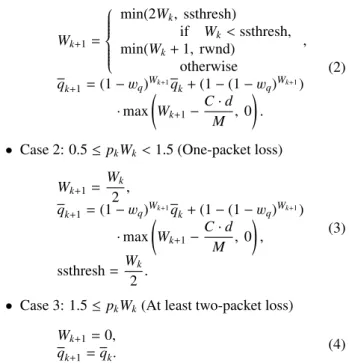
(2) IEICE TRANS. FUNDAMENTALS, VOL.E99–A, NO.6 JUNE 2016. 1248 Table 1 Parameters of the TCP network. Receiver advertised window size (rwnd[packets]) 1, 000 Link capacity (C[bps]) 1.54 × 10⁶ Round-trip propagation delay (d[sec]) 22.8 × 10⁻³ Packet size (M[bits]) 4, 000. Fig. 1 Structure of the drop probability of a packet. When q is less than qmin , p is set for zero, thus all packets will be received without loss of packets.. pk+1. 0 1 = qk+1 − qmin pmax qmax − qmin. if qk+1 ≤ qmin if qk+1 ≥ qmax otherwise (1). where, qmin and qmax are the minimum and maximum queue threshold values, respectively. pmax is the maximum packet drop probability. They determine the value of pk . Figure 1 sketches the shape of Eq. (1). • Case 1: pk Wk < 0.5 (No loss) min(2Wk , ssthresh) if Wk < ssthresh, , Wk+1 = min(W + 1, rwnd) k otherwise (2) qk+1 = (1 − wq )W(k+1 qk + (1 − (1 −)wq )Wk+1 ) C·d · max Wk+1 − ,0 . M • Case 2: 0.5 ≤ pk Wk < 1.5 (One-packet loss) Wk , 2 qk+1 = (1 − wq )W(k+1 qk + (1 − (1 −)wq )Wk+1 ) C·d · max Wk+1 − ,0 , M Wk ssthresh = . 2 Wk+1 =. (3). • Case 3: 1.5 ≤ pk Wk (At least two-packet loss) Wk+1 = 0, qk+1 = qk .. (4). ssthresh means the threshold value of a congestion window size, and rwnd, C, d, and M are parameters of the TCP network, and we employ these parameters as Table 1 [2]. wq is the weight factor of a low-pass filter to get the average queue size qk . Especially, qmax , qmin , pmax and wq are adjustable parameters of TCP/RED, and others are constant parameters. The S-model can be considered as a two-dimensional hybrid dynamical system, and it is composed of 11-tuple maps from Eqs. (1)–(4). Subspaces for each map are shown in. Fig. 2 Subspace for 11-tuple maps. This figure indicates seven subspaces only. The others are located in outside of this range, or they have no areas, e.g. generally rwnd is set as large value, and Wk is always smaller than it.. Fig. 2. Note that, subspaces are illustrated only seven areas because some maps have no regions in which the conditions of some maps are satisfied on the state space with normal settings of parameter values. 3. Bifurcation Analysis It is generally difficult to determine bifurcation parameters in hybrid dynamical systems by discontinuity of a state space, e.g., a hysteresis or a switch [14]. Discrete time hybrid dynamical systems are described as piecewise smooth functions, and they have an interrupt characteristic. It causes some problems for the analysis of bifurcation structures, but in our previous study analysis method for discrete time hybrid dynamical systems has been proposed [13]. The hybrid system is defined as follows: xk+1 = f (xk ) = fi (xk ) if. xk ∈ Di ,. (5). where xk ∈ Rn is the state, f is a function satisfying f : Rn 7→ Rn . fi , i = 1, 2, . . . m are C ∞ -class functions that are used on subspace Di . Thus, the applied functions are selected from fi , depending on the location of the current state xk . The solution φ is defined as xk = φ(x0 , k),. (6). where x0 is the initial value, which satisfies x0 = φ(x0 , 0). The detection of bifurcation parameters is difficult because Eq. (6) has non-smoothness on boundaries between two subspaces. If periodic points that satisfy Eq. (7) exist, the Jacobian matrix of a discrete time system is expressed as: x∗0 = φ(x∗0 , p).. (7).
(3) LETTER. 1249. ∂φ ∂ f ∂φ ∂φ (k + 1) = (k), (0) = I, ∂x0 ∂x ∂x0 ∂x0. (8). where ∂φ/∂x0 (k) represents the Jacobian matrix, which can estimate the stability of periodic points. However, in the case of a hybrid dynamical system, f is a C 0 -class function. To analyze the stability of the solution and to detect its bifurcation parameters, the Jacobian matrix is necessary, but it accomplished by using derivative of Eq. (6). In hybrid dynamical systems, function f is selected from fi , according to the state x. Additionally, the derivation of maps can be expressed by the same way. The Jacobian matrix is also calculated as follows:
(4) ∂φ ∂φ ∂ fi
(5)
(6) ∂φ
(7)
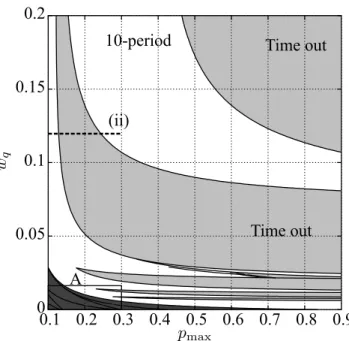
(8) (k + 1) = (k), (0) = I. (9) ∂x0 ∂x x ∈D ∂x0 ∂x0 k. i. The shooting method can be applied to solve Eq. (7) by using these equations. The border-collision bifurcation is the characteristic phenomena in the hybrid dynamical system, and it occurs when periodic points across the border that defines each subspace. It can be analyzed by adding the function defines the border to the recurrence formula of the shooting method, and they are expressed as follows: F(λ) = η(φ(λ)) = 0 ∂η(λ) ∂φ F ′ (λ) = =0 ∂q ∂λ. Fig. 3 Bifurcation diagram in the pmax –wq plane. other parameters are qmin = 5, qmax = 15, ssthresh = 20, and Table 1. All of bifurcation phenomena in this parameter ranges are BC-bifurcations.. (10) (11). where λ is the parameter, e.g., wq , pmax and so on. The Jacobian matrix is computed by Eq. (8). Note that, ∂φ/∂λ is given by
(9)
(10) ∂φ ∂ fi
(11)
(12) ∂ fi
(13)
(14) ∂φ
(15)
(16) (k + 1) = (k) + (12) , ∂λ ∂x
(17) xk ∈Di ∂x0 ∂λ
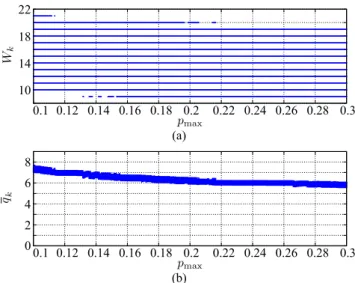
(18) xk ∈Di ∂φ (13) (0) = 0. ∂λ Additionally, in analysis of the border collision bifurcation, there is the serious problem explained, but we proposed the its workaround technique [13]. In this letter we use above shooting method and expansion borders for the BC bifurcation analysis. 4.. Analysis Results. We analyze bifurcation structures of the S-model. Figure 3 shows the two-parameter bifurcation diagram in the pmax – wq plane. The system with parameters on gray regions occurs the “At least two-packet loss”. The time out occurs because of dropping some consecutive packets; hence senders close the window size and have to wait the idle time. As a result, the throughput of the router will decrease. All bifurcation phenomena in this parameter ranges are bordercollision (BC) bifurcations, and some bifurcation sets have Arnold tongue structures. Figure 4 shows the magnification diagram of Fig. 3. It is confirmed that various periodic regions exist and they have an Arnold tongue structure. These. Fig. 4 Magnified figure of rectangle A in Fig. 3. Various periodic attractors are embedded in this region. The numbers in the figure show the periods of attractors.. parameter sets are also BC bifurcations. The one-dimensional bifurcation diagram varied the parameter pmax on the line (i) (wq = 0.002) in Fig. 4 is shown in Fig. 5. Figures 5(a) and (b) shows Wk and qk respectively. Many BC bifurcations happen, and they cascade with varied pmax . The average queue size decreases slowly. Therefore, the BC bifurcation phenomena affect the performance of TCP/RED. Figure 6 shows one-dimensional bifurcation diagram with wq = 0.13 on the line (ii). When wq is increased, Wk and qk has constant values against varying wq ..
(19) IEICE TRANS. FUNDAMENTALS, VOL.E99–A, NO.6 JUNE 2016. 1250. tion structures of the S-model constructed from TCP/RED. From analysis results observed bifurcation phenomena in this mathematical model are mainly BC-bifurcations. From bifurcation diagram Fig. 4, they have formed Arnold tongue structures. From bifurcation structures and one-dimension bifurcation diagrams, the tendency of the performance and parameter regions in which the TCP/RED system occurs the time out and the idle time are clarified. As a result, to alleviate the timeout, and to keep the average queue size, the weight factor should be set as lower values, i.e. wq = 0.002, but the timeout caused by dropping multi packets will occur when the max drop probability pmax is set as the large value by BC bifurcations. Acknowledgement Fig. 5 One-dimensional bifurcation diagram varied the parameter pmax on the line (i) in Fig. 4. (wq = 0.002) (y-axis: the window size Wk and the average queue size qk [packets]).. This work has been supported by JSPS KAKENHI Grant Number 25420373. References. Fig. 6 One-dimensional bifurcation diagram varied the parameter pmax on the line (ii) in Fig. 4. (wq = 0.13) (y-axis: the window size Wk and the average queue size qk [packets]).. On the line (ii), BC bifurcations do not occur with varying wq , and it is easy to see by the comparison with Fig. 4. Therefore steady state of the model is not changed, and state variables have the same vale for various wq . However, the average queue sizes have sparse values than the wq = 0.002 case, and include small values. Thus the throughput of the model is lower than previous one. Moreover, the time out happens at the middle value of pmax (the shaded region). As a result, in the S-mode, it can be considered that the weight wq should be set as lower value, e.g. wq = 0.002, thus weak low-pass filter is suitable for this network [2]. 5.. Conclusion. In this letter, we have investigated the stability and bifurca-. [1] S. Floyd and V. Jacobson, “Random early detection gateways for congestion avoidance,” IEEE/ACM Trans. Netw., vol.1, no.4, pp.397–413, Aug. 1993. [2] H. Zhang, M. Liu, V. Vukadinovi´c, and L. Trajkovi´c, “Modeling TCP/RED: A dynamical approach,” Complex Dynamics in Communication Networks, Understanding Complex Systems, pp.251–278, Springer-Verlag Berlin/Heidelberg, 2005. [3] M. Liu, A. Marciello, M. di Bernardo, and L. Trajkovic, “Discontinuity-induced bifurcations in TCP/RED communication algorithms,” Proc. 2006 IEEE International Symposium on Circuits and Systems, ISCAS 2006, 2006. [4] J. Postel, “Transmission control protocol,” Tech. Rep. 793, Request for Comment (RFC), Sept. 1981. [5] M. Allman, V. Paxson, and W. Steven, “TCP congestion control,” Tech. Rep. 2581, Request for Comment (RFC), April 1999. [6] V. Jacobson, “Congestion avoidance and control,” SIGCOMM Comput. Commun. Rev., vol.18, no.4, pp.314–329, Aug. 1988. [7] K. Fall and S. Floyd, “Simulation-based comparisons of Tahoe, Reno and SACK TCP,” SIGCOMM Comput. Commun. Rev., vol.26, no.3, pp.5–21, July 1996. [8] J. Padhye, V. Firoiu, D.F. Towsley, and J.F. Kurose, “Modeling TCP Reno performance: A simple model and its empirical validation,” IEEE/ACM Trans. Netw., vol.8, no.2, pp.133–145, April 2000. [9] P. Kuusela, P. Lassila, J. Virtamo, and P. Key, “Modeling RED with idealized TCP sources,” Proc. IFIP ATM & IP 2001, pp.155–166, June 2001. [10] Y. Zhang and L. Qiu, “Understanding the end-to-end performance impact of RED in a heterogeneous environment,” Tech. Rep., Ithaca, NY, USA, 2000. [11] D. Lin and R. Morris, “Dynamics of random early detection,” SIGCOMM Comput. Commun. Rev., vol.27, no.4, pp.127–137, 1997. [12] H. Ohsaki and M. Murata, “Steady state analysis of the red gateway: Stability, transient behavior, and parameter setting,” IEICE Trans. Commun., vol.E85-B, no.1, pp.107–115, Jan. 2002. [13] D. Ito, T. Ueta, T. Kousaka, and K. Aihara, “Bifurcation analysis of the Nagumo-Sato model and its coupled systems,” Int. J. Bifurcation and Chaos, vol.26, no.3, 1630006 (11 pages), March 2016. [14] K. Kinoshita, T. Ueta, H. Kawakami, J. Imura, and K. Aihara, “Bifurcation phenomena of coupled piecewise affine system with hysteresis properties,” Proc. NOLTA 2011, pp.407–410, Sept. 2011..
(20)
図
関連したドキュメント
In particular, we consider a reverse Lee decomposition for the deformation gra- dient and we choose an appropriate state space in which one of the variables, characterizing the
Keywords: continuous time random walk, Brownian motion, collision time, skew Young tableaux, tandem queue.. AMS 2000 Subject Classification: Primary:
Keywords and phrases: super-Brownian motion, interacting branching particle system, collision local time, competing species, measure-valued diffusion.. AMS Subject
We present a novel approach to study the local and global stability of fam- ilies of one-dimensional discrete dynamical systems, which is especially suitable for difference
In order to be able to apply the Cartan–K¨ ahler theorem to prove existence of solutions in the real-analytic category, one needs a stronger result than Proposition 2.3; one needs
We have introduced this section in order to suggest how the rather sophis- ticated stability conditions from the linear cases with delay could be used in interaction with
This paper presents an investigation into the mechanics of this specific problem and develops an analytical approach that accounts for the effects of geometrical and material data on
While conducting an experiment regarding fetal move- ments as a result of Pulsed Wave Doppler (PWD) ultrasound, [8] we encountered the severe artifacts in the acquired image2.
