Title
A Comparative Study of Language Policy and Actual English
Education Between Korea and Japan
Author(s)
Yamazato, Keiko; Kinjo, Seiko
Citation
沖縄キリスト教学院大学論集 = Okinawa Christian
University Review(9): 13-29
Issue Date
2012-12-28
URL
http://hdl.handle.net/20.500.12001/17484
A Comparative Study of Language Policy and
Actual English Education between Korea and Japan*
Keiko Yamazato** Seiko Kinjo***
Abstract
Among international languages, English is used in many cases (almost in all cases) in interna-tional affairs as the principal means of communication among people throughout the world. So, it is quite natural for English language teachers in any country to have developed a strong desire to help their students learn English properly in their daily lessons. However, it shouldn't be forgotten that teachers in their daily practices, in whatever country, must follow the directions given by their respec-tive ministries of education. This paper critically assesses how English education is organized in Korea and Japan, comparing political backgrounds, teacher training programs, English textbooks, and actual English lessons at school.
1 . Introduction
In the age of globalization, people are asked to communicate with each other wherever and whenever they meet. In order to exchange infor-mation on a certain matter they have to cope with, they need a means of communication and they quite naturally use the English language for that purpose. It means people are expected to be ready to use the English language at that mo-ment, anticipating that all the people who commu-nicate with have already received a good English education at school in advance.
Language Education in any country is done under its government language policy, and teach-ers are obliged to follow it. If a government has a plan to lead the nation people's English ability up to the level of native speakers of English, it will take strenuous and effective measures to help teachers conduct their English classes as success-fully as possible.
English teachers 1n each country want to help their students become good members of the global society, so they are curious about the English education in neighboring countries. When they get information of an effective way of teach-ing and its good outcome, they want to observe it and introduce it to their own classes.
One of Japan's neighboring countries is Korea
and their English education seems far better than that in Japan shown by that nation's higher rank in the TOEFL recently. This fact has caused the authors of this paper to compare the situation of English education in Korea and that of Japan. Therefore, this paper pursues a study of each country's English language policy, English text-books, and its actual English education at school. It will also give advice to Japanese English teach-ers on how to improve their teaching in order to respond to the requests from the present global society.
2. English Language Policy in Korea
According to one of the scholars who have been studying the English Education in Korea, Professor Mice Poonoosamy, Monash University in Australia, "the South-Korean government has kept the sustainable language policies to have an authoritative voice in the global world since 1990 till today." The government also offers a special scholarship program named TALK (Teach and Learn in Korea) to encourage people in educationally weak areas to learn English (Poonoosamy, 2009). This measure by the government is to assure that students in each school no matter where it is lo-cated in Korea are given an equal opportunity to have access to a good English education. The
gov-ernment doesn't forget Lo offer one more impor -tant program to the people in Korea in order to meeL the government ambiLion; LhaL is, an "English Teacher Training Program." This training pro-gram is described in SecLion 4. "In-Service Teacher Recurrent Education between Korea and Japan" in this paper.
2. 1. The English Levels the Korean Educators Airn at If Eng·lish teachers really understand what their government and Lhe g·lobal society request young· people, they will pay much aLtention Lo what sort of English education should be pro-grammed in Lheir school curriculum. The members of English educational reform group in Korea set up the final goal of their English education as fol -lows:
The kind of English we need today is not the kind of tourist Eng·lish, but the lan-guage of economics, science and tech nol-ogy" (Lee, Feb. 2011).
Businessmen in Korea notice that they truly need English ability to improve Lheir business as global business (NIKKEI BUSINESS, 2012). This is their way of surviving in the cun·ent situation of the business world (NIKKEI). Therefore, Koreans have naturally become more in teres ted in teaching
I
learning Eng· I ish so that the content of Eng·lish education has been improved year by year.Having such voices, they have been creating new interview questions for college entrance ex-amination. Professor Wonkey Lee, Seoul National University of Education showed sophisticated ques-tions as examples at The Japan Language Testing Association held at Momoyama Gakuin University in Japan in October, 2011. The two figures in the right column are a part of Lhe samples provided by Professor Lee (Lee, October, 2011).
The questions m these two fig·ures are class
i-(Type 5) Explain the given infonnation 1. An lntemet blog site asked its users whether they preferred light or dark backgrounds in blog design. The results were:
.
··
"'t
r)·,,o,l'rof••
l gl":f "•I (J:Jfl-,B;t:l-:-;l'ltln•l' 0111) £3¥ (J'
• ' ' I
""· .. '
How about you? Do you prefer light or dark backgrounds on a blog? Describe the diagram
using "majority." "quite a few."
and only.' Then say your
opinion. You'll be given one
minute to prepare your answer.
Th8 mqjortty lrke light baci<Krounds but QUtla n ftJw ""aders think it depends upOI) tb()
blog design. Only one tenth go for dor/t. b6ckgounds. As for me, I ogn:c w;(ll the f11RJOrfty. I tlunk light background IS more /Jppropn'ato lorn blog; J1>11en I soo a blog wrth
darlo. background. I tend to thin!< the ,;,rormiltion provided in the blog is unref,oble. I
don't know why, but 1t 5 trvo.
Nolc: tl7% Always Light 10% Always Dank Figure 1 36% Depends on lhe Blog 7% I don\ Care Either Way (Lee)
2. Look at the bar chart. which presents the percentage of the
subjects that high school students like to study. Compare and contrast each subject's ratio on the basis of the chart. and give us your opinion about your preference.
o/o) 40
Total vote: 210
30
20
~0
· Studt!Jits preferencos of the subp:cts tlHJ m tht! order of Chr:mPJstr,•. Biology. Phys,cs.
Astronomy. Compos/fum, Enrth Scumc~. CnJ(I;sh n11d Mnth
· Cht!mr:"itry is thr most f.JI'ot('d subjcc:. nnd Mnth IS tlltJ ltJast fn'.-o,-ed subject
· Acllt;JI/y I don't I!J.e Chcmislly v~:ty much unltlr.tJ these .~tudents. My f.Jvontc sub)t>Cl
is /Jiology.
Figure 2
(Lee)
fied in Type 5, the second highest level of the in-terview test. These are for an interview test, not for a reading test. Korean hig-h school students need to be trained to read what the i terns and the numbers of the figures indicate and at the same Lime they have to express Lheir thoughts related to Lhese data in the figures. The educators are ac-tually leading younger people toward the govern-ment ambition, that is, to have an authoritative voice in the global world and to respond to the r e-quest from the global society.
Not only high school students but also the students at every school in Korea are encouraged
-to learn English properly to achieve the government students are allowed to say this fragment.)
desi1·e. The Course of Study by the Ministry of @one student throws the die
Education states that elementary school students @everybody responds referring to the dots on
are fostered to be able to have conversation about the face of the die, "Wow, five!" their daily routines and general topics (Kim, 2011).
Their English textbooks are compiled along with They took turns to throw the die and drew
the statements introducing a large number of words to help them be good at conversation. Korean elementary school children are supposed to leam 500 words, junior high school children 1,290 words and senior high school students 2,800 words
(The Ministry of Education, Culture, Sports, Science
and Technology=MEXT, 2011)
Even elementary school students are asked not only to memorize words, but also to read and write as well as learning difficult grammatical items.
Teachers at a private school (Kyunhee Elementary
School) where the authors visited made the stu -dents challenge to learn such words: invisible, con
-fidential, exterminate, accomplish, justice, etc. One of the male students made up a very beautiful sentence usmg a difficult sentence structure "If I
were ... , I would .... " The sentence he made is "If I were invisible, I would visit North Korea." This
is not tourist English at all, but it reflects the
student's real state of mind about a not easy po-litical situation between North Korea and South
Korea.
At a public elementary school (Anpyeong Ele
-mentary School), the third graders whom the
authers observed showed their enthusiastic behav -ior in mastering the English expression of "How many do/ does ... have?" in their English activity. They were divided into several gToups and each of which was asked to draw a monster they were
creating on a large sheet of paper. Each group was
given a die and color pens. The activity went as fol-lows:
CDstudents in one group say, "Lets' make ears." @and ask in chorus "How many ears?"
(The teacher says in a full sentence, but the
a beautiful or ug·ly monster. All the students could say the question, and every student could answer
it. They could not only give responses orally, but also read and write the sentences or fragments of what they were saying. In addition, each of them made a report of what she/he'd done in the ac tiv-ity in front of the classmates.
®she
I
he made a report saymg "My monster has five ears!" pointing out the ears of themonster she/ he drew with the group-mates.
Such class activity with students' reports as the summary of the class has never been observed in Japan. It's raLher the teacher's job to summa -nze the class.
Another impressive thing of the same class
was the rules of studying in class. The rules are
written on a piece of paper and placed on the board m front of the students. See Picture 1.
The picture tells that the third graders at Anpyeong· Elcmen tary School have already started to seek what learning means: Love and respect e very-one! How beautiful it is!
r
h- d
-- -- d
3. English Language Policy in Japan A great voice of reformation of English edu-cation in Japan was announced by the late Prime Minister Keizo Obuchi in the late 1990s. He was keen on globalization so that he often challenged himself to speak English and asked English teach-ers to improve the Japanese people's English abil-ity to be able to use it adequately at the right moment, especially in a situation of oral commu-nication. Because Japanese people have been taught English based on the Grammar Translation Method, they understand English from the point of view of linguistics, but not as a means of communication. As a result it has caused them not to be good at speaking English. And what is worse, their inabil-ity of speaking in English has been severely criti-cized by the people of other nations.
The Ministry of Education, Culture, Sports, Science and Technology (=MEXT) arranged its Ad-visory Organ and started to seek possible ways to put the late Prime Minister Keizo Obuchi's pro-posal into practice (Hatta, 2003). Therefore, edu-cators began to consider implementing English Edu-cation at elementary school and offered a chance of experimenting with teaching English in a few elementary schools supported by the Ministry. Fi-nally all elementary schools commenced teaching English in 2011 (MEXT, 2010). While these matters were being dealt with, teaching /learning Aural
I
Oral English was stressed and introduced to Junior High School and Senior High School instead of grammar centered English education.3. 1. English Levels the Japanese Educators Aim at The Ministry's official guidelines (the Course of Study) for school-teaching state as follows:
CDFor Elementary School (overall objectives): ···familiarizing pupils with the sounds and basic expressions · · ·
®For Lower Secondary School (overall objec-tives):
To develop students' basic practical communi-cation abilities such as listening and speaking,
@For Upper Secondary School (overall objec-tives):
To develop students' practical communication abilities such as understanding information and the speaker's or writer's intentions, and expressing their own ideas · · · (There are six subjects)
Aural/Oral Communication I, Aural/Oral Communication II, English I, English II, Read-ing, Writing
As they are observed, the overall objectives for elementary school and lower secondary school emphasize the sound part of language. It means the educators do not pay much attention to the number of words students have to acquire. High school students may have to learn many English words if they wish to study the subjects of read-ing and writread-ing. However, the guidelines focus on English sounds too much and they have reduced the number of words in English education. Here are the changes.
<High School Level>
2,400-3,600 (1970)- 1,400-1,900 ('77)-1,400 ('89)- 1,300
('98)-[1,800 (2011, but not yet introduced)] <Junior High School>
950-1,100 (1970) -900-1,050 (1977)-1,000 (1989)- 900 (1998)- 1,200(2011)
(MEXT, 2011)
With that small number of words (1,300), what kind of topics can Japanese high school stu-dents discuss? Are they studying "Tourist English?" How about Junior High School students? They have studied only 900 words. The educators might have noticed the number was not good enough. There are now 1,200 words in the newly revised
-16-English textbooks.
Is it possible for Japanese students to express their political situation with this small vocabulary size? How far they are behind Korean students! Are Japanese English teachers satisfied with this fact?
4. In-service Teacher Recurrent Education between Korea and Japan
Teachers wish to have a chance to improve their teaching skills and also want to learn how to take care of their students along with changes in the students' environment which influences the current life style of young people. Teachers can-not ignore this.
4. 1. The Case of Korea
It is desired that the homeroom teachers at elementary school should introduce English to their students. The teachers are assigned to get the 120 hours training during the long vacation in August (Kim). From 200 to 300 participants attend and they get lectures at an educational institution or a college of education. The contents of this recurrent education program are as follows:
CDLectures about teaching methods and English teaching theories by college instructors or specialists: about nine hours in total.
®Group work in English conversation, pronun-ciation, classroom English, how to use flash cards and how to conduct the English class. The first three are taught by native speakers of English.
@Lesson hours: Two hours a day. Forty hours for English conversation. Sixty hours for training of using flash cards and classroom English and managing a class.
@Lectures by Principals and senior teachers giving their experience
®Explanation about the actual situation of English education at local schools by some members of the board of education there.
@Utilizing the elementary school-related site on the internet to get various rna terials
®Making teaching plans for fifty hours and doing teaching demonstrations
4. 2. The Case of Japan
Colleges of education offer a special course for the teachers who are in charge of English ac-tivities at Elementary School. There are three fields in the course: to do English communication prac-tice for twenty hours, to learn basic theories of teaching English for eight hours and to practice how to conduct an English class for twelve hours. The lessons of the course are taught by native speakers, famous Japanese English teachers, some teachers from Prefectural Education Centers and universities. The period of training lasts from eight days to twenty days. However, it is possible to entrust the training plan to each local board of education, so that the local board can offer many fewer hours of training like from six hours to twenty seven hours only as happened in 2005 (Kim).
5. Overall Goals of English Education and Textbooks Used in Japan and Korea
Section 3.1. illustrates partially Japan's Course of Study concerning the overall objectives of the Ministry of Education, Culture, Sports, Science, and Technology (MEXT), but in this section it is com-pared with that of Korea. The overall objectives of English education influence the curriculum as well as the contents of textbooks. English textbooks for elementary schools and middle schools in both coun-tries are examined to see if there is any difference.
5. 1. General View of Revised Curriculum in Korea and New Course of Study in Japan
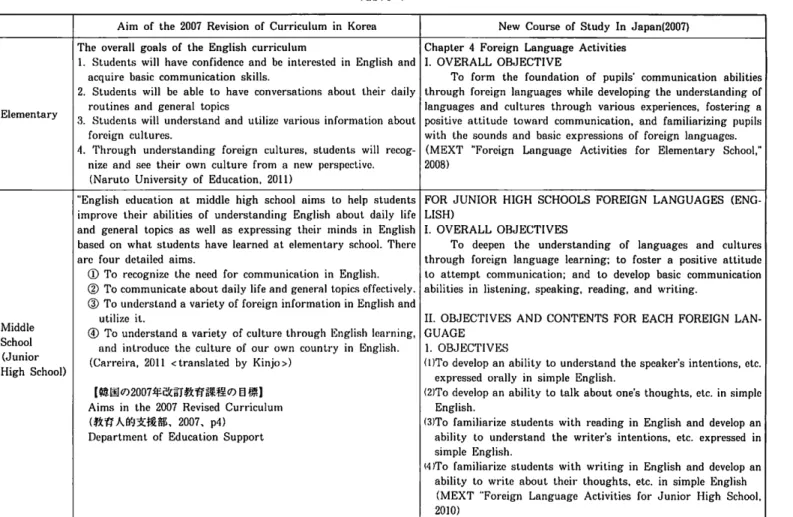
Table 1 on the following page shows the "Aim of the 2007 Revision of Curriculum in Korea" and the "New Course of Study in Japan (2007)" for elementary schools and junior high schools in both countries.
Elementary Middle School (Junior High School) Table 1
Aim of the 2007 Revision of Curriculum in Korea New Course of Study In Japan(2007) The overall goals of the English curriculum Chapter 4 Foreign Language Activities
1. Students will have confidence and be interested in English and I. OVERALL OBJECTIVE acquire basic communication skills.
2. Students will be able to have conversations about their daily routines and general topics
3. Students will understand and utilize various information about foreign cultures.
4. Through understanding foreign cultures, students will recog-nize and see their own culture from a new perspective. (Naruto University of Education, 2011)
To form the foundation of pupils' communication abilities through foreign languages while developing the understanding of languages and cultures through various experiences, fostering a positive attitude toward communication, and familiarizing pupils with the sounds and basic expressions of foreign languages. (MEXT "Foreign Language Activities for Elementary School," 2008)
"English education at middle high school aims to help students FOR JUNIOR HIGH SCHOOLS FOREIGN LANGUAGES (ENG-improve their abilities of understanding English about daily life LISH)
and general topics as well as expressing their minds in English I. OVERALL OBJECTIVES
based on what students have learned at elementary school. There To deepen the understanding of languages and cultures arc four detailed aims. through foreign language learning: to foster a positive attitude
CD To recognize the need for communication in English. @ To communicate about daily life and general topics effectively. @ To understand a variety of foreign information in English and
utilize it.
@) To understand a variety of culture through English learning, and introduce the culture of our own country in English. (Carreira, 2011 <translated by Kinjo>)
[~I!JQ)20071F~iJ¥t'«~lUfQ) 13m?) Aims in the 2007 Revised Curl'iculum (ftff AO':J:Jl:ti$, 2007, p4)
Department of Education Support
to attempt communication: and to develop basic communication abilities in listening, speaking, reading, and writing.
II. OBJECTIVES AND CONTENTS FOR EACH FOREIGN LAN-GUAGE
1. OBJECTIVES
(!)To develop an ability to understand the speaker's intentions, etc. expressed orally in simple English.
(2lTo develop an ability to talk about one's thoughts, etc. in simple English.
(3)To familiarize students with reading in English and develop an ability to understand the writer's intentions, etc. expressed in simple English.
14lTo familiarize students with writing in English and develop an ability to write about their thoughts, etc. in simple English
(MEXT "Foreign Language Activities for Junior High School, 2010)
Table 1 can be briefly summarized as follows: 51
h grade. When the 7111 national curriculum was
revised in 2007 after an interval of ten years, "Read-ing" was introduced in to the 3rd grade and "Writ-ing" into the 41
h grade as the Nation Common Basic
Curriculum. (!)While Korean elementary school students are
helped to acquire basic communication skills, Japanese students are helped to form the foundation of communication abilities and to be-come familiar with the sounds of English. ®While Korean middle school students are
mak-ing use of English skills obtained at elementary school to understand a variety of foreign infor-mation in English and express their minds, Japanese students are helped to become famil-iar with reading and writing English.
5.2.English Curriculum for Elementary School in Korea and Japan
In 1997 the 7th curriculum was established in Korea, but the 6th curriculum was still active for a while. Under the 6th national curriculum, only "Listening" and "Speaking" started in the 3rr1 grade, "Reading" in the 4th grade and "Writing" was in the
On the other hand in Japan, under the Chapter Four Foreign Language Activities by MEXT, Eng-lish education at elementary school is generally (not grade by grade) stated as aiming at fostering a pos-itive attitude toward communication, and familiar-izing pupils with the sounds and basic expressions of foreign languages. Therefore, students are not asked to learn Reading and Writing. Concrete ex-amples of these are shown in Table 2 and Table 3 in Section 5.3.
5. 3. English Textbooks
Textbooks are the right ones to understand what is taught at school. It may be possible to see how much of the government's ambition is reflected
-Table 2
I
KoreaI
The number-Skills-•••
of the words Listen Speak Read Write Otherst ~
1. Let's Play
3"' 80-120 1. Look and Listen 1. Look and Listen
grade (92 pages) 2. Listen and Repeat 2. Listen and Repeat 1. Let's Read Not Identified Chant, Songs, Games and Role play 1. Let's Play 411' 80-120 1. Look and Listen 1. Look and Listen
1. Let's Read 1. Let's Write 2. Let's Chant and Sing
grade (98 Pages) 2. Listen and Repeat 2. Listen and Repeat 3. Let's Role Play
4. Let's Review
5'h 1. Look and Listen 1. Listen and Speak 1. Listen and Read 1. Let's Write 1. Let's Practice
90-130 2. Read and Write
grade 2. Listen and Repeat 2. Look and Speak 2. Let's Read
3. Listen and Write 2. Let's Sing/Chant
6'h 90-130 1. Look and Listen 1. Listen and Speak 1. Listen and Read 1. Let's Write 1. Let's Practice
2. Read and Write grade (136 pages) 2. Listen and Repeat 2. Look and Speak 2. Let's Read
3. Listen and Write 2. Let's Sing I Chant (Nishiko)
Table 3
I
JapanI
~Contents~The number of the words
~
Let's Sing Let's Play Let'sI
ListenI
Let's Chant Activity5th 130 (64 pages) © © © © ©
6th 150 (64 pages) © © © © ©
©: conducted (Tsuruta)
"English Notebook" is constructed as follows;
(l)Let's Sing··· to sing songs with simple gestures
(2)Let's Listen ... to listen to the CD and choose right answers (3)Let's Chant ... to practice utterances in chants using CDs
(4 )Let's Play · · .... · ... · ... · to play games
(5)Activity (conversation) ... to talk with friends using English By Keiichi Tsuruta,
Ofuse Municipal Kurigaoka Elementary School
in them.
5.3.1. English Textbooks for Elementary School Table 2 and Table 3 show the contents of the textbooks used for Elementary School English Edu-cation in Korea and Japan.
5.3.1.1. Korean English Textbooks for Elementary School
Table 2 shows that the students 1n the 3ro grade in Korea learn from 80 to 120 words and they practice "Listen and Speak" using these words. When they become 4th graders, they also learn the same number of words. They start to read and write 1n addition to "Listen" and "Speak."
As it is observed in "The Overall Goals of the English Curriculum," the students in Korea start to
practice basic communication skills in their 5th grade. They learn many more words (340--500 in total) in the 6th grade.
5.3.1.2. Japanese English Textbooks for Elementary School
Table 3 shows the general contents of the Japa-nese textbooks, which are actually called "English Notebook." The contents are Let's Sing, Let's Play, Let's Listen, Let's Chant and Activity. When the contents of the Japanese Notebooks are compared with the contents of Korean textbooks, it is noticed how small the number of words that is learned by Japanese students. They learn only 280 words in two years in the 5th and 6th grades. The difference in English education between Japan and Korea seems to come from the difference of naming the
subject in the school cwTiculums: "English
Educa-tion" in Korea and "Foreign Language Activity" in
Japan. Therefore, elementary school students 111
Korea have to learn all four language skills by
the time they finish 6th grade. On the contrary,
Japanese students are not asked to learn all of
the four language skills, but only two, Listening
and Speaking during their elementary school days.
Foreign Language Activities have been
prac-ticed at Japanese elementary schools since 2011. The
"English Notebook" is used as the English
Leach-ing
I
learning material for teachers and students.Depending on the scene on the page, the Japanese
language is also used.
The four items in Table 3-Let's Sing, Let's
Play, Let's Listen and Let's Chant -are not the
so-called four skills in English learning. The con
-tents seem to be designed Lo have an aim that
students will become familiar with English through
the activities such as responding to English sounds
and rhythms paying no attention to English letters.
<D I want to go to Italy. fj":) "C ~ 1::: l. ,.~ .._!11l'~&3 Picture 2
I
J
ln order to explain what kind of activities is taken
into "Let's Listen," two pictures from the English
Notebook fot· 6'" gradet·s are shown below.
Picture 2 indicates that 6'" graders are asked
to listen to English on a CD containing the se
lf-introductions of the four people pictured on the page
and to write the names of their countries in
J /\PAN ESE. The purpose of Picture 2 is to help
students learn the flags of various countries and get
accustomed to saying "I want to go to- ." Picture 3
indicates that students at·e asked to listen to English
on a CD and match three items: person, country
andt·eason. In this matching, students at·e asked to
talk in l~nglish about the country and give the
t·eason why each pet-son in the picture wants to go to
that particular country.
These at·e the samples of one aspect of "Li
s-tening" activities in "English Notebook" which the
Japanese Ministt·y of Education made for 6'" gr
ad-ers. On the other hand, teachers arc advised not
to put weight on "Writing or Rc:=tding," and they
tl
·
•-
·
_ J Kon~
Anno • ~.
.
..
•
••
Picture 3 - 20-(1)Before you begin
(2)Listen and Talk
(3)In Conversation
(4)Communication Task
(5)Enjoy Reading
(6)After You Read
(?)Grammar in Use
{8)Think and Write
(9)Project \Nark
(IO)Let's Check
*total page: 14 pages
(2 pag·es) (2 pages) (1 page) (1 pag·e) (2 pages) (1 page) (1 page) (1 page) (1 page) (2 pages) Listening 5 Speaking 3 Reading Figure 3
should not use any grammatical expressions aL all.
On the contrary, in Korean textbooks for 6'"
graders, Reading and Writing sections are included.
Even though Japanese elementary school students are taught about 130 English words in Lhe 5'" grade
and 150 in the 6'" grade, Korean students are
taught 90~ 130 words in each grade (5'" and 6'")
and 80~ 120 (3'd and 4'"). At the end of elementary
school education, Japanese students learn only half
Lhe number of words that Korean students do.
5.3.2. English Textbooks for Middle School/ Junior
I-Iig·h School
The number of items to be learned by middle
school students is another concern of English teach
-ers.
5.3.2.1. Korean Eng·lish Textbooks for Middle
School
Figure 3 shows the general structure (con
-tents) of textbooks for Middle School (MIDDLE
SCHOOL ENGLISH 1, 2011).
The lesson with 14 pages is divided inLo four categories: Speaking, Listening, Reading and Writ
-ing which have the ratio of 5:3:3:3. As far as the
structure is observed in Figure 3, it can be said
Lhat "Speaking" is regarded as the most imporLanL skill so that the other three skills; Listening,
Read-ing and WriLing are kept in a good balance although with a smaller ratio than speaking.
When the authors visited Seocho Middle School
(public school in Seoul), they had a chance to see
their English textbooks and to observe an ordinary
English class which was conducted in English. The
four category ratio of 5:3:3:3 was acLually there.
5.3.2.2. Japanese Eng·Jish TexLbooks for Junior
High School
The general structure of one lesson in a typical
Japanese English textbook is as follows. (ONE
WORLD English Course 1, KYOIKU SHUPPAN
2012)
(!)Key Sentence
(2)Conversalion expression
(3)New Wot·ds (1 page) (4)Vocab(vocabulary) Builder (5)Acti vi ty ( 1 page)
*total page: 6- 8 pages
repeated Lo cover
2- 3 pages
The lesson with 6 ~ 8 pages shown above has
five items from (1) to (5), but four items from (1)
Lo (4) are repeatedly used. IL means each page has
a new key sentence, new words and new conver
sa-tion expressions. Because of these well balanced
items on each page, Speaking exercises a1-e far less
than that of Korean textbooks. The lasL iLem "Activ
that lesson.
5. 4. Discussion of English Textbooks, Students and Teaching at Middle School/Junior High School
Judging from the number of items in the two different structures of textbooks, it could be said how well Korean Textbooks are compiled while Jap-anese textbooks seem rather rough. One page of the Japanese textbook contains new words and a key sentence, and the same page also includes practices of the four skills. If one page has a gram-mar item (key sentence), the teacher must explain it in Japanese. Then the class becomes rather teach-er centteach-ered.
Students 1n Korea have already started to learn English as an ordinary subject of school curric-ulum in Elementary School so that they have the basic four skills of the English language before they enter Middle School. They can produce what they want to say about their daily life in their own words. If they go through 10 items of the struc-ture of the textbook stated on page 21, they can think, write, speak and read far better.
Japanese students have to start reading and writing English words (even letters) when they be-come junior high school students because Japanese Elementary School students are not asked to learn these two skills of the English language.
So, Japanese teachers in Junior High School have to teach a new grammar item (key sentence) and new words on each page. In other words, stu-dents need to have these things on each page ex-plained in Japanese. They cannot read by them-selves because the key sentence and the words on the page are new to them. They have to know the meanings of these before they start reading. There-fore, it takes a lot of time for Japanese students to remember the new words first and to use them as their own words to describe their daily life.
6. Background of a Teaching Experiment of Using Literature
Japanese English teachers are strongly de-manded to develop their students' communicative competence in English and many models have been shown to them. However, it is very rare to see a model dealing with literature, which was once the primary method in language teaching. Slater (1987) points out, "Literature also provides a rich context in which individual lexical or syntactical items are made more memorable." Nishihara (2002) describes "the utility of the use of literature in communicative language teaching. For example, there are claims that using literature increases the students' cultural knowledge." In other word, words and grammar are well taught in literature. To teach reading literature is to help students develop their communicative com-petence. "Reading" is a very important aspect in lan-guage teaching.
The textbooks used at school now contain new grammar i terns and new words on each page under the demand of helping students improve their com-municative competence, but they seem not effective to realize this demand, and these textbooks do not have many reading materials.
Therefore, an experiment of teaching reading using literature besides textbooks was conducted in order to see if it would work well in helping students improve their English ability keeping a good balance of the four skills.
6. 1. Setting up an Environment for the Experiment There are four classes in the Wh grade at Ishida Junior High School where one of the authors of this paper (Ms Kinjo) works. She was assigned these four classes to conduct an experiment of English teaching using English literature. The result of the experiment was checked in the light of their an-swers to a questionnaire and the results of a pre-fecture-wide test.
-22-6. 2. Steps of Introducing English I iterature In order to make the students take part in the experiment, several steps are prepared.
Step 1: to stock about 50 new English story books (Cinderella, Finocchio, Jack and the Beanstalk, The Three Little Pigs, The Ugly Duckling and Monkey etc.) in the library.
Step 2: to assign students to read and translate the stories into Japanese.
Step 3: to use audiovisual aids: videos, DVDs, CD players and TV which are helpful for stu-dents to understand the contents of the English stories.
Step 4: to make students write down the words they know while they are listening to and watching the DVD.
Although the stories of the literature books are different from the ones in the text books, they are already familiar to the students and the students know the contents of the stories. Reading such books, they are able to learn very common English expressions such as "a long long time ago, once upon a time there lived a --. there was a ---, etc." Most of the stories have the same and re-peatedly used expressions which help the students understand the content of each story relatively easily. This is the reason why the students are asked to translate a passage into Japanese in Step 2. This task is one way of making the students have an image of what they are reading.
When an experiment was conducted in 2011, the best students could write more than 100 words and slower learners could write less than 10 words while they were listening to and watching the DVD. Japanese English teachers may worry about how students cope with unlearned words in a story. One of the important things in such case is to let them infer the meanings of those words. This is called Top-down style in reading and it is a proc-ess of building appropriate contexts and
interpre-tation based on one's own experience, while a reader looks for an effective clue in a text (Kinjo, 2012). If the story is familiar one to them, they are able to find clues of the meanings of unlearned words.
Step 5: to offer image training
Knowing the fact that there were some stu-dents who were rather slow, another sub-experiment was conducted to help them before the originally planned experiment was carried out. The sub-experiment is "image training .. and it was given to not only slow learners but also ordinary learners. This image training started with matching English words and pictures, and then, phrases and pictures, and filling in the blanks with appropriate words using well-known songs like Mary Had A Little Lamb. After having this image training, the stu-dents became much more interested in reading sto-ries. At the same time they were encouraged to make use of their past experiences to have an image of what they are reading.
7. Findings
The experiment of teaching English using lit-erature is evaluated with two measures: a question-naire (twice) and the "Prefecture-wide Standardized Test for 8th graders in 2012 (It was actually given
in 2011, but reported in 2012).
7. 1. Resu Its of Quest i onna i re (twice)
It is important to see in what students show their interest most in their English lessons. The students in four classes were given a questionnaire twice but only in the first term. The first one was given in the beginning of the term (April) and the second one was given in the end of the term (July), having only one question in it, that is, .. Which part of your English study do you like best?" See Table 4.
The table shows more students in three classes have become interested in Reading at the end of the term except one class (Class 3) which remained
Table 4
Q. Which part of your English study do you like best?
Class 1 Class 2
Apr. Jul. Apr.
-Listening 44% 43% 44% Speaking 11 13 10 Writing 39 21 38 - - -Reading 6-
21 8the same. The reason hasn't been found yet.
7. 2. Resu Its in the "Prefecture-wide Standardized
Test for 8'hGraders in 2012 (conducted in 2011).
As another checking tool of the experiment, Lhe Prefecture-wide Standardized Test for 8'h grad-ers is used here. The lest was given in 2011 but re-ported by Naha Board of Education in 2012 as
Table 5 and Figure 4.
The results of three groups of students are compared: Ishida (experimental school), Naha (all schools in Naha City), and Okinawa (all schools in
Jul. 29% 26 32 13
-Ap1·.-35% 14 48 -3 Skills Listening Speaking Heading Writing 80 70 60 50 40 30 -Class 3
-
-Jul. Ap1·. ,16% 39% -16 211 -32 29 -2 8 Table 5 Ishida Naha -75.6% 71.6%I
55.5 63.6 50.9 48.1 -51.'1 50.9 Class 4 Jul. 28% 18 36 -18 -Okinawa 69.5% 51.3 47.3 -15.1 •Ishida •Naha •OkinawaOkinawa prefecture). Table 5 and Figure 4 show 20
lhal Ishida's scores in four items (Listening,
Speak-ing, Reading and Writing) are higher than those of Okinawa. If Ishida is compared with Naha, Lhe scores in three iLems are higher than Naha except Speaking. However, Ishida's Reading is higher Lhan Naha and Writing is still higher than Naha. There-fore, it could be said the experimental school stu-dents learned better m Reading and Writing in
ustng literature during the short period of Lime
(four months).
8. Conclusion
The language policy that is made by the
gov-ernment of a country controls English education al
school from elementary school to the college e
n-trance examination. The Korean Government has a desire of having an authoritative voice in Lhe global
world since 1990 till today (Poonoosamy) so Lhat it
emphasizes effective English language teaching· al all school levels. Educators design their English
edu-10 0
Listening Speaking Reading Writing
Figure 4
caLion noL as a kind to teach tourist English, but to teach the language of economics, science and
tech-nology (Lee). They have made marvelous progress
in leading young people showing good ranks in
TOEFL and TOEIC. They have introduced an
Eng-lish interview tesL in Lheir nationwide college en -trance examination wiLh highly sophisticated questions.
In comparison, the language policy of the Jap-anese govern men L seems noL practical. Although it emphasizes Lhe importance of developing students' communicative competence, the contents of text-books are not good enough Lo make it real. In
communicating wiLh others, people a1·e noL expected Lo uLLer one perfect grammatical sentence, but they
-24-have to know the context of the communication they are involved in. Therefore, teachers must be careful about teaching materials and ways of their teaching. In the research of Korean English textbooks in elementary school and middle school, it was found that the students in Korea learn English more than the students in Japan. In a private elementary school in Korea, students use a book for reading in addition to an ordinary English textbook. That is to say that English education in Korea gives much more input of English through reading than that of Japan.
An experiment done at Ishida Junior High School with reading instruction utilizing literature, showed that the students gained higher points than the average of all students of Okinawa prefecture as well as all students of Naha except Speaking in the Prefecture-wide Standardized Test. That is, gen-erally, teaching students to read literature is a valid method to improve their language ability.
9. Suggestions to Japanese English Teachers
This paper has pursued the importance of teaching .. Reading" in order to develop students' communicative competence. Japanese students at elementary schools are fostered to be familiarized with only English sounds, so they tend to show uneasiness when they are asked to read sentences and stories.
According to research about Junior High School students' favorite language skill (Benesse, 2008) by an Education Research and Development Center, students show about the same degree of interest in Listening, Writing and Speaking. "Reading" is the lowest with only 34%. Teachers have responsibility to improve their reading skill 1n the near future because if students are guided to have an interest in reading stories which are familiar to them, their English language skills will be improved keeping a good balance among the four skills as the experiment conducted at Ishida Junior High School shows. It is wise to remember
Slater's words: "Literature also provides a rich context in which individual lexical or syntactical items are made more memorable."
In the textbooks now being used at school, there are a lot of new grammar items and words on every page, but these textbooks do not have many reading materials. The authors of this paper urge Japanese teachers to go out and find interesting story books for your students to catch up with Korean students and have a dream of students in both counties discussing how to create a peaceful living condition for people's daily life in the global society!
Notes:
We (the authors of this paper) would like to express our gratitude from the depth of the heart to the following people who made it possible for us to visit elementary schools and a junior high school in Korea: Professor Randolph H. Thrasher (Okinawa Christian University); Professor Wonkey Lee and Professor Kim Jinsok (Seoul National University of Educa-tion); the Principal of Seocho-Middle School, the Vice-principal, and Ms Choi Ahjung; the Principal of Kyunhee Elementary School, the Vice-principal, Mr. Y ongGu Kim and Ms Kyung Hoon Lee who coordinates guests and class observations; the Principal of Anpyeong Elementary School, the Vice-principal, Ms Sujin Lee, the homeroom teacher of 3'<1 graders and the as-sistant teacher whose class we observed, other teachers, staff, and all of the students who allowed us to observe their classes.
*: The same title is used for the presentation by the same authors at the 2012 EWC/EWCA International Conference in Beijing, China. The content of the presentation is modified for this paper.
**: Keiko Y amazato: professor of English Communication De-partment of Okinawa Christian University and its graduate school
***: Seiko Kinjo: graduate of the Graduate School of Intercultural
Communication of Okinawa Christian University and an English teacher of Naha Municipal Ishida Junior High School
References
Anpyeong Elementary school. (June, 2011). Ms Sujin Lee's class, and another 3rd graders' English class.
Benesse. (2008). "dai 1 kai chugakko eigo ni kansuru kihon chosa." Benesse Educational Research & Development Center. Carreira, Matsuzaki Junko. (2011). "Comparison regarding
Eng-lish education of 2007 Revised National EngEng-lish Curriculum in the Republic of Korea and New Course of Study in Japan" EAST ASIAN STUDIES, Asian Research Institute Osaka University of Economics and Law. No. 55, 2011. pp 1-15. Educational Information Center. (2008). "21 nendo karano 'iko
shochi' de, shogakko 5 · 6 nensei ni 'gaikokugo katsudo' wo jisshi!" Obunsha.
Hatta, Yoko. (2001), "The Issues of Making English an Official Language and English Education in Japan." Bungakubu Kiyo, Bunkyo University. No. 16-2, pp 107-136.
Kim, Back Young. "Elementary School English Language Educa-tion in Korea." Naruto University of EducaEduca-tion 2 (2011), Naruto University of Education.
Kinjo, Seiko. (2012). "English Reading Instructions for Communi-cative Competence: Through Use of Literature in Junior High School," Unpublished M.A Thesis, Okinawa Christian Universi-ty Graduate School of Intercultural Communication, pp 24-28. Kyunhee Elementary School. (June and September, 2011). Classes
from 2"d grade to 61
h grade coordinated by Ms Kyung Hoon Lee.
Lee, Wonkey. (February 12, 2010). "Socialpolitical Contexts and ELT Policies in Korea," Lecture at the Graduate School of Okinawa Christian University.
Lee, Wonkey, (2012). "The Speaking Test of Korea's NEATs 2 & 3: Its Usability for University Admission Qualifications," (Octo-ber 29, 2010). JL1'A Newsletter No. 32. JLTA
MIDDLE SCHOOL ENGLISH 1. (2011). (Textbook in Korea). Ministry of Education, Culture, Sports, Science and Technology.
(2005). "Kankoku no shoto gakko eigo kyokasho no omona tokucho" (2005 nendo shiyo no kokutei kyokasho)
Ministry of Education, Culture, Sports, Science and Technology. (2008). "Chapter 4 Foreign Language Activities in Elementary School."
Ministry of Education, Culture, Sports, Science and 'rechnology. (September, 2008). "OVERALL OBJECTIVE," Foreign Languages in Junior High School.
Ministry of Education, Culture, Sports, Science and Technology.
(2010). "Start Primary School English Education."
Ministry of Education, Culture, Sports, Science and Technology. (2011). "Shidosuru gosu no nichi chu kan hikaku."
Naha City Board of Education (2012). "Heisei 23 nendo Okinawa ken gakuryoku totatsudo chosa kekka bunseki setsumeikai chugakko eigo,"
NIKKEI BUSINESS. (July 23, 2012), "Kankoku no eigoryoku ga nihon yori takai riyu."
Nishihara, Takayuki. (2002). "Eigo kyoiku ni okeru bungaku no atsukaikata ni kansuru ichi kosatsu- Literary text kara lit-erary reading he - www.pu-hiroshima.ac.jp/- n_takayk/ presentationl.pdf
Nishiko, Midori. (2011). Kankoku ni manabu eigo kyoiku-shogakko no eigo kyoiku donyu eno teigen, Tokyo Tosho Shuppan.
Hanna Nobuyuki, and Takeshita, Yoko. (2003). "English Educa-tion in Japan Today: The Impact of Changing Policies," English Language Teaching in East Asia Today. Eastern University Press.
One World English Course 1 (KYOIKU SHUPPAN in 2012) Poonoosamy, Mica. (2009), "Language Policies in South-Korea:
Talk Anglo-Korean Epic resistance in the hub of globaliza-tion." Institute for Citizenship and Globalisation. Deakin Uni-versity Australia.
Sasaki, Takashi. "English Education and the Ministry of Edu-cation, Culture, Science and Technology." ssk.econfu.com/ kyousyoku I ssk6.pdf
Seocho-Middle School. (September, 2011) Junior high school. Ms Ahjung Choi
Slater, Stephen and Collie, Joanne. (1987). Literature and the Language Classroom: A Resource Book of Ideas and Activities. p. 272. Cambridge University Press.
Tsuruta, Keiichi. "Eigo nototte donna kyozai." Suwa kyoiku sakuru
www.kurigaoka.ed.jp/kurienglish/kensyuu.pdf (2012-12-18)
-26-Appendix
!JAPANESE JUNIOR HIGH SCHOOLJ [Examples of Language-use Situations]
a. Situations where fixed expressions are often used: · Greetings ·Self-introductions ·Talking on the phone ·Shopping ·Asking and giving directions ·Traveling
Having meals. etc.
b. Situations that are likely to occur in students' lives: · Home life · Learning and activities at school · Local events
etc.
[Examples of Functions of Language] a. Facilitating communication:
· Addressing · Giving nods · Asking for repetition · Repeating
etc.
b. Expressing emotions:
·Expressing gratitude ·Complaining · Praising · Apologizing etc. c. Transmitting information: · Explaining · Reporting · Presenting · Describing etc.
d. Expressing opinions and intentions: ·Offering ·Promising ·Giving opinions · Agreeing · Disagreeing · Accepting
r~ · q:t~~~Wm2fl~ffi f9~00~lU :ff~IHl&(fOC~) !Japanese Elementary School!
[Examples of Communication Situations]
a. Situations where fixed expressions are often used ·Greeting ·Self-introduction · Shopping · Having meals · Asking and giving directions
etc.
b. Situations that are likely to occur in pupils' lives · Home life · Learning and activities at school · Local events · Childhood play
etc.
[Examples of Functions of Communication]
a. Improving the relationship with a communication partner b. Expressing emotions
c. Communicating facts
d. Expressing opinions and intentions
e. Stimulating a communication partner into action
(2) Consideration should be given to the following points when giving instruction to each grade, taking the learning level of pupils into account:
A. Activities in Grade 5
Considering that pupils learn the foreign language for the first time, teachers should introduce basic expressions about familiar things and events and engage pupils in communication activities where they experience interactions with one another.
B. Activities in Grade 6
Based on the learning in Grade 5, teachers should engage pupils in communication activities, focused on interactions with one another, including intercultural exchange activities, in ad-dition to activities related to pupils' daily lives or school lives.
rffi.
,J,~~~wm$~~ r9~oo~ttJ ~aaJ:&<ihtwnJ
I
KoreaI
m
3 ~1F iP t:> ~10~1F ~.: .13 ~t .Q OO~~:iffi~Xfi'H!U~H;t, 354(J)f§IJJt tt t ~.:, 47(J)~h~Qti!aiJ(J) t t ,.:, 79(/):J ~ .:z...::.-7-~ 3 ~~.m~~ 'f"'(lt\.Qo
The Nation Common Basic Curriculum introduces 47 cate-gories with 354 example sentences and 79 communication func-tions.
1. Greetings 2. Introductions 3. Thanks 4. Caution
5. Praise and congratulations 6. Promises
7. Hopes 8. Offering food
9. Starting a conversations/closing a conversation 10. Stating facts
11. Confirmation 12. Descriptions
13. Talking about habits 14. Talking about experiences
15. Talking about plans 16. Offering corrections 17. Comparison
18. Agreeing and disagreeing 19. Invitation
20. Proposals 21. Reminding
22. Talking about abilities 23. Expressing certainty 24. Talking about duties 25. Asking for permission 26. Giving orders, prohibitions 27. Expressing opinions
28. Expressing likes and dislikes 29. Expressing emotions 30. Expressing wants 31. Expressing sympathy 32. Expressing hopes -28-33. Expressing discomfort 34. Apologies 35. Regrets 36. Expressing interest 37. Convincing 38. Making requests 39. Giving advice 40. Giving warnings
41. Talking about reasons and results 42. Giving directions
43. Shopping 44. Ordering food 45. Asking for repetition 46. Asking for confirmation 47. Telephone conversations
(7diit.~OO*-A~-:/)
I!
~OO~!Ml-1*~~ I')~& -j .t&ffii"C'Ii, f:!lf~!J ilf$~J:ilf:W.Q):J~:iiii&lH: L
-c
.f"Q)~9:WU ~*t.: L-c
"\~ o c·Q)I!JQ):!/fMf¥iffilit, .:Q)$~~1D:<·~'t.ll:cl6, ~E.itililf, ~*' 7'"D-r\Jv· ::~~~=-71--r, :ff:7:t£:8W~ ·t§,:t.JL.g.;t~.:
c ~II{-::>
-c
8 4 Q)f1HtH:~ IJ *H./v"C'It\ ¢ o L il• L, fJ.!U·., Q)¥iffffi!!Wii, -ftL~tLQ)I@Q)EffiftifJd!'U:if:}-::> "C1=fbn~tQ)"C'~~o ¥ilf~I1J~)'C&j)fJ~~~ (or)'(&!)~) Q)ff1 r71 :/£:?&-::>"CQ)i~~ilfJ!>}t~tL"'t'lt\~Q)"C'~~o
*
~Ui, (fftOOt 8Af\:Q)~ilitfX1f~s~!i&~, ¥i~IUII~7"o 7'"7A, Yfilit~fJf-111, ~~Q)f~~Q)fm.'~il\t:,lt!liJtL, (Uf.OO