Keywords : English, imperialism, language, culture, globalization
1. Introduction:
A lingua franca is defined as a common, vehicular or bridge language used to facilitate communication between people who otherwise do not share native languages. A lingua franca is distinctly defined as a third language that is used to facilitate communication or exchanging information (Chirikba, 2008). Human society has developed such a purpose for language throughout history in order to promote religion, culture, trade, and politics. Lingua franca refers to a language that is used outside of its original community and is mutually recognized as a second language for communication between groups (Gordin, 2015).
Language used to bridge and facilitate cross-cultural communication mutually benefits world societies; however, this author believes that imposing a lingua franca on world societies without acknowledgment of the threatened minority native languages is detrimental to humanity. Language directly represents culture—when a world language is lost, a portion of humanity’s culture is also extinguished. In the year 1915, Edmond Laforest, a prominent Haitian writer, stood upon a bridge, tied a French Larousse dictionary around his neck and leapt to his death, to expose how the French language, imposed upon him by colonists, had killed him artistically. This symbolic and fatal gesture, dramatized the relation of language and cultural identity. The story of Laforest's death is told by Claire Kramsch in her landmark study of Language
and Culture (1998). Writers have an intense and intimate connection to language. Language is the essential tool of their trade. All authors have a very real connection between the language we speak and how we see the world. It is likely that the importance of language in constituting essential parts of our selves and our worldviews is something most people have not thought much about. That is particularly the case for monolinguals. Like culture, language is all around us and we may take it for granted, just as we do the values, beliefs, and behaviors that make up our cultural identity. This may be more the case for native speakers of English, a language whose worldwide prominence and prestige may lead to the sense that English is the default, universal way of seeing and describing reality. Many people who have not thought about the nature of language are likely to assume there is a kind of natural and logical connection between words and their ascribed meaning, but language does not work that way.
2. Language and culture:
In 1830, the German philosopher Wilhelm von Humboldt authored the idea that each language contains a unique spirit of the nation. He saw the European languages as more perfect than other languages since he correlated European languages with advanced level of European thought. It was common in Europe at this time to view European cultures and languages as civilized and superior. This elitist view fostered the idea that non-Europeans were savage or uncivilized and therefore should learn European languages to develop their thought.
* Received November 1,2018
** 長崎ウエスレヤン大学 現代社会学部 外国語学科
Nagasaki Wesleyan University, Faculty of Contemporary Social Studies, Department of Foreign Languages
グローバル化における「リンガフランカ」としての英語への挑戦
*フレイク・リー**
Challenging English Language as the Lingua Franca of Globalization
Anthropologist Franz (Frank) Boas strongly rejected this discriminatory view of language. Boas asserted that all languages and cultures are unique systems and cannot be compared easily. He emphasized that each language and culture has unique value and all languages and cultures should be carefully studied for their unique value.
A student of Boas named Edward Sapir and his student Benjamin Whorf speculated that the structure of individual languages has a strong influence on human thought. They particularly emphasized the impact of vocabulary on perception. The structure of a language is a reflection of the cultural reality of the people who speak that language. Not only does language structure reflect cultural reality, language structure also constructs cultural reality. Although the research of Sapir and Whorf has been criticized, their conclusion that the structure of language guides thought is generally accepted.
Language is not an objective, culturally neutral way to describe the world. Meaning is not universal as culture is reflected in language. What is important culturally is not universal. There are numerous examples of how the vocabulary of one language might not translate cross-culturally into another culture’s language. The Inuit and Eskimo culture have multiple words for water and snow as introduced by linguist Franz Boas in his 1911 publication of the Handbook of American Indian Languages. According to Boas,
“…the idea of water is expressed in a great variety of forms: one term serves to express water as a liquid; another one, water in the form of a large expanse or lake; others, water as running in a large body or in a small body as in a river or brook; still other terms express water in the form of rain, dew, wave, and foam. It is perfectly conceivable that this variety of ideas, each o f w h i c h i s e x p r e s s e d b y a s i n g l e independent term in English, might be e x p r e s s e d i n o t h e r l a n g u a g e s b y derivations from the same term. Another
example of the same kind, the words snow in Eskimo, may be given. Here we find one word, aput, expressing snow on the ground; another one, qana, falling snow; a third one, piqsirpoq, drifting snow; and a fourth one, qimuqsuq, a snowdrift.”
Boas was intrigued by the Inuit language and noted the many elaborate terms used to describe the frozen landscape. According to Boas research, other notable terms for describing snow include aqilokoq for “softly falling snow,” piegnartoq for “the snow that is good for driving sled,” matsaaruti for “wet snow,” and pukka for “powder snow”. In addition to the Inuit and Eskimo language, linguistic studies of the Sami languages of Sweden, Finland, and Norway conclude that the languages have anywhere from 180 snow and ice related words and as many as 300 different words for types of snow, tracks in snow, and conditions of the use of snow (Ole, 2006). The word snow is a dominant part of the environment and life in Inuit, Eskimo, and Sami cultures. With the cultural importance represented in the variety of vocabulary, perhaps and all-inclusive word for snow would be unthinkable.
Asian food culture is based on pot dishes, therefore, there are a vast variety of words meaning boil. In Japanese there is 煮る niru, 沸 かす wakasu, 茹でる yuderu, 沸く waku, 煮える nieru and 煎じる senjiru—depending on what is being boiled. Western dishes are cooked using fire in different ways making a variety of words reflecting the singular word 焼く yaku in Japanese. To bake, simmer, sauté, sizzle, broil, barbecue, or grill would still share the all-inclusive 焼く yaku description in Japanese. Depending on what is being talked about, there is variation in cultural emphasis reflected in language. Languages might simplify or amplify concepts based on cultural value ascribed to a specific object or act. English de-emphasizes the verb wear whether referring to a watch, a necktie, shirt, jeans, socks or sandals. In Japanese, it depends on what article one wears such as シャ ツを着る shatsu o kiru, ネクタイを締める nekutai o shimeru, 指輪をはめる yubiwa o hameru, 帽子を
被る boshi o kaburu, 靴を履く kutsu o haku, etc. Simplifying or amplifying concepts through the vocabulary of language can create cross-cultural gap in communication. Language limitations such as nuance differences are not always reflected well in translation. There are many examples to illustrate this, such as the difference between the intentional suntan and the accidental sunburn but both words are reflected as 日焼け hiyake in Japanese. Moreover, seaweed is a generalized term in English but is of dietary importance in Japan creating vocabulary distinguishing the types of seaweed—若芽 wakame, 海苔 nori, 昆布 konbu, 鹿 尾 菜 hijiki, あ お さ aosa, etc. Likewise, English can be limiting when one considers the vast variety of adjectives in the Japanese language are what make haiku poetry so vivid and expressive. The true art and feeling behind the words is often lost when translated into English. Language has an integral and crucial role in communication—not only thoughts and ideas, but also the culture the language represents.
Edmond Laforest, the Haitian writer who drowned with a French dictionary around his neck, was making a symbolic gesture of his indenture to the French language, that is to say his dependence on that language for his writing. French was the language of the colonizers and oppressors, who had brought African slaves to the island, from whom Laforest was descended. There was for Laforest a tragic disconnect between the language used to describe the world and embody his literary imagination on the one hand and the social and racial reality of Haiti on the other. Laforest's linguistic identity was further complicated by the fact that his first language was not standard French, but Haitian Creole, a language based largely on 18th-century French with influence from Portuguese, Spanish, and West African languages.
Linguists and cultural anthropologists emphasize the importance of our native language on our view of the world. The link between language and culture was famously
described in the work of anthropologists Benjamin Whorf and Edward Sapir. The Sapir-Whorf hypothesis postulates that your native language has a profound influence on how you see the world, that you perceive reality in the context of the language you have available to describe it. From this perspective, all language use, including the words we use to describe objects and the way sentences are structured, is tied closely to the culture in which it is spoken.
The polymath and critic George Steiner once observed that while you could see with one eye, two eyes gave you perspective. It is the same with language. What the monolingual ignore is that a second language is essential to pick up the particularities in their own cultures as well as those of others. There are some things that can be said easily in one language but are a difficult concept to explain in another. This author believes that the variety of colorful adjectives and set phrases in Japanese do not translate well into English. Japanese appreciation for nature and preserving the feeling or the ambience of a certain moment or the 詫寂/わびさび or wabisabi beauty of simplicity have created words that are unique to the Japanese language. Likewise, the recreated beauty of an object through 金繕い kin-tsukuroi can only be known through an appreciation of the Japanese language. Words describing nature such as 木漏れ日 komorebi, 木枯らし kogarashi, 森林浴 shinrinyoku, 幽玄 yugen, 物の哀 れ mono no aware, are very much unique to the Japanese language. Adjectives such as 懐かしい natsukashii can communicate volumes in a single word that English is clumsy to express while trying to describe a fond memory of something one has experienced in the past. 慎 ましい tsutsumashii, 喧しい kamabisushii, 厚かましい atsukamashii, and other adjectives also do not translate well. Set phrases such as 頂きます itadakimasu, 御馳走様 gochisōsama, お気の毒様 okinodokusama, お疲れ様 otsukaresama, 御苦労様 gokurō-sama, etc. express the cultural values and mindset of Japanese that do not directly translate into English—not only the language
of the expression, but also the cultural meaning behind these phrases have no established place in the English culture or language. Onomatopoeia is poetic in Japanese in both sound and meaning. The Japanese language is rich in onomatopoeia expressions such as そろそろ sorosoro, とぼとぼ tobotobo, ぼちぼち bochibochi, の ろ の ろ noronoro, ひらひら hirahira, ほやほや hoyahoya, ゆらゆら yurayura, ひそひそ hisohiso, ご しごし goshigoshi, こつこつ kotsukotsu, ばたんきゅう batankyu, てんやわんや tenyawanya, ふらふら furafura, ひょろひょろ hyorohyoro, ぱくぱく pakupaku, もぐもぐ mogumogu, きょろきょろ kyorokyoro, etc. represent words filled with both melody and emotion.
3. English as a World Language:
Often there is a close and natural connection between the language one learns and the culture represented by that language. In fact, interest in the target culture may be the starting point for learning a new language. In some cases, there is a tighter connection to a single culture than for others. Learners of Japanese, for example, are in a different position from learners of Spanish in that there are fewer regional variations and only one nation-state where Japanese is spoken. From that perspective, English is even more diverse culturally than Spanish. That derives not just from the fact that English is the official language of a variety of countries, but that it also functions as the lingua franca for exchanges between people with different native languages. In fact, it's estimated that there are today a larger number of people worldwide who speak English as a second language than as a native language (Nurnberg, 2000). English is seen in many countries as an essential tool for social and economic advancement.
The interest in English has resulted in a boom in English classes in many parts of the world. At the same time, there has been a shift in how English is taught as a second language. It's no longer the case that learning English is tied necessarily to learning as well about the culture of England or the United States. Many
people are learning English for highly utilitarian reasons, to advance socially or professionally. As a result, there is a lot of interest in “English for Special Purposes” (ESP) and English classes tailored to those with particular professional needs, such as business, tourism, or a highly technical field. This may lead to a limited proficiency in English within a narrow semantic field.
In the early days of the Internet there was concern that English would crowd out all other languages. That has not, however, been the case. Statistics show much faster Internet growth in countries where English is not the dominant language. In 1996, more than 80% of Internet users were native English speakers. By 2010, that percentage had dropped to 27.3 %. However, it remains a reality that English growth may lead to the decline of other languages. In some countries, private universities have determined the language of instruction is English. The popularity since 2012 of massively open online courses (MOOCs), which have predominantly been offered in English, from US universities, has led some to worry about that form of distance learning in English replacing local educational resources (Flake, 2017). Whether the cause is or is not the spread of English, it does remain that a large number of the world's estimated 6000 languages are today threatened with extinction (Simons & Charles, 2017).
Given the close connection between language and culture, losing language communities also means a loss of human cultural capital. The loss of culture is irreplaceable. For the majority of the world languages which do not have a written language, losing the last remaining speakers can mean the disappearance of many spoken stories and traditions. It can also mean a significant loss of knowledge of the natural world. Losing words for native plants can mean loss of knowledge of how that plant can be used for medicinal or other purposes. Ultimately, losing a language entails losing a unique view of our world.
spoken, it is necessary to consider the dialects and variety of countries that are represented. For example, Arabic is spoken in Algeria, Chad, Egypt, Kuwait, Libya, Iraq, Morocco, Syria, Oman, as well as Saudi Arabia. Even more diverse are the 31 sovereign states that officially recognize Spanish as the national language. Mexico, Colombia, Spain, Argentina,
Peru, Venezuela, Chile, Ecuador, Guatemala, Cuba, Bolivia, Dominican Republic, Honduras, Paraguay, El Salvador, Nicaragua, Costa Rica, Puerto Rico, Panama, Uruguay, and Equatorial Guinea all recognize Spanish as the majority language. Table 1 summarizes the top four languages with the most first-language speakers.
Table 1. Top four languages with the most first-language speakers
Rank Language Primary Country Total Countries Speakers (millions)
1 Chinese China 37 1,284
2 Spanish Spain 31 437
3 English United Kingdom 106 372
4 Arabic Saudi Arabia 57 295
[Source : Simons, G. F. & Charles D. F. (eds.) (2017). Ethnologue: Languages of the World, Twentieth edition. Dallas, Texas: SIL International]
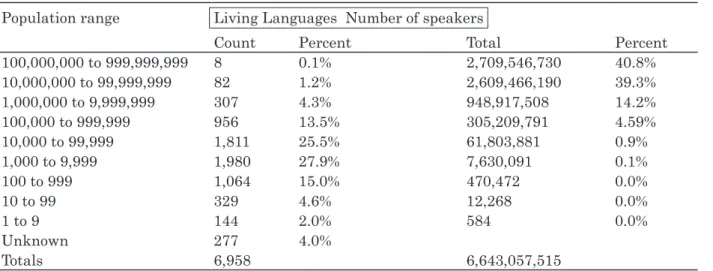
Table 2 summarizes the distribution of languages in the world by number of first-language speakers as compiled by Ethnologue. The population range column categorizes the languages by the number of digits in their population of first-language speakers. The count column gives the number of living language within the specified population range. The percent column gives the share of the count for
that population range as a percentage of the total number of languages given at the bottom of the count column. The total column gives the total population of all the languages in the given range category. The second percent column gives the percentage of the total country population as estimated at the bottom of the total column.
Table 2. Distribution of language by number of first-language speakers Population range Living Languages Number of speakers
Count Percent Total Percent
100,000,000 to 999,999,999 8 0.1% 2,709,546,730 40.8% 10,000,000 to 99,999,999 82 1.2% 2,609,466,190 39.3% 1,000,000 to 9,999,999 307 4.3% 948,917,508 14.2% 100,000 to 999,999 956 13.5% 305,209,791 4.59% 10,000 to 99,999 1,811 25.5% 61,803,881 0.9% 1,000 to 9,999 1,980 27.9% 7,630,091 0.1% 100 to 999 1,064 15.0% 470,472 0.0% 10 to 99 329 4.6% 12,268 0.0% 1 to 9 144 2.0% 584 0.0% Unknown 277 4.0% Totals 6,958 6,643,057,515
[Source : Simons, G. F. & Charles D. F. (eds.) (2017). Ethnologue: Languages of the World, Twentieth edition. Dallas, Texas: SIL International]
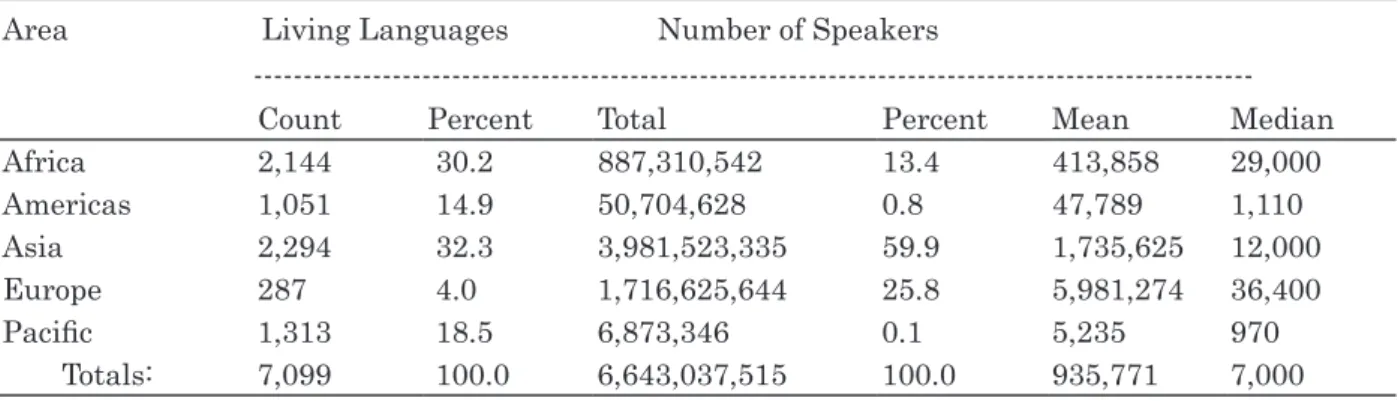
Table 3 summarizes the distribution of languages and their populations. The count column gives the number of living languages that originate in the specified area. A living language is defined as one that has at least one speaker for whom it is their first language; extinct languages and languages that are sued only as a second language are excluded from these counts. In this tabulation, each language is counted only once so that the total at the bottom of the column represents the total number of living languages in the world. A language that is spoken in more than one country is counted under the area of its primary country. This has the effect of counting the languages by their area of origin. The total column gives the total number of people who use those languages as their first language, regardless of where in the world they may live. Note, for instance, that the population given in the row for Europe is nearly twice the actual population of Europe. This is because it is a
count for speakers of European languages, some of which are now used as a first-language in other parts of the world due to the colonial expansion of the last few centuries. Since it is a count of the first-language speakers, any given person should be counted only once. As a result the total at the bottom of the column approximates the total world population; however, the total is somewhat less than the actual world population at present. This is because Ethnologue lacks population estimates for about 4% of the languages and because it does not automatically extrapolate population estimates to the current year, but waits for reports from reliable sources. The percent columns give the share of the count for that area as a percentage of the total number listed at the bottom of the count column. The mean column gives the average number of speakers per language, while the median column gives the middle value in the distribution of language populations.
Table 3. Distribution of world language by area of origin
Area Living Languages Number of Speakers
---Count Percent Total Percent Mean Median
Africa 2,144 30.2 887,310,542 13.4 413,858 29,000 Americas 1,051 14.9 50,704,628 0.8 47,789 1,110 Asia 2,294 32.3 3,981,523,335 59.9 1,735,625 12,000 Europe 287 4.0 1,716,625,644 25.8 5,981,274 36,400 Pacific 1,313 18.5 6,873,346 0.1 5,235 970 Totals: 7,099 100.0 6,643,037,515 100.0 935,771 7,000
[Source : Simons, G. F. & Charles D. F. (eds.) (2017). Ethnologue: Languages of the World, Twentieth edition. Dallas, Texas: SIL International]
4. English Language Imperialism:
At least 43% of the estimated 6000 languages spoken in the world are endangered. This figure does not include the data-deficient languages, for which no reliable information is available. As their exact number is unknown,
data-deficient languages are presented together with the safe ones in the table below. An estimate of the total number of languages draws from the literature of Austin (2008), Brenzinger (2007), Grenobole & Whaley (2006), Lewis (2009), and Moseley (2007).
Table 4. Overview of Vitality of the World’s Languages Condition Percentage Safe or data-deficient 57.13% Vulnerable 9.85% Definitely endangered 10.65% Severely endangered 8.95% Critically endangered 9.6% Extinct since 1950 3.8% Unknown 0.02%
[Source: UNESCO Atlas of the World’s Languages in Danger. Updated July 5, 2017]
Today, it is estimated that languages are dying at an unprecedented rate. A language dies every 14 days (Ryan, 2010). At the same time, English has become the undisputed global language. There is a correlation. In many countries, modernizing means embracing the English language. A modernized nation seeks to empower the citizens through education. The study of English is the forefront of this “ e d u c a t i o n ” . O r i g i n a l i t y o f t h o u g h t , creativeness, invention, and higher-order thinking are not the prime motives for education. Education, especially the teaching of English has morphed into being a massive international business. English is no longer just a foreign language on the school curriculum, and no longer the sole domain of England, it has become a vessel for every English-speaking nation on earth. Perhaps the popularity was self-endowed since according to the latest World University Rankings, the top universities are all found in the U.K. and the U.S. Therefore, most people naturally gravitate toward and desire to have an English education. But if one is not a native speaker, one is required to pass a test. This raises the question of whether it is morally correct to reject a student on linguistic ability alone. Perhaps a student might be a computer engineer who is a genius. One might question if the same language skill as a lawyer should be required for such a student. This author believes that it is wrong to require both a lawyer and a computer engineer to have the same English language proficiency.
English teachers reject or fail students constantly. Teachers have the potential to destroy one’s creative and intellectual potential while believing that their actions are making the world a better place by teaching the English language. A talented engineer would be denied pursuing their dream based on personal English language proficiency. Such a student cannot think about engineering or any other creative analytical skill until they master English. In the case of a monolingual scientist discovering the cure for cancer, such a scientist would potentially be denied to develop and publish his or her research. Moreover, one might question if the research would be taken seriously if it were published in a language other than English. This is a snapshot of what is happening in the academic world. Teachers, especially full-time tenured educators are gatekeepers who are quick to discriminate student potential. When considering research, the top research journals are all in English. This only serves to perpetuate and feed the English requirement. This author views translation as a solution. The flow of great ideas between languages is what defined the Golden Age in the Middle East. Research and literary works were being translated from Latin and Greek into Arabic, into Persian, and then it was translated on into the Germanic languages of Europe and the Romance languages. The Dark Ages of Europe ended this flow of translated information.
English as a monopolized tool for education has created a barrier in the world instead of
liberating humanity. Albert Einstein was considered remedial at school because he was dyslexic. Fortunately for the scientific advancement of humanity, he did not have to pass an English test because TOEFL didn’t start until 1964. TOEFL is an American test of English. TOEFL has become a business in and of itself. There are currently numerous tests of English which millions of students are required to take every year. However, the costs for taking such English language assessment tests are prohibitive to many millions of poor people. The business of education is rejecting those who are economically challenged. Likewise, international schools that boast offering an English education are so exclusive and expensive that the only who can afford to attend are the children of wealthy ambassadors and diplomats or United States military children. According to a current 2018 application found on the American School in Japan (ASIJ) website, after the application fee, registration fee, and building maintenance fee are paid, the tuition is over 3 million yen per semester (ASIJ, 2018). For this cost alone, most International Schools are almost entirely composed of military children (who attend for free), children of prestigious ambassadors, religious mission presidents and the very wealthy and privileged in society. International schools are not an option and the exclusiveness is maintained by the cost tuition.
This author begs the following questions: Do we really want to end up with English as the only language? Likewise, should all of humanity submit itself to French, Chinese, Arabic or another universal language and loose the culture and wisdom that all the other world languages have to offer? We need more languages than English. This current system equates intelligence with knowledge of English, which is quite arbitrary. This is enforced at the university or academic level as certain “snobbishness” is associated with the English language as it is an expression of intelligence and achievement that English speakers lavish in showing off microagressive displays of their English skills. Most Westerners are expected to
only speak English and this stigma is perpetuated through the imposed study of English. There is also a sense of elitism among academics who view English language proficiency as a measure of academic skill. Around the world, English has become an exclusive and discriminatory tool. English is The Great Divide in education. Both parents and a c a d e m i c s f o c u s o n E n g l i s h i s understandable—they want to give their children and students the best chance in life. In order to do that, they need a Western education because the best jobs go to people who graduate from Western Universities. This becomes circular and self-perpetuating.
The author lived his early years near the “Three Corners Reservation” on the borders of Utah, Wyoming, and Colorado where he was exposed to the diverse language and culture of Native Americans. English was imposed on all Native Americans resulting in cultural genocide that followed in the civilized years after the physical genocide of Native Americans. The author’s generation was perhaps the last to be exposed to the original languages once spoken in these areas. Native American languages do not satisfy today’s needs. Ethnic, indigenous, ancient and aboriginal languages are deemed to not be a language for science, research, a language used to in universities, a language used in the workplace, a language to rely to perform an advanced research project, and it is not considered a language to use at school. The author witnessed how the use of the language resulted in abusive bullying from classmates and punishment from teachers. Tables 5 and 6 describe the degree by which languages are endangered in the United States and Canada. According to UNESCO researcher Christopher Moseley (2010), there are a total of 191 endangered languages in the United States and 87 endangered languages in Canada. This is in direct reference to the imposition of English on native languages.
Table 5. Languages by degree of endangerment in the United States of America Condition Totals Vulnerable 11 Definitely endangered 23 Severely endangered 37 Critically endangered 74 Extinct 54
[Source: Moseley, C. (ed.), 2007. Encyclopedia of the World’s Endangered Languages, New York: Routledge]
Table 6. Languages by degree of endangerment in Canada
Condition Totals Vulnerable 22 Definitely endangered 6 Severely endangered 24 Critically endangered 31 Extinct 3
[Source: Moseley, C. (ed.), 2007. Encyclopedia of the World’s Endangered Languages, New York: Routledge]
Where is one free to speak their ancestral language? Languages other than English might be one’s mother tongue. Research says that mastery of other languages demands mastery of the mother tongue. Mastery of the mother tongue is a prerequisite for creative expression in other languages. It is said that if you want to kill a nation, the only way to kill a nation, is to kill its language. This is a reality that developed societies are aware of. The Germans, French, Japanese and Chinese—all these nations are aware of this. The Japanese imposed this on the nations that it campaigned against in World War II. Many Koreans, Chinese, Taiwanese, and Pilipino were denied the right to their own language and society was
purged by changing names to reflect Japanese names. The traditional language of the Ainu in Yezo (Hokkaido) and the languages of Okinawa and Ryukyu are severely endangered in Japan. Of the three Ainu dialects, two dialects have become extinct. Sakhalin and Kuril Ainu dialects are no longer spoken. Okinawan dialects are divided between northern and southern. Of the northern Okinawa dialects, Amami and Kunigami are critically definitely endangered. Likewise, the southern Okinawa dialects of Mikayo, Yaeyama, and Yonaguni are definitely endangered. According to Moseley (2010), Japan has a total of 8 endangered languages.
Table 7 describes the degree by which languages are endangered in Japan: Table 7. Languages by degree of endangerment in Japan
Condition Totals
Definitely endangered 5
Severely endangered 2
Critically endangered 1
[Source: Moseley, C. (ed.), 2007. Encyclopedia of the World’s Endangered Languages, New York: Routledge]
In Japan during World War II, English language and all katakana loan-words were changed to Japanese with “kanji” readings. Japanese linguistic and literary expert Donald Keene wrote on this at length by explaining the reason for certain Japanese sports being written in katakana while other sports were known by their Japanese names dates back to the war. All sports were changed to kanji readings, 排球 haikyu, 庭球 teikyu, 籠球 roukyu, 卓球 takkyu, 野球 yakyu, etc. After the war, it was determined that the sports that Japan has come to adore and think of as its own national sport remained in the kanji spelling, whereas the sports that are foreign or よその国のスポーツ yosono kuni no supotsu returned to katakana. For this reason 野球 yakyu is baseball, but basketball, volleyball, tennis, etc. are rendered in katakana. The popularity of baseball is maintained as one who has ever turned on the TV to watch sports in Japan will soon realize, the sports world in Japan is dominated by yakyu and sumo.
Language is legislated and manipulated to match an agenda. In Korea, the Romanization of geographical names was altered while the author was attending university at Keimyung in Taegu. The author was employed at Taegu National University of Education (TNUE) but the government felt that stronger consonants were needed to make places sound bolder in English. Taegu became Daegu, Pusan became Busan, Cheju become Jeju. Interesting to note that even as this author is typing these city names Daegu, Busan, and Jeju are marked as the incorrect spelling according to Microsoft Word® auto-correct and spelling check. The problems that ensue from the decision to change the spelling of these cities are numerous. Primarily, it is considered by many to be the wrong phonetics. Taegu, Pusan, and Cheju were known and spelled as such because that is how it is pronounced or at least heard by non-native speakers. However, not all place names are changed, as the Kimpo airport should now be the Gimpo airport. Furthermore, Korea would be known as Gorea. Moreover, if such changes
are to be logically implemented, then the consonant sounds for personal names should likewise fall under the same legislation. Kim should become Gim and Pak should become Bak and Che should be Je. For some illogical reason, personal names should be softer sounding than city names. One would think that the South Korean government would have better use for tax revenue than to change English signs throughout the entire country. It was no doubt a considerable and extremely expensive undertaking. Perhaps this is a potential research project that some ambitious educator might consider exploring. At the time of this writing, the cornerstone and entrance gate of Taegu National University of Education or TNUE was never changed to DNUE.
This author believes that countries that have not joined the ranks of the developed world should not be required to sacrifice their language and culture to join. It is an unethical standard, yet it is imposed on the entire planet. In the business world of product trade, this author questions the necessary of printing English labels on all products. It becomes difficult to believe that such products are legitimate local products.
Language is not just for conversing, nor is it just words coming out of our mouths. Language represents specific stages in our lives, and terminology that is linked to our emotions. When the author says, “thanks for your hard work” it would not convey the same meanings as ご苦労様でした gokurousama deshita in Japanese or 수고였습니다 sugohassho sumnida in Korean. Language is not simply words or letters put together. Language is an idea inside that relates to how we think, and how we see each other and how others see us. Whether a legitimate measure or not, language often plays a role as a measure of our intellect.
5. Conclusion:
At the beginning of the Industrial Revolution very little thought was given to the future because fossil fuels were the new energy to fuel machines which collectively were used to
replace slavery and benefit and advance humanity. Quality of life improved with the mass production of goods making products affordable. However, the true costs for the Industrial Revolution would not be known until several generations into the future when fossil fuels are depleted, the environment is polluted and global warming has become a global issue. English education and making English a universal lingua franca does have temporary benefits of increased communication and employment benefits, but the destruction it has caused is for the future generations to realize. The importance or the loss of something is rarely realized until it is gone. Animals such as the passenger pigeon and dodo birds were once considered to be so plentiful that they would never become extinct, but their populations are decimated. When the world loses a language, it loses a culture. It is the variety of language and culture that enriches humanity. Strength and fortitude comes with diversity. When a language disappears, a part of humanity dies with that language. The ideas, traditions, beliefs, creative expressions of that language are gone. Humanity will no longer have the benefit of that language as part of its collective. This author believes that this is a great misfortune to all of humanity. Standards in education and governmental policy should support bilingual education and minority languages need to be preserved.
The knowledge dimension of intercultural competence includes knowledge not only about other cultures, but one’s own culture as well. Although we tend to think that we know our own culture, this knowledge is often limited. A major part of developing intercultural competence is re-evaluating and expanding knowledge of one’s own culture. This applies at the level of national culture, as well as regional c u l t u r e a n d o t h e r r e l e v a n t d o m a i n s . Intercultural competence is much more than simply being knowledgeable of a foreign language. It is a combination of skills and attitudes.
The attitudes dimension of intercultural
competence is complex. It mainly includes interrelated attributes such as tolerance, open-mindedness, and willingness to suspend judgement. Tolerance means not getting easily frustrated by an unfamiliar culture or language. Open-mindedness means the capacity to see value in different and unfamiliar things. Willingness to suspend judgement means that one does not simply label foreign culture and language as strange. Much intercultural communication involves multilingual individuals who come from a wide variety of linguistic and cultural backgrounds. What is important for the future of preserving the language and cultures in the world is the ability to engage with different ways of thinking and broaden one’s worldview while developing a respect for diversity and communicating cooperatively and meaningfully with others.
Recognizing global languages and culture enables more people to make their voices heard and take an active part in their collective fate. Languages ensure access to knowledge, its transmission and its plurality. Recognizing global languages also means opening the door to a great deal of often overlooked traditional scientific knowledge to enrich our overall knowledge base. Excluding languages means excluding those who speak them from their fundamental human right to scientific knowledge. Linguistic and cultural diversity may be our best chance for the future. Creativity, innovation, and inclusion are things that must not be squandered.
References:
A SIJ (2018). The American School in Japan (ASIJ): Tuition and Fees School Year 2018-19. Retrieved October 12, 2018 from https://www.asij.ac.jp/ tuition.
A ustin, P. (2008). 1000 Languages. The Worldwide History of Living and Lost Tongues. London, Thames and Hudson.
B oas, F. (1911). Handbook of American Indian languages pp. 25-26.
Endangered. Berlin, New York, Mouton de Gruyter.
C hirikba, V. A. (2008). The problem of the Caucasian Sprachbund. Linguistic Areas to Areal Linguistics, 2008, p. 31. ISBN 9027231001. F lake, L. (2017). E-Learning and the iNtegrating
Technology for inQuiry (NTeQ) Model Lesson Design. Journal of Education and e-Learning Research. Vol 4, No 2 (2017) Page: 72-80. ISSN(E): 2410-9991/ ISSN(P): 2518-0169. G ordin, M. D. (2015). Scientific Babel: How Science
Was Done Before and After Global English. Chicago, Illinois: University of Chicago Press. ISBN 9780226000299.
G odwin-Jones, R. (2013). The technological imperative in teaching & learning less commonly taught languages. Language Learning & Technology, 17:1, pp. 7-19
G renoble, L. and Whaley, L., (2006). Saving l a n g u a g e s . A n i n t r o d u c t i o n t o l a n g u a g e r e v i t a l i z a t i o n . Cambridge, Cambridge University Press.
K ramsch, C. (1998) Language and Culture, Oxford: Oxford University Press.
L ewis, M. Paul (2009). Ethnologue: Languages of the World, Sixteenth edition. Dallas, Tex.:SIL International. Online version: http://www. ethnologue.com. Accessed 07 October 2010. M agga, O. H. (2006). Diversity in Saami terminology
for reindeer, snow, and ice, International Social Science Journal Volume 58, Issue 187, pages 25–34, March 2006.
M oseley, C. (2007). Encyclopedia of the World’s Endangered Languages, New York. Routledge M oseley, C. (2010). Atlas of the World’s Languages
in Danger, 3rd ed. Paris, UNESCO Publishing. Online version: http://www.unesco.org/culture/ en/endangered languages/atlas
R yan, P. (2010). Don’t insist on English! December 2010 TED presentation in Dubai. Retrieved July 15, 2017 from https://www.ted.com/talks/ patricia_ryan_ideas_in_all_languages_not _ just_english.
S imons, G. F. & Charles D. F. (2017). Ethnologue: Languages of the World, Twentieth edition. Dallas, Texas: SIL International. Retrieved July 30, 2017 from http://www.ethnologue.com.
W horf, B. (1940) Science and Linguistics, Technology Review 42: 229-248.
W ierzbicka, A. (2013). Imprisoned in English: The Hazards of English as a Default Language, Oxford: Oxford University Press.