Possibilities of Team-Teaching in Higher Education
高等教育におけるティーム・ティーチングの可能性
KINUGAWA Kiyoko & MATSUMOTO Naoko
衣川 清子・松本 菜穂子 英語教育におけるティーム・ティーチングというと、日本の中学校や高等学校の授業に おける日本人教師と外国人教師(ALT)とのチーム授業が思い浮かぶが、アメリカでは一 つの学問分野だけに限定されない学際的な授業の運営方法として主に中等教育で活用され はじめ、最近では高等教育においても広く用いられるようになっている。本稿は、埼玉女 子短期大学において近年行われてきた実質的なティーム・ティーチングの実践を振り返り、 その可能性と今後の課題を探っていく。
I. Introduction
College education consists of more than providing information. It aims at forming values, character, habits, and skills as well. These are best formed by a variety of educational experiences that mutually enrich and reinforce one another…. Single-teacher, single-subject teaching worked well in a stable culture. Today’s world demands something else.
Francis J. Buckley, S. J., 2000, pp. 10-11
Team-teaching in English education has been extensively used in junior high and high schools in Japan. There, the teacher team consists of a Japanese teacher (Japanese Teacher of English: JTE) and a native speaker of English (Assistant Language Teacher: ALT), and its main purpose is “the revolution of ‘Living English’” (Slade, 1999)―to expose students to authentic spoken English. The presence of a
native speaker of English in the room creates an atmosphere in which conversation in English seems more real. Indeed, this arrangement has helped improve students’ motivation in learning practical and communicative English (Scott, 2000).
On the other hand, we cannot help hearing a lot of stories that such a well-intentioned team-teaching arrangement is not necessarily working properly as it is hoped to be. In the worst cases, native speakers are treated like “human tape recorders”(Ikeno, 1999) which are only introduced when important phrases and idioms have to be pronounced for students’ repeating and memorizing. In other cases, tasks are completely divided between the JTE, who explains grammar and translates English sentences into Japanese, and the ALT, who occasionally talks to students in English and has students repeat after the model pronunciation. Teachers point out the reasons for these situations:(1) lack of preparation time (mainly because most ALTs are part-time instructors who have to visit several schools every week and JTEs are too busy with other school obligations);(2) difficulties in communication with each other;(3) not enough communicative skills in English on the side of JTEs or vice versa;(4) sense of territoriality on the side of JTEs who formerly had the full control of the classroom;(5) irreconcilable differences in each teacher’s teaching methods, etc (Jonas, 1998).
In colleges and universities in Japan, however, where there are a lot of language classes and equally the need for more communicativity is being stressed, we rarely hear team-teaching is being practiced. Is it because the team-teaching style is mainly suitable for younger students? Or is it because it is too costly to have two teachers in a course? On the other hand, there is ample evidence of team-teaching practices in the United States of America which date back to middle schools in the 1960s, and which are now extended to various milieu including higher education and even online courses. We think in higher education in Japan as well, that some kind of team-teaching is possible and it may be used to stimulate students’ motivation in a unique way and to guide them into the richer world of interdisciplinarity. In this paper, we will show some examples of team-teaching that has been carried out in a junior college setting with a certain degree of success, and discuss its advantages and
challenges.
II. What is team-teaching?
There are various imaginable forms of “team-teaching.” To coach a team of athletes can be a team-teaching; sometimes it is called a team-teaching when a team of teachers take turns teaching the same class; a group of students can be taught as a team, either by a teacher or a couple of teachers. Here we follow the definition by Davis (1995): “all arrangements that include two or more faculty in some level of collaboration in the planning and delivery of a course” (p.8). It refers to a situation where two (or sometimes more) teachers are always present in the classroom, making syllabus and instruction plans together, managing the class activities together, discussing how to proceed, sharing ideas ranging from syllabus to more detailed matters regarding each student’s progress and problems, and grading together.
Team-teaching undoubtedly implies teamwork. Teachers in a team are jointly responsible for the whole process of teaching. Cooperation and collaboration are the first words to come to mind. Ideally, for smooth cooperation and collaboration, teaching partners in the team should spontaneously join the project, and commit themselves and contribute to the joint project. To avoid unnecessary arguments and frustration that can arise from personality or psychological differences, at first the partners should be able to discuss and agree on some basic agenda.
Team-teaching starts at the very beginning—creating the course syllabus together. To make a team function effectively, the two teachers cooperate and share ideas about the overall curriculum—what to teach on the whole, how to teach, and when to teach each specific topic and knowledge. Each teacher should spare some time to brainstorm and contribute ideas for the course. Based on them, the partners are jointly responsible for the delivery of instruction. After each session is over, they reflect on their performances, discuss what went good and bad, and if necessary reconsider and change the strategies for the next session. They may hit on new ideas
as they go on. At the end of the semester they are involved in grading together, too. It is not a matter of simple addition of one plus one. In a sense, it is qualitatively an entirely different situation for the teachers. You can no longer have a full control of your class, and it is a strange land before your eyes which is inhabited by another king or queen who insists on at least an equal rule therein. Monopoly is denied, and the workloads will be greater because everything needs to be discussed before being put to practice in the real classroom, and will be evaluated after the session is over. Your teaching style and methods will be tested in the strict eye of the partner, whose style and methods may be totally different from yours. You might be frustrated at a moment when you think you could do better by yourself. You might end up stressed and wish you were the sole commander.
At the same time, you can use a big help from your partner. You are not alone in an enemy land of hostile or indifferent students; your partner may fight with you, utilizing rich resources you may not have at hand. You will have someone who understands and rightly recognizes your efforts and encourages you when you are down and troubled in times of dubious battles.
Suppose the other teacher in the team majors in a different discipline. When your partner has different knowledge and skills from yours, it means that students have a chance to learn two different sets of knowledge, and how to integrate them in a creative way. Where it is no longer a stable society, it is not enough to delve deep into and master a single discipline; you need to be able to have a flexible mindset and weigh and synthesize fragmented knowledge from multiple disciplines. Interdisciplinary team-teaching is definitely one of the useful devices for this purpose.
Another implication of this is that each team-teacher in an interdisciplinary course is a teacher and learner at the same time. They have not only something to offer to each other, but also something to learn from each other. It breaks down the traditional divide between the teacher and students or the characteristic one-way instructional street of giving pieces of knowledge to passive recipients. By becoming a role model of senior learner, team-teachers give the students a valuable lesson: a classroom is no longer a battlefield where solitary soldiers must compete for excellence
and victory. Together you can create an entire community of learners where all those involved are constantly and positively trying to learn.
Spontaneity, interdisciplinarity, and constant learning are the keywords of the educational merits of team-teaching in higher education. On the other hand, it is still in the beginning stage and it is yet to get on the track, and there are some challenges to overcome.
III. The three team-taught courses in Saitama Women’s Junior College (SWJC)
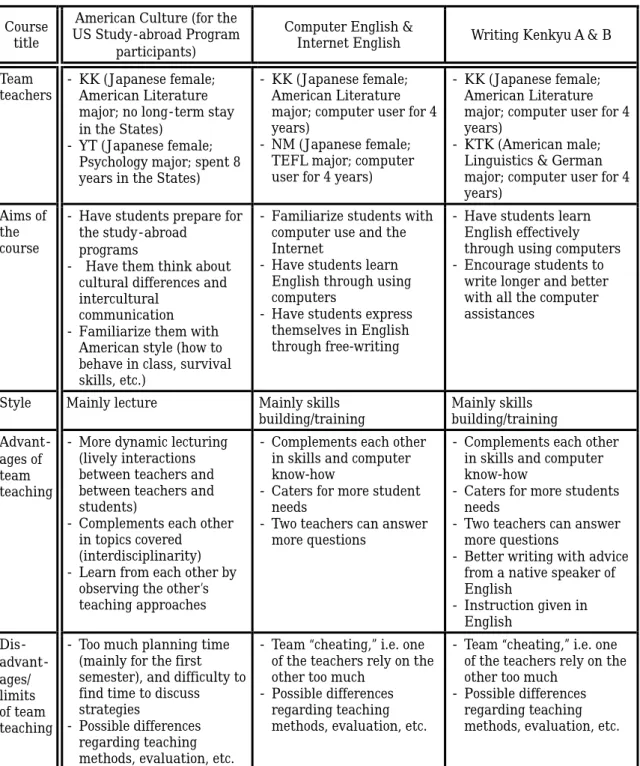
The first team-teaching tried in SWJC is a course currently called “American Culture,” which started in 1998. This course has been managed and taught by two female Japanese teachers whose major, educational background and academic interests are different. One teacher majored in American literature in her graduate school, read books about American history and culture, and likes to travel across America. Another teacher went to universities in the States after she graduated from Japanese university, learned psychology in America for eight years, and stayed in three different cities. Naturally their viewpoints and knowledge about America are diverse in many ways. These differences make the class more interactive and interesting to students, for teachers can provide students with various viewpoints and practical information, supplementing each other. Not to mention, this course has always been a great success.
Following the successful footsteps of this team-teaching class, three more team-teaching courses have started since 1999. All of these courses happen to be computer-mediated courses. One teacher is the same person who is in the “American Culture” course. The other teacher for “Computer English” and “Internet English” courses majored in English language teaching in her graduate school and is skilled with computers as well as her partner. The other teacher for “Writing Kenkyu A & B” is a native speaker of English who majored in linguistics and German in his graduate school and fieldwork settings and is learning how to use Windows computers through
team-teaching the class with his partner.
The following table shows the course descriptions of the three team-taught courses in SWJC. The teachers’ names are entered in their initials in avoid lengthy statement.
Table 1: The Three Team-Taught Classes at SWJC Course
title
American Culture (for the US Study-abroad Program
participants)
Computer English &
Internet English Writing Kenkyu A & B Team
teachers
- KK (Japanese female; American Literature major; no long-term stay in the States)
- YT (Japanese female; Psychology major; spent 8 years in the States)
- KK (Japanese female; American Literature major; computer user for 4 years)
- NM (Japanese female; TEFL major; computer user for 4 years)
- KK (Japanese female; American Literature major; computer user for 4 years)
- KTK (American male; Linguistics & German major; computer user for 4 years)
Aims of the course
- Have students prepare for the study-abroad
programs
- Have them think about cultural differences and intercultural
communication - Familiarize them with
American style (how to behave in class, survival skills, etc.)
- Familiarize students with computer use and the Internet
- Have students learn English through using computers
- Have students express themselves in English through free-writing
- Have students learn English effectively through using computers - Encourage students to
write longer and better with all the computer assistances
Style Mainly lecture Mainly skills
building/training Mainly skills building/training
Advant-ages of team teaching
- More dynamic lecturing (lively interactions between teachers and between teachers and students)
- Complements each other in topics covered
(interdisciplinarity) - Learn from each other by
observing the other’s teaching approaches
- Complements each other in skills and computer know-how
- Caters for more student needs
- Two teachers can answer more questions
- Complements each other in skills and computer know-how
- Caters for more students needs
- Two teachers can answer more questions
- Better writing with advice from a native speaker of English - Instruction given in English Dis- advant- ages/ limits of team teaching
- Too much planning time (mainly for the first semester), and difficulty to find time to discuss strategies
- Possible differences regarding teaching methods, evaluation, etc.
- Team “cheating,” i.e. one of the teachers rely on the other too much
- Possible differences regarding teaching methods, evaluation, etc.
- Team “cheating,” i.e. one of the teachers rely on the other too much
- Possible differences regarding teaching methods, evaluation, etc.
IV. Two team-teaching styles
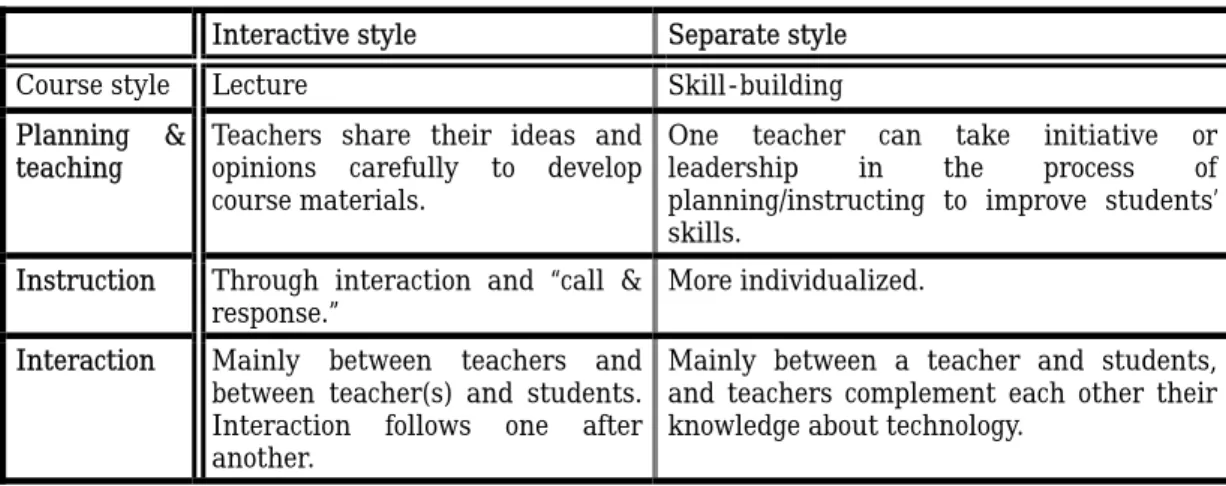
In order to explore advantages and disadvantages of team-teaching, the interview was conducted to two teachers (one in “American Culture” course, and the other in “Writing Kenkyu A & B”) on October 11 and 16, 2000. All questions were open-ended and interviews were spontaneously carried out (i.e. no preparation for the questions). From these interviews, we have found that there seems to be a slight difference among the three team-taught courses. The main difference lies in the teaching styles: (1) Interactive style; and (2) Separate style. The table 2 explains the overview of the differences between these styles.
Table 2: Two team-teaching styles
Interactive style Separate style Course style Lecture Skill-building Planning &
teaching
Teachers share their ideas and opinions carefully to develop course materials.
One teacher can take initiative or leadership in the process of planning/instructing to improve students’ skills.
Instruction Through interaction and “call &
response.” More individualized. Interaction Mainly between teachers and
between teacher(s) and students. Interaction follows one after another.
Mainly between a teacher and students, and teachers complement each other their knowledge about technology.
In the “Interactive style” team-teaching, students generally enjoy the interaction between the two teachers or between the teacher(s) and the students. “American Culture” course falls under this category. Here, teachers share their ideas and opinions carefully in the process of planning. Each teacher takes initiative in the fields where s/he is good at and makes plans through the discussions about how to develop course materials. However, in the class, even if one teacher begins to take leadership at first, another begins to follow him/her to cover or consolidate the knowledge s/he does not have by sharing his/her insights and interacting with each other. It can be said that the interaction is as if the teachers were the first-class jazz
players who could improvise in concert with each other. And the interaction leads to a harmony among teachers and students by the end of each session. The students learn the subject by participating positively in the class, adding variations on the theme to the jazz band performance established by the teachers. However, it should be noted that this style could more often happen in the lecture type course than the “Separate style” in which close monitoring of each student is more important.
In the “Separate style” team-teaching, one teacher practically takes initiative in introducing the purpose of the day’s coursework and instructing some technical things, but teachers and students can be more interactive through the former’s closer monitoring of the letter. Three computer-mediated courses are categorized to this style in that the main point is to teach technical things and language. Team-teachers in these courses act interactively, but less than the ones in the “Interactive style” course do because the need for individual instruction to students will be greater. In this respect, each teacher and the students can be more interactive and individualized than the ones in the “Interactive style” where the ultimate harmony—situation that everybody has learned a certain targeted piece of knowledge—is important. In this “Separate style”, teachers can keep an eye out for what each student is up to, and help them at the individual level. If one of the teachers cannot answer a student’s question or is lost at how to operate the machine as s/he wishes, the tip can be supplied by the other teacher and shared in the class on the spot. Even some students keen on technology can show teachers and other students new things about computers. Hence, it may be said that all participants in the class are in the position to do the team-teaching on the spot.
IV. Advantages/disadvantages of “Interactive style” team-teaching
1. Interdisciplinarity
who have majored in different disciplines can bring to the class a wider range of knowledge and skills than when only one teacher is there. It is a chance for students to get to know more new things, and that in a compact and guided way.
It is not just the wide variety of contents of what can be dealt, however. When one teacher is lecturing to the class, the other teacher can cut in and supply a perspective which was unknown or unfamiliar to the former. Students then find that nothing is one-dimensional, and that there are two or more sides to every story. They will be compelled to think hard and critically. Their knowledge is enriched and they will be stimulated to embark on their own spontaneous learning.
And when one teacher is taking a lead in talking, and the other is observing the former’s innovative experiments and inspirational behaviors in class, it is not only students that are learning; it might lead to teacher learning, and culminate in overall better teaching skills and faculty development. In a sense, team-teaching is a constant process of teacher learning, too.
2. Discussion between teachers and betwe n teacher(s) and students
e
The submission of an additional perspective or viewpoint from the teacher(s) might sometimes lead to a lively discussion or a heated argument involving all the people in the room. That will be another learning experience.
In a usual one-teacher class, so as not to confuse students about what is right or standard in the world of academics, the teacher feels s/he has to lecture the basic knowledge, or at least so-called objective truth. The teacher explains the points one by one, in a linear or coherent order, and finishes the lecture with concluding remarks. What the teacher says must be commonsense or unbiased statements. Sometimes it gets monotonous and dull and students tend to be passive receptors of the delivered data, facts and knowledge.
In team-teaching, however, teachers can speak their opinions, disagree and debate for some time on some key issues. Also, students can discuss or debate with the teacher(s). The discussion/debate process itself is an academic endeavor, and thus
teachers have a rare opportunity to show students how a certain discipline works and has worked so far.
Yet the discussion which has been started in the class is hoped to reach a consensus, at least temporarily, by the end of the session so that students can get a rough idea of what has been discussed. In such a discussion or debate, the teachers can intentionally propose an extreme view for the class to object. Or teachers can dramatize the topic when necessary. Through these imaginative debates or discussions, students’ knowledge will be deepened and stimulated.
Critical thinking which is becoming more and more important for the future education can be taught and practiced in this way, too. It can be dramatized as an argument between a person who is satisfied in the status quo or believes in stereotypical images and statements on one hand, and a person who loves changes and cannot help questioning such stereotypes and clichés on the other hand. Teachers can play these roles, or let the students do them. Sometimes some students add a totally new dimension to the discussion which neither teachers have expected or imagined. The lively class in which students participate actively will make an unforgettable impression on each student’s mind.
3. Safer and more lively environment for students
In a one-teacher class, teacher-student personality conflict is one of the inherent problems, but it is reduced to the minimum in a team-taught class due to the presence of more than one teacher. If one teacher is offended by a certain student’s misbehavior or inappropriate retort, the other teacher does not show it and continues the session, or can change the way of dealing with the student with a different tactics. If the class is too quiet or too noisy, two teachers’ two heads will have more ideas to revitalize or calm them down, and can pull them on the right track again.
In a strict one-teacher class, it is a very courageous enterprise for students to raise a hand and mouth a question in the middle of the lecturer’s speech when nobody even dares to breathe aloud. While the student waits for the lecture to end to find time to
ask the question in person, s/he might have forgotten it altogether. However, in a team-teaching class, it is easier for students to ask questions, because it is a customary practice that teachers ask questions to each other, and to students. Often one teacher cuts in the other’s talking to clarify uncertain points or to add his/her own comments. These teachers’ attitude should reflect on students—that there is no need of worrying about cutting in and stopping the speaker. On the contrary, teachers welcome questions and comments even in the middle of their lecturing.
One of the problems that a one-teacher class has in Japan is the difficulty having students speak their opinions in front of other students. In a team-taught class, however, stimulated by frequent, natural discussions and debates, students feel more relaxed to speak their ideas and opinions. What students have said will be welcome as alternative perspectives, useful additions, and a new starting point for a new topic discussion.
4. Progress toward a “learning community”
Since not only students but also teachers easily and naturally learn in the process of teaching and learning, a team-teaching class is the nearest way to “learning community.” Especially in the “Interactive style” team-teaching, there will be a move toward “collaborative learning.” “Collaborative learning reforms classroom learning by changing students from passive recipients of information given by an expert teacher to active agents in the construction of knowledge” (Goodsell and others, 1992, p. 4; quoted in Eisen and Tisdell, 2000, p. 7). According to Eisen and Tisdell, “Team teaching may not be the only route to such reform, but it is gaining in popularity because it helps to dissolve historical barriers to teacher-learner collaboration, thus opening up opportunities for a richer multidirectional exchange among everyone involved” (p. 7).
5. Some possible problems including team-“cheating”
As in any teamwork, team-teaching is a risky endeavor. When the relationship (whether work-related, psychological, or personal) between the teammates goes sour, so will the performance of the team. Team-teachers need to spend more time and energy managing a class than they do independently, because it must be coherent and relevant as a class session.
There is a need for careful advance planning and a fair sharing of works to do between the team members. Otherwise, one teacher works harder while the other is idle, which might lead to the complaints and disappointment on the side of the hardworking member, and malfunctioning of the team.
A balance of workloads needs to be hit according to the member’s strengths and weaknesses as much as possible. Both members should keep in mind that heightening the students’ learning to the maximum is the utmost goal of any teaching, be it in team or alone.
Aside from pedagogical considerations, there is criticism or reluctant message that team-teaching is costly because it requires two teachers where usually one teacher suffices. Without support from other colleagues and school administration, good team-teaching cannot survive. Still, in spite of all the shortcomings and limits, the team-teaching project is worth challenging because the rewards are rather long lived.
V. Advantages/disadvantages of “Separate style” team-teaching
1. Closer monitoring on students
Definitely, two teachers’ four eyes and two heads are better than one teacher’s two eyes and one head. Teachers can monitor each student, reach students faster when there is any question or problem, and better cater to their needs. Students also feel more at ease because there is always another teacher to ask for help when one teacher
is busy at lecturing or occupied with other students.
In a course where the mastery of technology and skills is basically the main thrust of the instruction, students should have the maximum opportunity for hands-on experiences. Especially for students who have sometimes difficulties understanding complicated procedures, the presence of two instructors is a bliss; if one teacher stands by a student and instructs him/her closely while the other teacher explains the procedure to the whole class, risk of certain students being left behind the others will be considerably reduced.
2. Safer and more lively environment for students
In a one-teacher class, teacher-student personality conflict is one of the inherent problems, but it is reduced to the minimum in a team-taught class due to the presence of more than one teacher. As in the “Interactive style” team-teaching, the classroom environment is a safer and more relaxed one. Always there will be another teacher with another opinion, way of thinking, and disposition.
In the “Separate style” team-teaching, instruction tends to be one-on-one rather than a general one, but the psychological pressure is lessened. Suppose one teacher has a personal conflict with a certain student or is offended by a student’s impolite attitude or lazy behavior, the other teacher may not have a similar conflict, or can change the tactics of dealing with the student after the latter witnesses what has been happening.
3. Possibilities of collaborative/cooperative learning
Here teachers are not someone who have absolute authority in the room. The authority is apparently divided by the presence of two teachers, and as neither of them is apt to assume the authority, it will be dispersed in the long run. Neither of the teachers has the complete knowledge or skills that will be learned by the students in the course. Teachers may teach each other and learn from each other on various
matters.
It is not only the students who are going to learn, and it is not only the teachers who are going to teach. Students who have already mastered the particular skills may teach other students who have not, and the teachers, in some cases. Teachers are no longer monopolizers of knowledge or skills. Teaching can be interactive in the true sense of word, not a one-way street. Collaborative or cooperative learning replaces competition.
4. Possible problems including team-“cheating”
As in the “Interactive style” team-teaching, there is a need for careful advance planning and a fair sharing of work to do between the team members. Otherwise, one teacher works harder while the other is idle, which might lead to the complaints and disappointment on the side of the hardworking member, and malfunctioning of the team.
In the “Separate style” team teaching, it is relatively easy to divide and assign each member’s share in the teamwork and degree of contribution to it. All the same, a balance of workloads needs to be hit according to the member’s strengths and weaknesses as much as possible. Both members should keep in mind that heightening the students’ learning to the maximum is the utmost goal of any teaching, be it in team or alone.
VI. Important factors to have a successful team-teaching course
1. Relative similarity of two teachers’ teaching philosophy and values
The first and most important factor in making the team-teaching successful is that the course should be taught by teachers whose basic teaching philosophy and values are similar. If their attitudes towards teaching were too different, the students would
be frustrated and confused, and a team-teaching adventure would be difficult in the first place. To have relatively similar basic philosophy for the course in common, such as what teachers want students to learn in the course and how it should be taught, is undoubtedly indispensable to carry out a joint project.
In principle it is not impossible for two teachers with different teaching philosophy and values to start team teaching. However, it would be too time-consuming and force tremendous physical and psychological burden on both partners if their starting points are extremely different. Suppose one teacher believes that discipline, pattern practices and memorization process are the most important to keep an order in class; another teacher thinks competition among students for better scores does not lead to real practical learning. The contradiction between two entirely different styles, and possible arguments between the teachers will only lead to students’ confusion and chaos, thus resulting in neither better scores nor practical learning.
From our experiences here, a good relationship between the team-teachers does not start easily or instantly. Actually it started long time ago, even years before the actual team-taught classes were formed and recognized in the curriculum. The past and present team-teaching classes started rather smoothly and eased into routine procedures because the team-teachers had a prior working relationship not in a joint act of teaching but in other tasks including student administration and overall academic affairs. We had noticed similar stances to teaching among us through chats with students outside the classes, informal motivational advice given to students, collaborations towards making better ad hoc activities, and just any exchange of ideas and idle thoughts.
Team-teaching is not an act that stops with the end of a class or a course. Team-teachers need to discuss and try to solve possible problems arising from each session, and make flexible changes in the course plans if necessary. They are compelled to meet face to face, make phone calls or exchange email, and such obligations know no limits. For such a working relationship to function smoothly enough, the partners in a team must be prepared to even sacrifice some time and commit themselves to some extent. The stronger ties they have with each other,
emotionally and intellectually, the easier, more efficient and effective the team-teaching acts will be.
2. The differences in knowledge, approach and viewpoints between teachers
The teachers’ differences in knowledge, approaches, and viewpoints are also important in order for the team-teaching to be done in richer, deeper, broader and multi-directional ways.The two teachers’ different opinions about a certain topic can be used educationally to provide students with various viewpoints and knowledge about the subject they are learning. Nothing is judged wholly good or bad. Ten people might have ten different opinions about one controversial topic. That even learned professionals differ in idea toward a certain topic will teach students an important lesson that nothing on earth is one-dimensional and that differences in opinions should be respected. It is each student’s task then to weigh those opinions and judge which s/he thinks is a sound argument for him/her. Students must be critical thinkers. Thus teachers’ real or pretended (or in some cases, dramatized) arguments will introduce students’ voluntary discussions, which is the first step to their becoming independent learners. Then the teachers can be facilitators of the learning in the form of critical thinking and debate, rather than just suppliers of pieces of knowledge. At an apparent end of the discussion, they can give a tentative “answer” to the puzzle. Their wider perspectives and richer knowledge will be a good guide out of the maze where students might be stuck.
In such a debate, however, one thing both teachers should keep in mind is that the teachers should find the right time and occasion to state a different opinion from their partners. Different opinions could be ice-breakers as well as ice-freezers. If an active interaction so far should stop then and there, it would have not been the right time to do so, and their strategy might have been wrong.
To avoid such a disruption in the smooth flow of instruction, it is necessary for the teachers to discuss the course material and procedures to a great extent in the process
of planning. They should also take account of the characteristics and typical responses and behaviors of the students in class. Also, they should not be afraid of changing the plans flexibly whenever they notice that certain problems are going to happen.
3. Teachers’ understanding of the partner
It is necessary that teachers understand and care about each other—in both aspects of personality and talents or skills. It is teamwork in every sense of the word. Team-teaching is not a “one-person show,” so it is the case where teachers may sometimes take pains planning and sharing the ideas, and where sometimes never-ending arguments appear to arise. This is not surprising because two or more teachers whose background and interests are different must have their own ways to teach and learn. In order to have a successful team-teaching class, teachers should be willing to share their ideas with their partners and have a broader mind to accept the differences. They should be aware of what their partners are doing or going to do as well. By each other’s understanding and caring, natural interaction between teachers is likely to occur, which will naturally pull the students into the world of limitless learning.
4. The less sense of territoriality
The less sense of territoriality is also important because the team-teaching is not only for students’ learning but also for teachers’ sharing and learning. One teacher mentioned “apprenticeship” in the interview. He said it was his first time to do any team-teaching and to teach a computer-mediated course, so he is learning many things from his partner, especially about technical aspects and how such technology can be applied to teaching English writing. As to the other teachers, they agreed that they were learning with each other through the team-teaching. However, if one teacher has too strong territoriality, the partner cannot integrate his/her own
contributions to his/her teaching dimension and might get frustrated. What is worse, they will not have anything to share not only with each other but also with students. This implies that students cannot gain anything from the team-teaching after all. “Sharing” is a very important factor in any style of team-teaching.
Conclusion
Depending on the learning needs and the teaching styles that best suit the goals, we have shown that team-teaching may have at least two different styles. Each style has its strengths and uses. It is hoped that each teacher in his/her context should vary and customize his/her method so that the team-teaching potentialities are maximized.
These referred above have been the basic important points for success in the team-teaching in our college, but they could be applied and extended to any teachers who would like to try team-teaching on their own, in their own style and under their own situation.
Works cited
Buckley, Francis J., S. J. (2000). Team Teach ng: What, Why and How? Thousand Oaks, California: Sage Publications, Inc.
i
e s
e c r t
Davis, James R. (1995). Int rdisciplinary Course and Team Teaching: New Arrangements for Learning. Phoenix, Arizona: Oryx Press.
Eisen, Mary-Jane, and Elizabeth J. Tisdell (2000). T am Tea hing and Lea ning in Adult Educa ion. San Francisco: Jossey-Bass.
Ikeno, Osamu (1999). Research about how Assistant Language Teachers (ALT) in the City of Matsuyama feel about team teaching. Retrieved December 6, 2000 from the World Wide Web: http://www.proj.ehime-u.ac.jp/project/mltmedia/proj7/work10.html
Kuroiwa, Kenneth T. Personal Interview. 11 Oct. 2000.
Jonas, Wendy (1998). Toward Better Team Teaching—Reflection from Both Sides of the Cultural Barrier. Retrieved December 6, 2000, from the World Wide Web:
http://www.twics.com/~comsig/comlink/comlink3/issue4/tteaching.htm
Scott, Mike (2000). An Overview. Retrieved December 6, 2000, from the World Wide Web: http://www.jetasc.org/php/article.php?content=teaching
Slade, Sarah (1999). Teaching and the JET Program. Retrieved December 6, 2000, from the World Wide Web: http://home.earthlink.net/~sarahslade/teaching.html