The Rise-fall in the Bi-syllabic Tonic Element
著者
Yuzawa Nobuo
journal or
publication title
TOHOKU UNIVERSITY LINGUISTICS JOURNAL
number
24
page range
43-52
year
2016-03-12
The Rise-fall in the Bi-syllabic Tonic Element
Nobuo Yuzawa
Utsunomiya University
Key Words: rise-fall, form, peak, range, hi-syllabic tonic element
1. Introduction
It has been shown in Yuzawa (2010, 2011) that the peak of the rise-fall tone tends to be located in a relatively fixed range in the tonic element (the part of an utterance from the tonic syllable to the end of the tone-unit) consisting of one syllable, both in nonsense utterances (e.g. '"'Na, '"An') and in meaningful utterances of English words (e.g. '"Lots.', '"None.'): the 30 to 60% range from the beginning of the tonic element.
This paper examines the form of the rise-fall when the tonic element consists of two syllables in order to discover whether the peak of this tone in the hi-syllabic tonic element is located within the same range as the peak in the monosyllabic tonic element. It also explores what form tends to be observed in these two syllables and whether segment types in the tonic element may influence the form. More than one kind of influence may be expected because the rise-fall needs three points to complete its form (the initial low point, the peak, and the final low point), but there are only two syllables available to assign these three points.
It should be noted that some researchers (e.g. Prator and Robinett (1985)) use the term 'rise-fall' differently from the one intended in this paper. Acoustic analysis reveals clearly what they interpret as the rise-fall should be interpreted as the fall in the British approach. When an utterance is spoken with the fall, a rising pitch always precedes the fall if the pitch before the fall is not high enough. This rising pitch, however, is not linguistically important. It simply occurs to make the fall happen. The fall needs to begin with at least a higher pitch than the pitch that is used at the end of utterances for statements. It is for this reason that the fall is a more appropriate term than the rise-fall in such cases. The rise-fall discussed in this paper is the rise-fall that is described as such in the British approach.
2. Data
1. (I) /\love it.
2. (Yes but) /\how ·soon? 3. ('Getting) /\fatter! 4. {'None whatso)Aever.
5. (I 1
don't) /\blame you.
All of them, taken from O'Connor and Arnold (1973), were recorded by the authors in the accompanying cassette tape. These audio data were digitised in 11,000 Hz and 16 bits for acoustic analysis. For a comparative analysis, these five utterances were also read by five native speakers of English (two male and three female). All these data were also digitised in 11,000 Hz and 16 bits. There are a total of six audio data per utterance, and these data are labelled O&A, M1, M2, F1, F2, and F3 in this paper. These terms are also used to identify the speakers. As the pre-tonic elements (syllables from the beginning of the tone-unit to the syllable immediately before the tonic syllable) are enclosed by parentheses, they are out of analysis here. The focus is on the form of the rise-fall in the tonic element. The intonation marking is based upon the one used in Roach (2009).
3. Analysis
Let us begin by examining all five utterances spoken by Ml. The acoustic analysis is shown in Figures 1 to 5.
Figure 1 Acoustic analysis of '"love it' spoken by Ml
Figure 3 Acoustic analysis of '"fatter' spoken by Ml
Figure 4 Acoustic analysis of '"ever' spoken by Ml
Figure 5 Acoustic analysis of '"blame you' spoken by Ml
The place marked with a shade corresponds to the second syllable. This marking is used throughout this paper. The FO scale ranges from 50 to 300Hz. In Figures 1, 3, 4, and 5, the peak is on the second syllable, not on the tonic syllable. This clearly represents that the peak is delayed. When utterances are spoken with the fall, the peak is always located on the tonic syllable. This delayed peak is the significant feature of the rise-fall. This type of delay is the same as the one observed for the hi-syllabic nonsense utterances discussed in Yuzawa (2010).
In Figure 2, however, the peak is on the tonic syllable, just as the utterance is spoken with the fall. What is important, however, is that the peak is closer to the syllable boundary. Ml also spoke this utterance with the fall, where the peak is located at the 25.2 %position from the beginning of the tonic syllable within the tonic element.
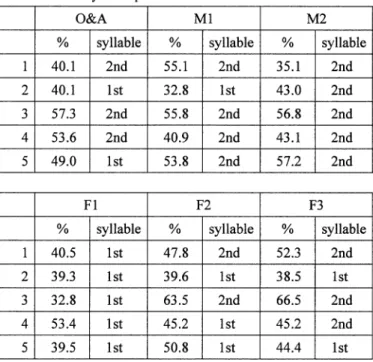
Table 1 Summary of the peak location
O&A M1 M2
% syllable % syllable % syllable
1 40.1 2nd 55.1 2nd 35.1 2nd 2 40.1 1st 32.8 1st 43.0 2nd 3 57.3 2nd 55.8 2nd 56.8 2nd 4 53.6 2nd 40.9 2nd 43.1 2nd 5 49.0 1st 53.8 2nd 57.2 2nd F1 F2 F3
% syllable % syllable % syllable
1 40.5 1st 47.8 2nd 52.3 2nd
2 39.3 1st 39.6 1st 38.5 lst
3 32.8 1st 63.5 2nd 66.5 2nd
4 53.4 1st 45.2 1st 45.2 2nd
5 39.5 1st 50.8 1st 44.4 1st
'%'indicates the location of the peak in percentage within the tonic element from its onset. 'Syllable' indicates the syllable on which the peak is located. According to Table 1, the peak of the 2nd utterance which is spoken by Ml is located at the 32.8 % position. When this value is compared with the above 25.2 %, it is understood that the 2nd utterance shown in the table also represents the delayed peak. In addition to this, the following three points may be found from Table 1:
First, the peak is located both on the tonic syllable and on the following syllable. In the present data, the distribution is almost the same: 13 cases for the tonic syllable and 17 cases for the second syllable.
Second, in none of the five utterances do all six speakers locate the peak on the same syllable. The number of cases in which the peak is located on the tonic syllable is as follows:
• 1st utterance: one case (F 1)
• 2nd utterance: five cases (O&A, Ml, F1, F2 and F3) • 3rd utterance: one case (Fl)
• 4th utterance: two cases (F1 and F2)
Third, two speakers (M2 and F 1) place the peak on the same syllable in all five utterances. M2 always places the peak on the second syllable, while Fl does so on the tonic syllable. This may be due to personal traits in using the rise-fall. In fact, it is only Fl who places the peak on the tonic syllable in the 1st and 3rd utterances.
4. Discussion
The peak is located within the range of 30 to 60 % of the tonic element from its onset, except for two cases: the 3rd utterance spoken by F2 and F3. This exception may be due to the influence of the segments over the FO contour in this 3rd utterance. The tonic syllable in this utterance contains the TRAP vowel, which intrinsically has a longer duration than the other short vowels, such as the KIT vowel. On the other hand, the second syllable, consisting only of a schwa, may not be lengthened much because of the intrinsic nature of this vowel. In spite of this, however, these two speakers place the peak on the second syllable.
Out of the 30 cases (five utterances spoken by six speakers), the peak is located on the tonic syllable in 13 cases, which accounts for 43.3 %of the total cases. The location of the peak is not stable. This may be due to the mismatch between the number of syllables given and the number of points required. The rise-fall needs three points to complete its form, but there are only two syllables in the tonic element. So, as was expected, it is natural that there should be such instability in the location of the peak. As shown in Figure 2, however, when the peak is located on the tonic syllable, it is closer to the syllable boundary, which is clearly different from the case with the fall, where the peak comes much earlier. As mentioned above, Fl places the peak on the tonic syllable in all five utterances, but the peak is located closer to the syllable boundary.
When Table 1 is examined closely, it is understood that the peak tends to be located on the second syllable when the tonic syllable includes a short vowel, but it tends to be located on the tonic syllable when the tonic syllable includes a diphthong. To examine this tendency in more detail, each utterance is analysed, starting with the 2nd utterance.
In the 2nd utterance, five out of six speakers place the peak on the tonic syllable, not on the second syllable. This may be due to the segment in the tonic syllable, which includes only a diphthong in its rhyme. When the tonic syllable includes a diphthong in the hi-syllabic tonic element, the peak may be reached within the diphthong because the diphthong is intrinsically long. In the case of the 1st, 3rd, and 4th utterances, however, the tonic syllable includes a short vowel. When a syllable with a short vowel attracts stress, at least one post-vocalic consonant is necessary so that the syllable may become heavy. When such a consonant is not a sonorant, the FO contour is not continuous there, just as a break is seen in the latter part of the FO contour for the tonic syllable in these three figures (i.e.
because of /v/ in Figures 1 and 4, and because of It/ in Figure 3). In short, the difference between Figures 1, 3 & 4 and Figure 2 is caused by the intrinsic duration of the vowel in the tonic syllable.
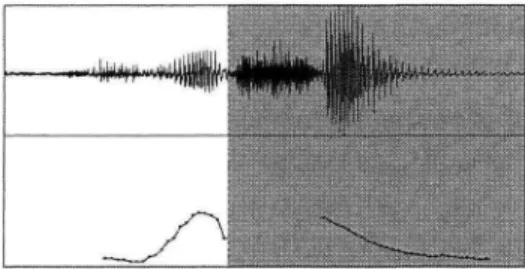
To understand features of the form of the rise-fall in the 2nd utterance more precisely, the FO contour corresponding to the diphthong of the tonic syllable is examined. As shown in Figure 2, it rises, but when does the rise actually begin? Figure 6 is the enlarged version of the tonic syllable in the tonic element '"how soon'.
Figure 6 Acoustic analysis of the tonic syllable in '"how soon' spoken by Ml
The vertical line in Figure 6 indicates the boundary between the first element and the second element of this diphthong. It can be noticed from this figure that the rise begins in the second element, which clearly shows the delayed peak. In relation to this, the form of the FO contour is examined when the same tonic syllable '"how' is used in a monosyllabic utterance. The acoustic analysis is shown in Figure 7.
Figure 7 Acoustic analysis of '"How' spoken by Ml
The vertical line in Figure 7 also indicates the boundary between the first element and the second element of the diphthong in 'how'. One common feature is found in Figure 6 and Figure 7: the peak is located on the second element of the diphthong. Not only does this show the delayed peak, but this may contribute to the possibility that the second element is perceptually stronger than the first. The diphthong itself may sound like a rising or crescendo diphthong and not like the falling or decrescendo diphthong used in its original form. One important difference is also found in the two figures: while the FO contour
corresponding to the first element of the diphthong is mostly level in Figure 6, only the first half of it is level and the rise begins in the second half in Figure 7. As a result, the peak comes much earlier in the monosyllabic tonic element.
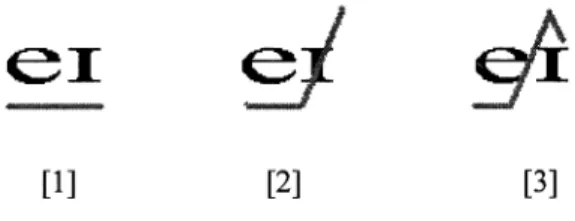
The 5th utterance has no break in the FO contour in the tonic element, as shown in Figure 5. This is because all the sounds are sonorants. When the audio data of this utterance are compared, it can be noticed that there are three types of the FO contour corresponding to the tonic syllable, as diagrammed in Figure 8.
ei
[1] [2] [3]
Figure 8 The relation between the diphthong and the FO in '"blame you'
[1] is used by M1 and M2; [2] is used by O&A, F2, and F3; and [3] is used by Fl. Except for [1], where the FO contour is level throughout the diphthong, the FO rises in the second element of this diphthong, which may help this element to perceptually be more prominent than the first. [1] and [2] may be caused by the presence ofthe post-vocalic /m/ in 'blame'. In [1], the rise starts while this consonant is beginning to be pronounced. In [2], the peak comes in the middle of this consonant. This again shows the instability of the peak location which is well noted as the main feature of the rise-fall.
Based upon the discussion so far, a hypothesis can be created to explain the form of the FO contour for the hi-syllabic tonic element when utterances including this element are spoken with the rise-fall.
'When the hi-syllabic tonic element is spoken with the rise-fall, there are basically two types of the FO contour corresponding to the tonic syllable. In Type I, where the tonic syllable consists of either a short vowel + the coda or a diphthong
+
the coda, the FO contour tends to be level for the vowel. In Type II, where the tonic syllable includes a diphthong followed by no coda, the FO contour starts to rise much earlier.'In this hypothesis, there is no mention of the case in which the tonic syllable includes a long vowel because of the lack of such utterances in the data. This will be examined in future research.
Finally, another interesting feature is found in the 2nd utterance spoken by M2. The acoustic analysis is shown in Figure 9.
Figure 9 Acoustic analysis of 'Ahow soon' by M2
The FO scale ranges from 50 to 200Hz. As shown in Figure 9, there are two peaks in this utterance: one in the tonic syllable and another in the second syllable. In addition, both peaks have the same height. The speaker may have tried to emphasise the delayed peak one more time after the FO contour had reached the peak in the tonic syllable, as though the first peak were not linguistically important. The acoustic analysis indicates that the speaker's intention was to prioritise the second peak, so this was interpreted as the peak when Table 1 was made. This double peak, which is not found among the other five speakers and hence may be this speaker's idiosyncratic trait, contributes to the further emphasis of the rise-fall.
5. Concluding Remarks
In the discussion on the form of the hi-syllabic tonic element, five major features have been found.
First, the peak is basically located within the range of 30 to 60 % in the tonic element. This range may work both for the monosyllabic tonic element and for the hi-syllabic tonic element.
Second, the delayed peak is observed. On average, the peak is located either on the tonic syllable or on the following syllable in almost the same frequency. As far as individual performance is concerned, however, there are two speakers who always place the peak on the same syllable. When the peak is located on the tonic syllable, it is located closer to the syllable boundary, which is the clear distinction from the case with the fall. This unstable peak location is mainly due to the mismatch between the number of syllables given in the tonic element and the number of points required to complete the form of the rise-fall.
Third, the form of the FO contour corresponding to the vowel in the tonic syllable is basically level or rising. Whether it is level or rising is closely related to the segmental structure of the tonic syllable. A hypothesis has been created to explain the form of the FO
contour for the hi-syllabic tonic element. As part of future research, this hypothesis will be tested with more utterances, especially with ones which include a long vowel.
Fourth, in the FO contour corresponding to a diphthong in the tonic syllable there is a noticeable difference between the monosyllabic tonic element (e.g. '"How?') and the hi-syllabic tonic element (e.g. '"how soon?') when no coda follows the tonic syllable. The presence of the tail delays the location of the peak further. In both cases, the peak is located on the second element of the diphthong, with the result that the second element may sound more prominent than the first element.
Fifth, a double peak may sometimes be used to emphasise the rise-fall. Judging from the effort that the speaker made for the second peak, especially the effort to make the second peak as high as the first, it may be valid to interpret the second peak as the main peak of the rise-fall.
References
O'Connor, J. D. & Arnold, G. F. (1973). Intonation of Colloquial English: A practical handbook, 2nd edn., London: Longman.
Prator, C. H., Jr., & Robinett, B. W. (1985). Manual of American English Pronunciation, 4th edn., New York: CBS College Publishing.
Roach, P. (2009). English Phonetics and Phonology: A practical course, 4th edn., Cambridge: Cambridge University Press.
Yuzawa, N. (2010). An Acoustic Analysis of the Rise-Fall: A Case ofNonsense Utterances. Tohoku Studies in Linguistics, 19, 17-32.
Yuzawa, N. (2011). Acoustic Features of the Rise-Fall in English: A Case of the Monosyllabic Tonic Element. English Phonetics, 14 & 15, 130-141.
*~X-z:'l'i, 3H:S:0)3flili5~7'-~?t
t:
L-
-c,
iHJlH;J:J(~*;O~ 2 ifw:O"Gf~Q~-fr(J)J::,ff.T~W/UO)%fm~~t!TL-t=.o ~tJTO)ii$:5ft £JT0)5~0)ii$*;Oq~Gnt=.o
m1
1;:,TJi,~l'iifW/U:t$~*P"JO)!f.j:}EO)lif11tfJP"JI;:{:V:Ji:TQ
::_
t: -z:'dbQo
m
21;:,
Ut~~'i~{:;$:1¥)IU'i
2ifw
F~'~,0)-
:1:7
f;:
~Q
:=_t:
f'i
~~v
';O~, ~51ff;: J:
-?-c
f'i
:=_5
L-
tc
~ "J ;O~lb Q ::_
t:
t:,
rJi,~:O~ifW~H:t$-lfw1;: lb Q
~itl'i,.:c
0){:\l:li:l'i?X 0)-lfw
t:
O)mJF.I;:Jliv'
=-
t:
-z:-
lb
Qo
m
31;:, ifWIU:t$ifw(J)£J:{fl;:j.t-t
Qilt*~~~~;:!f.f}E(J)~~f~rP:J;O~JtGn,
fEi.~
t:
L-
-c
~t:
cor=.=-
t:
-z:-
lb Q
0m
4f;:,
ifW~H:t$ifw(J)~f;:=m-m:if(J)Jj-~-2fu~it.2 {fjp{f~:t$~*