Built-in-Tradeoffs
Asiatic Ethics vs. Anglo-Saxon
Rationality
Satoshi Kuribayashi
Prologue
This is part of a study of economic ethics which intends to propound several major characteristics underlying the economic changes in Japan and Asian countries during the last half of the century. Within a framework of economic analysis, an emphasis is placed on contrasting traditional, but still prevalent, Asiatic ethics, behavioral pattern and values, with Anglo-Saxon efficiency and rationality in economic management. Recently the latter has been sometimes termed a main constituent of `global standards' by the major players in the world-wide financial market. But if the former is contradictory to the latter, where would Asian countries be located on the globe?
Asia's New Giant' appeared in 1976. The book of a comprehensive survey of Japan's economy, politics, social and cultural factors, and related institutions may have symbolized the success story of a country which revived and rose back from devastated conditions thirty years before. The other countries stared in wonder or rather in consternation at Japan. And Asian countries, in particular, were encouraged by her performance, this time by her remarkable economic power and vitality not by her military power so abominable and unforgettable to them. Actually a prime minister declared sonorously `The Look East Policy', meaning a farewell to the conventional `Look West Policy' and learning Japan's achievements well-done both in economics and management.?
Now Japan faces the most serious economic shrinkage: a terrible plight of deflation spiral. Was Asia's New Giant a foregone myth, illusion or disillusion? Where will the giant head for the next century? Will the giant follow the path of the fall and decay like the Roman Empire? Is this a mere convalescence?. Or, another, cycle of miracle? One of the key elements in the analysis is to examine how Japan and other Asian countries are going to adjust to the loosely defined `global standards', more specifically, Anglo-Saxon style of rationality and efficiency in capitalism, and at the same time how they are breaking away from their conventions. Makeshift fine-tuning pretending a seeming and temporary volte face would be a futile effort and a veneer of resistance.
The Miracle and the Bubble: A Recap
Does History repeat itself? An English historian, who left us voluminous tomes of a comparative study of civilizations in an historical perspective, once claimed that the catchword that `History repeats itself' has no truth in it, for every historical fact is intrinsically . unique and therefore essentially incompatible with any other fact.'
Looking back at the process of Japan's economic changes, metamorphoses indeed, after 1945, however, one may agree to an extent with the view expressed by a French evolutionist at the outset of the twentieth century who referred to the rise of Japan as marvelous and unparalleled in the World's history, and compared her progress to that of a comet which flashes across the sky, but pursues an irregular orbit, is dangerous to approach, and is extremely uncertain as to its appearance and disappearance. He concluded that "Japan, like the comet, may some day abruptly pass away from sight yonder beneath the horizon."4
Can repeatability of history be proved in Japan's economic development in post-war times?
A bold summing-up of the so-called miracle of Japan is this: all of it done marvelously and accomplished in the over-protection of the fixed exchange rate of ¥360 in the interval between 1949 and 1973. A quarter of a century of protection was long enough. During this period Japan had been like a bird in a cage. The cage did not have any connotation of `prison' but had that of a snug and cozy `compartment' for her to stay in. A modernized version of isolation policy and a paradis artificiels! The key to the cage was the fixed exchange rate, locked against the unpropitious and unlocked for the propitious. She acted an ingenue role naively in the very comfortable cage of ¥360, and had made a headlong rush, taking full advantage of the illegitimately depreciated rate , at developing export-oriented industries such as steel, automobiles, consumer electronics, precision machinery, under the bureaucratic administrative guidance (once famous, now notorious) of MITI, MOF, and BOJ. An exquisite cooperation and mix of the government and the private sector! Wasn't it a superb feat?
General Douglas MacArthur's straightforward impression was that "Japan is a land of twelve year olds." The cage of Y360 may have matched best with those kids' traditional feeling of amae (dependence), one of the Japanese tenets discussed by sociologists and anthropologists. Amiable children behaved well in the international scene following the humble deportment of 3S (sleeping, silence, and smiling). Enfants innocent, not enfants terrible. Are they grown-up adults today?
In April, 1949, GHQ set Y360 against one US dollar.' On the 15th August, 1971, the then President Nixon announced the temporary suspension of convertibility between US dollar and gold. The target of the Nixon shock was towards Japan.6 US economy was in an exhausted situation due to the Vietnam war led by the best and the brightest, and Japan was in a state full of energy with export-oriented industries. Up to this very moment, Japanese yen was the one and only currency which had never been appreciated nor depreciated in the IMF members. EC countries immediately decided to move to the float. But Japan, a seemingly humble kid yet, was hesitant and isolated. On the 18th December, 1971, at the Smithsonian conference, the yen rate was set at ¥308, 17% appreciation which was the highest among the ten countries. It meant the collapse of the Bretton-Woods system, the paternalistic protector (or the maternal protectress) having cared for the ingenue bird. A longtime blowing divine wind (kamikaze) was over. A farewell to the paradis artiiciels. Dans le temps, on etait heureaux.
1973 was a path-breaking year both for this innocent, hidden flower, and for the world economy. Two major events accelerated volatility of the prices of international commodities: the transition from the fixed to the floating exchange rate scheme, and the first oil shock.' Japan's economy recorded for the first time the negative growth in real GNP, most of which accrued from the
tremendous rise in the price of imported oil. The myth of two-digit growth apparently ended but the economy looked comparatively strong against the external pressures, e.g., two oil-shocks and yen-appreciations which were the major cause for several recessions.
The fact of vital importance, rarely broached clearly by economists (blameworthy fellows at least in their indolence), is that the bird in the cage totally lost the concept of `risk' during the long-lived, high economic growth period. A few conspicuous, illogical from the standpoint of economics, examples are as follows:
1. Management failed to recognize the implication of `opportunity cost', a benchmark for any (risky) investment project, which rationally compares the latent profits expected from the project
with its costs incurred. One of the most influential bankers said shamelessly that retained
earnings (belonging to shareholders) were 'no-cost funds'. He believed firmly that any project
should be done through taking advantage of 'no-cost funds'. A good example of free lunches! 2. Part of this misconception came from the fact that shareholders embraced no risk in their stocks.
Thus, their equity was taken as bearing `no risk'. At the same time they never behaved properly
as shareholders. Instead they were enthusiastic only in increasing their shares as a sort of status
symbol, whose models were `madams' of expensive and high class Ginza bars for the `company
gentlemen'. The madams contended with each other in entertaining and attracting these gentlemen through showing their accumulated sheets of stock of gentlemen's companies. Silent
shareholders with conspicuous consumption and pecuniary (but on paper) emulation!
3. Bureaucrats never understood the true economic meaning of `speculation'. They could not think of it functioning as a significant lubricant the role of which is to increase the liquidity in the
market, but thought of it carrying somewhat ambiguous and pejorative implication.' In
consequence, derivative instruments such as futures and options were considered speculative and
prohibited from trading for a long time by MOF bureaucrats. They could not realize that only
'naked' positions in derivatives are speculative but these financial products are used essentially
as risk-hedging tools for investors. This is MOF's stultification.
4. Japanese style management is a paragon of paradox in the context of competitive efficiency and rationality, or an immemorial antiquity. Its three underpinnings, i. e., seniority, life-time
employment, and in-house union, helped produce molly-coddles, a deformed product of
paternalism, among employers and employees. This management style worked well only in the
cage, and now a mirage like Bushido.9 One and only positive contribution of Japanese style
management is `Quality Control', which was not original but imported.
After overcoming successfully and fortunately (and sometimes fortuitously) the external pressures, Japan was attacked by the bubble. Innocent, naive people, self-called `investors', believing only in the ever-growing up of asset prices, were not immune against `risk' at all.
About a decade ago, Forbes, an American business weekly, issued a special report on Japan, titled `The Land of the Rising Stocks' (not `The Land of the Rising Sun')
, when she enjoyed the bubble in the apex.10 The crazy prices of assets, especially land and stocks, were enough to astound the reporters: "The total market value of the land in Japan, a country roughly the size of California, is
-3-greater than the value of the land in the entire U.S. (Or, similarly, the grounds of the Imperial Palace were supposed to be worth more than the whole state of California.)" On paper NTT is worth more than IBM, AT&T, Exxon, General Electric and General Motors put together. Nomura Securities, Japan's largest brokerage house, is valued on the Tokyo Stock Exchange at $71 billion, more than all the securities firms in the U.S. combined."
It appeared that `History repeats itself' here. "What has happened recently in Tokyo bears more than a few resemblances to past manias like the Dutch tulip bulb craze or the South Sea bubble", which were vividly depicted in Charles Mackay's invaluable, memoirs." By the way, big losers in the South-Sea Bubble included Isaac Newton, who exclaimed: "I can calculate the motions of heavenly bodies, but not the madness of people."",
The concluding comment on the Tokyo bubble from the Western standpoint: "Using Western analytical methods to understand the Japanese market is like ordering sushi and dousing it with ketchup. The Tokyo market is more like the U.S. market of 60 years ago. This is a market that operates more like a great pachinko parlor, with quick action and lots of noise, than like the U.S. markets... Tokyo is big, not broad, and it is fairly easily manipulated." To sum up: "How do you judge a stock market that seems to owe its pricing more to the spirit of Zen than to the logic of value?" Japan was far from capitalism, Western rationality or value-standard.
Was the bubble one of the processes of decay of Asia's New Giant, nothing miraculous, and was it the last, abortive flower of the ingenue? Or was it the second meteor? Or, the coup de grace or the peine forte et dur?
"The two cities (London and Paris) emerged from their ordeal with a new and enduring prestige not because they never fell but because they fell only to rise again and oppose a firmer resistance to the invader. As the ordeal continued, this resistance became indefatigable. .... and either city crowned its long endurance with a final feat of arms which made a permanent impress upon the national imagination."14 Tokyo had not their resistance and imagination nor the power of money instead of arms, and plunged in the deflation spiral, without enjoying her short relief in convalescence. Der Schlaf der Moenche ist kurz. Following Charlotte Bronte, "Tokyo will not be where it was, nor will this day or generation be either what or where they were."
Acta est fabula. Incipit Lamentatio.
A Vicious Cycle
It would take some time for a country to fall from the top of prosperity and take more time to rise up from the bottom which may be called `the effect of inertia'. Deflation Spiral is one of the inertia effects.
Deflation Spiral is defined as the state of economy where recessions continue accompanying the fall in prices, and the economic activities rapidly shrink spirally . Bankruptcies and further redundancies result by which sluggish consumption (i . e., decrease in demand) is accelerated. It causes the further fall in prices. This is what Japan has never experienced in the post-war period . A
vicious cycle, indeed! In turn, Asian nations face an economic turmoil and: the world economy is seriously affected. Do not forget that Japan is still maintaining the position of the second-largest economy in the world, as far as GNP is concerned, who is eventually required to have a great responsibility both at home and abroad. Politicians, bureaucrats and business executives have neglected or postponed the responsibility for many, many years. The charge and scourge for their delinquency and fatuity is Deflation Spiral. And the biggest victim is, of course, us, taxpayers , the populace voiceless who have never exercised their proper role implied in "vox populi, vox Dei".
Needless to say, the main cause of the current deflation spiral is the bubble a decade ago. Asset prices rose up to the unhistorical level and plummeted down in an instant, which is a typical case of the asset-deflation process. Asset price falls do not appear to follow the theory of inertia. There used to be a similar situation in pre-war Japan: a panic in the early Showa Era. Prices fell more than forty percent, many banks bankrupted, the rate of unemployment exceeded nine percent, the real growth of the economy recorded negative, &c. All of those incidents were a reaction to the bubble after the First World War. How akin to today's economic plight in Japan! If we learned something meaningful from History and grasped correctly the economic movements, then we could have avoided the economic problems causing the deflation spiral, the longest and the most serious depression in post-war times. In this respect, pop (more precisely, mock and sham) economists ignorant not only of economics but of history have to assume the responsibility together with politicians and bureaucrats.
Now ten years have passed since the crazy state of the land of the rising stocks. The Economist
pointed out that "Capitalism, you might say, is finally coming to Japan. Pity it had to be the hard way."15 In other words, till this time it has been impossible to explain Japan's economy in capitalist framework.
The essence and the most important factor of capitalism were characterized by the two great economists born in the same year, Keynes and Schumpeter, several decades ago, i.e., `animal spirits' by the former, and `creative destruction' by the latter.
Keynes observed in his revolutionary but theoretical and polemical book of 1936: "Most, probably, of our decisions to do something positive, the full consequences of which will be drawn out over many days to come, can only be taken as a result of animal spirits-of a spontaneous urge to action rather than inaction, and not as the outcome of a weighted average of quantitative benefits multiplied by quantitative probabilities."16 Thus, "the state of the `animal spirits', which is largely a function of the energy and competitiveness of groups of firms, is the most important factor in capitalist development."17
Schumpeter's rhetoric was similar: "The opening up of new markets, foreign or domestic, and the organizational development from the craft shop and factory to such concerns as U. S. Steel illustrate the same process of industrial mutation-if I may use that biological term-that incessantly revolutionizes the economic structure from within, incessantly destroying the old one, incessantly creating a new one. This process of Creative Destruction is the essential fact about capitalism ."18
Their implication is most significant in the sense that the economy which lacks animal spirits' and creative destruction (carried out by entrepreneur ship, or venture spirits in modern parlance) is not a
-5-capitalist economy. Who can deny the statement that Japan lacks these -5-capitalist attributes and is full of `imitative and uncreative majority'?
The current deflation spiral may be taken as a necessary evil for Japan to do without a trio of fools of politicians, bureaucrats and business executives (or a quartet of fools, if pop-economists are added to the trio) in the paradis artificiels, and optimistically speaking, may provide Japan with a rare, precious chance in the sense that the wonderland on earth where any revolution has never broken out and never in future either will be able to escape from many vicious cycles as well. But do the majority understand the true meaning of de Senancour's unforgettable word of 'perissons en resistant'?
No one but the trio or the quartet, however, would have an optimistic view at all. Rather, some may recall the denouement of the Buddenbrooks in which Thomas Mann portrayed in a grand scale the physical decay of a proud and formerly strong and energetic patrician family of merchants in an old Hansa city. Their last scion was a highly gifted and artistic weakling. Economists might say that prosperity of a family in a capitalist world will decay in three generations. The younger generation of Japan belong to the third generation and resemble the last scion of the Buddenbrooks in their weaklingness, physical and mental, though they are remote from a highly talented artist (but plagiarists, the third generation of copy cats). Japan is aging quite rapidly. A quarter of the population are those over sixty five-olds, the first generation who achieved the two-digit growth. They who trust and rely on the younger generation, at least as their guarantors of pension life, will be termed insane. Governments, both central and local, financial institutions, industries, are on the verge of bankruptcy.
Here are citations from a couple of historians: "If the word 'death' could be used to describe the passing-away of an institution, the `death' of Hellenism would be a case of suicide, not of murder."" It may not be absurd to replace Hellenism with Japan where "prosperity ripened the principle of decay."" And "expansion abroad and dissolution at home was an apparent incident."" It had been rotten from within. Finally, "...and if Rome still survived, she survived the loss of freedom, of virtue, and of honour:"22 If Japan still survived, she survived the loss of animal spirits and creative destruction, of efficiency and rationality.
Thee financial assets totaling more than 1200 trillion yen, a fruition of saving and accumulation by ordinary, industrious people for fear of uncertainty in future, will be a mere delusion, for the trio or the quartet will not use it for productive activities but waste it extravagantly for fulfilling their egoistic purposes. They are le esclaves du desir. The true enemy is not the foreign capital which aims at 1200 trillion yen, but the fools in the bureaucracy or in the industry who are going to be marked in history books in future only as an accelerator of the decay and dissolution of Japan who is an Asian country. La Nipponique "est sans vie, mais non sans corruption. Cependant elle a en elle plusieurs elements de dissolution" (Baudelaire).
Indolence is evil. Thus, prime ministers, bureaucrats, top bankers, are les fleurs du mal , an outgrowth of that metamorphosed abortive flower. Look at their faces and complexions. According to Baudelaire's physiognomy, they are an epitome of "produits avaries, nes d'un siecle vaurien".
Asiatic Ethics: An Economic Interpretation
What is the Asiatic and Japanese ethics in general which has been blamed and attacked incessantly from the Western side as irrational and economically inefficient? Several characteristics which are on everybody's lips are as follows. Nepotism is an example which is ubiquitous among the countries from North Korea down to Indonesia, Malaysia, Singapore. Japan is not an exception. Nepotism leads to deterioration and aggravation of economic performance, for it does not reconcile with legitimate evaluation system based upon meritocracy. Dango (underground negotiation intending to negate the competitive bidding), authoritarian and discretionary regulations in many areas and lack of full disclosure of information are also quite Asiatic. These are closely tied up with Asia's lacking of animal spirits, creative destruction and the concept of `risk'.
Gibbon observed that "Constantinople adopted the follies, though not the virtues of, ancient Rome."23 Do Asian countries play the role of Constantinople in their phase of economic changes and does Japan that of ancient Rome? "Only in Japan, part of the rigging is done as government policy. A broker may create an `election stock' which will conveniently take a sharp run a few months before the next election in time for you to get out at a nice profit you can use in the campaign."24 PKO (not `peace keeping operation' but `price keeping operation') through the money of taxpayers was carried out by the Japanese government and is followed by Hong Kong. This is a typical instance of destroying capitalism by the political and business leaders in Asia. They are ignorant or neglect purposely Adam Smith's `invisible hand' working in the stock market, the very center and mecca of capitalism.
Apart from a familiar and conventional (and somewhat obsolete) approach within the context of Confucius,25 take a compendious look at the framework of economic analysis on social choice, organization, decision making, etc.
"In a capitalist democracy there are essentiall
y two methods by which social choices can be made: voting, typically used to make `political' decisions, and the market mechanism, typically used to make `economic' decisions."26 Here the key words are included to form a trinity of capitalism, democratic election and the market mechanism. Capitalistic development is impossible without the flexible working of democracy and the market mechanism. The trouble with Asia is that she does not share these values neither the virtue of competition nor the value of freedom. Efficient social choices and economic decision-making do not get along with Asia where "the two methods of social choice, dictatorship and convention, have in their formal structure a certain definiteness absent from voting or the market mechanism."27 Too definite indeed in Asia!
When the market system fails, the organization emerges, since "there is a cost of using the price mechanism".28 Or, look at it another way: "The price system is an election in which some voters are allowed to vote many times and the only way people can vote is by spending money."29 The distinguishing mark of the organization is "a means of achieving the benefits of collective action in situations in which the price system fails."30 The once praised Japan Inc. is a good example of the organization in this sense. Administrative guidance, amakudari, convoy system, arbitrary and discretionary regulations, Japanese-style management, etc. flourished in Japan Inc.
Next comes authority, the centralization of decision making which serves to economize on the transmission and handling of information." For example, "an employment contract is precisely a contract on the part of the employee to accept authority."32 In Asia the employment contract is considered just like an agreement between the conqueror and the conquered. Job descriptions are usually not available. Asiatic dictators (employers in this case) appear to have a deep insight of "man's psychological craving for authorit
y."33
"The polar alternative to authority would be consensus".34 Bottom-up decision making such as nemawashi and ringi is a means. of consensus in Japanese-style management, which is an obstacle to speedy and timely decision making.
And finally come a free lunch and corruption. "In Asian countries, too many people, e. g., the Minister's nephew, or the President's son, seem to have been granted privilege without responsibility-""
Dictatorship, authority, convention,, consensus, collective action, free lunch, etc. constitute the basis of behavioral characteristics of Asiatic economic ethics. In contrast to Western countries which have succeeded in "the supercession of formal authority by a derivative forms of the price system",36 it will take many a year for Asia to adapt (this is an effect of inertia) or Asia will remain the same. One would agree with the view: "In Western minds the egocentric illusion... is fortified by the catchword of `the Unchanging East', which confounds the three living civilizations of Islam, Hinduism, and the Far East under the nondescript epithet `Oriental', and which carries the assumption that they all differ in equal measure from the civilization of the West and that they are indistinguishable from one another and from any of the extinct civilizations ... 37 Asiatic ethics has been unchanged hundred years, not only historically but also in cross-section. Then, the theory of inertia would apply to Asia as well as to Japan from now onward.
A few words on `Theory of Perspiration'. "Asian growth has so far been mainly a matter of perspiration rather than inspiration-of working harder, not smarter."" The Asian economic miracle represented by the tigers was based on perspiration rather than inspiration, no sign at all of increased efficiency. Perspiration is not evil at all. Edison said: "Genius is one percent inspiration and ninety-nine percent perspiration." But perspiration is most effective in manufacturing, and the value of manufacturing activity is acknowledged by only China or some other Asian countries. Higher value added is the product of inspiration. Thus, the limitation of Asian growth is obvious in this respect.
According to the Theory of Perspiration, Japan is an exception, because Japan's growth was, unlike Asian tigers, both through high rates of input growth and through high rates of efficiency growth. Here is given a small counter-argument, in a very simplified economic analysis, to examine whether Japan is an exceptional case of the Theory or not.
Natural rate of growth (NRG) of an economy is defined approximately as the summation of growth rate of labor productivity and growth rate of population 39 Negative growth rate means that
there is no labor productivity growth as long as population grows. After 1963, the rate of population increase in Japan had been above 1 % (except in 1966). The most recent year of recording above-1% increase was 1976 (1.03%). Therefore, a significant portion of Japan's economic growth may be explained by population increase at least after that year of 1973 , although the contribution of labor
productivity cannot be underestimated. Currently Japan faces the worst economic situation, recording negative economic growth in two consecutive years. If GNP growth rate is lower than NRG, then accumulated unemployment is prevalent. The Perspiration Theory may not apply to the two-digit economic growth in Japan, but does apply to her recent economic performance. Japan is no longer an exception. No significant difference between Japan and Asian tigers.
Asian economic growth was sustained mainly by perspiration rather than inspiration, by physical efforts rather than intellectual efforts, and the leaders in the political, bureaucratic, industrial and even academic domains of collectivist, authoritarian nations appear not to share Western people's firm belief in free competition, civil liberties, efficiency, free-market-democracy, &c.
Why, then, are Westerners worried about Asia so much? The answer in a simplistic and clear-cut way is: "No doubt Asia will eventually account for most of gross world product-but only because most of human beings are, after all, Asian."4o
Anglo-Saxon Capitalism and Efficiency
A move to the antipodes now.
Ruskin divided England into two classes: those who worked and those who played . For the playing class, `the first of all the English games is making money'. And Frank Harris, who terribly detested English institutions and conventions, did not hesitate to pour out: "In all games the English have a high ideal of fairness and courtesy. No one ever took an unfair advantage of another and courtesy was a law... It was for years the only thing in which I had to admit the superiority of John Bull."41
An economist's declaration that "in a free economy, there is one and only one social responsibility of business-to use its resources and engage in activities designed to increase its profits so long as it
stays within the rules of the game, which is to say, engages in open and free competition, without deception or fraud"42 is almost tantamount to the observations of Ruskin and Harris. "Their love of fair play alone would make them the worthiest leaders of humanity."43 Fair play has been built in capitalist mechanism for a long time by the English no less than open and free competition in their pursuit of money-making.
Fair play is closely connected with `gentlemanly capitalism'." "Gentlemanly capitalism was a formidable. mix of the venerable and the new: it combined inherited and invented traditions with profitable enterprise in occupations which were compatible with gentility." Light Creative Destruction! In Burke's judgment, "the genius of the English (gentlemen) was to infuse tradition with modernity, thereby preserving it."
Capitalism was under the social and political direction of the English gentleman, that elusive creature. Young gentlemen commanded positions in society which provided them with sufficient leisure to practice the gentlemanly arts, namely leadership, light administration and competitive sports. It was an easy task for them to combine the spirit of fair play with their favorite game, money-making, which is the driving force of capitalism.
Amateurism is another character of sport and fair play. The `cult of amateur', so familiar until recent times in every sphere of life from sport to politics, had its origins in the `distinctive - because innate, hereditary and hence general - character of aristocratic power'.
Hippolyte Taine, a recondite French critique litteraire, admired the English gentleman by saying that "Gentlemen were the most enlightened, the most independent, the most useful citizens in the country and a real gentleman is a real noble.... capable.... of sacrificing himself for those whom he leads." The English gentleman was made as well as born, unlike the French gentilhomme whose status was determined solely by birth or royal appointment. Gentle birth conferred an unmatched advantage, the lustre of time; but gentle status could also be acquired by initiation. There exists not much disparity between Tory and Liberal in this respect. "A Tory is a man who believes England should be governed by gentlemen. A Liberal is a man who believes any Englishman may become a gentleman if he likes."
In defining the capitalism under the direction of the English gentleman as `Anglo-Saxon capitalism', it is required to trace its course of development and put it in an historical context.
According to Toynbee,45 the principal chapters of English history in the last five hundred years were:
(a) the establishment of the Industrial System (the Division of Labor) of economy (since the last quarter of the eighteenth century);
(b) the establishment of Responsible Parliamentary Government (since the last quarter of the seventeenth century); and
(c) the expansion overseas (beginning in the third quarter of the sixteenth century with piracy and developing gradually into a world-wide foreign trade, the acquisition of tropical dependencies
and the foundation of new English-speaking communities in overseas countries with temperate
climates).
In other words, these achievements, three in number, are the substitution of a democratic for an aristocratic form of government, the substitution of a commercial and industrial for a purely agricultural economy, and the introduction of a new standard of business-like efficiency into the conduct of both economics and politics. The political invention (i. e., English constitutional tour de force of carrying Parliament) provided a propitious social setting for the subsequent English
economic invention: Industrialism. `Democracy' in the sense of a system of government in which the executive is responsible to a parliament which is representative of the people, and `Industrialism' in the sense of a system of machine-production by `hands' concentrated in factories to tend the machinery, are the two master-institutions that still dominate the life of the Western World.
Great Britain like her daughter, the United States, developed Democracy and Industrial System. A new standard of business-like efficiency both in economics and politics is the nub of Anglo-Saxon capitalism. Furthermore, during the development of capitalism, the English gentlemen grasped the last but not the least important factor: information. "Capitalists at the top of the gentlemanly hierarchy created or commanded an invaluable scarce resource which was form of capital in itself: information."46
rationality whose original, narrow meaning is `calculation' or 'computation'. The well-known Pareto optimality is achieved in the competitive market based upon the behavior of rational (in the narrow sense), economic men. Also, rationality has to do with means and ends and their relations.47 The second is that combination of rationality and information produces an efficient market, one of the ideal markets in capitalism. The market is efficient if the market prices have the following attributes: (1) full reflection of all available information, (2) instantaneous, and (3) unbiased reaction to new information.41 Free, quick, timely, and unbiased dissemination of information is nothing but full disclosure of information. Again the notion is quite Anglo-Saxon and against the Asiatic attribute which is greatly affected by inertia.
UK vs. US: A Digression
"It was early in July 1953
, a wonderfully rare hot day at the end of the summer term at Oxford. Two punts were being poled languidly down the River Cherwell, filled with high-spirited young men...(the) punt carried the college's American contingent of Rhodes Scholars... The punt ahead of them contained, by everybody's estimate, the brainest young men in the college. They were all 'reading Greats' -studying the Greek and Latin classics ... "There, there is England's tragedy."..." 49
How come England's daughter who has contributed to the development of democracy and efficiency misconceives of her Mother? This is a very interesting topic, although a digression. To state a tentative conclusion first, America has gone to extremes of English efficiency and rationality and has lost woof-and-warp of original English spirits. Anglo-Saxon capitalism was carried out by English gentlemen. Their daughter did not possess aristocracy nor any gentlemanly class. Americans might admit the superiority of this class with some envy and find their contentment (and complacency as well) in their own president: "Kennedy was almost British in his style. Grace under pressure was that much-quoted phrase describing a quality which Kennedy so admired, and so wanted as a description of his own behavior. It was a very much British quality: to undergo great hardship and stress and never flinch, never show emotion. Weaker, less worthy Mediterranean peoples showed emotion when pressure was applied, but the British kept both their upper and lower lips stiff. The British were loath to show their emotions, and so was Jack Kennedy.""
To those gentlemen who share their faith in the value of common sense, bon sense, of experience, of learning classics, etc., extremist Americans appear to be indulged in enthusiastically playing a great human comedy such as Prohibition in the twenties, McCarthy's red-hunting in the fifties, recent total ban of smoking, and the sex scandal of the President, to name a few. "American firms use quantitative methods for decision making, which favor analytic precision and detachment over insight and judgment based on experience... a longtime American tenet that reason was and ever must be antithetical to feelings."" En passant, Americans find that England has something common with Japan in considering wintertime central heating effete.
American leaders were very loyal to the naive definition of `rationality', i. e., quantitative
-11-computation. The typical paragon or incarnation or embodiment of rationality in this sense was McGeorge Bundy and Robert McNamara in the Kennedy administration: the best and the brightest among Americans. The almost British-like president selected as his policy promoters the almost antithetical persons against the English gentleman. They were disciplined, with a great analytical ability, a great hunger for facts and had the belief that sheer intelligence and rationality could answer and solve anything, and man could conquer all by discipline, and will, and rationality. McNamara's attitudes, his love of statistics, his determination to quantify everything, his almost total absence of sense of nuance and feel, were also dominant. It naturally led America to that tragic war . The only measure of the war the Americans were interested in was quantitative. One of the top military persons, John McNaughton, seemed to symbolize the inhumane and insensitive quality of that era, undoubting, unreflective, putting the quantifying of deaths and killing and destruction into neat, cold, antiseptic statistics, devoid of blood and heart. Quantify, quantify , quantify! The best and the brightest invented the very rational 'kill-ratio' which was the worst sample against humanity and sensitivity. As for McNamara, "he did not serve himself nor the country well; he was, there is no kinder or gentler word for it, a fool".52 Incidentally, McNamara gave every spare time to reading of unabridged Toynbee's Study of History in a quiet campus town, Ann Arbor . What did he read between the lines? Did he not learn in his business school days Alfred Marshall's golden dictum of
`cool head and warm heart' given to the C
antabrigian students intending to study economics, but did he learn `cool head and cold heart'?
Anglo-Saxon capitalism was under the social and political direction of older elites. Elites could be produced anywhere and anytime. But the gentleman is not so. He is a product quite indigenous to England. And amateurism is a very distinctive character of English aristocratic power . Lack. of amateurism drove American elites, the best and the brightest, to sheer professionalism in politics, economics, management, and elsewhere. Which is worth the last laugh, amateur or professional?
A few words on the so-called presuppositions of Harvey Road may be needed here . Keynes thought of the important decisions being reached by a small group of intelligent people; e.g., the government of Britain was and would continue to be in the hands of an intellectual aristocracy using the method of persuasion." It has been severely attacked by American economists mainly because its implications appear to be against democratic policies and decision making . It is crystal clear, however, that policies implemented by the hands of mediocre political merchants elected by a seeming democracy were and would continue to be totally unsuccessful, for elections make decisions on a sort of average." Gentlemanly capitalism is a natural consequence of Harvey Road presuppositions.
Another digression. Vicious democracies have not been criticized in any expository way by economists but by radical litterateurs, e.g., Edgar A. Poe in a mystical way in The Colloquy of Monos and Una, and Baudelaire in a dogmatic way. The latter sneered at democracy in general:
"Rien de plus ridicule que de
chercher la verite dans le nombre." He contrasted democracy with `cat': "Pouquoi les demo
crates n aiment pas les chats, it est facile de le deviner. Le chat est beau; it revele des idees de luxe, de proprete , de volupte, etc..." And Villiers de l'Isle-Adam, a disciple of Baudelaire, in a symbolic way: "Why does anyone not understand an easy thing that the reins by the
chiefly human and so-called `fair and equitable' are absolutely nothing but a tyranny by the `mediocre'
,. for the law that all the intellects are unequal congenitally in their qualities and dispositions is as given? To speak of the `mediocre', they do that exultantly on the plea of the number! By brandishing the number, they force to degrade these people-the geniuses who alone form the realization of 'human spirit' and thereby alone have the qualification to determine and lead the right trend." "Nobody could make a true noblesse offhand . It would take several hundred years and need something more than that." M a A A o v r a r a v r a (Sophocles , "These things are in the near future.")
A final digressive question. Do English gentlemen today agree with Ruskin, a noblesse spirituel?: "and at this day
, though I have kind invitations enough to visit America, I would not even, for a couple of months, live in a country so miserable as to possess no castles ,"55 or with Baudelaire: "in America, only time and money are valued. America having no aristocracy failed to evaluate properly Edgar A. Poe, a true philosopher and poet (and a God to Baudelaire), killed him, and trod his sacred
sepulchre underfoot." So much for literature.
Two Types of the Risk-Return Tradeoff
Let's go back to the sheep.
Many views are available in demarcating Asia and Japan in contrast to the Western world, in their behavior, psychology, political actions, and so forth, putting aside their economic aspects: analogue and integral thinking of Asian people vs. digital and differential of Westerners, chopsticks culture vs. knife-and-fork culture, The Greater East Asia Co-Prosperity Policy of the military Japan vs. The British Commonwealth of Nations, heterogeneity vs. homogeneity in religion, culture, &c...
Some economists predicted the natural decline of Asian economic growth higher than the world's average based on the proposition of convergence and regression which explains that any extreme economic performance should converge around the average in time. Others shared an optimistic, somewhat superficial, view of latent, productive effect of synergism among Asian economies, mainly explicable by their great degree of heterogeneity. This is a problem of geography of longitude (vertical location in Asia) not that of latitude (horizontal location of Europe and USA).
Looking at the economic and political system of Asia, one may see `the Unchanging Asia'. In Max Weber's Ideal-Typus framework in social sciences, neglect of market economy, dictatorship, totalitarianism, authoritarianism, many free lunches, neglect of copyrights and prevailing plagiarism, vicious democracies, all are Asiatic. To boot, corruption and nepotism and embezzlement are every year's and every country's incidents. Karl Marx would claim: "Ein Gespenst geht um in Asien-das Gespenst des Nepotismus and der Korruption. Alles Machte des neuen Europa and Amerika haben sich zu einer heiligen Hetzjagd gegen dies Gespenst verbundet." Leaders in politics, industry and bureaucracy are busy in accumulating money through dexterously invented modus operandi of deception and fraud, put it in their safe, secret Swiss bank accounts and finally flee to foreign
-13-countries right before their evil conducts come out, just imitating John Law, that legendary king and genius in the history of the bubble. How many of these cases have we witnessed in Asia? Who could say with sureness that they were bygones?
Some basic attributes of capitalism are individualism, specialization, a market economy, rational calculation, etc. All of them are against the Asiatic attributes. A trinity of Parliamentary Democracy, Capitalism and Industrialism56 is hardly understood by Asian people. Fair play instead of nepotism, no free lunch, creative destruction instead of conventionalism, meritocracy instead of seniority, free competition instead of underground negotiation, disclosure instead of secrecy, all combined constitute efficient functioning of capitalist economic system.
How to approach to these features of Asia incompatible with Anglo-Saxon style of rationality? The following is a tentative attempt to test the applicability of a theory of financial economics to the major differences in economic behavior observed thus far between Asia and Anglo-Saxon. The analytical framework is 'risk-return tradeoff', which was originally developed in the context of investor's behavior: `portfolio selection
The core of the theory is simple and intelligible and appealing to common sense." Investor who seeks for higher return must bear higher risk, and investor who doesn't like higher risk must put up with lower return. A typical case of the former is those in various venture businesses. Retired people, family of widows and orphans may be classified in the latter. Higher return with higher risk (or lower risk with lower return), i. e., the positive risk-return tradeoff, is the basis for sustaining capitalism. Animal spirits of Keynes, creative destruction and entrepreneurship of Schumpeter, cost-benefit relationship, risk-incentive tradeoff58 and venture business people eager in realizing American Dreams are interpreted by the positive risk-return tradeoff framework.
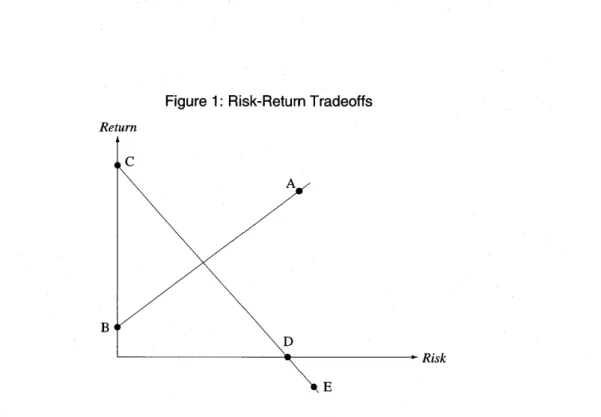
Economic ethics and behavior underlying and prevailing in Asia can also be explained by the risk-return tradeoff, not by the positive but by the negative risk-risk-return tradeoff. The behavior of those people who take lower risk or no risk and at the same time earn more and more money, and enjoy the benefits to a full extent produced by nepotism, corruption, plagiarism, etc. cannot lie on the positive tradeoff but on the negative tradeoff.
Look at Figure 1 which exhibits the two types of risk-return tradeoff. Points A and B show the positions of high-risk/high-return people and low-risk/low-return people, respectively. They are located on the straight line with positive slope. Point C represents the highest return achieved without taking any risk; whereas Point D shows the poor victims of fraud, deception, no information or of lack of information and disclosure. Even some of them face the negative return with much higher risk (Point E).
Figure 1: Risk-Return Tradeoffs
Return
B
Risk
There is no lack of negative tradeoff cases in Japan. Voltaire called the pilferer in the literary world as ecornifleurs du parnasse. The meaning is `to possess the belongings of others without any investment or capital, i.e., filching'. In Japan lots of ecornifleurs of various kinds. The Lockheed Scandal, The Recruit Scandal, The Orange Benefit Society Scandal...Many petit, not beau Jessamy, John Laws were engaged in secret maneuvers. Among them were included prime ministers, mock economists, sham political commentators, pianists, business executives one of whom has been back on the front scene recently and gives many talks of morality of business people!, and a university professor majored in economic ethics!! Many a persona non grata. "A crowd of critics, of compilers, of commentators, darkened the face of learning, and the decline of genius was soon followed by the corruption of taste" (Gibbon).
The poor victims are the silent mob, who never protest against the petit John Laws. This country, after all, is a wonderland where any revolution either violent or bloodless is never expected to break out.
Broadly speaking, Economic Ethics . is a subject of Political Economy or Moral Science in traditional term. The most important feature of the risk-return tradeoff is that under the negative tradeoff any price does not play role. The negative tradeoff does not convey any significant
information as signal to market participants, and moreover, any price cannot be set at all. The positive tradeoff between risk and return is the basic building block for efficient working of competitive price system in the capitalist world. It is essential in capitalism no less than institutionalized private property. Furthermore it may be applicable to interpreting psychological, behavioral, political issues as well as economic.
To repeat, in the world of negative tradeoff rationality and efficiency do not apply. It would only destroy the capitalist structure, not constructively in a Schumpeterian sense. PKO policy of the Japanese government mentioned above is an example. This is nothing more than a rigging in the
-15-stock market, the symbol of capitalism. The policy was followed by another Asian government . One prime minister, who shut the -door of the currency market of his country against foreigners , declared proudly: "Asian values are universal values". Certainly , if there is one such stuff, it must be the negative risk-return tradeoff! As shown in recent economic turmoil among Asian countries , the negative tradeoff entails eventually the biggest risk for a country in a long run . Who has to pay this dear bill? Ordinary people, taxpayers, poor victims.
Concerning the country risk, a brief, side-way review of evaluation . Rating agencies, most of whom are Anglo-Saxon, use both quantitative and qualitative figures in their country-rating (specifically, the debt of a country). The degree and nature of risk-return tradeoffs built in the country must be one of them. If hypothesizing any Asian country as an incorporated firm , like Japan Inc., then the value of a country, in the most simplistic way, may be expressed in the framework of Contingent Claims Analysis (CCA).59 In other words, the value of risky debt of a country as an hypothesized firm is a function of several variables (the rate of interest applied to the country , the volatility in the value of the country, etc.).
This is not a place for a detailed discussion on the applicability of CCA to country-risk rating which is highly technical. But one thing important is that CCA evaluates country-risk by utilizing
`stock' information appearing in country's b
alance sheet, not 'flow' information like GNP . In terms of Corporate Finance, 'the rate of return' is irrelevant to evaluation . It is far more difficult for any firm or country to improve the quality of its stock variables than flow variables . Not a few Asian countries show better performance in flow figures but far poorer in stock values than Western countries. Japan is a good example and it is another wonder for her to still occupy the seat of G7 .
Several Concluding Remarks
This paper is a progress report of my research project which is going to scrutinize not only economic but relevant historical, cultural, psychological, religious, legal, political and educational aspects in Japan and Asia. An original intention was to focus on the Big Bang in Tokyo towards the next century, as an example of Japan's adjustments to so-called global standards. Lots of people both in business and bureaucracy share rather optimistic views on the result; but it is suspect, for they do not appear to be well prepared to accept the dominance of the players abroad over the domestic financial institutions and markets. It is not an easy business for us to learn and implement the experience of the Big-Bang in London" carried into effect more than a decade ago. Another intention was to examine the limitations of `efficiency' in Asia in general. This is a comparative study of Economic Ethics, an area of Political Economy, whose implications for Japan as well as for Asian countries are, hopefully, many.
To list, at random, several remarks and topics for further study:
1. Risk and return may be considered as one of the duality concepts in Western-style thinking, in contrast to Asiatic non-duality, e.g., in Zen-style thinking , on the one hand; falsifiability and refutability are the attributes of economics as a science in the sense of Kuhnian paradigm (not a
`dismal' science), on the other . More rigorous analysis, according to freedom from judgment in Weberian notion, of applicability of risk-return tradeoffs to human behavior and
institutions other than economic, such as educational (e. g., universities in Japan, fallacy of
literacy and higher education), conventional, religious, to journalism, to professional sports, etc.
will be needed.
2. Therefore, a reappraisal of Thorstein Veblen, a longtime forgotten institutional economist, might be suggestive. Here is an example. In Japan as well as in other Asian countries, an inscrutable
jargon, a cliche, of `men of learning and experience' or `learned class' is used frequently. They form a clique and sometimes are selected members in various governmental advisory committees
not having any concrete purpose but providing them with comfortable chat-rooms. Usually policy recommendations made by them are paid no attention, only in complacency. This is not. at all the
implication of Harvey Road presuppositions of Keynes. Veblen's comment on learning and magic
seems to hit the right mark even in today's Japan and Asia: "The recondite element in learning is
still, as it has been in all ages, a very attractive and effective element for the purpose of
impressing, or even imposing upon, the unlearned; and the standing of the savant in the mind of
the altogether unlettered is in great measure rated in terms of intimacy with the occult forces." "In
point to derivation, learning, as well as the priestly office, is largely an outgrowth of sympathetic
magic; and this magical apparatus of form and ritual therefore finds its place with the learned class of the primitive community as a matter of course...so that their presence as an integral
factor in the earlier phases of the development of magic and science is a matter of expediency." 61 Another forgotten Japanese thinker put it similarly: "To consider learning and knowledge as `a
power', or as a privilege or rice and bowl superior to others is nothing but the groundless
anachronism which requests the present age to return to the primitive age when the letter had a magical power and the astrology was an instrument of the reins by priests."62 Finally Baudelaire's
original observation of the people of a European nation may directly apply to both the learned and the unlearned of Japan: "Ces gens-la ne pensent qu'en bloc. On pense en commun. C'est-a-dire
qu'on ne pense pas."
3. A Western illusion of `the Unchanging East' is related to the applicability of the theory of inertia to Asia and Japan. Recently Asian currency markets have been severely attacked by hedge-fund
operations using the derivative instruments. Were Asians ready for the highly computerized, time trading? The Big-Bang in Tokyo will provide the same problem. Indolent policy again? If so,
history repeats again. The target of the Nixon shock and that of BIS regulations a decade ago were
towards Japan. The Japanese government, bureaucrats and bankers failed to react quickly. The
power of inertia is very strong among Asian countries.
4. A few words on vicious democracies and elections in Asia. Number and average play a vital role in democracy and election. If abused, many political merchants (not politicians) take a part in full
blast in the backyard in engaging themselves in corruption through nepotism, election stocks, etc.
No matured democracy yet in Asia. The same locution seems to apply to freedom of speech, far
less in maturity. In this particular respect Japan is a rare exception. But too free! Hearing and
seeing the Japanese language spoken and written by the ordinary, average people (the
generation scions), one may recall a maxim: "Style is the character of man as well as nation and people." Japanese language is on the edge of collapse driven by `extreme opportunists"'. On
numbers, I recall my personal experience in Australia. I was stunned very much when I heard
Australians say Indonesia is a `big' and/or `great' country (taikoku in Japanese), much bigger
and/or greater than Australia. Their implication was that their definition of `big and/or great
country' is solely based on `quantity' not on 'quality'. Affluence or quality of life is irrelevant. As
long as they stick to their `rational computation' of the numbers, Asian (and African) countries
would remain as a threat to them to an extent, and, in turn, these countries would use the number of human beings as a weapon, not military but political and economic. Flight to quantity in the
age of flight to quality. This would be, I am afraid, against humanity and sensitivity. We have to
learn from the invaluable lessons of experience which were left to us by the bests and the
brightest in order not to commit and not to repeat their cardinal sin. The concept of `big and/or
great countries' in Western minds should be corrected. `Small' countries such as Australia and
New Zealand would be `great' countries as a safe, last resort as shown in a movie, On the Beach.
Populated nations with the noise of pinball house, fully jammed trams with heavily crowded
passengers, blinded mass only silent on `authority' at home, appear not first rate or great
countries. Thus, another adage for Westerner: "second rate mind for second rate nation" 64 (e. g.,
the so-called Japanologist?).
5. In this particular respect of value judgment in social sciences, however, Frazer's stance totally divested of any prejudice, preconception or predilection is instructive for us to approach to ethical
and religious issues in Asia in historical setting. Based upon the evidence observed in the
aborigines of Australia, he claimed: "These savages are ruled neither by chiefs nor kings. So far as
their tribes can be said to have a political constitution, it is a democracy or rather an oligarchy of
old and influential men, who meet in council and decide on all measures of importance to the
practical exclusion of the younger men. Their deliberative assembly answers to the senate of later
times: if we had to coin a word for such a government of elders we might call it a gerontocracy."65 Isn't there an affinity in the philosophy of this gerontocracy to the presuppositions of Harvey
Road rather than to the motivation of governments and bureaucrats of Japan and other Asian
countries which are still rife with corrupted leaders infatuated with businesses lucrative to
themselves? Another example from Frazer: "...strength of character in the race as in the
individual consists mainly in the power of sacrificing the present to the future, of disregarding the immediate temptations of ephemeral pleasure for more distant and lasting sources of
satisfaction." 66 Some may admit that a seeming resemblance exists between saving behavior of
Japanese and sacrificing the present to the future of the savage people. But quite contrary. The
sole concern of the latter was with how to keep their `virility', whereas that of the former is with how to cope with subsistence uncertain in future incurred by their senility, loss of `virility' to wit.
"The more the power is exercised the higher and stronger becomes the character; till the height of heroism is reached in men who renounce the pleasures of life and even life itself for the sake of keeping or winning for others, perhaps in distant ages, the blessings of freedom and truth."67 Thus, it rather resembles `knighthood'.
6. Finally but not least important, legal system in general in Japan and Asia, to which the present paper has not referred, is worth close study, in connection with discretionary regulations and
disclosure policies (e. g., accounting standards), for it exerts a strong, prescriptive power upon those who have an inclination to accept authority and to follow conventions. Topics in comparative legal-sociology may include jury system, continental civil law, Anglo-Saxon
common law, etc.
Epilogue
An Irish saying of "East for the future, West for the past". How can one interpret it? Was it a saying in the days of Ptolemaic geocentricism? And does it not stand in the age of Copernican heliocentricism?
If in the next century inspiration dominates over perspiration, quality over quantity, efficiency over physical efforts, and the value of manufacturing is appreciated only in China (and in other Asian countries) who account for most of the population on earth, will the Irish saying still be persuasive and suggestive?
Again following Marx: Die Geschichte aller bisherigen Gesellschaft ist die Geschichte von Ost-West-Kampfen (i. e., the war between the positive risk-return tradeoff and the negative risk-return tradeoff). Aforementioned prime minister would say: Volk alles Asien vereinigt Euch!
Pascal said: "The criterion of good and evil is a matter of latitude, indeed. What is good hither is taken as evil thither." Is the built-in tradeoff between risk and return is a matter of longitude?
Notes and References
This is the first paper of mine touching upon, explicitly or implicitly, the topics in history, ethics, organizational behavior, psychology, etc. The philosophically amateurish discussions and
somewhat exegetical, centrifugal rather than centripetal, expositions will be forgiven.
1. Hugh Patrick and Henry Rosovsky, eds., Asia's New Giant.
2. My personal experience. I worked as a consultant for the Prime Minister's Office of Malaysia, the main body promoting the Policy. The Office held many seminars and workshops on Japan's
economy and management style, but none on politics. Other ASEAN countries were the same. 3. Arnold J. Toynbee, A Study of History.
4. Gustave Le Bon, cited in Toynbee, op. cit. He was an authority on mob psychology, too.
5. When the War started, the rate was ¥4.25. When it ended, the rate was ¥15. One of my students believed in another's instinctive and naive statement that GHQ might have set it at 360 half in fun because they had a knowledge that `yen' in Japanese means `circle' in English.
6. Again my personal experience. I left for America for study in August 1970, when the maximum
amount of yen allowed for any person to carry out with was ¥80,000. I recall a Japanese visiting professor who was `shocked' terribly by the Nixon shock, because he had put all his money in
US dollars at a small local bank in Ann Arbor, a small campus town in the Midwest, and was
going back to Japan in September.
7. The other two major incidents in 1973, especially for the students of financial economics, were the opening of the first exchange for options trading (CBOE, Chicago Board Options Exchange)
and the publication of the path-breaking article on option pricing by Black and Scholes. See Note 59 below.
8. "Speculation is taking an unhedged position, short or long. A homeowner who buys a house financed with a mortgage is assuming a. speculative, levered position in real estate . A dealer who
buys governments with RP money is assuming a speculative, levered position in governments.
The only difference between the two is that the dealer knows he's speculating; the homeowner
used not to think of it that way." (Marsha Stigum, The Money Market). 9. Inazo Niitobe,. Bushido.
10. Forbes, May 18, 1987.
11. Paul Krugman in Fortune, August 18, 1997.
12. Extraordinary Popular Delusions and the Madness of Crowds, originally published in 1841. (Do not confuse it with Joyce Carol Oates's short story of the same title which was first published in
1972, and included in her Marriages and Infidelities. Who could imagine why she put that title?)
Gibbon's grandfather was one of the directors of the of South-Sea Company (Edward Gibbon,
Memoirs of My Life). 18 petitions and 86 bubbles imitating the South-Sea Company are listed in Mackay's memoirs, all of which are full of deception and fraud. Another book of interest is
Joseph de la Vega's Confusion de Confusiones, which was published in 1688, focusing on the
stock of the Dutch East India Company. On the South-Sea bubble and the Tulipomania, see also
John Kenneth Galbraith, A Short History of Financial Euphoria.
13. Burton G. Malkiel, A Random Walk down Wall Street. 14. Toynbee, op. cit.
15. The Economist, June 20"' 1998.
16. J. M. Keynes, The General Theory of Employment, Interest and Money. He emphasized the importance of the state of mob psychology in economic analysis which would cause the bubble. 17. Joan Robinson, Economic Heresies.
18. J. A. Schumpeter, Capitalism, Socialism and Democracy. 19. Toynbee, Hellenism.
20. Edward Gibbon, The History of the Decline and Fall of the Roman Empire. 21. Toynbee, A Study of History.
22. Gibbon, op. cit. 23. Ibid.
24. Forbes, May 18, 1987.
25. A minor counterexample of Confucius approach: "In Japan , Jesus Christ saves, Confucius
26. K. J. Arrow, Social Choice and Individual Values. 27. Ibid.
28. Ronald Coase, "The Nature of the Firm", Economica, Vol. IV, 1937. 29. Mark Blaug, Economic Theory in Retrospect.
30. K. J. Arrow, The Limits of Organization. 31. Ibid.
32. H. A. Simon, Models of Man: Social and Rational. 33. Erich Fromm, Escape from Freedom.
34. Arrow, op. cit.
35. Krugman in Fortune, March 2, 1998. 36. Arrow, op. cit.
37. Toynbee, op. cit.
38. Krugman, "The Myth of Asia's Miracle", Foreign Affairs, November/December 1994. 39. Roy F. Harrod, Towards a Dynamic Economics.
40. Krugman in Fortune, August 18, 1997. 41. Frank Harris, My Life and Loves.
42. Milton Friedman, Capitalism & Freedom. 43. Harris, op. cit.
44. P. J. Cain and A. G. Hopkins, British Imperialism: Innovation and Expansion, 1688-1914,
developed extensive discussions on gentlemanly capitalism. 45. Toynbee, op. cit.
46. Cain and Hopkins, op. cit. 47. Arrow, op. cit.
48. E. F. Fama, "Efficient Capital Markets: A Review of Theory and Empirical Work", Journal of Finance, May, 1970. Examples of efficient markets are the Euromaket in the City and the stock
market in New York.
49. Edward A. Feigenbaum, and Pamela McCorduck, The Fifth Generation. 50. David Halberstam, The Best and the Brightest.
51. Feigenbaum and McCorduck, op. cit. 52. Halberstam, op. cit.
53. Roy F. Harrod, The Life of John Maynard Keynes. Keynes expressed his worry about the current trouble of lack of intellect in his letter to T. S. Eliot.
54. Arrow, op. cit.
55. John Ruskin, Praeterita.
56. Toynbee, op. cit., and Arrow, Social Choice and Individual Values.
57. Harry Markowitz, Portfolio Selection. William F. Sharpe, "Capital Asset Prices: A Theory of Market Equilibrium under Conditions of Risk", Journal of Finance, September 1964. For more
comprehensive discussions, see E. F. Fama, and M. H. Miller, The Theory of Finance. Another
significant implication in portfolio selection is that risk is lowered by diversification, which is
consistent with a commonsense that `don't bring all your eggs in one basket'.