
JAIST Repository: グループKJ法のメンバー編成方式に関する研究
11
0
0
全文
(2) 修 士 論 文. グ ル ー プ KJ 法 の メンバー編成方式に関する研究. 北陸先端科学技術大学院大学 知識科学研究科知識社会システム学専攻. 清水 剛 2000 年 3 月. Copyright _ 2001 by Go Shimizu.
(3) グループ KJ 法の メンバー編成方式に関する研究 清水 剛 北陸先端科学技術大学院大学 知識科学研究科 2000 年 3 月. キ ー ワ ー ド : 収束的思考,KJ 法,グループワーク,SD 法,衆目評価法. 世代認識の隔たりや国際化による多文化とのギャップ、また社会、組織において プロジェクトを行うメンバーたちが各々の立場、視点、価値観、イメージといった ものから生まれる知識の差異というものに直面した時、我々は曖昧にしている物事 に対する認識表現を改めて整理する必要に迫られている。問題解決能力の養成のた めには問題意識だけでは不十分で、解決の手だて、思考の方法を理解することが問 われており、人間の創造的問題解決あるいは思考プロセスを支援することを念頭に おいた様々な考察が成されてきた。近年では組織変化が求められる中で、組織の知 的生産性や問題解決能力の向上が強く要求されるようになってきている。 発想を支援する手法として、発想法が数多く存在する。発想は発散的思考と呼ば れるアイデアの生成と収束定思考と呼ばれるアイデアの整理に分けることができる が発散的思考と収束的思考を繰り返し行なうことによりアイデアの質が高められる ことが多い。このうちの KJ 法は、収束的思考を支援する発想法として有名なものの ひとつである。 本論文では既存のグループ KJ 法の作業形態にヒントを得て、理論を限定し、仮説. を立て、ケーススタディを中心に問題解決プロセスのどの段階で、どのような意思 決定理論や支援システムを使えば、あるいは組み合せれば、役立つのかについて説 Copyright _ 2001 by Go Shimizu 明す.
(4) る。グループKJ法のメリットとしては、取材活動における分担取材の促進、冷静 な批判・相互理解の獲得、共通の達成体験による成長が挙げられているが、それを 取り巻くグループ作業のバリエーションのモデルを提案し、検証・評価を行う。グ ループ作業における KJ 法の確立を目指すこととする。 従来研究と比べ、本研究は技法ではなく、問題解決技法を使って参加者の意識レ ベ ルと参加形態が生み出す効果に留意した検証をその位置付けとした。実験では、グ ループ内における制約と個人のストレス、あるいは満足感といった心的相互作用の 関係性をラベル出し、図解化、衆目評価のステップで探った。計5回の SD 法による 因子分析とアンケート調査では、制約条件の要素を色濃く反映させる結果を得て、 制約条件下にあっても状況を改善できれば創造的問題解決は行なえるとの結論に達 した。 本研究では参加者が作成した KJ 法の図解化作業から抽出したデータをもとに参加 者の思考とイメージを反映した作業形態の機構を提案した。そして、そのデータを もとに評価実験を行ない、この機構が有効であることを示した。.
(5) The study on member’s organization for Group-KJ method Go Shimizu School of Knowledge Science, Japan Advanced Institute of Science and Technology March 2001. Keywords:. convergent thinking, KJ method, group work, semantic differential method,. public attention evaluation.. We sometimes feel a gap in the generation recognition and a gap between the multiple culture due to the internationalization.It feels difference in the knowledge that the members who hold a project in the society and the organization are born of the thing such as each person’s position, a point of view, value and an image.In such cases, we recognition expression vague make things renew put necessity.It isn’t sufficient to have a critical mind to cultivate the ability which solves a problem.The matter that the method of the solution and thinking is understood is being asked to the ability which does a solution of a problem is trained.The consideration were done to support a human creative solution of a problem.A change in organization is being asked in recent years.We require that we were improved the intellectual productivity and the ability which solves a problem. To support creativity, there are many of methods for it.In the process of the creative thinking, ideas are generated and arranged.We called the idea creation process“divergent thinking process”and the idea arranged process“convergent-thinking process”.In the real situation of the creative thinking Copyright _ 2001 by Go Shimizu.
(6) process, the quality of the ideas can be improved by repeating the divergent thinking process and the convergent thinking one.Among then, KJ method is one of famous methods. It got a hint by this thesis in the working form of the existent KJ method.Theory is limited, a hypothesis is made.And, it is done around the case study.It is checked whether you have only to use what kind of intention decision theory and a support system at which stage of the problem solution process. It is explained whether it is useful.Or, it is useful, or it explains when it is put together and put together.Growth by the achievement experience which is common to the acquisition of the calm criticism, mutual understanding is shown as the advantage of the group KJ method as to the promotion of assignment covering in the covering activities.The model of the variation of the group work to surround that is proposed, and verification, evaluation is done.It decides to aim at the establishment of the KJ method in the group work. This research is not a technique in comparison with the research so far.The verification that it paid attention to the effect which a participant’s consciousness level and a participation form produced was made that ranking by using the problem solution technique.It let a label let go to the front in the experiment.Then, a diagram was made, and public attention evaluation was done.It probed into the relations of the mental interaction such as a restriction inside the group and individual stress or a feeling of satisfaction.A factor analysis by the SD method of a total five times and questionnaire investigation were done.And, it got the result which depended and which a color made the element of the conditional condition reflect on thickly.A creative solution of a problem reached the conclusion that it could be done, if the conditions of the bottom of the conditional condition can be improved. In this study, we proposed a mechanism of the working forms where the idea of the participant was reflected based on information extracted from the diagram of KJ method system and they had made.We tested evaluation by those data.Those data showed that this mechanism was effective ..
(7) 目 次 1 序論 1 1.1 研究の背景............................................ ....2 1.1.1. 創造的問題解決・思考プロセスモデル. .............2. 1.1.2. 発想支援........................................3. 1.. 2 研究の目的................................................. 4 1.3 本論文の構成..............................................4 2 KJ法における「参加意識」 ・「合意形成」. 5. 2.1 KJ法の理念と概要........................................5 2.1.1 KJ法の理念. ...................................5 2.1.2. KJ法の目的 ...................................6. 2.1.3 KJ法の実施ステップとその内容. .................7 2.1.4 衆目評価.... ....................................7 2.2 KJ法とグループワーク...................................10 2.3 グループKJ法に見る「参加」と「合意形成」 ................10 3 グループKJ法モデルの設定. 12. 3.1 モデル設定の意図.........................................12 3.2 モデル A について.........................................12 3.3 モデル B と C について................................. ....13 3.4 モデル D について.........................................15 3.5 モデル E について.........................................15 4 実験. 17. 4.1 実験の目的とテーマ設定...................................17 4.1.1 実験の目的.....................................17 4.1.2 テーマ設定.....................................18 4.1.3 テーマ内容における関心レベルと位置関係の調査. ..18 4.2 実験方法.............................................. ...20.
(8) 4.2.1 ISOPで行なった実験. ........................21 4.2.2 e−KJで行なった実験. ........................21 22. 5 評価. 5.1 作業イメージに関する評価. ................................22 5.1.1. ISOPで行なった作業イメージに関する評価. .....22. 5.1.1.1 モデル A に関する評価................23 5.1.1.2 モデル B に関する評価................24 5.1.1.3 モデル C に関する評価................25 5.1.1.4 モデル D に関する評価................26 5.1.1.5 モデル E に関する評価................27 5.1.2. e−KJで行なった作業イメージに関する評価. .....28. 5.1.2.1 モデル A に関する評価................28 5.1.2.2 モデル B に関する評価................29 5.1.2.3 モデル C に関する評価............ ....30 5.1.2.4 モデル D に関する評価................31 5.1.2.5 モデル E に関する評価................32 5.2 満足度調査............................................. ...33 5.2.1. ISOPにおける満足度..........................33. 5.2.1.1 ラベル出しに関する満足度. ...........34 5.2.1.2 図解化に関する満足度. ............ ...35 5.2.1.3 衆目評価に関する満足度. .......... ...38 5.2.2 e−KJにおける満足度..........................51 5.2.2.1 ラベル出しに関する満足度. ...........51 5.2.2.2 図解化に関する満足度. ............ ...54 5.2.2.3. 衆目評価に関する満足度. .............59. 6 結論と展望 7 3 6.1 本研究のまとめ......................................... ...73 6.2 今後の課題................................................74.
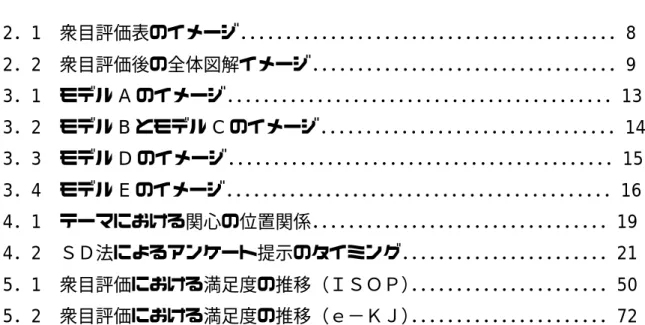
(9) 図 目 次 2.1. 衆目評価表のイメージ...................................... ....8. 2.2 衆目評価後の全体図解イメージ. .................................9 3.1 モデル A のイメージ...........................................13 3.2 モデル B とモデル C のイメージ............................. ....14 3.3 モデル D のイメージ...........................................15 3.4 モデル E のイメージ........................................ ...16 4.1 テーマにおける関心の位置関係. ................................19 4.2 SD法によるアンケート提示のタイミング. ......................21 5.1 衆目評価における満足度の推移(ISOP) ......................50 5.2 衆目評価における満足度の推移(e−KJ) ......................72.
(10) 表 目 次 1.1 創造的問題解決のプロセスモデル. ..............................3 5.1 モデル A の相関係数(ISOP)...............................23 5.2 モデル A の因子行列(ISOP)...............................24 5.3 モデル B の相関係数(ISOP)...............................24 5.4 モデル B の因子行列(ISOP)...............................25 5.5 モデル C の相関係数(ISOP) ...............................25 5.6 モデル C の因子行列(ISOP)...............................26 5.7 モデル D の相関係数(ISOP)...............................26 5.8 モデル D の因子行列(ISOP)...............................27 5.9 モデル E の相関係数(ISOP)...............................27 5.10. モデル E の因子行列(ISOP)........................... ....28. 5.11 モデル A の相関係数(e−KJ)........................... ....28 5.12 モデル A の因子行列(e−KJ)...............................29 5.13 モデル B の相関係数(e−KJ)........................... ....29 5.14. モデル B の因子行列(e−KJ)...............................30. 5.15. モデル C の相関係数(e−KJ)...............................30. 5.16. モデル C の因子行列(e−KJ)...............................31. 5.17 モデル D の相関係数(e−KJ)...............................31 5.18 モデル D の因子行列(e−KJ) ...............................32 5.19 モデル E の相関係数(e−KJ)...............................32 5.20 モデル E の因子行列(e−KJ)...............................33 5.21 衆目評価における満足度の推移(ISOP) .....................49 5.22. 衆目評価における満足度の推移(e−KJ) .....................71. C 因子得点表.
(11) C.1. モデル A(ISOP)..................................... ....83. C.2 . モデル B(ISOP)..... ....................................84. C.3 . モデル C(ISOP).........................................85. C.4 モデル D(ISOP).........................................86 C.5 モデル E(ISOP)..... ....................................87 C.6 モデル A(e−KJ).........................................88 C.7 モデル B(e−KJ)..... ....................................89 C.8 モデル C(e−KJ).........................................90 C.9 モデル D(e−KJ).........................................91 C.10. モデル E(e−KJ).........................................92.
(12)
図

関連したドキュメント
We present sufficient conditions for the existence of solutions to Neu- mann and periodic boundary-value problems for some class of quasilinear ordinary differential equations.. We
In Section 13, we discuss flagged Schur polynomials, vexillary and dominant permutations, and give a simple formula for the polynomials D w , for 312-avoiding permutations.. In
Analogs of this theorem were proved by Roitberg for nonregular elliptic boundary- value problems and for general elliptic systems of differential equations, the mod- ified scale of
“Breuil-M´ezard conjecture and modularity lifting for potentially semistable deformations after
Then it follows immediately from a suitable version of “Hensel’s Lemma” [cf., e.g., the argument of [4], Lemma 2.1] that S may be obtained, as the notation suggests, as the m A
The proof uses a set up of Seiberg Witten theory that replaces generic metrics by the construction of a localised Euler class of an infinite dimensional bundle with a Fredholm
Correspondingly, the limiting sequence of metric spaces has a surpris- ingly simple description as a collection of random real trees (given below) in which certain pairs of
discrete ill-posed problems, Krylov projection methods, Tikhonov regularization, Lanczos bidiago- nalization, nonsymmetric Lanczos process, Arnoldi algorithm, discrepancy
