JAIST Repository
https://dspace.jaist.ac.jp/
Title Coordinating Meanings of Logotypes for Support of Design Process
Author(s) Georgiev, Georgi V.; Nagai, Yukari; Taura, Toshiharu; Morita, Junya
Citation Proceedings of ConnectED 2007
Issue Date 2007-07
Type Conference Paper
Text version publisher
URL http://hdl.handle.net/10119/4169
Rights
Copyright ⓒThe University of New South Wales (UNSW). This material is posted here with permission of the UNSW.
Description
CONNECTED 2007 INTERNATIONAL CONFERENCE ON DESIGN EDUCATION, 9-12 JULY 2007, UNIVERSITY OF NEW SOUTH WALES, SYDNEY, AUSTRALIA. Hosted by The University of New South Wales (UNSW).
CONNECTED 2007 INTERNATIONAL CONFERENCE ON DESIGN EDUCATION 9 – 12 JULY 2007, UNIVERSITY OF NEW SOUTH WALES, SYDNEY, AUSTRALIA
Coordinating Meanings of Logotypes for Support of Design Process
Georgi V. Georgiev
1, Yukari Nagai
1, Toshiharu Taura
2, Junya Morita
11
Japan Advanced Institute of Science and Technology, School of Knowledge Science, 1-1 Asahidai,
Nomi, Ishikawa, 923-1292 Japan
2
Kobe University, Graduate School of Engineering, 1-1 Rokkodai, Nada-ku, Kobe, 657-8501 Japan
ABSTRACT
The general goal of every graphic design is to make a memorable work, through conducting to users meanings of some kind. In our research we focused on characteristics of meanings in logos – one of the most essential issues for creation of messages.
An evaluation questionnaire of 40 logotypes is used for investigation of the connection between user evaluations and discovered meanings. The evaluation was made with 6 point semantic scale. The participants described their perceived meanings for each of the logotype images presented.
The received meanings were analysed with WordNet concept dictionary. Noun relations in dictionary tree were calculated for every example. As a result the coordination and relatedness characteristics of meanings were strongly connected with users’ evaluation. This shows the importance of coordination of logotypes’ meaning for their success.
The results are used for construction of a proposed method for graphic design support. The design support system will be composed of database and concept dictionary, with the main aim to expand design creativity. We hope this expansion can also contribute to specific applications in graphic design education.
INTRODUCTION
Today’s environment is more and more visually oriented. Logotype design is a difficult and important area of graphic design, where the building of meanings is really essential. Thus conveying the message of the logotype – the most visible part of graphic design – is crucial for communication with and impression on users.
Graphic design and logotype design are both areas where shape plays an essential role, where mistakes can easily occur and later are difficult to correct. Logos do derive meanings, so they must be carefully constructed in order to be effective. Design of these symbols is crucial for effectiveness (Stahle 2002:17-18).
The strongly communicated message of a logotype is related to its meanings and their coordination. In logo design and graphic design education, meaning integration is more essential than shape simplification. On the semantic level, the message is a carrier of meaning (Mollerup 1997:68) and if the message is conducted in the desired, effective way then the logo has influence.
In design, the desired impression, sense, and creation of meaning often can have different results. Research into the
design process is increasingly revealing the role of concepts and their connections. A large part of design research is focused on expanding the area of concepts – in efforts to expand design creativity too. But there has not been enough research on creativity in this field of graphic and logotype design.
Closure of meanings and simplicity of shape are not sufficient for a good image, especially if not supported by other means and resources. Some previous research on visual components suggests the importance of meanings, and connects them to some other design characteristics (Henderson 2003:302), but this has not been explored in depth. Future research on measurement of meanings is suggested. Logo meanings should be carefully constructed to be effective (Stahle 2002:18).
Previously, logo characteristics—especially the number of meanings (Henderson 1998:19) and their relationships and integration in successful design—were not measured in an objective way.
The meanings of logotypes, their characteristics and implementation are researchable from the viewpoint of creativity in the design process. The traditional approach of research in this field is focused mainly on connection of logotype characteristics (Henderson 1998:20-23, Henderson 2003:299), based on user’s responses, and evaluation to describe guidelines of design.
In fact, this traditional approach is more likely to reduce creative results, and to make logotype design more uniform, rather than distinctive.
A possible problem in this approach is making design more dependent on current trends, which in some logo design tasks can be an aim, but a really strong logotype should be distinguishable and to a certain extent ‘timeless’. This traditional approach does not rely on knowledge of the graphic design process or creativity, and does not reveal difficulties in interpretation of meanings.
Different research was done on logo-word combination responses (Haase 1996:311, Stahle 2002:27) and logotypes alone (Henderson 1998:18, Henderson 2003:303), but these studies were based on speed of response or recognition and on the first-evoked associations. However, no extensive research on the reflection of meanings and their characteristics was done.
Design for effectiveness and usability is extremely important in the logo creation process (Stahle 2002:16). Discovering a current trend and designing a logo according
to it is limits creative results, and possibly will sooner result in the need for redesign.
A majority of logotype design tasks are focused on creating symbols with a strong message, making a distinct impression and sense in the mind. Also, creativity plays a substantial role in this specific design process.
I.STUDY OF MEANINGS
A. Aim
As a step to support education for creative design of meaningful logotypes, we aim to clarify the connection between the strength of a logo and the relationships among its meanings. For that purpose, we investigated relationships between evaluation scores of logos and their meanings, using questionnaires regarding 40 logos.
By understanding the meanings’ reflections and their relations, we will clarify the first stage of a new approach to support, and most important, to expand creativity in graphic design education.
B. Hypothesis
In successful logotypes, meanings are ‘concentrated’ and increasingly related, because concentrated meanings are easily interpretable.
C. Method
In this study of meanings we focused on the considered discovery of and connections between meanings. For that we examined coordination between senses by a questionnaire in which participants evaluated logotype examples on a 6 point scale. The participants indicated meanings that they could discover in each example.
D. Materials and participants
In the questionnaire, we used a sample of 40 logotypes in two groups. They originated from different areas and applications, regions, shapes, proportions, layouts and colour schemas. This choice covered a broad range of logotypes, excluding only those logos based on “wordmark”. Arrangement was made with consistency in placement, size and quality, and in random order for every participant.
A total of 11 graduate school students in 2 groups, 1 and 2, participated in the questionnaire. All the participants were students in the areas of design and knowledge science.
E. Structure and procedure
The time was limited to 30 minutes for completing all questions. The questionnaire logo arrangements were in 2 groups – a and b. For participants in Group 1, Group a logotypes were included in evaluation question, and Group b logotypes in a meaning discovery question. For participants in Group 2, the logo arrangements were the opposite. In this way the participants evaluated one group and discovered meanings of a different group of logo examples.
The structure was as follows:
- Question 1 included evaluation on a semantic 6 point scale from ‘Poor’ (1) to ‘Excellent’ (6). The resulting variables were evaluation scores in Table 1.
- Question 2 – participants indicated as many meanings as they discovered in each logotype. The nouns were extracted from answers of this question. In cases of adjective – noun pairs, only the nouns were considered in analysis.
Table 1 shows considerable differences in users’ evaluations, and meanings/relatedness values.
Table 1. Variables from questionnaire – minimum, maximum and average values. Question Q1 Q2 Variables Evalua-tion score Discover-ed meanings Average number of meanings Average distance between meanings Related-ness of meanings Min 4.4 19 1.5 6.3 0.075 Max 2.0 9 3.8 13.3 0.159 Average for all 3.319 - 2.398 10.343 0.0994
F. Measuring relatedness of meanings
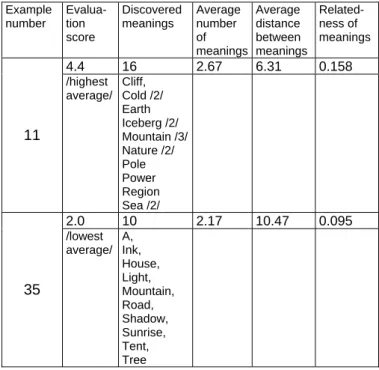
From results of Question 2 we performed an extensive analysis of meanings’ characteristics. To measure similarities among meanings indicated by the participants, we used the WordNet 2.1 lexical relations dictionary (Pedersen 2004:1024 and <http://wordnet.princeton.edu/>), and calculated average relatedness for every example (average of every pair of words, discovered as meanings). Thus, this variable quantifies the similarity among logotype meanings. All measured distances are noun “is-a” relations, measured by their path length. The path length is a scheme of counting nodes in WordNet 2.1 semantic dictionary tree.
Table 2. Meanings’ characteristics of two examples. Example number Evalua-tion score Discovered meanings Average number of meanings Average distance between meanings Related-ness of meanings 4.4 16 2.67 6.31 0.158 11 /highest average/ Cliff, Cold /2/ Earth Iceberg /2/ Mountain /3/ Nature /2/ Pole Power Region Sea /2/ 2.0 10 2.17 10.47 0.095 35 /lowest average/ A, Ink, House, Light, Mountain, Road, Shadow, Sunrise, Tent, Tree
The relatedness score is inversely proportional to the number of nodes along the shortest path between two words.
So the shortest possible path occurs when the two words are the same or are synonyms, in which case the length is 1. Thus, the maximum relatedness value is 1. Generally the relatedness score is a number between 0 and 1.
For example, the relatedness score of the words house and
mountain, measuring shortest path length, is 0.14 (inverse to
7 nodes in path between them, with object as a common category in root of the tree). The final result of the use of WordNet is a semantic relatedness measure of meanings.
The 4 variables extracted from Question 2 are shown in Table 1: discovered meanings (total number), average
number of meanings (per example), average distance
between them (also per example, measured in nodes), and
relatedness of meanings (inverse to distance). In Table 2, the
results of logotype examples are compared with the highest and lowest evaluation scores. Relatedness is inverse variable to the number of nodes in dictionary tree path (average distance).
II.ANALYSIS
A. Results
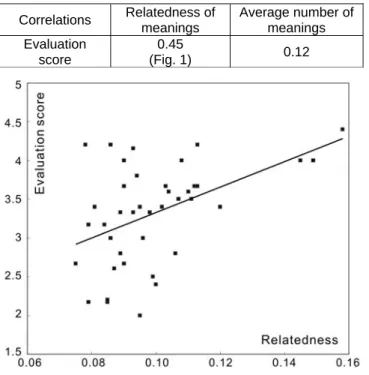
All the answers, except non-noun meanings (constituting less than 5% of all), are considered in the analysis. The correlations of putting together the evaluation and results of meanings analysis are shown in Table 3 and Fig.1.
The positive significant correlation between variables – logotype evaluation score and relatedness (inverse of meanings’ distances) was confirmed (correlation coefficient is r(38) = 0.45 with statistical significance p < 0.01, in Fig. 1).
Table 3. Correlations between variables.
Correlations Relatedness of meanings Average number of meanings Evaluation score 0.45 (Fig. 1) 0.12
Fig. 1. Plot of average Evaluation score as a function of Relatedness of meanings for all examples.
Therefore concentration of logotype meanings is very important for success, and a large number of meanings are connected with close coordination and sense relatedness. If we take only colourful logotypes, the correlation is even stronger.
Also it is possible to observe a not very strong positive correlation between number of meanings and evaluation (r(38) = 0.12) – the examples with more meanings are better evaluated.
B. Discussion
Discovered meanings are increasingly related and ‘concentrated’. Higher evaluation involved meanings with better user ‘definition’ of shape, extraction from background and better image recognition. The main reason for this is that the concentrated meanings are easily interpretable, making the logotypes more understandable, therefore easy to be remembered by users.
The results are significant also for the reason that participants were familiar with design process characteristics and difficulties. Creativity in discovery of meanings can be connected with creativity in designing logotypes. The creative logo must have well-coordinated meanings.
The key feature is coordination of meanings, and this should be used in a support system for graphic design. Finally we can say that, a simple logotype with a single meaning is good for recognition, but it is not good for creating meaning.
III.DESIGNPROCESSANDSUPPORT
A. Classifications
In design education two main classifications are widely used in symbol and logotype design: classification based on objects (1) and classification of techniques (2):
1. Taxonomical classification of motifs in logotypes (Mollerup 1997:98,127). This focuses on objects, which are stylized in image of logotype.
2. Design techniques taxonomy (Chen 2003:14). This includes the technique elements used by the designer for building the image of the logo.
As a result of our study of meanings, for the purpose of supporting the design process, we propose a third classification by three morphology levels, which is complementary to taxonomical classification of motifs.
B. Three morphology levels classification
We propose a classification by three morphology levels, focused on Gestalt perception of shapes, building logotype:
1. First level is lower level. It describes a part of a shape, sub-shape and element.
2. Second level is a single closed shape level. It describes interaction and space between elements of shape.
3. Third level is upper level. It describes combinations of shapes, relations and perception of logotype as a united whole.
This is a logical structure, based on morphology (Georgiev 2006:16), and it utilizes the coordination of meanings for support of design process.
It is possible, that some logo examples have not 3, but only 2 levels, or even 1 level, but the tree morphology level structure is applicable in most of the examples.
C. Support
As a result of our study of meanings and layers classification, we are proposing a support method for graphic design. It is based on structuring of meanings. The support method will use concept dictionary and database with visual form - word label associations (using taxonomical motif classifications).
Concept dictionary is a network of meaningfully connected concepts in semantic structure. In the example of the design task, the reasoned meanings should be compared to that semantic structure.
The support method includes extraction of the optimal semantic structure from concept dictionary. The semantic structure is shown to user and implemented using the three morphology levels of logotypes. In this way the best combination of meanings is found. Exploring possibilities of meanings’ matching from lower to upper levels will give more creative results and better meaning integration.
For example, especially if the concept dictionary connections are represented in morphology structure of the logo, this will give a coordinated and creative symbol.
The support system will provide better synthesis of initial concepts in the final symbol. Furthermore, it will provide new possibilities for synthesis by expanding the space of concepts. Conceptual synthesis is a key to creativity in the design process (Taura 2005:2).
This support system can be a tool, used in graphic design education. Using this system, we believe that the support of meanings’ coordination will contribute to design education. Specifically, this support will make creative logo design more efficient, aiming to get highly creative design results.
IV.CONCLUSIONANDFUTURESTUDIES
From the results of our study it is obvious that the logotypes that create the best impression have integrated meanings, so that the final image can be quickly perceivable. This means that participants in our study estimate highly the logos with narrow meanings (that is, not strongly connected with the total number of meanings). Even though evaluation is better with multiple meanings present, the concepts should be closely connected. The widely recognized meanings are likeable. Furthermore, the narrow, readily apparent concepts of logotype meanings are very well estimated.
This study clarified the coordination of meanings as a main feature of successful symbols. In summary, the closer coordination of meanings is a more important factor than the simplicity in likeability of a logo. This coordination is a
characteristic of creative logotype design. Simplicity may be the more important factor in prior brand recognition, but on the other hand, closely coordinated concepts lead to successful logo image. The close relation of meanings is the best way to express a high-quality and successful logotype.
This evaluation of symbols in the context of considered reflection of meanings, and classification structure in various design levels, is the base for the proposed system.
The presented approach of meanings analysis with concept dictionary also can be used for identifying difficulties in existing logotypes, for example non-matching meanings.
Among future studies will be the following aspects: Investigation of different factors, like the influence of a
word concept’s visualization (visualizing meanings’ connections), on creativity and design process results Exploration of meanings in depth, including the relations
of non-nouns, and observation on what type of meaning structures has more successful results.
The strength of relations should also be considered in future studies.
A perfect logotype features well-coordinated meanings; it is creative and successful as a result. This knowledge about determination of meanings contributes to creative logotype design, connecting education with real practice.
REFERENCES
Stahle, A. 2002. Discovering Logo Trends – Methodology and Practice. Georgetown University. Master’s thesis. Washington Mollerup, P. 1997. Marks of Excellence. London: Phaidon Press Ltd. Henderson, P.W, Cote, J, Leong, S and Schmitt, B. 2003. Building
Strong Brands in Asia: Selecting the Visual Components of Image to Maximize Brand Strength. International Journal of Research in Marketing 20 (2003) pages 297-313
Henderson, P,W and Cote, J. 1998. Guidelines for Selecting or Modifying Logos. Journal of Marketing. April 1998, vol. 62, pages 14-30.
Haase, S.J. 1996. Understanding Corporate Logos: Lexical and analogical considerations. Genetic, Social and General Psychology Monographs. 122:3, pages 309-327.
Pedersen, T, Patwardhan, S and Michelizzi, J. 2004. WordNet::Similarity – Measuring the Relatedness of Concepts. Proceedings of Nineteenth National Conference on Artificial Intelligence. Numb 19, pages 1024-1025
<http://wordnet.princeton.edu/>, WordNet Release 2.1, Cognitive Science Lab, Princeton University, accessed December 2006 Taura, T, Nagai, Y. and Tanaka, S. 2005. Design Space Blending -
A Key for Creative Design. Proceedings of International Conference on Engineering Design. ICED ’05, Melbourne, August 15-18. 2005
Georgiev, G. V, Nagai, Y, Taura, T, 2006. Method of Creative Graphic Design Focusing on Multiple Meanings: A systematic approach to meanings of symbols. Proceedings of The 53rd Annual Conference of JSSD 30.06 – 02.07.2006, Ishikawa, Japan, pages 16-17.
Chen, Y-T, Cai, D, Huang, H-F, and Kuo, J. 2003. An Evaluation Model for Graphic Design Works. In Proceedings of Sixth Asian Design Conference, pages 14-17. October 2003, Tsukuba, Japan.