A
Linear-Time Algorithm
for Bend-Optimal Orthogonal
Drawings
of
Biconnected Cubic
Plane Graphs
(Extended Abstract)
Shin-ichi NAKANO
and MakikoYOSHIKAWA
Gunma University
Kiryu 376-8515, Japan
nakano@c$\mathrm{s}$
.
gunma-u.$\mathrm{a}\mathrm{c}.\mathrm{j}\mathrm{p}$Abstract: An orthogonal drawing of aplanegraph $G$isadrawingof$G$withthegivenplanar
embedding in which each vertex is mapped to a point, each edge is drawn as a sequence of
alternate horizontal and vertical line segments, and any two edges do not cross except at
theircommon end. Observe that only a planar graph with the maximum degree fouror less
hasanorthogonal drawing. Thebest knownalgorithm to find an orthogonal drawing runs in
time $O(n^{7/4_{\sqrt{\log n})}}$ for any plane graph with$n$ vertices. In this paper we give a linear-time
algorithm to find an orthogonal drawing ofa given biconnected cubic plane graph with the
minimum number of bends.
Keywords: Graph Drawings, Algorithms,
Orthogonai
Drawings.!
$.\mathrm{I}\mathrm{n}.\cdot.\mathrm{t}$ro.
$\cdot$d
$.$$\mathrm{u}\mathbb{C}$
.tion
An $orth_{\mathit{0}}g\acute{o}nal\dot{d}ra$wing of a plane graph $G$ is a
drawing of $G$ with the given planar embedding
in which each vertex is mapped to a point, each
edge is drawn as a sequence of alternate
hori-zontal and vertical line segments, and any two
edges do not cross except at their common end.
Orthogonaldrawings haveattracted much
atten-tiondueto its numerouspractical applications in
circuit schematics, etc. [BLV93, K96, T87]. In
particular, we wish to find an orthogonal
draw-ing with the minimum $\mathrm{n}\mathrm{u}\mathrm{m}\dot{\mathrm{b}}$er
of bends. Forthe
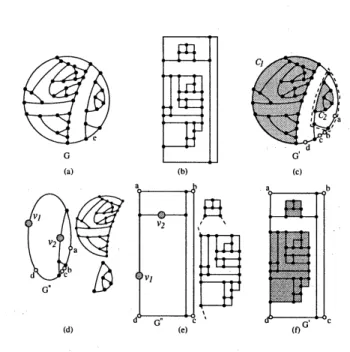
plane graph in Fig. $1(\mathrm{a})$, the orthogonal drawing
in Fig. 1(b) has the minimum number of bends,
that is, eleven bends.
For a given planar graph $G$, ifit is allowed to
choose its planar embedding, then finding an $\check{\mathrm{o}}$
r-thogonal drawing of $G$ with the minimum
num-ber of bends is $\mathrm{N}\mathrm{P}- \mathrm{C}\mathrm{o}\mathrm{m}\mathrm{P}^{\mathrm{l}\mathrm{e}\mathrm{t}}\mathrm{e}[\mathrm{G}\mathrm{T}94]$
.
However, $\mathrm{T}\mathrm{a}\mathrm{m}\mathrm{a}\mathrm{s}\mathrm{s}\mathrm{l}\mathrm{a}[\mathrm{T}87]$ and Garg and Tamassia [GT96]presented algorithms which find an orthogonal
drawing of a given plane graph $G$ with the
minimum number of bends in $O(n^{2}\log n)$ and
$O(n^{7/4_{\sqrt{\log n})}}$ time respectively unless it is
al-lowed to choose its planar embedding, where $n$
is the number of vertices in $G$. They reduce the
minimum-bendorthogonal drawing problem to a
minimum cost flow problem. On the other hand,
several linear-time algorithms areknown for
find-ing an orthogonal drawfind-ingofaplanegraph witha
presumably small number of$\mathrm{b}\mathrm{e}\mathrm{n}\mathrm{d}\mathrm{s}[\mathrm{K}96]$, andfor
3-connected cubic plane graphs a linear-time
al-gorithm is known forfinding an orthogonal
draw-ing withthe minimum number of$\mathrm{b}\mathrm{e}\mathrm{n}\mathrm{d}_{\mathrm{S}}[\mathrm{R}\mathrm{N}\mathrm{N}\dot{9}9]$.
$\mathrm{O}\mathrm{b}\sim$servethat $0,\mathrm{n}\mathrm{l}\mathrm{y}$ a planar graph with the
maxi-mum degree four or less has an orthogonal
draw-ing.
In this paper, generalizing the result in
[RNN99], we give a linear-time algorithm tofind
an orthogonal drawing of a biconnected cubic
plane graph with the minimum number of bends.
An orthogonal drawing in which there is no
bend and each face is drawn as a rectangle is
calledarectangular drawing. Givenaplanegraph
$G$ suchthat everyvertex has degree either twoor
three, in linear-time we can find a rectangular
drawing of$G$ whenever sucha graph has a
rect-angular drawing [KH94, RNN96, RNNOO]. The
orthog-2
Preliminaries
Figure 1: Aplanegraphandits orthogonal
draw-ing.
onal$\mathrm{d}\mathrm{r}\mathrm{a}\mathrm{w}\mathrm{i}\mathrm{n}\mathrm{g}.\mathrm{P}^{\mathrm{r}\mathrm{o}}\mathrm{b}\mathrm{l}\mathrm{e}\mathrm{m}$ to the rectangular drawing problem.
An outline of our algorithm is illustrated in
Fig. 1. Given a plane graph $G$ as shown in
$\mathrm{F}.\mathrm{i}\mathrm{g}$. $1(\mathrm{a})$, we first find a tree structure among
some cycles in $G$, then by analyzing the tree
structureweputfourdummyvertices$a,$$b,$$c$and$d$
of degreetwoonthe outer boundaryof$G$, and let
$G’$ be the resulting graph. The four dummy
ver-tices are drawn by white $\mathrm{c}\mathrm{i}\mathrm{r}‘ \mathrm{C}\mathrm{l}\mathrm{e}\mathrm{S}$
in Fig. 1(c). We
then contract each ofsome cycles $C_{1},$ $C_{2},$ $\cdots$ and
their insides (shaded in Fig. 1$(\mathrm{c})$) into a single
vertex as shown in Fig. 1(d) so that the
result-ing graph $G^{n}$ hasa rectangular drawing asshown
in Fig. 1(e). We also find orthogonal drawings
ofthose cycles $C_{1},$ $C_{2},$ $\cdots$ and their insides
recur-sively (See Figs. 1(d) and $(\mathrm{e})$). Patching the
ob-taineddrawings, we get an orthogonaldrawingof
$G’$ as shown in Fig. 1(f). Replacing the dummy
vertices $a,$$b,$$c$ and $d$ in the drawing of $G’$ with
bends, we finally obtain an
ort.h
ogonal drawingof$G$ as shown in Fig. 1(b).
The rest of the paper is organized as follows.
Section 2 gives some definitions and presents a
known result. Section 3 shows a tree structure
among some cycles in $G$. Section 4 presents an
algorithmto find anorthogonal drawing with the
minimum number of bends. Finally Section 5 is
a conclusion.
In this section we give some definitions and
present a known result.
Let $G$ be a connected graph with $n$ vertices.
An edge connecting vertices $x$ and $y$ is denoted
by $(x, y)$. The degree ofavertex $v$ is the number
of neighbors of$v$ in $G$. Ifevery vertex of $G$ has
degree three, then $G$is called a cubic graph. The
connectivity $\kappa(G)$ of a graph $G$ is the minimum
number ofvertices whose removalresultsin a
dis-connected graphorasingle-vertex graph$K_{1}$. We
say that $G$ is $k$-connectedif$\kappa(G)\geq k$.
A graph is planarif it can be embedded inthe
plane so that no two edges intersect
geometri-cally except at a vertex to which they are both
incident. A plane graph is a planar graph with
a fixedplanar embedding. A plane graph divides
the planeinto connected regions called
faces.
Weregard the contour ofa face as a clockwise cycle
formedbythe edges onthe boundary of the face.
We denote the contourof the outer face of graph
$G$ by $C_{o}(G)$.
For a simple cycle $C$ in a plane graph $G$, we
denote by $G(C)$ the plane subgraph of $G$ inside
$C$ (including $C$). We say that cycles $C_{1}$ and $C_{2}$
in a planegraph $G$ are independentif$G(c_{1})$ and
$G(C_{2})$ havenocommonvertex. Cycles$C_{1}$ and$C_{2}$
are vertex-disjoint if$C_{1}$ and $C_{2}$ have no common
vertex. An edge which is incident to exactly one
vertex ofa simple cycle $C$and located outside of
$C$ is called $\mathrm{a}\cdot leg$ of the cycle $C$, and the vertex
on $C$ to which the leg is incident is called a
leg-vertex of$C$. A simple cycle with exactly $k$legs is
called a $k$-legged cycle. For $k$-legged cycle $C$ the
$k$ subp\"aths of $C$ dividing $C$ at the $k$ leg-vertices
are called the contourpaths of$C$.
An orthogonal drawing of a plane graph $G$ is
a drawing of$G$ with the given planar embedding
in which each vertex is mapped to a point, each
edge is drawn as a sequenceof alternate
horizon-tal andvertical line segments, and anytwo edges
do notcross except at theircommonend. A point
where an edge changes its direction in a drawing
is called a bend. We denote by $b(G)$ the
mini-mum number of bends for orthogonal drawings
of $G$. An orthogonal drawing of $G$ with exactly
$b(G)$ bends is bend-optimal.
A rectangular drawing of a plane graph $G$ is
a horizontal or vertical line segment, and each
face is drawn as a rectangle. Thus a rectangular
drawingis an orthogonal drawing in which there
is no bend and each face is drawn as a rectangle.
The drawing of $G^{u}$ in Fig. 1(e) is a rectangular
drawing. The drawing of$G’$ in Fig. 1(f) is not a
rectangular drawing, but is an orthogonal
draw-ing. Inany rectangular drawing$D$ of$G$, the four
corners ofthe rectangle corresponding to $C_{o}(G)$
are vertices of degree two on $C_{o}(G)$
.
Wecallthesefourvertices the corner vertices of$D$. The
follow-ing result onrectangular drawings is known.
Lemma 2.1 Let $G$ be a connected plane graph
such that every vertex has degree $e\dot{i}ther$ two or
three, and let a,$b,$ $c,$ $d$ be
four
$des\dot{i}gnated$ verticesof
degreetwo on$C_{o}(G)$.
Then$G$hasa rectangulardrawing with the corner vertices a,$b,$ $c,$ $d$
if
andonly
if
$G$ has noneof
the following threetypesof
simple cycles $fT\mathit{8}\mathit{4}\mathit{1}$:
$(rl)\mathit{1}$-legged cycles,
$(r\mathit{2})\mathit{2}$-leggedcycles which contain at most one
designated vertex
of
degree two, and$(r\mathit{3})\mathit{3}$-legged cycles which contain no
desig-nated vertex
of
degree two.Furthermore one cancheck in lineartime whether
$G$
satisfies
thecondition above, andif
$G$ doesthenone can$fi_{\vee}nd$ a rectangular drawing
of
$G\dot{i}n$.linear
time $fRNN\mathit{9}\mathit{6}$,
RNNOOf.
.(a)1-legged cycle (b)2-legged cycles (c)$3- 1\mathrm{e}_{\infty^{\sigma}}^{\sigma}\mathrm{e}\mathrm{d}$cycles
Figure 2: Bad cycles $c_{1},$ $c_{2},$$C\mathrm{s}$ and $C_{5}$, and
non-bad cycles $C_{4},$ $C_{6}$ and $C_{7}$.
A cycleof type (r1), (r2) or (r3) is called a bad
cycle. Figs. $2(\mathrm{a}),$ $(\mathrm{b})$ and (c) illustrate l-legged,
2-legged and 3-legged cycles, respectively. Cycles
$o_{1},$ $c_{2},$$C_{3}$ and $C_{5}$ are bad cycles. On the other
hand, cycles $C_{4},$ $C_{6}$ and $C_{7}$ are not bad cycles;
$C_{4}$is a2-legged cycle but contains two designated
vertices of degree two, and$C_{6}$and$C_{7}$ are 3-1egged
cycles but containone or two designated vertices
of degree two.
Some linear-time algorithmsto finda
rectangu-lar drawing of a plane graph satisfying the
con-dition in Lemma 2.1 have been obtained [KH94,
RNN96, RNNOO].
3
Genealogical Tree
In this section we first show a tree structure
among some cycles in a biconnected cubic plane
graph $G$.
Let $G$be a biconnectedcubic plane graph. For
a pair of distinct cycles $C_{a}$ and $C_{d}$ in $G,$ $C_{d}$ is
called a descendant-cycle of $C_{a}$ if (i) $C_{d}$ is either
2- or 3-legged cycle, and (ii) $G(C_{d})$ is a proper
subgraph of $G(C_{a})$. Note that since $G$ is
bi-connected there is neither 0- nor 1-legged cycle
except the only $0$-legged cycle $C_{o}(G)$. Now we
choose an edge $e=(x, y)$ on $C_{o}(G)$, and replace
$e$ with two edges $(x, z)$ and $(z, y)$. Let $G^{l}$ be the
resulting plane graph. (Note that, for $G-e$ ,
that is a plane subgraph of $G$ obtained from $G$
by deleting $e,$ $C_{o}(G-e)$ is a 2-legged cycle of
$G^{l}$, however,
$C_{o}(G-e)$ is not a 2-legged cycle
of $G.$) Let $D_{e}(c_{O})=\{C|C$ is a descendant
cy-cle of $C_{o}(G^{l})$ not containing $z$
}.
A cycle $C_{c}$ in$D_{e}(c_{O})$ is called a child-cycle of $C_{o}(G’)$ (with
re-spect to edge $e$) if$C_{c}$ is not located inside ofany
other cycle in $D_{e}(c_{O})$. Since $G$ is a biconnected
cubic plane graph, $C_{o}(G^{l})$ has exactly one
child-cycle $C_{o}(G-e)$ (with respect to edge $e$). (See
Fig 3.) Then, recursively, for each child-cycle $C_{\mathrm{c}}$
we define its child-cycle as follows. We have the
following two cases.
Case 1: $C_{\mathrm{c}}$ is a 2-legged cycle.
Choose a leg-vertex of$C_{c}$ as $z$. Let $D_{z}(o_{C})=$
{
$C|C$is adescendant cycleof$C_{\mathrm{c}}$not containing $z$$\}$. A cycle $C_{\mathrm{c}c}$ in $D_{z}(c_{C})$ is called a child-cycle of
$C_{c}$ (with respect to $z$) if$C_{cc}$ is not located inside
of any other cycle in $D_{z}(c_{C})$
.
Since $G$ is abi-connected cubic plane graph, $C_{c}$ has at most one
3-legged child-cycle. ($C_{c}$ has no 3-legged
child-cycle if$G(C)$ has an inner face $F$ containing the
two leg-vertices, and $C_{c}$ has exactly one 3-1egged
child-cycle otherwise.)
Case 2: Otherwise, $C_{c}$ is a 3-legged cycle.
Let $D(c_{C})$ be the set of all descendant cyclesof
$C_{c}$. A cycle $C_{cc}$ in $D(c_{C})$ is calleda child-cycle of
$C_{c}$ if $C_{cc}$ is not located inside of any other cycle
In both cases above all child-cycles of $C_{c}$ are
independent each other.
Bythedefinitionabovewe canfind child-cycles
of each child-cycle recursively, and eventually we
get a (hierarchical) tree structure ofcycles in $G$
represented bya “genealogical tree” $T_{g}$, as shown
in Fig 3. Because of the choices for $e$ and $z,$ $T_{g}$
may have some variations. We choose an
arbi-trary (but fixed) one as $T_{g}$.
contour paths from $x$ to $y$ and from $y$ to $x$,
re-spectively. A bend-optimal orthogonal drawing
$D$ of $G(C)$ is
feasible
for $(P_{1}, P_{1})$ ifnone of thefollowing four open halflines intersects D. (See
Fig. $4(\mathrm{a})$. Intuitively $D$ needs two convex bends
on $P_{1}.$)
the vertical open halflinewiththe upper end
at $x$
.
thehorizontal open halflinewiththeleft end
at $x$.
the vertical open halfline with the lower end
at $y$.
the horizontalopen halfline with the left end
at $y$
.
Figure 3: cycles in $G’$ and agenealogical tree$T_{g}$
.
Using a method similar to one in [RNN96,
RNN99, RNNOO], in linear time one canfind such
atreestructure$T_{g}$ amongcyclesbytraversingthe
contour ofeachface a constant numberoftimes.
Now we observe the following. In any
orthog-onal drawing of $G$, every cycle $C$ in $G$ has at
least four convex corners, i.e., polygonal vertices
of inner angle $90^{\mathrm{O}}$. Since $G$ is cubic, such a
cor-ner must be a bend if it is not a leg-vertex of$C$
.
Thus we have the following facts for any
orthog-onal drawing of$G$.
Fact 1 At least four bends must appear on
$C_{o}(G)$.
Fact 2 At least two bend must appear on each
2-legged cycle in $G$
.
Fact 3 At least one bend must appear on each
3-legged cycle in $G$.
4
Orthogonal Drawing
In this section we give a linear-time algorithm
to find a bend-optimal orthogonal drawing of a
biconnected cubic plane graph. Assume that we
have agenealogical tree$T_{g}$ ofabiconnected cubic
planegraph $G$
.
We needsome definitions.We define “feasible drawings” as follows. Note
that rotated cases are omitted.
$\mathrm{V}\mathrm{e}\mathrm{r}\mathrm{t}\mathrm{i}\mathrm{c}\mathrm{e}\mathrm{S}\mathrm{L}\mathrm{e}\mathrm{t}c\mathrm{b}x\mathrm{a}\mathrm{n}\mathrm{e}\mathrm{d}\mathrm{a}y,\mathrm{a}\mathrm{n}\S_{P_{1}}^{\mathrm{e}}\mathrm{d}\mathrm{c}\mathrm{y}\mathrm{c}1\mathrm{e}_{P}\mathrm{w}\mathrm{i}\mathrm{t}\mathrm{h}\mathrm{t}\mathrm{h}\mathrm{e}\mathrm{t}_{\mathrm{W}\mathrm{o}_{\mathrm{k}}1}\mathrm{w}\mathrm{a}\mathrm{n}\mathrm{d}2\mathrm{b}\mathrm{e}\mathrm{t}\mathrm{h}\mathrm{e}\mathrm{C}1\mathrm{i}2- 1\mathrm{e}\mathrm{g}\mathrm{e}\mathrm{g}-\mathrm{S}\mathrm{e}$
Figure 4: Illustration for feasible drawings.
Also, a bend-optimalorthogonal drawing $D$ of
$G(C)$ is
feasible
for $(P_{1}, P_{2})$ ifnone of the fouropen halflinesdepictedindashedlines inFig.$4(\mathrm{b})$
intersects $D$.
Let $C$ be a 3-legged cycle with the three
leg-vertices$x,$$y$ and $z$appearing clockwise in this
or-der, and $P_{1},$ $P_{2}$ and $P_{3}$ be the clockwise contour
path from $x$ to $y$, from $y$ to $z$, and from $z$ to $x$,
respectively. A bend-optimalorthogonal drawing
$D$ of $G(C)$ is
feasible
for $(P_{1})$ ifnone of the sixopen halflines depicted in dashed lines in Fig. $4(\mathrm{c})$
intersects $D$. Similarly, we define
feasible
orthog-onaldrawings for $(P_{1}, P_{13}, -P),$ $(P_{1}, P_{1}, -P_{2})$ and
$(P_{1}, P_{2}, -P3).$($\mathrm{S}\mathrm{e}\mathrm{e}$ Fig.
$4(\mathrm{d})-(\mathrm{f}).$)
Now, for each cycle $C\neq C_{o}(G)$ corresponding
to a vertex in $T_{g}$, we determine whether $G(C)$
has each type of feasible drawings $\mathrm{b}\mathrm{y},\mathrm{a}$
bottom-up computation on $T_{g}$. For
$\mathrm{t}\mathrm{h}\dot{\mathrm{e}}$
bottom-up
com-putation we also compute a set $S_{C}$ of
vertex-disjoint cycles in $G(C)$ consisting of $\ell_{2}$ 2-1egged
cycles and $\ell_{3}3$-legged cycles for some $\ell_{2}$ and $\ell_{3}$.
Thus $b(G(C))\geq 2\cdot\ell_{2}+\ell_{3}$ by Facts 3.2 and 3.3.
feasible drawing using 2 $\cdot\ell_{2}+\ell_{3}$ bends. Thus
$b(G(C))=2\cdot\ell_{2}+\ell_{3}$ holds.
In the bottom-up computation weclassify each
contour path of each cycle as either 0-, 1-, or
2-corner path. Intuitively $k$-corner path has a
chance to have $k$ convex bends. And we define
Figure
5.
$\cdot$. Illustration for
$P_{1}P_{2}$-strain.
$P_{1}P_{2}$-strainby thosecorner pathsas follows. Let
$x,$$y,$$z$ be the three leg-vertices of a 3-legged
cy-cle $C,$ $P_{1}$ and $P_{2}$ be the clockwise contour paths
from $x$ to$y$and$y$ to$z$, respectively. Assumethat
$s$ and $t$ are vertices on $P_{1}$ and $P_{2}$, respectively,
and let $P_{1}’$ be the subpath of$P_{1}$ from $x$ to $s$, and $P_{2}’$ be the subpath of$P_{2}$ from $t$ to $z$. If (i) there
is a path $P$ from $s$ to $t$ such that the left side of
$P$ is an inner face of$G(C)$, and (ii) $G(C)$ has no
child cycle having l-or 2-cornerpath on$P,$$P_{1}’$ or
$P_{2}^{J}$, then thepathconsisting of$P_{1}^{J},$$P,$$P_{2}’$ arecalled
$P_{1}P_{2}$-strain. An example is illustrated in Fig. 5.
Intutively, we haveonly two chance to turnright
at $s$ and $t$ on $P_{1}P_{2}$-strain from $x$ to$z$.
In the bottom-up computation we show that
the following conditions $(\mathrm{c}\mathrm{l})-(\mathrm{c}9)$ hold.
$\mathrm{V}$
(c1) Any cycle $C$ has at least one 1- or 2-corner
path.
(c2) No cyclein $S_{C}$ contains any edge on any
0-corner
path of$C$.
(c3) For any 2-legged cycle $C$ if $C$ has a
1-corner path $P_{1}$, then $G(C)$ has a set $S_{C}^{J}$ of
vertex-disjoint cycles containing no edge on
$..P_{1}$ and consisting of $\ell_{2}’2$-legged cycles and $\ell_{3}’3$-legged cycles such that 2 $\cdot\ell_{2}’+\ell_{3}’=$
$b(G(C))-1$
.
(c4) For any2-legged cycle $C$if$C$ hasa O-corner
pat..h $P_{1}$, then the other contourpath$P_{2}$ is a
2-corner path, and $G(C)$ has an orthogonal
drawing feasible for $(P_{2}, P_{2})$
.
(c5) For any 3-legged cycle $C$ if $C$ has a
1-corner path $P_{1}$, then $G(C)$ has a set $S_{C}’$ of
vertex-disjoint cycles containing no edge on
$P_{1}$, and consisting of $\ell_{2}’2$-legged cycles and $\ell_{3}’3$-legged cycles such that 2 $\cdot\ell_{2}’+\ell_{3}’=$
$b(G(C))-1$.
(c6) For any 3-legged cycle $C$ if$C$ has a 1- or
2-cornerpath$P_{1}$, then$G(C)$ hasanorthogonal
drawing feasible for $(P_{1})$
.
(c7) For any 3-legged cycle $C$ if $C$ has a
2-corner path $P_{1}$ and no $P_{1}P_{2}$-strain
,
then$G(C)$ has anorthogonal drawing feasible for
$(P_{1}, P_{1}, -P_{3})$,
(c8) For any 3-legged cycle $C$ if $C$ has a
2-corner path $P_{1}$ and no $P_{3}P_{1}$-strain, then
$G(C)$ has an orthogonal drawing feasible for
$(P_{1}, P_{1,2}-P)$,
(c9) For any 3-legged cycle $C$ if$C$ has l-corner
paths $P_{1}$ and $P_{2}$, and no $P_{1}P_{2}$-strain, then
$G(C)$ hasan orthogonal drawing feasible for
$(P_{1}, P_{2,3}-P)$
.
Nowwe explain thebottom-upcomputationin
the following four cases.
Case 1: $C$ is a 2-legged cycle having no
child-cycle.
Let $x,$$y$bethe twoleg-vertices of$C$, let $P_{1}$ and
$P_{2}$ be the clockwise contour paths from
$x$ to $y$
and from $y$ to $x$, respectively. Now $G(C)=C$,
since for any 2-leggedcycle$C$if$G(C)$ hasanedge
in proper inside of$C$ then $C$ always has a
child-cycle.
Computation for $s_{c:}$ Set $S_{C}=\{C\}$. By Fact
3.2 any orthogonal drawing of $G(C)$ has at least
two bends.
Feasible drawings: By introducing two bends
on $P_{1}$, we can easily construct an orthogonal
drawing of $G(C)$ feasible for $(P_{1}, P_{1})$
.
Similarlywe can construct orthogonal drawings of $G(C)$
feasible for $(P_{2}, P_{2})$ and $(P_{1}, P_{2})$, respectively.
Thus $G(C)$ has each type of feasible orthogonal
drawings.
Classification and proof for $(\mathrm{c}1)-(\mathrm{C}9)$: In
this
case
every contour path of $C$ is classified asa 2-cornerpaths. Conditions $(\mathrm{c}\mathrm{l})-(\mathrm{c}4)$ hold since
every contourpathof$C$is 2-corner, and $(\mathrm{c}5)-(\mathrm{c}9)$
hold since $C$ is not a 3-legged cycle.
Case 2: $C$ is
$\mathrm{a}_{\mathrm{T}}3$-legged
cycle{,
$\mathrm{h}\mathrm{a}\mathrm{v}\mathrm{i}\mathrm{n}\mathrm{g}$no
child-cycle.
Let $x,$ $y,$$z$ be the three leg-vertices of $C$, let
$P_{1},$ $P_{2},$ $P_{3}$ be the clockwisecontour path from $x$
to $y$, from $y$ to $z$, and from $z$ to $x$, respectively.
Now ifweremoveall edgeson$C$from$G(C)$, then
either $G(C)=C$ or the remaining edges induce
oneach $P_{1},$ $P_{2},$ $P_{3}$, since otherwise $C$ has a
child-cycle, acontradiction.
Computation for $s_{c:}$ Set $S_{C}=\{C\}$
.
By Fact3.3 any orthogonal drawing of $G(C)$ has at least
one bend.
Feasible drawings: Construct a new graph $G’$
from $G(C)$ by adding one dummy vertices $v$ on $P_{1}$. Now the resulting graph $G^{l}$ has no bad cycle
(since$G$ hasnochild-cycle) with respect tocorner
vertices $x,$ $v,$ $y,$$z$, and then $G’$ has a rectangular
drawing with the corner vertices $x,$ $v,$$y,$$z$. The
rectangular drawing is also an orthogonal
draw-ing of $G(C)$ feasible for $(P_{1})$ using exactly one
bend (correspondingto $v$). Similarly we can
eas-ily construct orthogonal drawings of$G(C)$
feasi-ble for $(P_{2})$ and $(P_{3})$.
Now $G(C)$ has no orthogonal drawing feasible
for$(P_{1}, P_{1}, -P_{2})$, since it needs at least twobends
only on $P_{1}$. Similarly $G(C)$ has no orthogonal
drawing feasible for $(P_{i}, P_{j}, -P_{k})$ for any $i,$$j,$$k\in$
$\{1,2,3\}$
.
Classification and proof for $(\mathrm{c}1)-(\mathrm{C}9)$: In
this case every contour path of $C$ is classified as
a 1-corner path. Conditions $(\mathrm{c}\mathrm{l}),(\mathrm{c}2)$ hold since
everycontour pathof$C$is 1-corner, $(\mathrm{c}3),(\mathrm{c}4)$hold
since $C$ is not a 2-legged cycle, (c5) holds by
choosing $S_{C}^{l}=\phi,$ $(\mathrm{c}6)$ holds since $G(C)$ has
or-thogonal drawings feasible for $(P_{1}),$ $(P_{2}),$ $(P_{3})$,
respectively, as mentioned above, and $(\mathrm{c}7)-(\mathrm{c}9)$
hold since $G(C)$ has no 2-corner path.
Case 3: $C$is a
2-1egg.e
$\mathrm{d}$ cyclehavingoneormore child-cycles.Let $x,$$y$ be the two
$\dot{1}\mathrm{e}\mathrm{g}$
-vertices of $C$, and let
$P_{1}$ and $P_{2}$ be the clockwise contour paths from
$x$ to $y$ and from $y$ to $x,$
resp.ectively.
If $G(C)$has an inner face containing$x$ and$y$, then $C$has
no 3-legged child-cycle, otherwise, $C$ has exactly
one 3-legged child-cycle, which contains exactly
one leg-vertices of $C$
.
Thus $C$ has at most one3-legged child-cycle.
Let $C_{1},$ $C_{2},$ $\cdots,$$C_{f}$ be the child-cycle of$C$.
As-sume that for $C_{i},$ $1\leq\dot{i}\leq l$, we already have $S_{C_{i}}$,
we know whether $G(C_{i})$ has each type of
feasi-ble drawings, and conditions $(\mathrm{c}\mathrm{l})-(\mathrm{c}9)$ holds. We
have the following four subcases. Proofs for $(\mathrm{c}1)-$
(c9) are omitted.
Case $3(\mathrm{a}):C$ has no child-cycle having a 1- or
2- corner path on $C$
.
Computation for $S_{C}$: Condition (c2) means
that no cycle in $s_{C_{1}},$$s_{c_{2}},$ $\cdots,$$Sc_{\ell}$ contains any
edge on $C$. Also since $G$ is cubic, $C$ is
vertex-disjoint to any cycle in $s_{c_{1}},$ $s_{C_{2}},$$\cdots,$ $SC_{t}$. Set
$S_{C}=.\{C\}\cup S_{C_{1}}\cup S_{C_{2}}\cup\cdots\cup S_{C_{t}}$. Thuswe need
to introduce two newbends.
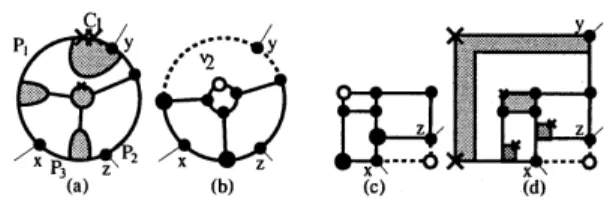
Feasible drawings: We first consider whether
$G(C)$ has an orthogonal drawing feasible for
$(P_{1}, P_{1})$. Construct a new graph from $G(C)$ by
adding two dummy vertices $v,$ $w$ on $P_{1}$ but not
on any child cycle of $C$. Then contract each
$G(c_{1}),$$c(C2),$$\cdots,$$G(c_{\ell})$ tovertices$v_{1},$ $v_{2},$$\cdots$,$v_{\ell}$,
respectively. See Figs. $6(\mathrm{a})$ and (b). Now the
resulting graph is a cycle and has a rectangular
drawing$D$ with thecorner vertices$x,$ $v,$$w,$$y$. See
Fig. $6(\mathrm{c})$. Next, if $C$ has a 3-legged child-cycle,
say$C’$, thenfind an orthogonal drawing of$G(C’)$
feasible for $(P’)$ where $P^{l}$ is
the contour path of
$C’$ not on $C$, in a recursive manner. By
condi-tions (c1) and (c6) $G(C’)$ always has sucha
draw-ing. Next, find an orthogonal drawing of each
2-legged child-cycle $G(C_{i})$ feasible for $(P_{i}’’, P^{ll})i$
where $P_{i}’’$ is the contour path of $C_{i}$ not on $C$,
in a recursive manner. By condition (c4) $G(C)$
always has such a drawing. Finally patch the
drawingsof$G(C_{1}),$$G(c_{2}),$$\cdots,$$G(C\ell)$ into $D$
.
SeeFig. 6(d). Thepatchingfor 2- and 3-legged
child-cycles always works correctly as shown in Fig. 7
and Fig. 8. Thus we can construct
an
orthogonaldrawing of $G(C)$ feasible for $(P_{1}, P_{1})$
.
Similarlywe can construct orthogonal drawings feasiblefor
$(P_{2}, P_{2})$ and $(P_{1}, P_{2})$, respectively.
Classification: In this case every contour path
of$C$ is classified as a 2-corner path.
Figure 6: Illustration for Case $3(\mathrm{a})$.
Case$3(\mathrm{b}):C$has exactlyonechild-cycleshaving
a 1- or 2- corner path on $C$, and the child-cycle
is a 2-legged cycle.
Computation for $s_{c:}$ Let $C_{1}$ be the 2-1egged
child-cycle having a corner path on $C$
.
Wecon-sider two cases. If $C_{1}$ has a 2-corner path on
$C$, then set $S_{C}=S_{C_{1}}\cup S_{C_{2}}\cup\cdots\cup S_{C_{\ell}}$
.
InFigure 7: Illustration for patchings.
Figure 8: Illustration for patchings. (Rotated
cases are omitted.)
bends. If$C_{1}$ has a 1-corner path on $C$, then, by
(c3), $G(c_{1})$ has a set $S_{C_{1}}’$ of vertex-disjoint
cy-cles containingno edgeon$C$, and consisting of$\ell_{2}’$
$2$-legged cycles and $\ell_{3}’3$-legged cycles such that
2 $\cdot\ell_{2}’+\ell_{3}’=b(G(C_{1}))-1$. Condition (c2) means
that no cycle in $S_{C_{2}},$$Sc3’\cdots,$$Sc_{\ell}$ contains any
edge on$C$. Set $s_{c}--\{C\}\cup S_{C_{1}}’\cup S_{C_{2}}\cup\cdots\cup S_{C\ell}$.
In this case we need to introduce one new bend.
Feasible $\mathrm{d}\mathrm{r}\mathrm{a}\mathrm{w}\mathrm{i}\mathrm{n}\mathrm{g}_{\mathrm{S}}$
.:
Omitted. Similar to theprevious case.
Classification: If$C_{1}$ hasa 2-corner path on$P_{1}$,
then $P_{1}$ is a 2-corner path and $P_{2}$ is a O-corner
path. If$C_{1}$ hasa 2-corner pathon $P_{2}$, then$P_{1}$ is
a $0$-corner path and $P_{2}$ is a 2-corner path. If $C_{1}$
has a 1-corner path on $P_{1}$, then $P_{1}$ is a 2-corner
path and $P_{2}$ is a 1-corner path. (In this case we
can addone $\mathrm{n}\mathrm{e}\dot{\mathrm{w}}$
bend either on $P_{1}$ or $P_{2}.$) If$C_{2}$
has a 1-corner path on $P_{2}$, then $P_{1}$ is a l-corner
path and $P_{2}$ is a 2-corner path.
Case $3(\mathrm{c}):C$has exactlyonechild-cycleshaving
a l-or2-corner path on $C$, and the child-cycle is
a 3-legged cycle.
Let $C_{1}$ be the 3-legged child-cycle having a
1-or 2-c1-ornerpath on $C$. Assume that $C_{1}$ shares
$y$
with $C$ as a leg-vertex. Let $P_{11}$ be the contour
pathof$C_{1}$ on $P_{1}$ and $P_{12}$ be the contourpath of
$C_{1}$ on $P_{2}$
.
Computation for $s_{c:}$ We consider three cases.
If$C_{1}$ hasa$P_{11}P_{12}$-strain, then set $S_{C}=\{C_{S}\}\cup$
$S_{C_{1}}\cup Sc_{2^{\cup}}\cdots\cup s_{C\ell}$, where$C_{S}$is the 3-leggedcycle
consisting of the $P_{11}P_{12}$-strain and the edges on
$P_{1}$ and $P_{2}$ not contained in $C_{1}$. By the definition
of strain and (c2), $C_{S}$ is vertex-disjoint to any
cycle in $S_{C_{1}}$. In this casewe need to introduce
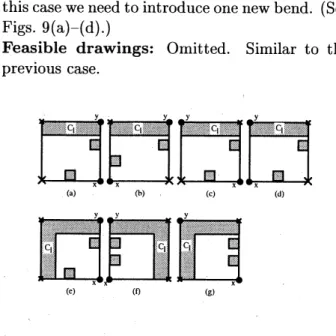
one new bend for $C_{S}$. (See Figs. $9(\mathrm{a})-(\mathrm{d}).$)
Otherwise, if $C_{1}$ has no $P_{11}P_{12}$-strain and
ei-ther $(\mathrm{i})P_{11}$ is a2-cornerpath, $(\mathrm{i}\mathrm{i})P_{12}$ is a 2-corner
path or (iii) $P_{11}$ is a 1-corner path and $P_{12}$ is a
1-cornerpath, thenset $S_{C}=S_{C_{1}}\cup S_{C_{2}}\cup\cdots\cup S_{C\ell}$.
Inthiscase wedo not need to introduce any new
bends. (See Figs. $9(\mathrm{e})-(\mathrm{g}).$)
Otherwise, $C_{1}$ has no $P_{11}P_{12}$-strain, and either
(i) $P_{11}$ is a 1-corner path and $P_{12}$ is a O-corner
path, or (ii) $P_{11}$ is a $0$-corner path and $P_{12}$ is
a 1-corner path. By (c5) $G(C_{1})$ has a set $S_{C_{1}}’$
of vertex-disjoint cycles containing no edge on
$C$, and consisting of$\ell_{2}’2$-legged cycles and $\ell_{3}’3-$
leggedcycles such that 2.$\ell_{2}’+\ell_{3}’=b(G(c_{1}))-1$.
Set $S_{C}=\{C\}\cup S_{C_{1}}^{l}\cup S_{C_{2}}\cup\cdots\cup S_{C_{\ell}}$. Thus in
thiscaseweneedtointroduceone new bend. (See
Figs. $9(\mathrm{a})-(\mathrm{d}).)$
Feasible drawings: Omitted. Similar to the
previous case.
Figure 9: Illustration for Case $3(\mathrm{c})$.
Classification: If either (i) $P_{11}$ is a 2-corner
path and $C_{1}$ has no $P_{11}P_{12}$-strain, (ii) $P_{11}$ is a
1- or 2-corner path and $C_{1}$ has a $P_{11}P_{12}$-strain,
or (iii) $P_{11}$ is a 1-corner path, $P_{12}$ is a O-corner
path and $C_{1}$ has no$P_{11}P_{12}$-strain, then $P_{1}$ is a
2-cornerpath. (See Figs. $9(\mathrm{e}),(\mathrm{a}),(\mathrm{a})$, respectively.)
Otherwise if(i) $P_{11}$ is a 1-cornerpath, $P_{12}$ is a
1-cornerpath and $C_{1}$ has no $P_{11}P_{12}$-strain, (ii) $P_{11}$
is a $0$-corner path, $P_{12}$ is a 1- or 2-corner path
and $C_{1}$ has a $P_{11}P_{12}$-strain, or (iii) $P_{11}$ is a
0-corner path, $P_{12}$ is a 1-cornerpathand $C_{1}$ hasno
$P_{11}P_{12}$-strain, then $P_{1}$ is a 1-corner path. (See
a $0$-corner path, $P_{12}$ is a 2-corner path and $C_{1}$
has no $P_{11}P_{12}$-strain, then$P_{1}$ is a $0$-corner path.
(See Fig. $9(\mathrm{f}).$) Classify $P_{2}$ similarly.
Case $3(\mathrm{d}):C$ has two or more child-cycles
hav-ing a l-or 2- corner path on $C$.
Omitted
Case 4: $C$isa 3-legged cycle havingone or more
child-cycles.
Let $x,$ $y,$$z$ be the three leg-vertices of $C$, and
let $P_{1},$ $P_{2},$$P_{3}$ be theclockwise contour pathfrom
$x$ to $y$, from $y$ to $z$, andfrom $z$ to$x$, respectively.
Computation for $s_{c:}$ If $C$ has no child-cycle
having a l-or 2-corner path on $C$then set $S_{C}=$
$\{C\}\cup S_{C_{1}}\cup S_{C_{2}}\cup\cdots\cup S_{C_{l}}$. In this casewe need
to introduce one new bend. Otherwise set $S_{C}=$
$S_{C_{1}}\cup S_{C_{2}}\cup\cdots\cup S_{C\ell}$. In this case wedo not need
to introduce any new bend.
Feasible drawings: If $G(C)$ has no child-cycle
havinga l-or 2-corner pathon $C$ then $G(C)$ has
orthogonal drawings feasible for $(P_{1}),$ $(P_{2}),$ $(P_{3})$,
respectively. (In this case we need to introduce
one new bend.)
Otherwise, $G(C)$ has an orthogonal drawing
feasible for $(P_{1})$ if and only if $G(C)$ has a
child-cycle having a 1- or 2-corner path on $P_{1}$.
Simi-larlywe candetermine whether $G(C)$ has
orthog-onal drawings feasible for $(P_{2})$ and $(P_{3})$.
If$C$ has no child-cycle having a 1- or 2-corner
path on $C$ then $G(C)$ has no orthogonal drawing
feasible for $(P_{1}, P_{1}, -P3)$, sincewe have nochance
to have two bend on $P_{1}$ even ifwe introduce one
new bend on $P_{1}$.
$G(C)$ has an orthogonal drawing feasible for
$(P_{1}, P_{1}, -P3)$ if and only if (i) $C$ has two
child-cycle having a 1- or 2-corner path on $P_{1}$, or $C$
has a child-cycle having a 2-corner path on $P_{1}$,
and (ii) $C$ has no $P_{1}P_{2}$-strain. (Construction is
omitted. See Figs. 10 and 11.)
Figure 10: Illustration for Case 4.
Classification: If$C$ has no child-cycle having a
l-or 2-corner path on $C$, then$P_{1},$ $P_{2}$ and $P_{3}$ are
Figure 11: Illustration for Case 4.
1-cornerpaths. Otherwise, ifeither (i) $C$ hastwo
or more child-cycles having a l-or 2-corner path
on $P_{1}$, or $C$ has a child-cycle having a 2-corner
path on $P_{1}$, then $P_{1}$ is classified as a 2-corner
path. Otherwise if $C$ has exactly one child-cycle
having 1-corner path on $P_{1}$, then $P_{1}$ is classified
as a 1-corner path. Otherwise $P_{1}$ is classified as
a $0$-corner path. We classify $P_{2}$ similarly.
Now we give our algorithm to find a
bend-optimal orthogonal drawing. Using a method
similar to one in [RNN96, RNN99, RNNOO] the
algorithm above runs in linear time.
Algorithm Orthogonal-Draw$(G)$
begin
1 Choose an edge$e$ on$c_{o}(G)$; Finda
genealog-ical tree$T_{g}$;
2 Do the bottom-up computation;
3 Find minimal cycles having 1- or 2-corner
path on $c_{o}(G’)$ as many as possible;
4 Do the following until $G_{0}$ has exactly four
vertices of degree two.
For each minimal 2-leggedcycle $C$
hav-ing 2-corner path on $G_{0}$ replace $G(C)$
$\mathrm{w}\mathrm{i}\mathrm{t}\mathrm{h}\mathrm{t}\mathrm{i}\mathrm{c}\mathrm{e}\mathrm{s}\mathrm{o}\mathrm{a}\mathrm{f}\mathrm{t}^{\mathrm{u}}\mathrm{e}\mathrm{g}\mathrm{r}\mathrm{e}\mathrm{e}\mathrm{t}_{\mathrm{W}}\mathrm{o}\mathrm{a}\mathrm{d}\mathrm{r}\mathrm{a}\mathrm{n}\mathrm{g}1\mathrm{e}\mathrm{C}\mathrm{o}\mathrm{n}_{G0}\mathrm{t}\mathrm{a}\mathrm{i}\mathrm{n}\mathrm{i}\mathrm{n}\mathrm{g}\mathrm{o}\mathrm{n}$
. two
ver-For each minimal 2-legged cycle$C$
hav-ing 1-corner path on $G_{0}$ replace $G(C)$
with avertex of degree two.
For each minimal 3-leggedcycle $C$
hav-ing 1-corner path on $G_{0}$ replace $G(C)$
with a quadrangle containing one
ver-tex of degree two on $G_{0}$
.
Put vertices of degree two on the edge
$e$.
5 Find maximal bad cycles $C_{1},$ $C_{2},$
$\cdots,$$c_{\ell;}$
6 Let $G”$ be the graph derived from $G^{J}$ by
con-tracting each$G(C_{i}),\dot{i}=1,2,$$\cdots$ ,$\ell$intoa
ver-tex $v_{i}$;
7 Find a rectangular drawing $D(G”)$ of$G”$;
8 For each $\dot{i}=1,2,$ $\cdots,$$\ell$, find a feasible
or-thogonal drawing $D(G(C_{i}))$ of $G(C_{i})$;
9 Patch the drawings$D(G(c_{i})),\dot{i}=1,2,$$\cdots,$
$\ell$,
into $D(G^{;;})$ to get an orthogonal drawing of
$G$; (See Figs. 1(e) and $(\mathrm{f}).$)
Theorem 4.1 The algorithm above
find
abend-optimalorthogonaldrawing
of
a biconnected cubicplane graph in linear time.
5
Conclusion
Inthis paperwepresentedalinear-time algorithm
to find an orthogonal drawing of a biconnected
cubic plane graph with the minimum number of
bends. It is remained as a future work to find a
linear-time algorithm for a larger class of plane
graphs.
References
[BLV93] G. DiBattista, G. Liotta and F. Vargiu,
Spirality
of
orthogonal representations andoptimal drawings
of
series-parallelgraphs and3-planar graphs, Proc. of Workshop on
Al-gorithms and Data structures, LNCS 709,
Springer (1993) 151-162.
[GT94] A. Garg and R.Tamassia, On the
compu-tational complexity
of
upward and rectilinearplanarity testing, Proc. of Graph Drawing’94,
LNCS 894, Springer (1995) 286-297.
[GT96] A. Garg and R. Tamassia, A new
mini-mum cost
flow
algorithm with applications tograph drawing, Proc. of Graph Drawing’96,
LNCS 1190, Springer (1997) 201-226.
[K96] G. Kant, Drawing planar graphs using the
canonical ordering, Algorithmica, 16 (1996)
4-32.
[KH94] G. Kant and X. He, Two algorithms
for
finding rectangular duals
of
planar graphs,Proc. of WG’93, LNCS 790, Springer (1994)
396-410.
[RNN96] M. S. Rahman, S. Nakano and T.
Nishizeki, Rectangular$g7\dot{\eta}d$ drawings
of
planegraphs, Proc. of COCOON’96, LNCS 1090,
Springer (1996) 92-105. Also, Computational
Geometry: Theory and Applications, 10
(1998) 203-220.
$[\dot{\mathrm{R}}’ \mathrm{N}\mathrm{N}99..]$ M.
$r_{\mathrm{S}^{\vee}}.\dot{\mathrm{R}}\mathrm{a}\mathrm{h}\mathrm{m}\mathrm{a}\mathrm{n}$
, S. Nakano and T.
Nishizeki, A linear algorithm
for
bend-optimalorthogonal drawings
of
triconnected cubicplane graphs, Journal of Graph Algorithms
and Applications, 3 (1999) 31-62.
[RNNOO] M. S. Rahman, S. Nakano and T.
Nishizeki, Rectangular Drawings
of
PlaneGraphs without Designated Corners, Proc. of
COCOON’OO, LNCS 1858, Springer (2000)
85-94.
[T87] R. Tamassia, On embedding a graph in
the grid with the minimum number
of
bends,SIAM J. Comput., 16 (1987) 421-444.
[T84] C. Thomassen, Plane representations
of
graphs, (Eds.) $\mathrm{J}.\mathrm{A}$. Bondyand $\mathrm{U}.\mathrm{S}$.R. Murty,
Progress in Graph Theory, Academic Press