Japan Advanced Institute of Science and Technology
JAIST Repository
https://dspace.jaist.ac.jp/Title
On the Duality of Source and Channel
Correlations: Slepian-Wolf Relaying Viewpoint
Author(s)
Meng Cheng; Anwar, Khoirul; Matsumoto, Tad
Citation
2012 IEEE International Conference on
Communication Systems (ICCS): 388-392
Issue Date
2012-11
Type
Conference Paper
Text version
author
URL
http://hdl.handle.net/10119/10898
Rights
This is the author's version of the work.
Copyright (C) 2012 IEEE. 2012 IEEE International
Conference on Communication Systems (ICCS), 2012,
388-392. Personal use of this material is
permitted. Permission from IEEE must be obtained
for all other uses, in any current or future
media, including reprinting/republishing this
material for advertising or promotional purposes,
creating new collective works, for resale or
redistribution to servers or lists, or reuse of
any copyrighted component of this work in other
works.
On the Duality of Source and Channel Correlations:
Slepian-Wolf Relaying Viewpoint
Meng Cheng
∗, Khoirul Anwar
∗and Tad Matsumoto
∗,
‡ ∗Japan Advanced Institute of Science and Technology (JAIST)1-1 Asahidai, Nomi, Ishikawa, 923-1292, Japan Email:{chengmeng, anwar-k, matumoto}@jaist.ac.jp
‡Center for Wireless Communications, FI-90014 University of Oulu, Finland
Email: [email protected]
Abstract—In this paper, we derive the theoretical outage probability of a transmission system in the presence of source and channel correlations in the block Rayleigh fading channels, based on the Slepian-Wolf theorem. Two transmitters and one common receiver are assumed, where the correlation knowledge between the two source information streams can be expressed as a bit-flipping model. The information bits at each transmitter are separately encoded and sent to a common decoder. In addition, we also assume the channels suffering from independent or correlated Rayleigh fading. It is known that the outage event happens when the instantaneous signal noise ratio (SNR) is lower than the given threshold ratio. This paper shows that the outage probability of the system model described above can be expressed by double integrals of the admissible rate region according to the Slepian-Wolf theorem, with respect to the joint probability density function (pdf ) of the corresponding instantaneous signal amplitudes (or the equivalent SNRs) of the channels. The results show that the second order diversity of the theoretical outage curves can be achieved if and only if the two information streams are fully correlated, regardless of the channels being independent or not. On the contrary, the channel correlation makes opposite influence on the decay of the outage probability. However, if the two streams are not fully correlated, this influence gradually disappears as the average SNRs increases. In this sense, the source and channel correlation problems are dual with each other.
I. INTRODUCTION
According to the remarkable contribution by Slepian and Wolf in [1], it has been proven that the distributed source coding scheme can achieve the same compression rate as the optimum joint encoding approach using one single encoder, by best exploiting the correlation knowledge of the source information streams. This theorem can be utilized as a sup-porting base of many applications, such as the relay system which comprises three basic components, a source, a relay and a destination nodes. Specifically, the source broadcasts the original information signal to both the relay and the destination nodes. In some of the relay strategies such as the Decode-and-Forward (DF) or Extract-and-Forward (EF) [2] schemes, relay aims to recover the original information before re-encoding and/or forwarding it to the destination. Due to the noise happening in the source-relay (SR) channel, the recovered information may contain some errors, but they are
This research is supported in part by the Japan Society for the Promotion of Science (JSPS) Grant under the Scientific Research KIBAN (B) No. 2360170.
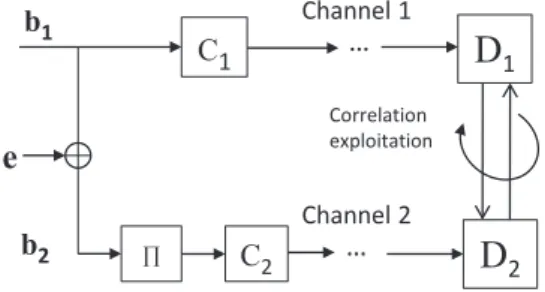
b 1 b 2
D
1 C 1 C 2 … …D
2e
Channel 1 Channel 2 Correlation exploitationFig. 1. System model of correlated source-channel transmission
still correlated with the original data. The common destination node receives two correlated signal streams sent from the source and the relay via the source-destination (SD) and relay-destination (RD) channels, respectively. The joint decoding takes place at the receiver utilizing the source correlation knowledge.
For simplicity, in this paper the two correlated information streams, represented by b1 and b2 as shown in Fig. 1, are
generated by a bit-flipping model satisfying the equations:
b2 = b1 ⊕ e and P (e = 1) = pe, where pe denotes
the flipping probability [3]. Obviously, pe = 0 indicates the extreme situation of full correlation while pe= 0.5 implies the completely independent case. The Source-Channel separation [4] is assumed.
The two channels shown in Fig. 1 are assumed to suffer from block Rayleigh fading, where the channel realization changes frame by frame. Moreover, we consider Channel 1 and 2 being either independent or correlated. The instantaneous channel gains of either one of the channels or both may be faded below the transmission requirement that depends on channel coding and modulation schemes. The admissible Slepian-Wolf rate region of the correlated source transmission is defined in [1], and it can be converted into the signal amplitude (or equivalently the SNRs) region. In this case, the outage capacity is dominated by the instantaneous channel realizations. Hence, it is straightforward to derive the outage probability by a double integral over the achievable regions with respect to the joint probability density function (pdf ) of the instantaneous signal amplitudes of the both channels.
This paper is organized as follows. First of all, the Slepian-Wolf theorem and the bit-flipping model are discussed in Section II. In Section III, the outage probability is defined and derived based on the Slepian-Wolf theorem in the case when Channel 1 and 2 are either independent or correlated. Moreover, the asymptotic analysis of the outage performance is also presented in this section. Finally, the conclusions are given in Section IV with some remarks.
II. SYSTEMMODEL
The system model of the correlated source-channel trans-mission is shown in Fig. 1, where b1and b2denote the source
bit streams transmitted from the first and second transmitters, respectively. The two information streams are correlated and
b2 is a flipped version of b1 with a flipping probability pe. The source correlation value can be further utilized at the joint decoder in order to enhance the decoding performance, based on the Slepian-Wolf theorem. Let s1 and s2denote the
transmitted symbols. The received signals y1and y2from the
first and the second time slots, respectively, can be expressed as:
y1= h1s1+ n1, (1)
y2= h2s2+ n2, (2)
where n1 and n2 are the zero-mean additive white Gaussian
noise (AWGN) components, both having the same variance
σ2
n per dimension. h1and h2represent the complex Rayleigh
fading envelops of the two channels, and the both are kept constant within a frame duration due to the block fading assumption. The instantaneous SNR of the i -th (i = 1, 2) channel γi=|hi|
2
Ei/N0, where Eirepresents the per-symbol signal power which is normalized to 1, and N0= 2σ2n which denotes the noise power spectral density. By assuming the independent block Rayleigh fading for both channels, the pdf of the instantaneous amplitude Ri of the i -th channel can be expressed as [5] p (Ri) = 2Ri Pri exp(−R 2 i Pri ), (3) where Pri= ⟨ |hi| 2 Ei ⟩
, denoting the average received signal power of the i-th channel. Therefore, the average SNR of the
i -th channel is Γi= Pri/N0. In this paper, we also examine
the impact of the correlation ρ = ⟨h1h∗2⟩. The joint pdf of
instantaneous amplitudes R1 and R2 is then given by [5]
p(R1, R2) = 4R1R2 Pr1Pr2(1− |ρ|2) I0 [ 2|ρ| R1R2 √ Pr1Pr2(1− |ρ|2) ] exp [ − 1 1− |ρ|2 ( R21 Pr1 + R 2 2 Pr2 )] , (4)
where I0(·) is the zero-th order modified Bessel’s function of
the first kind. According to [1], the admissible rate region is constituted as an unbounded polygon, represented by Part 3 as shown in Fig. 2. The original bits can be recovered if and only
Admissible
Region
H(b1|b2) H(b1) H(b1 , b2) H(b2)1
2
H(b1 , b2) R 1 R 2 H(b2|b1)3
4
Fig. 2. Achievable rate region of Slepian-Wolf theorem
if the transmitting rates are within this area. For instance, if
b1 is transmitted at the rateR1 which is equal to its entropy
H(b1), then b2can be transmitted at the rateR2which is less
than H(b2), but must be larger than their conditional entropy H(b2| b1). In other words,R1 andR2 should satisfy three
equations [1]:
R1> H(b1| b2), (5) R2> H(b2| b1), (6) R1+R2> H(b1, b2). (7)
where H(b1, b2) denotes the joint entropy of the correlated source information streams. Since we assume the binary symmetric source model (P (1) = P (0) = 0.5), H(b1) = H(b2) = 1, H(b1 | b2) = H(b2 | b1) = H(pe), H(b1, b2) = 1 + H(pe) with H(pe) =−pelog2(pe)− (1 − pe) log2(1− pe). The threshold amplitude is given by
R[H] =
√
(2RcH− 1) N0, (8)
where Rc represents the rate which takes into account of the channel coding and the modulation scheme [3]. However, the specific practical coding and modulation schemes are out of the scope of this paper. Equivalently, the inverse transform is defined as H[R] = R1
clog2(1 +
R2
N0).
III. OUTAGEDERIVATION
Besides the typical admissible region, the entire Slepian-Wolf rate region can be divided into 4 parts as shown in Fig. 2. In this paper, Part 4 should also be included as the admissible region, such as in the relay system, where b1 is the source
information stream which we are interested in, while b2 can
be seen as the recovered version of b1 at the relay. Although
b2 may contains some errors due to the fading variation
of the SR channel, it is still correlated with b1. By using
Eq. (8), the Slepian-Wolf rate constraint can be transformed into the corresponding signal amplitude domain. It is known that the outage event happens when the instantaneous signal amplitudes of Channel 1 and 2 are out of the admissible region,
and therefore the outage probability of our assumed model can be defined as [6]
Pout = P1+ P2, (9)
where P1 and P2 denote the probabilities that the rates R1
andR2fall into the inadmissible regions Part 1 and Part 2, as
shown in Fig. 2. Therefore, the mathematical expressions of
P1 and P2 are defined as follows:
P1= ∫ R[H(b1|b2)] R1=R[0] ∫ R[∞] R2=R[0] p (R1, R2) dR1dR2, (10) P2= ∫ R[H(b1)] R1=R[H(b1|b2)] ∫ R[H(b1,b2)−H(R1)] R2=R[0] p (R1, R2) dR1dR2. (11) The derivations of P1 and P2 are presented for different
scenarios as follows and the numerical results are shown by assuming Rc equals to 1 and Γ1= Γ2.
A. Independent Channels
If both Channel 1 and Channel 2 are statistically inde-pendent, the joint pdf of R1 and R2 can be expressed as
p(R1, R2) = p(R1)p(R2), and P1 and P2 can be further
derived as P1= ∫ R[H(b1|b2)] R1=R[0] p(R1)dR1 ∫ R[∞] R2=R[0] p(R2)dR2 = ∫ R[H(b1|b2)] R1=R[0] 2R1 Pr1 exp(−R 2 1 Pr1 )dR1 = 1− exp [ −(2RcH(pe)− 1)N0 Pr1 ] , (12) P2= ∫ R[H(b1)] R1=R[H(b1|b2)] p (R1) dR1 · [ − exp ( −R22 Pr2 )]√(2[RcH(b2,b1)−log2(1+ R1 N0)]−1)N0 R2=0 = ∫ R[H(b1)] R1=R[H(b1|b2)] 2R1 Pr1 exp(−R 2 1 Pr1 ) · [ 1− exp ( −(2 [RcH(b2,b1)−log2(1+R1N0)]− 1)N 0 Pr2 )] dR1. (13) Since no explicit solution is found for P2, the numerical
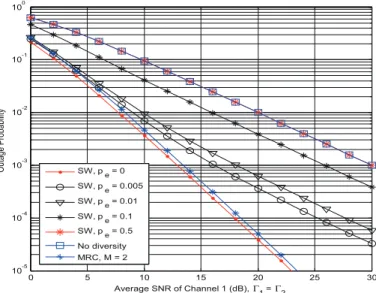
method may be used with sufficient accuracy. The theoretical outage curves of the system assumed are shown in Fig. 3, where the outage probability with maximum-ratio-combing (MRC) scheme [7] is also shown for comparison. Obviously, the second order diversity of the outage curve can be achieved only if b1 and b2 are fully correlated (pe = 0), the math-ematical proof of which is given in Appendix 1. It should be noted that the outage performance of the Slepian-Wolf transmission system is slightly better than that of the MRC scheme with diversity two. The mathematical proof of the
0 5 10 15 20 25 30 10-5 10-4 10-3 10-2 10-1 100 Average SNR of Channel 1 (dB), Γ1= Γ2 O ut ag e Pro ba bi lit y SW, p e= 0 SW, p e= 0.005 SW, p e= 0.01 SW, pe= 0.1 SW, p e= 0.5 No diversity MRC, M = 2
Fig. 3. Outage probabilities with source correlation,|ρ| = 0
asymptotic tendency is given in Appendix 2, but only for Γ1= Γ2.
It is also found in Fig. 3 that with pe ̸= 0, the decay of the outage curve converges into the first order diversity, as Γ1
and Γ2 increases. The mathematical proof of this asymptotic
tendency is shown in Appendix 3. Finally, with pe= 0.5, the outage curve of our model is exactly the same as that with no-diversity.
B. Correlated Channels
With an assumption that Channel 1 and 2 are correlated, the signal amplitudes R1 and R2follow the joint pdf p(R1, R2)
as shown in Eq. (4). Since the zero-th order modified Bessel function of the first kind I0(x) can be expanded as I0(x) =
∑∞ n=0
(x/2)2n
(n!)2 , Eq. (4) can be re-written as:
p(R1, R2) = 4R1R2 Pr1Pr2(1− |ρ| 2 )exp ( −R21/Pr1 1− |ρ|2− R2 2/Pr2 1− |ρ|2 ) ∞ ∑ n=0 1 (n!)2 ( |ρ| R1R2 √ Pr1Pr2(1− |ρ| 2 ) )2n = ∞ ∑ n=0 q(n)1 q(n)2 , (14)
where q(n)1 and q(n)2 are expressed as
q(n)1 = 2R 2n+1 1 |ρ| n Pr1n+1(1− |ρ|2)n+1/2exp ( −R21/Pr1 1− |ρ|2 ) ( 1 n! ) , (15) q(n)2 = 2R 2n+1 2 |ρ| n Pr2n+1(1− |ρ|2)n+1/2exp ( −R22/Pr2 1− |ρ|2 ) ( 1 n! ) . (16)
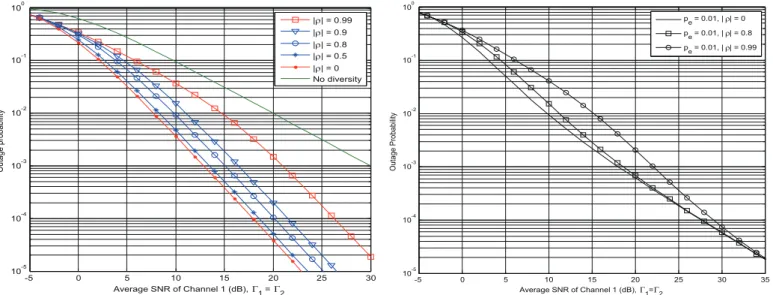
-5 0 5 10 15 20 25 30 10-5 10-4 10-3 10-2 10-1 100 Average SNR of Channel 1 (dB), Γ1= Γ2 O ut ag e pro ba bi lit y |ρ| = 0.99 |ρ| = 0.9 |ρ| = 0.8 |ρ| = 0.5 |ρ| = 0 No diversity
Fig. 4. Outage probabilities in the duality of source-channel correlation,
pe= 0
Now, given the fact that p(R1, R2) are factored into a
product of two independent terms, as shown by Eqs. (14)-(16),
P1 and P2 can easily be calculated numerically. The results
are shown in Fig. 4, where we assume the source streams are fully correlated (pe = 0). Clearly, the larger the channel correlation, the larger the outage probability. However, the second order diversity can finally be achieved with arbitrary value of |ρ| ̸= 1, when increasing the average SNRs. This asymptotic tendency is proven in Appendix 4.
Fig. 5 shows that when pe ̸= 0, the outage cavers change within a certain range of the average SNR values, giving different correlation factors. However, the outage curves can not achieve the second order diversity over the entire range of the average SNRs. See Appendix 4 for the proof of this tendency.
C. Duality Consideration
As observed before, when Γ1→ ∞, Γ2→ ∞ and |ρ| = 0,
the outage probability yields the equivalent diversity order 1 asymptotically, as far as pe̸= 0. On the other hand, when pe= 0, the equivalent diversity order converges into two, so far as
|ρ| ̸= 1. This duality can easily be understood by considering
that when Γ1 → ∞, Γ2 → ∞, only either the source bits
transmitted from the two transmitters being different, or the complex fading envelops of the two channels having different values determines the diversity order.
IV. CONCLUSION
In this work, the outage probability of the correlated source transmission based on the Slepian-Wolf theorem has been derived, as well as the asymptotic tendency analysis, with the aim of its applications on DF or EF relay system. It has been shown mathematically that when the channel correlation
ρ = 0, the second order diversity can always be achieved
if pe = 0. In the case when 0 < pe < 0.5, the diversity
-5 0 5 10 15 20 25 30 35 10-5 10-4 10-3 10-2 10-1 100 Average SNR of Channel 1 (dB), Γ1=Γ2 O u ta g e Pro b a b ili ty pe= 0.01, | ρ| = 0 pe= 0.01, | ρ| = 0.8 pe= 0.01, | ρ| = 0.99
Fig. 5. Outage probabilities in the duality of source-channel correlation,
pe̸= 0
order gradually changes and finally converges into one, as the average SNRs become large. When sources are fully correlated, the second order diversity can always be achieved as long as the channels are not fully correlated. According to the observations described above, it can be concluded that the source and channel correlations are dual with each other.
APPENDIX1
When pe = 0, P1 is always equal to 0, and therefore
the outage probability is only dominated by the value of P2.
For the mathematical simplicity, the pdf of the instantaneous SNR p(γi), instead of p(Ri), is used to prove the asymptotic tendency of the outage curve, as p(γi) =Γ1iexp(−γΓii). In the independent channels, by setting H (b1, b2) = 1 and Rc= 1 P2= ∫ 1 γ1=0 ∫ 2[1−log2(1+γ1)]−1 γ2=0 p(γ1)p(γ2)dγ1dγ2 = ∫ 1 0 p(γ1)· [ − exp ( −γ2 Γ2 )]2[1−log2(1+γ1)]−1 0 dγ1 = 1 Γ1 ∫ 1 0 [ exp(−γ1 Γ1 )− exp ( −γ1 Γ1− 1− γ1 Γ2(1 + γ1) )] dγ1. (17)
With the approximation that e−x =∑∞n=0(−x)n!n ≈ 1 − x, Eq. (17) can be reduced to
P2≈ 1 Γ1 ∫ 1 0 [ 1−γ1 Γ1 − ( 1− γ1 Γ1 − 1− γ1 Γ2(1 + γ1) )] dγ1 = 1 Γ1 ∫ 1 0 [ 1− γ1 Γ2(1 + γ1) ] dγ1 = 1 Γ1 [ 2 ln (1 + γ1)− γ1 Γ2 ]1 0 =2 ln 2− 1 Γ1Γ2 . (18)
The results shows that with pe= 0 the outage curve follows the tendency of the second order diversity.
APPENDIX2
Here, the proof of the advantage of the Slepian-Wolf relay system over MRC is presented. Assuming that Γ1= Γ2(> 0)
in both the schemes with pe = 0 and Rc = 1, Eqs. (13) can be further reduced to P2= 1 Γ1 ∫ 1 0 { exp ( −γ1 Γ1 ) − exp [ 1 Γ1 ( −1 + γ12 1 + γ1 )]} dγ1. (19)
According to [7], by setting the same threshold, the outage probability of the MRC scheme with the second order diversity can be expressed as Pout,mrc= 1 Γ1 ∫ 1 γ1=0 γ1 Γ1 exp ( −γ1 Γ1 ) dγ1. (20)
To prove that Pout,mrc− P2 > 0, we define that Pgap =
Pout,mrc− P2 as Pgap= 1 Γ1 ∫ 1 γ1=0 { exp [ 1 Γ1 ( 1− γ1− 2 1 + γ1 )] +(γ1 Γ1 − 1) exp ( −γ1 Γ1 )} dγ1 = 1 Γ1 {∫ 1 γ1=0 exp [ − 1 Γ1 ( 1 + γ2 1 1 + γ1 )] dγ1− exp(− 1 Γ1 ) } . (21) Let y1(x) = exp ( −1+γ2 1 1+γ1 ) . It is found that y1(x) > −1
hold within the range of [0, 1] if y1(x) is concave, since
y1(x)> min {y1(0), y1(1)} = −1, according to the property
of the concave function. y1(x) can be proven to be concave
by showing that y1(x)′′= exp(− 1 + x2 1 + x) [ 2 (1 + x)2 − 1 ]2 −4 exp(− 1+x2 1+x) (1 + x)3 < 0. (22)
By ignoring the common exponential terms in Eq. (22), because they are positive, it is found that giving a proof to Eq. (22) is equivalent to proving that y2(x) =
[ 2− (1 + x)2 ]2 − 4 (1 + x) < 0. Let t = 1 + x (t ∈ [1, 2]). Then, y2(t) = ( 2− t2)2− 4t = t4− 4t2− 4t + 4. The second order derivative of y2(t) can be expressed as
y2(t)′′= 12t2− 8. (23)
Obviously, y2(t)′′> 0 within the range of [1, 2]. Therefore
y2(t) is convex, and y2(t) < max{y2(1), y2(2)} = −3.
Hence, y2(t) < 0, which is equivalent to y1(x)′′ < 0. Now
y1(x) is proved to be concave, and consequently Pgap is proven to be positive.
APPENDIX3
When b1and b2are not fully correlated (pe̸= 0), as Pr1→ ∞ and Pr2→ ∞, P2will approaches 0 as seen in Eq. (13) and
only P1dominates the outage performance. Since Pr1= Γ1N0
and Rc= 1 are assumed, Eq. (12) can be written as P1= 1− exp ( −2RcH(pe)− 1 Γ1 ) ≈2RcH(pe)− 1 Γ1 . (24)
Obviously, when the average SNR Γ1 becomes large, the
value of P1 is inversely in proportion to Γ1 and hence the
diversity order converges into one. APPENDIX4
In the presence of the channel correlation, regardless of the source correlation, increasing the average SNRs Γ1and Γ2, or
equivalently increasing Pr1 and Pr2 yields:
2|ρ| R1R2
√
Pr1Pr2(1− |ρ|2)
≈ 0 (Pr1→ ∞, Pr2→ ∞) (25)
Hence, with I0(0) = 1, Eq. (4) can be approximated as
p(R1, R2)≈ 4R1R2 Pr1Pr2(1− |ρ|2) exp ( −R21/Pr1 1− |ρ|2− R2 2/Pr2 1− |ρ|2 ) = 2R1 Pr1 √ 1− |ρ|2 exp ( − R12 Pr1(1− |ρ| 2 ) ) 2R2 Pr2 √ 1− |ρ|2 exp ( − R22 Pr2(1− |ρ| 2 ) ) =p(R1′)p(R2′). (26) where R1′ = R1 √ 1− |ρ|2 and R2′ = R2 √ 1− |ρ|2, with Pr1′ = ⟨ R1′ ⟩ = Pr1(1− |ρ| 2 ) and Pr2′ = ⟨ R2′ ⟩ = Pr2(1− |ρ|2
). Hence, with Pr1 → ∞ and Pr2 → ∞ (equivalently, Pr1′ → ∞ and Pr2′ → ∞ ), the asymptotic property of the outage probability exhibits the same tendency as in the case of independent channels, which indicates that the tendency of the diversity order only depends on the source correlation.
REFERENCES
[1] D. Slepian and J. Wolf, “Noiseless Coding of Correlated Information Sources,” Information Theory, IEEE Transactions on, vol. 19, no. 4, pp. 471–480, Jul. 1973.
[2] M. Cheng, A. Irawan, K. Anwar, and T. Matsumoto, “BICM-ID for Relay System Allowing Intra-link Errors and a Similarity Constellation to ARQ Schemes,” in Progress In Electromagnetics Research Symposium (PIERS),
Malaysia, Mar. 2012, pp. 281–286.
[3] J. Garcia-Frias and Y. Zhao, “Near-Shannon/Slepian-Wolf Performance for Unknown Correlated Sources Over AWGN Channels,”
Communica-tions, IEEE Transactions on, vol. 53, no. 4, pp. 555–559, Apr. 2005.
[4] C. E. Shannon, “A Mathematical Theory of Communication,” vol. 27, pp. 397–423, Jul. 1948.
[5] M. Schwartz, W. Bennett, and S. Stein, “Communication Systems and Techniques,” Communications Magazine, IEEE, vol. 34, no. 5, p. 9, May. 1996.
[6] M. Cheng, K. Anwar, and T. Matsumoto, “Outage-Analysis of Correlated Source Transmission in Block Rayleigh Fading Channels,” in 2012 IEEE
Vehicular Technology Conference (VTC 2012-Fall), Sep. 2012, accepted.
[7] A. Goldsmith, Wireless Communications. Stanford University, USA: Cambridge University Press, 2005.