ALGEBRAIC STRUCTURE OF NULL DESIGNS
SOOJIN CHO
ABSTRACT. Null designs are defined as the elements of the kernel of the incidence matrices of $k$-subsets and $t$-subsets of an $n$-set. It has been known that the set of null designs is
the direct sum of the Specht modules of certain types as a group representation of the symmetric group. The same is true for the $q$-analogue of null designs if we use irreducible
unipotent representationsofthe general linear groups over a finite field
A bijection between two known bases of the module of null designs of the Boolean algebras $(q=1)$ is constructed.
1. Introduction
Let $B_{n}^{q}$ denote the subspace lattice of an $n$-dimensional vector space over the finite
field $\mathrm{F}_{q}$ (if $q=1$ then the subset lattice of an $n$-set $[n]\equiv\{1,2,$
$\ldots,$$n\}$), for a positive
integer $n$ and a prime power $q$.
For $0\leq i\leq n$, let
$X_{i}\equiv$
{
$x\in B_{n}^{q}$ : rank$(x)=i$}
andfor a given field $I\acute{\iota}$ and a finite set $X$, let
$K[X]$ be the $K$-vector space of the formal
sums $\sum_{x\in \mathrm{x} ,c_{x}\in \mathrm{A}\prime}c_{x}X$.
We will deal with only a field $K$ ofcharacteristic zero for the purpose ofthis paper.
For $0\leq i\leq j\leq n$, we define two $K$-linear maps
$d_{ji:}K[X_{j}]arrow K[X_{i}]$ and $u_{ij}$ : $K[X_{i}]arrow K[X_{j}]$ by
$d_{ji}(x)=y \leq_{X}\sum_{y\in}x_{i}y$
for $x\in X_{j}$ and
$u_{ij}(y)= \sum Xx\in \mathrm{x}y\leq x\mathrm{j}$
for $y\in X_{i}$
.
Note that $d_{ij}$ and $u_{ji}$ just represent the incidence matrix between $X_{j}$ and $X_{i}$
.
Ifwe take $K$ as the underlying field then, for given integers $0\leq t\leq k\leq n-k$, the
set of null $(t, k)$-designs is defined by the $K$-vector space
$N_{k,t}^{q}\equiv I\mathrm{f}e\Gamma(d_{k},t)$
.
The following a wellknown theorem which will be playing a keyrole intheproof of
the main theorem.
space over $\mathrm{F}_{q}$, which is defined by $\frac{[n][n-1]\ldots[n-.m+1\rceil}{[m][m-1]..[1]}$, where
$[i]=1+q+\cdots+q^{i-1}$
.
Theorem 1.1 [5]. For $0\leq i\leq j\leq n-i-1_{;}$ the$A_{ij}=(a_{xy})$,
defined
by$a_{xy}=\{$
1
if
$y\leq x$$0$ otherwise
has the
full
rank$u_{ij}$ is an injection.
1
In the next section, we summarize the known theorems about the ordinary
represen-tations of the symmetric group and the general linear group over $\mathrm{F}_{q}$. Then, in the third
section, we state a theorem which express $N_{t,k}^{q}$ as a representation of the symmetric
group on $n$ letters or the general linear group over a finite field. Finally, a construction
of a bijection between two known bases of $N_{t,k}^{1}$ is given.
2. Group Representations
Obviously, $N_{t,k}^{q}$ is a representation of the symmetric group $S_{n}$ of $n$ letters if $q=1$, and it is a representation of the general lineargroup over $\mathrm{F}_{q},$ $GL_{n}(q)$, if$q\neq 1$.
Remember that we only deal with afield ofcharacteristic $0$ as the underlying field of
group representations.
To investigate the structure of$N_{t,k}^{q}$ as grouprepresentations, we summarizethe main
theorems we will need about the representations of $S_{n}$ and $GL_{n}(q)$. For the detailed
definition and the proof of the theorems we refer to [3], [4] and [6].
The $(q)$-Specht modules aredefined for eachpartition $\lambda=(\lambda_{1}, \ldots, \lambda_{h})$ of$n$.
Remem-ber that the diagram $[\lambda]$ is the set of ordered pairs $(a, b),$
$1\leq a\leq h,$ $1\leq b\leq\lambda_{a}$ and
a tableau
of
type $\lambda$ is an arrayofintegers obtained by replacing the nodes in $[\lambda]$ by the
numbers 1, 2,...,$n$
.
Tabloidsare the tableauxwithforgotten columns, i.e. wethinkeachrow of a tabloid as a set and we use $\{T\}$ for the tabloid obtained from tableau $T$
.
Let$V$ be an $n$-dimensionalvector spaceover $\mathrm{F}_{q}$ ($V=[n]$, if $q=1$). Flags oftype $\lambda$ are the
sequences of subspaces (subsets, if$q=1$) of$V$
$\langle 0\rangle=V_{0}\subset V_{1}\subset\cdots\subset V_{n}=V$ ,where
$Dim(V_{i}/V_{i-1})=\lambda_{i}$ ($|V_{i}-V_{i-}1|=\lambda_{i}$ if$q=1$) for $1\leq i\leq n$ .
$M_{\lambda}^{q}$ is the permutation representation ofthe flags of type $\lambda$, hence
$M_{(ni)}^{q}-i$, is the
per-mutation representation of$i$-dimensional spaces of
flag i.e.
$M_{(n-i}^{q},i)=K[Xi]$.
For each partition $\lambda$, an irreducible submodule of$M_{\lambda}^{q}$, called $(q)$-Specht module, exists,
and they are all non-isomorphic. We are only interested in the two part partitions
$\lambda=(n-\dot{i}, i),$ $2i\leq n$, so we introduce one way to describe the $(q)$-Specht module for
$\lambda=(n-i, i)$
.
Theorem 2.1 (Kernel Intersection Theorem, [3, $\mathrm{p}72],$ $[4,$ $\mathrm{p}76]$).
$S_{(i)}^{q}=\overline{\bigcap_{j=}}n-i,i10Kerd_{ij}$ I
Remark on Theorem 2.1. For $Kerd_{ij^{\mathrm{S}}}$’ to be a $KGL_{n}(q)$-module (or $KS_{n}$-module), we expect $d_{ij^{\mathrm{S}}}$’ to be modulehomomorphisms. It, however, is easy enough to check.
Theorem 2.2.
$Di.ms_{(i)}^{q}=n-i,-$
ITheorem 2.3 (Young’s Rule).
$M_{(n)}^{q} \cong\bigoplus_{=}^{k}-k,ksi0(n-i,i)q$
.
1
For a given tableau $T$, let $C_{T}$ be the subgroup of of $S_{n}$ consisted with the column
stabilizers of$T$, then a generator of $S_{(n-i}^{1},i$
) is given by
$e_{T}\equiv\kappa\tau\{T\}$ ,where
$\kappa_{T}=\sum_{\pi\in c_{T}}(sgn\pi)\pi$
.
Remember that a tableau $T$ is called standard if each row and each column of $T$ form
increasingsequences.
Thefollowing theorem gives us a very natural basis ofthe Specht modules.
Theorem 2.4.
{
$e_{T}$ : $T$ is a standard $(n-i,$$i)$-tableau}
is a basis
for
$S_{(n-i}^{1},i$3. $N_{t,k}^{q}$ as a group representation
Since $N_{t,k}^{q}$ is a submodule of $K[X_{k}]=M_{(n-}^{q}k,k)$
’ by Theorem 2.3, $N_{tk,|}^{q}$ must be a
direct sum of$S_{(i)^{\mathrm{S}}}^{q}n-i,’$. The following theorem shows how $N_{t,k}^{q}$ is decomposed.
Theorem 3.1. As $KGL_{n}(q)$-modules (or as $KS_{n}$-modules
if
$q=1$),$N_{t,k}^{q} \cong\bigoplus_{i=t+1}^{k}s_{(n}^{q}-i,i)$
.
Sketch
of
the proof. Foreach$t+1\leq\dot{i}\leq k$, we canembed $S_{(n-i}^{q},i$) into $M_{()}^{q}n-k,k$ through $u_{ik}$ since$u_{ik}$ is amonomorphism. Then, we can show that $u_{ik}(s_{(n)}^{q})-i,i$ is a submodule of
$N_{t,k}^{q}$ by doing some calculation (eitherbydirect way or bythehelpofM\"obiusfunctions).
Now, Theorem 2.2 finishes the proof by comparing the dimensions.
1
Thefollowing theorem, due to R. L. Graham, S. -Y. R. Li and W. -C. W. Li , gives a very nice basis of$N_{t,k}^{1}$. For convenience, we use a square free polynomial
$x_{i}x_{i_{2}}\ldots x_{i}1k$ to represent a $k$-subset $\{i_{1}, i_{2}, \ldots, i_{k}\}$ of $[n]$.
Theorem 3.4 [1]. For $0\leq t\leq k\leq n-t-1$, let $S_{t,k,n}$ consist
of
those $\sigma\in S_{n}$ which satisfy:$a$. $\sigma(1)<\sigma(3)<\cdots<\sigma(2t+1)$,
$b$. $\sigma(2)<\sigma(4)<\cdots<\sigma(2t+2)$, $c$. $\sigma(2i-1)<\sigma(2i),$ $1\leq i\leq t+1$,
$d$. $\sigma(2t+1)<\sigma(2t+3)<\sigma(2t+4)<\cdots<\sigma(k+t+1)$,
$e$. $\sigma(2t+1)<\sigma(k+t+2)<\sigma(k+t+3)<\cdots<\sigma(n)_{f}$ and
$f$.
If
$2t+3\leq i\leq k+t+1<j\leq n$ and $\sigma(i)<\sigma(2t+2)$ then $\sigma(i)<\sigma(j)$.
Then $\{\sigma(\omega) : \sigma\in S_{t,k,n}\}$ is a basis
of
$N_{t,k^{f}}^{1}$ where$\omega=(x_{1^{-}2}X)(_{X_{3}}-X_{4})’\cdot\cdot(x2t+1-x_{2t+2})_{Xx}2t+s\cdots k+t+1$
and permutations in $S_{n}$ act on $\omega$ by permuting the indices
of
$x_{i}$.
4. A bijection between two bases of $N_{t,k}^{1}$
In this section, we construct a bijection between $S_{t,k,n}$ (see Theorem 3.4) and
$ST_{t,k,n}\equiv\cup^{k}$
{
$\tau i=t+1$ :
$T$ is standard of shape $(n-i,\dot{i})$
},
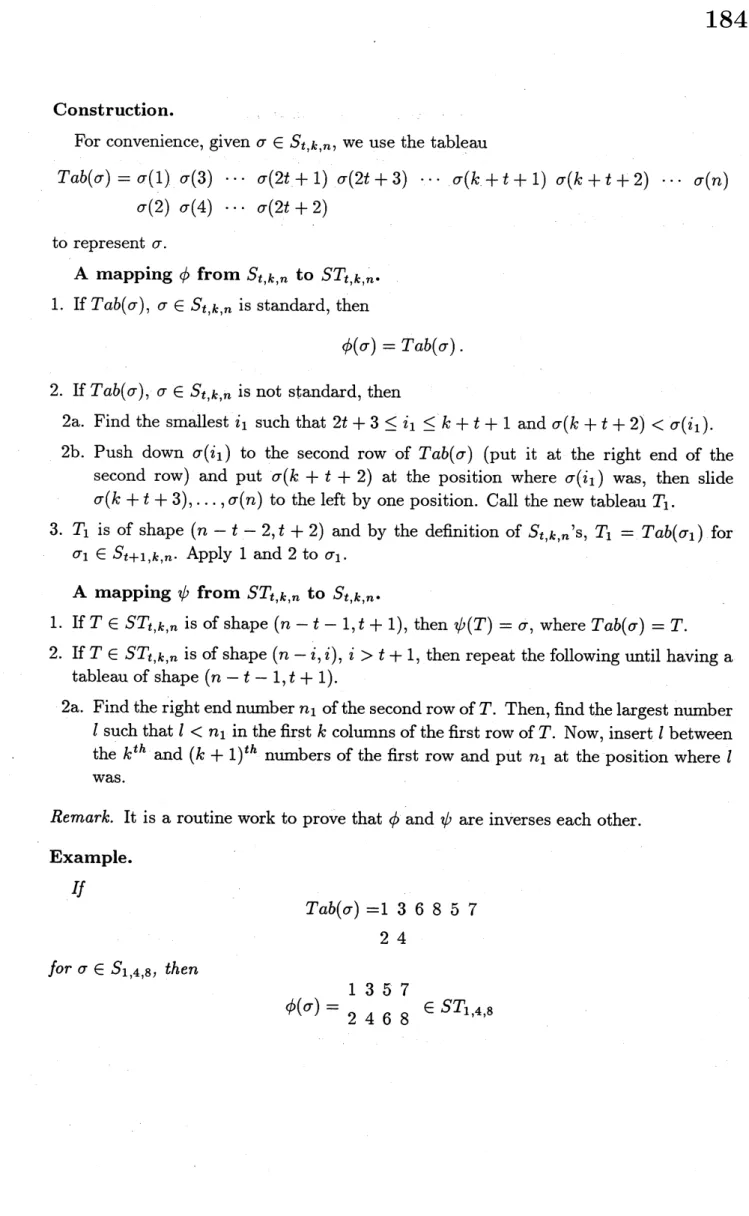
Construction.
For convenience, given $\sigma\in S_{t,k,n}$, we use the tableau
Tab$(\sigma)=\sigma(1)\sigma(3)$
...
$\sigma(2t+1)\sigma(2t+3)$..
.
$\sigma(k+t+1)\sigma(k+t+2)$...
$\sigma(n)$ $\sigma(2)\sigma(4)$...
$\sigma(2t+2)$to represent $\sigma$.
A mapping $\phi$ from $S_{t,k,n}$ to $ST_{t,k,n}$
.
1. If Tab$(\sigma),$ $\sigma\in S_{t,k,n}$ is standard, then
$\phi(\sigma)=^{\tau}ab(\sigma)$.
2. If Tab$(\sigma),$ $\sigma\in S_{t,k,n}$ is not standard, then
$2\mathrm{a}$. Find the smallest $i_{1}$ such that $2t+3\leq i_{1}\leq k+t+1$ and $\sigma(k+t+2)<\sigma(i_{1})$.
$2\mathrm{b}$. Push down $\sigma(i_{1})$ to the second row of Tab
$(\sigma)$ (put it at the right end of the
second row) and put $\sigma(k+t+2)$ at the position where $\sigma(i_{1})$ was, then slide
$\sigma(k+t+3),$ $\ldots,$$\sigma(n)$ to the left by one position. Call the new tableau $T_{1}$
.
3. $T_{1}$ is of shape
$(n-t-2, t+2)$
and by the definition of$S_{t,k,n^{\mathrm{S}}}’,$ $T_{1}=Tab(\sigma_{1})$ for
$\sigma_{1}\in S_{t+1,k,n}$. Apply 1 and 2 to $\sigma_{1}$.
A mapping $\psi$ from $ST_{t,k,n}$ to $S_{t,k,n}$
.
1. If$T\in ST_{t,k,n}$ is of shape $(n-t-1, t+1)$, then $\psi(T)=\sigma$, where Tab$(\sigma)=T$.
2. If$T\in ST_{t,k,n}$ is of shape $(n-i, i),$ $i>t+1$ , then repeat the following until having a
tableau of shape $(n-t-1, t+1)$.
$2\mathrm{a}$. Findthe rightendnumber
$n_{1}$ of the second row of$T$. Then, find the largest number
$l$ such that $l<n_{1}$ in the first $k$ columns of the first
rowof$T$
.
Now,insert $l$ betweenthe $k^{th}$ and $(k+1)^{th}$ numbers of the first row and put
$n_{1}$ at the position where $l$
was.
Remark. It is a routine work to prove that $\phi$ and $\psi$ are inverses each other.
Example.
If
Tab$(\sigma)=136857$ 24
for
$\sigma\in S_{1,4,8_{J}}$ then1357
References
[1] R. L. Graham, S. -Y. R. Li and W. -C. W. Li, On the structure
of
$t$-designs, SIAMJ. Alg. Disc. Math. 1 (1980), 8-14.
[2] J. E. Graver andW. B. Jurkat, The module structure
of
integral designs, J. Comb.Theory A 15 (1973), 75-90.
[3] G. D. James, The representation theory
of
symmetric groups, Lecture Notes inMath. 682, Springer-Verlag, New York, NY, 1978.
[4] G. D. James, Representations
of
general linear groups, LMS Lecture Note Series 94, Cambridge University Press, 1984.[5] W. M. Kantor, On incidence matrices
of finite
projective andaffine
spaces, Math.Z. 124 (1972), 315-318.
[6] B. E. Sagan, The symmetricgroup,
Wadsworth&Brooks/Cole
MathematicsSeries,Wadsworth, Inc., 1991.
GLOBAL ANALYSIS RESEARCH CENTER, DEPARTMENT OF $\mathrm{M}_{\mathrm{A}\mathrm{T}\mathrm{H}\mathrm{E}\mathrm{M}\mathrm{A}}\mathrm{T}\mathrm{l}\mathrm{C}\mathrm{S}$, SEOUL NATIONAL
UN1-VERSITY, SEOUL, 151-742 KOREA