博士学位論文
Induction of oviposition behavior
of Aphidoletes aphidimyza by olfactory cues
近畿大学大学院
農学研究科農業生産科学専攻
博士学位論文
Induction of oviposition behavior
of Aphidoletes aphidimyza by olfactory cues
平成 29 年 1 月 10 日
近畿大学大学院
農学研究科農業生産科学専攻
Contents
I. General introduction ... 1
II. Oviposition selection by Aphidoletes aphidimyza (Diptera: Cecidomyiidae) on banker plants with alternative prey aphids or crop plants with pest aphids ... 4
Introduction ... 4
Materials and methods ... 5
Insects and plants ... 5
Effect of the prey density ratio on the oviposition preference of female adults for the crop‒pest or banker plant–alternative prey systems in the laboratory ... 5
Effect of conditioning on the oviposition preference of female adults for the crop‒pest or banker plant‒alternative prey systems in the laboratory ... 6
Oviposition preference of female adults for the crop‒pest or banker plant‒alternative prey systems in a greenhouse ... 6
Results ... 7
Effect of the prey density ratio on the oviposition preference of female adults for the crop‒pest or banker plant–alternative prey systems in the laboratory ... 7
Effect of conditioning on the oviposition preference of female adults for the crop‒pest or banker plant‒alternative prey systems in the laboratory ... 10
Oviposition preference of female adults for the crop‒pest or banker plant‒alternative prey systems in a greenhouse ... 11
Discussion ... 11
III. Oviposition selection of Aphidoletes aphidimyza (Diptera: Cecidomyiidae) on a banker plant system of sorghum with Melanaphis sacchari (Hemiptera: Aphididae) ... 13
Introduction ... 13
Materials and methods ... 14
Effect of prey density ratio on oviposition preference of female adults for the crop‒pest or
banker plant‒alternative prey combinations in the laboratory ... 15
Oviposition preference of female adults for the crop‒pest or banker plant‒alternative prey combinations in a greenhouse ... 15
Results ... 16
Effect of prey density ratio on oviposition preference of female adults for the crop‒pest or banker plant‒alternative prey combinations in the laboratory ... 16
Oviposition preference of female adults for the crop‒pest or banker plant‒alternative prey combinations in a greenhouse ... 17
Discussion ... 17
IV. An Attractant of the Aphidophagous Gall Midge Aphidoletes aphidimyza From Honeydew of Aphis gossypii ... 19
Introduction ... 19
Materials and methods ... 20
Insects... 20
Handling A. aphidimyza females ... 20
Olfactometer ... 21
Honeydew collection ... 21
Behavioral responses to four odor sources ... 21
Analyses of honeydew volatiles ... 22
Behavioral responses to phenylacetaldehyde ... 23
Statistical analyses ... 23
Results ... 24
Behavioral responses to four odor sources ... 24
Analyses of honeydew volatiles ... 25
Behavioral responses to phenylacetaldehyde ... 26
V. Volatiles from eggplants infested by Aphis gossypii induce oviposition behavior in the
aphidophagous gall midge Aphidoletes aphidimyza ... 29
Introduction ... 29
Materials and methods ... 30
Insects and plants ... 30
Ovipositional responses to natural odor sources ... 30
Analyses of volatiles from infested eggplants ... 31
Chemical analyses of volatiles from infested eggplants ... 32
Ovipositional responses to synthetic compounds... 32
Results ... 33
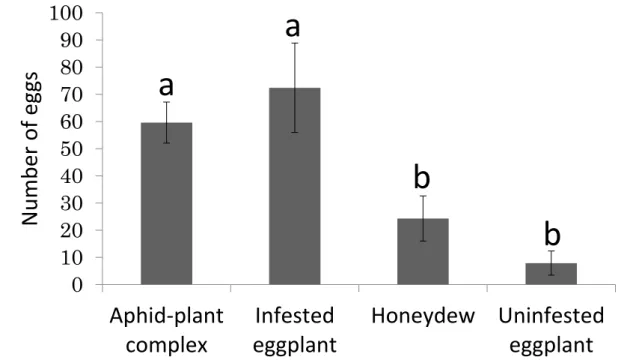
Ovipositional responses to natural odor sources ... 33
Analyses of volatiles from infested eggplants ... 34
Ovipositional responses to synthetic compounds... 35
Discussion ... 35
VI. General discussion ... 37
References ... 40
Acknowledgments
1
I. General introduction
The survival and reproduction of aphidophagous predators depend on their ability to locate suitable hosts, an ability that often relies on specific mechanisms for interpreting chemical cues derived from host – host plant complex. For instance, females of the aphidophagous parasitoid species Aphidius colemani (Viereck) respond to host plant and herbivore odors (Kalule and Wright, 2004). Both larvae and adults of Chrysoperla
carnea (Stephens) are attracted to honeydew (Duelli 1987), whereas Coccinella septempunctata L. (Al Abassi et al., 2000; Ninkovic et al., 2001), Adalia bipunctata L.
(Hemptinne et al., 2000; Francis et al., 2004), and Episyrphus balteatus DeGeer larva (Francis et al., 2005) all respond to the aphid alarm pheromone (E)-β-farnesen. In addition, honeydew produced by Sitobion avenae (F.) is a strong contact stimulant for oviposition in E. balteatus (Budenberg and Powell 1992).
Aphidoletes aphidimyza (Rondani) (Diptera: Cecidomyiidae) is a common and
widely distributed species that occurs in Europe, North America, the Middle East, and Japan. The predaceous larvae of this species attack over 80 species of aphids, including common pests such as Myzus persicae (Sulzer) and Aphis gossypii Glover (Harris 1973; Yukawa et al. 1998). Female A. aphidimyza lay eggs singly or in clusters of up to 40, usually placing them on plants near aphid colonies (Uygun 1971; Harris 1973; Nijiveldt 1988). Upon hatching, larvae immediately search for aphids on which to prey.
Aphidoletes aphidimyza is an effective natural enemy of aphids that is used to
control pests infesting greenhouse crops (Meadow et al. 1985; Morse and Croft 1987; Nijveldt 1988). However, the release of A. aphidimyza to control aphids often does not provide adequate control, as aphids multiply very quickly on greenhouse vegetables such as cucumbers or eggplants. A banker plant system has been developed to introduce natural enemies for pest control in protected cultures. This system allows natural enemies to be maintained in a greenhouse using alternative prey on banker plants. Populations of natural enemies remain stable on the banker plant system irrespective of the presence of pests on crops, providing a continuous source of predators in case of crop infestation. Typically, Rhopalosiphum padi (L.) is used as an alternative prey, and barley or wheat is used as a banker plant for A. aphidimyza (Bennison 1992; Nagasaka et al. 2010). This banker plant system has been used to control A. gossypii infestations on eggplant in greenhouses in Japan (Nagasaka et al. 2010). However, barley does not grow well in greenhouses when temperatures are high. Abe et al. (2011) estimated the intrinsic rates of increase of Melanaphis sacchari (Zehntner) and three other aphid species on sorghum plants at different temperatures, and found that the intrinsic rate of
2
increase of M. sacchari was highest at 35ºC, and it was higher than those of other species at all temperatures. Therefore, a banker plant system using M. sacchari as an alternative prey and sorghum as a banker plant was developed to control A. gossypii infestations on eggplant during hot seasons (Yano et al. 2011).
There is a risk that A. aphidimyza females produced by the banker plant system may prefer the alternative prey aphids on banker plants to pest aphids on crops and will thus fail to attack the target species during infestations. It is therefore critical, in developing a banker plant system using A. aphidimyza, to ensure the correct oviposition selection. In banker plant systems, the natural enemy should move quickly from the banker plant to the food crop when pests occur on the crop. To ensure this behavior, predators should choose to oviposit among pest aphids even at a low population density. Jandricic et al. (2013), using Aulacorthum solani (Kaltenbach) on pansies, concluded that the oviposition preference of A. aphidimyza females is strongly affected by aphid densities in the aphid patch location. Mansour (1975) suggested that oviposition preference after emergence might be affected by conditioning during feeding in the larval stages. To ensure the efficacy of the banker plant system, it is necessary to study the oviposition preference of A. aphidimyza females when they are offered pest aphids on crops and non-pest aphids on banker plants. The effects of the density ratios of aphid species and conditioning by larval feeding experience on oviposition selection should be investigated.
When A. aphidimyza prefers alternative prey or is unable to locate pest aphids because the population density of aphid patches is too low, it is very important to intervene in order to attract A. aphidimyza females produced in the banker plant system to crop plants with pest aphids. Under laboratory conditions, volatiles of honeydew excreted by M. persicae on sweet pepper induced an attraction response and oviposition behavior in A. aphidimyza females (Choi et al. 2004). However, the chemical compounds responsible for this behavior have not been identified.
The first objective of the present study was to investigate oviposition selection by A.
aphidimyza females offered the pest aphid A. gossypii on eggplants and an alternative
prey species, either R. padi on barley plants or M. sacchari on sorghum plants. To meet this objective, experiments were carried out in the laboratory and in greenhouses. The second aim of this study was to investigate the volatile chemicals produced by interactions between A. gossypii and eggplants, which attract A. aphidimyza females and induce oviposition. We carried out olfactory experiments to study these chemical cues. Based on the results, GC-MS analyses of odor sources and further olfactory experiments were performed to identify the volatile compounds that induce attraction and
3
oviposition. These attractants and oviposition stimulants, once identified, may be useful in controlling the behavior of A. aphidimyza, and will contribute to improved performance of the banker plant system.
4
II. Oviposition selection by Aphidoletes aphidimyza (Diptera: Cecidomyiidae) on banker plants with alternative prey aphids or crop plants with pest aphids
Introduction
The Cecidomyiidae family includes numerous herbivorous species that form insect galls on plant leaves and stems. However, species that prey on whiteflies, spider mites, scale insects, and aphids are also often present (Harris 1968). Aphidoletes aphidimyza (Rondani) (Diptera: Cecidomyiidae) is an aphidophagous predator and widely distributed species (Yukawa et al. 1998). The females of this species oviposit in or near aphid colonies and the hatched larvae prey on aphids. Hatched larvae of A. aphidimyza starve to death if they are more than 63 mm from food (Wilbert 1972) and they usually stay in the aphid colony throughout their larval stages.
Aphidoletes aphidimyza is an effective natural enemy to control aphids in
greenhouse crops worldwide (Meadow et al. 1985; Morse and Croft 1987; Nijveldt 1988). However, it can be difficult to establish and often does not provide adequate control because aphids multiply very quickly on greenhouse vegetables such as cucumber (Cucumis sativus L.) or eggplant (Solanum melongena L.). To overcome this risk, introductions could be made via a banker plant system, or an open-rearing system (Bennison 1992; Hansen 1983; Yano 2006). Prior to the occurrence of a pest, banker plants serve as a control agent reservoir in greenhouses by providing an alternative, non-pest food source. Typically, Rhopalosiphum padi (Linne) is used as an alternative prey, and barley (Hordeum vulgare L.) and wheat (Triticum aestivum L.) are used as banker plants for A. aphidimyza (Bennison 1992; Nagasaka et al. 2010). This banker plant system has been used to control A. gossypii infesting eggplant in greenhouses in Japan (Nagasaka et al. 2010).
From a practical standpoint, newly emerged females of A. aphidimyza from barley plants should move quickly to eggplant. In this case, A. aphidimyza should prefer A.
gossypii on eggplants to R. padi on barley plants. Mansour (1975) suggested a role for
the effects of conditioning, according to feeding experience in larval stages, on oviposition preference after emergence. Jandricic et al. (2013) concluded that A.
aphidimyza females are affected strongly by aphid densities in the aphid patch location,
using Aulacorthum solani (Kaltenbach) on pansies. The density ratio of A. gossypii to R.
padi might affect the oviposition selection of the two aphid species due to the effect of
density.
5
aphidimyza females that were offered the two combinations of aphids and plants was
also studied in the laboratory and greenhouse. Moreover, the effects of conditioning, according to the feeding experience of R. padi and A. gossypii, and the density ratio of A.
gossypii to R. padi, on oviposition selection by A. aphidimyza, were studied in the
laboratory.
Materials and methods
Insects and plants
Larvae of A. aphidimyza attacking turnip aphids Lipaphis erysimi (Kaltenbach) were collected on potherb mustard (Brassica rapa L. var. nipposinica) in Nantan City, Kyoto Prefecture, on August 25, 2005. Aphis gossypii aphids were collected from strawberry (Fragaria × ananassa Duchesne) plants in fields in Ayabe City, Kyoto Prefecture, on April 21, 2006. Rhopalosiphum padi was collected from maize (Zea mays L.) in Nantan City, Kyoto Prefecture, on August 29, 2003. The descendants of one A. gossypii female and one R. padi female were reared for successive generations on eggplant (cv. Senryo Nigou) and barley (cv. Temairazu) plants, respectively, in rearing cages (30 cm wide, 25 cm long, 30 cm high) maintained at 25ºC with a L16:D8 photoperiod. Aphidoletes
aphidimyza were reared on A. gossypii for successive generations in rearing cages
maintained at 25ºC with a L16:D8 photoperiod. All plants used for rearing insects and experiments were grown in a glasshouse at the Nara campus of Kinki University.
Effect of the prey density ratio on the oviposition preference of female adults for the crop‒pest or banker plant–alternative prey systems in the laboratory
The oviposition preference of A. aphidimyza female adults, for A. gossypii on an eggplant seedling (the crop‒pest system) or R. padi on barley plants (the banker plant‒alternative prey system), was investigated in the laboratory. A potted eggplant seedling (ca. 20 cm high) and barley seedlings (ca. 20 cm high) were placed in a plastic cage (30 cm wide, 25 cm long, 30 cm high). The total leaf surface areas of both plants were adjusted to the same value (ca. 300 cm2). The bottom of the cage was covered with
a wet paper towel for humidity. The numbers of second or third instar nymphs of A.
gossypii and R. padi inoculated on the eggplant and barley seedlings were, respectively:
(i) 250 vs. 250, (ii) 125 vs. 375, and (iii) 50 vs. 450. Five male and five female A.
aphidimyza adults (< 24 h old) were released from the center of the bottom of the cage.
Five males and five females were released to insure mating because the mating rate was often very low when only one female and one male were released. Interactions between
6
female adults have not been reported. Aphidoletes aphidimyza was reared on R. padi for one generation prior to the experiments. After 2 days, the number of eggs on each plant was checked under a stereomicroscope or by using a magnifying glass. To avoid position effects, we switched the position in which potted plants were placed for each replicate. The experiments were performed at 25°C under a L16:D8 photoperiod.
Effect of conditioning on the oviposition preference of female adults for the crop‒pest or banker plant‒alternative prey systems in the laboratory
A potted eggplant seedling (ca. 20 cm high) and barley seedlings (ca. 20 cm high) were placed in a plastic cage (30 cm wide, 25 cm long, 30 cm high). A total of 150 second or third instar nymphs of A. gossypii and R. padi were inoculated on the eggplant seedling and the barley seedlings, respectively. The total leaf surface areas of both plants were adjusted to the same value (ca. 300 cm2). Five male and five female A. aphidimyza
adults (< 24 h old) were released from the center of the bottom of the cage. The females had been reared on A. gossypii or R. padi prior to the experiments. After 2 days, the number of eggs on each plant was checked under a stereomicroscope or by using a magnifying glass. To avoid position effects, we switched the position in which potted plants were placed for each replicate. The experimental conditions were the same as those used for the experiments studying the effect of prey density ratio on oviposition preference.
Oviposition preference of female adults for the crop‒pest or banker plant‒alternative prey systems in a greenhouse
The oviposition preference of A. aphidimyza female adults, for the crop‒pest or banker plant‒alternative prey systems, was investigated in a plastic greenhouse (5 m wide, 9 m long, 3 m high). Four potted barley (ca. 150 leaves, 20 cm high) and four potted eggplant seedlings (10‒15 leaves, 50 cm high) were placed in each of the two rows in a cage (1.5 m wide, 2 m long, 1.5 m high) covered by fine nets constructed in the center of the greenhouse. The plant pots (18 cm diameter, 18 cm high) were placed at 0.5 m intervals in each row. The distance between rows was 0.5 m. One thousand A. gossypii nymphs were placed on each potted eggplant plant in one row; 1,000 R. padi nymphs were placed on each potted barley plant in the same manner in the adjacent row. Thirty male and 30 female A. aphidimyza adults (< 24 h old) were placed individually in small glass vials (0.5-cm diameter, 3 cm long), which were then plugged with cotton balls. The adult aphids were released from the center of the cage simultaneously by removing the cotton balls. The leaves of each plant in the two rows were cut after 48 h. Then, the
7
number of eggs laid on each plant was counted under a stereomicroscope in the laboratory. The first and second experiments were performed between 12‒13 June 2012 and 27‒28 September 2012, respectively. The positions of seedlings inoculated with the two aphid species were exchanged in the second experiment. The daily maximum and minimum temperatures were recorded on a thermometer during the experiments.
The number of eggs laid by A. aphidimyza females on eggplant plants infested with
A. gossypii, and on barley plants infested with R. padi, in the oviposition preference
experiments were analyzed by χ2 tests. These were performed based on the assumption
that A. aphidimyza females oviposit eggs in proportion to the density ratio of the two aphid species. A. aphidimyza females lay eggs at night; however, oviposition behavior has never been studied directly because of observational difficulties. Because oviposition of this species is undescribed, we assumed random oviposition against two populations of different aphid species. Accordingly, we could assume that the numbers of oviposited eggs would be proportional to the density ratio of the two aphid species. Theχ2 tests were performed using R2.70.
Results
Effect of the prey density ratio on the oviposition preference of female adults for the crop‒pest or banker plant‒ alternative prey systems in the laboratory
The experimental results are summarized in Table 1. When 250 A. gossypii nymphs on eggplant seedlings and 250 R. padi nymphs on barley seedlings were provided, A.
aphidimyza females laid significantly more eggs on eggplant plants with A. gossypii
than on the barley plants with R. padi, in 9 of the 10 replicates. An oviposition preference for barley plants was significant in one replicate. When 125 A. gossypii nymphs on eggplant plants, and 375 R. padi nymphs on barley plants, were provided, A.
aphidimyza females laid significantly more eggs on the eggplant plants than would be
expected in random oviposition in 5 of the 11 replicates. Females tended to oviposit on the barley seedlings rather than on the eggplant plants in four replicates. No significant differences were found, to what would be expected with random oviposition, in the numbers of eggs laid on the eggplant and barley seedlings in two replicates. When 50 A.
gossypii nymphs on eggplant plants and 450 R. padi nymphs on barley plants were
provided, A. aphidimyza females laid significantly more eggs on the eggplant plants than would be expected in random oviposition in 4 of 11 replicates. Females tended to oviposit on the barley seedlings rather than on the eggplant seedlings in two replicates. No significant differences were found between the number of eggs laid on the eggplant
8 and barley seedlings in five replicates.
When the number of eggs laid on eggplant and barley plants by A. aphidimyza females in each replicate were pooled, A. aphidimyza females laid significantly more eggs on eggplant than on barley plants, irrespective of the prey density ratio. No significant effects of prey density ratio on oviposition preference were found from these results.
9
Table 1 Numbers of eggs laid by five A. aphidimyza females on an eggplant with A.
gossypii nymphs, and on barley plants with R. padi nymphs, of different numbers in a
cage over 2 days at 25°C. The numbers of nymphs of A. gossypii and R. padi inoculated on eggplant and barley seedlings were, respectively: (a) 250 vs. 250, (b) 125 vs. 375, and (c) 50 vs. 450. P-values indicate probabilities ofχ2 values.
Eggplants with A. gossypii Barley plants with R. padi
(a) 250:250 1 115 0 115.00 < 0.001 2 47 2 41.33 < 0.001 3 83 0 83.00 < 0.001 4 68 26 18.77 < 0.001 5 82 8 60.84 < 0.001 6 50 0 50.00 < 0.001 7 64 7 45.76 < 0.001 8 23 0 23.00 < 0.001 9 53 0 53.00 < 0.001 10 4 107 95.58 < 0.001 Total 589 150 260.79 < 0.001 (b) 125:375 1 68 18 134.09 < 0.001 2 2 82 22.92 < 0.001 3 18 37 1.75 0.186 4 96 17 216.64 < 0.001 5 10 142 27.51 < 0.001 6 95 35 160.26 < 0.001 7 158 114 158.82 < 0.001 8 4 44 7.11 0.008 9 2 64 16.99 < 0.001 10 53 4 140.50 < 0.001 11 10 20 1.11 0.295 Total 516 577 287.54 < 0.001 (c) 50:450 1 65 35 336.11 < 0.001 2 39 53 107.25 < 0.001 3 0 14 1.56 0.212 4 0 16 1.78 0.182 5 0 13 1.44 0.229 6 2 23 0.11 0.739 7 68 156 103.14 < 0.001 8 2 83 5.52 0.019 9 28 162 4.74 0.030 10 2 74 4.58 0.032 11 0 20 2.22 0.136 Total 206 649 188.70 < 0.001
10
Effect of conditioning on the oviposition preference of female adults for the crop‒pest or banker plant‒alternative prey systems in the laboratory
When females conditioned by A. gossypii were used, they laid significantly more eggs on eggplant plants with A. gossypii than on barley plants with R. padi in 9 of the 11 replicates. When females were conditioned by R. padi, they laid significantly more eggs on eggplant plants with A. gossypii than on barley plants with R. padi in six of the nine replicates. When the number of eggs laid on eggplant and barley plants by A.
aphidimyza females in each replicate were pooled, A. aphidimyza females laid
significantly more eggs on eggplant plants than on barley plants in both conditions. Females tended to lay more eggs on eggplant plants than on barley plants in both cases (Table 2).
Table 2 Numbers of eggs laid by five A. aphidimyza females on an eggplant with 150 A.
gossypii nymphs, and on barley plants with 150 R. padi nymphs, in a cage over 2 days
at 25°C. Aphidoletes aphidimyza were reared for one generation on A. gossypii (a) or R.
padi (b) prior to the experiments. p-values are the same as for Table 1.
Eggplants with A. gossypii Barley plants with R. padi
(a) Conditioned by A. gossypii
1 5 11 2.25 0.134 2 25 20 0.56 0.456 3 52 0 52.00 < 0.001 4 47 0 47.00 < 0.001 5 16 0 16.00 < 0.001 6 28 0 28.00 < 0.001 7 19 0 19.00 < 0.001 8 28 10 8.53 0.004 9 13 0 13.00 < 0.001 10 26 0 26.00 < 0.001 11 13 0 13.00 < 0.001 Total 272 41 170.48 < 0.001 (b) Conditioned by R. padi 1 95 0 95.00 < 0.001 2 98 3 89.36 < 0.001 3 76 91 1.35 0.246 4 29 2 23.52 < 0.001 5 19 7 5.54 0.019 6 16 0 16.00 < 0.001 7 45 12 19.11 < 0.001 8 22 19 0.22 0.639 9 25 16 1.98 0.160 Total 425 150 131.52 < 0.001
11
Oviposition preference of female adults for the crop‒pest or banker plant‒ alternative prey systems in a greenhouse
In two replications, A. aphidimyza females laid significantly more eggs on eggplant plants with A. gossypii than on barley plants with R. padi (Table 3). In the first experiment, the daily maximum temperatures on 12 and 13 June were 35ºC and 29ºC, respectively, and the daily minimum temperatures were 19ºC and 18ºC, respectively. In the second experiment, the daily maximum temperature on 27 and 28 September was 39ºC and the daily minimum temperature was 15ºC.
Table 3 Numbers of eggs laid by 30 A. aphidimyza females on four potted eggplants
with 4,000 A. gossypii nymphs, and on four potted barley plants with 4,000 R. padi nymphs, in two greenhouse experiments. p-values are the same as for Table 1.
Eggplants with A. gossypii Barley plants with R. padi
1 55 1 52.07 <0.001
2 75 1 72.05 <0.001
Total 130 2 124.12 < 0.001
Trial number Number of eggs laid on χ2 p
Discussion
Our results showed that A. aphidimyza females laid significantly more eggs on the eggplant plants with A. gossypii than on the barley plants with R. padi in most replicates when there was an equal number of A. gossypii and R. padi nymphs. When the ratio of
A. gossypii to R. padi changed from 1:1 to 1:3 or 1:9, females tended to oviposit more
eggs on the eggplant plants with A. gossypii than on the barley plants with R. padi, if we assumed random oviposition. Five females and five males were released in each trial. The variable number of oviposited females in each trial resulted in high variability in the number of oviposition between trials.
Oviposition by A. aphidimyza females was affected by the host plants of aphids (Mansour 1975), the supply of honeydew (Mansour 1975), the height of the leaves infected by aphids (Jandrincic et al. 2013; Mansour 1976), plant pubescence (Lucas and Brodeur 1999), light intensities (Mansour 1976), oviposition-deterring pheromones secreted by Aphidoletes larvae (Ruzicka and Havelka 1998), aphid density (Guo et al. 2014; Jandricic et al. 2013; Lucas and Brodeur 1999), and the presence of eggs and larvae of conspecifics (Guo et al., 2014). Jandricic et al. (2013) concluded that A.
12
in the aphid patch location, using M. persicae and A. solani on pansies. On the other hand, Choi et al. (2004) reported that female adults of A. aphidimyza showed a positive response to honeydew volatiles produced by M. persicae. In the studies of A.
aphidimyza by Choi et al. (2004) and Jandrinsic et al. (2013), there were significant
linear positive relationships between oviposition and aphid density when the females were exposed to plants infested with different numbers of aphids. From a practical point of view, it is important to estimate the minimum aphid density above which A.
aphidimyza females are able to oviposit. However, this threshold density has not been
evaluated. The positive response in the oviposition of A. aphidimyza females, to increased aphid density, might be due to the accumulation of honeydew on leaves. In this study, both host plants and aphid species might have affected the oviposition preference of A. aphidimyza for the eggplant plants with A. gossypii versus the barley plants (Table 2, 3). This oviposition preference may reflect the preference of A.
aphidimyza in natural habitats. The number of eggs laid per adult female was smaller in
the experiments conducted in a greenhouse than in those conducted in the laboratory. This might have been due to differences in aphid densities, temperature conditions, and the spatial scales of the experiments.
Newly emerged adults of A. aphidimyza from barley plants with R. padi prefer to move to eggplants with A. gossypii irrespective of either conditioning by R. padi or a change in the density ratio of the two aphid species. This combination of crop–pest and banker plant–alternative prey system enables the dispersal of A. aphidimyza.
13
III. Oviposition selection of Aphidoletes aphidimyza (Diptera: Cecidomyiidae) on a banker plant system of sorghum with Melanaphis sacchari (Hemiptera: Aphididae)
Introduction
Aphidoletes aphidimyza (Rondani) (Diptera: Cecidomyiidae) is an effective natural
enemy used for controlling aphids that attack greenhouse crops worldwide (Meadow et al. 1985; Morse and Croft 1987; Nijveldt 1988). Females oviposit in or near aphid colonies, and the hatched larvae prey on aphids in the colony. The larvae usually stay in the same aphid colony throughout their larval stages. Oviposition by adults is thus crucial for effective predation by larvae to control aphids.
Release programs of A. aphidimyza to control aphids often do not provide adequate control because aphids multiply very quickly on greenhouse vegetables such as cucumber or eggplant. To overcome this risk, introductions can be made by means of a banker plant system or an open-rearing system (Hansen 1983; Bennison 1992; Yano 2006). Such systems provide the ability to maintain natural enemies within a greenhouse using alternative prey on banker plants.
Typically, Rhopalosiphum padi (Linnaeus) is used as an alternative prey, and barley or wheat is used as a banker plant for A. aphidimyza (Bennison 1992; Nagasaka et al. 2010). This banker plant system has been used to control A. gossypii that infest eggplant in greenhouses in Japan (Nagasaka et al. 2010). However, barley does not grow well during hot seasons in greenhouses. The main cultivation period for eggplants and peppers in unheated greenhouses is from planting in April to the end of the harvest in September, during which time the average temperature is about 25ºC. The maximum temperature in summer rises to more than 35ºC in the daytime, and barley does not grow well at these temperatures. Abe et al. (2011) estimated the intrinsic rates of increase in Melanaphis sacchari (Zehntner) and three other aphid species on sorghum plants at different temperatures, and found that the intrinsic rate of increase of M.
sacchari was highest at 35ºC and was always higher than that of other species at all
temperatures. Therefore, a banker plant system using M. sacchari as an alternative prey and sorghum as a banker plant was developed to control A. gossypii infesting eggplant during hot seasons (Yano et al. 2011).
From a practical standpoint, newly emerged females of A. aphidimyza from sorghum plants should move quickly to eggplant. In this banker plant system, a low density of A. gossypii on eggplant should be chosen for oviposition. Examining
14
aphidimyza females are affected strongly by aphid density in the aphid patch location.
We showed that A. aphidimyza females laid more eggs on eggplants harboring A.
gossypii than on barley plants harboring R. padi when offered the two combinations of
aphids and plants, irrespective of the density ratio of the two aphid species (Higashida et al. 2016). However, if A. aphidimyza females require aphids to meet a threshold density for oviposition, extreme disparities in the densities of two aphid species might affect A.
aphidimyza’s oviposition preference. However, ovipositional selection by A. aphidimyza
on eggplant with A. gossypii or sorghum with M. sacchari has not been studied so far. The density ratio of A. gossypii to M. sacchari might affect the oviposition selection of
A. aphidimyza tobetween the two aphid species.
The objectives of the present study are to investigate oviposition selection by A.
aphidimyza females that were offered the two combinations of aphids and plants was
also studied in the laboratory and greenhouse. Moreover, the effects of the density ratio of A. gossypii to M. sacchari upon oviposition selection by A. aphidimyza were studied in the laboratory. All oviposition experiments in the laboratory were conducted at 25ºC, which is the average temperature during the main cultivation period for eggplants in unheated greenhouses.
Materials and methods
Insects and plants
Larvae of A. aphidimyza attacking turnip aphids Lipaphis erysimi (Kaltenbach) were collected on potherb mustard (Brassica rapa L. var. nipposinica) in Nantan City, Kyoto Prefecture, on August 25, 2005. Aphis gossypii individuals were collected from strawberry (Fragaria × ananassa Duchesne) plants in Ayabe City, Kyoto Prefecture, on April 21, 2006. Melanaphis sacchari individuals were collected from sorghum (Sorghum bicolor [L.] Moench) in Ayabe City, Kyoto Prefecture, on September 28, 2006. Aphis gossypii and M. sacchari were reared for successive generations on eggplant (cv. Senryo Nigou) and sorghum (cv. Kazetachi), respectively, in rearing cages (30 cm wide, 25 cm long, 30 cm high) at 25ºC with a L16:D8 photoperiod. Aphidoletes
aphidimyza was reared on A. gossypii for successive generations under the same
environmental conditions as above. All plants used for rearing insects and experiments were grown in a glasshouse at the Nara campus of Kinki University.
15
Effect of prey density ratio on oviposition preference of female adults for the crop‒pest or banker plant‒alternative prey combinations in the laboratory
The oviposition preference of A. aphidimyza adult females, for A. gossypii on eggplant seedlings (the crop‒pest combination) or M. sacchari on sorghum seedlings (the banker plant‒alternative prey combination), was investigated in the laboratory. A potted eggplant seedling (ca. 20 cm high) and sorghum seedlings (ca. 20 cm high) in a pot were placed in a plastic cage (30 cm wide, 25 cm long, 30 cm high). The total leaf surface areas of both plants were adjusted to the same value (ca. 600cm2). The bottom
of the cage was covered with a wet paper towel to maintain humidity. The numbers of second or third instar nymphs of A. gossypii and M. sacchari inoculated on the eggplant and sorghum seedlings were (i) 250:250, (ii) 375:125, and (iii) 450:50, respectively. Five male and five female A. aphidimyza adults (< 24 h old) were released from the center of the bottom of the cage. Five males and five females were released to ensure mating, as the mating rate was often very low when only one female and one male were released. Interactions between adult females have not been reported. Aphidoletes
aphidimyza was reared on M. sacchari for one generation prior to the experiments. After
2 days, the number of eggs on each plant was checked under a stereomicroscope or using a magnifying glass. To avoid position effects, we switched the position of the potted plants for each replicate. The experiments were performed 10 times at 25°C under a L16:D8 photoperiod.
Oviposition preference of female adults for the crop‒pest or banker plant‒alternative prey combinations in a greenhouse
The oviposition preference of A. aphidimyza female adults for the crop‒pest or banker plant‒alternative prey combinations was investigated in a plastic greenhouse (5 m wide, 9 m long, 3 m high). Four potted sorghum (ca. 50 leaves, 70 cm long) and four potted eggplant (10‒15 leaves, 50 cm high) seedlings were placed in each of the two rows in a cage (1.5 m wide, 2 m long, 1.5 m high) covered by fine nets constructed in the center of the greenhouse. The plant pots (18 cm in diameter, 18 cm high) were placed at 0.5 m intervals in each row, and the distance between rows was 0.5 m. One thousand A.
gossypii nymphs were placed on each potted eggplant plant in one row, and 1,000 M. sacchari nymphs were placed on each potted sorghum plant in the same manner in the
adjacent row. Thirty male and thirty female A. aphidimyza adults (< 24 h old) were placed individually in small glass vials (0.5 cm in diameter, 3 cm long), which were then plugged with cotton balls. The adults were released from the center of the cage simultaneously by removing the cotton balls. The leaves of each plant in the two rows
16
were cut after 48 h, and the number of eggs laid on each plant was counted under a stereomicroscope in the laboratory. The first and second experiments were performed on 19‒20 June 2010 and 29‒30 September 2010, respectively. The positions of potted plants inoculated with the two aphid species were exchanged in the second experiment. The daily maximum and minimum temperatures were recorded on a thermometer during the experiments.
The numbers of eggs laid by A. aphidimyza females on eggplant infested with A.
gossypii and on sorghum infested with M. sacchari in the oviposition preference
experiments were analyzed using a generalized linear mixed model (GLMM) with a binomial distribution and a logit link function. These tests were performed under the assumption that A. aphidimyza females oviposit in proportion to the density ratio of the two aphid species. Aphidoletes aphidimyza females lay eggs at night; however, oviposition behavior has never been studied directly because it is difficult to observe. Because oviposition in this species is undescribed, we assumed random oviposition by the two populations of different aphid species. Accordingly, we assumed that the numbers of oviposited eggs would be proportional to the density ratio of the two aphid species. Statistical analyses were performed using R3.0.1.
Results
Effect of prey density ratio on oviposition preference of female adults for the crop‒pest or banker plant‒alternative prey combinations in the laboratory
GLMM analyses were performed on the pooled data of the three aphid density ratio combinations. Fig. 1 shows the percentage of A. aphidimyza that oviposited on eggplant with A. gossypii and 95% confidence intervals estimated by GLMM analyses, and the hypothesized percentages that would oviposit on eggplants in proportion to three different density ratios of the two aphid species. When the ratios of nymphs of A.
gossypii inoculated on eggplant seedlings and M. sacchari inoculated on sorghum
seedlings were 250:250 and 375:125, A. aphidimyza females laid a significantly higher proportion of eggs on sorghum than predicted by proportional oviposition. When the numbers of nymphs of A. gossypii and M. sacchari inoculated on the eggplant and sorghum seedlings were 450 and 50, respectively, the proportions of eggs laid on each type of plant were not significantly different from predictions based on proportional oviposition.
17
Fig. 1 Percentages with 95% confidence intervals of A. aphidimyza ovipositing on
eggplant with A. gossypii estimated by GLMM analyses for three aphid density ratios. The numbers of nymphs of A. gossypii inoculated on eggplant seedlings and M.
sacchari inoculated on sorghum seedlings were (i) 250:250, (ii) 375:125, and (iii)
450:50. The bold line shows the hypothetical percentages of oviposition on eggplants in proportion to the density ratio of the two aphid species.
Oviposition preference of adult females for the crop‒pest or banker plant‒alternative prey combinations in a greenhouse
GLMM analysis was performed on the pooled data of the two replicates. Aphidoletes
aphidimyza females laid significantly more eggs on eggplant with A. gossypii than on
sorghum with M. sacchari (Z = 2.066, P = 0.0388). In the first experiment, the daily maximum temperatures on 19 and 20 June were 38ºC and 32ºC, respectively, and the daily minimum temperatures were 21ºC and 20ºC, respectively. In the second experiment, the daily maximum temperatures on 29 and 30 September were 37ºC and 38ºC, respectively, and the daily minimum temperature was 14ºC in both cases.
Discussion
Results of laboratory experiments examining oviposition preference showed that A.
18
harboring A. gossypii when equal numbers of aphids of both species were provided. Our previous study showed that A. aphidimyza females laid significantly more eggs on eggplant harboring A. gossypii than on barley harboring R. padi (Higashida et al. 2016). These results may be due to differences in odor among honeydews. We identified phenyl acetaldehyde as an attractant of A. aphidimyza in the honeydew of A. gossypii (Watanabe et al. 2016). The oviposition preference of A. aphidimyza females may be affected by qualitative and quantitative differences in the honeydew attractants of different aphid species. Plant species used to rear M. persicae as prey for A. aphidimyza over many generations affected its ovipositional preference (Mansour 1975). However, such a shift of ovipositional preference was not observed in A. aphidoletes strains that had been reared on A. gossypii on eggplant or R. padi on barley (Higashida et al. 2016). No ovipositional preference was observed when 450 A. gossypii individuals and 50 M.
sacchari individuals were provided. The observed shift in ovipositional preference may
have been caused by changes in the density ratio of aphid species. Aphidoletes
aphidimyza females are believed to be able to recognize small patches of M. sacchari,
but this ability may have been inhibited by the odor of the honeydew from large patches of A. gossypii. Aphidoletes aphidimyza preferred A. gossypii to M. sacchari in the greenhouse experiment. The results of greenhouse experiments, which is favorable for the use of the banker plant system.
This discrepancy between the results of the greenhouse and the laboratory experiments may be due to differences in temperature, humidity, and plant architecture. In the greenhouse, temperature and humidity conditions are variable, and are not always suitable for the survival of A. aphidimyza. During the day, A. aphidimyza must avoid direct sunlight on plants. Aphidoletes aphidimyza adults are known to be active at night and prefer to lay eggs on the undersides of leaves (Mansour 1976). Eggplant leaves are wider than sorghum leaves, providing a suitably sheltered habitat during the day and an oviposition site at night.
In conclusion, the combination of sorghum and M. sacchari seem to be suitable for ovipositional preference of A. aphidimyza. It is therefore likely to be effective as a banker plant system under high temperature conditions.
19
IV. An attractant of the aphidophagous gall midge Aphidoletes aphidimyza from honeydew of Aphis gossypii
Introduction
Honeydew is a sugar-rich excretion produced by sap-feeding Sternorrhyncha that many natural insect enemies use for survival (Wäckers 2005). They also use it as a volatile cue to locate prey and hosts, as an oviposition stimulant, and as an arrestant for foraging (Lundgren 2009). Olfactometer studies suggest that many aphidophagous parasitoid species are attracted to volatiles of honeydew (Hågvar and Hofsvang 1989; Wickremasinghe and van Emden 1992). Aphidophagous predator species such as the Asian lady beetle Harmonia axyridis Pallas (Leroy et al. 2012) and larvae and adults of the lacewing Chrysoperla carnea (Stephens) are attracted by honeydew (Duelli 1987). Honeydew from Sitobion avenae (F.) is a strong contact oviposition stimulant for the syrphid Episyrphus balteatus (De Geer) (Budenberg and Powell 1992), whereas that from Aphis fabae Scop. has been shown to attract females of E. balteatus and elicit oviposition (Scholz and Poehling 2000). Moreover, many aphid predators and parasitoids alter their foraging behavior and explore more intensively when they are in contact with honeydew, including coccinellids (Carter and Dixon 1984; Ide et al. 2007; Purandare and Tenhumberg 2012), predatory mites (Fleschner 1950), parasitoids (Bouchard and Cloutier 1984; Budenberg et al. 1992), syrphid larvae (Leroy et al. 2014), and chrysopids (Downes 1974; Han and Chen 2002).
Aphidoletes aphidimyza (Rondani) (Diptera: Cecidomyiidae) is a gall midge species
and widely distributed. Its larvae are predaceous and attack over 80 aphid species (Harris 1973; Yukawa et al. 1998). Female A. aphidimyza lay up to 40 eggs near aphid colonies, singly or in clusters (Harris 1973; Nijveldt 1988; Uygun 1971) and can locate an isolated infested Brassica plant among noninfested plants in a greenhouse (El-Titi 1972/1973, 1974).
Host selection is an important aspect of oviposition, as offspring are often restricted to feed on the host chosen by females during egg laying. The optimality theory predicts that females should choose oviposition sites associated with high expected fitness for their offspring (Mangel 1987). This is especially important for species that are relatively sessile and have limited mobility to forage immediately after hatching (Thompson 1988). Female A. aphidimyza lay eggs on foliage within or close to aphid colonies (Nijveldt 1988), as neonatal larvae starve to death if they hatch >63 mm away from food (Wilbert 1972), thus illustrating the importance of oviposition location for this
20
species. Furthermore, honeydew excreted by M. persicae on sweet pepper attracted A.
aphidimyza females, and the volatiles extracted in pentane induced a similar response,
although specific attractant compounds were not identified (Choi et al. 2004).
Aphidoletes aphidimyza can be an effective biological control agent against aphids,
although establishing it to control rapidly multiplying aphid populations in greenhouses is difficult (Markkula and Tiittanen 1985; Meadow et al. 1985; Nijveldt 1988). To address this issue, banker plant or openrearing systems can effectively maintain the control agent (Bennison 1992; Hansen 1983; Yano 2006). Prior to pest occurrence, banker plants serve as a reservoir of control agents by providing such pests with a non-pest food source, but the control agent must move quickly from the banker plant to the food crop when pests occur. Therefore, controlling the behavior of the control agent is crucial to the banker plant system. The banker plant system currently is being used to develop A. aphidimyza as a control agent of A. gossypii on eggplants in Japan.
The objectives of this study were to investigate chemical cues that induce attraction of female A. aphidimyza. We used an olfactometer to observe behavioral responses of A.
aphidimyza to volatile chemicals emitted from A. gossypii feeding on eggplants. Based
on initial results, we analyzed honeydew with gas chromatography coupled with mass spectrometry (GC/MS), and then performed olfactometer experiments to identify attractant compounds. The results will help explain the response of A. aphidimyza to volatiles of A. gossypii and will provide useful information for the use of A. aphidimyza as a biological control agent in greenhouses.
Methods and Materials
Insects
We collected A. aphidimyza larvae attacking Lipaphis erysimi (Kaltenbach) on Brassica
rapa (var. Nipponsinica) on August 25, 2005, in Nantan City, Kyoto, Japan, and A. gossypii from strawberry plants Fragaria × ananassa Duchesne ex Rozier in fields in
Ayabe City, Kyoto, Japan, on April 21, 2006. We continually cultured descendants of one female A. gossypii on eggplants (cv. Senryo 2 gou) in plastic rearing cages (30 × 30 × 25 cm) at 25 °C with a L16:D8 photoperiod. Aphidoletes aphidimyza were reared on
A. gossypii for successive generations under the same conditions.
Handling A. aphidimyza females
We selected 20 female and 20 male newly emerged A. aphidimyza adults (< 24 hr old) and fed them a 20 % sucrose solution via tissue paper balls placed in 100-ml vials at the
21
four corners of a plastic cage (30 × 30 × 25 cm). To facilitate mating, we placed an artificial flower made from wires and filter paper at the center of the cage. After 48 hr, the mated female adults were used in olfactometer experiments.
Olfactometer
A three-chamber olfactometer was constructed from three acrylic boxes (20 ×20× 20 cm) attached side by side. We cut square holes (18 × 18 cm) in the walls between chambers to allow insect and air movement. A 3-mm-diam tube was fitted through the top of the middle chamber to remove air. A small acrylic box (4× 3 ×3 cm) was attached to the outer wall of the outer two chambers, and a square hole (1.5× 1.5 cm) was cut to connect the small boxes with the main chambers; holes were covered with a fine nylon filter (0.2-mm mesh) to diffuse air currents. The outer walls of the small boxes were fitted with 3-mm-diam tubes that were connected to 1-l glass containers holding different volatile sources. Air was drawn with a pump through the glass containers into the small boxes via the tubes at a constant flow rate of 0.5 l/min. Before reaching the glass containers, the air passed through an activated charcoal filter and a humidifier.
Honeydewcollection
We collected honeydew excreted by A. gossypii of unspecified ages feeding on eggplants by placing aluminum foil (9-cm diam) below a leaf holding about 1000 aphids for 48 hr at 25 °C with a L16:D8 photoperiod. We removed impurities (dead aphids or exuviates) from samples with forceps and performed bioassays within 24 hr of collection.
Behavioral responses to four odor sources
Ten mated female A. aphidimyza were introduced into the middle olfactometer chamber through the top opening and left for 10 min before observations commenced. Experiments began immediately following the start of the scotophase, which generally coincides with oviposition. Chambers were placed in an environmental chamber maintained at 25 °C and illuminated with red light (which is not perceived by female adults) to facilitate the observation of midge behavior. The primary objective of this experiment was to evaluate the response of A. aphidimyza females to odor sources mentioned below. In preliminary experiments, we found that some of the released A.
aphidimyza females laid eggs on the nylon filters covering the holes of the
honeydew-treated olfactometer chamber. This suggested that the honeydew volatile may induce oviposition by the females. Therefore, we observed (1) the number of insects in
22
each chamber at 10, 20, and 30 min after the start of observations; (2) the number of eggs oviposited on the filters 30 min after the start of observations. After each assay, the main chambers were cleaned with pure ethanol, rinsed with distilled water, and dried. Two-way choice tests between controls and four odor sources were repeated 10 times per source. Our odor sources were the honeydew on aluminum foil that we previously collected, 200 aphids, an uninfested eggplant, and an eggplant infested with 200 aphids (fourth instar nymphs or adults) for 24 hr. A small amount of honeydew accumulated on leaves in the latter treatment during the 24 hr inoculation period. An empty jar was used as the control except in the honeydew trial, where a piece of clean aluminum foil was used. To avoid position effects, we switched the side where sources were placed for each replicate.
Analyses of honeydew volatiles
Our results indicated that the honeydew attracted A. aphidimyza and induced oviposition. Therefore, we analyzed the chemical composition of the honeydew to identify crucial compounds inducing this behavior. Honeydew was collected on the surface of a glass Petri dish (9-cm diam, 1.5-cm height) over a period of 48 hr. The collection protocol was the same as previously described. Prior to the collection, we cleaned the Petri dish by carefully rinsing it with acetone and hexane. After the solvents fully evaporated, we kept the dish in a drier at 100 °C for 48 hr. To collect headspace volatiles directly from the honeydew in the Petri dish, we used solid-phase microextraction: five Twisters [polydimethylsiloxane (PDMS)-coated stir bar, film thickness 0.5 mm, 10-mm length; Gerstel GmbH & Co. KG, Mülheim an der Ruhr, Germany] were set on the inside surface of a Petri dish lid to prevent direct contact of the Twisters with the honeydew for 4 hr. As a control, we also set five Twisters in a glass Petri dish that had been located under an uninfested eggplant for 48 hr. The collected volatiles were directly desorbed in the injector with a thermal desorption-cold trap system (Gerstel GmbH & Co. KG, Mülheim an der Ruhr, Germany) and then analyzed by GC/MS with an HP-5MS capillary column (Agilent Technologies). The oven temperature was increased from 40 to 280 °C at 10 °C/min. Compounds detected in the headspace of honeydew and the control were identified by comparing their mass spectra to those in the Wiley7N database and their retention times to those of the following authentic compounds: α-pinene, camphor, menthol (Tokyo Chemical Industry Co., Ltd., Tokyo, Japan), 6-methyl-5-hepten-2-one, limonene, 1,8-cineol, nonanal, dodecane decanal, tridecane, neryl acetone (Wako Pure Chemical Industries, Ltd., Osaka, Japan), isopulegol (Soda Aromatic Co., Ltd., Tokyo, Japan), and
23
phenylacetaldehyde (Sigma-Aldrich Inc. St Louis Mo, USA). Since thujone was not available, it was identified by comparing its mass spectrum to that in the database.
Behavioral responses to phenylacetaldehyde
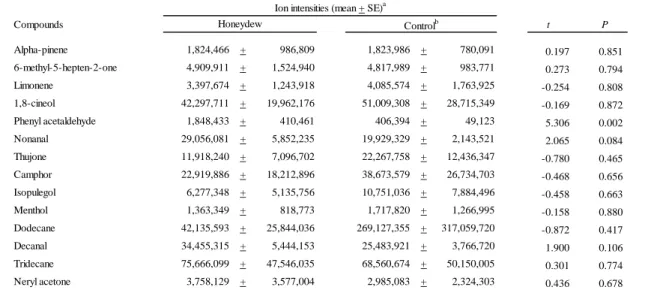
Since phenylacetaldehyde was found in significantly higher amounts in the honeydew than in the control (Table 6), its impact on behavior of A. aphidimyza was assayed by the same method as for the odor sources described above. Phenylacetaldehyde [100 ng/0.2 g in triethyl citrate (TEC)] was adsorbed by two pieces of filter paper (2 × 2 cm) in a glass Petri dish (9-cm diam, 1.5-cm high); this represented a similar quantity to that found in the honeydew.We used two pieces of filter paper to adsorb 0.2 g TEC as a control. Two-way choice tests between phenylacetaldehyde and controls were repeated 10 times.
Statistical analyses
We compared the number of females choosing odor treatments and controls at 10-min intervals after the start of observations by using a generalized linear mixed model (GLMM) with a binomial distribution and a logit link function. We used a pairwise t-test to analyze the number of oviposited eggs during the experiment. We used a student t-test to compare the quantities of compounds detected in the honeydew and the control by GC/MS. All analyses were performed using R 2.15.2 (R Development Core Team 2012).
Results
Behavioral responses to four odor sources
Table 4 shows the number (mean ± SE) of A. aphidimyza females found in the treated and control chambers 10, 20, and 30 min after the start of observations, with the results of GLMM analysis. Females found in the middle chamber (no-choice individuals) were excluded from data analysis. Although we found no significant differences between the number of A. aphidimyza females in the honeydew treatment chamber and the number in the control chamber 10 min after observations began (Z=1.39, P=0.165), we found significantly more females in the treated chamber than in the control chamber 20 and 30 min after the start of the observation period (at 20 min: Z=2.02, P < 0.05; at 30 min:
Z=2.46, P< 0.05). On the other hand, the number of adult midges in the chambers with
the aphids, the uninfested plant, and the infested plant treatments did not differ from the control at any time after the start of observations (Table 4).
24
Table 4 Female Aphidoletes aphidimyza responses to olfactory treatments and phenyl
acetaldehyde (N= 10). Ten mated females were introduced into the olfactometer. The number of females (mean ± SE) found in treated and control chambers 10, 20, and 30 min after the start of observation are indicated. GLMM was used to test the differences between the numbers of females found in the treatment and control chambers
Response Z P Response Z P Response Z P
Honeydew vs. Control 52 vs. 35 1.39 0.165 56 vs. 33 2.02 < 0.05 61 vs. 28 2.46 < 0.05 Aphids vs. Control 44 vs. 36 0.86 0.388 43 vs. 40 0.33 0.742 44 vs. 32 1.37 0.17 Infested plant vs. Control 44 vs. 43 0.1 0.923 47 vs. 38 0.77 0.441 44 vs. 40 0.42 0.672 Uninfested plant vs. Control 44 vs. 29 1.74 0.081 41 vs. 33 0.9 0.37 48 vs. 35 1.42 0.155 Phenyl acetaldehyde vs. Control 50 vs. 31 2.09 < 0.05 59 vs. 26 3.48 <0.001 46 vs. 39 0.76 0.448
Comparison after 10 min after 20 min after 30 min
To estimate the effect of volatile chemicals on oviposition, we calculated the number of oviposited eggs per female attracted to the chamber as the total number of eggs on the filter in the treated and control chambers 30 min after the start of observations, divided by the average number of females found in the chamber in the observations at 10, 20, and 30 min. The number (mean ±SE) of oviposited eggs per female attracted to the treated chamber at 30 min was significantly higher in the honeydew treatment than in the control (t = 3.32, df=9, P < 0.01) (Table 5), whereas the aphid and infested plant treatments rarely induced oviposition (aphid: t=1.21, df=9, P = 0.258; infested plant: t = − 0.82, df=9, P= 0.435), and uninfested plants never induced oviposition (Table 5).
25
Table 5 Number of eggs laid per attracted female Aphidoletes aphidimyza (mean ± SE)
on the filters in treated and control chambers of the olfactometer over a 30-min period (N=10). Ten mated females were introduced into the olfactometer
Treatment Control
Honeydew vs. Control 2.20 ± 0.66 0 3.32 < 0.01
Aphids vs. Control 0.31 ± 0.26 0 1.21 0.258
Infested plant vs. Control 0.03 ± 0.03 0.21 ± 0.21 0.82 0.435
Uninfested plant vs. Control 0 0 ‒ ‒
Comparison Number of eggs laid per attracted female (mean± SE)
a
t P
aNumber of eggs laid per attracted female = total number of eggs laid over a 30-min
period in each chamber / average number of females found in each chamber 10, 20, and 30 min after the start of observation
Analysis of honeydew volatiles
We detected 14 compounds in the headspaces of both the Petri dish with honeydew and the control (Table 6). These included phenylacetaldehyde, which was present in significantly higher amounts in the honeydew Petri dish than in the control (t=5.24, df=6,
P= 0.002). The amounts of the other 13 compounds did not differ between the two
samples, suggesting that they were plant volatiles adsorbed onto the surface of the Petri dishes.
26
Table 6 Headspace volatiles of honeydew-containing Petri dishes and control Petri
dishes Compounds t P Alpha-pinene 1,824,466 + 986,809 1,823,986 + 780,091 0.197 0.851 6-methyl-5-hepten-2-one 4,909,911 + 1,524,940 4,817,989 + 983,771 0.273 0.794 Limonene 3,397,674 + 1,243,918 4,085,574 + 1,763,925 -0.254 0.808 1,8-cineol 42,297,711 + 19,962,176 51,009,308 + 28,715,349 -0.169 0.872 Phenyl acetaldehyde 1,848,433 + 410,461 406,394 + 49,123 5.306 0.002 Nonanal 29,056,081 + 5,852,235 19,929,329 + 2,143,521 2.065 0.084 Thujone 11,918,240 + 7,096,702 22,267,758 + 12,436,347 -0.780 0.465 Camphor 22,919,886 + 18,212,896 38,673,579 + 26,734,703 -0.468 0.656 Isopulegol 6,277,348 + 5,135,756 10,751,036 + 7,884,496 -0.458 0.663 Menthol 1,363,349 + 818,773 1,717,820 + 1,266,995 -0.158 0.880 Dodecane 42,135,593 + 25,844,036 269,127,355 + 317,059,720 -0.872 0.417 Decanal 34,455,315 + 5,444,153 25,483,921 + 3,766,720 1.900 0.106 Tridecane 75,666,099 + 47,546,035 68,560,674 + 50,150,005 0.301 0.774 Neryl acetone 3,758,129 + 3,577,004 2,985,083 + 2,324,303 0.436 0.678
Ion intensities (mean + SE)a
Honeydew Controlb
a We performed four replicates of volatile collection for each type of Petri dish b Petri dishes were placed under uninfested eggplants as a control
Behavioral responses to phenylacetaldehyde
Table 4 shows the number (mean ± SE) of A. aphidimyza females found in the phenylacetaldehyde chamber treatment and control chamber 10, 20, and 30 min after the start of observations, with the results of GLMM analysis. Significantly more A.
aphidimyza were found in the chamber with the phenylacetaldehyde treatment than in
the control chamber at 10 and 20 min after the start of the observation period (at 10 min:
Z = 2.09, P < 0.05; at 20 min: Z=3.48, P < 0.001) (Table 4), whereas A. aphidimyza
were not attracted to phenylacetaldehyde at 30 min (Z = 0.76, P = 0.448) (Table 4). Oviposition was not observed in any of the chambers at any time.
Discussion
We found that A. aphidimyza females were attracted to volatiles emitted from honeydew produced by A. gossypii, but neither to the aphids nor to uninfested plants, or infested plants (Table 4). The small amount of accumulated aphid honeydew on the leaves of infested plants did not induce attraction. This suggests that volatiles in honeydew act as cues to help A. aphidimyza locate prey. Similarly, Choi et al. (2004) reported that adult
A. aphidimyza was attracted to honeydew excreted from M. persicae, but did not
27
plants. Thus, honeydew from both M. persicae and A. gossypii attracts A. aphidimyza, and honeydew of other aphid species should be investigated for such properties. The chemical cues contained in honeydew attract the green lacewing, C. carnea (Duelli 1987). Choi et al. (2004) suggested that it would be profitable to use a more general indicator of prey presence such as honeydew to attract aphidophagous natural enemies with a wide prey range, such as A. aphidimyza and lacewings rather than using herbivore-induced plant volatiles (HIPV).
We detected phenylacetaldehyde in honeydew produced by A. gossypii (Table 6), which attracted A. aphidimyza. Phenylacetaldehyde is a common floral scent and attracts many lepidopterans, especially noctuid moths (Cantelo and Jacobson 1979; Creighton et al. 1973; El-Sayed et al. 2008; Honda et al. 1998). Tóth et al. (2009) found that phenylacetaldehyde attracted aphidophagous green lacewings (C. carnea) in field tests, indicating that aphid predators may use phenylacetaldehyde emitted from honeydew to locate prey.
Leroy et al. (2012) found that lady beetles, H. axyridis, are attracted by honeydew of Megoura viciae Buckton and identified four attractive compounds released from the aphid honeydew, of which limonene was the most effective. Takemoto and Takabayashi (2015) reported that HIPV blends produced by broad bean plants infested by two aphid species were more attractive to Aphidius ervi than single volatiles. Based on statistical comparison, single behaviorally active components other than phenylacetaldehyde were not detected in the A. gossypii honeydew, however, it cannot be ruled out that some of the components are active only in a mixture, contributing to an attractive bouquet.
We found no significant differences between the number of A. aphidimyza females in the honeydew treatment chamber and the number in the control 10 min after the start of observations. Neither were A. aphidimyza attracted to the phenylacetaldehyde treatment chamber at 30 min (Table 4). Concentration of attractants or effects of attractant components other than phenylacetaldehyde might have caused the slow attractive response of A. aphidimyza to honeydew volatiles. After 30 min, the concentration of synthetic phenylacetaldehyde in air might be lower than the level of attraction threshold 30 min.
We showed that A. aphidimyza deposited eggs more frequently on the filters attached to the honeydew treatment chamber than on the control filters (Table 5). Moreover, previous studies have reported that numbers of A. aphidimyza females are nearly proportional to aphid densities (Choi et al. 2004). Mansour (1976) reported that A.
aphidimyza laid eggs on artificial substrates, such as muslin, parafilm, and filter paper,
28
finding that aphid honeydew stimulates A. aphidimyza oviposition. Similarly, aphid honeydew stimulates oviposition by syrphid flies, and artificially applied honeydew elicited oviposition and increased landing by E. balteatus on wheat (Budenberg and Powell 1992). Finally, E. balteatus females also were able to evaluate aphid numbers and adjust oviposition rates (Bargen et al. 1998).
We showed that the volatiles emitted from honeydew produced by aphids not only attracted A. aphidimyza but, in contrast to phenylacetaldehyde also induced oviposition. Other volatile compounds contained in honeydew might cause oviposition behavior and also have an effect as mentioned above. Further detailed analyses of headspace volatiles of honeydew are needed. As described in the introduction, the primary objective of this study was to identify the attractant of A. aphidimyza derived from A. gossipii honeydew. Since the olfactometer was developed for detecting the behavioral response of A.
aphidimyza, the oviposition data from the olfactometer filter should be viewed with
caution. The filter is too small for oviposition by ten females, and it is unclear, whether the filter is a good substrate for oviposition at all. Consequently, results are not suitable for any quantitative evaluation of oviposition stimulants. Our oviposition data suggest that volatile chemicals derived from A. gossypii honeydew do affect oviposition, and a critical next step is to identify the crucial compounds. However, a diagnostically more conclusive bioassay must be developed to tackle this problem. Phenylacetaldehyde, the attractant for A. aphidimyza females, and oviposition stimulants may be useful to control gall midges in greenhouses.