Damon Brewster
1. Introduction
As part of their first-year Core experience, in their freshman year, all J. F. Oberlin students, bar those from overseas, take four 90-minute periods of Eigo Core classes in the English Language Program (ELP). There are 176 of these classes each semester. These courses are designed to bridge the gap between high school English curricula, which are often form focused and aimed at increasing language knowledge as a means to pass entrance exams, and a more communicative and interactive approach to learning English, encouraging the use of the language as a tool for communication. Students are asked to be active and independent learners, and are given frequent assessments throughout the semester that require preparation, co-operation and practice.
The ELP provides classes to a large cohort of approximately 2,000 students each year. They are streamed into three levels after taking the Computerized Assessment System for English Communication (CASEC) English proficiency test as a placement tool. Within a cohort this large, there is inevitably a wide variety of learner types, and as such, the Eigo Core classes aim to give a broad platform for all students to improve their English level in the four skills of reading, writing, listening, and speaking. An important ELP goal is to provide a good grounding in these skills with the experience of communicating with their peers and teachers in an all-English classroom environment, so that students will be
motivated and ready to build on these achievements in English Extension classes (see Hunter & O Neill, 2012, for a more detailed discussion of these elective classes), study abroad programmes and, where available, their own department s English classes. If students decide to pursue their English studies and apply themselves to this task, they will, with the help of this English foundation, in all probability, meet one of the university s founding principles, that of nurturing internationally-minded people.
2. Levels and curriculum
Our students display a wide diversity of language proficiency, attitude, and learning skills, and there is no definitive way to describe them. However, as a starting point, taking the CASEC scores used for placement, typical students in each level would score the following: Level 1 - 355, Level 2 - 470, and Level 3 - 570. (According to the Japan Institute for Educational Measurement, these scores correspond to the following TOEFL® PBT scores: Level 1 - 367, Level 2 - 415 Level 3 - 450.) This way of characterising students is limited in that the ELP s Eigo Core classes are not designed to improve test scores, and the nature of the test has no room for measuring students productive skills, writing and speaking, which are key elements in the curriculum s focus on communication. Therefore, while we see students making significant gains in their CASEC test scores post-course completion, the ELP is exploring a richer way of measuring and describing what kind of English user our students become after finishing their Eigo Core classes. This challenge is one of several that the ELP has focused on in recent years: some of these are outlined below in section 3.
The Eigo Core curriculum is divided across two semesters and two double-skill strands. These are the two classes, Eigo Core IA/IB in spring and Eigo Core IIA/IIB in autumn, each meeting for 180 minutes a week, giving a total of 360 minutes of classroom instruction per week. While Eigo Core A deals primarily with listening and speaking and Eigo Core B with reading and writing, both strands intertwine all fours skills. Across all levels, students are given between five and six assessments, each semester, in Eigo Core A and B respectively, with the focus on the process as well as the final product. For example, when there is a speaking presentation, students will spend several classes before the final speech or pair-discussion, brainstorming ideas, preparing scripts and practising with classmates. All of this will be taken into account when awarding a grade for the assignment. Below, Tables 1 and 2 show the assessments for the Eigo Core IIA and IIB courses as an example.
Within each level, there is a clear progression from easier to more challenging activities and assessments. For instance, in the Level 2 Eigo Core B course, the students will start by practising paragraph writing on subjects drawn from their personal experience, such as a good memory or a description of a friend or family member. The focus will be on how to build sentences into a coherent paragraph, to learn how to edit their own work, and how to make simple transitions between ideas and form complex sentences with basic conjunctions. They will then move on to short, four- or five-paragraph essays by the end of the course,
describing events in the past and speculating about the future, building on the basic structures they have worked on with paragraphs and adding more sophisticated writing elements as well as getting used to consulting with their teacher for advice.
Speaking Assessment 1 25% Speaking Assessment 2 25% Assessment 3 20% Notebook 20% Participation 10% Interview or conversation based on textbook units 1-4: with a partner Interview or conversation based on textbook units 9-12: with a partner Listening, vocabulary & grammar Vocabulary, Mind Maps, Journal English use, interaction, and classroom behaviour
Table 1: Overview of assessments in Eigo Core IIA
Essay 1 15% Essay 2 15% Essay 3 20% Quizzes 15% Vocabulary & Reading 20% Sustained Reading 15% Narrative: Summer vacation Narrative: High School and university Description: The future Short vocabulary quizzes Based on textbook reading and vocabulary Graded Readers and activities
Table 2: Overview of assessments in Eigo Core IIB
The Eigo Core classroom is an environment where students should feel comfortable using English and applying the knowledge they have built up from high school in a more natural way. The teachers aim to help students with their organisational study skills as well as with their English. Fostering a class community in which students are encouraged to communicate in English and learn its usefulness, as well as the pleasure of mastering its elements, is a key feature of the Eigo Core curriculum. If students are turned off English studies at this stage, they will become demotivated and not fully participate in the learning opportunities the University offers in the following years.
3. Challenges and developments
What should a typical student expect to be able to achieve?
Plainly, students enter tertiary education for all sorts of reasons, but chief among them is the desire to increase their skill set in the hopes of improving their possibilities in the future, in their careers or otherwise. Therefore, knowing what they can expect to gain from the
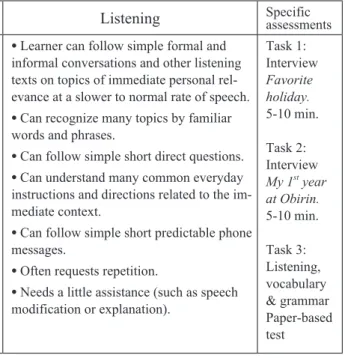
classes they take is a critical factor when they make decisions about which institution to enter. The proficiency score an average student achieves has been outlined above, but beyond this appraisal of ability, the ELP has, this year, described for the first time in detail what students can do on completing the course (see Table 3 below). These Can Do statements are based on the Common European Framework of Reference (CEFR) and the Canadian Language Benchmark (CLB) system. It is hoped that this will give prospective students, parents, high schools, university administrators, and other stakeholders a clearer picture of what students can achieve compared to the more one-dimensional, traditional proficiency test approach (see ワークショップ形式のFDを通して「現実の学生」に向き合 う, pp. 103-117 in this volume for a discussion of this development). It is important to bear in mind that these descriptors at the moment are based on data of what an average student can do; moving forwards, they will need to be altered to become more aspirational and goal-oriented.
Speaking Listening Specific assessments
•Learner can take part in short routine con-versations.
•Can communicate basic needs, can ask and respond to simple familiar questions, can de-scribe a situation, or tell a simple story. Uses a variety of short sentences.
•Demonstrates control of basic grammar; uses correct past tense with common verbs.
•Demonstrates adequate vocabulary for basic routine everyday communication.
•Clear evidence of connected discourse (and, but, first, next, then, because).
•Pronunciation difficulties may impede communication. Needs only a little assis-tance.
•Can use the phone for very short, simple, predictable exchanges.
•Learner can follow simple formal and informal conversations and other listening texts on topics of immediate personal rel-evance at a slower to normal rate of speech.
•Can recognize many topics by familiar words and phrases.
•Can follow simple short direct questions.
•Can understand many common everyday instructions and directions related to the im-mediate context.
•Can follow simple short predictable phone messages.
•Often requests repetition.
•Needs a little assistance (such as speech modification or explanation). Task 1: Interview Favorite holiday. 5-10 min. Task 2: Interview My 1st year at Obirin. 5-10 min. Task 3: Listening, vocabulary & grammar Paper-based test
Table 3. Global descriptors (based on the Canadian Language Benchmarks) for Level 2 students completing Eigo Core I & IIA.
What can we do to help students with low motivation or other issues impacting their studies?
entering further education institutions has been steadily increasing across the developed world, and Japan is no exception. Inevitably this means that a small but significant number of students find themselves in university with no clear goal or direction, with little
motivation, and increasingly with psychological issues. University classes in the first year are a challenge for these students, and the number dropping out or taking a leave of absence is rising year on year. For this reason, the ELP has been working closely with its University College of Cornerstone Education colleagues to implement a system whereby students at risk of dropping out can be identified early on in their first-year English classes, so that they can receive the support they need from their advisors, departments and counselling services. To address this issue, in the 2012 autumn semester, a pilot programme was run within the ELP, taking advantage of the fact that students meet so regularly and for long periods of time with their ELP teachers. The ELP will be building on the feedback from this trial in the hope that more students at risk of failing their courses and dropping out of university can be given appropriate advice and help from the university. This initiative is an addition to the efforts of ELP full-time staff to liaise with part-time faculty, counselling staff and administration staff to deal with ongoing classroom issues.
In a required class, how can we maintain motivation?
The ELP realizes that to achieve success in a chosen subject, motivation is key. It is even more relevant in ELP classes because they are required classes not electives. As outlined above, the Eigo Core curriculum is designed to promote learner involvement, and to show students the practical advantages of using English to communicate ideas and opinions. A classroom atmosphere of collaboration is fostered with the focus on pair and group work, where students can receive peer support and encouragement. In addition, the ELP provides opportunities for students to practice outside the classroom, with a conversation circle, where students can relax with lunch and chat with native English speakers, running four times a week at lunchtimes, English Extras, a place for students to bring specific practice requests to staff, as well as several online resources, such as www.elpweb.com/resources, which facilitate learning off campus. In addition to Eigo Core classes, the ELP also provides between approximately 40 to 50 classes each semester of Eigo Extension classes, which offer students the opportunity to study English alongside and after finishing Eigo Core classes.
As part of its efforts to improve motivation among the first-year students, the ELP along with other programmes in the Foreign Language Department are working on introducing a
Writing Centre and electronic language portfolios to encourage students to take control of their learning, improving their meta-cognitive learning skills and feelings of self-efficacy. The Writing Centre would be a place where students can go to receive advice from more proficient undergraduate or graduate students with their writing. It will be one more element helping students increase their learning networks and develop their skills in appraising their own learning needs. An eLanguage Portfolio will provide students with the opportunity to reflect on their language learning experiences, while also collecting work showing their progression across a variety of skills. More than simply a means of showing achievement, this initiative will put students at the heart of their own learning. We are looking forward to these exciting developments and improving students experience of English language learning at J. F. Oberlin University.
The ELP is also aware that there are students who are highly motivated to learn English and have specific goals, including a wish to study abroad, obtain professional licenses, or to simply enjoy the process of becoming a fluent language user. For these particular students, given the restrictions delivering a uniform programme of language learning to a large number of students imposes, Eigo Core classes may not offer the challenge they need. Moving forwards, the ELP, with the help of the Foreign Language Department, is exploring the possibilities of providing special courses for these high flyers .
4. Conclusion
In 2013 and beyond, we will build on the initiative started in Autumn 2012 that allows channels of communication to be opened between the Eigo Core class teachers and supervisors, department student affair committees, and the counselling centre to encourage students to maintain motivation. It may also be necessary to rethink how best to serve the very motivated students at a high proficiency level, perhaps by giving a choice when they enter university of studying a more academically challenging course specifically focused on students with clear English language learning goals.
The ELP successfully delivers a broad English curriculum meeting the needs of a wide variety of students. As it is designed at present as a foundation for their English language studies, the ELP must think of clarifying study options and pathways from high school through the first-year experience and on to graduation. Liaising with other departments with
a need for English and synthesizing goals should help strengthen English language studies at J. F. Oberlin and help it move towards attracting more students who recognize it as one of the best places to pursue an English language education.
Reference
Hunter, S. & O Neill, T. (2012). The ELP: J. F. Oberlin University s English Language Program.