Rate of Degradation of Nucleotides in
Cooling-stored Carp Muscle
著者
OHTA Fuyuo, HIRAHARA Takashi
journal or
publication title
鹿児島大学水産学部紀要=Memoirs of Faculty of
Fisheries Kagoshima University
volume
26
page range
97-102
別言語のタイトル
冷却貯蔵コイ筋肉中のヌクレオチドの分解速度につ
いて
Vol.26 pp. 97-102 (1977)
Rate of Degradation of Nucleotides in
Cooling-stored Carp Muscle*1
Fuyuo Ohta*2 and Takashi Hirahara*2Abstract
The rates of degradation of adenosine phosphates (Adp), inosinic acid (IMP) and total nucleotides (Nd) in the carp muscle cubes held at various temperatures between +2~+25°C were investigated. 1) The rate of degradation of IMP was affected more greatly by the vari ation of temperature than that of Adp, while the degradation rate was smaller in IMP than that in Adp. Arrhenius plots for IMP and Nd degradation gave a curve with increasing slope below about 15°C. 2) The lower the storage temperature was, the higher the level of maximum value of IMP in the muscle cubes was and the longer the time to reach the maximum was. 3) Both the keeping-quality time and its relative extension for each 1°C reduction in storage temperature, which were calculated by the application of linear equation between tem perature and square root of Nd degradation rate, increased with an approach of storage tem
perature to 0°C.
Recently, the nucleotides degradation sequence in fish muscle has been evaluated
to be more useful as an index offish quality1-5).
The sequence was also suggested
to be an important factor in assessment of frozen-stored fish quality6^. On the other
hand, many species of fish are kept in the ice box or the refrigerated room during
their transportation and storage. Therefore, the information on the rate of nucleo
tides degradation at different temperatures above 0°C is required for keeping-quality
of the fish.
However, the problem appears to have been little studied, though the
microbiological loss of fish quality in the region of temperature above 0°C has been demonstrated by some researchers7-8).
In the experiment, the rates of degradation of nucleotides in carp muscle held at various temperatures between +2°—+25°C were investigated, and the effect of
storage temperature, particularly of its small variation on the time of keeping-quality
was discussed.
Materials ane Methods
Seven cultured carp (Cypinus carpio L.) were obtained from a commercial nursery
(25-38 cm in length, 0.8-1.5 kg in weight). One fish was used for each different ex
periment.
From the fish immediately after being killed by decaptitaion, ordinary
** Effect of Storage Temperature on Degradation of Nucleotides in Fish Muscle-II *2 Laboratory of Food-Preservation Science, Faculty of Fisheries, Kagoshima University
98 Mem. Fac. Fish., Kagoshima Univ. Vol. 26 (1977)
muscle alone was taken out and cut into small cubes (ca. 10 mm3). After the cubes were mixed together enough, proper aliquots of the mixture were taken in a petri-dish and stored at 3 or more different temperatures between +2°—j-25°C.
The nucleotides contents in the cubes were determined by means of ion exchange chromatography or its simplified modification. Duplicate samples were analyzed at a time and the average value was applied for analysis of the results. The content of every nucleotides was expressed as the content of adenosine phosphates (Adp), in-osinic acid (IMP) and total nucleotides (Nd), respectively, and the change of the content of each nucleotides of them, were submitted to the calculation of rate or rate-constant of their degradation. The determination and calculation were made similarly as stated in the previous report9^. In brief, the rate of Nd degradation was calculated by making use of the fact that the relation of the logarithmic value of Nd content to the time was represented in the form of linear equation, and also the rate-constants of Adp and IMP were calculated by employing Frost's method for the consecutive first order reaction. And furthermore, using the rate-constants, the maximum value of IMP and the time required to reach maximum were calculated.
Nucleotides in the muscle cubes ought to degrade faster than those in such a case of the uncut muscle as fillets. However, in the author's another experiment10), no distinct difference in the relation of nucleotides degradation rate to temperature was found between cubes and fillets, though the rate of degradation was greater in the cubes than in the fillets as stated in Newbold's report11*.
Results and Discussion
Relation of temperature to rate of Adp- and IMP degradation The Arrhenius plots for Adp- and IMP degradation are shown in Fig. 1. Although considerable scatter is seen in the figure, some distinctive feature worthy of attention are to be observed. The rate-constant of Adp was larger than that of IMP, whereas
the slope of plot was remarkably greater in IMP than in Adp, particularly its extent
being large in the range of temperature below the transition point, about 15°C.
The
existence of transition point seems to coincides with Fraser's resultsn\ where the rate of IMP degradation in mackerel increased sharply at about 10°C or above. Ap
parent activation energy below the transition temperature was approximately 25
kcal/mole.
The value was not far from the values obtained by Dyer et al.13) for IMP
degradation in the frozen-stored swordfish and also was almost equal to the values
obtained in the author's separate test14) for the activity of IMP dephosphorylation
of carp muscle extracts. The results show that the temperature dependence of deg
radation of IMP was greater than that of Adp, though IMP degraded more slowly than did Adp. Such difference between IMP and Adp appears to have been based on the difference in their biochemical role and significance.
1.6 1.4 1.2 1.0 0.8 0.6 0.4 0.2 0
LogKa(Adp) Log Ki (IMp)
L//L o,A,K,v,o,d,b : Fish samples,1-7 lm(p moles/g) 50 3.4 3.5 3.6 3.4 3.5 I/T(x103) I/T(x103)
Fig. 1. Arrhenius plots of log rate-constant vs temperature. Ka and Ki represent rate-constants of degradation of adenosine phosphate and inosinic acid, respectively.
Relation of temperature to both the maximum value of IMP and the time to reach its maximum It has been known that IMP in fish muscle increases
with the sharp slope of decrease of Adp to reach its maximum and subsequenly
Tm(hr.)
15 20 25 5
Temperature, °C
10 15 20 25
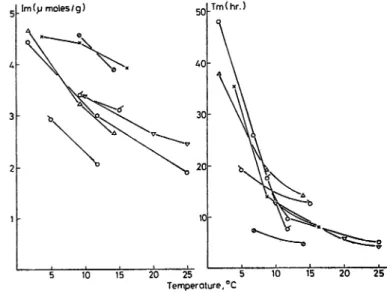
Fig. 2. Maximum values of IMP (lm) and the time required to reach them (Tm). Symbols are the same as in Fig. 1.
100 Mem. Fac. Fish., Kagoshima Univ. Vol. 26 (1977)
decreases slowly. Both the level of maximum value and the time to reach its max imum will be affected by the rate of IMP degradation and, accordingly, by the storage temperature. As seen in Fig. 2, the level of maximum value of IMP increased as the storage temperature was lowered. And the time to reach maximum was pro longed with the lowering of storage temperature, which was noticeable particularly in the region of temperature below about 15°C.
In brief, judging from the points of both the level of IMP content and the time of keeping its level, to keep the fish muscle at lower temperature may be considered to be relatively more effective.
Relation of temperature to the total nucleotides degradation The Arrhenius plots for the total nucleotides degradation are shown in Fig. 3. The plots were, as in the case of IMP degradation mentioned above, the curve with increasing slope below about 15°C, and the activation energy in the range below the transient temperature was approximately 28 kcal/mole.
1.8 1.6 1.4 1.2 1.0 0.8 0.6 0.4 0.2-Log Rate 3.4 3.5 3.6 I/T(x103)
Fig. 3. Arrhenius plots for the total nucleotides degradation. Symbols are the same as in Fig. 1.
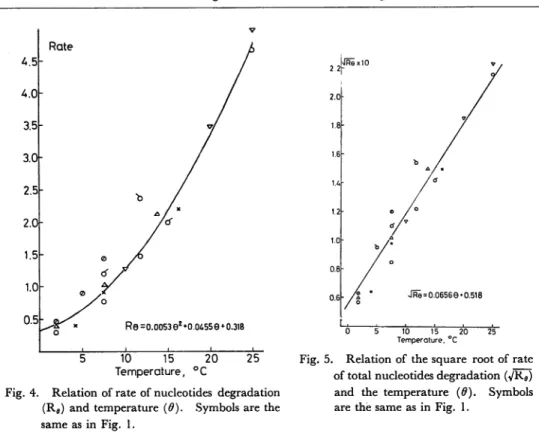
The relation between the temperature (0°C) and the rate of nucleotides degrada tion (Rfl) was observed to be curvilinear. The equation obtained by regression analysis, was as the following; R5=0.0053<?2+0.0455^+0.318 (Fig. 4). However, the relation between the square root of rate and the temperature was found to be
10 15 20 Temperature, °C
Fig. 4. Relation of rate of nucleotides degradation
(Re) and temperature (0). Symbols are the
same as in Fig. 1.
5 10 15 20 25
Temperature, °C
Fig. 5. Relation of the square root of rate of total nucleotides degradation (VR$) and the temperature (0). Symbols are the same as in Fig. 1.
nearly linear, its relation equation being </R7= 0.06560+0.518 (Fig. 5). The rates
calculated from the equation agreed with them from the above secondary equation
within the allowance of ±5%.
Effect of temperature on the keeping-quality time Using the relation equation mentioned above, the effect of temperature on the time of keeping fish-quality was discussed quantitatively. The time length of keeping-quality (D0), in which the degradation reaches a specified critical level at the arbitrary temperature 0°C, is to be expressed as follows; D^=S/R^, where S=quality magnitude, difference between initial quality and critical value, R^=rate of nucleotides degradation at
0°C. Then, substituting the above equation, VR7=O.O6560+O.518, gives an approx
imate relation between keeping-quality time and temperature, D^=D0/(1+ O.1270)2, where D0=S/R0=keeping-quality time (in days) at 0°C.
From the above equation, both the relative value of keeping-quality time at the arbitrary temperature to that at 0°C and the relative extension in keeping-quality
time for 1 °C reduction were calculated as shown in Table 1. The results show that
the effect of temperature on keeping-quality time increased with the lowering of temperature, particularly its extent was noticeable around 0°C. For exsample, the relative extension was about 30% around 0°C while about 7% at 20°C.
102 Mem. Fac. Fish., Kagoshima Univ. Vol. 26 (1977) Table 1. Keeping-quality time and its extension with
1°C reduction at different temperatures.
Storage temperature °C Relative time of keeping-quality (20°C, 1.0) Relative extension for 1°C reduction of storage temperature 0 12.53 0.312 5 4.69 0.175 10 2.43 0.122 15 1.48 0.094 20 1.00 0.075 25 0.72 0.064
greater the effectiveness of low temperature on the keeping of fish-quality, as meas
ured with the degree of nucleotides degradation, was, and moreover the keeping time
around 0°C was noticeably affected by small variation of temperature.
Acknowledgements
The authors wish to thank Miss M. Kono for her much assistance in the experi mental work. 6; r io; i i 12 is; 14' References
Saito, T., K. Arai and M. Matsuyoshi (1950): Bull. Jap. Soc. Fish., 24, 749-750. Spinell, J., M. Eklund and D. Miyauchi (1964): /. FoodSci., 29, 710-714.
Jones, N. R., J. Murray, E. I. Livingston and C. K. Murray (1964): /. Sci. Food Agric, 15,
763-774.
Uchiyama, H., S. Ehira, H. Kobayashi and W. Shimizu (1970): Bull Jap. Soc. Fish., 36,
177-187. (in Japanese)
Ohta, F., H. Kikuchi and T. Ishigami (1975): Mem. Fac. Fish., Kagoshima Univ., 24, 173—
179. (in Japanese)
Ohta, F., H. Miki and N. Koreeda (1975): ibid., 24, 181-187. (in Japanese)
Castell, C. H. and W. A. Maccllum (1950): /. Fish. Res. Bd. Canada, 8, 111-116.
Spencer, R. and C. R. Baines (1964): Food Technology, 18, 769-773.
Ohta, F. (1972): Mem. Fac. Fish., Kagoshima Univ., 21, 119-124. (in Japanese) Ohta, F.: Unpublished data.
Newbold, R. P. and P. K. Slope (1971): J. Food Sci., 36, 209-214.
Fraser, Doris I., Dianne P. Pitts and W.J. Dyer (1968): J. Fish. Res. Bd. Canada, 25,
239-253.
Dyer, W. J. and Doris I. Hiltz (1969): ibid., 26, 1597-1603. Ohta, F.: Unpublished data.