Describing Stewardship of the Common Sea among
Atob Fishers of the Pacific Rim Islands :
Cases from the Philippines, Taiwan and Japan
著者
ZAYAS N. Cynthia
journal or
publication title
南太平洋研究=South Pacific Study
volume
31
number
2
page range
71-80
South Pacific Studies Vol.31, No.2, 2011
Notes
Describing Stewardship of the Common Sea among Atob
Fishers of the Pacific Rim Islands 1
- Cases from the Philippines, Taiwan and Japan
ZAYAS N. Cynthia
Center for International Studies, University of the Philippines UPCIS 1/F Benton Hall, U. P. , Diliman, 1101 PHILIPPINES
Abstract
Atob is a term used in Central Philippines to mean stone tidal weir. It is a relic of the megalithic past of Pacific cultures. The cases I will use from the Pacific Rim are the Philippines, Taiwan and Japan. Nowadays, there are hardly any new weirs being built as the coastal waters have been utilized for more efficient, active and mechanized
fishing methods. The rules for building stone tidal weirs were founded on the communal use of the sea. As the sea is also believed to be inhabited by spirits, then the notion of the "commons" is shared between humans and spirits. This paper will describe traditional coastal management system, the commons, from the view point of managing the atob.
Key words: atob, big man, commons, spirits, traditional management system
Introduction
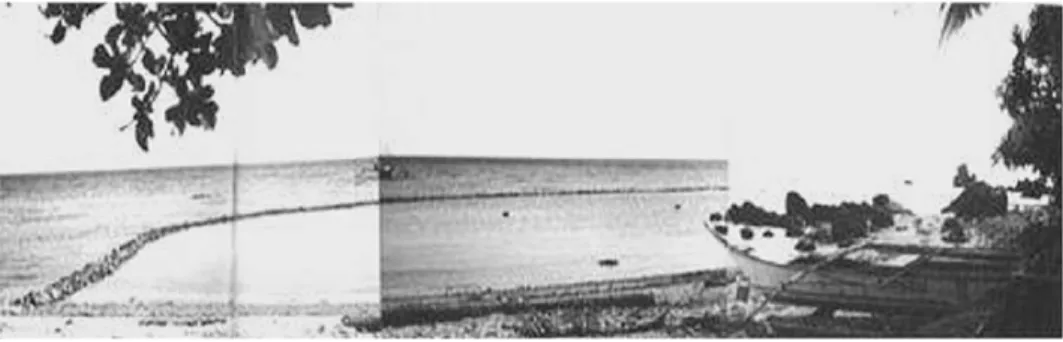
The stone tidal weir is essentially an arc-shaped (shapes are varied on the Pacific Islands) stone barrier built in such a way that when the tide rises, it fills up the barrier and
catches fish when the tide recedes. Stone tidal weir fisheries were once undertaken in many parts of the world but were most numerous in the Pacific Rim and Oceania, especially in Received: 25 May, 2010
Accepted: 13 December, 2010
1. This paper evolved from my original paper entitled "The ATOB: Social Arrangements in Stone Tidal Weirs Fisheries in the Pacific Rim" which was read during the 16th World Congress of the International Union of Anthropological & Ethnological Sciences, (IUAES 2009), Kunming, China, 27-31 July 2009. Panel A- 45 Four Patterns of State Response: Addressing Economic, Ecological, Social, Political and Religious Problems in the Context of Legal Pluralism. Part of the result from these essays where obtained during my field works in Japan, Taiwan and the Philippines from 2007-2008. As a result, I would like to acknowledge my personal and institutional debts as a visiting scholar/professor to the following institutions: Kagoshima University, Research Centre for the Pacific Islands, as a Visiting Professor from May 2008 - February 2009; International Research Center for Japanese Studies, Kyoto, as a Visiting Foreign Scholar from October 2006 - September 2007; and Academia Sinica, Taipei, as a Visiting Researcher, from April 2007 - March 2008. To these institutions' faculty and staff my deep debt of gratitude. I acknowledge however that whatever data and conclusions written in this paper are mine alone and does not necessarily reflect my previous affiliations cited above.
72 South Pacific Studies Vol.31, No.2, 2011
the Penghu Archipelago in Taiwan (TAWA 2010, YABUUCHI 1978, ZAYAS 2008b). The islands of Southern Japan including the Ryukyu Islands, the Penghu Archipelago, and the Visayas in Philippines are focused on in this study because they are of importance in the transformation of a unique maritime civilization that developed and spread further out into the Ocean. Sandwiched between Continental Asia and the vast Pacific Ocean, these islands are formed like an arc. Archaeologist Peter Bellwood believes that Taiwan and the Philippines possess the island lifeways of greatest antiquity in the world from where the ancient peoples of Australia and Oceania migrated (BELLWOOD et al. 2003). The late Professor Nishimura Asahitaro considers the weirs as the living fossils of fixed fishing gear with ancient origins (NISHIMURA 1968, 1981).
The `common property problem' was the term used to describe the degradation of natural resources between the 1950s and the 1970s. It was popularized in the book The Tragedy of the Commons (HARDIN 1968 in ACHESON 2006). Such was the power of the perceived problem that the United States Congress passed important conservation laws. In the 1980s, in reaction to government interventions, anthropologists and other social scientists advocated local management by the community (ACHESON 2006). These interventions to regulate the use of the commons have seeped into small-scale fishing villages without taking into account local values and practices of communal sharing. This paper will describe how communal behavior of sharing marine resources from stone tidal weirs, atob, reflects the alternative local notion of what the commons is all about and what it means to stone tidal weir fishers. Because of its ancient origin as a relic of megalithic culture, the atob is an ideal illustration of the continuity from the past to the present (NISHIMURA 1981). In this paper, I will argue that communal sharing behavior can be discussed along anthropological concepts, in particular, that of the "big man."
Atob in Central Philippines is essentially an arc-shaped stone barrier built in such a way that when the tide rises, the enclosure fills, and when it recedes, fish are left trapped within the enclosure (Fig. 1). Being a naturally shallow stone trap, it is possible to catch fish by hand or with scoop nets, a task often performed by women and children.
The term atob is the metathesized form of the Malayo-Polynesian word for stone, bato. It is a device most natural and gentle to catch fish. It resembles a natural pool in the sea
ZAYAS: Describing Stewardship of the Common Sea among Atob Fishers of the Pacific Rim Islands 73
where anyone can simply gather marine animals during low tide. Stone tidal weirs are widespread all over the world but are most numerous in the Asia Pacific Region. Essentially found along sandy and/or coralline coasts, they come in various shapes and sizes depending upon the topographic configuration of the place.
Ancient References to the Weirs
Between the 17th and 18th centuries, we can find various references to the stone tidal weir. For instance, in 1697, a Chinese official on his way to Taiwan stopped by Penghu and commented in his diary: "• • • the sea is their field and the fish is their crop" (YU 2004). In another place, in West Central Philippines, and at another time, in 1668, a missionary described a stone-assisted fish trap called atub (ALCINA 2004). Finally, in the Ryukyu Islands around 1724, the king ordered that an ishihimi (fish weir) be built for his concubine of the southern island of Kohama with the use of sandofu `obligatory labor' like a tax. However, the nature of the weir, its usage, and construction cannot be deduced from the brief passages cited above. Data from contemporaneous sources from both the 20th and
21st centuries can provide us with some basic cultural practices of the first sea farmers.
Building the Atob
Atobs vary in sizes from less than 50 meters to more than 150 meters long. It is a laborious undertaking as the following examples will demonstrate. In Panay Island, it took two men two years to rebuild a 109-meter long atob as a side job. The source of the basalt rock was in a nearby river 50 meters from the site of the atob. With an aid of bamboo raft, the stones were transported during high tide and calm sea. Furthermore, to fit them to the wall, they had to be chipped and polished by hand and metal bar. In Jibei Island, Taiwan, after World War II, it also took two years for a three-generation family of four men to build a 80-meter long and a 1-2-meter high chioh-ho (fish weir). To construct an atob, an abundant supply of human labor is a major requirement. For large scale construction of weirs of 624 meters, for instance, ca. 17th century in Kobama Island in the Ryukyu Islands, many laborers had to be assembled from neighboring islands to complete one for the Ryukyuan King's concubine. It took 2-3 persons to carry a stone to make a pile of 1.2 meters.
Two types of stones are generally used to build weirs: basalt rocks for its foundation, and coral stones to make it stand high. If the wall is built on an inclined tidal flats towards the deeper part of the sea, a considerable height of 3-5 meter stone wall is needed to trap whatever sea animals are brought in the receding tide. Gathering the stones alone and choosing the appropriate shapes and types of stones would need a tremendous amount of energy. Yet, despite these, atobs still played a significant role in littoral communities.
74 South Pacific Studies Vol.31, No.2, 2011
repair, production, and distribution of catch. Ownership is not about the relationship between persons and the weir per se, but about customary relations among people that
evolved as a result of constructing the weir and using it for their own benefit.
Atob in Panay Island, Central Philippines 2
In 1991 my research team undertook a maritime anthropological survey in the island of Panay. In one of our stops in Tinigbas, Antique, we met the late Aquilino Chavez. He was in his house looking out through the window. Later, we learned that he was watching over his taun, a bamboo trap with a non-return valve stashed at the deepest portion of the atob. The atob was crescent shaped, 109 meters in length and 59 meters in width. In this village, during low tide, gleaners or old people, children and women go to the tidal flats and the atobs to gather their viand or side dish for the evening. They glean with simple tools such as baskets, knives to gather shells, octopus, shrimps, sea weeds, among others. The gleaners were generally not forbidden to enter the atob, but they could not gather in the taun. Chavez made the taun so the catch belongs to him but, in practice, he shared his catch with his neighbors. The distinctions between private fishing rights within the atob and the communal rights of the community have its roots on the idea of the "big man." As the atob can only be built by someone with resources, money and labor, this person must be a person of high status. To maintain such a reputation, he/she is obligated to share resources, in this case, the fish trapped inside the atob with the community. The atob clearly is not private property, but the taun is. Yet despite owning the catch, it is still a practice to share some of it with neighbors or relatives. This is what Acheson calls a response to uncertainty (ACHESON 1981). Fish catch is never certain. As someone who shares his catch, a weir owner may one day be a recipient of other people's catch. There is also a silent agreement that no one owns the tidal reefs or the sea (ZAYAS 2008a).
Aquilino Chavez utilized his atob until his death in 1993. When Chavez was alive, his nephew helped him repair the stone wall which was susceptible to crumbling whenever strong waves would hit it. Since then, no one has maintained the weir which is now ruins. Nevertheless, Nenita, Chavez' daughter, would never sell the stones as construction materials. As she said, even if they are merely piles of stones, these are a remembrance
from her late father.
The nuance of property rights in Tinigbas is delicate. The inshore waters, even the waters within the atob constructed by its owner, are not regarded as private property except for the taun. This is what, perhaps, is meant by the social nature of property rights, meaning that even if the atob owner has the sole right over the catch of his taun, he still has some form of obligation to share his catch. As for the stones of the neighboring atobs now in ruins, if the owner does not show interest to re-use them, anyone can gather them to rebuild
2. Part of this paper was presented to the Anthropological Association of the Philippines Annual Conference (UGAT) in 2008.
ZAYAS: Describing Stewardship of the Common Sea among Atob Fishers of the Pacific Rim Islands 75
the atob, or built another one. In the case of Chavez' stones, his daughter wasn't inclined to part with them. The villagers respect the heir(s)' decision.
For Filipinos, the stones from the ruins are seen as pamana `inheritance' from the departed owner. In a way, the stones embody the past life of the owner and, as such, it has some spiritual meaning to it. The spirituality emanates from the belief in the anito, a generic term for both ancestral and environmental spirits. The sea and the ancestor are inhabited and endowed by anitos, respectively. Consequently, Filipinos regard such environmental spirits as guardians and, in other instances, as rulers of that particular space (POLO 1983). Because there are supernatural dwellers in the sea, humans cannot abuse it and claim ownership. This is clearly manifested in the offering rituals before the fishing season when the weir owners would want to invoke the assistance of spirits to help them have a large catch.
The Home of Stone Tidal Weirs, Jibei, Penghu Archipelago, Taiwan
Penghu Archipelago in Taiwan has the highest concentration of stone tidal weirs in the world (ZAYAS 2008b; Fig. 2). Located in the middle of the Taiwan Straits, its environment is most suitable for attracting fish. On its northern part is the island of Jibei, said to have 100 stone tidal weirs with names, thus earning for it the nickname "stone tidal weir village."
76 South Pacific Studies Vol.31 _ No.2. 2011
My informants from Jibei has narrated to me that, in the mid 18th century when Taiwan, including Penghu, was part of Chinese territory, fish farmers once complained of poachers in their territory to the Qing Emperor. Recognizing their livelihood, the Qing Emperor reprimanded the outsiders, but reminded everybody that the sea is for everyone. The proof of such stories is in a stone tablet securely tacked in the wall of a temple in Jibei. Weirs may be owned, but the custom of sharing is always present among fish farmers with the saying: `when a fisherman sees someone, he will share his catch with him', and `even onlookers are given a share'. By all indications, ancient life ways are reflected in stone tidal weir ownership by a clan, a temple and a clan, by a temple and/or the whole community. Weir leaders can be someone who initiated the building of weir(s). The rights to a weir-share are inherited by the eldest son or by the person who will take over the family. Each weir-group has its own rules as to who will patrol the area, repair, gather fish, etc. These tasks are rotated and are decided upon by drawing lots. The person holding the position called Jiao Hu Quian De `a de facto village chief oversees the productivity of the weir; he supervises the proper drawing of lots, sees which weir(s) need repair, and/or attends to any weir-related work. This person used to be the one with the most number of shares and was looked upon as the "village chief" who often received gifts of gratitude for taking care of the stone tidal weirs of the others. Many of these rules are written in a notebook. Without strict observance of the rules, the sheer number of weirs with interlocking ownerships could result in chaotic fishing or conflict among community members. Thus, the leadership of an elderly member of the weir or village community, as well as the authority of the temple, contributes to the strict observance of the notebook rules by the individual. This perhaps is the reason why chioh-ho fisheries rules have endured the ravages of time.
Nowadays, in the Penghu Archipelago in Taiwan, weir title is given by the local government to weir owners for a fee. It has a form similar to a land title where its location plan and description are written in an official document coming from the provincial property registry office. Each weir is owned by groups, not by individuals.
Southern Japan and the Ryukyu Islands
In the past, ishihimi were communally owned. Access to the sea was a villager's right by virtue of the village's iriai `the sea fronting the village' which is the property of the community. During the 16th century, the availability of forced labor in feudal Japan enabled large scale construction of stone tidal weirs. Fiefs took control of the territorial waters. As a result, a large number of ishihimi was reported in 1707 in Kyushu; there were 160 ishihimi in the Shimabara Peninsula. It was said that the Lord Matsudaira was fond of awarding ishihimi to his vassals (NISHIMURA 1971). Nishimura believes that individual ownership of large-scale stone tidal weirs originated during the feudal age. For instance, in the distant Island of Kohama in Okinawa, a former concubine of the King was said to have been rewarded with a large ishihimi after leaving the capital around 1724. By royal order, an
ZAYAS: Describing Stewardship of the Common Sea among Atob Fishers of the Pacific Rim Islands 77
ishihimi was built to catch fish to feed the Tsukasaba (the meaning is unclear). It is said that an enormous number of sandofu `forced laborers' was gathered in various islands to complete the not less than 624 meter long ishihimi with a thickness of 1.2 meters, each stone used in piling up the wall needed 2-3 persons to carry it (NISHIMURA 1975).
With the changes in the political system in 1875, the whole sea of the Japanese archipelago was declared national territory. Anyone who would like to have access to it had to pay taxes. However, this reform gave rise to conflicting claims, so the government reverted to the old system creating the 1901 Fisheries Law which was based on the old guilds which regulated use of the sea, the season for fishing, and the methods used. Thus, the management of the iriai waters was given to fishing cooperatives. The 1901 Fisheries Law established four rights: 1) set net rights, 2) demarcated rights, 3) special fishing rights, and 4) exclusive fishing rights.
All these can be inherited, sold, rented, or shared. This law only institutionalized what has been the common practice of the guilds since the feudal period. The Fisheries Law of 1949 clarified the rights of the individual and those of the Fishing Cooperative Association. In reality, the significant difference of the 1901 Fisheries Law and the 1949 Fisheries Law was that fishery rights were transferred from the individual to the association. This is definitely an instance of institutional intervention, i.e., taking management from the people and transferring it to the institution, the Fishing Cooperative. Together with this was the loss of the individual fishery rights of the ishihimi owners (title), the ishihimi, and the stones. The ishihimi owners protested and reasoned that the monetary compensation from the fishing cooperative association paid to the weir owners was for the fishery right, not for the ishihimi. The piled-up stones which make the ishihimi therefore belonged to the owner. Since the rocks in the bottom and on top of the ishihimi entailed great expense in bringing and putting them together, then these belong to the owner. Not all stones are owned by the weir builder, the association argued. Because the upper stones, being corals, were taken from the shore, these belong to the association. In arguing for their ishihimi rights, weir owners argued that the legislation did not in fact affect their ownership rights, but only the rights to the fish caught in the trap as the seashore is now owned by the association. However, soon after the 1949 Fisheries Law was enforced, Japanese fisheries began to motorize. In the end, the weir lost its economic significance to the owners. Some weir stones were then used in the construction of roads, houses, buildings, and land reclamation projects of the government.
In Okinawa, its outer islands, and Kyushu in Southern Japan, the use of stone tidal weir referred to as nagaki, katsi, sukki, etc. (Fig. 3) has religious significance. In mainland Okinawa, nagaki are usually built in pairs, one of which is meant for the nuru, `priestess'. In Taketomi Island, a stone sanctuary called ugaN stands facing a katsi. In Kyushu, the sukki has close connection with the worship of Ebisu `god of fishery'. In the Shimabara Peninsula, there is a monument erected for the souls of dead mullets which came from a
78 South Pacific Studies Vol.31, No.2, 2011
Fig. 3. Sedome gakki in Amami Oshima
The Notion of the Commons
In most contemporary Asian societies, traditional law takes precedence whenever there is a question pertaining to heritage. In some Pacific Rim communities where fishing was once a major subsistence activity, open access to the sea is regulated by the village community. At present the spirit of communalism has almost disappeared except among inshore fishers including those who are still harvesting from stone tidal weirs. The practice of communal sharing perhaps derives from a universal norm among littoral peoples that the sea is for everyone. Its bounty is shared for no one owns it, or its resources. The value of sharing in maritime communities is as ancient, if not even more ancient, than the stone tidal weir. Anthropologists believe that maritime peoples cannot help but share risks in the face of uncertainty as sustenance from the sea is never "certain" as sustenance from the land is (ZAYAS 2008b). Sharing though has limits that are tucked in the social nature of property. Fishers cannot help but give even a small portion of fish from one's taun, or within the weir chamber of the chioh-ho to passersby, onlookers, and neighbors. Sharing fish catch is a kind of security where fishing is essentially an uncertain activity. As it had been described, weir ownership ranged from the individual to group. But such "ownership" has its respective nuances. In Tinigbas village, it is the taun or the non-return valve that defines who owns the weir, since it is the owner alone who can gather from it. Yet, the weir owner still has the obligation to share part of the catch. In Jibei, gathering from the weir is rotated among owners. When an assigned person undertakes fishing and passersby happen to be there, it is customary that a piece or two from the weir owner is given to the passersby. The share will increase especially if he/she volunteers to help. The concept of sharing here represents the idea that the sea or the fishing grounds may be controlled territory, but somehow or the
ZAYAS: Describing Stewardship of the Common Sea among Atob Fishers of the Pacific Rim Islands 79
other, those without access to it, e.g. passersby, and volunteer helpers, can also share in its produce. Sharing in the produce without the privilege of that space, implies that no one really has complete control of the sea. Thus, users are merely stewards and never owners. For weir owners, the idea of the commons is sharing catch with fellow human beings as well
as with spirits during ritual activity.
The distinctiveness of these cases lies in the fishers' belief that they respect the guardians and/or owner spirits or gods of the sea. Fishers see them as possessing more power than humans. The practice of annual offerings to the sea gods and/or spirits has to be undertaken before the start of the fishing season, or else, there would be no catch or danger would beset the fishers. Present-day Japanese, Filipino, and Taiwanese fishers continue to practice thanksgiving festivities for the owners of the sea and its bounty.
Describing three unrelated practices in Taiwan, Japan and the Philippines, communal behavior of sharing fish catch within and beyond the communities lead us to conclude that possession of an atob is a status symbol of the "big man." Its owner cannot help but share whatever he/she has as marine products are perishable unless processed immediately. Besides, one's status as the "big man" grows as he/she redistributes his resources as often as possible.
The Ancientness of the Atob
There are at least three related ideas that can be deduced from the terms atob, chioh-ho, and ishihimi, as well as the similar descriptions of `fish farming'. Firstly, the stone fish traps were in use during the 17th and the 18th centuries. Secondly, the idea of the sea as a common property is similarly practiced in contemporary times. Finally, these ancient stone fish traps in the Pacific Rim - in the Visayas in Central Philippines, in Southern Japan, and in the Penghu Archipelago in Taiwan - might even be the stepping stones of our ancestors on their way to the Pacific Islands where stone tidal weirs were once a common feature of their seascapes. Many historical linguists believe that the Pescadores, the Portuguese name for the Penghu Archipelago, was the jump-off point in the peopling of the Pacific. With more cases in the future, archaic forms of the notion of the commons might be clarified.
References
ACHESON, J. M. 1981. Anthropology of Fishing. Annual Review of Anthropology, 10: 275-316.
ACHESON, J. M. 2006. Institutional Failure in Resource Management. Annual Review of Anthropology, 35: 117-34.
ALCINA, I. F. 2004. History of the Bisayan People in the Philippine Islands Vol. 2 (Translated, Edited, and Annotated by KOBAK, C. J. and GUTIERREZ, L.), UST
80 South Pacific Studies Vol.31, No.2, 2011
Publishing House, Manila (Originally Published in 1668 as Historia de las Islas e Indios de Bisayas).
BELLWOOD, P., STEVENSON, J., ANDERSON, A. and DIZON, E. 2003. Archeological and
Palae-Environmental Research in Batanes and Ilocos Norte Provinces, Northern Philippines. Indo-Pacific Prehistory Association Bulletin,23:141-161.
McCAY, B. and ACHESON, J. M.(eds.)1990. The Question of the Commons-the Culture
and Ecology of Communal Resources,439 pp., University of Arizona Press, Arizona. NISHIMURA, A.1964. Primitive Fishing Methods. In:Ryukyuan Culture and Society:A
Survey(Tenth Pacific Science Congress Series, Anthropology)(Ed. SMITH, A. H.), 67-75,University of Hawaii, Honolulu.
NlSHIMURA, A.1968. Living Fossil of Oldest Fishing Gear in Japan. In:the VIIIth
International Congress of Anthropological and Ethnological Sciences, Tokyo and Kyoto.
NISHIMURA, A.1971. Ishihibi, the Oldest Fishing Gear, Its Morphology and Function. In:
Studia Ethnographica et Folkloristica in Honorem Bela Gunda(Eds. SZABADFALVI, J. and UJVARY Z.),619-630, Kossuth Lajos Tudomanyegyetem, Debrecen, Hungary. NISHIMURA, A.1975. Cultural and Social Change in the Modes of Ownership of Stone
Tidal Weirs. In:Maritime Adaptations of the Pacific(Eds. CASTEEL R. W. and QUIMBY G.),77-88, Mouton Publishers, The Hague-Paris.
NISHIMURA, A.1981. Maritime Countepart of Megalithic Culture on Land. Journal de la
Societe Oceanistes,72-73:235-266.
POLO, J. B.1983. The Binalayan Fishing-Drama:A Fellowship at Sea,110 pp., Divine
Word University Publication, Tacloban City.
TAWA, M.2010. Stone Tidal Weirs of East Asia in Transition.Jinbunronkyu(人 文 論 究,
関 西 学 院 大 学 人 文 学 会),59(4):95-107.
YABUUCHI, Y.1978.(Gyoro-bunkajinruigaku no kihonteki bunken shiryo to sono hosokuteki
kenkyu(漁撈 文 化 人 類 学 基 本 的 文 献 資 料 と そ の 補 説 的 研 究),744 pp., Kazama
Shobo, Tokyo(in Japanese).
YU Y.2004. Small Sea Travel Diaries(Translated from the Literary Chinese and Annotated
by KELIHER, M.),225 pp., SMC Publishing, Taipei.
ZAYAS, C. N.2008a. Bato nga Tinumpok: Representations of Kabilin, Knowledge Heritage
and Cultural Landscapes. In:Proceeding of the UGAT Anthropological Association of the Philippines' 30th Annual Conference "Performing Heritage",23-25 0ctober 2008, San Fernando, Pampanga.
ZAYAS, C. N.2008b. Stone Tidal Weirs in the Visayas(Philippines), Pescadores(Taiwan),
and the Ryukyus(Japan)(海 の 畑−"パ シ フ ィ ッ ク ア ジ ア"地 域 に お け る 石 干 見
文 化).In:Sea Corridors and Encounters between the Cultures of Asia and the World
(海 の 回 廊 と 文 化 の 出 会 い− ア ジ ア ・ 世 界 を つ な ぐ)(Ed. HASHIMOTO, S.),