Case of Village Leader Election in Negeri
Sembilan
著者
KUWAHARA Sueo
journal or
publication title
南太平洋研究=South Pacific Study
volume
14
number
2
page range
233-256
Dyadic Relations in Malay Village Politics
—A Case of Village Leader Election in Negeri Sembilan
Sueo Kuwahara*
Abstract
Since the war, the Malaysian government has rapidly introduced various modernization policies to counter the socio-political problems such as poverty among rural Malays and the expansion of econo mic differences between ethnic groups. Much has been said about the fact that during the introduc tion of these policies a rapid socio-political polarization of the Malays into two social classes and a he ated political confrontation between them has become manifest in many parts of Malaysia. On the other hand, less attention has been paid to areas like a Malay village in Negeri Sembilan where people are more homogeneous, kinship relations are comparatively strong, and furthermore, villagers are under the control of one ruling political party.
Through the analysis of a local leader election in a village in Negeri Sembilan, we can see the strength of sibling relations and the weakening relations among cousins. The extent of the dyadic re lation the leaders have with the villagers can be seen through a local election. The leader of the one side was more like a patron in his nature toward the supporters, and the other a broker. While many of the major works on village politics have had its focus on inter-party conflicts, this study is focusing on intra-party conflicts at the village level.
Key words: village politics, patron-client relationship, broker, political resource, dyadic relationship.
Introduction
One of the most serious political and social problems in Malaysia has been the prob
lem of poverty in rural areas, the expansion of the economic gap between ethnic Malay and Chinese Malaysian, and the political instability brought about by it. Near ly 80% of ethnic Malay people are said to live in rural areas. The Malaysian govern ment undertook various policies for poverty eradication in rural Malays right after
World War II. However, contrary to government's efforts, the income disparity be tween the two peoples grew bigger and bigger. This generated serious tension be tween them, and brought about racial violence in 1969, which was the most serious political crisis since the Malaysia's independence. This tragic incident was a turning
point for the government.
Thus they started the New Economic Policy (NEP)0.
The purpose of the NEP was to step up an effective policy for poverty eradication, to help accelerate the modernizing process of rural Malay areas, and to raise Malay en trepreneurs in order to diminish the great economic disparity between the two
pies. Consequently, the self-sufficing economy until the early 1970s disintegrated. In the process of rapid modernization, the social, economic and political polarization of the Malays and the heated political confrontation between the two social classes be came manifest in many parts of rural areas in Malaysia. Most politicians of the major parties had their own rural districts as their electoral bases, and were not free from the influence of local politics. The close relationship between politicians and villagers be came a cause of serious confrontation among villagers who tried to get the concessions of benefits from various development projects. The NEP was often said to have brought about various forms of benefits to Malay people. However, it is pointed out that NEP only created a limited number of Malay business elites, and created a se rious political confrontation between the rich and the poor within the Malay society (Shamsul 1986). Especially, in the northern states of Malaysia such as Kelantan, Kedah and Trengganu, where the ratio of ethnic Malays in the state population is very high, the expansion of the economic gap between the rich and the poor has become a political problem. A serious class confrontation, with each class supporting its own political party, has caused a serious crack in the Malay society (Kessler 1978, Lihiters-Yasumoto 1985, Shamsul 1986).
There are theoretical and empirical studies focused on political leadership and poli tical confrontation between two religiously and economically stratified groups within the Malay society (Husin Ali 1968, 1975, 1976, Rogers 1969, 1975, 1977, Bailey
1976, Kessler 1978, Shamsul 1982, 1986, Lihiters-Yasumoto 1985 )2).
However,
rural Malay societies do not always face the same confronting situations mentioned above. There also exist those societies that are religiously, economically and political ly more moderate and homogeneous and they are under the control of one political party. At a glance, differences within such societies do not seem to exist, because factions are less visible. However, even in such societies, the submerged differences become manifest especially during election time.
There are a number of studies which analyzed the process of elections. However,
many of the studies are macro analysis of the process of general elections3*.
A few
anthropological studies focus on village level elections, and they describe and analyze its process microscopically. The studies of Geertz (1965) and Fukushima (1986) are two of the few that draw our attention. In his Social History of an Indonesian Town (1965), Geertz argued about the historical formative process of social groups around the town of Modjokuto, and what kind of social categories those social groups formed in the chain relation of the town-village. According to Geertz, Modjokuto town and the surrounding villages are made of such opposing axes as modern vs. traditional, and elite vs. masses. Furthermore, he describes the second axis as whether they were Santri (orthodox Islam) or Abangan (ostensible Islam), and in Abangan whether they were a town or a village. Geertz describes the aspects of confrontation and in tegration among those cultural aspects which emerged in a complicated way through
the dynamic process of an actual election (Geertz 1965)4).
political relation in a village in the northern part of Middle Java. His focus was on the formative and splitting process of political factions in the village head election in 1975. Fukushima's aim of taking up the past election of a village head as a focus of matter is in that, firstly, this election was an important incident deciding the present political relations of the village. Also it shows how it affected opposing relations in the village, such as between Gorukal of the ruling party and Nahadatur Urama of the conservative Islamic organization. Secondly, in this election process, the process of each faction was decided by complicated factors far beyond the Geertz's framework of cultural analysis (ibid.: 58). Fukushima pays attention to the ideological con frontation as the cause of the formation of factions at election time. From there, he clarifies the strategy of the candidates and the aspects of the formation of the chain of their dyadic relationship. He describes in detail about the meaning of the past elec tion in the present political order of the village. On the basis of such analysis, he re-lativizes Geertz's cultural analytical framework with the reason that in rural Java societies where human relations are interwoven in dyadic way, human relations can not so easily be reduced to a few simple principles as Geertz asserted (ibid.: 77).
The election of a village head or a party branch leader changes a quiet village at ordinal times dramatically. The election often brings the problems of the unconscious level up to the observable level. In other words, we can see what problems villagers have on their minds during an election. The studies on the matter of villagers' poli tical activities such as a leader election seem important in understanding the Malay vil lage societies which have been exposed to rapid modernization or a flood of informa tion. It is in this point that the focus of this study is on leader elections in a village level society.
There are a number of those socio-political studies on Malay village societies where the kinship system is bilateral, and class difference is related to the antagonism be tween the two parties, whereas this study aims to show a case of a Malay agricultural village in Negeri Sembilan, in which I try to examine the nature of conflict among the more homogeneous villagers who are under the control of one political party. After a brief look at the research area, first, I shall introduce the case of a leader election in a Malay village. Then I shall discuss the factors which triggered confrontation among the villagers through the analysis of the election of party branch leaders in 1989. This
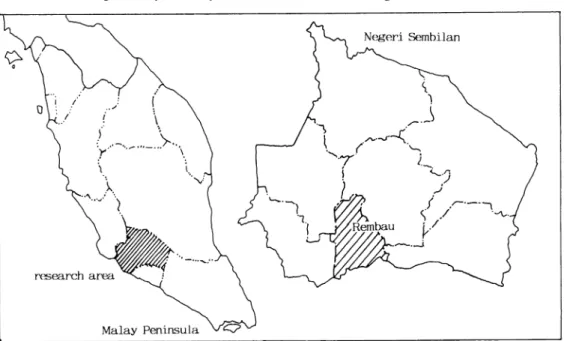
research was undertaken in a Malay village in Rembau, Negeri Sembilan5). In this
paper, the village is given a pseudonym Kampung (Kg.) Padang Binjal.
2 Village setting
Kg.Padang Binjal is in one of the subdistricts under the administrative district of Rembau. Kg.Padang Binjal is about 80 km southeast of Kuala Lumpur and about 30 km northwest of Malacca. It has a population of 208, all of whom are ethnic Malays.
Fig. 1 Map of Malay Peninsula and the state of Negeri Sembilan
\ V^
Negeri Sembilan
^\"\ \x
oil/ .••''
l \
\
/..-,.... v.. \
/ ^
A
_r
^
l
'
I
r~"' V
\
/
'^'7^»---research area ^-^ •'• Malay Peninsula \ — — <r&^
Fig. 2 Map of Kg. Padang Binjal
In the village, there are 44 households and 50 families with 98 males and 110 females. Kg.Padang Binjal is located close to the Rembau River. Between the village settle ment and the Rembau River is a wide patch of abandoned rice fields (Fig. 1 & 2).
aban-don the fields. Abandonment of rice fields did not occur in the village alone but was widespread in the whole of Negeri Sembilan. One of the reasons for such an aban donment was due to an ecological imbalance caused by rapid deforestation, which con sequently induced the introduction of rubber plant cultivation. Local people reasoned out that the cause for such change was due to a shortage of water for irrigation. It should be noted, however, that the market price of rubber was comparatively higher than that of rice. Presently, village people subsist mainly on rubber tapping. The small rubber holdings are located in a hilly section at the back of the village. Beyond the rubber trees are large oil palm and rubber plantations which are owned by big capitalists.
The village settlement pattern follows the road which extends from north to south. On its northern and southern sections are located the village mosque and community gathering place (balai raya) respectively. There are only two stores, a variety store which sells every day needs and coffee and a snack store which sells cooked food.
In Kg.Padang Binjal, the richest household is the one in which both the wife and the husband are teachers. On the contrary, the poorest household is the one of the old aged who lives on a small pension. No villagers own enough land to be called the landlord class. Eight (20%) out of the total 44 households own no rubber land. On
the other hand, 20 households(45%) don't own any rice paddies at all6).
Today, the
value of the rice field is almost nothing since rice farming has not been practiced at all. Using the income and land as indicators, it might be possible to say that a big disparity of wealth doesn't exist in Kg.Padang Binjal. Any household stands equal to a petty peasant. A marked difference in social class cannot be seen, either.
There are 9 matri-clans called suku in Kg.Padang Binjal. Each clan is subdivided into several lineages called perut. There are 3 to 4 lineages par clan in the village. Three lineages from all clans have lineage heads called buapa. A buapa is placed at the bottom of the leadership hierarchy in a matrilineal kinship organization. He is the mother's brother to his sister's children. He is expected to know everything about
adat and directs various rituals. The clan head is called lembaga, and all the lembaga
of the major clans of Kg.Padang Binjal live outside the village. The influence of the
lembaga has continually diminished in recent years. Today, not many villagers could
immediately give the name of their lembaga when asked. A number of village peo ple, especially younger generations, did not know their lembaga's name or where he lived. Undang is a kind of territorial chief representing the adat district (luak) of
Rembau. He has great authority and power. The current undang is the 20th undang
of Rembau. He has been in power for nearly 30 years since 19637).
The state of Negeri Sembilan consists of 7 administrative districts, each of which is further subdivided into several subdistricts called mukim. Each district has a district
governor called District Officer (D.O.). Each subdistrict has a penghulu mukim as parish head. Each subdistrict consists of some natural settlements called kampung. Some neighboring kampung get together to make the smallest unit of administration called JKKK (Jawatankuasa Kemajuan dan Keselamatan Kampung or Village
De-velopment and Security Committee). Each kampung has a village head who is partly a public official and called ketua kampung. The ketua kampung is expected to stand in-between penghulu, the subdistrict head, and villagers and to play a roll as a mediator between them. He is a JKKK chairman, too. He is elected by villagers. Usually the election is held at the same time as the UMNO (United Malays National Organization) branch leader election, and there is a tacit understanding that the ketua
kampung should be a member of UMNO. Every UMNO branch leader is elected in
each unit of the JKKK.
3 Village Politics and Social Background
In the stats of Kelantan (Kessler 1978), Trengganu (Lihiters-Yasumoto 1985), and Selangor (Shamsul 1986), there is an opposing relation between social classes such as petty farmer vs. landlord in a village society. Each has its own supporting political party which is also in a confronting relation with each other. Kessler's study in Kelantan is a case in point where PAS (Parti Islam SeMalaysia) and UMNO receive political support from two opposing peasant classes. It shows a marked confrontation between UMNO supported by the upper class and the PAS by the lower class. The political structure of class dissatisfaction and antagonism are the same in Lihiters-Yasumoto's study in Trengganu and Shamsul's study of Selangor. In the case of Negeri Sembilan, however, the class difference and confrontation seem to be small at the village level. Every villager is a supporter of UMNO. The party name of PAS itself is seldom heard in the village. NEP is seen in Kg.Padang Binjal in such ways as the provision of a subsidy needed for acquisition, management and maintenance of rubber holdings. However, it cannot be seen in Kg.Padang Binjal that the subsidy from the government is in the hands of some dominant village leaders, who exploit it and use the power struggle such as seen in other areas.
All the other areas except Negeri Sembilan are generally known as loosely struc tured societies with a bilateral kinship structure. The most distinctive feature of such a society is in its week bondage as a descent group. The loose social structure and the week group union seem to have something to do with the inducement of the class confrontation. The small class difference in Kg.Padang Binjal seems to show that matrilineal customary law (adat) plays the role of the break in tendency of class dif ferentiation. Considering the existence of ancestral land which is jointly owned and managed by the clan, and strictly restricted not to deal with non clan members, such exclusiveness of villages seems to have some effectiveness on the small class confronta tion in the villages in Negeri Sembilan.
However, the development policy brought the rapid increase in use of non-ancestral land such as rubber holdings and forests which were acquired mainly by male indi viduals. It is true that at least on the economic level, the traditional exclusiveness of village has been broken up gradually. This land can be acquired by individuals in
other villages far away from his own village. So, some people get this kind of ac
quired land and do business successfully by using their personal relation and power as
a party branch leader, beyond their own village level. That is, if it is put on the poli
tical perspective beyond the village level, there can be seen the tendency of class dif ference and power struggles heading toward class dissatisfaction and antagonism.
4 Process of an Election
On July 21, 1989, there was a UMNO branch meeting at the village community hall
(balai raya), and the election of the branch leader was held. The electorate of both men and women gathered at the balai raya from the 3 neighboring villages, that is, Kg.Padang Binjal, Kg.Dusun and Kg.Anak Bukit, which together constituted the unit of one JKKK. Registration had been done well beforehand. The UMNO district functionaries also attended the meeting. In the election, one branch leader and a vil lage head were to be elected. The chairman expedited the proceedings. First of all, the candidates for the branch leader were recommended, and the incumbent Abidin
and his opponent Shahran, who is an elementary school teacher, were officially nomin ated by supporters. Then the chairman announced it was time to vote. The voting was done by means of the show of hands, because most elderly women in the village
were illiterate. The result of the show of hands showed the number of votes for the two candidates became equal, so that the deciding vote was left to the chairman. First, he hesitated to make a decision, but then proposed to have the two candidates draw lots to decide. Abidin won and was reelected as a branch leader. However, the next day, the supporters of Shahran complained about the result of the vote. According to them, there was a dishonest act in the counting of votes or hands, and asserted that the real number of Shahran's votes was 33, whereas that of Abidin's was 25. They said that one of the three counters changed the number, and because of it, the number of the votes of the two candidates coincided. Two of Shahran's ardent supporters took quick action to protest. They collected signatures of the people who
approved of the invalidity of the election and to do the election again. A few days la
ter, they sent a letter and the signatures to the UMNO headquarters. About a week
later, the objection of Shahran's supporters was approved, and an unprecedented deci
sion was conveyed that the election should be done over again on the 12th of August.
The election was put back where it started again. This time, both sides of Shahran and Abidin unfolded a more heated election campaign than before. The village split into two factions. There seemed to be tense feelings between the two factions. The most symbolic example of this was the ritual feast called kenduri. One of the ardent supporters of Abidin was to give a ritual feast for his pregnant daughter. All the
household heads were invited to the feast. However, Shahran and some of his sup
porters canceled their invitation to the feast.
sup-porters visited a house which was thought to be a supporter of Shahran. He tried to undermine the solidarity of Shahran's faction. Shahran heard about this and asked me to accompany him to the house. He tried to pretend that he just happened to
stop by the house without knowing that Abidin was there8).
In front of my eyes,
Abidin and his supporter spoke ill of a supporter of Shahran, who was one of the cen tral figures in the objection of the last election. To this assault, Shahran did his best in refuting and defending his ill-spoken of supporter.
The supporters of Shahran assembled in the coffee shop near the village community hall every day, and chatted about the election campaign. At night, men and women of all ages seemed to spend all the time talking about the election of Kg.Padang Binjal.
On the 12th of August, a Saturday afternoon, the branch leader election was held again at the community hall of Kg.Padang Binjal. Before 3 p.m. when the meeting started, many villagers had been there for more than one hour. The supporters of Shahran spent their time talking at the shop until just before the meeting started, whereas the supporters of Abidin went into the community hall much earlier and waited for the meeting to start. At 3 p.m., only registrants of the election were allowed to enter the hall. A lot of children and spectators who did not register sur rounded the community hall and looked inside the hall. Two policemen also came from a nearby town in case of emergency and stared inside as well. The incumbent branch functionaries sat at the middle of the table in front. Village people sat at the opposite section facing the front. Half of the seats were for women and the other half for men. First, an election administrative commissioner read the names of the registrants, and confirmed the numbers of people present. Those who called their names answered by raising their hands or saying ada which meant present. It was confirmed that out of the 179 registrants, there were 122 present. Many women whom I seldom saw in the village were sitting in the women's section. Many of them were family members of the villagers, who were brought about to attend the election all the way from distant towns and villages where they lived.
About ten minutes before 4 p.m., after the imam (religious leader) lead everyone in a prayer from Quran, an election administrative commissioner proposed to elect the chairman first. The incumbent chairman was recommended by the supporters of Shahran and approved. Then, the deputy chairman was recommended by the suppor ters of Abidin and also approved. The new chairman and deputy chairman took their seats at the middle of the front desk, and the chairman announced the start of meet ing. Then, a supporter of Abidin raised his hand and asked the chairman for permis sion to speak. He then recommended Abidin as the new branch leader. Right after that, a supporter of Shahran recommended Shahran as the new branch leader. The same supporter, then, asserted objection to the candidacy of Abidin by giving a num ber of reasons that he was not qualified as the branch leader. The supporters of Abi din opposed strongly. Abidin also defended and justified himself. After some ex change between the two sides, the chairman announced that it was time to vote by a
showing of hands. First, the chairman asked those who supported Abidin to raise their hands. An absolute majority of hands including many of the women were raised. Three counters carefully confirmed the number of raised hands. Then, the supporters of Shahran were asked to raise their hands, and the number was confirmed. It was quite obvious that the numbers of hands of those who supported Shahran were far less than those of Abidin. The result was that 80 votes went to Abidin, and 42 votes went to Shahran. Abidin was reelected as the UMNO branch leader of Kg.Pa dang Binjal. Supporters of Shahran were dumb struck with the unexpected result. Next was the election of the village head. The result was that the new candidate of Abidin's faction won against the incumbent of Shahran's faction by 60 to 42 votes. With this, the UMNO branch leader election which had split the village into two for the past month was over at last.
5 Analysis and discussion
In the following sections, I shall discuss on the following points from an analytical point of view. First, I shall discuss the kinship factor, and the non-kinship factor, as factors of the villagers' choice of candidates. On the kinship factor, my analysis is from the viewpoint of descent, sibling and marriage relations to the candidates. And also I shall try to clarify the nature of village leadership through the observation of the various relationships between the candidates and supporters who have no kinship rela tions with each other. By all of these, I shall try to elucidate what kind of political attitude and social demand of villagers it reflects.
As to research method and data, the study is based on the data acquired by partici pant observation during and around the election day in the village, and by inquiries about the relations between each candidate and villagers, and by a household survey conducted in all of the households in Kg.Padang Binjal beforehand. Especially, as to the trend of votes, the study is based on the data of my observation on the election day, and also the follow up data I had my informants check a few times about every
villager who voted on that day9).
1) kinship factors
The case of Shahran
In Negeri Sembilan, a clan is called suku and is a matrilineal descent group. In the village, there are some suku of the same name but who are not from the same des cent. According to the exogamous principle, husbands are to come from other vil lages. The clans of husbands are in their original villages. It is common for women to live in their original village where members of her own descent group are living. In the following, I shall examine the voting of Shahran's wife's clan members, namely, the siblings and cousins of Shahran's wife's mother (Shahran's mother-in-law), the
sibl-Fig. 3. Relationship between Tiga Batu clan and Shahran
*
4=o
t
0
#
U *I
4-=a
*-
a
1=466AA6AA AIAAAAao AAAA60AA a=1AA6AA
2>A passed away
PA living in Kg.Padang Binjal
DA living outside Kg.Padang Binjal
S Shahran
asm
ings and cousins of Shahran's wife, and Shahran's uncle on his mother's side (Shahran's mother's brother) and his family members, and furthermore, Shahran's father-in-law and his relatives (Fig. 3).
The suku of Shahran is Biduanda Waris. Shahran is from Kg.Serdang, a neighbor ing village, and his clan is in that village. His mother and her descent group are in Kg.Serdang. But in Kg.Padang Binjal, he has only his mother's brother as his clan members. So the supports Shahran can expect are from his wife's clan. If the bon dage among clan members is strong, the members of the descent group of Shahran's wife are naturally expected to vote for Shahran.
Shahran's wife's suku is Tiga Batu. There are 6 households whose wives belong to the Tiga Batu suku in Kg.Padang Binjal. All of them belong to the same descent group. The members of the Tiga Batu suku amount altogether to 53 people. Out of 53, the number of electorates is 47. Out of 47, only 12 people live in the village. The other 35 people live outside the village. Out of these 47 people, only 11 people actually voted for Shahran. This number is only 23% of the Tiga Batu suku electo rates. The rest of the people seem to have been indifferent to registering for the election, or forgot to do so, or they abstained from voting.
Why was the number of support that Shahran got from his relatives so small ? As already mentioned above, there are 6 households which belong to the same suku as Shahran's wife. Out of these 6 households, there are 2 pairs of households. One household is Shahran's wife's mother's and another is her daughter's. There is also a pair of households which is a sibling relation. So, six households are actually reduced to three core relations. Looking at the relationship of these three households, one is the household of Maimunah, Shahran's wife's mother. The other two are the house holds of Shahran's wife's mother's cousins, Sharifah and Zaiton. The
great-grand-mothers of these three were sisters. That is, their mothers' mothers were sisters with each other. So, Maimunah, Sharifah and Zaiton are second cousins with each other and belong to the same suku Tiga Batu of Kg.Padang Binjal. As members of the same suku, they share the duty to attend and help every ritual that is held for some one in the same suku. For example, they have an obligation to attend a marriage ceremony of the same suku members. In fact, at the marriage ceremony of Zaiton's daughter, Maimunah and Sharifah helped, and Maimunah's brother who lives in a neighboring village executed the rituals on his own as a chief of the descent group. Thus, they always cooperate with each other on something that is related to their clan. However, in daily life, they do not visit each other very often. Nor are they very close with each other. It was natural for Maimunah to support her daughter's hus band, Shahran, actively. However, Sharifah didn't register for the election. Zaiton voted for Abidin, Shahran's opponent.
Also a close relationship among their sons and daughters who are cousins with each other cannot be seen. Zaiton has 6 sons and 2 daughters, all of whom are already grown up. Out of the sons, all except one live outside the village. Out of the 8 sons and daughters, only one attended the election. That is the one who chose to live in the village. He voted for Abidin, like his mother. Sharifah has 4 grown-up sons and 2 grown-up daughters. Out of the 6 children, only the eldest daughter lives in the same village as her mother. She has her own household. All the others are living outside the village. The eldest daughter together with her husband supported Shahran. However, the rest did not come back for the election to vote for Shahran. There was a reason that the eldest daughter of Sharifah supported and acted for Shahran in the election. Her fifth daughter became a teacher. But she had some mental problem and took a temporary leave. So, Sharifah and her husband often went to Shahran for advice. With such a special circumstance, the couple were very cooperative with Shahran for his election.
In Kg.Padang Binjal, there is the household of Maimunah's elder sister. She has 7 sons and one daughter. They are all grown-up. The youngest son, and the second eldest son who recently came back with his family live in the village. The youngest one is not married yet and lives with his mother. The second eldest son lives in his
own house on land which he borrowed from his mother. Maimunah's and Maimu
nah's eldest sister's children are cousins. They are the closest relatives in the village. However, in reality, they are not so close and they do not see each other very often. In the election, out of Maimunah's 8 children, 5 came to vote for Shahran. Three of them came all the way from distant towns for the election. However, some of them did not make up their minds who to vote for until just before the election. There often seemed to be a restrained relation among the cousins. Finally, 5 sons voted for Shahran. But the reasons for their choice was not because they are cousins of Shahran's wife. The personal relationship of each to Shahran was more important in their decision. In fact, they often went to Shahran for advice about business, their children's higher education and employment, and so on, for Shahran has a large circle
of acquaintances and political connections.
The suku of Shahran is different from that of Shahran's mother's brother's children.
However, they are cousins of Shahran through their father's side. Shahran's uncle and his wife voted for Shahran. Out of their 10 sons and daughters, 4 voted for Shahran, but two of his daughters voted for Abidin. Shahran and his cousins are not so close because of the big age difference between them. The four cousins supported Shahran in the election because Shahran is a candidate for the party branch leader and their father was Shahran's partner running for village head. Both of them were standing against Abidin and his partner. The cousin relationship with Shahran was not an important factor in their support of Shahran.
The suku of Shahran's father-in-law is Biduanda Rulung and there are 3 households which belong to it. The women in the three households are sisters. The three sisters are from one of the oldest families in the village. They live next door to each other. The great-grandfathers of both Shahran's father-in-law and the three sisters were brothers. So, they are second cousins. Thus the three sisters are related to Shahran's father-in-law on their father's side, and they belong to the same suku, Biduanda Rulung. However, the three sisters didn't support Shahran. They sup ported Abidin in the election. The reason is that the late husband of one of the sis ters was the brother of Abidin's mother. For the sisters, a marriage relation took precedence over a clan relation as far as the election was concerned.
Thus, in the case of Shahran, as he himself is from another village, he didn't have the support of his mother's siblings in Kg.Padang Binjal. So, he had to depend on his wife's descent group. He had his wife's siblings. However, their connection was not strong enough for him to gain their support. After all, they were an indirect rela tion through Shahran's wife.
The Case of Abidin
In the following, I shall examine the voting of Abidin's mother's clan members. Among them are siblings and cousins of Abidin himself, siblings and cousins of Abi din's mother, and the siblings and the children of the spouses of Abidin's mother's siblings.
Abidin was born in Kg.Padang Binjal. He lives in the state capital, Seremban. His parents live in Kg.Padang Binjal. His mother was from Kg.Padang Binjal while his father came from Kg.Serdang, the neighboring village. His father's descent group is suku Tiga Nenek, and is in his original village. The central kinship group which supported Abidin was his mother's clan, suku Anak Melaka, to which Abidin be longed. There are 8 households in the suku Anak Melaka. Five of them came from other villages in their mothers' generation. So the other three households become a subject of discussion. These three households are Abidin's mother's, her sister's, and her daughter's (Fig.4).
Abidin has two brothers and four sisters. He is the second eldest son. The eldest
Fig. 4 Abidin's family of orientation and the sibling and marriage relations of
his clan members
Z* = <
mill
)AAA oocdAaA loo ooo
AAA<
0/X passedaway
#A> living in Kg.Padang Binjal OiA living outside Kg.Padang Binjal
A Abidin
sisters and got 6 votes. Abidin's eldest sister has 9 children. Seven out of them who have voting rights attended the election and voted for Abidin. They live outside the village, and came all the way to support Abidin. Abidin's mother's younger sister who lives next door to Abidin's mother has 6 grown-up children. The third eldest daughter's family live together with her mother. She voted for Abidin. However, her other children did not show much interest in Abidin's election, even though Abi din is their cousin. Abidin got at least 16 votes (67%) out of 24 members of his own clan who have voting rights.
Abidin's elder sister's husband has a younger sister. She lives next door to him. Their clan is suku Semeruggang. She has 6 grown-up children all of whom live out side the village. Her husband passed away long ago and she lives alone. All her children came back to the village on the election day and voted for Abidin. Adding up all the votes, Abidin got at least 40 votes, which is about the half of his total votes, from his clan members and those who are in the sibling relations of their supouses. On the other hand, Shahran got only 15 votes of these, which is only 36% of his total
votes.
To sum it up, the strength of Abidin is in that he himself is from Kg.Padang Binjal and he has a strong sibling relation of his own and his mother in the village. That is, the strength of the sibling relation and the unity of family members made Abidin's elder sister's husband and his younger sister call their children to come all the way to the election. Thus, Abidin's strong siblingship was one of the important factors that lead him to win the election. However, Abidin's wife was not a big help because she is not from Kg.Padang Binjal and has no kinship relations there.
Comparison
To make a comparison between the two candidates, as Abidin is from Kg.Padang Binjal, he could gain the support of his own siblings and his mother's sisters who are members of his mother's clan. However, his spouse is from the other village, so he couldn't get much help through her. On the other hand, in the case of Shahran, as he himself is from another village, he had to depend on his wife's descent group. Abidin had an advantage over Shahran in that his and his mother's sibling relations have a strong family unity, which brought a lot of votes for Abidin. The strong sibl ing relation and unity of family members made Abidin's elder sister's husband and his younger sister call their children to come all the way to the election. Peletz (1988) stressed the importance of sibling relation more than the descent relation as an analy tical framework of the social structure of matrilineal societies in Negeri Sembilan. In such a society, inheritance is from mother to daughter. However, as the inherited property is shared equally among sisters, the bondage between brothers and sisters is maintained strongly in the relation of the inheritance and management of property.
Peletz (1985: 82) points out that the structural complementarity underlying sister's ties with their brothers also provided the model for relationships between women and their husbands, who address and refer to one another with terms used by siblings. On the other hand, the mother's brother-sister's son relationship is very week in com parison with that of the Minangkabau of West Sumatra from where their ancestors came. In West Sumatra, there is a word called mamak-kemanakan which refers to a
special relationship between the mother's brother and his sister's son. However, in Negeri Sembilan, such a word is hardly heard. Thus, where the mother's brother-sis ter's son relation is not so present, the core of the unity of matrilineal descent group is week as is the nature of the descent group. On the other hand, the unity of the sibl ings, who are related to those who share the harvest (Peletz 1986), is stronger. However, the strong unity seen among the siblings is not seen among their children's generation, who are cousins with each other. In this sense, it is a sibling relation rather than descent relation that is actually strong.
In Kg.Padang Binjal, Shahran didn't have his or his mother's siblingship. He had his wife's sibling relation, but it is an indirect relation through Shahran's wife. The strength of Abidin is in that he has his own siblingship in the village. Abidin has a stronger sibling relation than Shahran, which was one of the important factors that lead him to win the election. Statistically looking, 9 (21%) of those who supported Shahran were called all the way to the election for voting, whereas on the side of Abi din, the number totaled 37 (46%). This also shows a result of the difference in the strength of sibling relation and the dyadic relation of mother-children between the two
candidates.
2) Factor of non-kinship relations
sibl-ing relations were more effective than descent relation in rallysibl-ing the people around the same purpose. But there were also those who supported the two candidates with whom they had no kinship relations. In the following, I shall examin the relations between each candidate and their supporters.
Supporters of Shahran
Looking at the supporters of Shahran first, there are the households of Ismail and
his son, who are unrelated to Shahran in terms of kinship. Ismail's clan is suku Anak
Melaka, and his wife belongs to suku Tiga Nenek. His son belongs to suku Tiga
Nenek, his mother's clan. Ismail's son's wife's clan is Anak Melaka. Ismail's clan is the same as Abidin's, and his wife's clan is also the same as Abidin's father's clan, Tiga Nenek. However, both Ismail and his wife belong to different clans of same
name from the clans of Abidin's parents, and there is no direct kinship relations be
tween the two couples, since they came from different villages. Likewise, Ismail's son's wife came from outside the district, and her clan, Anak Melaka, has nothing to do with the same clan of Kg.Padang Binjal. There are a few such clans in Kg.Padang
Binjal that are the same in clan name but different in descent. Ismail's son is one of
those who often asked Shahran for advice about various things. His father is the
imam (religious leader) of Kg.Padang Binjal, who is an immigrant. He himself was born in the village. He makes a living helping with his father's small store in the vil lage. However, recently he hopes to emigrate into a new settlement of rubber small holdings within the state. Since he has no political connection, he asked Shahran for help. Shahran not only gave him necessary information but also helped him make an application form in various ways. Shahran is a good assistant for him because he lives in the same village and can be asked for help anytime. He himself also assisted Shahran by driving him anywhere if Shahran asked. On the other hand, he was also
dissatisfied with Abidin. According to him, Abidin, as a political representative of
the village, should try to make a political effort for the welfare of the people of Kg.Padang Binjal. However, as he lives in a distant town, he seldom came back to the village except during the election time and on a few special occasions. Thus he
has made little contribution to the villagers. Furthermore, he is well known to with
his liking of gambling and often becomes the talk of the villagers. In fact, some of the villagers often frowned on him because of that. According to the ethics of some villagers, leaders should set a good example for villagers in both their daily and reli gious lives as a good Moslem. His everyday behavior as a party branch leader repre
senting the village was hardly acceptable morally and ethically especially for a man like Ismail's son whose father is imam. There are also other people who are dissatis fied and doubtful about whether or not Abidin is ethically or morally suitable to be a leader. This is one of the reasons Shahran was strongly supported by some of the vil lage people.
There are many other people who, like Ismail's son, asked for a help and assistance from Shahran. Although there is a village head, people more often depended on
Shahran in various ways.
This is mostly due to Shahran's kind and open-hearted
character and the social, economic, and political network he has built, and furth
ermore, his vocational function as a school teacher. In this village society, those who play a central role in political activity are mainly school teachers, village heads, subdis trict heads, lineage chiefs, and party branch leaders. Out of them, especially school teachers often become central figures in the village politics. There is a view that by placing school teachers as political brokers they are playing the role or function of
bridging gaps in communication between the peasants and the outside world.
According to this view, school teachers can be political brokers in the following
reasons. 1) They are often more literate than the others in the village. 2) They can talk fluently and persuasively during meetings. 3) They know the art of writing let ters to officials in the towns. 4) They also know how to keep minutes and records. 5) They don't feel ill at ease or afraid in the company of officials who may be associ ated with political parties or government department. 6) They especially are quite close to the villagers because their work connects them with the village children, their parents, and education at the rural level in general. 7) They are in more constant touch with news in their own communities and the outside world as well, because they read newspapers and frequently maintain contact with colleagues in other towns ( Husin Ali 1976: 10).Apart from being the most knowledgeable, they also happen to be the people with the most connections and contacts with people outside the village. It is to these poli tical brokers that the peasants go for help, whether to get recommendation for their children for some welfare aid or minor scholarships or to fill out forms and to write letters of application for land or financial aid for planting rubber on their land (Husin
Ali ibid., Norazit 1982 : 210).
In fact, Shahran and the schoolmaster of Kg.Serdang
are often more busy writing various letters of application for villagers than they are doing their own school work. The conditions of a leader that villagers often empha sized were the abilities to do clerical work, to process various documents or papersand to speak English. Today, leaders are sought for their modern bureaucratic know ledge and their ability to cope with complicated procedures. In this sense, school
teachers who are intellectuals in the village still play an important role as political
brokers and attract a great deal of attention as leaders. Furthermore, teachers earn a comparatively substantial income. They are financially more stable and have more
time than other people in the village. They usually work for half a day and can put the rest of the time into political activity. This privileged circumstance also brings them
an advantageous condition as a political broker.
Supporters of Abidin
Now we turn to the case of Abidin. Those who strongly supported and assisted
Abidin were families of Mokhtar and Yatim, who have no kinship relations with him. After resigning as a police officer in the 1960s, Mokhtar worked at a Chinese rubber estate as a rubber tapper for a while. Then in 1976, he acquired 3 acres of small
rub-ber holdings in Kg.Padang Binjal, and has been making a living on the rubrub-ber since.
Other than rubber, he often got small contracts from Abidin. So far, he got such
contracts as small road repair and construction works of a small public building. Be cause of this connection, Mokhtar and his family were very active supporters of Abi
din.
Yatim also is a strong supporter of Abidin. He is a secretary of the UMNO branch of Kg.Padang Binjal. Yatim's wife's mother lives together with his family. His wife's mother was married in Kg.Padang Binjal from an outside village called Kg.Mes-ta. There are more who came from the same village. Abidin's elder sister's husband and her husband's elder sister also came from Kg.Mesta. Mokhtar himself is from the neighboring village of Kg.Mesta. Most of those who are from Kg.Mesta are sup porters of Abidin. In this sense, the relation of people from the same original place seems to be of some role. Yatim lives next door to Abidin's parents' house, and has a closer relationship with Abidin than with Shahran, because of a good neighbor
relation10).
For Abidin who used to be away from the village, Mokhtar and Yatim
are important sources of information on the village affairs. It was necessary for Abi din to have such a network in the village in maintaining the political status as a branch leader. Thus, in the case of Abidin, the relationship with the families of supporters like Mokhtar and Yatim had a great influence in the election.
3) Nature of leadership
Patron and Broker
Now let us turn to the candidates themselves. First, Shahran, in addition to what we have already seen above, he is 48 years old and has long been an English teacher
of an elementary school in a neighboring village. Shahran has been a faithful party
member of the UMNO, and has been active in various campaigns and other activities for the party. In this way he got acquainted with the state ministers, some Members of Parliament and other important figures in central politics. He has been making a habit to attend every meeting that some important politicians attend. He often goes all the way to the airport to meet or send off some important political figures. He also manages to attend a party convention wherever it is held. He has made strong personal relations with many politicians through such devoting activities. Thus the strong political connections with politicians and bureaucrats are an important political resources for Shahran. As a social network, he has colleagues from school and his wife's kinship group. As an economic network, he has some executive bank clerks, businessmen, and small entrepreneurs of ethnic Chinese and Indian origin. By using such various connections, Shahran solved many kinds of problems such as his personal matters and the matters brought by villagers. He was able to gain the necessary help in the matter of children's higher education through his strong political connections.
Abidin, on the other hand, is 41 years old and from Kg.Padang Binjal. He is one of the few university graduates. His parents and his elder sister's family live in the
village. Abidin lives in the state capital with his family. He has long been the UMNO branch leader of Kg.Padang Binjal. He has a large circle of political net works in the center. Whereas Shahran has no political status and economic power ex cept vocational status as a school teacher, Abidin has a certain amount of political power as a UMNO branch leader and as the district head of the union of street stall keepers. Thus he is in the position of controlling jobs and funds to a certain extent. In this way, those who gathered around Shahran are different in nature from those who stood together for Abidin if we see each of them in relation to each candidate. Then how can we understand the difference in their political grounds ?
Two Types of Political Resource
In the relationship between the two candidates and their non-kin-related supporters, Shahran is more like a mediator or a broker to them, which is typically seen in his re lation to Ismail's son, whereas Abidin is more like a patron or a guardian to his sup porters. The typical example of this is seen in his relation to Mokhtar. Shamsul (1982 : 220-221) clarifies the usage of the term patron-client relationship as referring to a localized phenomenon and describes as a face-to-face relationship between two per sons of unequal standing in economic power and political influence, and furthermore he points out the concept of a broker as in the following. 1) In most instances the term has been used within the context of the social gap thesis. 2) It suggests that the rural mass at the bottom end of the stratum and the urban intelligentsia at the top are separated by a social distance and hence a broker or mediator or a middleman appears to bridge this gap. 3) Therefore, a broker or a mediator is perceived as an intermedi ary who arranges an exchange or transfer of goods and services between two parties who are not in direct contact. Furthermore, according to Nozarit (1982 : 211-212), there are three types of brokers, political, economic and cultural brokers. The role of a cultural broker is to convey the government's ideology or policies to the peasant masses. A cultural broker act as an agent at the grass-roots level to help explain and maintain the government policies down from above. Husin Ali (1975) described empirically that, when a modern bureaucratic system was brought in and party politics became wide-spread and steadily established, the traditional leaders were succeeded in smooth proceeding to bureaucratic and party leaders. He stressed an aspect of a cultural broker as an agent of modernization. On the other hand, Shamsul (1982) criticizes Husin Ali's analysis of Malay leadership as being based on the conventional model of a social gap thesis, which involves an aspect of a social role model. He
asserts more about the class differences rooted in the economic factors, and stresses
the aspect of an economic broker. However, I shall clarify the usage of the concepts of patron and broker in this paper by referring to Norazit (1982 : 216).
Norazit explains about the difference between patron and broker as following. Patrons are those who control over the first order resources, such as land, jobs, capit al, funds, and specialized knowledge. They control these resources directly.
Brok-ers, on the other hand, are those who have control over the second order resources, that is, they have strategic contacts with other people who have control of first order resources or who have access to such persons. The role of the patron and the broker can be found in one person. As already mentioned above, Shahran's political re source is a large circle of the human connections which include various political, eco nomic, and social networks. He himself has no political and economic power. In that sense, he has no power as a patron who controls over the first order resources such as land, job, and capital. Rather, he stands to the villagers as a mediator or broker who has strategic contacts with those who control first order resources. On the other hand, Abidin has political status as a local UMNO branch leader and a dis trict head of the union of street stall keepers. He is in a position of controlling over first order resources to a certain extent. In that sense, he seems to stand as a patron toward the villagers.
6 Conclusion
As already mentioned above, Geertz argued about the aspects of confrontation and integration among those cultural categories made of such opposing axes as modern vs. traditional, and elite vs. masses, and in its second axis as Santri vs. Abangan, and so on, in the dynamic process of actual election in Modjokuto town of Java. Fukushima, on the other hand, pays attention to the ideological confrontation as the cause of the formative and splitting process of political factions in the village head election in Mid dle Java. From there, he clarifies the strategy of the candidates and the aspects of the formation of their dyadic relationship in rural Java society where human relations are interwoven in a dyadic way. Both Geertz and Fukushima described the election as a formative and confronting process of cultural categories or political factions, whereas in the case of leader elections in Kg.Padang Binjal we see the difference in the strength of sibling relations of the two leaders, and also the difference in the na ture and type of dyadic relations between the two leaders and villagers. Those cultu ral categories and ideological factions shown in Java could not be seen in the Malay village of Negeri Sembilan. This fact seems to indicate a homogeneous feature of Negeri Sembilan Malay village society.
Through the analysis of local leader elections in Kg.Padang Binjal, we saw the strength of sibling relations and, in comparison with this, the weakness of the relations among cousins. In contrary to the unity in sibling relations in Kg.Padang Binjal,
cousins seemed to restrain themselves from or be indifferent to each other. It seems
possible to read in it the weakening unity of the trans-generational and lineal descent group. Moreover, usually a peaceful and quiet village was split into two factions under the two UMNO branch leader candidates throughout the process of the elec tions. The leader of one side was more like a patron in his nature towards his sup porters, and the other leader a broker. Some of the people of Kg.Padang Binjal
stood against the long-term domination of a patron-like leader by voting for a broker like leader. We can read into that the modest dissatisfaction of some of the village people against the moral, behavior, and responsibility of the patron-like leader as a leader. Some people of Kg.Padang Binjal might be strongly claiming fairness and ethics by voting for the leader who is fairer and more cooperative, and is always near them. Thus, the other aspect that can be seen through a local election would be the difference in types and the extent of the dyadic relation between the leader and his villagers, and its nature, and furthermore, the dynamism of such dyadic relations.
Hitherto, the concept of a patron-client relationship was very often used in the stu dies of peasant society. The patron is described in it as an economic broker who pro tects the peasants from their economic predicament by offering them loans and credit in times of economic trouble, and also as a cultural broker who mediates between the peasants and the outside world (Norazit 1982 : 215). The patron is seen as playing the two roles of both protector and mediator in one person, if we look from the view point of the studies of peasant society. The leader described here is an image of the old traditional leaders. The leaders we have seen through the analysis of the local election in this study are different from the patron or protector such as the penghulu (traditional leader) of old days, and the leaders discussed in the context of economic polarity of social class. Today, the role of patron as a broker of socioeconomic mobility or an agent of modernization is not like before, with the development of the social system and the institutionalization of higher education. In that sense, it is possible to see, with the decline of traditional leaders in the process, that the functions under certain patrons in local societies were taken over by the society or state in the course of modernization. As far as to see in Kg.Padang Binjal, the present leaders of the village society are party leaders, and not the one who is both a patron and a brok er but the one who is either a patron or a broker.
The studies of the Patron-client relationship and brokers are, in a sense, the study of a dyadic relationship. The study of dyadic relationships shows that the more func tional social relations depend on the network based on the dyadic relation among peo ple compared to those belonging to the groups whose border is vague (Nakane 1980 : 281). In Southeast Asian societies, even the relationship between parents and chil dren or between brothers and sisters is taken as an accumulation of individual dyadic relations based on the individual face-to-face relationship between husband and wife, father and children, mother and children, and among brothers and sisters. The indi vidual dyadic relationship means an informal relation which attaches importance to in dividual attributes, nature, and disposition (Kuchiba 1990 : 118-120). However, Seki-moto (1991 : 103-105) pointed out that such a network model of dyadic relationship was insufficient to grasp the society in multi-faceted and holistic perspectives. Moreover, he pointed out that the dyadic relational study is easy to fall into the plane morphological study of society and should be overcome by pursuing the ideas shared by those who live in the scene of peasant society. In the election of Kg.Padang Bin jal, two types of dyadic relations which are different in their nature functioned
strong-ly. The one was a rather plane dyadic relation like sibling relationships among brothers and sisters. Especially, a number of dyadic relations of mother, wife, and sister, and the strength of their powers of drawing children were conspicuously seen in the election. The other was the hierarchical and multi-faceted dyadic relations be tween those who have the political resources and those who don't, such as a patron-client or broker. It seems possible to understand the village politics more dynamically by looking at the two types of dyadic relations in a more holistic way. However, in this point, more empirical study based on detailed field research of pursuing each per sonal relation within each household or family seems to be required.
Notes
1 The NEP has two objectives. First, to reduce and eventually eradicate poverty irrespective of race. Second, to restructure the Malaysian society to correct eco nomic imbalance, so as to reduce and eventually eliminate the identification of race with economic function ( Shamsul 1986 : 191-192).
2 Shamsul (1983) has done a detailed critical review of past studies on this theme.
I have also referred on this matter (Kuwahara 1991).
3 To give an example, see Mauzy 1986, Gale 1986, Rogers 1986.
4 On Geertz's study about this matter, I quoted from Fukushima (1986). He did a critical review about Geertz's study on this theme.
5 Negeri Sembilan consists of 7 districts and 62 subdistricts with the population of
573,500, in which the ratio of ethnic Malays to the total population is 46.2 %, and the ratios of Chinese and Indians are 36.6% and 16.9% respectively (Peletz 1988 :
132). The district of Rembau consists of 177 villages called kampung. The population of Rembau is 36,380 as of 1980, in which the racial compositions of Malays, Chinese, Indians, and others are 26,978, 5,350, 4,005, and 17 respectively.
6 For a more detailed description of the village, see Kuwahara (1990).
7 On the matter of village leadership in Kg.Padang Binjal, see Kuwahara (1991). 8 When Shahran asked me to accompany him, he did not tell me the reason for it
very clearly. He wanted some plausible excuse. It was my first occasion to see
and exchange words with Abidin since I came to the village. Since then they con sidered me as the one who sided with Shahran. Since that time, some of those who supported Abidin's side kept some distance from me. On the re-election day, I was specially permitted to enter the community hall for observation as a guest and waited for the meeting to start in the back. However, just before the meeting started, Abidin raised an objection about my being inside the hall, and I stepped
just out of the hall. And also, before I left the village after finishing my research,
I hosted a thanks-giving feast (kenduri) and invited all the villagers of Kg.Padang Binjal. But most of those who came to the feast were the supporters of Shahran.
One of the reasons for this might be that the place where the kenduri was held was
seem to show how they placed me in the village. However, without being placed in such circumstances, I could not have had such an interesting experience to see the two candidates facing and confronting each other with my own eyes.
9 My information was mainly from Shahran and his supporters. I could not collect information from both sides equally. In that sense, I might be one-sided towards one candidate. I became intimate with Shahran and his supporters since the be ginning of my stay in the village. However, it was almost at the very last minutes of my stay that I met Abidin for the first time. So, I could not have much chance to talk with him. Moreover, by the circumstances mentioned above, there was a kind of difficult atmosphere for me in getting some information about the election from Abidin and his supporters. I often heard some critical opinion about Abidin from Shahran's supporters. However, against this criticism, I could not hear any refutation or counter-opinions about the election and opponents from Abidin him self or his supporters. I could not even know what kind of opinion they had to wards Shahran. In that sense, my data lacks balance, and I can not say that there is no risk of bias in my information. So, I tried to be very careful about the treat ment of my data. On the equivalence of the numbers of votes and supporters of each candidate, I tried to supplement it with the data acquired by household and genealogical surveys.
10 It can be estimated that there are various kinds of personal relations between Abi din and Yatim. However, it was difficult to collect detailed information because of my position in the village.
Acknowledgement
The paper is based on the data acquired during my field research done in Negeri Sembilan, Malaysia, from October, 1988 to August, 1989. All the names of villages and individuals which appear frequently in the text are pseudonyms. For ethical reasons, I am not able to list their names and the places, but I am greatly indebted to many individuals, especially the villagers in the research area in Negeri Sembilan in the course of my study.
Bibliography
Bailey, C. 1976. Broker, Mediator, Patron, Kinsman: An Historical Analysis of Key Leadership Roles in a Rural Malaysian District. Papers in International Stu dies Southeast Asia Series No. 38., Ohio University Center for International
Studies, Athens.
Fukushima, M. 1986. Jawa Noson ni okeru Sonchou Senkyo to Network (Village head election and network in Javanese villages). Ajia Keizai, 27(6): 57-78. Gale, B. 1986. Politics at the Periphery: A Study of the 1981 and 1982 Election
25-53, Pelanduk Publications, Kuala Lumpur.
Geertz, C. 1965. The Social History of an Indonesian Town. MIT Press.
Husin Ali, S. 1968. Patterns of Rural Leadership in Malaya. Journal of the Royal
Asiatic Society, Malaysian Branch, 41(1): 95-145.
1975. Malay Peasant Society and Leadership. 192pp., Oxford University
Press.
1976. Political Functionaries in Rural Malaysia: Leaders or Middlemen? In:
Changing Identities in Modern Southeast Asia.
(Ed. Banks, D. J. ), Mouton,
London.Kessler, C. S. 1978. Islam and Politics in a Malay State of Kelantan 1838-1969.
274pp., Cornell University Press, New York.
Kuchiba, M.
1990.
Taijinkankei no Dainamizumu (Dynamism in human relations).
In: Kouza Tounanajiagaku 3: Tounanajia no Shakai. (Ed. Tsubouchi, Y.
),100-126, Koubundo, Tokyo.
Kuwahara, S. 1990. Minankabaukei Mareijin Sonraku Shakai ni okeru Keizai
Henka to Bokeisei wo megutte (On economic change and matrilineal system in
Minangkabau Malay village society).
Malaysia Shakai Ronshu, 2: 1-39, Tokyo
University of Foreign Language.
1991.
Malay Sonraku Shakai no Leadership ni kansuru Ichi Kousatsu (A
study on leadership in a Malay village society). Shigakuka Houkoku, 38 : 85-96,Kagoshima University.
Lihitars-Yasumoto, N.
1985.
Malay Sonrakushakai no Leadership no Kouzou
(Structure of leadership in Malay village societies).
Kikan Jinruigaku, 16 (1):
89-141.Mauzy, D. K.
1986.
The 1982 General Elections in Malaysia: A Mandate for
Change.
In: Readings in Malaysian Politics. (Ed. Gale, B. ), 3-24, Pelanduk
Publications, Kuala Lumpur.
Nakane, C. 1980.
Tounan Ajiateki Shakai Kouzou no Tokushoku : Ningen Kankei
ni tsuite no Ichi Siron (Features of Southeast Asian social structure: an essay on
human relations) Tounan Ajia • Indo no Shakai to Bunka. 269-297, Yamakawa Shuppansha, Tokyo.
Norazit, S. 1982.
Role of Patron in Peasant Society with Special Reference to
Malaysia and Philippines.
Akademika, 20 and 21 : 205-217.
Universiti Kebangsaan
Malaysia.
Peletz, M. G. 1988.
A Share of the Harvest. 383pp., University of California
Press, Berkeley.
1985.
Siblingship and Social Structure in Negeri Sembilan.
In: Change and
Continuity in Minangkabau. (Eds. Thomas, L. and Benda-Beckmann, F. ),
73-109, Ohio University Press, Athens.
Rogers, M. L. 1969.
Politicization and Political Development in a Rural Malay
Community. Asian Survey, 9(12): 919-933.
15(5): 407-421.
— 1977. Sungai Raya: A Sociopolitical Study of a Rural Malay Community.
108pp., University of California Press, Berkeley.
Sekimoto, T. 1991. Nishakankei Network ron Saikou:Tounanajia no Jirei (Rethink
ing dyadic relation network: Southeast Asian cases). Chugoku: Shakai to Bunka,
6: 99-113.
Shamsul, A. B. 1982. The Patron-Client Relations as an Aspect of Peasant Ideolo
gy: A Note with Reference to Malay Peasant Society.
Akademika, 20 & 21:
219-233.1983. Malay Village Politics: Some Post Observations. Jurnal Anthropologi dan sosiologi, 10 and 11: 75-89, Universiti Kebangsaan Malaysia.
1986. From British to Bumiputra Rule. 282pp., Institute of Southeast Asian Studies (ISEAS), Singapore.