Diurnal Rhythm of the Swimming Activity of the
Juvenile Spotted Mackerel Pneumatophorus
tapeinocephalus (BLEEKER)
著者
KAWAMURA Gunzo
journal or
publication title
鹿児島大学水産学部紀要=Memoirs of Faculty of
Fisheries Kagoshima University
volume
20
number
1
page range
91-97
別言語のタイトル
サバ若令魚の遊泳活性日周性について
Vol. 20, No. 1, pp. 91—97 (1971)
Diurnal Rhythm of the Swimming Activity of the
Juvenile Spotted Mackerel
Pneumatophorus tapejnocephalus (Bleeker)
Gunzo Kawamura*The rhythm of fish behaviour is very interesting for biologists and fishermen. Studies on it can give informations that could help us to operate the suitable fishing gear and to catch fish more effectively. Hitherto many investigations
have been carried out on marine animals,15 "6) but a few have been done on the
migratory fishes.7)_9) In this paper the author describes an experimental observa tion of the diurnal rhythm of the swimming activity of the juvenile spotted
mackerel.
Material and Method
The fish used were juveniles of spotted mackerel Pneumatophorus tapeinocephalus (Bleeker) with 11.7 to 21.4 cm. length, caught in Odomari Bay on 31 May 1970,
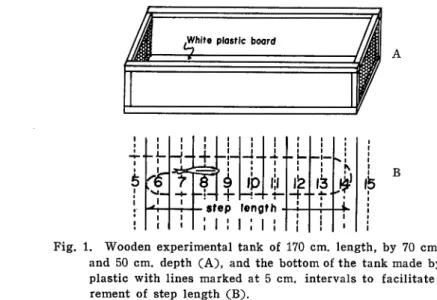
and kept in a fish-stock-preserve in the sea water pond of Sakura Jima Aquarium. Food used was cold Stolephorus japonicus (Houttuyn). A wooden experimental tank of 170 cm. length 70 cm. width and 50 cm. depth, with two of its opposing
side walls replaced with net, a white plastic board with lines marked at 5 cm.
intervals with black paint constituting the bottom was used (Fig. 1).
—' H 1——» L.-l— i i i i
i s
i*— . * I T" r—!—r • IP l;l step length ! i : i; i :6
\'2 13 0-f---s---7
feFig. 1. Wooden experimental tank of 170 cm. length, by 70 cm. width and 50 cm. depth (A), and the bottom of the tank made by white
plastic with lines marked at 5 cm. intervals to facilitate measu rement of step length (B).
92 Mem. Fac. Fish., Kagoshima Univ. Vol. 20, No. 1 (1971)
Five fish given no food for two days before the experiment, one of them being much larger than the others, were picked up from the fish-stock-preserve, and placed in the experimental floating tank in the pond. These fish forming them selves into a group continued to swim taking a rather fixed course around a fixed area. After a few hours, the time taken by the largest fish to repeat 50 turnes was recorded and each step length was measured. Illumination and water temperature were also measured simultaniously.
Actual data for this paper were collected after four days of training on taking measurements in day as well as night to minimize error. Measurements of each observation were repeated for 24-34 hours, and five observations were carried out 27-28 July (I), 20-21 August (II), 2-3 September (III), 19-20 October (IV) and 31 October-1 November (V).
Swimming activity is expressed by the swimming speed and the number of frequencies of the turns and is estimated by using the following formula
(SS/0-070xio-4
in which S is the step length (cm.), 7* is the number of frequencies of the turns
and t is time in minutes.
Result and Discussion
Results are shown in Fig. 2.
Sea water flow into the pond when tide rises and flow out from it when tide falls, so the daily changes in water temperature in the pond is irregular, but it shows the tendency that the water temperature is high during the day and low in the night. Average water tempeerature in each observation gradually de creased, viz. 28.9, 26.4, 28.5 23.0, 21.7°C.
Illumination decreased gradually until one or two hour before the sunset and thereafter rapidly and increased rapidly from one hour before sunrise. But in the daytime the illumination changed variably due to cloudiness.
In the daytime fish forming a group swam in the tank actively, and the swim ming activity changed variably and started to decrease just before the sunset and increased from one or two hours before sunrise. In the night they swam sluggishly in a mass and sometimes dispersed but immediately getting together again, never stopping swimming. Swimming activity is high in the daytime and low in the night. The difference is remarkable. Ii et. al.10) observed nocturnal behaviour of 26 kinds of fish and noted that the activity of nocturnal behaviour of mackerel was lower than that of diurnal behaviour. Accordingly, it is clear
that mackerel is a diurnal fish.
Hirata and Kobayashin) reported that diurnal rhythm of the feeding activity of gold fish was affected by objective enviromental factors such as water tem perature, duration of sunshine and dissolved oxygen. And Hirata12) peported that it was affected by the average temperature and change in water temperature. Nambia et. al.13) reported that the water temperature was found to be an important
*> 8 e 10 12 14 16 18 20 October 31 *V* November 1 ru r32 •12 •30 •10 •23 • 8 ••26 • 6 • 4 • 2 • 0 r 12 r30 •10 •28 • 8 •26 • 6 •24 - U
L22
- 2 . 0Fig. 2. Diurnal changes of swimming activity of mackerel (open circle and bold line), water temperature (broken line) and illumination (fine line).
94 Mem. Fac. Fish., Kagoshima Univ. Vol. 20, No. 1 (1971)
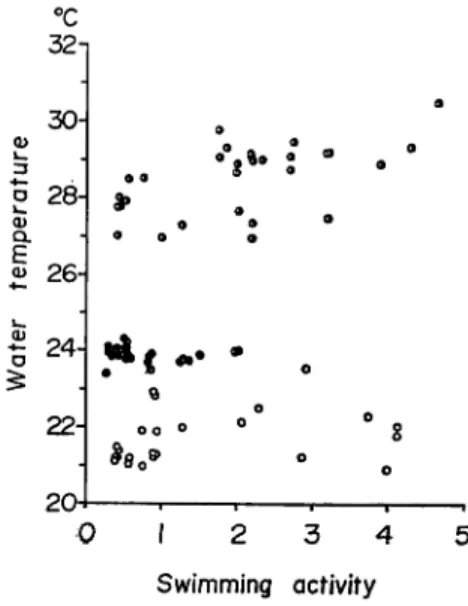
factor regulating the swimming speed. In this study the trend of change in
water temperature was irregular and did not agree with the trend of the swim
ming activity (Fig. 3). Furthermore, though the average water teperature in
the fifth observation was lower than in the first observation, there was no re
lation between swimming activity and change in water temperature. As spotted
mackerel is found distributed in water of temperature about 30 to 17°C, the
swimming activity of it may not be affected by such changes in water tempe
rature that occured in our observations.
32 30 28-•9 » 0) CL E 26-. . ' u . • o 24-22- 0 O ° *80* 20-,%• • 0 1 2 3 4 5 Swimming activity
Fig. 3. Relationship between swimming activity and water temperature
semi open circle : III observation 2-3 September
closed circle : IV observation 19-20 October
open circle : V observation 31 October-1 November.
As the diurnal changes of swimming activity agree with that of the illumina tion it is likely that tha latter affected the former. Tanoue14) reported that the difference in the illumination-intensity might be one of the important factors to help a good catch of mackerel under the solar eclipse.
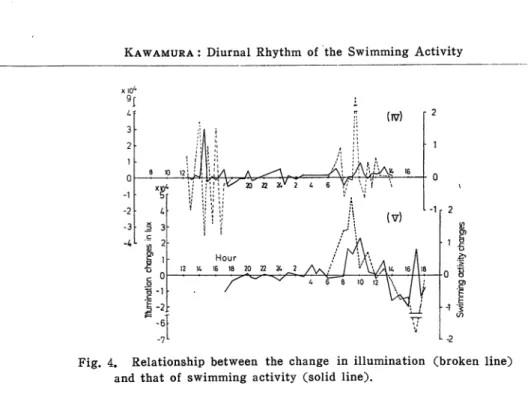
The relationship between the change in illumination and the change of swimm ing activity in the fourth and fifth observations is shown in Fig. 4. Between them, though there is no correlation in the fourth observation there is significant corre lation in the fifth observation. In the fourth observation the illumination chang
ed variably due to the effect of cloud between the measurement. Therefore this
figure does not explain the relationship between them clearly. In the fifth ob
servation the sky was clear and there was no variable change in the illumina tion, so the relationship between them could be more reliable.
The relationship between the illumination and the swimming activity is shown in Fig. 5. This figure shows significant correlation between them, and the
coef-Fig. 4. Relationship between the change in illumination (broken line) and that of swimming activity (solid line).
Fig. 5. X104 xuf 14-M • U; (v) 12-X # • 12- • • t
-io:
• • ID • • • • r 8- S' o 1 6: •• 6- • i *• • 4--" 2- • • • 4 . 2-• • oJ-4a- 0 * - • , — 1 2 0 1 Swimming activityRelationship between the illumination and the swimming activity.
ficients are r4=0.836 and r5=0.772, in other words the swimming activity increased
in proportion to the illumination (t=7.620, df : 20, p<0.001, t=4.028, df : 12, p< 0.005). When the illumination increased to 80000 lux the swimming activity in
creased a little and when the former increased above 80000 lux the latter inc
reased with a high rate. There must be some biological critical point at 80000
lux.
According to the reports of Atsl5) and Hunter,16) fish cannot maintain a school
in darkness. Pelagic schooling diurnal fish, such as spotted mackerel, might need a decrease of swimming activity in order to maintain a shool under low illumination. Brock and Riffenbourgh17) regarded the schooling of fish as a me chanism of protection against predation. And so it can be infered reasonably that the decrease of swimming activity under low illumination may be advan tageous to the species by enabling a school to be maintained under dim light and this could protect fish against predation.
96 Mem. Fac. Fish., Kagoshima Univ. Vol. 20, No. 1 (1971)
Summary
The author observed the diurnal rhythm of swimming activity of juvenile
spotted mackerel in the experimental tank floated in the sea water pond.
The
results were summarized as follows :
1)
Swimming activity was high in the daytime and low in the night.
2) Swimming activity was changed in proportion to the illumination and the
change in illumination.
Acknowledgments
The author wish to express their appreciation to Captain K. Takahashi and
the crews of Nansei Maru, a training ship of Faculty of Fisheries, Kagoshima
University for their help in making the catch of fish sample possible and to the
staff of the Sakura Jima Apuarium for their kind cooperation in carrying out
this work.
References
1) N. Y. Kawamoto and J. Konishi (1955) : Diurnal rhythm in phototaxis of fish. Rep. Fish.
Mie Univ., 2 (1), 7-17.
2) I. Kubo (1962): On the bimodality found in the catch of Japanese spiny lobster, Panulirus japonicus. Bull. Jap. Soc. Sci. Fish., 28 (3), 322-325 (in Japanese).
3) I. Kubo and N. Ishiwata (1964): On the relationship between activity of Japanese spiny lobster and under water light intensity. Ibid., 30 (11), 884-888. (in Japanese).
4) R. Kusuda (1963) : An ecological study of the anadromous "AYU" Plecoglossus altiveis T. et S-I. Diurnal variations in the composion of the anadromous AYU schools in the River Okumo, Ibid., 29 (9), 817-821. (in Japanese).
5) M. Hamabe (1964) : Study on the migration of squid (JOmmastrephes sloani pacificus
steen-strup) with reference to the age of the moon. Ibid., 30 (3), 209-215. (in Japanese).
6) T. Matsushita (1955) : Dailyrhythmic activity of the sperm whales in the Antarctic Ocean. Ibid., 20 (9), 770-773. (in Japanese).
7) S. Mishima S. Saito and K. Shimazaki (1966) : Study on the daily vertical movement of salmon-I. On the tendency of netting by gillnet. Ibid., 32 (11), 922-930. (in Japanese). 8) S. Mishima and K. Shimazaki )1969) : On the diurnal change of salmon catch by the
gill-net in the Okhotsk Sea. Bull. Fish. Hokkaido Univ., 20 (1), 5-21.
9) K. Shimazaki and S. Mishima (1969) : On the duirnal change of the feeding activity of salmon in the Okhotsk Sea, Ibid., 20 (2), 82-93. (in Japanese).
10) A. Ii, K. Inoue H. Tuge T. Ogawa and K. Uchihashi (1953) : Observations on the noc turnal behaviour of fishes-II. Bull. Jap. Soc. Sci. Fish., 19 (4), 239-242. (in Japanese). 11) H. Hirata and S. Kobayashi (1956) : Diurnal rhythm of the feeding activity of goldfish
in Autumn and early winter. Bull. Fish. HokkaidoUniv., 12 (2), 72-84.
12) H. Hirata (1960) : Diurnal rhythm of the feeding activity of goldfish with special reference to the inflection point of temperature changes. Bull. Jap. Soc. Sci. Fish., 26 (8), 783-791. (in
Japanese).
(13 K. P. P. Nambia, T. Hiyama and T. Kusaka (1970) : Behaviour of fish in relation to moving nets-Ill Effect of water temperature and diurnal rhythm on the avoidance of the fish.
Ibid., 36 (5), 476-480.
14) T. Tanoue (1959) : On the fluctuation of mackerel-long-line catch under the influence of the solar-eclipse. Mem. Fish. Kagoshima Univ., 19, 116-123.
15) J. W. Atz (1953) : "Orientation in schooling fish. In proceeding of a conference on orienta
tion in animals. Sect. 2." 103-130. (Office of Naval Reserch, Dept. Navy, Washington).
16) J. R. Hunter (1963) : Procedure for analysis of schooling behaviour. /. Fish. Res. Bd.
Canada, 23 (4), 547-562.
17) V. E. Brock and R. H. Riffenburgh (1960) : Fish Schooling: A possible factor in reduc