権利
Copyrights 日本貿易振興機構(ジェトロ)アジア
経済研究所 / Institute of Developing
Economies, Japan External Trade Organization
(IDE-JETRO) http://www.ide.go.jp
シリーズタイトル(英
)
IDE Spot Survey
シリーズ番号
30
journal or
publication title
Promoting 3Rs in Developing Countries
-Lessons from the Japanese Experience
page range
[59]-79
year
2008
____________________________
Michikazu Kojima ed., Promoting 3Rs in Developing Countries: Lessons from the Japanese Expe-rience, Chiba, IDE-JETRO, 2008.
Shipbreaking and Metal Recycling
Industries in Taiwan
Tadayoshi Terao
Introduction
Taiwan has attempted to systematize its waste management policy since the introduction of policy aimed at regulating environmental pollution in the late 1980s. At that time, the metal recovery industry was one of the most serious sources of industrial pollution and was one of the first big targets of the regulation. It was also expected that the introduction of a regulated system would allow the metal recovery industry to play an increasingly important role in promoting material recycling. After the 1960s, as rapid economic growth continued, shortages of resources such as metal became chronic. Taiwan’s metal recycling industry, which im-ported a great deal of metal scraps into the country, developed rapidly at this time. In particu-lar, the shipbreaking industry, which produced various kinds of iron and steel scrap in large quantities, became a major industry in southern Taiwan. The Kaohsiung Port became the cen-ter of the world’s shipbreaking industry in the 1970s and 1980s afcen-ter Japan’s domination ceased in the late 1960s. However, despite attempts, following the contraction of the global market in the late 1980s and early 1990s, Taiwan’s shipbreaking industry did not regain its former strength, and the majority of global shipbreaking now takes place in South Asia.
Along with large quantities of iron and steel, such as the “ship plate” used in rolling mills and scrap iron used in electric furnace-based steel production, as byproducts of the demolition process the shipbreaking industry brought Taiwan a range of used goods and waste products originating from various industrial commodities. Many small enterprises that made use of such miscellaneous materials existed and prospered around the shipbreaking area on the out-skirts of Kaohsiung Port in southern Taiwan. The various nonferrous metal scraps were known in Taiwan as fei-wuchin (“mixed metal scrap” in Mandarin Chinese).
The mixed metal scrap recovery companies eventually came to process not only the mate-rials originating from shipbreaking, but also from home electrical appliances as well as scrap electric wire and so on imported in large quantities as raw materials from developed nations such as the United States, Western Europe and Japan. The mixed metal scrap recovery indus-try, however, created water, air and soil pollution and was also the source of problems caused by discarded residual substances. Collectively, these became serious issues which caused longstanding environmental degradation. The environmental regulation of the mixed metal scrap recovery industry was one of the key issues in the formation of Taiwan’s waste man-agement policy.
This study focuses on the development of industries related to metal scrap recovery, with a particular emphasis on the shipbreaking industry that prospered in southern Taiwan, as the early history of the development of the country’s recycling industry. Through a survey of the historical background, the processes by which the modern metal recycling industry developed from the scrap mixed metal recovery business that grew up around the shipbreaking industry will be explained. Moreover, this investigation of the history of Taiwan’s shipbreaking try will reveal principles that have implications for the sound development of the same indus-try in South Asian countries.
In Section 1, the different periods are classified and the developmental process of the ship-breaking industry after World War II in Taiwan is examined. Section 2 provides a description of the business conditions surrounding the shipbreaking industry and the iron and steel mate-rials generated from shipbreaking. Section 3 analyzes the factors which caused the shipbreak-ing business to prosper in Taiwan and Section 4 explains the parallel development of the
met-al recovery industry, which was based on the nonferrous metmet-al scrap generated from ship-breaking. In Section 5, the environmental pollution problems caused by the scrap mixed metal recovery industry will be explained, and the relationship between the mixed metal scrap re-covery industry and the present-day recycling industry will be described.
3.1 Development of Shipbreaking Industry in Taiwan
Taiwan’s shipbreaking industry got its start after the Second World War with the salvage of wrecked vessels that had languished in the Keelung and Kaohsiung ports. According to Pan (1974) and Tsai (1993), the development of the shipbreaking industry of Taiwan after World War II can be classified into six periods.48
During the first period from 1946 to 1950 the main activities of the industry were the sal-vage of wrecked vessels and the removal of grounded vessels leftover from World War II. At the conclusion of World War II, there were 178 sunken vessels in the Kaohsiung Port (mostly small ships of around 100 to 200 MT in size, although there were 11 ships over 5000 MT) and more than 100 ships in the Keelung Port (five of which were over 7000 MT). In February 1946, the US Forces’ Far East general headquarters in Tokyo asked the Kaohsiung Port Ad-ministration Office to remove the sunken ship located at the entrance of the Kaohsiung Port by July of the same year to ensure the smooth passage of Japanese repatriation ships.
The government also promoted sunken ship salvation from the port by private enterprise by developing a legal framework for it which included the “Ship Salvage Promotion Act” and its “detailed enforcement rules” in 1947. Many companies entered the shipbreaking business during this period. Some of the vessels salvaged were repaired for further use rather than be-ing dismantled. Salvage of sunken ships in ports other than Kaohsiung and Keelung ports also got underway during this period, along with that of many vessels that sunk around the Penghu Islands during World War II.
The second period of development of Taiwan’s shipbreaking industry is from 1950 to 1952. Of the steamship lines that used inland routes along large rivers through mainland China or around the coastline, 29 relocated to Taiwan as the civil war on the mainland intensified. Traf-fic across the Taiwan Strait became impossible with the division of mainland China from Taiwan. Many of the steamships owned by these lines were small, and the voyage across open sea was difficult. As there was no river large enough to provide an inland route through Tai-wan, many of these steamships remained anchored or neglected for long time and were even-tually disassembled during this period.
The third period is from 1952 to 1962. During this time, many of the vessels operating in Taiwan had either been requisitioned from Japan following the end of colonial rule or were secondhand ships purchased from the United States, Canada and other countries. According to Chen (2005), 90% of the new vessels introduced in Taiwan every year until the second half of the 1960s were actually used vessels, many of them imported from abroad. Many of used ships requisitioned from Japan or introduced immediately after the conclusion of World War II, came to the end of their lives soon, and were disassembled during this period. Most of the vessels demolished during this period were supplied from within Taiwan.
48 Classification of shipbreaking industry’s development phases is based on Pan (1974) until the 1970s and on
The fourth period is from 1962 to 1978. Although the main supply of vessels for demolition came from within Taiwan by this period, the country’s shipbreaking industry hoisted itself onto the international stage during the early 1960s, and the supply from other countries ex-panded during this period. The size of vessels disassembled also increased as the number im-ported increased. In addition, the government set forth an incentive to promote the shipbreak-ing industry: the “Encouragement of Imported Vessels Dismantlshipbreak-ing Act,” which was enacted by the International Trade Administration Bureau of Ministry of Economic Affairs in 1965 and aimed at promoting and managing the importation of vessels for demolition. Furthermore, by providing special loans for the import of vessels for demolition from 1973, the government tried to strengthen the country’s shipbreaking industry from within before it was exposed to the severe competition of the international market.
During the fifth period from 1978 to 1986 most shipbreaking activity took place in Kaoh-siung Port, which was by then the center of the world shipbreaking industry. Although new entries to shipbreaking business in Kaohsiung Port were tried, shortage of space at the port’s specialized demolition wharf became a problem during in this period. The wharf was owned by the government and leased to contractors based on their past track record. At the same time, competition from countries new to the industry, such as mainland China, was being felt. As the international prices for iron and steel had remained low from the early 1980s, the Taiwan Shipbreaking Industry Association tried to suppress the prices of vessels for demolition by organizing a cartel of Taiwan’s shipbreaking companies in August 1982 to make joint pur-chases on the international market. However, keeping the members of the cartel in line proved difficult and it finally collapsed in October 1983 (Chang 1986, p. 27). Because of the la-bor-intensive nature of the business, Taiwan’s international competitiveness was quickly lost when wages rose sharply as a result of the country’s successful economic development.
The sixth period is the years following 1987. A fire caused by an explosion that occurred during the demolition process of a tanker at the Darengong Specialized Wharf for Shipbreak-ing at the Kaohsiung Port on August 11, 1986, killed 16 people and injured another 47. This serious accident once again focused attention on safety in the shipbreaking industry and led to the Kaohsiung Ports Administration announcing a policy which hastened the relocation of the shipbreaking wharf from Kaohsiung Port. As the international market in vessels for demoli-tion rapidly dried up due to changes in maritime transportademoli-tion in the latter half of 1980s, Taiwan’s shipbreaking industry suffered further damage, with the loss of its international competitiveness and the relocation of many businesses. Although the international market later began to recover in the mid-1990s, Taiwan’s shipbreaking industry did not regain its former prosperity and Kaohsiung Port lost its central position to south Asian countries such as India, Bangladesh and Pakistan.
The movement of the shipbreaking industry around the world from the beginning of the 1970s is shown in the Figure 1, while Figure 2 shows the change in the volume of vessels for demolition imported into Taiwan. By the middle of the 1970s, Taiwan already had one of the world’s largest shipbreaking industries. Although it continued to thrive until the mid-1980s, the amount of demolition decreased sharply during the late 1980s and did not recover. Almost all of the large vessels, such as crude oil tankers, dismantled in Taiwan were imported.
3.2 Conditions within the Shipbreaking Industry and Supply of Materials from Dismantled Ships
In this section, using the available data, we will examine the actual conditions within the shipbreaking industry, the number of enterprises, the quantity of vessels disassembled and the market for ship plate and scrap iron and other metals.
According to data issued in 1974 (Interchange Association 1974, p. 113), there were 117 shipbreaking enterprises in Taiwan employing a total of about 50,000 workers. Data issued in 1980 (Interchange Association 1980, p. 59) indicates that out of the 180 companies that were members of the Taiwan Shipbreaking Industry Association, only about 60 were actually en-gaging in the business. In addition, according to data issued in 1985, although about 200 companies were members of the Taiwan Shipbreaking Industry Association at the end of Sep-tember 1984, only about 50 of them were actually engaged in shipbreaking (Interchange As-sociation 1985, p. 42).49
These reports show that the number of companies actually operating within the demolition business was actually decreasing, rather than increasing, even though the number of compa-nies affiliated with the Taiwan Shipbreaking Industry Association increased by the first half of the 1980s, when the country’s shipbreaking industry was at its peak. As the total number of vessels being demolished did increase, it can be concluded that the scale of activities of each enterprise that was actually engaged in demolition generally expanded during this period.
The number of companies that joined the Taiwan Shipbreaking Industry Association until 1986 is shown in the Figure 3. The member companies are classified according to scale. Those companies in the “first class” achieved an annual demolition record of 50,000 MT or more, those in the “second class” did 30,000 MT or more, and those in the “third class” de-molished less than 30,000 MT.50 The number of member companies increased rapidly in 1973
and henceforth continued to rise, peaking at 209 in 1981. Overall, this change in the total number of member companies can be mainly attributed to comparatively small-scale “third class” companies, although the number of “first” and “second class” companies showed the most consistent increase until the middle of the 1980s.
The most important material obtained by the shipbreaking industry was iron and steel such as secondhand ship plate and scrap iron. According to Interchange Association (1974), the iron and steel obtained from dismantled ships with a Light Displacement Tonnage (LDT) of 604,487 in 1970 amounted to 432,489 MT. (The ratio of the metal to the weight of the dis-mantled ships was 0.7155).51 Out of the 432,489 MT of iron and steel from dismantled
ves-sels, 56% (242,285 MT) was ship plate and the remaining 44% (190,213 MT) was the scrap
49 The reports on the steel industry of Taiwan by the Interchange Association of Japan were published at least
four times: in 1974, 1980, 1985 and 1990. These reports were based on translation and reorganization of the publications issued by the Taiwan Steel and Iron Industries Association. The Interchange Association is a de facto diplomatic institution of Japan responsible for overseeing of external affairs related to Taiwan.
50 The data is from the Interchange Association (1974, p. 113), and the classification of the member companies
is based on data from Taiwan Shipbreaking Industry Association (1987, p. 97).
51 LDT (Light Displacement Tonnage) is total weight of a ship’s hull, machinery, equipment and spare parts. The
price per LDT has been used as an index in the shipbreaking market. The shipping industry, which supplies the vessels for demolition, however, measures the quantity of vessels for demolition not in a unit of weight, like LDT, but in a unit of volume, such as Gross Tonnage. As the corresponding relation between Gross Tonnage and LDT changes with the type or structure of different vessels, the Gross Tonnage cannot be translated into LDT simply by using a specific coefficient.
iron used mainly in electric furnaces. (See section 3 for a detailed description of the differ-ences between ship plate and scrap iron.) In the 1971 data, the amount of shipbreaking is rec-orded as 919,063 LDT, with 650,154 MT (ratio of 0.7074) of iron and steel generated. Out of the iron and steel, 409,747 MT (63%) was ship plate and scrap iron accounted for 240,407 MT (37%).
The data on domestic consumption of iron and steel generated from shipbreaking contains information about ship plate only. In 1970, the export volume of ship plate was 19,149 MT, while the amount of domestic consumption was 233,136 MT, giving a percentage of export of 7.89%. In 1971 export was 9,250 MT, while domestic consumption was 400,497 MT, giving an export ratio of only 2.26%. As indicated above, no data about the export of scrap iron ob-tained by shipbreaking was available.
Data on the domestic market for iron and steel material from dismantled ships could be ob-tained only for 1971. Regarding ship plate, 188,294 MT (47.14%) was sold to iron mills and 188,714 MT (47.12%) was sold to scrap merchants, with the remaining 22,989 MT (5.74%) used by the shipbreaking companies in the iron mills they themselves operated. In terms of scrap iron, 131,373 t (54.64%) was sold to other iron mills, 35,549 t (14.79%) was sold to scrap merchants and 73,486 t (30.57%) was used in the iron mills managed by the shipbreak-ing companies. This tells us that the total amount of scrap iron generated from shipbreakshipbreak-ing in 1971 was sold on the domestic market.
The amounts of scrap iron imported and exported by Taiwan are mostly consistent, with the exception of several years during the middle of the 1980s. The amount of imports began overwhelmingly exceeding the export amount at the start of the 1970s and this pattern con-tinued. (Exports and imports of scrap iron are shown in Figure 4 and Figure 5, respectively.) Therefore, it is thought that the proportion of export scrap iron that originated from ship-breaking was small, and that most of the scrap iron generated from shipship-breaking was used domestically.52
The amount of the iron and steel material generated from shipbreaking from 1982 to 1986 is estimated at 11,650,000 MT in total. This number is estimated as follows: The 15,580,000 LDT of shipbreaking of this period is multiplied by the coefficient to convert the volume of the vessel for demolition into its weight (0.88) and then multiplied by the ratio of that of iron and steel material (15,580,000 x 0.88 x 0.85 = 11,650,000). It is assumed that 0.748 MT (0.88 x 0.85) of iron and steel material is generated from 1 LDT of ship. Although this number was slightly higher than the 1970 and 1971 figures, it was a near value. Out of the iron and steel material derived from shipbreaking, ship plate constitutes 60%, and scrap iron 40%. There is also no significant difference between this rate and the value for 1970 and 1971.
The 11,650,000 MT of iron and steel generated from shipbreaking made up about 41% of the 28,410,000 MT total amount of “iron source” (iron equivalent unit of iron and steel ma-terial) used during this period in Taiwan.53 As the ship plate accounted for about 60% of this,
the proportion of ship plate generated from shipbreaking to the total amount of iron in Taiwan at that time is about 24%.
52 It is supposed that there was also a certain amount of export of ship plate that originated in shipbreaking after
the beginning of 1970s.
53 See Table 2-2 in Tsai (1993, p. 29), which is based on data from the Taiwan Shipbreaking Industry
From above data, it can be seen that a significant amount of the iron and steel material gen-erated from dismantled vessels was supplied to the iron and steel manufacturing industries in Taiwan, which were at the time growing rapidly. This is significant because, at this time, inte-grated steel manufacturing by blast furnace had not yet hit its stride and iron and steel materi-al generated from shipbreaking could substitute for a significant amount of scrap iron import (much of Taiwan was dependent on imported scrap iron supplies at that time). In the late 1980s, when the country’s shipbreaking industry shrunk rapidly, the volume of scrap iron im-ported into Taiwan actually increased. The amount of shipbreaking in Taiwan and the import of scrap iron are shown in Figure 1 and Figure 4, respectively. In addition, the large ves-sels—the raw material of the shipbreaking industry—procured for demolition were almost all sourced from outside the country and basically supplied at prices dictated by the international market.
3.3 Factors behind the Development of the Shipbreaking Industry
There is an international market in large vessels for demolition, and the shipbreaking industry is strongly affected by international market trends. The market in vessels for demolition is al-so strongly influenced by market conditions in marine transportation. As the construction of large vessels takes many months and their lifespan is very long, it is difficult to adjust the supply of maritime transportation service by changing the number of vessels, to affect condi-tions in the marine transportation market in the short term. When the marine transportation business is active and charter rates soar, even superannuated vessels continue to be used rather than be disassembled, and used ships are also sought after. Then, as the supply of vessels for demolition decreases, the price of these vessels rises. Conversely, when conditions in the ma-rine transportation market get worse and charter rates fall, the supply of vessels for demolition should increase.
Because of this strong influence of fluctuating market conditions in marine transportation, the supply and price of vessels for demolition generally tends to be unstable. It is difficult for large vessels that journey across borders to be completely regulated or protected by any one specific country. Consequently, not only is the market for marine transportation essentially international by nature, but so also is the market for vessels for demolition. Moreover, the products generated from shipbreaking, such as ship plate, iron scrap, used machines, miscel-laneous daily-use secondhand articles, mixed metal scrap and so on, are various.
The shipbreaking industry is also influenced by trends in the international price of scrap iron and other nonferrous metals. Changes in international metal prices can also be described an unstable factor in the development of the shipbreaking industry. Various advantageous conditions in respect to international competition served as a background to the development of the shipbreaking industry in southern Taiwan during the 1970s and 1980s. One of the fac-tors considered most important is the process of Taiwan’s rapid industrialization, which led to a big demand for iron as a raw material from iron and steel manufacturers based on the out-skirts of Kaohsiung Port. The construction boom also created a demand for large quantities of cheap construction materials, such as low quality iron bars. Shipbreaking generated large quantities of homogeneous ship plate at one time, which could then be heated and molded at low temperatures that did not cause it to melt. The iron bars, which were the main product of this process, could be used as low quality construction materials. Although problems
re-mained regarding the maintenance of quality levels, since the ship plate could be processed at a temperature lower than that needed for dissolution by electric oven, the simplicity of the process kept production costs low.54
Iron bar and wire manufacturing using ship plate is considered to have begun in Japan in the Taisho Era, prior to World War II. Along with the iron plate that came from shipbreaking in Japan, comparatively homogeneous scrap iron, such as irregular products from iron mills and waste iron plate generated in steel production processes, were used as raw materials. Most of ship plate was processed by rolling mills and then used in construction. However, the de-mand for low quality construction materials gradually decreased as Japan’s economy grew. Because the ship plate was not able to meet the JIS standard because of its variable quality, its use decreased in large-scale construction such as public work projects after the middle of the 1970s, and it had almost entirely disappeared from the market by around the early 1990s.
The companies that the demanded scrap iron that was generated from demolished ships in large quantities, such as the iron and steel manufacturers that used electric furnaces, were also concentrated in southern Taiwan. Many of Taiwan’s shipbreakers depended on this subsidiary market or on investment by the electric furnace iron manufacturers, who needed to secure a stable supply of scrap iron.
Other factors in the development of the industry are that the wages remained stable, the cost of recovery processes was still low and the problem of environmental pollution, with its costly countermeasures, had not yet arisen. In Kaohsiung, geographical conditions were also advantageous: the climate is warm and the port was not subject to freezing.
Another factor thought to be important in the development is the support provided by the government. As a preferential treatment measure, import regulations on vessels for demolition were lifted in 1965 and a low-interest loan program to support the importation of vessels for demolition was implemented in 1973. In addition, the Kaohsiung Port special wharf for ship-breaking was built on land leased from the government.
The data explaining the elements of international competitiveness of the shipbreaking business in Taiwan is slim. The Japan Shipbuilding Subcontractor’s Association (Nichizokyo) sent two research missions to Taiwan, in 1976 and 1979, to observe conditions in the Taiwa-nese industry and make comparisons with Japan’s situation.55 The Japan Shipbuilding
Sub-contractor’s Association (1976) investigated the cost structure of the shipbreaking business in Kaohsiung Port using data provided by the Interchange Association (1974) (the original data was from China Steel Corporation’s 1971 survey). This data was compared to the conditions
54 On the characteristics of shipbreaking industry, see Sato (2004, pp. 13-14).
55 See Japan Shipbuilding Subcontractor’s Association (1981), for an outline of their missions to and research in
Taiwan. The investigating commission’s general impression of Taiwan’s shipbreaking industry are as follows: (1) Wages were cheap and demolition processes used a lot of unskilled labor; (2) There was little plant-and-equipment investment in the apparatus for demolition and facilities, and the operation efficiency seemed low; (3) There was capital strength beyond that anticipated for the purchase of large vessels for demo-lition. Main points uncovered by their research are as follows: (1) The total number of laborers working on the demolition wharf at Kaohsiung Port was about 20,000 to 25,000; (2) Demolition work subcontracted out to groups of workers; (3) Most of ships dismantled were tankers weighing from 20,000 LDT to 30,000 LDT; (4) Reflecting the small amount of equipment used, recovery rate of scrap was not so high: only about 50% for passenger liners and 60 to 70% for cargo ships and tankers; (5) Pollution problems had not yet surfaced; (6) It became to be difficult to maintain the demolition wharf at Kaohsiung Port that was constructed on land bor-rowed from the government.
predicted for a Japanese shipbuilding subcontractor entering the shipbreaking business and the possibility of Japanese companies reentering the industry was examined (see Table 1).
The 1971 data relating to Taiwan shows that about 79% of a shipbreaker’s costs went to the purchase from the international market of vessels for demolition, with the cost of wages mak-ing up only about 2.5% of the total costs. To make comparisons with Japan in 1976, the Japan Shipbuilding Subcontractor’s Association converted the 1971 Taiwanese data to its 1976 equivalent using the index of wholesale prices and wages in Taiwan. Although the cost of vessels for demolition rose between 1971 and 1976, the rise in wages and fuel costs is sharper than that of vessels for demolition. In the comparison of Taiwan and Japan in 1976, although the cost of purchasing vessels for demolition from the international market are the same, labor costs in Japan are assumed to be three or more times those in Taiwan.
On the other hand, fuel costs in Japan were assumed to be one-fifth or less those in Taiwan. This significant difference is due to the composition of fuel. Liquefied oxygen and propane were mainly used in Japan, while in Taiwan there was more use of acetylene gas, and propane was not so readily available. There is almost no difference between equipment costs in Taiwan and Japan because the amortization costs of leasing the government-owned land in Kaohsiung Port and for load construction on that land were high, which kept “the cost of equipment” in Taiwan where demolition work was far more labor-intensive than in Japan, from dropping to a low level. Japan’s “other costs” were small because interest was not included.
The Japan Shipbuilding Subcontractor’s Association estimated that shipbreaking expenses for 1976 in Japan could be a little lower than in Taiwan, as shown in Table 1, if the interest burden was not taken into consideration. The Japan Shipbuilding Subcontractor’s Association concluded that, even with an interest burden taken into consideration, Japanese companies still should have been able to compete with Taiwan.56 In addition, based on the above
calcula-tions the Japan Shipbuilding Subcontractor’s Association concluded that the reason the Tai-wanese shipbreaking industry was prosperous was the high domestic prices of iron and steel material—which was a reflection of the high demand for materials such as ship plate and scrap iron by steel manufacturers—rather than the low wages.
Generally, the profitability of the shipbreaking industry depends upon the purchase price of the vessels for demolition, the cost of the ship dismantling process and the sale prices of ma-terials generated. Although the purchase price of vessels for demolition was determined by the international market, the towing voyage expenses to a demolition point occur. For purchas-ing-related expenses to reach a considerable level, the costs of raising funds must also be tak-en into consideration. Either labor-inttak-ensive processes or more machine-based process can be used in ship demolition work, and the option selected may be determined by the relative costs of labor and capital. Although the prices of goods and materials generated are influenced by the international market, taking relatively high transportation costs into consideration, the size of the domestic demand for generated material had the potential to be the key factor deter-mining the prosperity of Taiwan’s shipbreaking industry.
56 Japan was the world's largest shipbreaking country until the mid-1960s, when replaced by Taiwan. However,
demolition of large-sized vessel purchased from overseas was no longer performed by this time. In those days, sharp reduction of the subcontract business by serious shipbuilding depression serves as a backdrop to the shipbuilding subcontractors in Japan. They tried re-entry to the world shipbreaking business, and it was in-quired as an effective use measure of idle facilities. Although the Japanese government also introduced the preferential treatment to shipbreaking industry, as a support measure of remedy for recession, successful re-entry to shipbreaking business of Japanese companies could not be realized. See Chapter 2 of Sato (2004).
In the middle of the 1970s, domestic demand for iron and steel material generated from shipbreaking—especially the expanding demand for ship plate as a construction material that could be produced with at a low processing cost and the demand for scrap iron for processing by electric furnace, which was becoming more common as a production process—was the most important factor in the development of the shipbreaking industry in Taiwan. It is con-cluded that there was no significant change until the middle of 1980s, when Taiwan’s ship-breaking industry began to decline.
On the other hand, in Japan at the same time, the sharp decline in the demand for ship plate material that had already occurred is considered to be one of the factors preventing the suc-cessful reentry into the shipbreaking industry, contrary to the expectations of the Japan Ship-building Subcontractor’s Association.
3.4 Deployment of Shipbreaking Industry and Mixed Metal Scrap Recovery
The shipbreaking industry gradually came to wield significant political power with the rapid expansion of both the industry and individual companies. In the early stage, shipbreaking companies participated in the Taiwan Steel and Iron Industries Association, which was estab-lished in 1962, with the small Shipbreaking Subcommittee organized within the Association in 1966. In 1971, the Taiwan Shipbreaking Industry Association, which was established inde-pendently of the Taiwan Steel and Iron Industries Association, attracted more than 20 compa-nies.57
Mr. Wang Yuyun, the president of Hwa Eng Copper and Iron Corp., who also served as the chair of the Shipbreaking Subcommittee within the Taiwan Steel and Iron Industries Associa-tion, was elected as the first chair of the Taiwan Shipbreaking Industry Association. In the 1970s, Wang Yuyun entered politics as the Mayor of Kaohsiung City, and the Hwa Eng Group, a family company, grew by diversifying into electric wire manufacturing, finance and other industries. In addition, Mr. Pan Xiaorui, president of Nan Feng Steel Corp., one of the leading companies involved in the Taiwan Shipbreaking Industry Association at the time of its estab-lishment, also successfully branched out from shipbreaking and iron and steel manufacturing into the hotel business.58
The number of member companies of the Taiwan Shipbreaking Industry Association in-creased in line with development of the country’s shipbreaking industry, reaching its peak in 1981 with 209 companies. In addition to the scrap iron and ship plate, which are the main products generated from vessel demolition, various secondhand machines and parts, interior fixtures, various miscellaneous goods, mixed metal scrap, used electric wire and so on were all generated in large amounts as the industry developed.
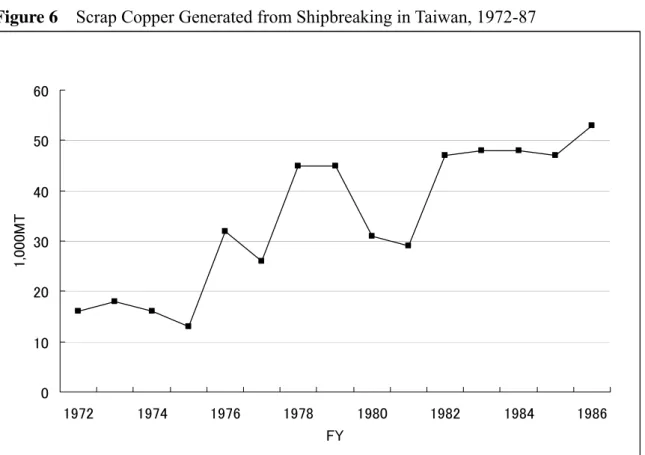
As the shipbreaking industry developed in southern Taiwan, many small companies that recovered metals from nonferrous metal scrap sprang up around it. Although the main prod-ucts shipbreaking are iron and steel materials, nonferrous metal scrap scraps are also propor-tionately generated as a byproduct of the process. Figure 6 shows changes in the amount of copper scrap generated from shipbreaking, based on data from the Taiwan Steel and Iron
57 Under the authoritarian regime in Taiwan, any social organizations were under control of the government, and
were put under the surveillance of the government and the ruling KMT (Kuomintang: Nationalist Party of China). See Terao (2002, pp. 270-71).
58 See China Credit Information Service, Ltd. (various issues), on examples of business groups originated in
dustries Association (1987).59 The amount of copper scrap generated was generally stable,
accounting for a little less than 2% of the total material generated from a single vessel. Used machinery accounted for another 2% of the total material generated and a market for it also developed around Kaohsiung Port.
As the supply of vessels for demolition—the raw material required by the shipbreaking in-dustry—was unstable, the supply of scrap mixed metal that was received by the metal recov-ery companies from the shipbreaking industry was also unstable. One of the actions taken by scrap mixed metal recovery companies to stabilize the supply of mixed metal scrap and to further expand their business was to import miscellaneous scrap mixed metal in the form of scrapped home electrical appliances, computer equipment, electric wire and so on.
These imports, from the United States, Japan and Europe, allowed the scrap mixed metal companies to further expand, although while the shipbreaking industry and companies oper-ating within it grew rapidly and became quite large, most of the metal scrap recovery compa-nies that grew up around of them remained small.60
There are numerous examples of electric furnace steel manufacturing enterprises operating shipbreaking companies as subsidiaries and the mutual entering between these businesses could be observed in Taiwan. There are also examples of shipbreaking companies started up by companies which had had their main focus on the steel manufacturing industry. These grew to be some of the biggest players in the shipbreaking industry. Tong Ho Steel Enterprise Corporation, an electric furnace steel manufacturer, is a typical example. However, examples of vertical integration of shipbreaking companies and mixed metal scrap recovery companies could not be found.
Although both shipbreaking and mixed metal scrap recovery can both be regarded as activ-ities undertaken within the broad scope of the scrap metal industry, which as a whole pro-gressed in southern Taiwan, conditions differed significantly between the two sectors. Al-though it was possible for a small scrap mixed metal company to enter the shipbreaking busi-ness in the 1950s, as demonstrated by Mr. Wang Yuyun and his brothers (who eventually moved into wire and electric cable production), as the shipbreaking industry developed it be-came more difficult for a small company to do so.
After the Taiwanese government’s introduction of an advanced public recycling system in the latter half of the 1990s, entry into this market by various types of private business was
59 Taiwan’s import volume of copper scrap is shown on Figure 5-7 of Terao (2005, p. 68). Compared to the
amount of copper scraps generated from shipbreaking shown on Figure 6, the import of copper scrap in the mid-1980s was about 40,000 MT, while the amount generated from shipbreaking was about 50,000 MT. It turns out that the amount generated from shipbreaking had reached the scale exceeding the volume of import at that time.
60 Although "mixed metal scrap" indicates valuable metals, when defining mixed metal scrap-related industry, it
is thought that it suits the actual condition that the industry which mainly treats iron and steel scrap distin-guishes from this. The scale of the company which mainly treats a steel scrap, such as those of shipbreaking industry, was far larger than mixed metal scrap recovery companies. Shipbreaking companies and mixed metal scrap recovery companies which included many informal workshops cannot be treated as a company of the same type. In addition, although the metal scrap separated from the mixed metal scrap for each kind of metal, such as copper and aluminum, might be called a mixed metal scrap in everyday expression, the definition of “mixed metal scrap” in Taiwan’s international trade statistics referred to metal scrap comprised of a mixture of various metals (or plastics and other materials derived from the original products) that could not easily be separated and that could not be categorized as the scrap of a single metal, such as lead scrap, copper scrap,
aluminum scrap, etc. It should be assumed that most of the metal scraps from waste consumer electronics products, etc. was classified in the international trade statistics and cleared customs as “mixed metal scrap.”
observed. Some of these new entries were enterprises that grew out of the scrap mixed metal recovery business and succeeded in transforming themselves into large integrated recycling plants that processed home electrical appliances and automobiles.
3.5 The Rise of the Scrap Mixed Metal Recovery Industry and Environmental Pollution Regulation
Companies involved in Taiwan’s scrap mixed metal recovery industry that developed around shipbreaking branched out into the recovery of metals from used home electrical appliances, electric wire and so on imported from the United States, Europe and Japan, and they grew rapidly in the 1980s. In this section, we will briefly examine the pollution problems that arose with the development of the industry and countermeasures against them that were taken by the Taiwanese government.
From the mid-1960s, when activities related to the recovery of metal from the scrap mixed metal imported from developed nations began to increase, pollution caused by improperly conducted recovery activities already existed. There are a number of reasons why metal re-covery from mixed metal scrap developed as an industry in southern Taiwan: (1) The ship-breaking industry was largely based at a specialized wharf at Kaohsiung Port. (2) Along with the scrap iron used as a raw material for steel manufacturing by electric furnace and ship plate (the raw material used in the production of steel rods for construction)—the main materials recovered from the disassembled vessels—came a significant amount of mixed metal scrap. (3) Metal recovery companies specializing in recovering metals from such mixed metal scrap grew up around the shipbreaking industry in Kaohsiung. In addition to the mixed metal scrap, many different kinds of used goods, such as various types of machinery, interior fixtures and miscellaneous items, were generated in large quantities and a market of buyers and sellers in those goods accumulated around Kaohsiung Port.
The pollution caused by the mixed metal scrap recovery industry increased to the point where it became a social problem after the import of mixed metal scrap increased rapidly again from around 1983. The main countries of origin were the United States and Japan. At this time, about 30,000 to 40,000 people were engaged in the mixed metal scrap recovery in-dustry in Kaohsiung and Tainan, where it was most highly concentrated. Including workers’ families, a total of over 100,000 people are considered to have been dependent on the industry (Environmental Protection Administration, Executive Yuan 1987, pp. 199-200).
Following the implementation of import regulations and the introduction of the classifica-tion of “mixed metal scrap” into foreign trade statistics, 400,000 to 500,000 MT per year was imported at the peak in the latter half of 1980s (see Figure 7). The government calculated that about one-third of the total amount of mixed metal scrap recovered at the time of peak import originated from Taiwan. Therefore, the total amount of mixed metal scrap recovered in Tai-wan, including that of domestic origin, is estimated to have been 700,000 MT or more per year at its peak. Specifically, this scrap mixed metal was derived from large home electrical appliances, electric wire, motors, host computers, personal computers and the like.
Most mixed metal scrap recovery companies were small, and their dismantling and non-ferrous metal recovery processes were quite labor intensive. Although smaller mixed metal scrap recovery industries also existed in northern and central Taiwan, most of it was concen-trated in southern Taiwan, around Kaohsiung and Tainan.
The mixed metal scrap industry has been the source of various pollution-related problems and accidents in Taiwan. Open burning of plastics, vinyl and other materials used to cover electric wire and cable generated dioxin and other poisonous gases. Household electrical ap-pliances discharged residual toxic substances such as heavy metals and strong acids that pol-luted soil and rivers and occasionally spontaneously ignited.61
From 1983, when environmental pollution became too great to ignore, as a countermeasure the government designated the industrial districts in southern Taiwan where many metal re-covery workshops were already concentrated as specialized metal rere-covery districts in order to impose control, and forced all workshops located elsewhere to relocate to these districts. The government’s first attempt to relocate all mixed metal recovery workshops to the specia-lized metal recovery district within the Dafa Industrial District in Kaohsiung County did not succeed and it was forced to additionally designate the Wangli Industrial District of Tainan City, besides the mouth of the river Erhren-hsi, which was also home too many metal scrap recovery workshops, as a second metal recovery district. These two industrial districts became the only places in Taiwan where the recovery of metal from mixed metal scrap could legiti-mately be carried out. Simultaneously, the government placed strict regulations on the impor-tation of mixed metal scrap, gradually reducing import permits by a significant amount.
At the end of 1985, 200 mixed metal scrap recovery factories employing about 1800 full-time workers were operating within the Dafa Industrial District. Another 188 factories were operating in the Wangli Industrial District. In total, it can be concluded that even at the beginning of the 1990s about 400 mixed metal scrap recovery factories were operating in Taiwan.
The accumulation of the mixed metal scrap recovery factories in the Dafa Industrial District was a result of the designation of the area as specialized district by the government. On the other hand, the Wangli Industrial District was approved by the government as a specialized district in recognition of the numerous metal recovery workshops that were already operating in the area. This difference in the processes by which the districts were formed is reflected in the significant differences in the character of the two areas. The Wangli area of Tainan City is characterized by small workshops that specialize in recovering mixed metal scrap such as electrical wire discarded by US military bases in the area.62
From 1983, the import of mixed metal scrap was gradually regulated using a step-by-step approach, beginning with the severely contaminated and continuing to the less contaminated. By January 1993 the import of mixed metal scrap was almost completely prohibited.63 When
the recovery companies in the Dafa Industrial District collectively refused the government’s request to build an incinerator to dispose of the residual substances leftover from processing
61 See Environmental Protection Administration, Executive Yuan (1987, pp. 199-200), and Terao (1993, pp.
167-71), on pollution problem by the metal recovery from mixed metal scrap in Taiwan.
62 According to the July 14, 1983 issue of “United Daily News” (news paper in Chinese), among population of
about 14,000 in Wangli area of Tainan City, about 10,000 people had made their living by a certain form in re-lation to metal scrap recovery business, directly or indirectly, at that time. There were also metal scrap recov-ery companies which made open burning of the mixed metal scrap originating in the imported disposed household electric appliances or the disassembled vessel, to gather valuable metal, on the vacant lot of dry river bed of the Erhren-hsi River.
63 Metal scrap recycling manufactures in Taiwan had continued demanding resumption of mixed metal scrap
import. Although the quantities and types of items were restricted, from the first half of the 2000s, the gov-ernment started to admit import of mixed scrap metal, only through the application by the companies which performs proper recycling process.
the mixed metal scrap, the government penalized them by reducing by half the amount of mixed metal scrap they could import.
The government repeated its request for the installation of an incinerator in 1989 and when no plans for installation were forthcoming it temporarily suspended all imports of mixed met-al scrap from October 1989. Although they were soon lifted each time, temporary suspensions on the import of electrical wire occurred repeatedly from 1983, when import control and reg-ulation began.
An incinerator was not installed and the residual substances from the processing of mixed metal scrap that accumulated in the Dafa Industrial District was neglected, although one company did engage in illegal open-air burning of the residual waste within the district. In 1989, some of this neglected residual waste ignited spontaneously, which led to a protest by local residents, who blocked entry and exit to the industrial district, effectively shutting it down. A similar incident had previously occurred in the Dafa Industrial District in 1986. A hazardous wastes incinerator was not installed in the Dafa Industrial District until 1999.64
As can be seen from the above, the measures by which the government set up specialized industrial districts to concentrate companies and control their operations were not effective in halting the spread of pollution and ensuring residual waste was properly dealt with. However, the import bans on the mixed metal scrap certainly reduced the scale of activities in the metal recovery industry in Taiwan, which has resulted in reduced environmental pollution.
On the other hand, a strong yen after the Plaza Accord in 1985 also affected the new Tai-wan dollar and TaiTai-wan’s comparative advantage in the mixed metal scrap recovery industry derived from the use of labor-intensive processes was lost as wages in the country rose. Some of the metal recovery companies that had their activities restricted in Taiwan by the ban on import of mixed metal scrap requested permission to relocate outside of the country. By the early 1990s some companies had already moved from Taiwan to mainland China and South-east Asian countries like Indonesia, Malaysia, Thailand and Vietnam.
After Taiwan’s import ban on mixed metal scrap in January 1993, the shift to mainland China progressed further. Compared to Taiwan, where import was restricted, regulation of pollution and waste was relatively severe and wages was high, mainland China and Southeast Asia offered favorable conditions for mixed metal scrap recovery companies. Much of the Taiwanese industry moved to an industrial district in Ningbo in Zhenjiang Province.
3.6 Conclusion: From Shipbreaking and Mixed Metal Scrap Recovery to Recy-cling
The shipbreaking industry of Taiwan began with the salvation of sunken ships undertaken to rehabilitate the harbor after World War II. Then, vessels transferred from mainland China un-der a strained cross-strait relationship were discarded and disassembled. Later, most of the disassembly was carried out on ships imported specifically for that purpose. Soon after ves-sels for demolition began to be procured from the international market the industry enjoyed a long expansion, with Taiwan’s shipbreaking industry becoming the world’s biggest during the 1970s and 1980s.
Miscellaneous nonferrous metal scrap other than steel was also inevitably generated in large quantities as a byproduct of the dismantling process as the industry developed and the
amount of disassembly rapidly increased, leading to the growth of the mixed metal scrap re-covery industry which sprang up around the shipbreaking industry. The supply of nonferrous scrap metal from shipbreaking was affected by instability in the shipbreaking business. In or-der to compensate for fluctuations in the supply of raw materials, mixed metal scrap recovery companies began importing scrap metal in the form of home electrical appliances discarded by developed nations, such as the United States and Japan, which enabled them to expand at an even faster pace.
Although the scale differed significantly, both shipbreaking and mixed metal scrap recovery were labor-intensive industries, and as issues related worker safety and environmental pollu-tion surfaced, both of these industries declined until the early 1990s as their internapollu-tional competitiveness weakened and Taiwan’s environmental regulation was enhanced. Examples exist of companies that started in shipbreaking becoming major electric furnace iron manu-facturers.
The metal recovery industry, which prospered in various forms in southern Taiwan, did not stop at metal production or metal processing, but also contributed to the development of the market for a variety of used equipment removed from the disassembled ships. Some compa-nies entered the hotel business using the furnishings and fixtures taken from passenger vessels. Furthermore, Mr. Wang Yuyun, a politician who controlled the “Kaohsiung Wang Faction,” one of the biggest local political factions in Kaohsiung, emerged from the shipbreaking indus-try.
The mixed metal scrap recovery industry can be considered to have provided the founda-tion for the development of various industries that had their origins in waste or used goods. It can also be considered to be one of the points of origin of Taiwan’s present-day recycling in-dustry. Many companies currently operating recycling plants under the public recycling sys-tem established by the government have their origins in the mixed metal scrap business.
Several examples of the mixed metal scrap recovery companies that relocated to mainland China or Southeast Asia to avoid Taiwan’s environmental pollution regulations were respon-sible for creating environmental pollution in its adopted country. On the other hand, there are several scrap metal reclamation companies that have conducted recycling activities appro-priately in their new location and have grown rapidly, contributing to the growth of the recy-cling industry within their host country. The mixed metal scrap recovery industry that devel-oped in Taiwan can be said to have supported the international circulation of metal resources and contributed to the development of the recycling industries in East and Southeast Asia.
The large quantities of miscellaneous nonferrous metal scrap originating from disassembled vessels that became available when Taiwan’s shipbreaking industry was the world’s largest was a significant contributing factor in the growth of the country’s mixed metal scrap recov-ery industry. The prosperity of Taiwan’s shipbreaking industry has been a strong influence on both the development of the international division of labor in the area of metal recycling and the country’s own present-day recycling industry, through its effect on the mixed metal scrap recovery business.
Based on a number of factors, the fact that the shipbreaking industry prospered could be said to have been a kind of historical accident. It had, however, important meaning for the development of the recycling industries in East and Southeast Asia.
After the 1990s, the center of the international shipbreaking industry moved from Taiwan to countries in South Asia, and the mixed metal scrap reclamation business has also moved from Taiwan to mainland China or Southeast Asian countries.
There are many examples of Taiwanese metal scrap reclamation businesses also moving to mainland China or Southeast Asia. Strict regulation on environmental pollution in Taiwan provided the impetus for mixed metal scrap recovery businesses to relocate to places where regulations were looser. However, it could be said that businesses that carried out recovery processes and activities appropriately in their new locations were pioneers in the local recy-cling industries.
The Taiwan experience could prove valuable for countries that are latecomers to metal re-cycling industry from the point of view of transboundary relocation of industries which im-port large quantities of mixed metal scrap from developed countries. Moreover, south Asian countries and mainland China, which are at the present center of the world shipbreaking in-dustry, are facing similar situations to that of Taiwan during the 1970s and 1980s, where non-ferrous metal scrap originating in vessels was generated in large quantities. An analysis of the Taiwanese experience could provide a referential framework for considering current problems faced by those late-coming countries as well as their future development. The introduction of severe regulations aimed at controlling pollution may depress domestic metal recycling in-dustries and encourage transboundary relocation. On the other hand, such policies, developed carefully, could prove the basis for the sound, long-term growth of those countries’ domestic recycling industries.
References
Chang, Rong-fuu. 1986. “Study of Taiwan’s shipbreaking industry” (in Chinese). Master dis-sertation, Graduate School of Industrial Management, National Cheng Kung University. Chen, Cheng-ta. 2005. “Developmental process of the Taiwanese shipbuilding industry in the
1970s: Formation and contraction of the export-oriented heavy and chemical industrializa-tions” (in Japanese). Paper presented at the Eastern Japan Annual Meeting of the Japan Association for Asian Studies, May 2005.
Chen, Li-chun, and Kazuhiro Ueta. 2002. “Taiwan.” In The State of the Environment in Asia
2002/2003, ed. Japan Environmental Council. Springer-Verlag.
China Credit Information Service. Various issues. Business groups in Taiwan (in Chinese). Taipei: China Credit Information Service.
Environmental Protection Administration, Executive Yuan. 1987. Yearbook of environmental
protection (1985 edition) (in Chinese). Taipei: Environmental Protection Administration,
Executive Yuan.
Interchange Association. 1974. Taiwan’s Iron and steel manufacturing industry (in Japanese). Tokyo: Interchange Association.
_________. 1980. Taiwan’s Iron and steel industry (in Japanese). Tokyo: Interchange Associ-ation.
_________. 1985. Current situation of Taiwan’s iron and steel industry (in Japanese). Tokyo: Interchange Association.
Japan Shipbuilding Subcontractor’s Association. 1976. “Is cost of ship demolition in Taiwan really low?” (in Japanese). Nichizokyo, no. 27, October: 24-25.
_________. 1981. Ten years of the Japan Shipbuilding Subcontractors Association (in Japa-nese). Tokyo: Japan Shipbuilding Subcontractor’s Association.
Pan, Sy-zuan. 1974. Old ship demolition in Taiwan (in Chinese). Taipei: Economic Daily News.
Sato, Masayuki. 2004. Shipbreaking industry: Modern history of Japan from the viewpoint of
iron and steel recycling (in Japanese). Tokyo: Kadensha.
Taiwan Shipbreaking Industry Association. 1987. Directory of Taiwan shipbreaking industry (in Chinese). Kaohsiung: Taiwan Shipbreaking Industry Association. Taiwan Steel and Iron Industries Association. 1983. Twenty years of the Taiwan Steel and Iron Industries
Association (in Chinese). Taipei: Taiwan Steel and Iron Industries Association.
Terao, Tadayoshi. 1993. “Taiwan: The Political Economy of Industrial Pollution.” In
Devel-opment and Environment: Experiences of East Asia, ed. Reeitsu Kojima and Shigeaki
Fu-jisaki, 139-99. Tokyo: Institute of Developing Economies.
_________. 2002. “Taiwan: From Subjects of Oppression to the Instruments of ‘Taiwaniza-tion’.” In The State and NGOs: Perspective from Asia, ed. Shinichi Shigetomi, 263-87. Singapore: Institute of Southeast Asian Studies.
_________. 2005. “The Rise and Fall of ‘Mixed Metal Scrap’ Recovery Industry in Taiwan: International Trade of Scraps and Transboundary Relocation of the Business.” In
Interna-tional Trade of Recyclable Resources in Asia, ed. Michikazu Kojima, 63-84. IDE Spot
Survey no. 29. Chiba: Institute of Developing Economies.
Togawa, Ken’ichi, and Rie Murakami. 2001. “A comparison of home appliances and automo-biles recycling system in Japan, Korea, and Taiwan” (in Japanese). Mita Journal of
Eco-nomics 94, no. 1: 23-47.
Tsai, Zheng-xun. 1993. “Study on transition of industry: An example of shipbreaking industry in Taiwan” (in Chinese), Master dissertation, Graduate School of Business Management, National Sun Yat-sen University.
Table 1 Cost Structure of Shipbreaking in Taiwan and Japan (1976 and 1971)
Cost Items Taiwan/1971 Taiwan/1976 Japan/1976
NT$ % NT$ % NT$ %
Purchasing vessel for dismantle 2,510 78.5 3,460 74.9 3,460 76.0 Wages 81 2.5 177 3.8 543 11.9 Fuel 138 4.3 275 6.0 49 1.1 Transportation 23 0.7 32 0.7 21 0.5 Depreciation 157 4.9 239 5.2 234 5.1 Others 287 9.0 437 9.5 246 5.4 Total 3,197 100 4,619 100 4,553 100
Sources: Interchange Association (1971, p. 120) and Japan Shipbuilding Subcontractor's Associa-tion (1976, pp. 24-25).
Notes: 1. Original data of Taiwan in 1971 is based on survey by China Steel Corp.
2. Data of Taiwan in 1976 was estimated by Japan Shipbuilding Subcontractor's Associa-tion, by using index of prices and wages in Taiwan.
3. Data of Japan in 1976 is based on hypothetical estimation by Japan Shipbuilding Sub-contractor's Association.
4. 'Others' of Taiwan included interest payment, while that of Japan did not.
Figure 1 World Shipbreaking Industry by Country, 1975-2001
Source: Compiled from the “Ship Building Data for 2002” published by the Ship Build-er’s Association of Japan.
Notes: 1. Vessels with a gross tonnage of 100 tons or more are covered.
2: The raw data is from Lloyd’s Register (Casualty returns for years up to 1993, world casualty statistics for years from 1994 onwards).
3: “Gross tonnage” is the unit used to express the internal capacity of a vessel. 1 gross ton is equivalent to 100 cubic feet.
0 5 10 15 20 25 1975 1980 1985 1990 1995 2000 Year M ill io n G ro ss T o nna ge
Figure 2 Taiwan’s Imports of Vessels for Dismantling by Origin, 1972-94
Sources: Compiled from the “Monthly Statistics of Imports, Taiwan District, Republic of China,” the Statistics Office, Directorate General of Customs, Ministry of Finance, various issues.
Figure 3 Number of Member in Taiwan Shipbreaking Industry Association
Source: Compiled from the data in Taiwan Shipbreaking Industry Association (1987, p. 97).
0 500,000 1,000,000 1,500,000 2,000,000 2,500,000 3,000,000 3,500,000 4,000,000 1972 1974 1976 1978 1980 1982 1984 1986 1988 1990 1992 1994 Year MT Others France Germany Sweden UK USA Japan 0 50 100 150 200 250 1971 1973 1975 1977 1979 1981 1983 1985 FY
1st Class 2nd Class 3rd Class Number of Company
Figure 4 Taiwan’s Import of Iron Scrap by Origin, 1972-2004
Sources: Compiled from the “Monthly Statistics of Imports, Taiwan District, Republic of China,” the Statistics Office, Directorate General of Customs, Ministry of Finance, various issues.
Figure 5 Taiwan’s Export of Iron Scrap by Destination: 1972-2004
Sources: Compiled from the “Monthly Statistics of Exports, Taiwan District, Republic of China,” the Statistics Office, Directorate General of Customs, Ministry of Finance, various issues. 0 50,000 100,000 150,000 200,000 250,000 300,000 350,000 400,000 450,000 1972 1976 1980 1984 1988 1992 1996 2000 2004 MT Others Vietnam Korea China Hong Kong Thailand Japan 0 500,000 1,000,000 1,500,000 2,000,000 2,500,000 3,000,000 3,500,000 4,000,000 1972 1976 1980 1984 1988 1992 1996 2000 2004 Year MT
Figure 6 Scrap Copper Generated from Shipbreaking in Taiwan, 1972-87
Source: Compiled from the data in Taiwan Shipbreaking Industry Association (1987, p. 24). Note: The data includes copper alloy.
Figure 7 Taiwan’s Import of “Mixed Metal Scrap” by Origin, 1984-93
Sources: Compiled from the “Monthly Statistics of Imports, Taiwan District, Republic of China,” the Statistics Office, Directorate General of Customs, Ministry of Finance, various issues.
0 10 20 30 40 50 60 1972 1974 1976 1978 1980 1982 1984 1986 FY 1, 000 M T 0 100,000 200,000 300,000 400,000 500,000 600,000 1984 1985 198 198 198 198 1990 1991 1992 1993 Year MT