Some
notes
onparametric
multilevel
q
‐Gevrey
asymptotics
for
somelinear \mathrm{q}
‐difference differential
equations
By
A. LASTRA
*and S. MALEK
**Abstract
This manuscript pretends toprovide asurvey of the work
[8],
which has beenpresentedinRIMS Symposium
Algebraic Analytic
Methods inComplexPartial Differential Equations.The concise scheme in thesenotesaimstogivea clear ideaonthe procedurefollowed in that
work,aswellastoclarifythesteps
underlying
inthe results in[8].
In the work
[8],
we studya familyof linearq−difference‐differentialequations, underthe actionofa perturbation parameter $\epsilon$. The procedure leans on a\mathrm{q}‐analog
of an accelerationprocedure anda q‐analog of
Ramis‐Sibuya
theoremin twolevels, based onthe ideas of theone‐level result in
[2].
§1.
IntroductionThis
manuscript
pretends
toprovide
anabridged slightly
modified version of thework
[8],
which has beenpresented
in RIMSSymposium Algebraic analytic
methodsin
complex partial
differentialequations.
Inthatwork,
theproblem
understudy
isthefamily
ofequations
ofq−difference‐differentialnature of theshape
Q(\partial_{z})$\sigma$_{q}u(t, z, $\epsilon$)=( $\epsilon$ t)^{d_{D}}$\sigma$_{q^{2}}R_{D}(\partial_{z})u(t, z, $\epsilon$)\neq^{d}+1
(1.1)
+\displaystyle \sum_{l=1}^{D-1}(\sum_{ $\lambda$\in I_{\ell}}t^{d_{ $\lambda$,\ell}}$\epsilon$^{$\Delta$_{ $\lambda$,\ell}}$\sigma$_{q}^{$\delta$_{\ell}}\mathrm{c}_{ $\lambda$,\ell}(z, $\epsilon$)R_{\ell}(\partial_{z})u(t, z, $\epsilon$))+$\sigma$_{q}f(t, z, $\epsilon$)
.2010MathematicsSubjectClassification(s): Primary35\mathrm{C}10; Secondary35\mathrm{C}20.
Key Words: asymptotic expansion, Borel‐Laplace transform, Fouriertransform, formalpowerse‐
ries,singular perturbation, q‐difference‐differential equation
partially supported bytheprojectMTM2012‐31439of Ministerio de Ciencia\mathrm{e}Innovacion, Spain
UniversityofAlcala, Departamentode Física\mathrm{y}Matemáticas, Ap. de Correos20, E‐28871Alcalá
de Henares(Madrid), Spain.
**
Universityof Lille1,Laboratoire PaulPainlevé,59655 VilleneuvedAscq cedex,France.
The
approach
followed hesontheappearanceoftwodifferentq‐Gevrey
asymptotic
behaviorof the formal solution linked to two
independent
respects. On theonehand,
the q
‐Gevrey
penomenoncoming
from the structure of theequation
itself,
but alsoanother q
‐Gevrey
order related with the coefficients involved. As a firstapproach,
one is
tempted
tostudy
anauxiliary problem
in the Borelplane
directly, following
the classical
Borel‐Laplace
method ofsummability
of formal solutions.However,
thisapproach
is doomed to failure no matter theGevrey
order we set in thestudy:
theBorel transform ofthe formal solution
might
not admit a slowenough
q‐exponential
growth along
anydirectionoritmight
remain asaformalpowerseriesof null radius ofconvergence. The alternative
procedure
followedis tosplit
the summationprocedure
intwo
steps.
Firstly,
weproceed
withaq‐analog
ofBorel‐Laplace
summation method ofalowertype, $\kappa$and attain the solution
by
meansofanacceleration‐like action.This idea is an
adaptation
of that in[6],
to the q‐Gevrey
case.Also,
the idea ofconcatenating
formal andanalytic
q‐analogs
of Borel andLaplace
operators
in ordertosolve q‐difference
equations
appears in[1].
The work
[8]
continues a series of works dedicated to theasymptotic
behavior ofholomorphic
solutions todifferent kinds ofq−difference‐differentialproblems involving
irregular
singularities investigated
in[3], [4], [7], [10].
These works canbe classifiedinthe branch of studies devoted to
study
from ananalytic
point
of view ofq‐differenceequations
and theirformal/analytic
classiffication in[18],
[11],
[12], [13], [14].
It isworth
pointing
outanotherapproach
inthe constructionofaq‐analog
ofsummability
for formal solutions to
inhomogeneous
linear q−difference‐differentialequations
basedon Newton
polygon
methods,
see[16],
and also the contribution in the framework ofnonlinearq
‐analogs
ofBriot‐Bouquet
typepartial
differentialequations,
see[19].
§2.
Description
of theproblem
We consider the
equation
(1.1)
for itsanalytic
andasymptotic study.
In thissection,
we
give
a briefdescription
of the elements involved in theequation
understudy
andtheir
precise
construction.Regarding
equation
(1.1),
D, k_{1}, k_{2}
arepositive integers
withD\geq 3
andk_{1}<k_{2}.
We write
$\sigma$_{q}^{ $\gamma$}
, for thegeneralized
dilationoperator
on tvariable,
$\sigma$_{q}^{ $\gamma$}(f(t))=f(q^{ $\gamma$}t)
.This definition is assumed tobe extended to formal power series. Let $\kappa$ be
given
by
1/ $\kappa$=1/k_{1}-1/k_{2}
. Assume thatI_{\ell}
is afinitenonempty
subset ofnonnegative integers
whilst
$\delta$_{\ell}
andd_{D}
arepositive integers,
for every1\leq\ell\leq D-1
. We also putd_{ $\lambda$,\ell}\geq 1
and
$\Delta$_{ $\lambda$,\ell}\geq 0
, forevery$\lambda$\in I_{l}
. We make theassumption
that$\delta$_{1}=1
and$\delta$_{\ell}<$\delta$_{\ell+1}
, for
every
1\leq P\leq D-1
. We assumethatPARAMETRICMULTILEVELq-GEVREYASYMPTOTICS QDIFFERENCE‐DIFFERENTIALEQUATIONS
forevery
1\leq\ell\leq D-1
and all$\lambda$\in I_{\ell}
. LetQ,
R_{l}\in \mathbb{C}[X]
with\deg(Q)\geq\deg(R_{D})\geq\deg(R_{\ell}) , Q(im)\neq 0, R_{D}(im)\neq 0,
for all
1\leq P\leq D-1
and m\in \mathbb{R}.We
require
the existence ofanunbounded sectorS_{Q,R_{D}}=\{z\in \mathbb{C}:|z|\geq r_{Q,R_{D}}, |\arg(z)-d_{Q,R_{D}}|\leq$\eta$_{Q,R_{D}}\},
forsome r_{Q,R_{D}},
$\eta$_{Q,R_{D}}>0
, such that\displaystyle \frac{Q(im)}{R_{D}(im)}\in S_{Q,R_{D}}, m\in \mathbb{R}.
Let $\sigma$\geq 2 be an
integer.
Let\mathcal{E}_{p}
be anopen sector withvertex at theorigin
andradius $\epsilon$_{0} forevery
0\leq p\leq $\sigma$-1
and such that\mathcal{E}_{j}\cap \mathcal{E}_{k}\neq\emptyset
forevery0\leq j, k\leq $\sigma$-1
ifand
only
if|j-k|\leq 1
(under
the notation\mathcal{E}_{ $\sigma$}
:=\mathcal{E}_{0}
)
and such that\displaystyle \bigcup_{p=0}^{ $\sigma$-1}\mathcal{E}_{p}=\mathcal{U}\backslash \{0\}
, forsome
neighborhood
of theorigin,
\mathcal{U}. Afamily
(\mathcal{E}_{p})_{0\leq p\leq $\sigma$-1}
satisfying
theseproperties
is knownas a
good covering
in\mathbb{C}^{\star}.LetTbeanopenboundedsectorwithvertex at0 and radius
r $\tau$>0
. We make theassumption
that(2.1)
0<$\epsilon$_{0}, r_{T}<1,
$\nu$+\displaystyle \frac{k_{2}}{\log(q)}\log(r_{T})<0,
$\alpha$+\displaystyle \frac{ $\kappa$}{\log(q)}\log($\epsilon$_{0}r_{T})<0,
$\epsilon$_{0}r_{T}\leq q^{(\frac{1}{2}- $\nu$)/k_{2}}/2
forsome v\in \mathbb{R}.
We consider a
family
of unbounded sectors(S_{\mathfrak{D}_{p}})_{0\leq p\leq $\sigma$-1}
withbisecting
direction0_{p}\in \mathbb{R}
andafamily
ofopendomains\mathcal{R}_{0_{p}}^{b}
:=\mathcal{R}_{0_{\mathrm{p}},\overline{ $\delta$}}\cap D(0, $\epsilon$_{0}r_{T})
, where\displaystyle \mathcal{R}_{\mathrm{b}_{p},\overline{ $\delta$}}=\{T\in \mathbb{C}^{\star}:|1+\frac{e^{i0_{p}}}{T}r|>\tilde{ $\delta$}
, foreveryr\geq 0\},
forsome\tilde{ $\delta$}>0.
We assume
\mathfrak{d}_{p},
0\leq p\leq $\sigma$-1
, are chosen so that some conditions are satisfied. Inorderto enumerate
them,
wedenoteq_{\ell}(m)
the rootsof thepolynomial
P_{m}( $\tau$)=\displaystyle \frac{Q(im)}{(q^{1/k_{2}})^{k_{2}(k_{2}-1)/2}}-\frac{R_{D}(im)}{(q^{1/k_{2}})^{\frac{(d_{D}+k_{2})(d_{D}+k_{2}-1)}{2}}}$\tau$^{d_{D}}.
We takeanunbounded sectorwithvertex at 0 and
bisecting
direction0_{p},
S_{\mathrm{D}_{\mathrm{p}}},
0\leq p\leq
$\sigma$-1; andwe choose
$\rho$>0
such that:1)
There existsM_{1}>0
such that| $\tau$-q_{l}(m)|\geq M_{1}(1+| $\tau$|)
holds for allm\in \mathbb{R},
2)
There existsM_{2}>0
andl_{0}\in\{0, d_{D}-1\}
such that| $\tau$-q_{l_{0}}(m)|\geq M_{2}|q_{l_{0}}(m)|
holds for every
m\in \mathbb{R},
$\tau$\in S_{\mathfrak{d}_{p}}\cup\overline{D}(0, $\rho$)
,and all0\leq p\leq $\sigma$-1.
3)
For every0\leq p\leq $\sigma$-1
wehave\mathcal{R}_{$\Phi$_{p}}^{b}\cap \mathcal{R}_{$\Phi$_{p+1}}^{b}\neq\emptyset
, and for all t\in Tand$\epsilon$\in \mathcal{E}_{p}
, wehave that
$\epsilon$ t\in \mathcal{R}_{\mathfrak{d}_{p}}^{b}
. Here wehaveput
\mathcal{R}_{v_{ $\sigma$}}^{b} :=\mathcal{R}_{v_{0}}^{b}.
The
family
\{(\mathcal{R}_{7_{p},\overline{ $\delta$}})_{0\leq p\leq $\sigma$-1}, D(0, $\rho$), T\}
is said to be associated to thegood
covering
(\mathcal{E}_{p})_{0\leq p\leq $\sigma$-1}
. Forevery0\leq p\leq $\sigma$-1
westudy
theq−difference‐differentialequation
Q(\partial_{z})$\sigma$_{q}u^{\mathrm{D}_{\mathrm{p}}}(t, z, $\epsilon$)=( $\epsilon$ t)^{d_{D}}$\sigma$_{q^{2}}R_{D}(\partial_{z})u^{$\theta$_{\mathrm{p}}}(t, z, $\epsilon$)\neq^{d}+1
(2.2)
+\displaystyle \sum_{l=1}^{D-1}(\sum_{ $\lambda$\in I_{\ell}}t^{d_{ $\lambda$,l}}$\epsilon$^{$\Delta$_{ $\lambda$,\ell}}$\sigma$_{\mathrm{q}}^{$\delta$_{\ell}}\mathrm{c}_{ $\lambda$,l}(z, $\epsilon$)R_{1}(\partial_{z})u^{$\Phi$_{p}}(t, z, $\epsilon$))+$\sigma$_{q}f^{0_{p}}(t, z, $\epsilon$)
.We now
give
somedetailonthe construction of the elements c_{ $\lambda$,l} andf^{0_{\mathrm{p}}}.
For every
1\leq\ell\leq D-1
and$\lambda$\in I_{l}
and everyinteger
n\geq 0, weconsiderfunctionsm\mapsto C_{ $\lambda$,l}(m, $\epsilon$)
andm\mapsto F_{n}(m, $\epsilon$)
belonging
tothe BanachspaceE_{( $\beta,\ \mu$)}
,forsome$\beta$>0
and$\mu$>\deg(R_{D})+1
. The Banach spaceE_{( $\beta,\ \mu$)}
consists of all continuous functionsh:\mathbb{R}\rightarrow \mathbb{C} such that
|h(m)|\leq C_{h}(1+|m|)^{- $\mu$}\exp(- $\beta$|m|) , m\in \mathbb{R},
forsome
C_{h}>0
. The infimum of suchC_{h}>0
defines its norm.We assume all these functions
depend
holomorphically
on$\epsilon$\in D(0, $\epsilon$_{0})
.Moreover,
we assume there exist
\tilde{C}_{ $\lambda$,l},
C_{F}>0
such that\Vert C_{ $\lambda$,\ell}(m, $\epsilon$)\Vert_{( $\beta,\ \mu$)}\leq\overline{C}_{ $\lambda$,\ell}
, for every $\epsilon$\inD(0, $\epsilon$_{0})
, and also\displaystyle \Vert F_{n}(m, $\epsilon$)||_{( $\beta,\ \mu$)}\leq c_{F$\rho$^{-n}q}\frac{n(n-1)}{2k_{1}}
,for all1\leq\ell\leq D-1, $\lambda$\in I_{\ell},
n\geq 0 and$\epsilon$\in D(0, $\epsilon$_{0})
.Then,
we putc_{ $\lambda$,f}(z, $\epsilon$)=\mathcal{F}^{-1}(m\mapsto C_{ $\lambda$,\ell}(m, $\epsilon$))(z)
,which,
for every1\leq\ell\leq D-1, $\lambda$\in I_{\ell}
, defines a boundedholomorphic
function onH_{$\beta$'}\times D(0, $\epsilon$_{0})
forany
0<$\beta$'< $\beta$
.Here,
H_{ $\beta$}
standsfor thestrip
H_{ $\beta$}=\{z\in \mathbb{C} : |\Im(z)|< $\beta$\}
. We assumethe formalpowerseries
$\psi$_{k_{1}}( $\tau$, m, $\epsilon$)=\displaystyle \sum_{n\geq 0}F_{n}(m, $\epsilon$)\frac{$\tau$^{n}}{(q^{1/k_{1}})^{\frac{n(n-1)}{2}}},
which is
convergent
onthe discD(0, $\rho$)
, canbeanalytically
continued withrespect
to $\tau$asafunction
$\tau$\mapsto$\psi$_{k_{1}}^{b_{p}}( $\tau$, m, $\epsilon$)
on aninfinitesectorU_{l_{p}}
ofbisecting
direction0_{p}
, and|$\psi$_{k_{1}}^{$\Phi$_{p}}( $\tau$,m, $\epsilon$)|\displaystyle \leq$\zeta$_{$\psi$_{k_{1}}}(1+|m|)^{- $\mu$}e^{- $\beta$|m|}\exp(\frac{k_{1}\log^{2}| $\tau$+ $\delta$|}{2\log(q)}- $\alpha$\log| $\tau$+ $\delta$|)
,for all
$\tau$\in U_{0_{p}}\cup\overline{D}(0, $\rho$)
andm\in \mathbb{R},somepositive
constant$\zeta$_{$\psi$_{k_{1}}}
which doesnotdepend
PARAMETRICMULTILEVELq-GEVREYASYMPTOTICSQ DIFFERENCE DIFFERENTIALEQUATIONS
Theq
‐Laplace
operatoracting
ondifferentstagesplays
tworolesinthe work: revertBorel
operations
actionfrom thestudy
ofauxiliary
problems
in the Borelplane,
andaccelerating
the solutions ofauxiliary problems.
We refer to Definition 3.3 for thedefinition ofq
‐Laplace
operator.One canprovethat the function
(2.3)
$\psi$_{k_{2}}^{\mathfrak{v}_{p}}( $\tau$, m, $\epsilon$) :=\mathcal{L}_{q;1/ $\kappa$}^{$\Phi$_{p}}(h\mapsto$\psi$_{k_{1}}^{$\theta$_{p}}(h,m, $\epsilon$))( $\tau$)
isacontinuous
complex
valued functionon(S_{l_{p}}\cup\overline{\mathcal{R}_{\mathfrak{y}_{p}}^{b}})\times \mathbb{R}
,holomorphic
withrespectto $\tau$on
S_{\mathfrak{D}_{p}}\cup \mathcal{R}_{0_{p}}^{b}
such that|$\psi$_{k_{2}}^{l_{p}}( $\tau$,m, $\epsilon$)|\displaystyle \leq$\zeta$_{$\psi$_{k_{2}}}(1+|m|)^{- $\mu$}e^{- $\beta$|m|}\exp(\frac{k_{2}\log^{2}| $\tau$|}{2\log(q)}- $\nu$\log| $\tau$|)
,for
$\tau$\in(S_{$\Phi$_{p}}\cup\overline{\mathcal{R}_{0_{p}}^{b}}),m\in \mathbb{R}
, forsome$\zeta$_{$\psi$_{k_{2}}}>0
, and some $\nu$\in \mathbb{R}. The constant$\zeta \psi$_{k_{2}}
depends
on$\zeta \psi$_{k_{1}}
sothat$\zeta \psi$_{k_{2}}( $\zeta \psi$_{k_{1}})\rightarrow 0
when$\zeta \psi$_{k_{1}}
tendstoO. Onecanapply
q‐Laplace
transform of order
k_{2}
tothefunction$\psi$_{k_{2}}^{\mathfrak{y}_{p}}
in $\tau$variableand,
indirection0_{p}
, and obtainthat the function
F^{v_{p}}(T, m, $\epsilon$):=\mathcal{L}_{q;1/k_{2}}^{$\theta$_{p}}( $\tau$\mapsto$\psi$_{k_{2}}^{\mathfrak{d}_{\mathrm{p}}}( $\tau$, m, $\epsilon$))(T)
,is a
holomorphic
function withrespecttoT variable in theset\mathcal{R}_{0_{p},\overline{ $\delta$}}\cap D(0, r_{1})
forany0<r_{1}\leq q^{(\frac{1}{2}- $\nu$)jk_{2}}/2.
We define the
forcing
termf^{0_{p}}(t, z, $\epsilon$)
by
f^{$\Phi$_{p}}(t, z, $\epsilon$):=\mathcal{F}^{-1}(m\mapsto F^{\mathfrak{d}_{p}}( $\epsilon$ t, m, $\epsilon$))(z)
,whichturns out tobe abounded
holomorphic
function defined onT\times H_{$\beta$'}\times \mathcal{E}_{p}
pro‐vided that
(2.1)
holds. Theoperator \mathcal{F}^{-1}
stands for the inverse Fouriertransform(see
Proposition
3.6).
§3.
Review ofsome formal andanalytic
transformsWe recall the definitions and main
properties
of q‐Borel,
q‐Laplace
and Fouriertransforms.
Throughout
thissection,
\mathbb{E} standsforacomplex
Banachspace. Theproofs
are omitted andcan be foundin
[15], [1],
[9]
and[8].
Let
q>1
be areal number andk\geq 1
be aninteger.
Definition 3.1. Let
\displaystyle \^{a}(T)=\sum_{n\geq 0}a_{n}T^{n}\in \mathrm{E}[[T]]
. We define the formalq‐Boreltransform of order k of
â(T)
astheformalpowerseries\hat{B}_{q;1/k}
(â(T))
( $\tau$)=\displaystyle \sum_{n\geq 0}a_{n}\frac{$\tau$^{n}}{(q^{1/k})^{n(n-1)/2}}\in
\mathrm{E}[[ $\tau$]].
Proposition
3.2. Let $\sigma$\in \mathrm{N} andj\in \mathbb{Q}
.Then,
thefollowing formal
identity
holds\displaystyle \hat{B}_{q;1/k}(T^{ $\sigma$}$\sigma$_{q}^{j}\hat{a}(T))( $\tau$)=\frac{$\tau$^{ $\sigma$}}{(q^{1/k})^{ $\sigma$( $\sigma$-1)/2}}$\sigma$_{q^{- $\sigma$}}^{j_{\mathrm{F}}}(\hat{B}_{q;1/k}
(â(
T))
( $\tau$))
,The q
‐Laplace
transform of order k>0 extends that used in[3]
for k=1, andintroduced in the work
[17].
Itprovides
acontinuousq‐analog
for the formal inverse of\hat{B}_{q;1/k}
developed
in[1].
The associated kernelof the q‐Laplace
operator isthe Jacobithetafunction of order
k,
$\Theta$_{q^{1/k}}(x)=\displaystyle \sum_{n\in \mathbb{Z}}q^{-\frac{n(n-1)}{2k}}x^{n}
,forx\in \mathbb{C}^{\star},
m\in \mathbb{Z}. As adirectconsequence of Lemma 4.1 in
[3],
extended foranyvalue of k, Jacobi theta function oforder k satisfies that forevery
\tilde{ $\delta$}>0
there existsapositive
constantC_{q,k}
notdepending
on
\tilde{ $\delta$}
, such that|$\Theta$_{q^{1/k}}(x)|\displaystyle \geq C_{q,k}\tilde{ $\delta$}\exp(\frac{k}{2}\frac{\log^{2}|x|}{\log(q)})|x|^{1/2}
, for every x\in \mathbb{C}^{\star}verifying
|1+xq^{m} $\tau$|>\tilde{ $\delta$}
, for all m\in \mathbb{Z}. This last propertyiscrucial in order for theq‐Laplace
transform of order ktobewell‐defined.
Definition 3.3. Let
$\rho$>0
andU_{d}
be an unbounded sector withvertex at 0 andbisecting
direction d\in \mathbb{R}. Letf
:D(0, $\rho$)\cup U_{d}\rightarrow \mathrm{E}
be aholomorphic
function,
continuouson
\overline{D}(0, $\rho$)
such that there existconstants K>0and $\alpha$\in \mathbb{R}with\displaystyle \Vert f(x)||_{\mathrm{E}}\leq K\exp(\frac{k}{2}\frac{\log^{2}|x|}{\log(q)}+ $\alpha$\log|x|)
forevery
x\in U_{d},
|x|\geq $\rho$
and\Vert f(x)\Vert_{\mathrm{E}}\leq K
for all
x\in\overline{D}(0, $\rho$)
. Take$\gamma$\in \mathbb{R}
such thate^{i $\gamma$}\in U_{d}
. We put$\pi$_{q^{1/k}}=\displaystyle \frac{\log(q)}{k}\prod_{n\geq
0}(1-\displaystyle \frac{1}{q^{\underline{n}+\underline{1}}\mathrm{F}})^{-1}
, and define theq‐Laplace
transform of order k off
indirection $\gamma$as\displaystyle \mathcal{L}_{\mathrm{q};1/k}^{ $\gamma$}(f(x))(T)=\frac{1}{$\pi$_{q^{1/k}}}\int_{L_{ $\gamma$}}\frac{f(u)}{$\Theta$_{q^{1/k}}(\frac{u}{T})}\frac{du}{u},
where
L_{ $\gamma$}
stands for theset\mathbb{R}_{+}e^{i $\gamma$} :=\{te^{i $\gamma$}
:t\in(0,
\inftyLemma 3.4. Let
\tilde{ $\delta$}>
O. Under thehypotheses of Definition
3.3,
\mathcal{L}_{\mathrm{q};1/k}^{ $\gamma$}(f(x))(T)
defines
a bounded andholomorphic function
on the domain\mathcal{R}_{ $\gamma$,\overline{ $\delta$}}\cap D(0, r_{1})
for
any0<r_{1}\leq q^{(\frac{1}{2}- $\alpha$)/k}/2
. The valueof
L_{q;1/k}^{ $\gamma$}(f(x))(T)
doesnotdepend
on the choiceof
$\gamma$under the condition
e^{i $\gamma$}\in S_{d}
due toCauchy formula.
Proposition
3.5. Letf
be afunction satisfying
theproperties
inDefinition
3.3,
and
\overline{ $\delta$}>0
.Then, for
every$\sigma$\geq 0
one hasT^{ $\sigma$}$\sigma$_{q}^{j}(\displaystyle \mathcal{L}_{q;1/k}^{ $\gamma$}f(x))(T)=\mathcal{L}_{q;1/k}^{ $\gamma$}(\frac{x^{ $\sigma$}}{(q^{1/k})^{ $\sigma$( $\sigma$-1)/2}}$\sigma$_{q}^{j-\frac{ $\sigma$}{k}}f(x))(T)
,for
everyT\in \mathcal{R}_{ $\gamma$,\overline{ $\delta$}}\cap D(0, r_{1})
, where0<r_{1}\leq q^{(\frac{1}{2}- $\alpha$)/k}/2.
Weare also
making
useof Fourier transform andsomeof itsproperties,
inthespirit
of[5, 9].
PARAMETRIC MULTILEVELq-GEVREYASYMPTOTICSQ DIFFERENCE DIFFERENTIALEQUATIONS
Proposition
3.6. Take$\mu$>1,
$\beta$>0
and letf\in E_{( $\beta,\ \mu$)}
. The inverse Fouriertransform
isdefined
by
\displaystyle \mathcal{F}^{-1}(f)(x)=\frac{1}{(2 $\pi$)^{1/2}}\int_{-\infty}^{\infty}f(m)\exp
(ixm)
dm,for
x\in \mathbb{R}, whichcanbe extendedtoan
analytic
function
onthestrip
H_{ $\beta$}
. Let$\phi$(m)=imf(m)\in E_{( $\beta,\ \mu$-1)}.
Then,
we have\partial_{z}\mathcal{F}^{-1}(f)(z)=\mathcal{F}^{-1}( $\phi$)(z)
,for
everyz\in H_{ $\beta$}.
Let
g\in E_{( $\beta,\ \mu$)}
and let$\psi$(m)=\displaystyle \frac{1}{(2 $\pi$)^{1/2}}(f*g)(m)
, the convolutionproduct of f
andg,
for
all m\in \mathbb{R}. Thefunction
$\psi$
is an elementof
E_{( $\beta,\ \mu$)}
.Moreover,
we have\mathcal{F}^{-1}(f)(z)\mathcal{F}^{-1}(g)(z)=\mathcal{F}^{-1}( $\psi$)(z)
,for
everyz\in H_{ $\beta$}.
§4.
Sketch of theprocedure
Thissection isthe maincoreof thesenotes. Weaim to
clarify
theprocedure
followedinthe construction of the
analytic
solutions of the mainproblem
understudy.
For thesakeof
clarity,
we focus onthe steps inthe construction rather thangiving
detailonthe technical and cumbersome
constructions,
which canall befound in[8].
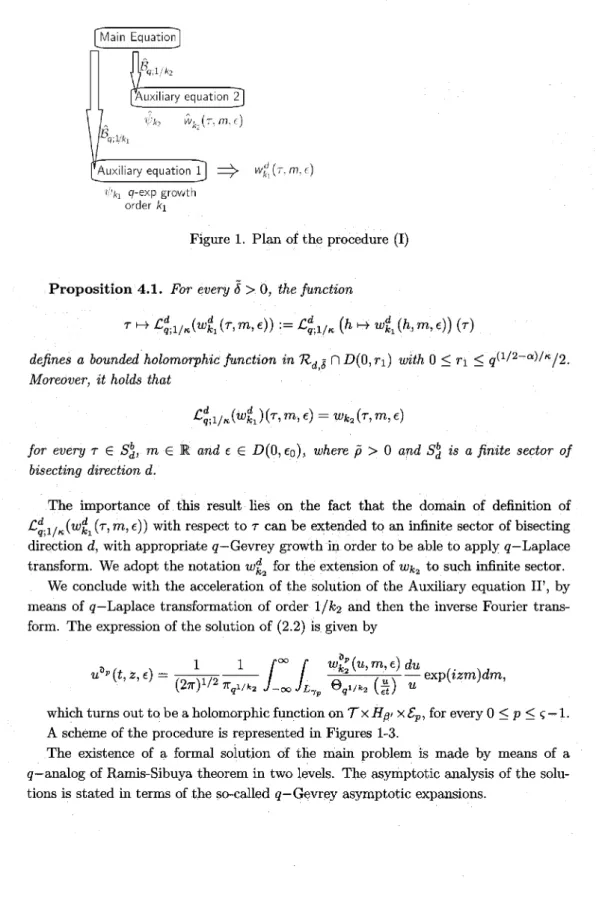
Let us consider the main
equation
(2.2)
for each0\leq p\leq $\sigma$-1
. We omit thesubindexp for the sake of
clarity,
refering
to d for the direction$\theta$_{p},
\mathcal{E}_{d}
for\mathcal{E}_{p}
andf
for
f^{0_{p}}
. Weapply
Fouriertransform atboth sides of theequation
andthen the formalq‐Borel transformation of order
k_{1}
.Equation
(2.2)
is transformed into theauxiliary
q−difference‐convolution
equation
(Auxiliary
equation
1)
Q(im)\displaystyle \frac{$\tau$^{k_{1}}}{(q^{1/k_{1}})^{k_{1}(k_{1}-1)/2}}w_{k_{1}}^{d}( $\tau$, m, $\epsilon$)=\frac{$\tau$^{d_{D}+k_{1}}}{(q^{1/k_{1}})^{(d_{D}+k_{1})(d_{D}+k_{1}-1)/2}}$\sigma$_{q}^{-d_{D}/ $\kappa$}R_{D}(im)w_{k_{1}}^{d}( $\tau$,m, $\epsilon$)
+\displaystyle \sum_{\ell=1}^{D-1}(\sum_{ $\lambda$\in I_{l}}\frac{$\epsilon$^{$\Delta$_{ $\lambda$,\ell}-d_{ $\lambda$,\ell_{T}}d_{ $\lambda$,\ell}+k_{1}}}{(q^{1/k_{1}})^{(d_{ $\lambda$,\ell}+k_{1})(d_{ $\lambda$,\ell}+k_{1}-1)/2}}$\sigma$_{\mathrm{q}}^{$\delta$_{\ell}-\frac{\mathrm{d}_{ $\lambda$}p}{k_{1}}-1}\frac{1}{(2 $\pi$)^{1/2}}(C_{ $\lambda$,i}(m, $\epsilon$)*^{Rp}w_{k_{1}}^{d}( $\tau$, m, $\epsilon$)))
(4.1)
Here,
we denote the convolutionproduct
+\displaystyle \frac{$\tau$^{k_{1}}}{(q^{1/k_{1}})^{k_{1}(k_{1}-1)/2}}$\psi$_{k_{1}}( $\tau$,m, $\epsilon$)
.h_{1}(m)*^{Q}h_{2}(m) :=\displaystyle \int_{-\infty}^{\infty}h_{1}(m-m_{1})Q(im_{1})h_{2}(m_{1})dm_{1}, m\in \mathbb{R},
foranycontinuousfunctions
h_{j}
:\mathbb{R}\rightarrow \mathbb{C},
j=1
,2.By
meansofa fixedpoint argument
inappropriate
Banach spaces offunctions,
wegetthe existence ofafunction
w_{k_{1}}^{d}
, continuous onU_{d}\cup D(0, $\rho$)\times \mathbb{R}
,holomorphic
withrespect to $\tau$ on
U_{d}\cup D(0, $\rho$)
, which solves(4.1)
and satisfiesforevery
$\tau$\in U_{d}\cup D(0, $\rho$)
, all$\epsilon$\in \mathcal{E}_{p}
andsomeC_{1}>0
. Thefunction w_{k_{1}} isholomorphic
on
D(0, $\epsilon$_{0})
withrespect totheperturbation
parameter.We
apply
Fouriertransformtothe mainequation
and thenformalq‐Boreltransformof order
k_{2}
. Thisprocedure
concludes with a secondauxiliary equation
(Auxiliary
equation
2):
Q(im)\displaystyle \frac{$\tau$^{k_{2}}}{(q^{1/k_{2}})^{k_{2}(k_{2}-1)/2}}\hat{w}_{k_{2}}( $\tau$, m, $\epsilon$)=R_{D}
(im)
\displaystyle \frac{$\tau$^{d_{D}+k_{2}}}{(q^{1/k_{2}})^{(d_{D}+k_{2})(d_{D}+k_{2}-1)/2}}\hat{w}_{k_{2}}( $\tau$, m, $\epsilon$)
+\displaystyle \sum_{\ell=1}^{D-1}(\sum_{ $\lambda$\in I_{\ell}}\frac{$\epsilon$^{$\Delta$_{ $\lambda$,l}-d_{ $\lambda$,\ell_{T}}d_{ $\lambda$,\ell}+k_{2}}}{(q^{1/k_{2}})^{(d_{ $\lambda$.\ell}+k_{2})(d_{ $\lambda$,\ell}+k_{2}-1)/2}}$\sigma$_{q}^{$\delta$_{\ell}-\frac{d_{ $\lambda$\ell}}{k_{2}}-1}\frac{1}{(2 $\pi$)^{1/2}}(C_{ $\lambda$,\ell}(m, $\epsilon$)*^{R_{\ell}}\hat{w}_{k_{2}}( $\tau$, m, $\epsilon$)))
+\displaystyle \frac{$\tau$^{k_{2}}}{(q^{1/k_{2}})^{k_{2}(k_{2}-1)/2}}\hat{ $\psi$}_{k_{2}}( $\tau$, m, $\epsilon$)
,Asitwas
pointed
outin theintroduction,
suchequation
can, inprinciple, only provide
formal solutions duetothe
forcing
term isonly
guaranteed
tobeformal.However,
onecan substitute
\hat{ $\psi$}_{k_{2}}
by $\psi$_{k_{2}}
, as defined in(2.3),
to arrive at a novelauxiliary
equation
(Auxiliary
equation
2 whichcanbeanalytically
solved.Q(im)\displaystyle \frac{$\tau$^{k_{2}}}{(q^{1/k_{2}})^{k_{2}(k_{2}-1)/2}}w_{k_{2}}( $\tau$, m, $\epsilon$)=R_{D}(im)\frac{$\tau$^{d_{D}+k_{2}}}{(q^{1/k_{2}})^{(d_{D}+k_{2})(d_{D}+k_{2}-1)/2}}w_{k_{2}}( $\tau$, m, $\epsilon$)
+\displaystyle \sum_{\ell=1}^{D-1}(\sum_{ $\lambda$\in I_{\ell}}\frac{$\epsilon$^{$\Delta$_{ $\lambda$.\ell}-d_{ $\lambda$,\ell}}$\tau$^{d_{ $\lambda$,\ell}+k_{2}}}{(q^{1/k_{2}})^{(d_{ $\lambda$,\ell}+k_{2})(d_{ $\lambda$,\ell}+k_{2}-1)/2}}$\sigma$_{q}^{$\delta$_{\ell}-\frac{\mathrm{d}_{ $\lambda$\ell}}{k_{2}}-1}\frac{1}{(2 $\pi$)^{1/2}}(C_{ $\lambda$,\ell}(m, $\epsilon$)*^{R_{\ell}}w_{k_{2}}( $\tau$,m, $\epsilon$)))
+\displaystyle \frac{$\tau$^{k_{2}}}{(q^{1/k_{2}})^{k_{2}(k_{2}-1)/2}}$\psi$_{k_{2}}( $\tau$,m, $\epsilon$)
,Indeed,
the solutionof theprevious
problem,
w_{k_{2}}( $\tau$, m, $\epsilon$)
, isholomorphic
with respectto $\tau$ on
S_{d}\cup \mathcal{R}_{d}^{b}
, andholomorphic
with respectto $\tau$ onS_{d}\cup \mathcal{R}_{d}^{b}
. There existsC_{2}>0
such that
|w_{k_{2}}( $\tau$,m $\epsilon$)|\displaystyle \leq C_{2}(1+|m|)^{- $\mu$}e^{- $\beta$|m|}\exp(\frac{k_{2}\log^{2}| $\tau$|}{2\log(q)}+ $\nu$\log| $\tau$|)
,forevery
$\tau$\in S_{d}\cup \mathcal{R}_{d}^{b},
m\in \mathbb{R},
$\epsilon$\in D(0, $\epsilon$_{0})
.Moreover,
thisfunction isholomorphic
withrespect to $\epsilon$ in its domain of definition. It can be obtained
by
a fixedpoint
argumentin
appropriate
Banach spacesof functions.At this
point,
onemayobserve thattwo different q‐Gevrey
levelsaredistinguished.
A first levelinthe Borel
plane,
inwhichw_{k_{1}}^{d}
lies;
and asecond level in the Borelplane
inwhich wk_{2} remains. The fist funtion has been obtained after Borel action of order
1/k_{1}
,whilst the secondoneisonly
at1/k_{2}
depth.
It is naturaltoexpect
someBorel‐likerelationship
of order1/ $\kappa$=1/k_{1}-1/k_{2}>0
amongthem. Asamatter offact,
onegets
PARAMETRICMULTILEVELq-GEVREYASYMPTOTICS Q DIFFERENCE‐DIFFERENTIALEQUATIONS
$\psi$_{h}
q‐expgrowthorderk_{1}
Figure
1. Plan of theprocedure
(I)
Proposition
4.1. Forevery\overline{ $\delta$}>0
, thefunction
$\tau$\mapsto \mathcal{L}_{q;1/ $\kappa$}^{d}(w_{k_{1}}^{d}( $\tau$, m, $\epsilon$)):=\mathcal{L}_{q;1/ $\kappa$}^{d}(h\mapsto w_{k_{1}}^{d}(h, m, $\epsilon$))( $\tau$)
defines
a boundedholomorphic function
in\mathcal{R}_{d,\overline{ $\delta$}}\cap D(0, r_{1})
with0\leq r_{1}\leq q^{(1/2- $\alpha$)/ $\kappa$}/2.
Moreover,
itholds that\mathcal{L}_{q;1/ $\kappa$}^{d}(w_{k_{1}}^{d})( $\tau$, m, $\epsilon$)=w_{k_{2}}( $\tau$, m, $\epsilon$)
for
every$\tau$\in S_{d}^{b},
m\in \mathbb{R} and$\epsilon$\in D(0, $\epsilon$_{0})
, where\tilde{ $\rho$}>0
andS_{d}^{b}
is afinite
sectorof
bisecting
direction d.The
importance
of this result lies on the fact that the domain of definition of\mathcal{L}_{q;1/ $\kappa$}^{d}(w_{k_{1}}^{d}( $\tau$, m, $\epsilon$))
with respectto $\tau$ can be extendedtoaninfinitesectorofbisecting
direction d,with
appropriate
q‐Gevrey growth
in ordertobe abletoapply
q‐Laplace
transform. We
adopt
the notationw_{k_{2}}^{d}
for the extension of w_{k_{2}} tosuch infinitesector.We conclude with the acceleration of the solution of the
Auxiliary
equation
II, by
means of q
‐Laplace
transformation of order1/k_{2}
and then the inverse Fourier trans‐form. The
expression
of the solution of(2.2)
isgiven by
u^{$\theta$_{p}}(t, z, $\epsilon$)=\displaystyle \frac{1}{(2 $\pi$)^{1/2}}\frac{1}{$\pi$_{q^{1/k_{2}}}}\int_{-\infty}^{\infty}\int_{L_{$\gamma$_{p}}}\frac{w_{k_{2}}^{0_{p}}(u,m, $\epsilon$)}{$\Theta$_{q^{1/k_{2}}}\{\frac{\mathrm{u}}{ $\epsilon$ t})}\frac{du}{u}\exp(izm)dm,
whichturns out tobea
holomorphic
functiononT\times H_{$\beta$'}\times \mathcal{E}_{p}
,forevery0\leq p\leq $\sigma$-1.
A scheme of the
procedure
isrepresented
inFigures
1‐3.The existence of a formal solution of the main
problem
is madeby
means of aq
‐analog
ofRamis‐Sibuya
theorem intwolevels. Theasymptotic
analysis
of the solu‐$\psi$_{k_{1}}
q‐expgrowthorderk_{1}
Figure
2. Planof theprocedure
(II)
$\psi$_{k_{1}}
q‐expgrowthorder k_{1}
Figure
3. Plan of theprocedure
(III)
Definition 4.2. Let V beaboundedopen sectorwithvertex at0in\mathbb{C}. Let
(\mathbb{F}, \Vert\cdot\Vert_{\mathrm{F}})
be a
complex
Banachspace. Letq\in \mathbb{R}
withq>1
and let k be apositive integer.
Wesay that a
holomorphic
functionf
: V\rightarrow \mathbb{F} admits the formal power series\hat{f}( $\epsilon$)=
\displaystyle \sum_{n\geq 0}f_{n}$\epsilon$^{n}\in \mathbb{F}[[ $\epsilon$]]
asitsq‐Gevrey
asymptotic expansion
of order1/k
if forevery opensubsector U with
(\overline{U}\backslash \{0\})\subseteq V
, there existA,
C>0 such that\displaystyle \Vert f( $\epsilon$)-\sum_{n=0}^{N}f_{n}$\epsilon$^{n}\Vert_{\mathbb{F}}\leq CA^{N+1_{q}\frac{N(N+1)}{2k}| $\epsilon$|^{N+1}},
forevery $\epsilon$\in U, and
N\geq 0.
We prove that the difference of two solutions u^{0_{p}} and u^{0_{p+1}} in the intersection of
their domain of definition withrespecttothe
perturbation
parameterisasymptotically
PARAMETRICMULTILEVELq—GEVREYASYMPTOTICS QDIFFERENCE DIFFERENTIALEQUATIONS
Let \mathbb{F} be the Banachspaceof
holomorphic
and bounded functionsdefinedonT\times H_{$\beta$'},
with thesupremum norm.
Lemma 4.3. There exists a
formal
powerseries\displaystyle \hat{f}(t, z, $\epsilon$)=\sum_{m\geq 0}f_{m}\frac{$\epsilon$^{m}}{rn!}
, withf_{m}\in
\mathbb{F}
for
everym\geq 0which is thecommonq‐Gevrey
asymptotic expansion
of
order1/k_{1}
on\mathcal{E}_{p}
of
thefunction
f^{\mathrm{f}_{\mathrm{p}}}
, seen asholomorphic functions from
\mathcal{E}_{p}
to\mathbb{F},for
all0\leq p\leq $\sigma$-1.
More
precisely,
the main result of the work[8]
readsasfollows:Theorem 4.4.
If
1/r_{Q,R_{D}},
\tilde{C}_{ $\lambda$,l}
andC_{F}
aresmallenough,
then there existsaformal
powerseries
û
(t, z, $\epsilon$)=\displaystyle \sum_{m\geq 0}h_{m}(t, z)\frac{$\epsilon$^{m}}{m!}\in \mathbb{F}[[ $\epsilon$]],
formal
solutionof
theequation
Q(\partial_{z})$\sigma$_{q}\hat{u}(t, z, $\epsilon$)=( $\epsilon$ t)^{d_{D2}}$\sigma$^{\frac{d}{q^{k}}\mathrm{n}+1}R_{D}(\partial_{z})\hat{u}(t, z, $\epsilon$)
+\displaystyle \sum_{p=1}^{D-1}(\sum_{ $\lambda$\in I_{\ell}}t^{d_{ $\lambda$,\ell}}$\epsilon$^{$\Delta$_{ $\lambda$,\ell}}$\sigma$_{q}^{$\delta$_{\ell}}c_{ $\lambda$,\ell}(z, $\epsilon$)R_{\ell}(\partial_{z})\hat{u}(t, z, $\epsilon$))+$\sigma$_{q}\hat{f}(t, z, $\epsilon$)
.Moreover,
û(t, z, $\epsilon$)
turns out tobe thecommonq‐Cevrey
asymptotic expansion
of
order1/k_{1}
on\mathcal{E}_{p}
of
thefunction
u^{0_{\mathrm{p}}}, seen asholomorphic function from
\mathcal{E}_{p}
into \mathbb{F},for
0\leq
p\leq $\sigma$-1
. In addition tothat,
û isof
theform
û
(t, z, $\epsilon$)=a(t, z, $\epsilon$)+\^{u} \mathrm{l}(t, z, $\epsilon$)
+û2
(t, z, $\epsilon$)
,where
a(t, z, $\epsilon$)\in \mathrm{F}\{ $\epsilon$\}
andûl
(t, z, $\epsilon$)
,\hat{\mathrm{u}}_{2}(t, z, $\epsilon$)\in \mathbb{F}[[ $\epsilon$]]
and such thatfor
every0\leq p\leq
$\sigma$-1, the
function
u^{0_{p}} can be written in theform
u^{0_{p}}(t, z, $\epsilon$)=a(t, z, $\epsilon$)+u_{1}^{0_{p}}(t, z, $\epsilon$)+u_{2}^{$\Phi$_{p}}(t, z, $\epsilon$)
,where
$\epsilon$\mapsto u_{1}^{0_{p}}(t, z, $\epsilon$)
is a \mathbb{F}‐valuedfunction
that admitsûl
(t, z, $\epsilon$)
as its q‐Gevrey
asymptotic expansion
of
order1/k_{1}
on\mathcal{E}_{p}
and also$\epsilon$\mapsto u_{2}^{v_{p}}(t, z, $\epsilon$)
isa\mathbb{F}‐valuedfunction
that admits
û2
(t, z, $\epsilon$)
asits q‐Gevrey
asymptotic expansion
of
order1/k_{2}
on\mathcal{E}_{p}.
For the
application
of theprevious
result to some factorizedproblem,
we refer toSection 7 in
[8],
References
[1]
T. Dreyfus, Building meromorphic solutions ofq‐difference
equations using a Borel‐[2]
P.Hsieh,Y.Sibuya,Basictheoryof ordinary differential equations.Universitext.Springer‐Verlag, NewYork, 1999.
[3]
A. Lastra, S. Malek, On q‐Gevrey asymptotics for singularly perturbedq‐difference‐
differential problemswithan
irregular
singularity.Abs.Appl.Anal. 2012, Art. ID860716,35pp.
[4]
A. Lastra, S. Malek, ParametricGevrey
asymptoticsfor singularly perturbed PDEswithdelays,Abstract andApplied Analysis,vol.
2013,
Article ID 723040.[5]
A. Lastra, S. Malek, Onparametric Gevrey asymptotics forsome nonlinear initial valueCauchy
problems, preprint ArXiv2014, toappear inJournalofDifferentialEquations.[6]
A. Lastra, S. Malek, Onparametric multisummableformal solutions to some nonlinearinitial value Cauchy problems, to appear inAdvances inDifferenceEquations.
[7]
A. Lastra, S. Malek, J. Sanz, Onq‐asymptoticsfor
q‐difference differential equationswith FUchsian andirregular singularities,Journal of DifferentialEquations,vol.252,Issue
10
(2012),
5185‐5216.[8]
A. Lastra, S. Malek, Onparametric multilevel q‐Gevrey asymptotics for some linear q‐difference differential equations,to appear inAdvances in Difference Equations,2015.
[9]
S. Malek, OnparametricGevrey
asymptoticsfor
aq‐analog
ofsome linear initial valueCauchy problem, to appearinFunkcialaj Ekvacioj, 2015.
[10]
S. Malek, Singularly perturbedq‐difference differential equationswithirregularsingular‐
ity,J.Dynam. Control.
Syst.
17(2011),
no.2, 243‐271.[11]
F. Marotte, C.Zhang,
Multisommabitité des séries entières solutions formelles duneéquation aux q‐différences linéaire analytique. Ann. Inst. Fourier
(Grenoble)
50(2000),
no. 6, 1859‐1890
(2001).
[12]
J.‐P. Ramis, J. Sauloy, C.Zhang,
Localanalytic classiffication ofq‐difference equations.Astérisque
No. 355(2013),
\mathrm{v}\mathrm{i}+151pp.[13]
J.‐P.Ramis,J.Sauloy,
C.Zhang, Développement asymptotiqueetsommabilité des solutionsdeséquationslinéairesauxq‐differences.
(Fb ench) [Asymptotic
expansionandsummabilityof solutions of linear \mathrm{q}‐difference
equations]
C. R. Math. Acad. Sci. Paris 342(2006),
no.7,515‐518.
[14]
J‐P.Ramis,C.Zhang,
Développement asymptotique q‐Gevrey etfonctionthêta deJacobi.(French)
[
\mathrm{q}‐Gevrey asymptotic expansion and Jacobi thetafunction]
C. R. Math. Acad.Sci. Paris 335
(2002),
no. 11, 899‐902.[15]
J.‐P. Ramis,About thegrowth ofentirefunctions
solutionsoflinearalgebraicq‐difference
equations.Ann. Fac. Sci. Toulouse Math.
(6)
1(1992),
no. 1,53‐94.[16]
H. Tahara, H. Yamazawa, q‐analogueof
summabilityof formal
solutions ofsome linearq‐difference differential equations,toappearinOpusculaMathematica 2015.
[17]
L. DiVizio, C.Zhang,
Onq‐summation andconfluence.Ann. Inst. Fourier(Grenoble)
59(2009),
no. 1, 347‐392.[18]
L. DiVizio,J.‐P.Ramis,J.Sauloy, C.Zhang,
Equationsauxq‐differences.Gaz. Math. No.96