UItradiscrete Soliton Systems
and
Combinatorial
Representation
Theory
${\rm Re}\dot{\ovalbox{\tt\small REJECT}}ho$
Sakamoto
Department$\mathfrak{o}fPhys\dot{\ovalbox{\tt\small REJECT}}cs$
, Tokyo
University
of$Sc\dot{\ovalbox{\tt\small REJECT}}$ence, Kagurazaka $Sh\dot{\ovalbox{\tt\small REJECT}}$
njukuku Tokyo Japan
1
Introduction
This lecture note is intended to be a brief introduction to a recent development on the interplay between the ultradiscrete (or tropical) soliton systems and the combinatorial representation theory. We will concentrate onthe simplest
cases
which admit elementary explanations without losing essential ideas of the theory. In particular wegive definitions for the main constructions corresponding to the vector representation of type $A_{1}^{(1)}.$This note is organized as follows. In Section 2 we give a definition ofthe simplest ex-ample ofthe box-ballsystems. InSection
3 we
explaina
relationship between the box-ball systems and the crystal bases of the quantum affine algebras. InSection 4 we
give the definition of the rigged configuration bijection for the vector representation oftype $A_{1}^{(1)}.$In Section 5 we see that the riggedconfigurations give the complete set of the action and angle variables for the box-ballsystems. This is thefundamental observation in the recent development on a relationship between the box-ballsystems and thecombinatorial
repre-sentationtheory. In Section 6
we
explain basic properties ofthe box-basket-ball systemswhich
are
recently found generalizations of the box-ball systems. The characteristic prop-erty of the system is that it is a mixture offermions and bosons with mutual interactions. Finally, in Section 7,we
give commentson
generalizations and further developments of the materials discussed in this note.This is the lecture note prepared for the conference “Algebraic Combinatorics related to Young diagram and statistical physics” held at International Institute for Advanced Studies (Kyoto) during August 6-10,
2012.
The author is grateful to Professor Masao Ishikawa, Professor Soichi Okada and Professor Hiroyuki Tagawa for the kind invitation to the conference and thewarm
hospitality.2
The
box-ball
systems
In this section, let
us
define the simplestcase
of the box-ball systems introduced by Takahashi and Satsuma [TS]. The box-ball systems are prototypical examples of the ultradiscrete soliton systems. Originally the ultradiscrete soliton system isa
class of discrete dynamical systems obtained by the ultradiscrete (or tropical) limitof the ordinary soliton systems [TTMS]. In this articlewe
are interested in ultradiscrete soliton systems which admit combinatorial interpretations.Following the box and ball interpretation of the system [T3],
we prepare
boxes whichcan
accommodate at mostone
ball within each box. We put many such boxeson a
line and put finitely many balls of thesame
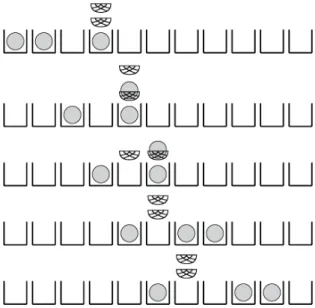
kind to the boxes. We regard this configuration asthe initial state of the system. Then we perform the time evolution of the state by the following algorithm.The time evolution ofthe box-ball system: Consider each ball from left to right and
move
the ball to the nextavailable
empty box.Each
ball is moved exactlyonce.
Hereifnecessarywe put enoughmanyempty boxesonthe right of the givenstateinorder to keep the balls within the state. We give an example of such time evolution starting from the top
row
and proceeding downwards.Inthe box-ball system,
we
regardconsecutiveballsas
solitarywaves.
For example, the ini-tial state in the above examplecontainstwosolitary waves of length3 and 1, respectively. Then our interpretation of the above example isas
follows. If there isno
interaction between waves, theymove
at velocity equal to each length. In thecourse
of the time evolution, solitarywaves
make collision with each other, though theyretain their original shapes after the collision except for the changes in the positions compared with the pos-sible positionswe would have if there isno interaction betweenwaves.
Such properties of the waves of the box-ball systemsare
characteristic of the soliton systems (see, e.g., [T4]) andwe
will call suchwaves
solitons.Here
we
givea
short list of remarkson
the earlypapers.
During $1980’ s$, therewere
several attempts of findingcellular automata with solitonic properties. A typical example of such researchesis thefilter automata introducedbyPark, Steiglitz andThurston [PST]. In 1990, Takahashi and Satsuma [TS] introducedthe simplest
case
ofthe box-ball systems and Takahashi [T3] described the algorithm in terms ofthe boxes and balls. The above definition corresponds to the original Takahashi-Satsuma box ballsystem. A relationshipbetween theTakahashi-Satsuma box-ballsystem and the ordinary soliton systems includ-ing the $KdV$ equation is discovered by Tokihiro, Takahashi, Matsukidaira and Satsuma
[TTMS] via the limiting procedure called the ultradiscrete limit. A connection with the Toda equation is discussed in [NTT]. Such connections between the box-ball system and the usual soliton systems show the classical integrability of the box-ball system.
Takahashi’sbox and ball algorithm provides several generalizations of the original box-ball system. For $exam\iota\rangle$}$e$, in [T3]
an
internal degree of freedom for the balls (balis withdifferent colors) is introduced. A connection with the Toda equation in the generalized context is discussed in [TNS]. The other degrees of freedom called a carrier [TM] or a capacity of boxes [TTM]
are
also introduced. Such combinatorial interpretations of the time evolutions give nice intuition about the models in manycases.
3
A
connection
with
the
crystal
bases
A veryimportant fact [HHIKTT, FOY] about the box-ball systems is that their dynamics is infactgoverned by the Kashiwara’s crystal bases [K2] forthe quantumaffine algebras. This formalism includes all extensions of the box-ball system which
are
mentioned in the last section. Although the formulation does not depend on the types ofthe algebra, we will concentrate on the simplestcase
$A_{1}^{(1)}$here.
In order to describe the formulation, we need to consider more general boxes which
have capacities more than one. Let $(a, b)$ represents the box of capacity $a+b$ containing
$b$ balls. Then the state $(a, b)$
can
accommodate extra$a$ balls. Letus
denote the set of allsuch states
as
$B^{1,s} :=\{(a, b)|a, b\in \mathbb{Z}_{\geq 0}, a+b=s\}$ (1)
which we call
crystals.1
In particular we call $B^{1,1}$ the crystals for the vectorrepre-sentation. In this coordinate, the states of the box-ball system in the previous section
are
sequences of balls $(0,1)$ and empty places $(1, 0)$. Thenwe
represent the statesas
$(1, 0)\otimes(0,1)\otimes\cdots$ where $\otimes is$ the tensor product ofcrystals (thereaders may regardthis
asjust alternativenotation). We call such elements of tensor products paths.
The main ingredient of the formalism is the map called the combinatorial$R$-matrices $R$ : $B^{1,s}\otimes B^{1,s’}$ $arrow$ $B^{1,s’}\otimes B^{1,s}$
(2)
$(a, b)\otimes(c, d) \mapsto (c’, d’)\otimes(a’, b$
In the present
case
$A_{1}^{(1)}$, the explicit form of the map is
$a’=a+ \min(b, c)-\min(a, d)$
$b’=b- \min(b, c)+\min(a, d)$ $c’=c- \min(b, c)+\min(a, d)$
$d’=d+ \min(b, c)-\min(a, d)$. (3)
An important point of the map $R$ is that it has a deep mathematical origin as the inter-twining map that interchanges left and right of the tensor products of crystals. For the laterpurposes we introduce avertex diagram for the map $R:a\otimes b\mapsto b’\otimes a’$
as
follows:1In general, we can identify the Kirillov-Reshetikhin crystals $B^{r,s}$ for type $A_{n-1}^{(1)}$ with the set of $r\cross s$ semistandard tableauxwith letters 1, 2,...,$n$. In this identification our $(a, b)$ is the height one
semistandard tableau with$a$ $1$’sand$b2’ s.$ $B^{r,s}$ corresponds to the Kirillov-Reshetikhin module naturally
$a+_{b’}^{b}a’.$
By a repeated
use
of the map $R$ we define the time evolution of the box-ball systems$T_{l}(l\in \mathbb{Z}_{\geq 1})$
as
follows. Let $u_{l}$ $:=(l, 0)$ be the empty box of capacity$l$ and let $b=$ $b_{1}\otimes b_{2}\otimes\cdots\otimes b_{L}$ be
a
given state of the box-ball system. We call $u_{l}$ the carrier. Ifnecessary
we
put enough many empty boxes $(1, 0)$on
the right. Then we define $b_{1}’$, ..
.,$b_{L}’$ by the following diagram.
(4) Here the precise meaning of the diagramis
as
follows. We compute$R$ : $u_{l}\otimes b_{1}\mapsto b_{1}’\otimes u_{l}^{(1)}.$Then by using$u_{l}^{(1)}$ we compute $R:u_{l}^{(1)}\otimes b_{2}\mapsto b_{2}’\otimes u_{l}^{(2)}$. We dothis procedure recursively
until the end ofthe state. Then
we
define$T_{l}(b):=b_{1}’\otimes b_{2}’\otimes\cdots\otimes b_{L}’$. (5) We
can
see that the time evolution rule given in Section 2 coincides with $T_{\infty}$ here.As a benefit of the definition by the crystal bases, we can show the quantum inte-grability of the box-ball system
as
the consequence of the Yang-Baxter relation for the combinatorial $R$-matrices [FOY]. More precisely, we have$T_{l}T_{k}(b)=T_{k}T_{l}(b)$ (6)
for arbitrary $l,$ $k\in \mathbb{Z}_{\geq 1}$ and states $b$. Moreover,
we
can construct conserved quantities ofthe box-ball system
as
follows. Letus
define (see(4))$E_{l}(b) := \sum_{i=1}^{L}H(u_{l}^{(i-1)}\otimes b_{i}) , E_{0}(b) :=0$ (7)
where $u_{l}^{(0)}$
$:=u_{l}$ and the energy function $H:B^{1,s}\otimes B^{1,s’}arrow \mathbb{Z}$ is defined by
$H((a, b) \otimes(c, d)) :=\min(a, d)$. (8)
Again
an
important point of theenergy
function is that it hasa
deep mathematical origin and is the consequence of the infinite dimensional symmetry of the quantum affine algebras. Letus
consider the affinization ofthe crystal $B$For
elements
of tensor productsof
$Aff(B)$,we
introduce the affinecombinatorial
R-matrices by
$R_{aff}$ : $b_{1}[d_{1}]\otimes b_{2}[d_{2}]\mapsto b_{2}’[d_{2}-H(b_{1}\otimes b_{2})]\otimes b_{1}’[d_{1}+H(b_{1}\otimes b_{2}$ (10) wherewehave$R:b_{1}\otimes b_{2}\mapsto b_{2}’\otimes b_{1}’$ under the combinatorial$R$matrix. Then by the Yang-Baxter relation for the affine combinatorial $R$-matrices we see that $E_{l}$ are the conserved
quantities ofthe box-bail systems [FOY]:
$E_{l}(T_{k}(b))=E_{l}(b)$. (11)
4
The rigged configurations
Another important aspect ofthe box-ball systems is
a
connection with the rigged config-urations. In this section we give thedefinition of a specialcase of the rigged configuration bijection corresponding to the vector representation of type $A_{1}^{(1)}$. Although this case is simpler than the generalcase, it is still nontrivial and we can see basic ideas ofthe theory. Originally the rigged configurations
are
discovered through insightful analysis of the Bethe ansatz for quantum integrable systems [KKR, KR]. The main ingredient of the theory is a bijection between the set of rigged configurations and elements of the tensorproducts of crystals. Such a bijection is generalized for highest weight elements of tensor
products of the arbitrary Kirillov-Reshetikhincrystals of type $A_{n}^{(1)}$
and its mathematical theory is established by
an
important paper of Kirillov, Schilling and Shimozono [KSS].In our case, a rigged configuration is composed of a Young diagram (called the
con-figuration) and integers (called the riggings) associated with each
row
of the Young diagram. Let $\nu_{i}(i=1, \ldots, g)$ be the lengths of therows
ofthe configuration and let $J_{i}$be the rigging associated with the
row
$v_{i}$. Then we represent the rigged configuration as$(\nu, J)=\{(\nu_{i}, J_{i})\}_{i=1}^{g}$. We call each $(\nu_{i}, J_{i})$ string. Although there is a characterization
ofthe possible rigged configurations, we regard the set of the rigged configurations
as
the set of objects obtained by the map (in fact, bijection)$\Phi:b\mapsto(\nu, J)$ (12)
from arbitrary paths $b$. We call the bijection $\Phi$ the rigged configuration bijection.
Let us define the algorithm of the bijection $\Phi$. For the given Young
diagram $\nu$ let $Q_{\ell}(v)$ be the numberof boxes contained-in the left $\ell$
columns of $\nu$. Suppose that we are
given the path$b=b_{1}\otimes b_{2}\otimes\cdots\otimes b_{L}\in(B^{1,1})^{\otimes L}$ wherethe positions of the balls $b_{k}=(0,1)$
are
given by $k=k_{1},$$k_{2}$,. . . from left to right. Let $P_{\ell}(k, \nu)$ be the vacancy numberdefined by
$P_{\ell}(k, \nu):=k-2Q_{\ell}(\nu)$
.
(13)For example, we have $P_{2}(16, \ovalbox{\tt\small REJECT})=16-2\cdot 5=6$. Suppose that a length $L$ path $b$
corresponds to the rigged configuration $(\nu, J)$. Then we call the string $(\nu_{i}, J_{i})$ singular if
the rigging $J_{i}$ coincides with the corresponding vacancy
number, that is, $P_{\nu_{i}}(L, \nu)=J_{i}.$ The bijection $\Phi$
is defined by a recursive procedure corresponding to the positions of balls $k_{1},$$k_{2}$, .. .. We start from the empty rigged configuration.
1. Suppose
that we have
done theprocedure up
to$k_{j-1}$ andobtained
theintermediate
rigged configuration $(\eta, I)$.
2. For the next position $k_{j}$, we do the following. Suppose that the rigged configuration
$(\eta, I)$ corresponds to a length $k_{j}-1$ path. Compute the vacancy numbers $P_{\eta_{i}}(k_{j}-$ $1,$$\eta)$ for all rows of$\eta$ and determine all the singular strings.
3.
If there isno
singular string, adda
lengthone row
to the bottom of $\eta$.
Otherwisechoose
one
of the longest singular string and adda
box to the correspondingrow.
Denote by$\eta’$ the new configuration thus
obtained.2
4. Define the new rigging $I’$ as follows. For the strings that
are
not changed under $\etaarrow\eta’$, we choose the same riggings as before. Let $\eta_{i}’$ be the changedrow
under$\etaarrow\eta’$
.
Thendefine
thenew
rigging by $I_{i}’=P_{\eta_{i}’}(k_{j}, \eta’)$so
that the string $(\eta_{i}’, I_{i}’)$ issingular in $(\eta’, I The$ output $(\eta’, I’)$ isthe
new
rigged configuration corresponding to the length $k_{j}$ path.5. Repeat the
same
procedure for all $k_{j}$. Let $(\nu, J)$ be the final output. Then define$\Phi(b)=(\nu, J)$.
A Mathematica package for the above procedure is available at [S3]. If
we
reverse
all the procedurewe
obtain the algorithm for $\Phi^{-1}$. Asexamples, let
us
look at the example of the time evolution of the box-ball system at Section 2. In the first line, the positions of balls $k_{j}$are
1, 2, 3,8. Then the computation of $\Phi$ proceedsas
follows:$\emptysetarrow 1$
(14) Herewe
put riggingson
the right of the correspondingrow
and put $k_{j}$ above thecorre-sponding arrows. Similarly, for the third line of the same example, we have
$\emptysetarrow 7$
(15)5
The
inverse scattering formalism
The main observation on the relationship between the rigged configurations and the
box-ball systems is that the rigged configuration bijection gives the inverse-scattering
formal-ism for the box-ball systems. In order to get the ideas of the result, let
us
compare the two examples in (14) and (15). Then wesee
that the shapes of the configurations aresame
and the differences of the riggingsare
two times the lengths of the correspondingrows.
Herewe
have the factor 2 in the change ofriggings since we apply $T_{\infty}$ twice.In general, let $b$bethegivenstate and let $\Phi(b)=\{(\nu_{i}, J_{i})\}_{i=1}^{g}$. Thenwehave [KOSTY]
$\Phi(T_{l}(b))=\{(\nu_{i}, J_{i}+\min(l, \nu_{i}))\}_{i=1}^{g}$. (16)
This property is valid for general box-ball systems including all
cases
that appeared in [HHIKTT, FOY]. The proof of this fact heavily relies on a deep theorem of Kirillov-Schilling-Shimozono [KSS].3 Indeed, ifwe
compare (14) and (15) wecan see
that this property is already nontrivial. To summarize, configurations are the conserved quantities (action variables) and the riggingsare
the linearlization parameter (angle variables) of the box-ballsystems. Since $\Phi$ is bijective, the rigged configurations give the complete setofthe action and angle variables of the box-ball
systems.4
Once we know that the rigged configurations are the underlying mathematical struc-ture of the box-ball systems,
we can
prove several fundamental properties of the box-ball systems. For example, the box-ball systems considered in [HHIKTT, FOY]are
shown to be solitonic byintroducing a method to explicitly extract solitons from pathsas
elements of the affinization of the crystals [S1]. The main point of the proof of the result is to introduce a structure of the affine combinatorial $R$-matrices on the rigged configurations viacareful combinatorial arguments. We remark that the proof of the solitonic properties of the box-ball systems corresponding to the vector representation of type $A_{n}^{(1)}$is proved in [TNS] bytaking certainultradiscretelimit ofanordinary soliton system and
an
elegant alternative proofoftheir result is given in [FOY] by using the crystal bases.Another important problem that is solved by the rigged $config_{UT}$ation bijection is
the initial value problem of the box-ball systems [KSYI]. The result includes all the extensions considered in [HHIKTT, FOY]. We note that an equivalent result for the
case
of the vector representation of$A_{1}^{(1)}$is rederived in [MIT2]. Let
us
explain the result for thecase
of the vector representation of $A_{1}^{(1)}$. The main point is to give
an
explicit piecewise linearformulafor the map$\Phi^{-1}$ : $(\nu, J)\mapsto b$.Forthegiven riggedconfiguration
$(\nu, J)=\{(\nu_{i}, J_{i})\}_{i=1}^{g}$, let us define the following ultradiscrete tau functions:
$\tau_{r}(k)$ $:=- \min_{n\in\{0,1\}^{g}}\{\sum_{i=1}^{g}(J_{i}+r\nu_{i}-k)n_{i}+\sum_{i,j=1}^{g}\min(\nu_{i}, \nu_{j})n_{i}n_{j}\},$ $(r=0,1)$ (17)
where
we
denote $n=(n_{1}, \ldots, n_{g})^{5}$ Let us represent the k-th element of the path $b$as
$b_{k}=(1-x(k), x(k))$. Then we have the following analytic expression for the image $b$: $x(k)=\tau_{0}(k)-\tau_{0}(k-1)-\tau_{1}(k)+\tau_{1}(k-1)$. (18)
3Iftwo tensor products $b$ and $b’$ are isomorphic under the combinatorial $R$-matrices $R$ : $b\mapsto b’$, we
have $\Phi(b)=\Phi(b’)$ [KSS, Lemma8.5]. Theproof depends on a large part of the paper.
4In fact ifwe restrict to consider the box-ball systems corresponding to the vector representation
of type $A_{1}^{(1)}$,
we do not need to use heavy apparatus like rigged configurations. For example, [TTS] introduced a combinatorialmethod to obtain the conserved quantities. In [MITI], amethod to obtain the action and angle variables is derived, which is shown to be the specialcaseof the rigged configurations [KS1]. In [KOTY] it is conjectured that the rigged configurations give the action and angle variables of thebox-ballsystem corresponding to the vectorrepresentationof type$A_{1}^{(1)}$. This problem is considered in [T1] with differently definedbijection. We remark that in [F] the Robinson Schensted-Knuthalgorithm
is used to give some of the conserved quantities of the box-ball system corresponding to the vector representationsof type $A_{n}^{(1)}$
(socalled $P$-symbolsare conserved under the time evolutions).
5Ifwe consider paths with periodicities, these functions $\tau_{r}$ exactlycoincide with the tropical
Since
the time evolution of the box-ball system is linearlizedon
the set of therigged
configurations, this result gives
an
explicit solution for the initial value problem of the box-ball systems.Sketch
of
the proofof
(18). The mainstepof theproof is to show the following interpreta-tion ofthe taufunctions. For thegiven path$b=b_{1}\otimes b_{2}\otimes\cdots$, define$T_{\infty}(b)=b_{1}^{(1)}\otimes b_{2}^{(1)}\otimes\cdots,$ $T_{\infty}^{2}(b)=b_{1}^{(2)}\otimes b_{2}^{(2)}\otimes\cdots$ , and so on. Then we have to show the following interpretation:$\tau_{r}(k)=(1-r)\cross($number of balls in $b_{1}\otimes b_{2}\otimes\cdots\otimes b_{k})$
$+ \sum_{i\geq 1}$(number of balls in
$b_{1}^{(i)}\otimes b_{2}^{(i)}\otimes\cdots\otimes b_{k}^{(i)}$). (19)
For example, in the example of Section 2,
we
have $\tau_{0}(8)=9$ and $\tau_{1}(8)=5$. Since ballsalways
move
rightwards, the summation in the second term is always finite. From (19)we
can
easily deduce (18).Proof of(19) proceeds as follows. From the expression (17) we canconstruct determi-nantsfrom which
we
obtain thetau functions $\tau_{r}$as
theultradiscrete limit. Then by usinga calculus of determinants we
can
show that the tau functions satisfy the ultradiscrete Hirota bilinear form. The Hirota bilinear form implies that the functions $\tau_{r}$ correspondsto the
same
dynamics of the box-ball systems. Unfortunately this is not thewhole story. The main difficulty is the fact that the analytic expression in (17) is very different from the$Wedothisinthef$
Sincecombinatorial
ollowingw
$ay.Thep$roof i$si$nductiono
$ntheranknofA_{n}^{(1)}.$definition o$fthemap\Phi^{-1}andthusitisq$uite difficult t$\circ$ compare.
we know that the tau functions satisfy the
same
dynamics of the box-ball systems, it is enough to considera
state $T_{\infty}^{N}(b)$ where $N\gg 1$. We call sucha
state the asymptoticstate. Since we have the inverse scattering formalism which is the consequence of the most part of the paper [KSS],
we can
easily obtain the corresponding asymptotic rigged configuration. Then weinvoke the result of [S1] to reducethe problem to thecase
of$A_{n-1}^{(1)}$ (thecase
$A_{1}^{(1)}$can
be shown by [S1]). This part is logically
a
bit complicated andwe
will omit the details. Here
we
remark thatwe
use
the fact that the tau functions for the general $A_{n}^{(1)}$have
a
similar recursive structure with respect to the rank and that weuse
the Yang-Baxter relations for the affine combinatorial $R$-matrices to represent the right hand side of (19) by the energy function and the combinatorial $R$-matrices. Thus the proof heavily utilizes the infinite dimensional symmetry behind the box-ball system. $\square$
Finally
we
remark that the conserved quantities $E_{l}$ of [FOY] indeed coincide with therigged configurations [S2]:
$E_{l}(b)=Q_{l}(\nu)$ (20)
where $\Phi(b)=(\nu, J)^{6}$ There is ageneralization of this formula for the most general rigged
6In [T2], Takagi introduced ascheme to factorize thedynamics ofthebox-ball systemsoftype $A_{n}^{(1)}$ into $A_{1}^{(1)}$ case by using the time evolution corresponding to the carrier of type $B^{2,1}$. This scheme is rephrased intotherigged configuration language [KOSTY, Section2.7] to factorize the map$\Phi$forgeneral
$A_{n}^{(1)}$
case into the map $\Phi$ for $A_{1}^{(1)}$ casebyusing the $B^{2,1}$ type time evolution. The proof of (20) in [S2]
configuration bijectionoftype $A_{n}^{(1)}$
(seeSection7). By (20) wesee that the configurations have a simple representation theoretical origin in terms of the combinatorial $R$-matrices and the energy function. In fact, in [S2] it is shown that the quantities $E_{l}$ (and suitable
refinements) give enough information to reconstruct riggings. In this sense, the combina-torial algorithm of$\Phi$ itselfhas arepresentation theoretical
origin via the time evolutions of the box-ball systems. However the mathematical origin of the riggings is still unclear. In fact, the riggings depend
on
theinformation
about the final positions where thecor-responding string is finally changed during the procedure $\Phi$. This information
is rather combinatorial and we cannot get rid of its difficulty
even
ifwe
use the representationtheoretical interpretation ofthe algorithm of $\Phi$ discussed
above.
6
Interlude:
the
box-basket-ball
systems
In this section, we explain the basic properties of the box-basket-ball systems (BBBS
for short) introduced by [LPS]. The starting point of the construction is to replace the combinatorial $R$-matrices in the definition of the box-ball system by the whurl relations of [LP]. Rather non-trivially, the resulting dynamical system becomes
a
soliton system.The
characteristic
property of theBBBS
is that the system contains thefermions
(balls)and bosons (baskets) with mutual interaction between them. We remark here that the BBBS is different from thesuper-symmetric box-ballsystem of [HI] constructed from the crystals for the quantum superalgebra [BKK] since their system is the extension of the box-ball system by adding another kind of the fermionic particles.
In order to obtain intuition about the model, it is convenient to start from a com-binatorial description of the time evolution of the BBBS. Let $b=b_{1}\otimes b_{2}\otimes\cdots$ be the state of the BBBS. In this situation, each state is parametrized
as a
three dimensional vector $(a, b, c)\in \mathbb{Z}^{3}$. Our interpretation of each parameter is as follows; $b$ is the numberof baskets, $c$ is the number ofballs and $a$ is the number ofempty places that can fit
extra balls. The meaning of such an interpretation will become clearwhen
we
explain the combinatorial description of the time evolution.In the rest of this section,
we
consider the following situation. Weput many capacityone
boxeson a
line. If necessary,we
put enough many empty boxes on the right of the state. As the rule, each boxor
basketcan
accommodate at mostone
ball whereas we can put more than one baskets on abox. Thus the balls are fermionic particles and the baskets are bosonic particles. There is anontrivial interaction between the two kinds ofparticles by placing a ball within a basket. Ifnecessary we
assume
that a ball is alwaysplaced in a box before placed in a basket. We introduce several definitions that will be used later. Let $V=(1,0,0)$, $F=(0,0,1)$, $B_{i}=(i+1, i, 0)$ and $U_{i}=(i, i, 1)$ where $i\geq 1.$
Here we give several diagrams that represent these symbols:
$V=\sqcup, F=\sqcup, B_{2}=\sqcuprightarrow\Leftrightarrow, U_{2}= \sqcup\ovalbox{\tt\small REJECT}\ovalbox{\tt\small REJECT}\Leftrightarrow.$
Now
we
explain the time evolution rule. We start from an initial state that contains finitely many baskets and balls.$\sqcup Q\sqcup\sqcup\sqcup\sqcup\sqcup\sqcup\sqcup\sqcup\sqcup\sqcup\Leftrightarrow\Leftrightarrow$ $u\sqcup\sqcup\sqcup\sqcup\sqcup\sqcup\sqcup\sqcup\sqcup\sqcup\bigotimes_{\bullet}^{\Leftrightarrow}$ $\mathfrak{B}$
@
$\sqcup\sqcup\sqcup\sqcup\sqcup\sqcup\sqcup\sqcup\sqcup\sqcup\sqcup$ $rightarrow$ $\sqcup\sqcup\sqcup\sqcup\sqcup\sqcup\sqcup Q\sqcup\bullet\sqcup\sqcup\sqcup\Leftrightarrow$ $\approx$ $\sqcup\sqcup\sqcup\sqcup\sqcup\sqcup\sqcup\sqcup\sqcup\sqcup\sqcup\Leftrightarrow$Figure 1: Example ofthe time evolution of the BBBS.
The time evolution of the
BBBS:
First,move
every empty basket to the right one step. Full basketsare
not moved. Second, consider each ball from leftto right andmove
the ballto thenext availableemptyboxor
basket. Each ball is moved exactlyonce.
Note that if there is
no
basket, the above rule coincides with theone
for the box-ball system. We givea
simple but nontrivial example in Figure 1.The BBBS
can
be constructed from the whurl relation$R:(a, b, c)\otimes(d, e, f)\mapsto(d’, e’, f’)\otimes(a’, b’, c’)$ (21)
where the explicit relations
are
$a’=a- \min(a+b, a+c, b+f)+\min(e+c, d+c, d+b)$ $b’=b- \min(a+b, a+c, b+f)+\min(a+e, d+f, e+f)$ $c’=c- \min(e+c, d+c, d+b)+\min(a+e, d+f, e+f)$
$d’=d+ \min(a+b, a+c, b+f)-\min(e+c, d+c, d+b)$
$e’=e+ \min(a+b, a+c, b+f)-\min(a+e, d+f, e+f)$
$f’=f+ \min(e+c, d+c, d+b)-\min(a+e, d+f, e+f)$. (22) We apply the whurl relation with $u_{l}$ $:=(l, 0,0)$ to the diagram (4) to define the operators $T_{l}(l\in \mathbb{Z}_{l\geq 1})$. Then
we can
show that the above mentioned combinatorial definition ofthe time evolution coincides with $T_{\infty}$. Since the whurl relations satisfy the Yang-Baxter
relation,
we can
show that $T_{l}T_{k}(b)=T_{k}T_{l}(b)$ for arbitrary $l,$$k\in \mathbb{Z}_{\geq 1}$ and states $b$. Thusthe underlying symmetry of the whurl relations, we have not been able to construct a conserved quantity analogous to $E_{l}.$
Even if
we
know that theBBBS
isa
quantum integrable system, it is far from clear whether the system is a soliton system. Below we explain that the system is indeed solitonic. For this purpose we classify solitarywaves
which do not change their shapes during the free propagations under$T_{\infty}$. As the result, wesee
that thereare
the followingtwo
cases.
1. A consecutive sequence of $k$ balls $F_{k}$ $:=FF\cdots F$
.
Under the free propagation by$T_{\infty},$ $F_{k}$
moves
at velocity $k.$2. Any sequence of $F,$$B,$$U$ which does not contain the consecutive subsequence $FF$ or $FU$, which we calla slow soliton. Under the free propagation by $T_{\infty}$, the slow
solitons
move
at velocity 1.Note that $F_{k}$
are
the usualsolitons
of the box-ball systemwhereas
the slow solitonsare
the
new
feature of theBBBS.
Let us clarify what
are
the slow solitons. Theanswer comes
from the analysis ofthe phase shift. Here the meaning of the phase shift isas
follows. Let $A$ and $B$are
solitonson
a line and suppose that they make collision during the time evolution and retain their original form after the collision. Then we compare the position of the soliton after the collision with the position ofthecorrespondingsolitonsupposing that there isno
collision. This difference (rightwardsshift ispositive) givesthephaseshift. We summarize the basic physical properties of the fermionic solitons $F_{k}$ and the bosonic solitons $B_{a_{1}}B_{a_{2}}\cdots B_{a_{m}}$ inthe following table.
Here the phase shift is defined by the scattering with $F_{l}(l>k)$. For example, in the
example in Section 2, we see that the length one soliton $F_{1}$ get shifted by $-2$ after the
collision with $F_{3}^{7}$
Let
us
look at two solitons $F_{1}$ and $B_{i}$ of velocity one. If we consider the scatteringwith $F_{k}(k>1)$, they get shifted by $-2$ and $-1$, respectively. To summarize, $F_{1}$ and $B_{i}$
have the
same
velocity whereas theyhave different values ofthe phaseshift. Thus during the time evolutions we may have superposition of suchstates and this is the originofthe slow solitons. Therefore, in order to analyze the slow solitons, we make scatterings with 7Letusmentionthe generalizationstothebox-ballsystemsofthevectorrepresentationsfortypes$A_{n}^{(1)}.$Then it is known that thephaseshift coincides with the energy function (witha different normalization)
betweentwosolitons [FOY]. Hereweidentify freely propagatingsolitonswith the semistandardtableaux and regard them as the elements of crystals $B^{1,s}$ of types $A_{n-1}^{(1)}$. Note that since we are neglecting all l’s (empty places), we have $A_{n-1}^{(1)}$
here. In [S1], it is generalized to include all cases considered in [HHIKTT, FOY] and the scatterings ofsoitons are identified with the affine combinatorial $R$-matrices (10) whereeach $soh^{-}ton$corresponds to the truncated $r\overline{l}$
many $F_{k}$’s and decompose them into elementary solitons $F_{1}$ and $B_{i}$
.
For example, theexample in Figure 1 shows the decomposition of the slow soliton $U_{2}$ into two elementary
solitons $F_{1}$ and $B_{2}.$
Based on
these observations,we define the solitons of
the states ofthe BBBS
as
theelementary solitons $F_{l}$ and $B_{i}$ which we
can
obtain by scattering with manyadditional
$F_{k}’ s$. Letus
define the amplitudes of$F_{l}$ and$B_{i}$ by $l$ and$i$, respectively. Thenwe can
showthat thenumberand amplitudes ofthe solitons
are
preserved during the time evolutionof the BBBS. Moreoverwecan
show that scatterings of multiple solitonscan
bedecomposed into two body scatterings. Hence wesee
that the BBBS is solitonic.7
Generalizations and further
developments
In the most of the present note, we only think about the simplest possible case, namely the vector representation of type $A_{1}^{(1)}$
.
We doso
in order to provide the basic ideaswithout getting into the
technical
complexities. In fact,one
of the nice features ofour
approach is its universality. For example, the
definition
of thebox-ball
system in (4) has straightforward generalizations forthetensor productsoftheKirillov-Reshetikhin crystals$B^{r,s}$ for the quantum affine algebras of types other than $A_{n}^{(1)}$
.
Here $B^{r,s}$ is theKirillov-Reshetikhin crystals corresponding to the weight $s\Lambda_{r}$, where $\Lambda_{r}$ is the r-th fundamental
weight. In this case, instead of using $u_{l}$ in (4),
we
use the classically highest weightelement of$B^{r,s}$
.
Thenwe
denote by$T^{r,s}$ the resultingtime evolutions. Again thebox andball interpretation of the time evolution provides
a
nice way to get intuition about the generalized models. For example, for the box-ball systems corresponding to the vector representations of general non-exceptional affine algebras, there is an interpretation of$T^{1,\infty}$ in terms of particles and anti-particles with pair creations/annihilations [HKT]. In
thisfinalsection, wewill givecomments on the methods of the generalizations and further properties.
Known extensions. The rigged configuration is known to have many extensions. In-deed it is expected that such a bijection exists for the arbitrary Kirillov-Reshetikhin crystals corresponding to general affine quantum algebras. As mentioned in Section 4, the bijection for type$A_{n}^{(1)}$
is already constructedinfull generalities. Apartfrom this case, we have the following generalizations.
$\bullet$ $\otimes B^{1,1}$ for arbitrary non-exceptional affine algebras [OSS2].
$\bullet$ $\otimes_{i}B^{r_{i},1}$ for type $D_{n}^{(1)}$ [S4].
$\bullet$ $\otimes_{i}B^{1,s_{i}}$ for type $D_{n}^{(1)}$ [SS].
$\bullet$ $B^{r,s}$ of type
$D_{n}^{(1)}$
[OSSI].
We
remark that the combinatorial algorithms involved in these extensions share manycommon
features and the philosophy which underlies these extensions is the same. We also remark that all these resultsare
related with the highest weight elements of tensor products of crystals. However, ifwe
think about the box-ball systemswe
encounter the rigged configurations for not necessarily highest weight elements. This extension is quitenatural. Indeed thealgorithmpresented in
Section 4
does applyto bothcases
withoutany change. Thereforeit is quitenatural to consider the Kashiwara operators (analogueofthe Chevalley generators in the crystals setting) on the set ofthe rigged configurations. This is achieved in [S5] for allsimply laced cases. Remarkably, the definition of the Kashiwara operators for the allcases
considered in [S5] is uniform.The method of generalizations. As examples of the generalizations, let
us
consider thecases
$A_{n}^{(1)}$or
$D_{n}^{(1)}$. Then the rigged configurations take the following form:
$(v, J)=((v^{(1)}, J^{(1)}), (\nu^{(2)}, J^{(2)}), \cdots, (v^{(n)}, J^{(n)}))$ (23)
together with the Young diagrams $\mu^{(a)}$ which is determined by the shape of the tensor
product $B=\otimes_{i}B^{r_{i},s_{i}}$ by the followingrule: each $B^{r_{i},s_{i}}$ in $B$corresponds to the length $s_{i}$
row
of $\mu^{(r)}i$. Note that we should consider that each $(\nu^{(a)}, J^{(a)})$ corresponds to the node$a\in I_{0}$ of the Dynkin diagram $($without $the 0-$node, $see [K1])$ for the affine algebras. For
example, the vacancy number for the present
case
takes the following form$P_{\ell}^{(a)}( \nu)=Q_{\ell}(\mu^{(a)})-2Q_{\ell}(\nu^{(a)})+\sum_{b\in I_{0},b\sim a}Q_{\ell}(\nu^{(b)})$, (24)
where $a\sim b$
means
that the nodes $a$ and $b$are
connected bya
single edgeon the Dynkindiagram. Note that the definition (13) corresponds to the special case $a=1$ and $\mu^{(1)}=$
$(1^{k})$. There is a nice characterization of the highest weight rigged configurations. Forthe
given rigged configuration $(\nu, J)$, if
$P^{(a)}(\nu)\nu_{i}^{(a)}\geq J_{i}^{(a)}\geq 0$ (25)
is satisfied by all the strings $(v_{i}^{(a)}, J_{i}^{(a)})$, then $(\nu, J)$ is the highest weight rigged
configu-ration.
The algorithm $\Phi$ is almost parallel to the definition given in Section 4 (see, for
exam-ple, [S2, Appendix $A$] for details). To get a feeling ofthe algorithm, suppose that
we
have aletter $a$in a type $\otimes B^{1,1}$ path $(in$ Section$4, we$described $the$case
$a=2)$.
Herewe
iden-tify the elements of crystals $B^{r,s}$ with semistandard tableaux or Kashiwara-Nakashimatableaux (generalizations of the semistandard tableau,
see
[KN]). Then we have to add abox to each of $\nu^{(a-1)},$ $\nu^{(a-2)},$$\cdots,$
$\nu^{(1)}$ in this order. The rule for the addition to $\nu^{(a-1)}$
is exactly the same one given in Section 4. Suppose that we have added a box to the
$\ell^{(a-1)}$
-th column of $\nu^{(a-1)}$. Then we look for the longest singular string of $(\nu^{(a-2)}, J^{(a-2)})$
whose length does not exceed $\ell^{(a-1)}$ to determine where to add a box. We do this
recur-sively until $(\nu^{(1)}, J^{(1)})$ by recursively defining $\ell^{(b)\prime}s$
the
new
vacancy numbers
as
inSection 4.
For themodifications
requiredfor
the negative letters in type $D_{n}^{(1)}$, see,
for
example, [OSSI]. Roughly speaking,we
doan
almost similar procedure twice (for $\overline{a}$, first proceed from $\nu^{(a)}$ to $\nu^{(n)}$
and next to the left from $\nu^{(n)}$
as
above) following the crystal graph for the vector representations $B^{1,1}$ of type $D_{n}^{(1)}.$
The inverse scattering formalism (16) holds almost identically for the general
cases.
For arbitrary $T^{r,s}$ of type $A_{n}^{(1)}$
[KOSTY] and for $T^{1,s}$ of type $D_{n}^{(1)}$
[KSY2], it is known that the only change caused by $T^{r,s}$ is theshift in the rigging
$( \nu_{i}^{(r)}, J_{i}^{(r)})\mapsto(\nu_{l}^{(r)}\prime, J_{i}^{(r)}+\min(s, \nu_{i}^{(r)}))$ (26)
and all the other places do not change. We expect that
a
parallel formalism should exist for all types of the quantum affine algebrasonce
the corresponding rigged configuration bijection is established.Similarly, the relation (20) has the following straightforward generalization for
ar-bitrary rigged configurations of type $A_{n}^{(1)}$(not necessarily highest weight). In (4) and
(7),
we use
the time evolution $T^{r,s}$ instead of $T_{l}(=T^{1,l})$. Then wecan
define $E^{r,s}(b)$as
generalizations of$E_{l}(b)$. Then we have [S2]
$E^{r,s}(b)=Q_{s}(\nu^{(r)})$. (27)
On the other hand, the ultradiscrete tau functions formalism is only available for the
case
$\otimes_{i}B^{1,s_{i}}$ of type $A_{n}^{(1)}$.
Perhapswe
need to thoroughly understand the dynamics ofthe box-ball systems for general
cases
$(say, the$case
$\otimes_{i}B^{r_{l},1} of$ type $A_{n}^{(1)})$.
Further properties. So far
we
have explained that the rigged configurations behave very nicely with respect to the box-ball systems. In particular, the rigged configurations havethe concrete mathematicalmeaningas
the actionand angle variables forthe box-ball systems. As the final remarkswe
explain thereare
equally remarkable properties ofthe rigged configurations with respect to other mathematical problems. In most cases, the riggedconfigurationsbehave surprisingly simply with respect to global and deep structures of the corresponding algebras whichare
usually difficult to realize.$\bullet$ The combinatorial $R$-matrices become trivial
on
the level of the riggedconfigura-tions. If thetwo tensor productsareisomorphic under thecombinatorial $R$-matrices
$R$ : $b\mapsto b’$, we have $\Phi(b)=\Phi(b’)$. Remind that the combinatorial $R$-matrices for general situations are highly complicated objects. This propertyis confirmed in all known cases and we expect that it is true for arbitrary quantum affine algebras.
$\bullet$ The Sch\"utzenberger involution and its generalizations become almost trivial
oper-ation (see, for example, [KSS, SS
we
take complements of all the riggings with respect to the corresponding vacancy numbers. Note that in thiscase we
consider only the highest weight rigged configurations which satisfy (25).$\bullet$ In [OS1] a
new
kind of bijection $\Psi$for the rigged configurations is introduced. The map $\Psi$ gives
one
toone
correspondence for the followinghighest weight rigged configurations for arbitrary non-exceptional quantum affine algebras of sufficiently large rank, and (ii) the set of pairs of the highest weight rigged configurations of type $A_{n}^{(1)}$
and the Littlewood-Richardson tableaux. In ex-periments, we can
see
that the map $\Psi$ coincides with (and generalizes) the globalinvolution exchanging the nodes $0$ and $n$ ofthe Dynkin diagram of the algebra (if
such an involution exists, see [LOS]). Remarkably, the construction of the algo-rithm $\Psi$ is quite simple and does not depend
on
the choices of the correspondingnon-exceptional algebras. Indeed, the algorithm coincides with the type $A_{n}^{(1)}$
rigged configuration bijection if wechange left and rightinthedefinition (as ifwe
are
using mirrors). The littlewood-Richardson tableaux naturally appearas
the recording tableaux. We remark that such a correspondence is very difficult to construct if we do not use the rigged configurations (see [S7]).$\bullet$ In [S6] the affine Kashiwara operators for type
$D_{n}^{(1)}$
are realized via the Dynkin involution exchanging the nodes $0$ and 1. The realization relies
on a
rathernon-trivial bijection between the Kashiwara-Nakashima tableaux and a combinatorial objects called the plus-minus diagrams. Then the involution is realized
as
changing columnsofthe plus-minus diagrams. In [OSSI]we
seethat the plus-minus diagrams essentially coincide with the rigged configurations. Thus wecan
realize the Dynkin involution$0rightarrow 1$ as atransformation on the rigged configurations.However the main point of the result is not the practical values. Rather, the result reveals that the crystal structure of the corresponding
case
is essentially governed by the rigged configurations. Note that in thiscase
the rigged configurations fornon-highest weight elements play the role.
Concluding words. We have seen that the rigged configurations have very special properties which
are
usually difficulttosee so
that it is tempting to say that they are one of the canonical realizations of the Kirillov-Reshetikhin crystals. Not only they give a nice presentation, they also have concrete mathematical meanings and itseems
that they originate from deep aspects of the infinite dimensional symmetry of the quantum affine algebras. Although the theory ofthe rigged configurations is still in a very early stage, we expect that the progress of the theory will give unique insights into the nature of the symmetry ofthe quantum affine algebras.References
[BKK] G. BENKART, S.-J. KANG AND M. KASHIWARA: Crystalbasesfor the quantum
superalgebra $U_{q}(\mathfrak{g}\mathfrak{l}(m,$n J. Amer. Math. Soc. 13 (2000),
295-331.
[F] K. FUKUDA: Box-ball systems and Robinson Schensted Knuth correspondence. J. Algebraic Combin. 19 (2004),
67-89.
[FOY] K. FUKUDA, M. OKADO AND Y. YAMADA: Energyfunctionsinboxball systems.
[HHIKTT]
G.
HATAYAMA, K. HIKAMI, R. INOUE, A. KUNIBA, T. TAKAGI ANDT. TOKIHIRO: The$A_{M}^{(1)}$ automatarelatedtocrystals of symmetric tensors. J. Math.
Phys. 42 (2001), 274-308.
[HKT] G. HATAYAMA, A. KUNIBA AND T. TAKAGI: Simple algorithm for factorized dynamics of$\mathfrak{g}_{n}$-automaton. J. Phys. A: Math.
Gen.
34 (2001)10697-10705.
[HI] K. HIKAMI AND R. INOUE: Supersymmetric extension of the integrable box-ball system. J. Phys. A: Math. Gen. 33 (2000)
4081-4094.
[K1] V.
G.
KAC:Infinite
Dimensional Lie Algebras, third edition, Cambridge Univ. Press (1990).[K2] M. KASHIWARA: Oncrystalbases of the$q$-analogue ofuniversal enveloping algebras.
Duke Math. J. 63 (1991), 465-516.
[KN] M. KASHIWARA AND T. NAKASHIMA: Crystal graphs for representations of the
$q$-analogue of classical Lie algebras. J. Algebra
165
(1994),295-345.
[KKR]
S.
V. KEROV, A. N. KIRILLOV AND N. YU. RESHETIKHIN: Combinatorics,the Bethe ansatz and representations of the symmetric group. Zap. Nauchn. Sem. (LOMI) 155 (1986) 50-64. (English translation: J. Sov. Math. 41 (1988) 916-924.) [KR] A. N. KIRILLOV AND N. YU. RESHETIKHIN: Zap. Nauchn. Sem. (LOMI)
155
(1986)
65-115.
The Bethe ansatz and the combinatorics of Young tableaux. (English Translation: J. Soviet Math. 41 (1988) 925-955.)[KSS] A. N. KIRILLOV, A. SCHILLING AND M. SHIMOZONO: A bijection between Littlewood-Richardson tableaux and rigged configurations. Selecta Math. (N.S.) 8
(2002) 67-135.
[KS1] A. N. KIRILLOV AND R. SAKAMOTO: Relationships between two approaches: rigged configurations and
10-eliminations.
Lett. Math. Phys.89
(2009),51-65.
[KS2] A. KUNIBA AND R. SAKAMOTO: The Bethe ansatz in aperiodic box-ball system and the ultradiscrete Riemann theta function. J. Stat. Mech. (2006) P09005.
[KOTY]
A.
KUNIBA, M. OKADO, T. TAKAGI AND Y. YAMADA: The vertex operatorsfor the box-ball systems andthe partition functions (in Japanese).
RIMS
Kokyuroku1302 (2003), 91-107.
[KOSTY] A. KUNIBA, M. OKADO, R. SAKAMOTO, T. TAKAGI AND Y. YAMADA:
Crystal interpretation of Kerov Kirillov Reshetikhin bijection. Nuclear Phys. B740 (2006),
299-327.
[KSYI] A. KUNIBA, R. SAKAMOTO AND Y. YAMADA: Tau functions in combinatorial Bethe ansatz. Nuclear Phys. B786 (2007)
207-266.
[KSY2] A. KUNIBA, R. SAKAMOTO AND Y. YAMADA: Generalized energies and in-tegrable $D_{n}^{(1)}$
cellular automaton. in New Trends in Quantum Integrable Systems, World Scientific (2011), 221-242.
[LP] T. LAM AND P. PyLyAvsKyy: Crystals and total positivityon orientablesurfaces.
Selecta Math. New Ser. (published online)
[LPS] T. LAM, P. PYLyAvsKYY AND R. SAKAMOTO: Box-Basket-Ball Systems. Rev. in Math. Phys. 24 (2012) 1250019.
[LOS]
C.
LECOUVEY, M.OKADO
AND M.SHIMOZONO:
Affine
crystals,one-dimensional
sums
and parabolicLusztig$q$-analogues. Math. Zeit.271
(2012)819-865.
[MITI] J. MADA, M. IDZUMI AND T. TOKIHIRO: On the initial value problem of a
periodic box-ball system. J. Phys. A: Math. Theor. 39 (2006) L617-L623.
[MIT2] J. MADA, M. IDZUMI AND T. TOKIHIRO: The box-ball system and the
N-soliton solution of the ultradiscrete KdV equation. J. Phys. A: Math. Theor. 41 (2008)
175207.
[NTT] A. NAGAI, D. TAKAHASHI AND T. TOKIHIRO: Soliton cellular automaton, Toda molecule equation and sorting algorithm. Phys. Lett. A255 (1999), 265-271. [OS1] M. OKADO AND R.
SAKAMOTO:
Stable rigged configurations for quantumaffine
algebras ofnonexceptional types.
Adv.
Math.228
(2011)1262-1293.
[OSSI] M. OKADO, R. SAKAMOTO AND A. SCHILLING: Affine crystal structure on
rigged configurations of type $D_{n}^{(1)}$.
J. Algebraic Combin. (published online).
[OS2] M. OKADO AND N. SANO: KKR typebijection for the exceptional affine algebra
$E_{6}^{(1)}$. Contemp. Math. 565 (2012) 227-242.
[OSS2] M. OKADO, A. SCHILLING AND M. SHIMOZONO: A crystal to rigged configu-ration bijection for nonexceptional affine algebras. in Algebraic Combinatorics and
Quantum Groups (Ed. N. Jing), World Scientific (2003),
85-124.
[PST] J. K. PARK, K. STEIGLITZ AND W. P. THURSTON: Soliton-like behavior in automata. Physica D19 (1986),
423-432.
[S1] R. SAKAMOTO: Crystal interpretation of Kerov Kirillov Reshetikhin bijection II. Proof for $\mathfrak{s}\mathfrak{l}_{n}$
case.
J. Algebraic Combin. 27 (2008), 55-98.[S2] R. SAKAMOTO: Kirillov Schilling Shimozono bijection as energy functions of crys-tals. Int. Math. Res. Not. (2009),
579-614.
[S3] R. SAKAMOTO: http://demonstrations.wolfram.com/PeriodicBoxBallSystem/ [S4] A. SCHILLING: A bijection between type $D_{n}^{(1)}$
crystals and rigged configurations. J. Algebra 285 (2005), 292-334.
[S5]
A. SCHILLING:
Crystal structureon
rigged configurations. Int. Math. Res. Not. 2006, (2006) Article ID 97376, pages1-27.
[S6] A. SCHILLING:
Combinatorial
structure of Kirillov-Reshetikhincrystalsoftype$D_{n}^{(1)},$ $B_{n}^{(1)},$ $A_{2n-1}^{(2)}$. J. Algebra 319 (2008),2938-2962.
[SS] A. SCHILLING AND SHIMOZONO: X $=$ M for symmetric powers. J. Algebra 295 (2006)
562-610.
[S7] M. SHIMOZONO: On the X $=M=K$ conjecture. preprint, $arXiv:math/0501353.$
[T1] T. TAKAGI: Inverse scattering method for
a
soliton cellularautomaton.
Nucl. Phys. B707 (2005),577-601.
[T2] T. TAKAGI: Separation of colour degree of freedom from dynamics in a soliton cellular automaton. J. Phys. A: Math. Gen. 38 (2005),
1961-1976.
[T3] D. TAKAHASHI: On
some
soliton systems defined by using boxes and balls, in Pro-ceedingsof
theInternational
Symposiumon
Nonlinear Theory and Its Applications (NOLTA 93), (1993),555-558.
[TM] D. TAKAHASHI AND J. MATSUKIDAIRA: Box and ball system with
a
carrier andultradiscrete modifiedKdV equation. J. Phys. A: Math. Gen. 30 (1997), L733-L739. [TS] D. TAKAHASHI AND J. SATSUMA: A soliton cellular automaton. J. Phys.
Soc.
Japan
59
(1990),3514-3519.
[T4] K. TAKASAKI: http://www.math.h.kyoto-u.ac.jp/$\sim$
takasaki/soliton-lab/gallery/ solitons/index e.html
[TNS] T. TOKIHIRO, A. NAGAI AND J. SATSUMA: Proof of solitonical nature of box andball systems by
means
of inverse ultra-discretization. InverseProblems 15 (1999),1639-1662.
[TTM] T. TOKIHIRO, D. TAKAHASHI AND J. MATSUKIDAIRA: Box and ball system
as
a realization of ultradiscrete nonautonomous KP equation. J. Phys. A: Math.
Gen.
A33 (2000)
607-619.
[TTMS] T. TOKIHIRO, D. TAKAHASHI, J. MATSUKIDAIRA AND J.
SATSUMA:
Fromsolitonequations tointegrablecellular automatathrough
a
limitingprocedure. Phys. Rev. Lett. 76 (1996), 3247-3250.[TTS] M. TORII, D. TAKAHASHI AND J. SATSUMA: Combinatorial representation of