Abstract
We take a Schr\"odinger equation which has a pair ofsimple turning points connected by a
Stokes line, and considerWKB theoretic transformation series to the Weber equation. Under suitable conditions, the transformation series is Borelsummable, andanalysisof so-called fixed
singularities can be reduce tothe Weber equation.
\S 1.
IntroductionWe consider a second order linear differential equation with
a
large parameter(1.1) $( \frac{d^{2}}{dx^{2}}-\eta^{2}Q(x))\psi=0.$
The coefficient $Q(x)$ is
a
holomorphic function (typically rational function orpolyno-mial). $Tbe$ equation has formal solutions (WKB solutions) of the form
(1.2) $\psi(x, \eta)=\exp(\int^{x}S(x, \eta)dx)$ ,
where $S(x, \eta)=\eta S_{-1}+S_{0}+\eta^{-1}S_{1}+\cdots$ is
a
formal power seriessatisfying the Riccatiequation
(1.3) $S^{2}+ \frac{dS}{dx}=\eta^{2}Q(x)$.
The WKB solutions $\psi(x, \eta)$ $(or S(x, \eta))$ are divergent in general, and we apply Borel
resummation method. (See e.g., [12], [9].) Under generic assumptions, the WKB
solu-tions (ofsuitable normalization) is Borel summble (see [4], [8]), but in some
cases
not.2010Mathematics Subject Classification(s): Primary $34M60$; Secondary $34M25.$
Key Words: exact WKB analysis, fixed singularity, transformationseries, Borel summability Supported by JSPS Grants-in-Aid No.22-1398
SHINJI SASAKI
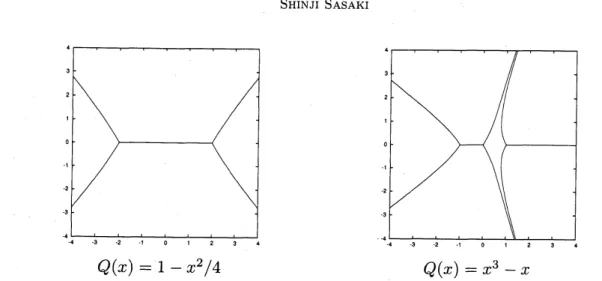
$Q(x)=1-x^{2}/4 Q(x)=x^{3}-x$
Figure 1. two examples in which Stokes lines connect simple turning points
For exampleif $Q(x)=E-x^{2}/4$ (namely the Weber equation) with
a
positive constant$E>0$, WKB solutions
are
not Borel summable (depending on the normalization). Seee.g., [11]. This is
a
general phenomenonif theequation hasapairof turing points (zerosof $Q(x))$ connected by
a
Stokes line $\Im\int^{x}\sqrt{Q(x)}dx=0$. See e.g., [2], [3]. In Figure 1,we
give examples ofStokes
lines connecting turning points.In such
cases,
the Borel transform ofa
WKB solution has singularitieson
the realaxis (in the Borel plane), which we call “fixed singularites” Theyare fixed in the sence
that the location is independ of$x$
.
To analyze such singularities, in [1], WKB theoretictransformation to the Weber equation is constructed, and Borel transformability is
given. Here transformation series is a formal power series $x(q, \eta)=x_{0}(q)+\eta^{-1}x_{1}(q)+$
$\eta^{-2}x_{2}(q)+\cdots$ which transforms the equation
(1.4) $( \frac{d^{2}}{dq^{2}}-\eta^{2}Q(q))\psi=0$
to the Weberequation (withan infinite power series $E=E(\eta)=E_{0}+\eta^{-1}E_{1}+\eta^{-2}E_{2}+$
$)$
(1.5) $( \frac{d^{2}}{dx^{2}}-\eta^{2}(E-\frac{x^{2}}{4}))\phi=0,$
with a gauge transform $\psi=x^{-1/2}\phi$. This is equivalent to that $x(q, \eta)$ satisfies the
following:
(1.6) $Q(q)=( \frac{dx}{dq})^{2}(E-\frac{x^{2}}{4})-\frac{1}{2}\eta^{-2}\{x;q\}.$
Here $\{x;q\}$ is the Schwarzian derivative. Though this is a transformation between
equations, this also connect WKB solutions of certain normalization. (See [1] and the
following section.)
given elsewhere.
\S 2.
Borel summability of transformation seriesIn this section, for simplicity
we
assume
that thecoefficient
$Q(q)$ in (1.4) ispolyno-mial. Let $q\pm$ be simple tuming points of the equation (1.4). Assume $q\pm$
are
connectedby
a
Stokes line and theother Stokes lines emanating fromthe two points tend toinfin-ity. For example, if $Q(q)=q(q^{2}-1)$ and
we
take$q+=0$ and$q_{-}=-1$, these conditionsare
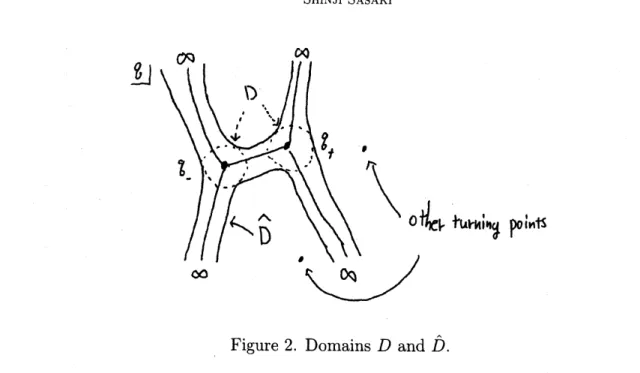
satisfied (See Figure 1). Take a neighborhood(2.1) $D= \{|\int_{q+}^{q}\sqrt{Q}dq|<d\}\cup\{|\int_{q-}^{q}\sqrt{Q}dq|<d\}$
of $\{q_{\pm}\}$ and set
(2.2) $\hat{D}=\bigcup_{q\in D}\{\Im\int_{q}^{q}\sqrt{Q}dq=0\}.$
(cf. Figure 2.) We take $d$ small enough
so
that $\hat{D}$ does not contain any tuming pointsexcept for $q\pm\cdot$ Then there exist formal power series $x(q, \eta)=x_{0}(q)+\eta^{-1}x_{1}(q)+$
$\eta^{-2}x_{2}(q)+\cdots$ and $E(\eta)=E_{0}+\eta^{-1}E_{1}+\eta^{-2}E_{2}+\cdots$ with $x_{j}(q)$ being holomorphic
on
$\hat{D}(j=0,1,2, \ldots)$ which satisfy the equation (1.6) and $dx_{0}/dq\neq 0.$ $x(q, \eta)$ and $E(\eta)$
are uniquely determined up to the choice of$x_{0}(q)$.
See
[1], [9].Remark. $x_{0}(q)$ is amap which maps aturning point to a turning point, a level
curve
(Stokes line) $\Im\int^{q}\sqrt{Q}dq=0$ to a level
curve
(Stokes line)$\Im\int^{x}\sqrt{(E_{0}-x^{2}/4)}dx=0.$There
are
two turning points $q\pm$, andwe
have two choices of$x_{0}(q)$.The Borel summability of$E(\eta)$ is known. See [8]. In addition
we
havethe followingtheorem.
Theorem 2.1. Under the assumptions above, the
transformation
series $x(q, \eta)$ isSHINJI SASAKI
Figure 2. Domains $D$ and $\hat{D}.$
Thus the equation (1.4) on $\hat{D}$
is transformed to the canonical equation (1.5) by two
Borel summable series $x(q, \eta)$ and $E(\eta)$. Then as is explained in [1] and [9] (though
mainly Airy case, not Weber case), a WKB solution of (1.4) is also transformed into
a
WKB solution of (1.5); Let $\psi(q, \eta)$ be a WKB solution of (1.4) normalized at$q+$ $\phi(x, E, \eta)$ be
a
WKB solution
of (1.5) normalized at $2\sqrt{E}$. Herewe assume
$x_{0}(q_{+})=$$2\sqrt{E_{0}}$. (For normalization, see e.g., [9].) Then the following relation holds:
(2.3) $\psi(q, \eta)=(\frac{dx}{dq}(q, \eta))^{-1/2}\phi(x(q, \eta), E(\eta), \eta)$.
Though this is
a
formalrelation, if Borel transformed, this becomesan
analytic relation.Set $x(q, \eta)=x_{0}(q)+X(q, \eta)$ and $E(\eta)=E_{0}+F(\eta)$. By Taylor expansion, we have
$\psi(q, \eta)=(\frac{dx}{dq}(q, \eta))\sum_{n=0}^{-1/2\infty}X^{n}(q, \eta)\partial^{n}\phi n!$$\overline{\partial x^{n}}(x_{0}(q), E(\eta), \eta)$
(2.4)
$=( \frac{dx}{dq}(q, \eta))\sum_{n=0}^{-1/2\infty}\frac{X^{n}(q,\eta)}{n!}(\sum_{m=0}^{\infty}\frac{F^{m}(\eta)}{m!}\partial E^{m}\partial x^{n}\partial^{n+m}\phi(x_{0}(q), E_{0}, \eta))$ .
Then by Borel transform,
we
have(2.5)
$\psi_{B}(q, y)=((\frac{dx}{dq})^{-1/2})_{B}(q, y)*\sum_{n=0}^{\infty}\frac{X_{B}^{*n}(q,y)}{n!}*(\sum_{m=0}^{\infty}\frac{F_{B}^{*m}(y)}{m!}*\frac{\partial^{n+m}\phi_{B}}{\partial E^{m}\partial x^{n}}(x_{0}(q), E_{0}, y))$,
where the subscript $B$
means
Boreltransform $and*$ is convolution. Now let us takeoneterm
$(( \frac{dx}{dq})^{-1/2})_{B}(q, y)*\frac{X_{B}^{*n}(q,y)}{n!}*\frac{F_{B}^{*m}(y)}{m!}*\frac{\partial^{n+m}\phi_{B}}{\partial E^{m}\partial x^{n}}(x_{0}(q), E_{0}, y)$ .
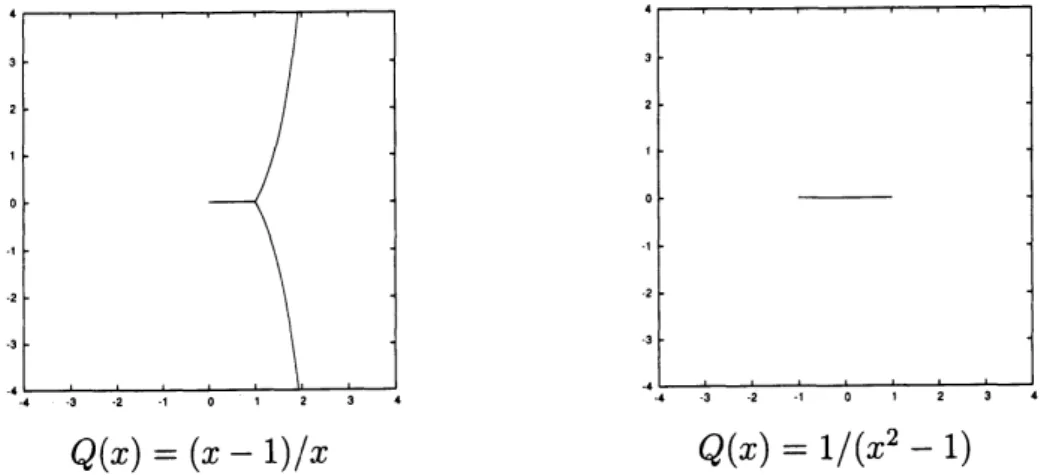
$Q(x)=(x-1)/x Q(x)=1/(x^{2}-1)$
Figure
3.
Stokeslines connectinga
pairofa
simple turning pointanda
simplepole(left),a
pair ofsimple poles (right).Since $X$ and $F$
are
Borel summable, the front part$(( \frac{dx}{dq})^{-1/2})_{B}(q, y)*\frac{X_{B}^{*n}(q,y)}{n!}*\frac{F_{B}^{*m}(y)}{m!}$
is holomorphic in
a
strip region containing the positive real axis. Sincewe
know wellabout $\phi_{B}$ (see e.g., [11], [10]), for this single term,
we
can see
continuability avoidingsingularities, disconitinuity at
a
singularity, etc. Then by summing up with respect to$m$ and $n$ (with
care
on convergence), we see continuablity etc. also for $\psi_{B}(q, y)$.Remark. $\phi_{B}(x_{0}(q), E_{0}, y)$ has infinitely many singularites in the $y$-plane with real
period$2\pi E_{0}$, and with Borel summability
we can
analyze all singularitiesthroughtrans-formation. Thus Borel summability of transformation is important in the analysis of
fixed singularities.
Remark. In this paper, we considered only two simple turning points problem. On
the other hand, simple poles (of $Q$) are known to play
a
role similar to simple turningpoints ([6], [7]), and
a
pair ofa
simple turning point anda
simple pole,or a
pairof
simple poles
causes
fixed singularitiesas
well (cf. Figure 3). The former one can betreated in the
same manner as
a pair of simple turning points. However the latterone
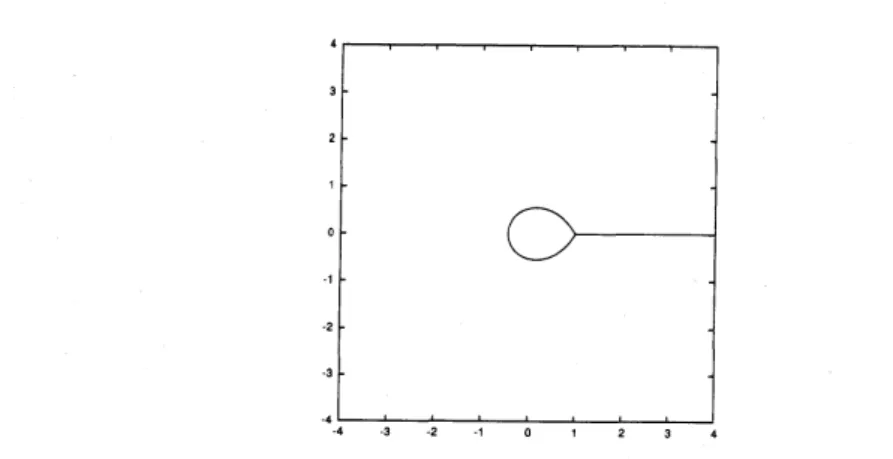
is difficult to treat with. Also, a sole simple turning point makes a pair in
some
sense,SHINJI SASAKI
Figure 4. $A$ loop of
Stokes
line endinga
sole simple tuming point.References
[1] Aoki, T., Kawai, T. and Takei, Y., TheBender-Wu analysis and the Voros theory, Special
Functions: ICM-90 Satellite
Conference
Proceedings (M. Kashiwara and T. Miwa, eds),Springer-Verlag, 1991, pp. 1-29.
[2] Delabaere, E., Dillinger, H. and Pham, F., R\’esurgence de Voros et p\’eriodes des courbes
hyperelliptiques, Ann. Inst. Fourier (Grenoble) 43 (1993), 163-199.
[3] Delabaere, E. and Pham, F., Resurgent methods insemi-classical asymptotics, Ann. Inst.
Henri Pincare 71 (1999), 1-94.
[4] Dunster, T. M, Lutz, D. A. and Sch\"afke, R., Convergent Liouville-Green expansions for
second-order linear differential equations, with an applition to Bessel functions, Proc. R.
Soc. Lond. Ser. A Math. Phys. Eng. Sci. 440 (1993), 37-54.
[5] Kamimoto, S. and Koike, T., Onthe Borel summabilityof WKB-theoretic transformation
series, RIMSpreprint 1726 (2011).
[6] Koike, T., Onaregular singular point in the exactWKB analysis, Toward the Exact WKB Analysis
of Differential
Equations, Linearof
Non-Linear (C. J. Howls, T. Kawai and Y. Takeieds.), Kyoto Univ. Press, 2000, pp. 39-54.[7] Koike, T., Onthe exact WKB analysis of second order linear ordinarydifferentialequations
with simple poles, Publ. Res. Inst. Math. Sci. 36 (2000), 297-319.
[8] Koike, T. and Sch\"afke, R., in preparation.
[9] Kawai, T. and Takei, Y., Algebraic Analysis
of
Singular Perturbation Theory, Transl.Math. Monogr. 227, Amer. Math. Soc., 2005.
[10] Sasaki, S., Resurgence of WKB solutions of the Weber equation through integral
repre-sentation, in preparation.
[11] Takei, Y., Sato’s conjecture for the Weber equation and transformation theory for Schr\"odinger equations with a merging pair of turning points,
Differential
Equations and Exact WKB Analysis (Y. Takei, ed), RIMS K\^oky\^uroku Bessatsu B10, 2008, pp. 205-224.[12] Voros, A., The return of thequartic oscillator–The complex WKB method, Ann. Inst.
Henri Pincare 39 (1983), 211-338.