Title
Effect of the Aspect Ratio of a Superconducting Tape on the AC
Loss in Perpendicular External Magnetic Field
Author(s)
野田 稔
Citation
福岡工業大学研究論集 第40巻第2号 P199-P208
Issue Date
2008-2
URI
http://hdl.handle.net/11478/949
Right
Type
Departmental Bulletin Paper
Textversion
Publisher
福岡工業大学 機関リポジトリ
FITREPO
Effect of the Aspect Ratio of a Superconducting Tape
on the AC Loss in Perpendicular External Magnetic Field
Kaoru YAMAFUJI
(President of Fukuoka Institute of Technology )Minoru NODA
(Department of Information Electronics )Takanori FUJIYOSHI
(Department of Computer Science and Electrical Engineering , Faculty of Engineering , Kumamoto University )Abstract
Recently , intensive efforts to decrease the width of the high -T cuprate superconducting tape for the coated conductors have been made for decreasing the AC loss . It has been found experimentally that the AC loss of the former type of superconducting tape , with the width extremely larger than the thickness , can be described well by the theoretical expression for the superconducting thin strip with the infinite width proposed by Brandt and Indenbom . However , the AC loss in the recent types of tapes , with a much narrower width , is expected to show a noticeable deviation from their expression . In this paper , based on the critical state model , a theoretical expression for the dependence of the AC loss on the aspect ratio in the cross section of the superconducting tape is proposed . Effect of the magnetic -flux -density dependence of the critical current density on the AC loss is also discussed .
Keywords : superconducting tape , alternating perpendicular field , AC loss , aspect ratio , thin strip , critical state model , critical current density
ᲫᲨIntroduction
The development of the superconducting coated con -ductors for the electro -magnetic power devices has been progressing actively in Japan and other countries . While the present situation may be fairly satisfactorily so far as the request on the high current density from the application side is concerned , the problem of the optim ization of the AC loss still remains as one of the impor -tant tasks to be developed .
The superconducting tape for the coated conductors composed of the YBCO series high T cuprate super -conductors developed previously has the cross section with , typically , the thickness of a few m and the width of several mm , for the purpose of obtaining a high
current density . As the first step for decreasing the AC loss , therefore , these previous type of superconducting tapes have been tried to cut into many strips with much narrower width in retaining the thickness to be a few
m.
The superconducting tapes under developing for the coated conductors are usually the c -axis oriented ones having a strong anisotropy for the critical current density . Amemiya et al .[1]showed experimentally that the observed data of the AC loss in the previous type of tapes under the applied oblique magnetic field can be scaled to a single master curve when the observed values of the AC loss are replotted against the perpen -dicular component , , of the applied oblique magnetic field , , where is the angle from the broadest surface of the thin superconducting tape . Whereas this kind of scalability can be attributed to the strong anisotropy in the critical current density , they
199 福岡工業大学研究論集 Res . Bull . Fukuoka Inst . Tech ., Vol .40 No .2(2008)199−208
also confirmed [1] that the obtained master curve showed a good agreement with the theoretical expres -sion proposed by Brandt and Indenbom [2]for the AC loss of the thin superconducting tape with an infinite width in the applied perpendicular magnetic field . An essentially the same conclusion was also obtained by Tsukamoto [3]based on a more detailed discussion .
If the aspect ratio of the width , , to the thickness , , in the cross section of the superconducting tape is defined by / / , the value of / for the above -mentioned previous type of superconducting tape is much less than . Then the theoretical expression for the AC loss derived by Brandt and Indenbom [2]for the limit of is safely applicable to the case of previous type of superconducting tape . So far as the superconducting tape is intended to use in the coated conductors , however , the optimum value of should be chosen as for the purposes of decreasing the AC loss of the tape in keeping the high critical current density . Then the expression for the AC loss derived for the limit of [2]is expected to show a noticeable deviation from the observed data for the optimized superconducting tapes .
In this paper , a theoretical expression for the AC loss in the superconducting tape under the applied perpen -dicular magnetic field is derived for the case of , based on the critical state model [3], which was also adopted in the derivation of the theoretical expression by Brandt and Indenbom [2]. Since the critical cur -rent density at a given spatial position generally depends on the magnetic flux density of the concerning position [4], the effect of the magnetic flux density dependence of the critical current density on the AC loss is also discussed theoretically , while Brandt and Indenbom [2]discussed only the limiting case that the critical current density is constant independently of the magnetic flux density .
ᲬᲨTheoretical expression for the AC loss in the superconducting tape with constant critical current density
Let us consider the superconducting tape having infinite length along the axis , the width of along the axis , and the thickness of along the axis .
When the aspect ratio in the cross section of the tape is defined by / / , then is given by
/ . (2.1) The purpose of the present theoretical investigation is to derive a theoretical expression for the AC loss in the superconducting tape having the cross section of under the perpendicular magnetic field applied to the
-direction .
For this purpose , we hereafter use the normalized coordinates defined by
/ , / / . (2.2) Furthermore , we adopt the so -called critical state model [4, 5]for the transport electric current induced by the
applied magnetic field , because this model has been known to describe well the electro -magnetic properties in both the low - metallic and the high - cuprate superconducting materials [6].
According to the critical state model , the density of the induced electric current , , is related to the critical current density , , as[5]
, , , (2.3a) where is generally given by a function of the flux density , , . In equation (2.3a), takes the value of or according as whether the direction of the induced current is the positive or the negative direction of the axis , and takes the value of 0 in the region where the current is not induced .
In this section , let us confine the discussion to a special case that the critical current density has a con stant magnitude independent of the magnetic flux den -sity . In this special case , equation (2.3a) is reduced to
, . (2.3b) This type of the simplified model has also been adopted by Brandt and Indenbom [2]in the derivation of the theoretical expression for the AC loss in the thin super -conducting tape with .
density on the AC loss will be discussed in the section 3.
The shape of the flux front in the initial magnetization process
When the magnetic field , , is initially applied to the superconducting tape in the -direction and is increased from zero , the magnetic flux begin to pene -trate into the tape . Let us denote the shape of the flux front in this initial magnetization process by
, (2.4) and define the complex flux density , , at the complex position , , by
; , (2.5a) where the magnetic flux density induced by the trans -port electric current , , is given from the Biot -Savart law by
,
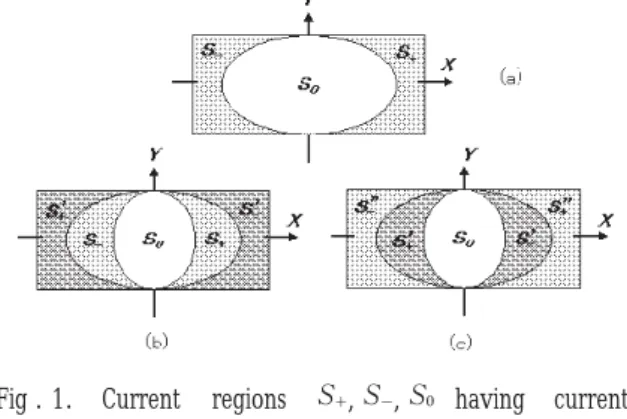
. (2.5b) In equations (2.5a) and (2.5b), is the magnetic susceptibility of the vacuum , and is the region inside which the induced electric current has the current den -sity of , as shown schematically in figure 1a.
Then the shape of the flux front given by equation
(2.4) can be determined from the condition that defined by equations (2.5a) and (2.5b) is zero every-where in the region inside the flux front , .
If we denote the shape of the flux front in the film limit of by ; , then iti is given by[2, 7] ; , (2.6a) . (2.6b) It has been shown [2, 7]that equation (2.6a) with equation (2.6b) is almost the exact solution of the critical state model for the film limit of . In fact, if we derive the expression for defined by equa -tion (2.5b) using equa-tion (2.6a) as described in Appendix , we get
; ;
, (2.7a) . (2.7b) Inserting equation (2.7a) into equation (2.5a), the shielding cond
7c)
on of the magnetic flux inside the flux front leads to
, (2.7c) , (2.7d) where the normalized applied magnetic field , , is defined by
. (2.7e) If we assume that varies as the function of as given by equation (2.
he c
, therefore , equation (2.7a) suggests that the magnetic flux is completely shielded in the region inside the flux front for the case of .
For t
ode
ase of , on the other hand , the exact solution of the critical state m l has no tt ye been
Ძ ᲬᲨ
Fig . 1. Current regions , , having current density of , where takes , , , respec -tively , (a) in the intial magnetization process , (b) in the following field decreasing process , and also (c) in the following field increasing process .
201 EffectoftheAspectRatioofaSuperconductingTapeontheACLossinPerpendicularExternalMagneticField (YAMAFUJI・NODA・FUJIYOSHI)
obtained . However , a good expression for the AC loss that explains well the observed results can be derived even by starting from the appropriately chosen approxi -mate shape of the flux front[8], because the expression for the AC loss is derived after the double integrals of the shape of the flux front , as can be seen in the later sections .
Then let us consider the following expression as an approximate candidate of the shape of the flux front for the case of :
Δ , , (2.8) and determine the functional form of Δ Δ , from the shielding condition that defined by equation (2.5a) becomes zero only at the center of the tape ,
.
The detailed derivation of ; defined by equa -tion (2.5b) by using given by equation (2.8) is shown in Appendix , and the resulting expression is given by ; Δ Δ , ; (2.9a) , . (2.9b) In the slab limit of ∞, equation (2.9a) with equation (2.9b) gives the well known behavior of the flux front in the slab sample :
; ∞. (2.9c) This fact may gives a support that equation (2.8) is a fairly good approximation for the expression for the flux front even for the case of , so far as the shielding condition at the center of the cross section of the tape is concerned .
For the superconducting tape with , the small quantities less than the order of magnitude of can be
disregarded . If we retain up to the linear terms of in equation (2.9a), the functional form of Δ Δ , is determined by equating equation (2.9a) to equation (2.7a):
Δ ,
Δ , (2.10a) and the result is given by
Δ , . (2.10b) If equation (2.8) with equation (2.10b) were the exact solution of the critical state model even in the tape with , then ; given by equation (2.9a) with equation (2.9b) should satisfy the shielding con -dition given by ; ; .
In figure 2, the value of ; / for the shapes of the flux front , , given by (2.8) with equation (2.10b) is plotted against for and . We can see that equation (2.8) with equation (2.10b) may be applicable to the derivation of the theoretical expres -sion for the AC loss at least in the range of , because in this range the value of ; / is less than 1/10 for the case of . This conclusion is consistent with the fact that the terms of the order of were disregarded in the derivation of equation (2.10b).
ase
Expression for the AC loss in the range of magnetic field of
Let us consider the c that the AC magnet eldic fi
ᲬᲨᲬ
Fig . 2. dependences of / for and
with the amplitude of is applied to the concerning superconducting tape with in the perpendic -ular direction , , in the direction , where the varia -tion speed of the AC field with time is assumed as low enough so that the critical state model is applicable to the derivation of the theoretical expression for the AC loss .
In this paper , let us confine the discussion to the case of for simplicity , where is the centering field at which the flux front reaches the center of the cross section of the tape . The expression for the case of
can also be derived along the similar scheme to that in the present section .
The magnetization in the initial increasing process of the applied magnetic field , is defined by
, . (2.11a) For the present limiting case of , , equation (2.11a) is reduced to
. (2.11b) By carrying out the above integration with the aid of equation (2.8), we get
Δ ,
Δ , . (2.11c) With the aid of equations (2.7d) and (2.10b), equa -tion (2.11c) is reduced to
. (2.11d) In the following decreasing process of the applied magnetic field from to , the current density of the induced current is given by in the intermediate region between the inner flux front and the outer flux front , which is characterized by the range on the axis
/ , and is given by in the outside region of , as schematically shown in figure 1b .
Then the magnetization is given by
. (2.12a) Similarly , the magnetization in the following increasing process of the applied magnetic field , shown schemati -cally in figure 1c, is given by
. (2.12b) Then the AC loss per cycle per unit volume , , is given by , ; / , (2.13a) / / , (2.13b) / / / . (2.13c) Equation (2.13b) is the same as the expression for obtained by Brandt and Indenbom [2]for the limit of
.
It may be worth noticing that , for the case of , equations (2.13a) (2.13c) are reduced to
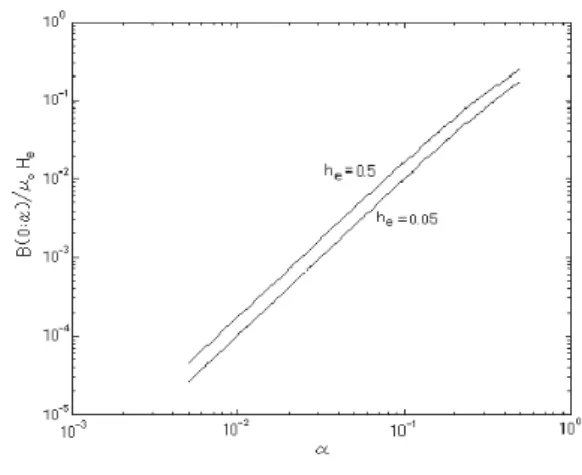
; . (2.14) It is to be emphasized that the absolute value of the AC loss is decreased noticeably due to the decrease of the width , / . As can be seen from figure 3, however , the deviation of the normalized shape of the AC loss , , from for
becomes noticeable only at .
On the other hand , the present expression for the AC loss given by equations (2.13a) (2.13c) is expected to be a good approximation for , as mentioned in Section 2.1.
Then the present expression for is expected to
203 EffectoftheAspectRatioofaSuperconductingTapeontheACLossinPerpendicularExternalMagneticField (YAMAFUJI・NODA・FUJIYOSHI)
be useful for the practical purposes only for the range of , while the expression proposed by Brandt and Indenbom [2]can be applicable for the range of
.
ᲭᲨEffects of the B -dependence of the critical current density on the AC loss
Let us consider the superconducting tape for which the -dependence of the critical current density can be described well by
/ , (3.1) where is a function of the temperature and also depends on the kind of material as well as the fabrica -tion condi-tions of the tape . This type of the -dependence of the critical current density appears in many samples of the high - cuprate superconductors [9, 10]. It is to be noted that the limit of the constant
critical current density discussed in the previous section can be formally obtained by taking the limit of ∞ and replacing by in equation (3.1).
For investigating the effects of the -dependence of the critical current density on the AC loss , we have only to consider the film limit of , because the effect of the -dependence of the critical current density on can hardly be detected experimentally for the case of
.
As the shape of the flux front in the presence of the -dependence of the critical current density , therefore , let us adopt the same functional form as equation (2.8):
Δ , , (3.2a) . (3.2b) Then the flux penetration of the flux front along the -direction , , is subject to the characteristic field , / in the film with as can be seen from equations (2.7c) with equations (2.7d) and (2.7 b), whereas the penetration of the flux front is subject to in the slab sample with as can be seen from equation (2.9c).
In the film limit of , therefore , the distribution of the flux density along the -axis is described by the following Maxwell equation :
, , ; . (3.3a) The solution of the above Maxwell equation is given by
, ;
. (3.3b) In equation (3.3b), is defined by
/
. (3.4a) It is to be noted that defined by equation (3.4a) is much smaller than unity :
, (3.4b) because the value of is so small for the concerning tape with that the value of the numerator in equation (3.3a) is usually much smaller than the value of [8, 9].
Inserting equation (3.3b) into equation (3.1), we Fig . 3. dependences of normalized loss density
get
, , . (3.3c) Inserting equation (3.3c) into equation (2.5b) and taking the limit of , we get
;
Δ ;
. (3.5a) The functional form of Δ ; introduced in equation (3.2a) can be determined by the same process as in the section 2.1. Since the value of Δ ; is reduced to 1 in the absence of the -dependence of the critical current density , equation (3.5a) is reduced to
; , (3.5b) which is the same as ; given by equation (2.7a).
By equating equation (3.5a) to equation (3.5b), we get
Δ ,
. (3.6) The magnetization in the initial increasing process of the applied magnetic filed is given by equation (2.11a), where , is given by equation (3.3c). If we retain only the linear terms of , the expression for the initial magnetization is given by ; (3.7a) Δ , Δ , , (3.7b) . (3.7c) Since equations (3.6) and (3.7b) are same as equa -tions (2.10b) and (2.11c), respectively , if is replaced by / , we get the following expression for the AC loss :
/ ,(3.8a) where is given by replacing by in equation (2.13b), is given by replacing by
in equation (2.13c), and is given by
. (3.8b) It may be worth noticing that , for , equations (3.8a) is reduced to
. (3.8c) In figure 4, some examples of the present result are compared with the special case of disregarding the magnetic -flux -density dependence of the critical current density . As can be seen from figure 4, the effect of the magnetic -flux -density dependence given by equation (3.1) becomes noticeable for .
205 EffectoftheAspectRatioofaSuperconductingTapeontheACLossinPerpendicularExternalMagneticField (YAMAFUJI・NODA・FUJIYOSHI)
ᲮᲨSummary of the theoretical results
For the superconducting tape with the rectangular cross section characterized by the aspect ratio of /
/ and also by the critical current density having the -dependence given by
/ , (3.1) the AC loss in the perpendicular AC field applied to the -direction with the amplitude of is given by
; (4.1a) / , (4.1b) where is defined by equation (2.7b).
In equation (4.1a), is given by
. (4.1c) Furthermore , is given by / (2.13c) and is given by . (3.8b) For , equation (4.1a) is reduced to
. (4.2) Since the terms of the order of and of / are neglected in the derivation of the present expression , the present expression is expected to be a good approxi -mation for / and / / , while the expression proposed by Brandt and Indenbom [2]is applicable only for / .
References
[1]Amemiya N , Nishioka T, Jiang K and Yasuda K 2004 Supercond . Sci . Technol . 17 485-92
[2]Brandt E H and Indenbom M 1993 Phys . Rev . B48 12893 -906
[3]Tsukamoto , O 2005 Supercond . Sci . Technol . 18 596-605
[4]Bean C P 1962 Phys . Rev . Lett . 8 250
[5]Irie F and Yamafuji K 1967 Phys . Soc . Jpn . 23 255
[6]Yamafuji K and Fujiyoshi T 2005 Critical Cur -rents in Superconductors (Nihon Univ . Fuzambo International ) pp47 -69
[7]Zeldov E ,Clem J R , McElfresh M and Darwin M 1994 Phys . Rev . B49 9802
[8]Brandt E H 1996 Phys . Rev . B54 4246 -4264 Fig . 4 dependence of normalized loss density
Appendix
When the applied magnetic field is initially applied to the superconducting tape with a rectangular cross sec-tion , and is increased from , the centering field ,
, is defined as the applied magnetic field , at which the flux front reaches the center of the tape . Since the current density distribution at is given as
for and for , equation (2.5a) is reduced to[8]
(A .1a) . (A .1b) In the initial increasing process of in the range of , on the other hand , the region inside the flux front given by equation (2.4a) still remains . Let us investigate the values of in the region inside the flux front , defined by / . If we consider on the axis by assuming that the shape of the flux front is given by equation (2.6a), then equation (2.5b) is reduced to
,
, ; . (A .2c) In equation (A .2c), , has the following func -tional form :
, .
(A .2d) Unfortunately , the exact integration of the second integration in equation (A .2c) can hardly be carried out analytically . If we notice that the point of
is corresponding to the point of , however , the
second term in equation (A .2c) can be well approx -imated by replacing , by , . Then , the integrations in equation (A .2c) can be carried out analytically with the aid of the following integration formulae :
, (A .3a) . (A .3b) If we put , the resulting expression is obtained by putting Δ in equation (2.7b). The difference between the analytic result and the numerically calcu -lated exact result is negligibly small , as can be seen in figure 2.
If we retain up to the linear terms of , on the other hand , equation (A .2c) is reduced to
,
. (A .4) It is to be emphasized that the right hand side of equa -tion (A .4) becomes independent of inside the flux front in the limit of ,where takes any value of
. If we choose the relation of and as given by equation (2.7c), therefore , the magnetic flux at any point on the axis inside the flux front is completely shielded to be zero for the case of the film limit of . This is the reflection of the fact [2, 6]that equation (2.6a) is almost the exact solution of the critical state model in the film limit [2, 6].
It is , however , to be noted that equation (2.6a) can hardly be regarded as the exact solution even for the limit of from the following 2 points :
First , at least the value of / with the definition of should be zero in the region
207 EffectoftheAspectRatioofaSuperconductingTapeontheACLossinPerpendicularExternalMagneticField (YAMAFUJI・NODA・FUJIYOSHI)
inside the flux front , if equation (2.6a) is the exact solution . As can be easily confirmed , however , the above value in the limit of is not zero .
Secondly , according to equation (2.6a), the value of the flux front at is always fixed to , whereas the result of the numerical calculation [8]indicates that the value of the flux front at begins to depart from at and approaches to as . Nevertheless , we may conclude that equation (2.6a) is a very good solution , except for only in the very vicinity of .