
立命館学術成果リポジトリ
24
0
0
全文
(2) 立命館言語文化研究 26 巻 4 号. Yukio Ikari claimed that neuroimaging techniques such as ERPs and fMRI have made it possible to explore the function of particular areas of the brain in the scientific study of language acquisition, but many of the methods have only been applied to monolingual language processing as yet. He demonstrated a possible use of ERPs and fMRI in bilingual processing in the presentation Perspectives on Bilingual Studies with the Help of Brain Imaging Techniques . The full papers from the individual presenters are provided below.. −2−.
(3) Bilingualism as a First Language in the Japanese Context(TAURA, MISHINA-MORI, NAMBA & IKARI). 2.17-Year Longitudinal Narrative Development in a Non-Dominant Language of Two Japanese-English Bilingual Siblings Hideyuki TAURA. 2.1 Rationale Berman and Slobin(1994)looked into monolingual children s narrative development and revealed very similar developmental paths taken by children irrespective of their mother tongue. Examining the narrative literature on bilinguals, Wei(2010)states that there seem to be no qualitative differences in narrative development between monolinguals and bilinguals but the issue of acquisition speed and the influence of the dominant language exerting an influence over the lessdominant language still remains to be explored. De Houwer(2009), in extensively reviewing the literature on bilingual development, calls for studies to research the Interdependence Hypothesis and the Separate Development Hypothesis in bilinguals with typologically distant language combinations. These two contrasting hypotheses are posed with regard to how bilingual children develop individual languages interdependently or separately. Studies to testify which hypothesis is more plausible have been conducted mostly with their main focus placed on such linguistic aspects as phonology and lexical items, not on global skills like narratives, and targeting bilinguals with typologically close languages such as English and French. De Houwer further points out that researchers need to focus on the development of bilinguals less dominant languages. In answer to this, Taura and Taura(2012)undertook a study tracking an early JapaneseEnglish bilingual s narrative from ages 4;0 to 18;00 years with the focus on the less-dominant language, English. It was disclosed that the child s English nar rative development was predominantly similar to that of English monolinguals, which lends suppor t to the Separate Development Hypothesis. The results additionally revealed some idiosyncratic features which dif fered from her monolingual counterpar ts narrative styles, and also highlighted fur ther development at age 11;02 after she spent nine months in Australia where she attended a local primary school. Regarding this point, a query arose as to whether the less-dominant language would improve at an accelerated pace or not, if the bilingual child were to stay in the L2 community where the less-dominant language was being used for a lengthy period of time. This paper attempts to explore this issue by comparing the data taken from the bilingual girl(M)to her brother, whose data were also longitudinally collected. Thus the research question is formulated:(1)Do two siblings follow similar developmental paths to each other in their non-dominant language(English)while sharing identical socio-economic, parental, and educational variables?(2)Does immersion in the non-dominant language community markedly enhance language development or is it an age-related issue?. 2.2 Data collection The participant in this study is K, an early Japanese-English bilingual who was born and raised −3−.
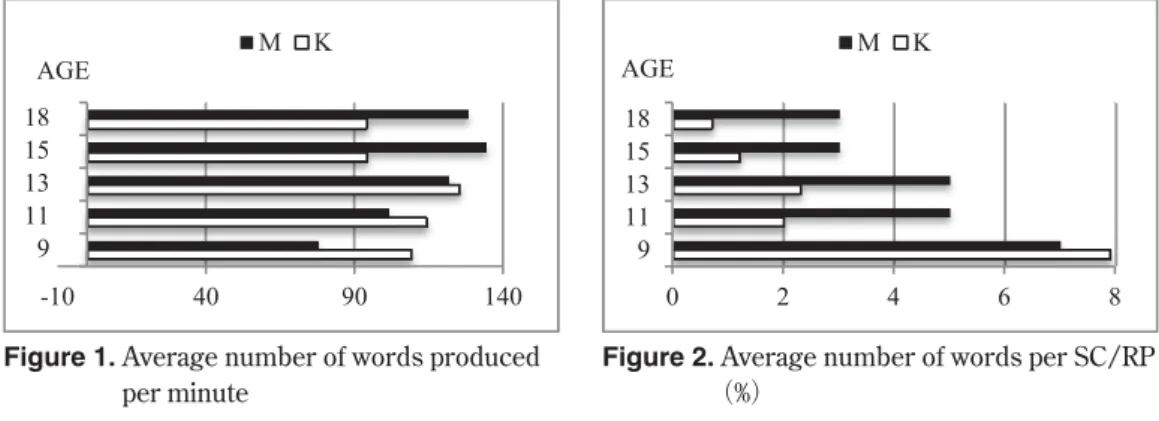
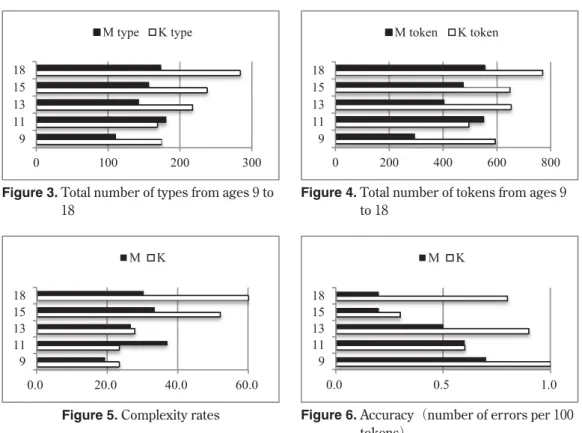
(4) 立命館言語文化研究 26 巻 4 号. in Japan with a one-parent one-language policy(English to Mother and Japanese to Father). His narrative data using Frog, where are you? were collected yearly from age 8;06 to 24;10 and compared to his sister s(M s)data. In addition, the data taken during three prolonged stays in the English-dominant communities were used to find answers to the second research question. They included data from age 8;03 to 9;05(15 months at Grade 3/4 primary school), 14;03 to 14;11(9 months at G9 high school), and 22;07 to 24;10(17 months working at an Australian company as an interpreter). In examining children s narrative development, Mayer s(1969)picture book Frog, where are you? has been widely used to elicit narrative data. Researchers such as Nippold(2006)and Bamberg and Damrad-Fr ye(1991)used it to explore L1 nar ratives, while Lanza(2001) employed it to investigate bilingual narratives by English-Norwegian bilingual children. For this study the same frog book was used to elicit data which were then analyzed in terms of fluency, accuracy, complexity, and lexical profiles.. 2.3 Results The comparative results between the siblings(K, the brother and M, the sister)are firstly presented in the order of conventional linguistic variables of fluency, vocabulary, complexity, and accuracy. Secondly, K s data taken at the beginning and the end of his prolonged stay in an L2 community are examined to find possible answers to our second research question.. 2.3.1 Siblings data M. AGE. K. M. AGE. 18 15 13 11 9. K. 18 15 13 11 9. -10. 40. 90. 140. Figure 1. Average number of words produced per minute. 0. 2. 4. 6. 8. Figure 2. Average number of words per SC/RP (%). Fluency measured by the average number of words produced per minute(Figure 1)shows an L2 sojourn effect for M with a sharp increase from ages 9 to 11, which was not the case with K. Disfluency(Figure 2)measured by the number of words per self-correction(SC)and repetition (RP), however, shows both an L2 sojourn ef fect(in M from ages 9 to 11)and an obvious developmental path(from ages 9 to 18 in both siblings). Lexical analyses reveal an L2 sojourn effect in M – a big leap in the number of types and tokens from age 9 to 11 but a developmental path in K – a linear increase from ages 9 through 18 −4−.
(5) Bilingualism as a First Language in the Japanese Context(TAURA, MISHINA-MORI, NAMBA & IKARI). (Figures 3 & 4). Complexity rates(calculated by the number of subordinate and relative clauses along with passive forms divided by the number of sentences)display an L2 sojourn effect in M – a sharp increase from ages 9 to 11 but a developmental increase in K from ages 9 through 18(Figure 5). Accuracy rates(calculated by the number of errors produced every 100 tokens)indicate a developmental path with M all the way from ages 9 through 18 but a fluctuating path with K (Figure 6) . M type. K type. M token. 18 15 13 11 9. K token. 18 15 13 11 9 0. 100. 200. 0. 300. 200. 400. 600. 800. Figure 3. Total number of types from ages 9 to 18. Figure 4. Total number of tokens from ages 9 to 18. M. M. K. 18 15 13 11 9. K. 18 15 13 11 9 0.0. 20.0. 40.0. Figure 5. Complexity rates. 0.0. 60.0. 0.5. 1.0. Figure 6. Accuracy(number of errors per 100 tokens). 2.3.2 K s data from three prolonged stays in L2 communities K underwent three periods in his life with intensive and extensive L2 English exposure - from ages 8;03 to 9;05(15 months Grade 3/4 primary school), 14;03 to 14;11(9 months Grade 9 high school), and 22;07 to 24;10(17 months at an Australian company as an interpreter). This section investigates whether or not such experiences helped him improve his L2 from the perspectives of accuracy, fluency, and vocabular y. When K s data were analyzed in terms of accuracy, MyersScotton s 4-M model was used for a more thorough analysis by dividing the morphemes into four types of content morphemes(i.e., nouns, verbs, adjectives, and adverbs that are directly activated by an intended message), early system morphemes(i.e., plural s and articles the , a , and an that are indirectly activated by content morphemes), and late system morphemes(i.e., bridge late system morphemes such as of and the outsider late system morphemes used with the third person singular present s ). This model theoretically predicts that L1/L2 acquisition and attrition takes place in the order of content, early system, and late system morphemes. Fluency analysis was −5−.
(6) 立命館言語文化研究 26 巻 4 号. conducted in two ways: whether it was affected by lexical retrieval(intra-sentential pauses)or by constructing a sentence(inter-sentential pauses), and how much time was needed to produce a morpheme in milliseconds. Vocabulary was assessed according to its lexical density(the number of types divided by the number of tokens), which shows a higher rate as more different words are used when the total number of tokens(words)is controlled. The results are summarized in Table 1. Table 1. L2 sojourn effects. K s accuracy was already ver y high(94% and above)at 8;06 in all types of morphemes, therefore attention was focused on the accuracy of the late system morphemes that are presumably the most dif ficult to acquire. The accuracy improved during ever y prolonged stay in the L2 dominant community: 1.2% at 9;05, 1.6% at 14;11, and 0.6% at 24;10. The results were not as straightforward in fluency:(1)lexically-induced(intra-sentential)pauses became shorter in the first and third L2 sojourns, which was seen in the inter-sentential pause durations in the third sojourn, but(2)both types of pauses became longer(less fluent)in the second sojourn. Another fluency measurement was calculated to find the time needed to produce a token(ms), however, and the results showed a clear L2-sojourn effect: 57.2, 190.5, and 145.5 ms faster respectively in the first, second, and third sojourns. Lexical density(type token ratio)exhibited an inconsistent nature showing fluctuations in the pause durations: lexical varieties became more abundant in the third sojourn only while the two preceding occasions showed otherwise.. 2.4 Discussion The Japanese-English siblings non-dominant language, English, was tracked longitudinally over many years to identify any common tendencies. The results are indeterminate depending upon the aspect examined – developmental, sojourn effects, or fluctuation. Features showing language development were observed, including less hesitation in both siblings' language samples, K s improved lexical density and complexity, and M s enhanced accuracy. A sojourn effect revealed itself in fluency(word production speed), lexical density, and complexity in M s data while K s accuracy fluctuated over the years. A detailed analysis of K s data examining the L2-sojourn effect showed an improved accuracy −6−.
(7) Bilingualism as a First Language in the Japanese Context(TAURA, MISHINA-MORI, NAMBA & IKARI). and faster word production speed in English. However, the inter-/intra-sentential pause durations and lexical density variables did not reveal straightfor ward results and tended to fluctuate depending on K s age.. 2.5 Conclusion The answers to our two research questions are as follows: (1)Do two siblings follow similar developmental paths to each other in their nondominant language(English)while sharing identical socio-economic, parental, and educational variables? Developmental paths common to both siblings were seen only in the gradually decreasing hesitation, but other variables showed individual differences and fluctuations in one sibling. (2)Does immersion in the non-dominant language community markedly enhance language development or is it an age-related issue? Such experiences did enhance accuracy and the speed of the word production, but other variables tended to be age-dependent. This study was able to find some answers to the research questions. In the next phase, the indeterminate results that arose during the present research will be examined further to determine why certain individual linguistic differences arose. This will highlight any possible improvement of one linguistic aspect over another(such as improved accuracy or abundant complex structures due to slower word production).. References Bamberg, M. and Damrad-Fr ye, R.(1991). On the ability to provide evaluative comments: Fur ther explorations of children's narrative competences. Journal of Child Language, 18, 689-710. Berman, R., and Slobin, D.(1994). Relating events in narrative: A cross-linguistic developmental study. Mahwah, NJ: Erlbaum. De Houwer, A. (2009). Bilingual first language acquisition. Bristol: Multilingual Matters. Lanza, E. (2001). Temporality and language contact in narratives by children bilingual in Norwegian and English. In Verhoeven, L. and Stromqvist, S. (Eds.)Narrative Development in a Multilingual Context, (pp. 15-50). Amsterdam: John Benjamins. Mayer, M. (1969). Frog, where are you? New York: Penguin Books. Myers-Scotton, C.(2002). Contact Linguistics. Oxford: Oxford University Press. Nippold, M. (2006). Later language development: School-age children, adolescents, and young adults. Austin, Texas: Pro-ed. Taura, H., and Taura. A.(2012). Linguistic and narrative development in a Japanese-English bilingual s first language acquisition: A 14-year longitudinal case study. International Journal of Bilingual Education and Bilingualism, 14, 4, 475-508. Wei, L. (2010) . BAMFLA: issues, methods and directions. International Journal of Bilingualism, 14, 1, 3-9. (本研究の一部は,2011-2014 年度「立命館大学・国際言語文化研究所・萌芽的プロジェクト研究」お よび 2014 年度「立命館大学・研究の国際化推進プログラム」助成を受けて行った) −7−.
(8) 立命館言語文化研究 26 巻 4 号. 3. The Locus of Cross-Linguistic Influence in Simultaneous Japanese-English Language Development Satomi MISHINA-MORI. 3.1 Introduction The syntax-pragmatics interface has been considered to be the major locus of inter-lingual influence in bilingual first language acquisition. However, counter-evidence suggests that the level of influence may depend on the typological distance between the two languages being acquired. The current paper attempts to support this claim through the analysis of object drop in young Japanese/English bilinguals.. 3.2 Literature Review It has been widely accepted in the field of bilingual first language acquisition that the two grammars develop more or less independently(e.g., De Houwer 1990; Paradis & Genessee 1996). However, researchers have further found that under certain conditions, the two grammars interact with each other(e.g., Muller & Hulk, 2001; Paradis & Navarro 2003, Serratrice et al. 2004, Yip & Matthews 2007, Haznedar 2010). Muller & Hulk(2001)proposed that when the following two conditions are met, the two grammars are likely to interact with each other: 1)The structure in question occurs at syntax-pragmatics inter face, i.e., the str ucture where both syntax and pragmatics are involved, and 2)the two grammars share a superficially overlapping structure, with one of the two languages having ambiguity in the input. One of the most typical grammatical structures that satisfies these conditions is argument realization in children exposed to null and over t argument languages because the argument form depends on the discourse-pragmatic context. In many cases, the over t form constitutes the common structure between the two languages. Although there has been strong evidence for the hypothesis above, there have also been a number of studies that report counter-evidence or weaker evidence(e.g., Zwanaiger et al. 2005, Mishina-Mori 2007, Hacohen & Schaeffer 2007). For example, Zwanaiger et al.(2005)found no such evidence of interaction in the use of subjects among five English-Inuktitut bilingual children; the null subject ratios were equivalent to those of their monolingual peers. Mishina-Mori(2007) and Hacohen & Schaeffer(2007)added discourse-pragmatic analysis but found only weak or no influence. Because these studies in many cases have involved children acquiring languages that are from typologically less related language pairs, some have conjectured that a pair of languages with distinct structures may cause less transfer(Mishina-Mori 2007; Blais et al. 2010). It should also be noted that most of the previous studies have focused on subjects, but only few have focused on object realization. Therefore, it seems reasonable to further test the hypothesis on object realization in children acquiring typologically distant languages. To this end, the current study will examine young bilingual children who have been exposed to Japanese and English simultaneously −8−.
(9) Bilingualism as a First Language in the Japanese Context(TAURA, MISHINA-MORI, NAMBA & IKARI). from birth. In the following report, we will briefly describe the argument choice patters of both languages. Japanese is a null-argument language, in which both subjects and objects can be dropped together with the particles as long as the referent is recoverable from context. Object drop is prevalent in Japanese children as well. Hirakawa(1993), for example, reports that approximately 40% of objects were null in the natural speech sample of a two-year-old. (1)Yuri wa hon wo katta. (2)Yuri wa (. ) katta.. Yuri TOP book ACC buy-PAST 1) Yuri bought a book. In contrast, null arguments are largely ungrammatical in English, and thus given information is expressed in pronominal form(see examples 3 and 4). Children at the earliest stages of language development do drop objects, but the reported ratio is not as high as those reported in Japanese children, no higher than 5 to 10% in two-year-olds(Ingham 1993, Valian 1991). However, some transitive verbs, such as eat, drink, or read, can be optionally transitive under cer tain conditions ---e.g., typically when the referent has a generic sense or when the referent is obvious from the discourse context(Rispoli 1992, Ingham 1993, Sugioka & Kageyama 2011)(see examples 5 and 6). This, according to Yip & Matthews(2007), is considered to create ambiguity in the input for young children: (3)Yuri bought a book. (4)Yuri bought( )* / it. (5)A: Did you eat your peas? B: *Yes, I ate( ). [=specific referent( peas )].(Yip & Matthews 2007) (6)Let s eat( ). [=generic referent](Yip & Matthews 2007) Based on the above information, it follows that object drop in Japanese and English could be vulnerable to cross-linguistic influence because it falls at the syntax-pragmatic interface, and the two languages have null object as an overlapping surface structure,. 3.3 Research question The research question to be addressed in this study is the following:Is there a cross-linguistic influence in the use of objects in Japanese/English simultaneous bilinguals at early stages of linguistic development? Following Yip & Matthews(2007), we predict that(1)There will be an influence from Japanese to English; that is, the ratio of object drop in bilingual English will be higher than that of their English monolingual peers(or similar to the ratio of object drop in −9−.
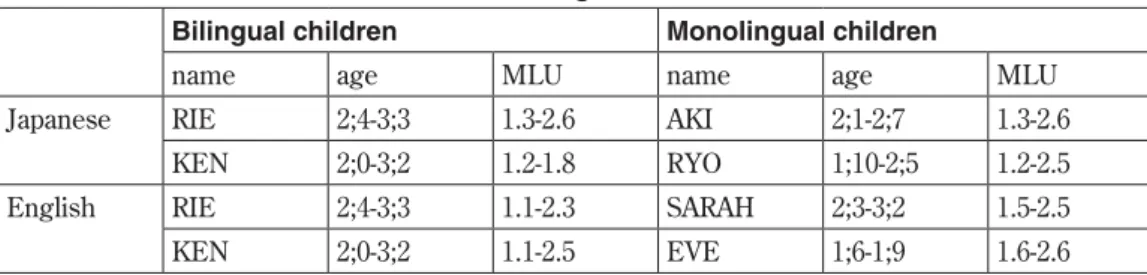
(10) 立命館言語文化研究 26 巻 4 号. Japanese monolingual peers); and(2)There will be no influence from English to Japanese; that is, the ratio of object drop in bilingual Japanese will approximate that of their Japanese monolingual peers. This prediction is based on the claim that the language with ambiguity in the input would be more vulnerable to influence. In this case, that language is English because the realization of objects is determined by a variety of factors and can thus be considered complicated. In Japanese, however, object realization is solely dependent upon context.. 3.4 Method We observed two Japanese/English simultaneous bilinguals(Mishina 1997), pseudonyms Rie (girl)and Ken(boy), and two MLU-matched controls for each language. The English data are drawn from Sarah and Eve s corpus(Brown 1973), and the Japanese data from Aki and Ryo s corpus(Miyata 1995).. Table 1. MLU & age of the children Bilingual children name Japanese English. age. Monolingual children MLU. name. age. MLU. RIE. 2;4-3;3. 1.3-2.6. AKI. 2;1-2;7. 1.3-2.6. KEN. 2;0-3;2. 1.2-1.8. RYO. 1;10-2;5. 1.2-2.5. RIE. 2;4-3;3. 1.1-2.3. SARAH. 2;3-3;2. 1.5-2.5. KEN. 2;0-3;2. 1.1-2.5. EVE. 1;6-1;9. 1.6-2.6. Naturalistic parent-child interaction was video/audio-taped monthly for approximately a year (11 to 13 sessions for each language per one child), and the whole interaction was transcribed using CHAT conventions(MacWhinney 1995)for English and JCHAT(Oshima-Takane & MacWhinney 1995)for Japanese. The data were then coded for the argument choice patterns (argument form and information status)of objects following Matsuoka et al. (2008)and analyzed using CLAN(MacWhinney 1995). We conducted two analyses: 1)the overall ratio of null objects in both languages was calculated to obser ve whether there was any indication of transfer; and 2)the developmental changes of the null object ratio were documented to see whether the influence was limited to a certain period of time.. 3.5 Results First, we calculated the percentage of null objects out of all occurrences of objects in the whole corpus for each child and for each language; the results are tabulated in Table 2. As the results clearly indicate, the ratios of English object drop are very similar among all subjects, approximately 15%. A Chi-square analysis shows that there is no statistically significant difference among the null object ratios of the four children(χ2 = 5.62; p=0.1316), which means that the bilingual children s − 10 −.
(11) Bilingualism as a First Language in the Japanese Context(TAURA, MISHINA-MORI, NAMBA & IKARI). object drop use is more or less identical to that of their English monolingual peers. This finding goes against our prediction̶that is, we obser ved no evidence of influence from Japanese to English in the use of objects in bilingual children. In the Japanese data, too, the four children showed little difference in their use of null objects. The ratios were approximately 60%, with no statistically significant differences among the four children(χ2= 3.56; p=0.3122), indicating that the bilingual children s object drop use is ver y similar to that of Japanese monolingual children. Thus, based on these results, we detect no influence from English to Japanese. Table 2. The ratios of object drop in bilingual and monolingual children Bilingual children English Japanese. Monolingual children. RIE. KEN. SARAH. EVE. 14%(17/125). 18%(53/292). 12%(36/305). 17%(89/535). RIE. KEN. AKI. RYO. 56%(148/263). 66%(23/35). 63%(45/71). 65%(54/83). Now, we turn to a developmental analysis. The longitudinal data were divided into three stages based on the children s MLUs in each language(Stage 1: MLU 1.0-1.5; Stage 2: 1.5-2.0; Stage 3: 2.02.5) , and the ratio of null objects was calculated for each stage separately, as presented in Tables 3 and 4. As Table 3 shows, bilingual children seem to drop English objects more often than monolingual children at Stage 1(χ2= 8.74; p=0.009) , indicating an influence from Japanese. However, in the later stages, the ratios are similar between bilingual and monolingual children, suggesting that this influence is present only at the initial stages of development. On the other hand, Table 4 shows that Rie s null object ratio at Stage 3 is clearly lower than that of the other children(χ 2= 10.64; p=0.01) , which can be taken as an indication of influence from English to Japanese.. Table 3. The ratio of English object drop at stages 1 – 3(*p<0.05) Bilingual children. Monolingual children SARAH. EVE. 0(0/6). 16%(8/50). χ2. RIE. KEN. Stage 1. 29%(5/17). 45%(17/38). Stage 2. 9%(3/32). 18%(10/55). 16%(18/114) 16%(22/138). 1.23. Stage 3. 9%(6/65 ). 14%(12/86). 10%(18/185) 17%(59/347). 6.66. 8.74*. Table 4. The ratio of Japanese object drop at stages 1 – 3(*p<0.05) Bilingual children. Monolingual children. χ2. RIE. KEN. AKI. RYO. Stage 1. -(6/6). -(1/2). -(4/4). -(0/0). -. Stage 2. 58%(69/119). 64%(9/14). 74%(14/19). 63%(26/41). 1.91. Stage 3. 36%(24/66). 60%(6/10). 56%(27/48). 67%(28/42). 10.64*. − 11 −.
(12) 立命館言語文化研究 26 巻 4 号. 3.6 Discussion The current data show that there is no indication of influence in either direction regarding the overall tendency. When we break down the data into three sessions, however, we detected influence from Japanese to English at Stage 1 only, which may indicate that these interactions occur only temporarily. We also observed influence from English to Japanese at Stage 3, which goes against our prediction. The results thus provide weak evidence supporting our prediction, based on Yip & Matthews(2007), that there would be an influence from Japanese to English; however, they are consistent with recent observations that typologically less related languages may induce less influence(Mishina-Mori 2007, Blais, et al 2010). The fact that the directionality of the influence was not consistent with the prediction would suggest that there are some other languageexternal factors affecting the children s use of arguments. Thus, the accumulated evidence seems to suggest that cross-linguistic influence is likely to occur at the syntax-pragmatics interface; however, consideration of other factors, such as language dominance and parental input, may also be necessary to account for the variations observed in different subjects.. Note 1)TOP- topic marker; ACC-accusative marker; PAST- past tense marker.. References Blais, M., Oshima-Takane, Y., Genesee, F. & Hirakawa, M.(2010). Crosslinguistic Influence on Argument Realization in Japanese-French Bilinguals. In Franich, K., Iserman, K. M. and Keil, L. L.(eds.), Proceedings of the 34th Annual Boston University Conference on Language Development, 34-45. Somerville, MA: Cascadilla Press. Brown, R.(1973). A First Language: the Early Stages. Cambridge, Mass.: Harvard University Press. De Houwer, A. (1990). The arquisition of two languages from birth: A case study. Cambridge: Cambridge University Press. Hacohen, A. & Schaeffer, J.(2007). Subject realization in early Hebrew/English bilingual acquisition: The role of crosslinguistic influence. Bilingualism: Language and Cognition 10(3). 333-344. Haznedar, B.(2010). Transfer at the syntax-pragmatics interface: Pronominal subjects in bilingual Turkish. Second Language Research 26(3). 355-378. Hirakawa, M.(1993). Null subjects versus null objects in an early grammar of Japanese. McGill Working Papers in Linguistics, 9, 30-45. Ingham, R.(1993). Input and learnability: Direct-object omissibility in English. Language Acquisition, 3, 95-120. MacWhinney, B. (1995). The CHILDES Project : Tools for Analyzing Talk.(second edition). Hillsdale, N.J.: Lawrence Erlbaum Associates Publishers. Matsuoka, K,, Mishina-Mori, S. & Sugioka, Y.(2008). Discourse-Pragmatic Analysis of Subjects in Japanese/ English Bilingual Children s Speech. Paper presented at Conference on Bilingual Acquisition in Early Childhood. The Chinese University of Hong Kong. December 12. Mishina, S. (1997). Language Separation in Early Bilingual Development: A Longitudinal Study of Japanese/ English Bilingual Children. Unpublished Ph.D. dissertation, University of California, Los Angeles.. − 12 −.
(13) Bilingualism as a First Language in the Japanese Context(TAURA, MISHINA-MORI, NAMBA & IKARI) Mishina-Mori, S. (2007)Argument Representation in Japanese/English Simultaneous Bilinguals: Is There a Crosslinguistic Influence? In H. Caunt-Nulton, S. Kulatilake, and I.Woo(eds.), Proceedings of the 31st Annual Boston University Conference on Language Development, 441-450. Somerville, MA: Cascadilla Press. Miyata, S. (1995). The Aki corpus---Longitudinal speech data of a Japanese boy aged 1;6-2;12. Bulletin of Aichi Shukutoku Junior College, 34, 183-191. Muller, N. & Hulk, A. (2001). Crosslinguistic influence in bilingual language acquisition: Italian and French as recipient languages. Bilingualism: Language and Cognition, 4(1), 1-21. Oshima-Takane, Y. & MacWhinney, B.(1995). CHILDES Manual for Japanese.(Montreal: McGill University). Paradis, J. & Genesee, F. (1996). Syntactic acquisition in bilingual children: Autonomous or interdependent? Studies in Second Language Acquisition, 18, 1-25. Paradis, J. and Navarro, S.(2003). Subject realization and crosslinguistic interference in the bilingual acquisition of Spanish and English: what is the role of the input? Journal of Child Language,30, 371-393. Rispoli, M.(1992). Discourse and the acquisition of eat. Journal of Child Language, 19, 581-595. Serratrice, L., Sorace, A., & Paoli, S. (2004). Crosslinguistic influence at the syntax-pragmatics interface: Subjects and objects in English-Italian bilingual and monolingual acquisition. Bilingualism: Language and Cognition 7(3), 183-205. Sugioka, K. & Kageyama, T. (2011). Mokutekigo no shor yaku (Object drop). In Kageyama, T. (ed)., Meishi-no-imi-to-kobun(The semantics and structure of nouns): pp.90-118. Tokyo: Taishukan. Valian, V. (1991). Syntactic subjects in early speech of American and Italian children. Cognition, 40, 21-81. Yip, V. & Matthews, S.(2007). The Bilingual Child: Early Development and Language Contact. Camridge: Cambridge University Press. Zwanaiger, E., Allen, S. E., & Genesee, F.(2005). Crosslinguistic influence in bilingual acquisition: subject omission in learners of Inuktitut and English. Journal of Child Language, 32, 893-909.. − 13 −.
(14) 立命館言語文化研究 26 巻 4 号. 4. Analyzing Balanced Bilinguals Code-Switching Using Systemic Functional Grammar Kazuhiko NAMBA. 4.1 Introduction Balanced bilingual speakers are known to switch between two languages in conversation, i.e. code-switching(CS hereafter). When CS occurs, what happens to the grammar of the two languages? In order to account for the structure of CS, morpho-syntactic approaches have been taken, e.g. the MLF model(Myers-Scotton, 2002). CS between typologically distant languages, e.g. Japanese and English, yields a variety of patterns. In particular, the switching of discourse markers and pragmatic particles is frequently observed but has not been studied thoroughly. Halliday s Systemic Functional Grammar(SFG hereafter)(Halliday & Matthiessen, 2013)deals with these items by focusing on three layers of meaning in the clause. In this paper, SFG is applied to analyze the pragmatic elements in Japanese-English CS.. 4.2 Literature review From the structural point of view, CS can be divided into three categories(Muysken, 2000). One is insertion in which the grammatical frame of the clause is made of the matrix language(ML hereafter)and words and other elements are inser ted from the other language. Another is alternation in which the ML changes even in the middle of the sentence or clause(Muysken 2000). The third is congruent lexicalization in which the ML is a mixture of the two languages. The following example shows the pattern of insertion. The ML of this clause is English which makes the grammatical frame. The other language, Japanese is called the embedded language (Myers-Scotton, 2002). (1)I wish I had oneechan or oniichan. elder sister elder brother Example(2)shows CS between independent and dependent clauses. With this case, the ML switches from Japanese to English. This pattern is refered to as alternation in Muysken s categories. (2)Soo muccha kuyashii cause we worked so hard Yes really. disappointed. Another category called congruent lexicalization is only observed in CS between typologically close languages, such as English and Dutch, it is therefore not included in this study. Japanese-English CS frequently involves the switching of discourse markers and interpersonal − 14 −.
(15) Bilingualism as a First Language in the Japanese Context(TAURA, MISHINA-MORI, NAMBA & IKARI). particles(Namba 2012). The MLF model(Myers-Scotton, 2002)treats the switching of those pragmatic items as inser tion. However, Muysken(2000)argues that they are patterns of alternation. Example(3)is a frequently observed pattern in Japanese-English CS. (3)ja you have a long way to go ne so. don t you. The English part expresses propositional meaning, it is about an actual event. On the other hand, the Japanese part includes ja, a discourse marker and ne, a sentence final particle which has a pragmatic function. These pragmatic elements have been focused on in CS studies. In Poplack s seminal study (1980)she called this tag switching and 29% of her data falls into this category. Such examples are usually treated as being outside the clause elements but in Japanese they are treated as a building block of the clause. A framework is needed which integrates grammar and pragmatics. Since Halliday s SFG(Halliday & Matthiessen, 2013)focuses on meaning and pragmatics it is worth applying SFG to examine Japanese-English CS. In SFG, a clause has three layers of meaning, i.e. experiential, interpersonal and textual meanings. The three parts of example 3 appear to correspond to them well. The experiential meaning focuses on how a clause represents the speaker s experience of the world. The English part of example 3 appears to denote this. The interpersonal meaning expresses how interactions occur between the speaker and the interlocutor. In this example, the Japanese sentence final particle ne has an interpersonal meaning of confirmation. The textual meaning indicates the flow of information. In example 3 ja works as a discourse marker and indicates that the speaker is about to express a conclusion. These three layers of meaning can occur simultaneously but with this example, ja has only the textual meaning and ne has only the interpersonal meaning. With this example, it appears that a Japanese textual element and an interpersonal element are inserted into an English clause. More data on this kind of CS needs to be analyzed with particular emphasis on how alternation occurs. In this paper, the following research question will be pursued. How can Systemic Functional Grammar account for the insertion and alternation of pragmatic elements in Japanese-English code-switching ?. 4.3 Methodology CS tends to occur when bilingual speakers are in casual settings. Therefore the data used for this study was obtained from a corpus of balanced bilinguals natural conversations. The participants, aged 16-23, are students and graduates of an international school in Osaka, Japan. Some of them are from international families and others lived in English speaking countries as well − 15 −.
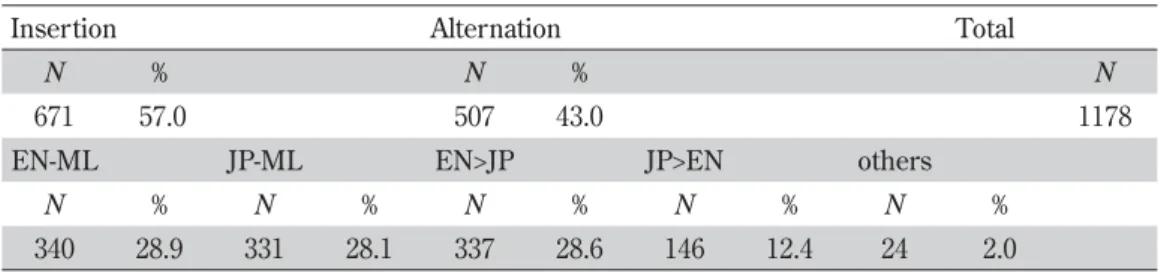
(16) 立命館言語文化研究 26 巻 4 号. as Japan. They are balanced bilinguals and use English and Japanese in their daily school life. Data was collected when three participants gathered to discuss their school life, universities and other topics together. The conversations of five separate groups were recorded with a video camera and a digital PCM sound recorder. The first five minutes of the conversations were not analyzed since it takes time to relax and get the conversation flowing smoothly. 40 minutes of each conversation were transcribed and analyzed.. 4.4 Results From the five conversations, 5993 clauses were retrieved and 1178 of them were identified as bilingual clauses(see Table 5.1). Table 5.1 Overview of the language of the clauses used English. Japanese. Bilingual. Others. Total. N. %. N. %. N. %. N. %. N. 1827. 30.5. 2758. 46.0. 1178. 19.7. 230. 3.8. 5993. The 1178 bilingual clauses are further categorized into insertion and alternation. As table 5.2 below shows, out of 671 insertional CS examples, the ML is English in 340 clauses and Japanese in 331 clauses. Out of 507 alternation examples the ML starts with English with alternation into Japanese occurring in 337 clauses. 146 clauses start with Japanese and switch to English. Others include more complicated patterns, e.g. Japanese into English and back into Japanese again.. Table 5.2 Patterns of CS Insertion. Alternation. Total. N. %. N. %. N. 671. 57.0. 507. 43.0. 1178. EN-ML. JP-ML. EN>JP. JP>EN. others. N. %. N. %. N. %. N. %. N. %. 340. 28.9. 331. 28.1. 337. 28.6. 146. 12.4. 24. 2.0. In this paper, we d like to focus on the switching of pragmatic elements, i.e. interpersonal and textual elements, using the framework of SFG. In 337 examples of English to Japanese alternation, the most frequently occurring pattern is the switching of interpersonal elements(177 examples). On the other hand the 61 occurrences of textual element switching is the highest number in Japanese to English alternation. Those two alternation patterns will be discussed in relation to insertion in the next section.. − 16 −.
(17) Bilingualism as a First Language in the Japanese Context(TAURA, MISHINA-MORI, NAMBA & IKARI). 4.5 Discussion 4.5.1 Switching of interpersonal elements In examples 4 and 5, the clause starts in English, CS occurs, and the clause changes into Japanese. The Japanese part is a repetition of the English part, i.e. do you know and shitteru kana (example 4), copulas in English and Japanese(example 5). This pattern is called the portmanteau construction (Chan, 2009)and is frequently obser ved in CS between typologically distant languages. (4)do you know EK toka shitteru kana such as know SF F S. PRD NGT. Mood. Mood. S: Subject F: Finite PRD: Predicator. (5)It s a sport da yo. NGT: Negotiator. COP SF S. COP: Copula. F PRD NGT. Mood. SF: Sentence final particle. Mood. From the perspective of the interpersonal meaning, these are repetitions of mood, essential parts of the interpersonal meaning in the two languages. In English the mood of the English clause is determined by the order and the presence of the subject and the finite. In example 4, the finite do is followed by the subject you . The order of Finite > Subject signifies the interrogative mood in which the speaker is demanding information from the interlocutor. On the other hand in example 5, the subject it is followed by the finite s . This order of Subject > Finite signifies the declarative mood in which the speaker is giving information to the interlocutor. In Japanese the mood is realized with the combination of the predicator and the negotiator(Teruya 2007). The predicator can be a verb + conjugation(example 4), a noun phrase + copula(example 5), or an adjective +conjugation. With these two examples, the mood is expressed separately in each language and thus, from the perspective of the interpersonal meaning, is an example of alternational CS. While the predicator is compulsory in the Japanese mood system, the negotiator adds various negotiatory values to the clause (Teruya, 2007, p.141). There are a small number of Japanese negotiators located at the end of English clauses. In example 6, the English declarative mood is expressed by the order of the Subject and Finite. The Japanese interrogative particle ka is added at the end. Here the speaker is asking herself a question and confirming what she said. With this case, the insertion of an interpersonal element occurs rather than alternation. The negotiator is inserted in to the clause and adds an interpersonal value to the English mood system.. − 17 −.
(18) 立命館言語文化研究 26 巻 4 号. (6)Ah he left. ka SF. S F. NGT. Mood. 4.5.2 Switching of textual elements In SFG another layer of the clause gives the textual meaning. Each clause can be divided into Theme and Rheme. Theme is an element that serves as the point of departure in the message (Halliday & Matthiessen, 2013). It relates the clause to the context and controls the flow of information. In example 7, the Japanese discourse marker demo relates the clause to the previous context. This is one function of the theme and is called the textual theme . The English pronoun I is the essential part of the theme and is called the topical theme . The topical theme establishes the topic around the beginning of the clause with the Rheme following and giving information about the topic. With this example, from the perspective of the textual meaning, the insertion of the Japanese textual theme into the English clause occurs. (7)demo I. m serious. but textual. topical. Theme. Rheme. In example 8, the topical theme as well as the textual theme is Japanese. From the perspective of the textual meaning, the essential part of the clause is given in Japanese. On the other hand, the essential part of the interpersonal meaning of the clause, i.e. the Mood, is expressed in English. If we look at this bilingual clause from the two perspectives, i.e. interpersonal and textual meaning, the matrix language of the interpersonal meaning is English and that of the textual meaning is Japanese. At the beginning of the clause, the textual ML is Japanese but at the boundary of the Theme and the Rheme, alternation occurs and the interpersonal ML is English. With this example, alternation occurs over two layers of meanings. (8)ma fuyu wa you should think about it well winter TOP textual. topical. Theme. Rheme S F Mood. − 18 −.
(19) Bilingualism as a First Language in the Japanese Context(TAURA, MISHINA-MORI, NAMBA & IKARI). 4.6 Conclusion In this study SFG is used to account for the insertion and alternation of pragmatic elements in Japanese-English code-switching. We have looked at the insertion of an interpersonal element(6), an inser tion of a textual element(7), alter nation in interpersonal elements(4)(5)and alternation in textual and interpersonal elements(8). Example 8 can be analyzed from textual and interpersonal perspectives. If we look at the data from the textual meaning s perspective, the ML is Japanese, whereas if we look at the data from the interpersonal meaning s perspective, the ML is English. The ML has been defined from the morpho-syntactic point of view, this study, however, suggests that the ML should be set according to each layer of meaning in SFG, i.e. interpersonal, textual and experiential. Only the two layers of pragmatic meaning were focused on in this study and further studies focusing on the experiential meaning are needed. When all the three layers are analyzed simultaneously, a deeper understanding of code-switching will be gained .. References Chan, B. H. (2009). Code-switching between typologically distinct languages. In The Cambridge Handbook of Linguistic Code-switching, ed. B. E. Bullock and A. J. Toribio. Cambridge: Cambridge University Press. Halliday, M. A. K. & Matthiessen, M.I.M. (2013). Halliday s Introduction to Functional Grammar. Fourth edition. London: Routledge. Matras, Y. (2009). Language Contact. Cambridge: Cambridge University Press. Muysken, P. (2000). Bilingual Speech : A typology of code-mixing. Cambridge : Cambridge University Press. Myers-Scotton, C.(2002). Contact Linguistics : Bilingual encounters and grammatical outcomes. Oxford ; New York: Oxford University Press. Namba, K. (2012). Non-insertional code-switching in English-Japanese bilingual children: alternation and congruent lexicalisation International Journal of Bilingual Education and Bilingualism, 15(4), 455-473. Poplack, S. (1980). Sometimes I'll start a sentence in Spanish y termino en español : Toward a typology of code-switching. Linguistics, 18, 581-618. Teruya, K. (2007). A Systemic Functional Grammar of Japanese. London : Continuum.. − 19 −.
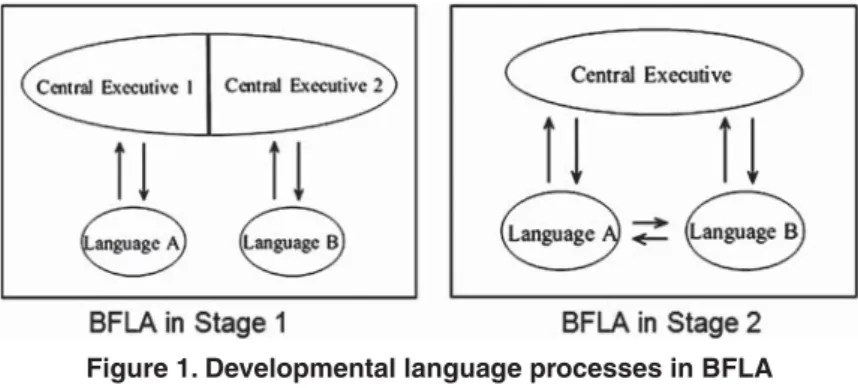
(20) 立命館言語文化研究 26 巻 4 号. 5. Perspectives on Bilingualism Studies with the Help of Brain Imaging Techniques Yukio IKARI. 5.1 Introduction In this presentation we will show the possibilities of brain imaging techniques(BITs)for bilingualism studies. First, we will introduce our three hypotheses, demonstrating they could be proved with BITs. Second, we will consider the effective use of BITs. Finally, we will think about the possible use of BITs in the future.. 5.2 Three hypotheses 5.2.1 First Hypothesis Hypothesis 1: The neural network could work in different ways in the language processing of bilingual first language acquisition(BFLA), depending on its development.. Figure 1. Developmental language processes in BFLA This is a model of our proposal about language processing of BFLA on the basis of the idea of Working Memory. BFLA is defined as the simultaneous acquisition of two languages from birth. There are basically two different ideas concerning BFLA. One is that one of the two language grammars superiorly works at first and then two individual grammars are gradually formed. The other is that the language grammars concerned work independently right from the beginning, continuing to sophisticate their own grammars later. In this paper we take the latter position. Each language is separately processed in the first stage. In the second stage both languages are being processed together, interacting with each other. In order to show our proposal could be true, some authentic BFLA studies with BITs are needed. See the brain imaging in figure 2. This was a very popular brain imaging of fMRI when it was published. In this experiment the sentence-generation task was performed silently. The subject was instructed to describe events occurring during a particular period of the previous day. This task was practiced before the imaging sessions. The total number of participants was twelve, 9 male and 3 female. Their average age was around 30. Six of the subjects had been exposed to two languages during infancy. They were early bilinguals. This is an image of one of their brains (Kim et al., 1997). − 20 −.
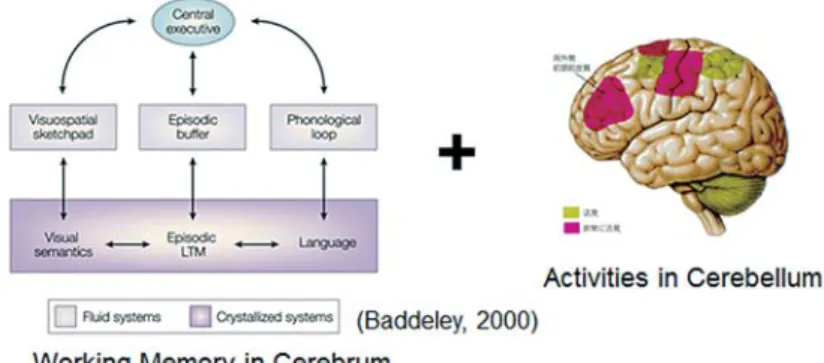
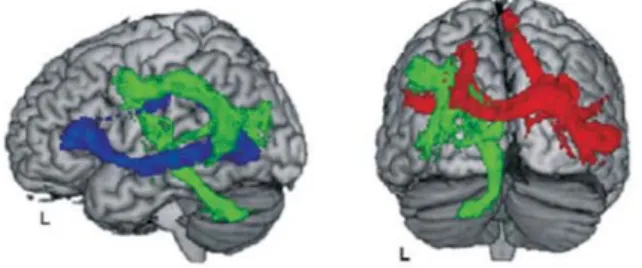
(21) Bilingualism as a First Language in the Japanese Context(TAURA, MISHINA-MORI, NAMBA & IKARI). Figure 2. Brain imaging of an early bilingual s language processing Through this image our proposal seems to have been proved. The image in the square shows each language has a common area as well as its own individual one. This should support our proposal of the language processing shift from independent grammar processing to a cooperative one.. 5.2.2 Second Hypothesis Hypothesis 2: The Cerebellum might be involved in the language processing of BFLA as well as the cerebrum.. Figure 3. The cerebellum and its relation to working memory in the cerebrum. According to our idea, language processing could be involved in the cerebellum as well as the cerebrum where working memory functions. As you might know, many studies have been done so far concerning cerebrum functions such as those which involve the Broca s and Wernicke s areas. And yet very little investigation has been done into the role of the cerebellum. The cerebellum might play a significant role in automatic language processing. At this point, we will show you recent research by Kinno et al. (2014). Kinno and his colleagues made the interesting discover y that our brain might have three different language processing routes. The purpose of their study is to explore the mechanism of Japanese language processing. However, what is more significant to us is that one of these routes might have something to do with the Cerebellum. This could also support our second hypothesis. − 21 −.
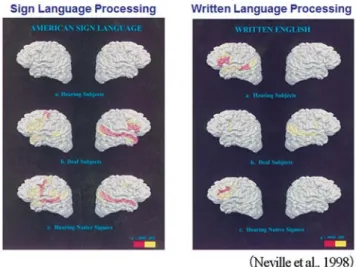
(22) 立命館言語文化研究 26 巻 4 号. Figure 4. Brain imaging of Japanese language processing 5.2.3 Third Hypothesis Hypothesis 3: Hearers and signers use a different medium of processing, i.e., speech and sign language, in their brain when reading.. Figure 5. Different processes of reading in hearers and signers Reading signers and hearers might have different processing modes in the middle-stage, i.e., inner speech in the case of the hearers and its counterpart(possibly in this case sign language) for the signers. However, few studies have been done to prove this. In the meantime, we came across a piece of research shown in the following figure. When using American sign language, hearers, signers and codas(hearing native signers) appear to activate their own individual processing areas. The same could be said for the right side images concerning written language. Take a close look at the middle images. You can see a light yellow belt in this part. This portion of the right hemisphere is being activated which might imply that signers could be using sign language when reading. If this is the case, it would be a great discovery.. − 22 −.
(23) Bilingualism as a First Language in the Japanese Context(TAURA, MISHINA-MORI, NAMBA & IKARI). Figure 6. Brain imaging of bilingual processing 5.3 Effective use of BITs We will now give you some other information, concerning the effective use of BITs. Look at the contents of Table 1. Table 1. Features of BIT devices. As you see in this table, there are four devices and each of them has its own function and limitation. It follows from this that what is significant for the ef fective use BITs is careful consideration of the division of these four devices into two groups on the basis of the targets to be measured, i.e. brain activity and cerebral blood flow. The combination of the devices with different targets should be that of EEG & fMRI or MEG & NIRS.. 5.4 Conclusion Through the considerations detailed above, it can be seen that the use of BITs is likely to yield promising results connected with bilingualism studies in the future. We really hope that further studies of bilingualism will advance by using BITs actively, not only in the field of unimodal bilingualism but also in that of bimodal bilingualism, i.e., signers and codas with sign and written/ spoken languages respectively. − 23 −.
(24) 立命館言語文化研究 26 巻 4 号. References Baddeley, A.D.(2000)The episodic buffer: A new component of working memor y? Trends in Cognitive Sciences, 4(11) . 417-423 Kim, K.H.S., Relkin, N.R., Lee, Kyoung-Min and Hirsh, J.(1997)Distinct cortical associated with native and second languages. Nature 388:171-174 Kinno, R., Ohta, S., Muragaki, Y., Maruyama, T. & Sakai, K. L.(2014)Differential reorganization of three syntax-related networks induced by a left frontal glioma. Brain 137, 1193-1212 Neville, H. J., Bavelier, D., Corina, D., Rauscheker, J., Karni, A., Lalwani, A., Braun, A., Clark, V., Jezzard, P., and Turner, R.(1998)Cerebral organization for language in deaf and hearing subjects: Biological constraints and effects of experience. Proceedings of the National Academy of Sciences USA Vol. 95, 922– 929.. − 24 −.
(25)
図

+6
関連したドキュメント
Oscillatory Integrals, Weighted and Mixed Norm Inequalities, Global Smoothing and Decay, Time-dependent Schr¨ odinger Equation, Bessel functions, Weighted inter- polation
Gmelin concerning the Fundamental Theorem of Algebra to establish the following result about the polynomials that represent prime numbers (see [20], Satz 7).. St¨ ackel’s
As in [6], we also used an iterative algorithm based on surrogate functionals for the minimization of the Tikhonov functional with the sparsity penalty, and proved the convergence
There we will show that the simplicial set Ner( B ) forms the simplicial set of objects of a simplicial category object Ner( B ) •• in simplicial sets which may be pictured by
Assuming strong consensus for some fixed value of θ in (0, 1 2 ) , we are going to show that there will be finally blocked edges in the infinite percolation component with
I think that ALTs are an important part of English education in Japan as it not only allows Japanese students to hear and learn from a native-speaker of English, but it
But in fact we can very quickly bound the axial elbows by the simple center-line method and so, in the vanilla algorithm, we will work only with upper bounds on the axial elbows..
In this paper we prove in Theorem 5.2 that if we assume (1.1) satisfying the conditions of the Equivariant Hopf Theorem and f is in Birkhoff normal form then the only branches
