Hideyuki Taura*
Abstract
This study aims to longitudinally examine the way in which English has been acquired by a female Japanese EFL learner, during her first three years of studying English at high school. The data collected yearly for three years, included writing samples, an oral interview, and brain-images (fNIRS) taken while the learner performed a verbal fluency task. It was found that it took two and a half years for her to reach the "English native speaker" level in three aspects of writing – grammar, vocabulary, and story development. A lexical boost effect was observed in the third year while accuracy and oral fluency showed indeterminate results and fluctuations from year to year. Brain-imaging data revealed that during the letter task, Broca’s area was activated in a similar way for the first two years but showed significantly more activation in the third year. The right hemisphere showed increasingly more activation each year. In the first and second years, Broca’s area was more active than in the homologous area in the right hemisphere, but in the third year the activation levels were identical to each other. Thus, both linguistic (writing and vocabulary) and brain-imaging data showed an identical boost in the third year. This could be interpreted that Broca’s area plays a major role in the initial stages of English learning but as the learner's English improves the right hemisphere is also equally involved in the process that takes over two years, suggesting qualitative changes in the brain when a foreign language is learned in a classroom setting, even after the critical period.
Keywords: acquisition, EFL (English as a foreign language), fNIRS (functional near-infrared spectroscopy)
*
1. Introduction
1.1 Hemispheric lateralization
The specialization of various functions into the two cerebral hemispheres is called lateralization, seen for instance in language processing which is predominantly conducted in the left hemisphere in over 90% of right-handed people (e.g., Knecht, 2000). There is, however, some right hemisphere involvement in certain aspects of language use such as prosody. The regions of the brain used for language production include Broca's area, which is located in the inferior third frontal gyrus in the dominant cerebral hemisphere (Brodmann areas 44 and 45). Another brain region supporting language comprehension is Wernicke's area and it is found in the posterior section of the superior temporal gyrus in the dominant cerebral hemisphere (Brodmann area 22). The age at which language lateralization takes place is controversial to date. Recent development of neuroimaging technologies has allowed researchers to investigate brain activation in small children in a non-invasive way. Wartenburger et al. (2007), for example, found that by using fNIRS (functional near-infrared imaging), four-year-old children already showed signs of L1 lateralization in the left hemisphere. Other researchers report on lateralization beginning at an even earlier age. In Dahaene-Lambertz's (2000) study, 4-month-old infants showed left hemisphere involvement when presented with auditory stimuli and in Peña et al's (2003) research, infants as young as two to five days old displayed more activation in the left hemisphere while listening to children‘s stories. These findings suggest that L1 lateralization seems to occur quite early on.
1.2 L1 vs. L2 in different aspects of language
Various aspects of language have been investigated by researchers, who explored whether they are processed in different brain regions. For instance, Perani et al. (1997) found that there are no cortical response differences observed between early bilinguals (onset age [OA] of bilingualism, zero to four years of age) and late bilinguals (OA of ten years or older) when listening to stories. Quaresima et al. (2002) discovered that early bilinguals (OA zero to five years) showed similar activation patterns in the left lateral frontal lobe whether a translation task was from L1 (Dutch) to L2 (English) or vice versa. Weber-Fox and Neville (1996) argued that for early and late bilinguals there were no differences in brain activation during a semantic judgment task, but there were differences in the activated regions with an L1 and L2 grammatical judgment task. This issue of task-dependency is also reported by Yokoyama et al. (2010) who researched late Japanese-English bilinguals and found that different brain regions are used to process more complex structures (passive form) while the same brain areas are activated when easier tasks are being performed in both Japanese and English. In contrast, Suh et al. (2007) who examined Korean-English bilinguals found that they used a totally different cerebral network for their L1 compared to their L2, in comprehending syntactically complex sentences. Koyama et al. (2013) revealed that the cerebral
mechanisms for L2 reading in late learners depended both on their which language was their L1 and which language they were learning as their L2.
Thus, the research into which areas of the brain are activated for L1 or L2 produced inconclusive results to date.
1.3 Age, L2 proficiency, and brain regions
The critical period hypothesis for language acquisition was first proposed by Lenneberg (1967) who argued that it is difficult to achieve native-like proficiency once one passes the critical period (puberty). Data supportive of this hypothesis have been presented by some researchers such as Johnson & Newport (1989) who found that age 16 marked the dividing line: those who arrived before 16 were able to produce a more accurate L2 in comparison to those whose arrival was after that age. Luk and Shirai's (2009) research produced similar results, though the dividing age was found to be a lot earlier than 16. On the other hand, Hakuta et al. (2003) rejected the critical period for L2 acquisition. Recent fMRI technology has managed to disclose that the age of acquisition is linear and negatively related to activation levels in anterior language regions (Mayberry et al., 2011).
There are some researchers who have attempted to identify whether L1 and L2 processing in bilinguals takes place in the same or different brain regions, depending upon one's onset age for L2. Kim et al, (1997) found early bilinguals (OA in infancy) show that both the L1 and L2 activate the same region in Broca‘s area whereas late bilinguals (OA in early adulthood) show activation in a different region of Broca‘s area. Dehaene et al. (1997) reported their bilingual participants (OA before seven) as showing a left-hemispheric dominance for comprehending L1, but during an L2 listening task, the right hemisphere showed signs of activation. In an fNIRS study on syntax, Jasinska and Petitto (2013) argued that early bilinguals exhibit fundamental changes solely in what had been claimed as language areas in the left hemisphere while late bilinguals show such development in the larger prefrontal cortex area that governs higher cognitive executive functions. Similar findings are reported by Bloch et al. (2009) who examined oral production of early (OA before 5 years old) and late (OA after nine) bilinguals.
Research into foreign language learning in a classroom setting has also produced a wide range of findings. Osterhout et al. (2008) posited that adults who had learned a foreign language in a classroom setting showed restructuring in their brains within the first several weeks.
Sakai (2005) argued that cortical activation is influenced not only by the age of acquisition of the L2, but also by the proficiency level. Bowden et al. (2013) found that syntactic processing in university students learning a foreign language in a classroom setting was initially different from their L1 processing but shifted to a native-like acquisition process, once sufficient proficiency and exposure had been achieved. Nakada et al. (2001) was in line with this argument stating that L2
reading represents a cognitive extension of the L1 reading system. The lexical network is found to change as one‘s L2 vocabulary increases according to Saidi et al. (2013). Oishi (2006) found that Japanese EFL learners showed a positive correlation between their proficiency and the level of cerebral activation until they had reached a certain level of proficiency with TOEFL and TOEIC tests. Oishi also identified that there was little brain activation in novice learners, followed by hyper-activation in intermediate learners and reduced activation in very proficient learners. Perani
et al. (1998) points out the issue of proficiency over a certain onset age when they tested early (OA
before 4) and late (OA after 10) bilinguals‘ listening skills.
Thus, the onset age of L2 acquisition and proficiency level appear to be key variables when examining if language processing occurs in the same cerebral region for the production of the L1 or L2.
1.4 Research design and observation span
Several researchers examined research design, such as Osterhout et al. (2008) who examined L2 learning effects on the brain structure, collecting data from four university students over nine weeks – immediately after an intensive Spanish course began and before it ended. Stein et al.‘s study (2012), which paid more attention to structural rather than functional changes in the brain, tracked ten participants (mean age of 17.5 years) for an initial five months of learning a second language. After reviewing recent neuroimaging studies on bilinguals, researchers such as Abutalebi
et al. (2009) suggested, as a future direction that longitudinal and cross-linguistic studies should
compare linguistically distant languages.
1.5 Research Questions
The literature review above revealed three queries to which research findings are not conclusive as yet:
(1) Are different brain regions being activated depending on whether the L1 or L2 is being used? (2) Does the onset age of L2 acquisition and proficiency level exert any influence on the cortical network in the brain?
(3) Are different brain regions activated depending on what different aspects of the language are being used, such as vocabulary or writing?
As mentioned above, it has been suggested that research should be conducted longitudinally, using two linguistically distant languages.
The present fNIRS study thus uses the research design of a longitudinal case study examining how L2 acquisition affects the language network in the brain in a Japanese EFL learner to whom English, an alphabetical language, is linguistically distant from the mother tongue – a logographic language - Japanese.
Research Question: Does L2 learning that begins at age 12 result in qualitative changes in the brain as a function of proficiency in lexical and writing skills?
2. Method 2.1 Participants
One female participant was the basis for this study and she was born and raised in Japan with no experience of visiting any English-speaking countries. Her first exposure to English started as a primary school pupil where she enjoyed a weekly English conversation class. She began to learn English as a school subject when she entered a public junior high school in Osaka at 11;03 (eleven years and three months) in April, 2011. She received four English lessons per week at school. In addition she studied English once a week at an English cram school. Data were collected three times from her: (1) the first time in October, 2011 at 12;09 when she was a seventh grader – six months after starting to learn English, (2) the second time, one year later, in September, 2012 when she was an eighth grader at 13;07, and (3) the third time in October, 2013 as a ninth grader at 14;08.
2.2 Tasks & Data analysis
A writing test, interview, and verbal fluency task were used in this study over a three-year period, to observe how English is learned from both linguistic and neuroimaging perspectives.
2.2.1 Writing task
To investigate the participant's linguistic skills, written data in English were collected once a year during a three-year period using the Test of Written Language (TOWL-3), by Hammill and Larsen (1996). It is a simple test requiring the participant to look at a prehistoric or futuristic picture, think about and then write a story about it in 15 minutes. It employs both analytical and holistic measurements to examine three aspects of writing: (1) Conventional Component (CC) such as punctuation, capitalization, and spelling, (2) Contextual Language (CL) such as syntactic, morphological, and semantic elements, and (3) Story Construction (StC) such as logical and coherent story development and reader impact. TOWL-3 also calculates an overall writing score by adding the three-subset scores and converting the sum into a Quotient. Each writing sample was scored according to the scoring manual provided by TOWL-3 to first produce raw scores for CC, CL, and StC and then to convert them into age-appropriate standard scores with 8-12 points indicating the native speaker average, which is set between 90 and 110 points in the overall writing scores of the Quotient.
fluency analysis. The lexical analysis was carried out in terms of the number of different words (types), the total number of words (tokens), and the lexical density (TTR - type token ratio) as well as the levels of words, using a software program the Complete Lexical Tutor (http://www.lextutor.ca/). The morphosyntactic accuracy analysis was based on Myers-Scotton's 4-M model (2002). Fluency was measured with the number of morphemes and types (different words) produced per minute.
2.2.2 Oral interview
A three-minute long semi-structured interview was conducted. The interview always started in Japanese for one minute, then in English for one minute, and ended in mixture of two languages for the final minute. In the first year, however, the participant was asked to orally translate six simple Japanese sentences into English because it was assumed that her English was not good enough for an oral interview as she had only been learning the language for six months. The pause length before she uttered the first English word following a cue sentence or question was analyzed. Then the time spent producing a word was calculated by counting the number of words in each sentence and measuring the time needed for every sentence.
2.2.3 Verbal fluency task
Verbal fluency tasks are frequently used to elicit brain activation data from bilingual subjects because of the relative ease in making comparable tasks in the two languages (e.g., Arai et al., 2006; Ehlis et al., 2007; Fallgatter et al., 2004; Kameyama et al., 2004; Schecklmann et al. 2008; Taura et al., 2010). The Verbal Fluency Task (VFT) in the present study included four sub-tasks as shown in the blocked design in Figure 1 that also shows the task stimuli and the timing of the tasks (Figure 2). The experiment began with a 15-second rest. Then the first letter task was given for 30 seconds followed by a 30-second rest, before the second letter task began. This pattern repeated itself again with category tasks in each language. At the end of the fourth task, there was another rest lasting for 30 seconds. To offset the language sequence effects, a counter-balanced version was used every second year.
Two kinds of tasks were given to the participants: the letter task and the category task in Japanese and English. For the Japanese letter task, for instance in 2012, hiragana prompts of the letters KA and SA were projected onto a computer screen, and the participants were then expected to say aloud as many Japanese words as possible, that started with the KA syllable in the first 15 seconds and then SA in the second 15 seconds. The English letter task used the letters 'E' and 'S' in the same way. Meanwhile, in the Japanese category task, participants were required to produce as many words as possible that related to cue words such as 'country', where for example they may have said 'Japan' or 'France'. Both Japanese and English category tasks had two category words that
were shown on the computer (MacBook Pro 17‖) screen for 15 seconds each. The actual category words shown in English were 'animal' and 'colour' while the words 'food' and 'country' were projected onto the screen in Japanese. Our decision to use such English letters and categories was based on previous studies by Schecklmann et al. (2008) and Ehlis et al. (2007) while the hiragana examples were selected from Japanese studies (e.g., Arai et al., 2006; Kameyama et al., 2004; Murai et al., 2004).
Figure 1. Verbal fluency task (VFT) in 2011, 2012, and 2013
Figure 2. Timing of VFT stimuli
2.2.4 fNIRS machine and data analysis
Among the variety of brain imaging techniques, the non-invasive functional neuro-imaging method known as fNIRS is said to be easy to use and sensitive to detecting small substance concentrations, with a high temporal resolution (Toga and Mazziotta, 2002). In principle, fNIRS measures brain activation using changes in the intensity of light detected by source and detector probes that are attached to the head with a harmless light that penetrates the brain. Other brain imaging techniques, including fMRI (functional magnetic resonance imaging), PET (positron
emission tomography), and MEG (magnetoencephalography), require large and bulky instruments which make it difficult for small children to be examined. In comparison, fNIRS uses light via fibre optics, which can even allow babies to be examined (Miyai et al., 2001). In addition, fNIRS is sensitive to a very low substance concentration using a fluorescence method and the result is similar to a PET scan without the disadvantage of radioactive tracers. The temporal and spatial resolution differ vastly from one brain imaging method to another: high temporal resolution is obtained using the MEG eletrophysiological method (starting from 1 m.s.) while hemodynamics-based techniques such as fMRI (starting from 1 mm) provide a greater spatial resolution. fNIRS offers a smaller, easier-to-use option to monitor vascular, metabolic-cellular, and neuronal responses with a high temporal resolution of about 1,000 m.s., despite a low spatial resolution of about 3 cm. It is also recognized that fNIRS data are consistent with fMIR data in predicting hemispheric dominance on linguistic tasks (e.g., Kennan et al., 2002).
fNIRS has been widely used and proved to be useful in various academic disciplines (see Ansaldo et al., 2012 for summary). In the field of linguistics, fNIRS is superior to other functional neuroimaging techniques from the participants' point of view in that it allows them to be seated in front of a computer screen without being placed in a closed-in noisy tube-like machine as they do in an fMIR experiment, when they engage in a language task (for overview see Gallagher et al., 2012 and Quaresima et al., 2012), particularly for children (e.g., newborns to adults in Quaresima
et al., 2012; pre-school children in Hidaka et al., 2012; elementary school children in Sugiura et al.,
2011). Such neuroimaging researchers as Ameel et al. (2009), Midgeley et al. (2009), Rossi et al. (2012), Sugiura et al. (2011) successfully examined the first and second language network in the brain, which makes it a useful method for fNIRS researchers to identify how early bilinguals' languages are processed. In addition to monolingual language processing (e.g. Tupak et al., 2010; Quaresima et al., 2000), a number of fNIRS studies have examined bilingual language processing (e.g., Kovelman et al., 2009; Midgeley et al., 2009; Oi et al., 2010; Quaresima et al., 2010; Schrerer et al., 2012) using a verbal fluency task (VFT, henceforth) and found it to be a useful tool. fNIRS studies using VFT also found that oxygenated hemoglobin (oxy-Hb) signals were able to detect an increase in brain activation throughout a period of language stimulation and a subsiding at the end of the task (Quaresima et al., 2012). In addition, a more advanced level of language meant that the speaker required less of an effort to produce it and thus the language processing became more automatic, resulting in a decreased oxy-Hb level (Saidi et al., 2013).
fNIRS has also been widely used in clinical settings to detect the language faculty (see Klumpp and Deldin, 2010 for overview) or how languages are processed. The present enquiry into L2 learning in a young Japanese EFL learner is therefore a valid attempt to use a VFT and fNIRS equipment together.
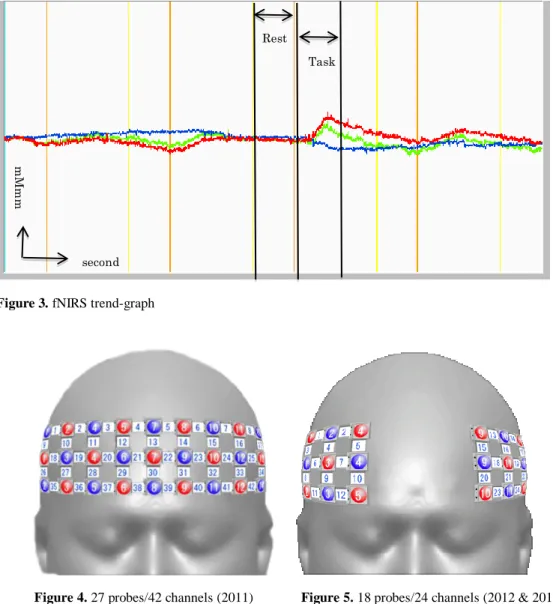
(Shimadzu FOIRE-3000). This non-invasive device uses three wavelengths of harmless near-infrared light (780±4nm, 805±5nm, 830±5nm). We used 13 emitters and 14 receptors three centimeters apart from each other, detecting three types of parameters - oxygenated hemoglobin (oxy-Hb), deoxygenated hemoglobin (deoxy-Hb), and total hemoglobin (total-Hb) in 42 areas (channels). While the tasks are ongoing, the FOIRE-3000 machine produces a trend graph which concurrently shows how three types of hemoglobin data increase, decrease, or level off (Figure 3). This graph also helps the researcher to discard any data from particular channels that show the involvement of artifacts due to jerking movements of the participant, or probes popping out of the holder sockets. Out of the three hemoglobin data types, this study focuses solely on the oxy-Hb, following such previous neurolinguistic studies as Guo et al. (2011) and Moriai-Izawa et al. (2012).
Figure 3. fNIRS trend-graph
Figure 4. 27 probes/42 channels (2011) Figure 5. 18 probes/24 channels (2012 & 2013)
m M m m second Rest Task
In the first year, all of the 27 fiber probes were used to collect data from the entire frontal lobe (Figure 4). In 2012 and 2013, however, this was reduced to 18 probes (Figure 5) since this study only wanted to focus on the left inferior frontal gyrus (Broca‘s area) and its homologous area in the right hemisphere, as some previous studies (e.g. Quaresima et al., 2012; Herrmann et al., 2005; Kameyama et al., 2004) and our own research (Taura et al. 2010 and 2011) have discovered that the most activation takes place in these areas when linguistic tasks are undertaken.
Figure 6. International 10/20 system
Based on the International 10/20 system for placement on the head (Jasper, 1958), a flexible brain cap was put on the participant's head to cover the frontal cortex, with the lowest probes being positioned along the T3-Fp1-Fz-Fp2-T4 line (Figure 6). After measuring the length between the nasion and inion, receptor #8 was placed on the Fpz location (the central position of the T3-Fp1-Fz-Fp2-T4 line). Then both Broca‘s area and the homologous area in the right hemisphere were visually identified according to the instructions provided by Fukuda (2009; 16). The fNIRS machine operates in this way: (1) it detects near-infrared rays that are first released from the emitters, then penetrate the skull into the cerebral cortex, and return to the receptors, and (2) it caluculates how much hemoglobin is concentrated in a particular area of the brain. This is possible since brain activation requires oxygen (oxy-Hb)that in turn absorbs the near-infrared rays in the cortex, which means that less rays return to the receptors when coming through the areas where intensive brain activation is taking place. Changes in oxy-Hb, deoxy-Hb, and total-Hb from 130 miliseconds earlier are estimated based on a modified version of the Lambert-Beer Law (Seiyama
et al., 1988; Wray at al., 1988) which is used as an arbitrary scale unit, fNIRS value of mMmm -
molar-concentration multiplied by the unknown length of the optical path since the machine cannot measure optical path length (Hoshi, 2003).
The collected fNIRS data undergo the following process. The fNIRS data taken from the channels identified as Broca's area (F7 in Figure 6) and its homologous area in the right brain (F8) were converted into z-scores, which is a first step to make the data comparable among samples derived from other tasks and previous years. Then, the z-scores of the three channels identified as Broca's area were averaged out. Lastly, after the z-scores of certain VFTs were calculated, the scores of the rest task preceding the task were subtracted from those z-scores. By doing this, the fNIRS data where the most activation took place in 15-second intervals, could be identified for each task and rest period. For instance, the bold z-scores in the middle row labeled as oxy-Hb in the first rest task were subtracted from the bold z-scores in the far right row labeled as oxy-Hb in the English letter task. The same procedure was repeated for all the tasks from each year of data. The subtracted z-scores comprised the fNIRS data used for the statistical analyses.
2.3 Procedure
Our participant was shown into a laboratory and seated in a chair with her eyes approximately 30 cm away from the computer monitor. First, her head measurements were taken to allow the flexible cap to be placed correctly on her head according to the International 10/20 system (Jasper, 1958). While the cap was being put into place, a procedure which took about ten minutes, information was gathered on her language background, and right or left-handedness. Once the cap was ready and the optical fibers from the fNIRS machine were connected up, photos were taken to record the position of the cap from three angles—left, right and front. Then, a video clip was shown to the participant to advise her what the experiment (VFT) involved. When made fully aware of the task, the participant was told that it was her right to stop the procedure at any time if she felt uncomfortable. Upon completion of the VFT, a three-minute interview was conducted while the cap and fibers were removed and then she was asked to write an essay for the TOWL-3 analysis during a 15-minute period. At the end of the experiment, a token of gratitude (book voucher) was given to her. Prior to the experiment, a consent form (approved by the Ethics Committee at Ritsumeikan University, Appendix) was signed by her parents each year to allow her to participate in this study.
3. Results & discussion 3.1 Linguistic aspects 3.1.1 Writing skills
The participant was instructed to write a descriptive story in English based on a picture what had a theme that was either prehistoric or futuristic, within a 15-minute time frame. The first two sentences written each year are in order: (2011) Animal is big. The man has kives., (2012) There is
These animals broke the trees. These sentences illustrate her writing improvement to a small extent,
and this is followed by a detailed analysis of her writing samples using her TOWL-3 scores (Table 1, Figures 7 & 8) and examining them from both morphosyntactic and lexical perspectives.
Table 1. TOWL-3 scores
Figure 7. CC, CL, and StC (8 < NS norm < 12) Figure 8. Quotient (90 < NS norm < 110)
The data show that the basic rules for writing in English (CC) did not take long before they were acquired: CC was the sole component that reached the same level as English native speakers at the age of 13:07 – one and a half years after the student had started learning English. In comparison, the participant's acquisition of grammar/vocabulary (CL) and story development (StC) did not reach English native-speaker level until a year later at age 14;08 (two and a half years after starting to learn English). The lag in acquisition could be because in the beginning there are a fairly limited number of basic writing rules like capitalization and punctuations, however later on there is a larger number of morphosyntactic rules and an indefinite number of lexical items. More superior story development was made possible in the third year due to a solid base in grammar and vocabulary. Individual components are briefly looked at. In the first year, all the sentences already began with capital letters and ended with periods. The second year saw the introduction of proper nouns with capital letters and in the third year the notion of paragraphs was incorporated with two paragraphs as opposed to only one paragraph in the first and second years. Thus, concerning the basic writing rules (CC), the second year exhibited a significant improvement to the first year, resulting in the student reaching the same level as her American counterparts..
CL and StC, on the other hand, showed a great change in the third year, as shown in the scores over the three years of 6, 6, and 13 (CL) and 3, 5, and 12 (StC). The following sentence written in
0 5 10 15 12.09 13.07 14;08 CC CL StC 0 20 40 60 80 100 120 12.09 13.07 14;08
the third year typically exemplifies the leap in skills - After the fighting, people feel very happy and
they try to make their lives better. For the first time, an introductory phrase was used ‗After the fighting‘ in front of the main clause (CL) and through the sentence she expressed the characters'
emotions and a philosophical theme (StC). In addition, in the third year, a higher degree of grammatical accuracy was observed in the subject-verb agreement of ‗the animals are‘ and ‗this picture shows‘ in comparison with ‗many people is‘ and ‗astronaut discover(s)‘ in the second year. Appropriate usage of articles also occurred in the third year ‗This is a picture … the fighting‘ whereas the second year saw both appropriate use of articles such as, ‗the moon‘ and omission of articles ‗(an) astronaut‘.
3.1.2 Lexical analysis
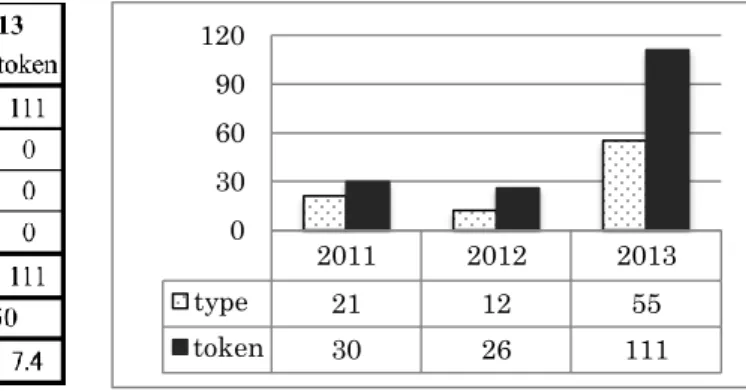
The results of lexical analyses are summarized in Table 2 and Figure 9.
Table 2. Lexical analysis results
(K-1: most frequently used 1,000 words) Figure 9. Type and token
The volume (token) of the writing samples (15-minute time limit) tripled to 111 words in the third year. This change followed a smaller and similar number of words in the first two years (30 and 26 words, respectively). Thus the third year yielded 7.4 words on average per minute as opposed to a mere 2.0 words in the first year. The variety of words also exhibited an increase in the third year with 55 types, as opposed to 12 in the first year and 21 types in the second year. Though writing fluency surged in terms of types and tokens, the actual level of vocabulary did not change that much during the three years. The vast majority of words came from the kindergarten to first grade (K-1) first 1,000-word level used by English native speakers.
3.1.3 Accuracy analysis
According to Myers-Scotton‘s 4-M model (2002), in any language contact situation language acquisition and attrition occurs in the order of content, early, bridge, and outsider system
2011 2012 2013 type 21 12 55 token 30 26 111 0 30 60 90 120
morphemes. The model predicts that the participant in the present research would acquire content morphemes such as nouns and verbs more accurately before the three types of system morphemes.
Figure 10. Summary of 4-M analyses
Figure 11. Accurate and inaccurate trial count
Examining the student in the present study, this order did occur in the second year (2012) when the accuracy of using content morphemes was 76.5% while the accuracy rates of early, bridge, and outsider system morphemes marked 66.7%, 66.7%, and 33.3% respectively (Figure 10). This, however, did not hold true in the other two years (2011, 2013). As seen in 2011, for instance, the accuracy rates were 94.7% (content), 55.6% (early), 100% (bridge), and 100% (outsider). When we examine the individual morpheme types, they should increase in accuracy each year, however this was only seen in the early system morphemes, from 55.6% in 2011 to 66.7% in 2012 and 76.6% in 2013. The other three types fluctuated in accuracy as seen for example with the content morphemes, which were 94.7% correct in 2011 but 76.5% accurate in 2012 and 94.5% correct in 2013.
The fluctuation is possibly due to the very limited number of morphemes used by learner in this content early bridge outsider Total
2011 94.7 55.6 100 100 87.6 2012 76.5 66.7 66.7 33.3 60.8 2013 94.5 76.6 100 76.9 87 0 10 20 30 40 50 60 70 80 90 100 2011 2012 2013 accurate use 32 22 122 errors 5 10 18 0 30 60 90 120
research in the first two years, with only 37 used in 2011 and 35 in 2012 compared to 140 in 2013, resulting in a low reliability of the rates (Figure 11). The fluctuating nature of morpheme usage has been pointed out by Ellis (2008) in the early stages of learning a second language.
3.2 Oral fluency
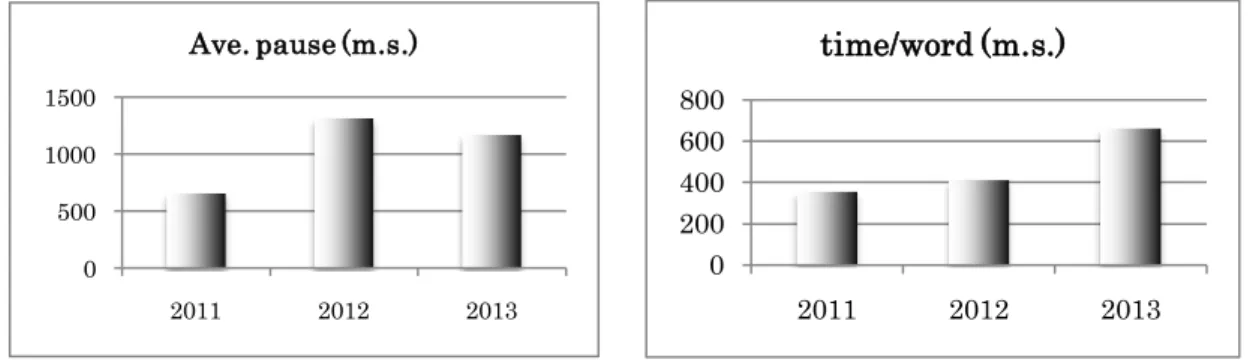
One-minute long interview in English was conducted every year. The participant was asked to orally translate a simple Japanese sentence into English such as ‗I play tennis‘ in the first year, taking into consideration that she had only been studying English for only six months. From the second year on, short oral interview was given in English with question and answer format such as ―… Where did you go? -- I went to Kyoto.‖ then in the third year, ―Why do you want to be an air hostess? - Because I like to study English.‖ in the third year (the participant‘s reply is italicized). Figure 12 summarizes the average time the learner needed before answering the question in English. In the first year, she only needed 659 m.s. because she had only to translate a given Japanese sentence, whereas the time almost doubled in the second and third years (1,317 and 1,170 m.s., respectively) because she had to respond to the question. The response time improved (decreased) in the third year in comparison to the second year.
Figure 13 summarizes the average time the participant spent uttering a word in three-or-more-word sentences (one or two-word sentences were excluded on the grounds that they are likely to be prefabricated units or formulaic chunks as seen in ‗I‘m fine‘ in response to ‗How‘re you?‘). The first year the time was 354 m.s. in total, followed by 410 m.s. in the second year, and then 661 m.s. in the third year. The time lengthened and longer and more complex sentences were produced in the third year with 5.3 words on average in each sentence compared to 3.5 words in the second year.
Figure 12. Time needed to reply Figure 13. Word production time
3.3 Neurolinguistic aspects 3.3.1 Behavioural data
The number of words produced by the participant for the four tasks each year is summarized in 0 500 1000 1500 2011 2012 2013 Ave. pause (m.s.) 0 200 400 600 800 2011 2012 2013 time/word (m.s.)
Figure 14. The task duration was 30 seconds for each task. Category tasks tended to result in more words than with letter tasks in both languages whereas the Japanese tasks tended to induce more words than the English tasks for both category and letter tasks.
Figure 14. Behavioural data
3.3.2 Brain Activation data (fNIRS)
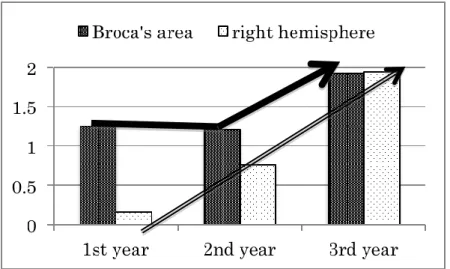
A mixed-design analysis of variance was carried out on the fNIRS data using English letter fluency tasks, which were collected over the three years observing both brain hemispheres (F(5,68)=72.09, p<.001, Partial Eta Squared=.841). Post-hoc Bonferroni analyses revealed that the brain activation in Broca‘s area stayed the same for the first two years of the experiment until it increased significantly in the third year. In comparison, the homologous area in the right hemisphere showed an increasingly greater amount of brain activation each year. A hemispheric comparison carried out in all three years disclosed that the left hemisphere was activated significantly more than its right equivalent in the first two years but there were no differences found in the third year (Figures 15 & 16).
The data analysis revealed that differing development stages occurred in both brain hemispheres of the participant who was learning English as a foreign language in a formal school setting. In the first two years Broca‘s area, the language faculty, showed no obvious changes in activation, though brain activation occurred more in Broca's area than in the right hemisphere. This signifies that in the early stages of foreign language acquisition, the left hemisphere, where one's native language is processed, plays a major role as well. However, in the case of this learner, in the third year both hemispheres were activated more with a statistical difference, than in the preceding two years when there were no significant differences between the hemispheres.
E letter E category J letter J category
1st year 7 14 10 16 2nd year 2 11 7 14 3rd year 5 12 9 14 0 2 4 6 8 10 12 14
Figure 15. Yearly comparison between hemispheres (mMmm)
1st year in Broca‘s area 2nd year in Broca‘s area 3rd year in Broca‘s area
1st year in the right hemisphere 2nd year in the right hemisphere 3rd year in the right hemisphere
Figure 16. Hemispheric comparison of fNIRS data for each year (red signifying more activation than green or blue)
4. Conclusion and future scope
Japanese EFL learner, revealed linguistically that it took two and a half years for her to reach the level of her counterparts in English-speaking countries in three aspects of writing – grammar, vocabulary, and story development. In addition, lexical boosting was observed in the third year. Meanwhile, accuracy and oral fluency showed indeterminate results – fluctuation from year to year, which implied that her English was still in the initial stages of acquisition. Brain-imaging data revealed that the number of words in the English category task almost reached the number produced for the Japanese category task over the three years. However, that it was not the case with the more difficult English letter task. During this task, the participant's Broca‘s area showed a similar level of activation in the first two years but significantly more activation in the third year. The similar area to Broca's in the right hemisphere was also increasingly more activated from year to year. In the first and second years, Broca‘s area was more active than the homologous area in the right hemisphere, but in the third year the activation levels were identical to each other. Thus, both linguistic (writing and vocabulary) and brain-imaging data showed an identical trend of lexical boosting in the third year. This yearly observation through the fNIRS data could be interpreted that Broca‘s area plays a major role in the initial stages of English learning but then becomes equally activated as its counterpart in the right hemisphere as English ability improves, which takes over two years. The particular aspects of English learning which exhibit this trend are limited to writing and vocabulary. Accurate use of morphosyntax and oral fluency are the areas that do not show such a tendency probably due to the fact that they require more than three years to reach a higher level. Accuracy and oral fluency are two aspects that could be explored in future research in relation to brain-activation to attempt to explain differential acquisition paths.
Acknowledgements
I am grateful to the Japanese EFL learner who took part in this study and Ms. Mari Shibukawa, her teacher, who encouraged her to do so. Special thanks go to Mr. Satoshi Yomota, Mr. Yoshiyuki Kato, and Mr. Daisuke Shotsu from the Shimadzu Corporation in helping me with regards to the use of the fNIRS equipment and task design. This research is partly funded by a grant-in-Aid for Scientific Research (B, #25284111), a Grant-in-Aid for Exploratory Research by the Japan Society for the Promotion of Science (#25580143), and a Ritsumeikan University grant promoting academic research.
References
Abutalebi, J., Tettamanti, M., and Perani, D. (2009). The bilingual brain: Linguistic and non-linguistic skill. Brain and Language, 109, 51-54.
Ameel, E., Malt, B., Storms, G., a, Fons Van Assche. (2009). Semantic convergence in the bilingual lexicon. Journal of Memory and Language, 60, 270-290.
Ansaldo, A., Kahlaoui, K., and Joanette, Y. (2012). Functional Near-Infra Red Spectroscopy (fNIRS): A Promising Functional Imaging Technique for the Study of Brain and Language.
Brain & Language, 121, 2, 77-184.
Arai, H., Takano, M., Miyakawa, K., Ota, T., Takahashi, T., Asaka, H., Kawaguchi, T. (2006). A quantitative near-infrared spectroscopy study: A decrease in cerebral hemoglobin oxygenation in Alzheimer‘s disease and mild cognitive impairment. Brain and Cognition, 6, 2, 189–194. Bloch, C., Kaiser, A., Kuenzli, E., Zappatore, D., Haller, S., Franceschini, R., Luedi, G., Radue, E.,
and Nitsch, C. (2009). The age of second language acquisition determines the variability in activation elicited by narration in three languages in Broca‘s and Wernicke‘s area.
Neuropsychologia, 47, 625-633.
Bowden, H.W., Steinhauer, K., Sanz, C., and Ullman, M. (2013). Native-like brain processing of syntax can be attained by university foreign language learners. Neuropsychologia, 51, 2492-2511.
Dahaene-Lambertz, G. (2000). Cerebral specialization for speech and non-speech stimuli in infants.
Journal of Cognitive Neuroscience, 12, 3, 449-460.
Dehaene, S., Dupoux, E., Mehler, J., Cohen, L., Paulesu, E., Perani, D., van de Moortele, P.F., Lehericy, S., and Le Bihan, D. (1997). Anatomical variability in the cortical representation of first and second language. NeuroReport, 8, 17, 3809-3815.
Ehlis, A. C., Herrmann, M. J., Plichta, M. M., and Fallgatter, A. J. (2007). Cortical activation during two verbal fluency tasks in schizophrenic patients and healthy controls as assessed by multi-channel near-infrared spectroscopy. Psychiatry Research, 156, 11-13.
Ellis, R. (2008). The study of second language acquisition. Oxford: Oxford University Press. Fallgatter, A.J., Ehlis, A., Wagener, A., Michel, T., & Herrmann, M.J. (2004). Near-infrared
spectroscopy in psychiatry. Nervenarzt, 75, 911-916.
Fukuda, M. (2009). 'Seishinshikkann to NIRS (Mental illness and near-infrared spectroscopy) Tokyo: Nakayama shoten.
Gallagher, A., Beland, R., and Lassonde, M. (2012). The contribution of functional near-infrared spectroscopy (fNIRS) to the presurgical assessment of language function in children. Brain and
language, 121,124-129.
Guo, T., Liu, H., Misra, M., & Kroll, J. F. (2011). Local and global inhibition in bilingual word production: fMRI evidence from Chinese–English bilinguals. NeuroImage, 56, 2300–2309.
Hakuta, K., Bialystok, E., and Wiley, E. (2003). A test of the critical-period hypothesis for second-language acquisition. Psychological Science, 14, 1, 31-38.
Hammill, D. and Larsen, S. (1996). The Test of Written language (TOWL-3). Austin, Texas: Pro-ed.
Herrmann, M. J., Ehlis, A.-C., Scheuerpflug, P., & Fallgatter, A. J. (2005). Optical topography with near-infrared spectroscopy during a verbal-fluency task. Journal of Psychophysiology, 19, 2, 100–105.
Hidaka, S., Shibata, H., Kurihara, M., Tanaka, A., Konno, A., Maruyama, S., Gyoba, J., Hagiwara, H., and Koizumi, M. (2012). Effect of second language exposure on brain activity for language processing among preschoolers. Neuroscience Research, 73, 1, 73-79.
Hoshi, S. (2003). Functional near-infrared optical imaging: utility and limitations in human brain mapping. Psychophysiology, 40, 511–520.
Jasper, H.. (1958). The ten–twenty system of the International Federation. Electroencepholography
and Clinical Neurophysiology, 10, 371–375.
Jasinska, K.K., and Petitto, L.A. (2013). How age of bilingual exposure can change the neural systems for language in the developing brain: A functional near infrared spectroscopy investigation of syntactic processing in monolingual and bilingual children. Developmental
Cognitive Neuroscience, 6, 87-101.
Johnson J. and Newport, E. (1989). Critical period effects in second language learning: The influence of maturational state on the acquisition of English as a second language. Cognitive
Psychology, 21, 60-99.
Kameyama, M., Fukuda, M., Uehara, T., and Mikuni, M. (2004). Sex and age dependencies of cerebral blood volume changes during cognitive activation: A multichannel near-infrared spectroscopy study. Neuroimage, 22, 4, 1715-1721.
Kennan, R.P., Kim, D., Maki, A., Koizumi, H., and Constable, R.T. (2002). Non-Invasive Assessment of Language Lateralization by Transcranial Near Infrared Optical Topography and Functional MRI. Human Brain Mapping, 16, 183–189.
Knecht S, Dräger B, Deppe M, Bobe L, Lohmann H, Flöel A, Ringelstein EB, Henningsen H. (2000). Handedness and hemispheric language dominance in healthy humans. Brain, 123, 12, 2512-2518.
Kovelman, I., Shalinsky, M. H., Barens, M. S., and Petitto, L. (2008). Shining new light on the brain‘s ―bilingual signature‖: A functional Near Infrared Spectroscopy investigation of semantic processing. Neuroimage, 39, 1457- 1471.
Koyama, M.S., Stein, J.F., Stoodley, C.J., and Hansen, P.C. (2013). Cerebral mechanisms for different second language writing systems. Neuropsychologia, 51, 2261-2270.
Luk, Z.P., and Shirai, Y. (2009). Is the acquisition order of grammatical morphemes impervious to L1 knowledge? Evidence from the acquisition of plural -s, articles, and possessive 's. Language
Learning, 59, 4, 721-754.
Mayberry, R.I., Chen, J., Withcer, P., and Klein, D. (2011). Brain & Language, 119, 16-29. Midgley, K., Holcomb, P., and Grainger, J. (2009). Language effects in second language learners
and proficient bilinguals investigated with event-related potentials. Journal of Neurolinguistics,
22, 281-300.
Miyai, I., Tanabe, H., Sase, I., Eda, H., Oda, I., Konishi, I., Tsunazawa, Y., Suzuki, T., Yanagida, T., and Kubota, K. (2001). Cortical mapping of gai in humans: A near-infrased spectroscopic topography study. NeuroImage, 14, 1186-1192.
Moriai-Izawa, A., Dan, H., Dan, I., Sano, T., Oguro, K., Yokota, H., Tsuzuki, D., & Watanabe, E. (2012). Multichannel fNIRS assessment of overt and covert confrontation naming. Brain &
Language, 121, 3, 185-93.
Murai, T., Yamashita, H., Ogawa, T., Nakao, K., Fujita, K., Shimada, Y., Takiguchi, S., and Yasui C. (2004). Shouniyougo souki kadai no kokoromi – syougakusei heno jissenrei [Attempts of productive vocabulary for children: practical research on elementary school children]. Osaka: Osaka University of Education. 53, 1, 83-89.
Myers-Scotton, C. (2002). Contact Linguistics: Bilingual Encounters and Grammatical Outcomes. Oxford: OUP.
Nakada, T., Fujii, Y., and Kwee, I.L. (2001). Brain strategies for reading in the second language are determined by the first language. Neuroscience Research, 40, 351-358.
Oishi, H. (2006). Noukagaku kara no dainigengo syuutokuron [Second language acquisition theory from neuroscience]. Kyoto: Showado.
Osterhout, L, Poliakov, A, Inoue, K., McLaughlin, J., Valentine, G., Pitkanen, I., Frenck-Mestre, C., and Hirshensohn, J. (2008). Second-language learning and changes in the brain. Journal of
Neurolinguistics, 21, 509-521.
Peña, M., Maki, A., Kovačc, D., Dehaene-Lambertz, G., Koizumi, H., Bouquest, F., and Mehler, J. (2003). Sounds and silence: An optical topography study of language recognition at birth.
Proceedings of National Academy of Science, USA 100: 11702-11705.
Perani, D., Paulesu, E., Galles, N.S., Dupoux, E., Dehaene, S., Bettinardi, V., Cappa, S.F., Fazio, F., and Mehler, J. (1997). The bilingual brain: Proficiency and age of acquisition of the second language. Brain, 121, 1841-1852.
Quaresima, V., Bisconti, S., and Ferrari, M. (2012). A brief review on the use of functional near-infrared spectroscopy (fNIRS) for language imaging studies in human newbors and adults.
Brain and Language, 121, 2, 79-89.
sentences: Near-infrared spectroscopy in language research. Brain and Language, 121, 152-163. Saidi, L., Perlbarg, V., Marrelec, G., Pelegrni-Issac, M., Benali, H., and Ansaldo, A. (2013). Functional connectivity changes in second language vocabulary learning. Brain and Language,
124, 56-65.
Sakai, K., (2005). Language acquisition and brain development. Science, 310, 5749, 815-819. Schecklmann, M., Ehlis, A.-C., Plichta, M. M., and Fallgatter, A. J. (2008). Functional
near-infrared spectroscopy: A long-term reliable tool for measuring brain activity during verbal fluency. Neuroimage, 43, 1, 147- 155.
Scherer, L., Fonseca, R., Amiri, M., Adrover-Roig, D., Marcotte, K., Giroux, F., Senhadji, N., Benali, H., Lesage, F., and Ansaldo, A. (2012). Syantactic processing in bilinguals: An fNIRS study. Brain and Language, 121, 144-151.
Seiyama A, Hazeki O, Tamura M (1988) Noninvasive quantitative analysis of blood oxygenation in rat skeletal muscle. Journal of Biochemistry, 103, 419–424.
Stein, M., Federspeiel, A., Koenig, T., Wirth, M., Strik, W., Siest, R., Brandeis, D., and Dierks, T. (2012). Structural plasticity in the language system related to increased second language proficiency. Cortex, 48, 458-465.
Suh, S., Yoon, H. W., Lee, S., Chung, J-Y., Cho, Z., and Park, H. (2007). Effects of syntactic complexity in L1 and L2; An fMRI study of Korean-English bilinguals. Brain Research, 1136, 178-189.
Sugiura, L., Ojima, S., Matsuba-Kurita, H., Dan, I., Tsuzuki, D., Katura, T., and Hagiwara, H. (2011). Sound to Language: Different Cortical Processing for First and Second Languages in Elementary School Children as Revealed by a Large-Scale Study Using fNIRS. Cortex, 21, 10, 2374-2393.
Taura, H., Nasu, A., Abe, D., Hirai, S., Inoue, M., Nakagawa, A., Nakamura, T., Oga, M., and Takamura, R. (2010). Effects of L2 immersion experiences on translation task performance through a brain-imaging technique of functional near-infrared spectroscopy. Studies in Language
Science, 1, 31-53.
Taura, H. and Nasu, A. (2011). The Effects of Onset-Age and Exposure Duration on the L2 as Observed in Brain Activation: an fNRIS Study. Studies in Language Science, 2, 19-42.
Toga, A.W. and Mazziotta, J.C. (2002). Brain Mapping: The Methods. California: Academic Press. Tupak, S., Badewien, M., Dresler, T., Hahn, T., Ernst, L., Herrmann, M., Fallgatter, A., and Ehlis, A. (2012). Differential prefrontal and frontotemporal oxygenation patterns during phonemic and semantic verbal fluency. Neuropsychologia, 50, 1565-1569.
Wartenburger, I., Steinbrink, J., Telkemeyer, S., Friedrich, M., Friederici, A. D., and Obrig, H. (2007). The processing of prosody: Avidence of interhemispheric specialization at the age of four. NeuroImage, 34, 416 – 425.
Weber-Fox, C.M. and Neville, H.J. (1996). Maturational constraints of functional specialization for language processing: ERP and behavioral evidence in bilingual speakers. Journal of Cognitive
Neurolinguistic, 17, 79-91.
Wray, S., Cope, M., Delpy, D., Wyatt, J., Reynolds, E. (1988). Characterization of the near infrared absorption spectra of cytochrome aa3 and haemoglobin for the non-invasive monitoring of cerebral oxygenation. Biochimica et Biophysica Acta, 933, 1, 184–192.
Yokoyama, S. (2010). Nokarano gengokyouiku nyumon: saishinno chikenkara kenkyuhouhou made [Introduction to language research on brain: the latest information and procedure for research]. Tokyo: Hitsuji syobou.
Appendix : Approval from the Ethics Committee at Ritsumeikan University 審 査 結 果 通 知 書 2012 年 8 月 30 日 言語教育情報研究科 教授 田浦 秀幸 殿 立命館大学 衣笠キャンパス 人を対象とする研究倫理審査委員会 委 員 長 渡 辺 公 三 以下の課題について、審査結果を通知いたします。 今後の手続きにつきましては、下記のとおりご対応をお願いします。 記 1.申請課題 研究課題名 : 脳科学による言語処理メカニズム解明研究:言語習得と保持・喪失 研 究 分 類 : 一般 研 究 期 間 : 2011年4月1日 ~ 2017年3月31日 所属 職名 氏名 2.申請研究者 言語教育情報研究科 教授 田浦 秀幸 3.審査結果 ○ (1) 承 認 【承認番号:衣笠-人-2012-4】 (2) 条件付承認 (3) 変更の勧告 (4) 不 承 認 (5) 非 該 当 4.修正項目(審査委員会所見) ・ 審査結果(2)(3) については、承認の条件として、以下の修正を行ってください。 ・ 今後の手続きは、別紙のフローチャートをご参照ください。 5.備考 前回条件付承認(2012.8.3)における下記委員会所見に対し、2012年8月28日付の回答にて申請書類の修正 が確認されたため、承認とします。 ただし、既発表論文において事実と異なる記載があったこと並びに長期に亘る研究計画であることから、 以下のとおり本委員会への報告を行なうことを要請します。
1) 2013年3月: ”Study in Language Science”vol.3誌に掲載された訂正文
2) 2015年3月: ①研究対象者(グループ)に変化がないか、②使用する機器についての安全性確認、 ③その他、倫理的な問題の有無について、を記載した実施状況報告書(様式任意)