Establishment of the Product Level Conformity Assessment
Case: Japan Automotive Software Platform and Architecture
Akio Tokuda
Contents1. INTRODUCTION
2. STANDARDIZATION OF PROTOCOLS
3. CONFORMANCE TEST SPECIFICATIONS OF FLEXRAY 4. THE CO-OPERATION MECHANISM OF JASPAR 5. CONCLUTION
Abstract
As the variety of interoperability test has been excused in the platform of “smart community”, SDOs (standards developing organizations) have recently emphasized the importance of the system level conformity assessment (SLCA) which is free from the interoperability problems of complex product system. In the real industrial world, however, even the PLCA (Product Level Conformity Assessment) have not been ensured because the dependable formal methodology, process and necessary organizational devices have not been systematically established for that sake. The objective of this paper is to show how to establish the PLCA and what kind of co-operation among the actors is needed by means of describing the setting process of the conformance test specifications of the automotive network in Japanese industrial consortium. The description reveals that if users of products require a highly dependable PLCA, vertical co-operation among actors should be designed for drafting the conformance test specifications while horizontal co-operation should be oriented for restricting the universality of the specifications among actors.
Keywords: product level conformity assessment, standard, interoperability problem, conformance test, consortium
1. INTRODUCTION
SDOs have recently emphasized the importance of the system level conformity assessment (SLCA) which is free from the system level interoperability problems of complex product systems. As the multiplicity of technologies and their convergence demand a top-down approach to standardization, SDO, such as IEC, has tried to make an improvement of its standardized conformity assessment system from product-oriented to system-oriented one
by means of increasing co-operation with many other SDOs (e.g. ISO, ITU) and industrial consortia [2]. However, they have not gained the clear picture on how to cope with the system level interoperability problems. In the real industrial world, even the PLCA (Product Level Conformity Assessment) have not been ensured because the dependable formal methodology, process and necessary organizational devices have not been systematically established for that sake1).
The objective of this paper is to show how to establish the dependable PLCA, which is free from the product level interoperability problems, and what kind of co-operation is needed to it. For this purpose, I am dealing with, as the case study, the standard setting process of the conformance test specifications of the automotive network system in Japanese industrial consortium (JasPar: Japan Automotive Software Platform and Architecture)2). This paper proceeds as follows. The history of standardization of automotive network protocols will be briefly traced and then overview the standardization process of FlexRay, the de facto standard of the next generation network protocol in section 2. In section 3, a comparative analysis of the drafting process of FlexRay’s conformance test specifications between European and Japanese consortiums will be made. In section 4, the standardization process of Japanese consortium is described more in detail by focusing on the co-operation mechanisms inside it. Finally, I will draw some conclusions from the case study.
2. STANDARDIZATION OF PROTOCOLS
2.1. The Distributed Cooperative Control
With the aim of creating new applications such as environment-friendliness and advanced safety, car manufactures are confronted by the need to integrate an increasing number of
1) It’s very complicated to assert that the most of SDOs were oriented on changing the existing conformity assessment approach – to system-oriented conformity assessment system. Particularly, the system-oriented solutions are used in the narrow areas of industry (automobile electronics, health and etc.). From the other hand some industries could not realized system-oriented equipment. For instance, in Telecommunications the main forces directed to research of Packet switching network (PSN) and applications realized on their basis. Taking into account the diversification of functions of Next Generation Networks based on the PSN, the realization of unified system-oriented equipment is impossible theoretically. Therefore we have to bear in mind that the importance of the SLCA varies sector by sectors.
2) The case is made based on the intermittent interviews, held from 2005 to2011, toward every chief examiners of the consortium. All the description made in this case with regard to the consortium was permitted to disclose by the steering committee of JasPar.
ECUs (Electronic Control Units) into a single network. For instance, development of the environment-friendly automobile, integration of the engine control unit with the braking control unit and the motor control unit are essential. We are moving to the phase of distributed cooperative control of multiple ECUs to realize such new applications [1] [3]. In order to realize the distributed cooperative control of ECUs, it has been important for car manufactures to standardize network protocols. Today, there are a number of sets of protocols, which serve as international de facto standards in the automotive sector. Figure 1 shows the recent development of standardized protocols by the domains.
In each domain, electronic devices (e.g. sensors, ECUs, and actuators) are connected by standardized protocol. After much conflict between local protocols, several consortiums worked to set standardized domains: a body control domain by LIN (Local Interconnect Network) Consortium, a multimedia control domain by MOST (Media Oriented Systems Transport) Cooperation, a safety control domain by Safe-by-Wire Plus Consortium and a powertrain and a chassis control domain by FlexRay Consortium.
Amazingly, every standardized protocol except Safe-by-Wire was developed via
European-Figure 1 Standardized Protocol by Domains
Source: Renesas Electronics Co., Ltd.
2003 2007 2010 : ASIC ●sub-network “SAFE-by-WIRE (ASRB)” 150kbps ●sub-network “SAFE-by-WIRE (ASRB)” 150kbps “MOST” “IDB1394” “MOST” “IDB1394” ●sub-network “LIN”2.4∼19.2kbps ●sub-network “LIN”2.4∼19.2kbps ●sub-network “FlexRay®” ∼10kbps ●sub-network “FlexRay®” ∼10kbps CAN” CAN” Safty: Airbag Safty: Airbag Diag tool x-by-wire Powertrain Chassis Powertrain Chassis Body Body A/C MD/CD changer CAN 500kbps CAN 125kbps↓ CAN 125kbps CAN 500kbps Door switch switch sensor sensor squib gateway lamp PannelInst- keyless
VICS Navi Audio Video compo TVSS squib
OSS ACC pressureTier
Air-bug control Climate
Motor ClimateMotor BlowerMotor
ABS Engine Steering AT EPS Multimedia Multimedia Diagnostic
origin consortiums. Also these domains are mainly networked via core protocol CAN (Contoroller Area Network), which was developed by the German system supplier Bosch. The CAN was the first protocol to gain the de facto standard status in the automotive industry [5].
2.2. Standardization of FlexRay
As a successor protocol to CAN, FlexRay has attracted attention in the automotive sector. In recent years, the volume of data carried by networks has grown hugely, so a protocol with higher communication speed than CAN has become necessary.
In the development and standardization of FlexRay, a standard consortium of European origin, fulfills the leadership role. In 2000, a group of four companies: BMW, Daimler-Chrysler (now Daimler), the semiconductor vendor Motorola (now Freescale) and Phillips (now NXP) formed the FlexRay Consortium (hereafter FRC). Subsequently, Bosch, GM, and Volkswagen joined FRC, and were followed by the Japanese companies Toyota, Nissan, Honda, and Denso (Murray, 2004).
The aim of FRC was to establish a de facto standard by jointly developing a protocol and corresponding systems. While promoting FlexRay with the SAE (Society of Automotive Engineers) and marketing it to US car manufactures, FRC built up a collaborative framework with a corresponding standard setting consortiums such as the Japanese embedded system standardization consortium JasPar (Japan Automotive Software Platform and Architecture), for promoting the diffusion of FlexRay. JasPar is a consortium of Japanese origin established in 2004. Its main objective is to change the product architecture of automotive embedded systems from a vertically integrated architecture to an open disintegrated one by means of modularization of systems with standardized interfaces via collaboration with European corresponding consortiums including FRC. While validating the standardized specifications drafted by FRC, JasPar carried out practical experiments to set concrete parameters and propose them to FRC.
3. CONFORMANCE TEST SPECIFICATIONS OF FLEXRAY
JasPar established the FlexRay Conformance Working Group (hereafter WG) with the objective of standardizing conformance test specifications (hereafter CTSpec) of its network protocol. Why did JasPar need to conduct similar activities despite the fact that FRC was
already doing the same standardization work on the CTSpec? In this section, I will focus on the activities of the Conformance WG of JasPar while making a comparative analysis with those of FRC.
3.1. The Experience of CAN
A conformance test basically means looking to see whether the product has been turned out in accordance with the standardized specifications. The CTSpec of FlexRay is a guideline available to any of FRC’s semiconductor vendors when they want to assess whether their microcomputers (hardware) and device drivers (software) conform to the standardized protocol specifications.
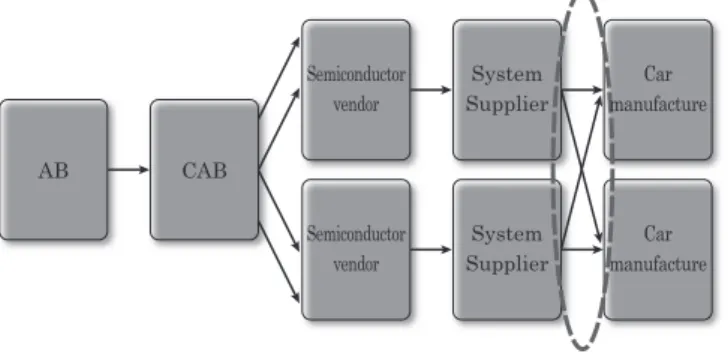
Figure 2 shows the flow of the conformance procedure. Based on the CTSpec set by FRC, CAB (Conformity Assessment Body), which is certified by the AB (Accreditation Body: e.g. FRC), assesses devices of semiconductor vendors for certification. Then, system suppliers procure the certified devices from the semiconductor vendors. Finally these certified devices are embedded into ECUs and delivered to car manufactures.
The CTSpec is no more than a test for assessing whether the vendor’s devices conform to the specifications on a “stand-alone basis”. For Japanese car manufactures, however, it gives the priority to create more product-oriented test specifications which ensure the “product-level interoperability”3) of these devices. When CAN was introduced to the
3) In the first instance, two complementary technical components Y and Z are compatible, it is said those components are compatible complements or “vertically compatible”. In the second instance not only component Y but also another functionally equivalent component X is compatible with component Z, we can say that with respect to interoperability with component Z, both components are compatible substitute or “horizontally compatible” [4]. In this paper, if the vertically incompatibility happens, it
Figure 2 Procedure of Conformance Test
Semiconductor vendor Semiconductor vendor System Supplier System Supplier AB CAB Car manufacture Car manufacture
Japanese market, interoperability problems frequently occurred even though CAN was supposed to be used as the standardized protocol. Car manufactures were able to connect different ECUs procured from the same supplier, but ECUs from different suppliers weren’t interoperable (see Fig. 2 dotted oval).
The reason behind the interoperability problems was, in part, the “abstract” nature of the description of the protocol specifications. This “abstract” nature meant exact parameter values and ranges were not clearly fixed in the specifications, so that the semiconductor vendors had been, to a certain extent, able to interpret them freely. This resulted in discrepancies of devices among vendors despite the fact that they conformed to the standardized specifications.
The second reason the interoperability problem arose was the “imperfect” test coverage of CTSpec against protocol specifications. The semiconductor vendors had utilized CTSpec to interpolate the “abstract” nature of the protocol specifications. However, the CTSpec of CAN does not cover all the tests against its protocol specifications. The validity is determined on the basis of some sampling representative values. If a certain number of sampling values are acceptable, it assumes all values to be acceptable. Thus the vendors had no choice but to add their own test specifications in order to make sure all the values are right. As we will see in the next section, similar concerns regarding product-level interoperability have been raised in the case of FlexRay.
3.2. The Feature of CTSpec of FlexRay
The setting process of the CTSpec at FRC marks a sharp contrast with that of JasPar. Despite FRC starting the Conformance WG, the actual development has not been made at the WG, but outsourced to one of the members of FRC, C&S. The only work to be done at the WG was to review the draft developed by C&S, and then nominate conformity assessment bodies who conduct conformance test according to that draft.
The reason why C&S was selected at FRC was largely due to the influence of the head of the WG at that time over the selection process. Other firms such as TTAutomotive and TÜV NORD, which represented a developer and company other than C&S, had almost
means the situation that there is “component-level interoperability problem (between Y and Z)” while if horizontally incompatibility happens, it means the situation that there is “Product-level interoperability problem (between X, Y and Z). Later type of relationship between components represents more general form of compatibility than that of former.
been selected by a vote at the WG. However, the decision was reversed and C&S was selected for the post.
After the selection, on the one hand, C&S drafted a CTSpec with which a wide range of use cases could be tested (thus the universality if the specification supposes to be high). Because it would give FRC an advantage to win the protocol standardization competition against other protocols such as TTP/C by positively incorporating the use cases of many car manufactures into the protocol specifications. On the other hand, the development of a full coverage of test cases against a wide range of use cases would incur a large expense of prohibitive costs. Therefore, C&S made the decision to develop an economy-oriented CTSpec by means of loosening the test coverage. With European conformance test specifications, validity is determined on the basis of a sampling of values. The approach is to test a certain number of a sampling of values and if they are acceptable to assume all values to be acceptable. However, this approach means that no one knows whether all the values are correct.
The method of drafting the CTSpec at FRC reminded Japanese car manufactures of the product-level interoperability problems, which happened during the introduction stage of CAN that caused them to decide to develop the improved version of a FlexRay CTSpec by themselves.
3.3. The CTSpec Setting Process at JasPar
In order to develop a more dependable CTSpec, the horizontal and the vertical co-operation between working groups have been enhanced at JasPar. Firstly, the horizontal co-operation among car manufacturers attempts to narrow down their use cases at the cost of universality of the CTSpec. Then, vertical co-operation enhances the use cases to identify vertical interoperability problems between complementary components. Finally horizontal co-operation is made via collaborative experiment and assessment among semiconductor vendors for securing horizontal compatibility of each alternative device. Based on this co-operation, test items with 100% coverage against narrow use cases were created at JasPar. To give a specific instance: paying attention to 97 pieces of SDL (Service Description Language) charts in which all of behaviors of microcontrollers are described, JasPar tested path checks against all the charts and then drafted specifications that give 100% path coverage. JasPar has likewise added test items to their CTSpec, which are not covered by
those of FRC. After verifying the FRC’s physical layer specifications relevant to the bus driver, JasPar identified FRC covered only 140 test items against the FRC’s physical layer specifications. As a result, they added 66 test items to it, so that the test coverage reached 100% (Table. 1).
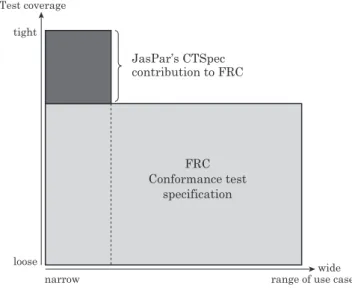
Figure 3 describes the conceptualized characteristics of the CTSpec of each consortium. FRC standardized their CTSpec, which covers the full range of use cases, while it does not cover the full range of test items against its standardized specifications. By contrast with FRC, JasPar narrowed down the use cases keeping its test coverage at 100%.
We could paraphrase this relationship as saying that FRC tried to standardize a relatively “wide and loose” CTSpec while JasPar tried to develop a “narrow and tight” one. Both types of CTSpec have their pros and cons, but my research is to clarify what brought them to this difference in drafting their CTSpec, by focusing on the co-operation mechanism of JasPar in the following section.
Table 1 The Number of Test Items of Each Consortium FRC’s Physical Layer
Specifications FRC’s CTSpec against its PLSpec. JasPar’s addition for FRC’s CTSpec.
The number of test items 206 140 66
Figure 3 Relationship of CTSpec
Test coverage tight loose JasPar’s CTSpec contribution to FRC FRC Conformance test specification wide narrow range of use cases
4. THE CO-OPERATION MECHANISM OF JASPAR
When it comes to the setting of a standardized interface, which is useful for ensuring the product-level interoperability, there may be a limit to what individual suppliers can achieve alone. In order to make sure of product-level interoperability, vertical and horizontal co-operation is called for among the concerned car manufacturers and suppliers. How has such operation been conducted at JasPar? I will briefly introduce the co-operation mechanism of the Automotive LAN WG at JasPar.
Figure 4 shows the organization chart of JasPar in 2008. Since its foundation, JasPar has devoted energies mainly to the activity of the Automotive LAN WG. The ultimate mission of the WG, together with its subsidiary WGs and task forces, is to draft the “narrow and tight” CTSpec of FlexRay.
The Automotive LAN WG itself has been operated by car manufactures. One of the most important tasks of the WG was, via horizontal co-operation among car manufactures, to narrow down the use cases in order to reduce the workload of the relevant subsidiary WGs while making the setting of standardized default values of parameters quite easy. In
Figure 4 Organization Chart in 2008
Informatics WG Functional Safety WG Microcontroller WG Intellectual Property WG Automotive LAN WG (Head:Nissan) Standardization WG Software WG FlexRay Tool WG (Head:Toyota) Date-link
Layer TF Layer TFPhysical FlexRay Conformance WG (Head:Honda) Steering Committee The board of directory (Toyota, Nissan, Honda, Toyotsu Electronics)
General Affairs
(Nissan) (Toyotsu Electronics)Secretariat
Com/NM TF on nominationSubcommittee FlexRay Circuit WG (Head:Denso) FlexRay Wiring WG (Head:Yazaki) Process WG
addition, the two following types of co-operation were carried out under the WG. 4.1. The Vertical Co-operation for Component-level Interoperability
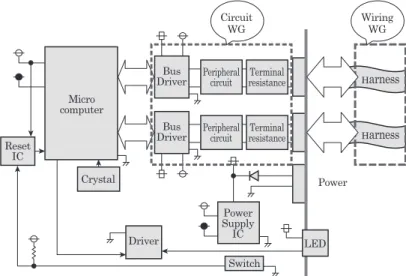
With recent high-speed networks, wiring has to be designed with a deep understanding of physical conditions on the circuit side, due to interference interdependence across components which cause component-level interoperability problems (e.g. physical, electrical and electro-magnetic noise interfere sampling at bus drivers). The Circuit WG at JasPar carried out a series of experiments to gather information regarding the cause of the interoperability problems and used them as the basis for developing the recommended circuit. The Wiring WG works alongside this activity, identifying the characteristics required in the bus driver from the wiring simulation data and presenting this data to the Circuit WG. It is after this continuous circulation of information that the Circuit WG finally completes the recommended circuit (Fig. 5). The Wiring WG uses the circuit as the basis to carry out the final wiring simulation. In this way, the collaboration between the circuit side and the wiring side is maintained.
To put it another way, JasPar shares information via vertical collaboration between WGs, then tries to find latent component-level interoperability problems across the WGs, and finally finds solutions to them for setting an interface, which is free from any intervention between complementary components.
Figure 5 Co-operation between the WGs
Circuit WG Reset IC Micro computer Crystal Driver Bus
Driver Peripheralcircuit resistanceTerminal
Bus
Driver Peripheralcircuit resistanceTerminal
Harness Harness Power Supply IC LED Switch Power Wiring WG
4.2. The Horizontal Co-operation for Product-level Interoperability
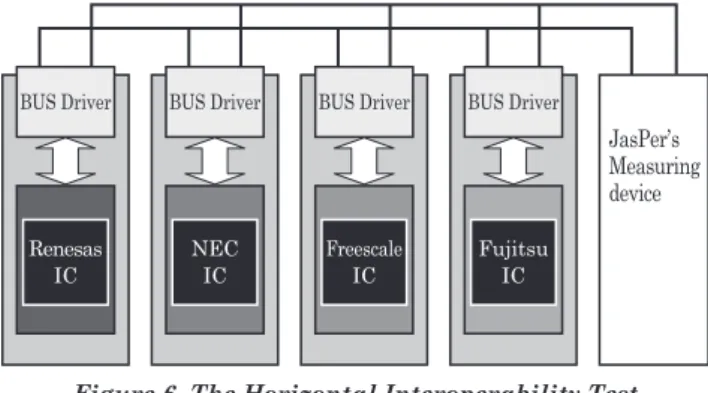
Through vertical collaboration with the Wiring WG, the Circuit WG carries out experiments repeatedly in connection with different ECUs in order to make sure of their horizontal compatibility (Fig. 6).
With this experiment, the Circuit WG can identify product-level interoperability problems between standardized bus drivers and alternative semiconductors’ ICs, which could be the cause of the horizontal incompatibility between them. Then information relevant to product-level interoperability problems accumulated at the WG will be utilized at the Conformance WG for drafting the tight CTSpec.
It is appropriate to draw conclusions that such vertical and horizontal co-operation among WGs may be unique to JasPar and allowed them to produce the essential input into the Conformance WG for drafting the “narrow and tight” CTSpec. It is one of the contributions by Japanese consortium to Europe-centered standardization activity.
5. CONCLUTION
After making the comparative analysis, we could find that the horizontal co-operation among the car manufacturers at FRC made the protocol specifications all-inclusive. As a result, it is impossible to set all parameters conclusively, so that the characteristics of the standardized interface cannot help being “abstract”. From the viewpoint of the diffusion of the standard in the market, the universality of it is so high that it was able to exercise a competitive advantage during the standardization battle against its rival protocols. In contrast, the characteristics of its CTSpec results in “imperfect” from the viewpoint of the dependability of product systems. Because the development of a “wide and tight” CTSpec
Figure 6 The Horizontal Interoperability Test
BUS Driver Renesas IC BUS Driver NEC IC BUS Driver Freescale IC BUS Driver Fujitsu IC JasPer’s Measuring device
will incur large expenses, FRC decided to draft a “wide and loose” CTSpec, which left a factor of uncertainty in the product-level interoperability. In other words, premium quality with regard to the product-level interoperability is left to automotive manufactures. After all, the system integration capability of the firms still ought to be counted even in the world of modularization with standardized interfaces.
On the other hand, JasPar attempted to narrow down use cases through horizontal co-operation among car manufacturers. Also, vertical co-co-operation has been enhanced to identify vertical incompatibility between complementary components. Lastly, horizontal co-operation has been made among semiconductor vendors for securing product-level interoperability. Based on these co-operations, a “wide and tight” CTSpec, which is expected to be useful for securing product-level interoperability of the product system, is created at JasPar. To see it from another angle, the quality premium of product-level interoperability is embedded into the standardized interface ex ante.
Under a clear strategy not to make the same mistake as CAN did, JasPar tried to develop the CTSpec free from product level interoperability problems via both vertical and horizontal co-operations inside the consortium. We can enjoy a variety of benefits that come from the world of modularization with standardized interfaces only if we can successfully set the standards dependably through adequate ex ante co-operation among firms. I hope any SDOs which emphasize the importance of the product level conformity assessment of complex product systems would learn some lessons from the case study, and I suppose one of the important roles of official SDOs is, as socio-technological entities, to keep a balance between the dependability and the universality of the standardized interface of the systems by designing the necessary forms of co-operations among the actors, those are suggested in this paper.
Clearly, the case study requires further analytical study. In order to properly answer the question: what kind of co-operation among actors is needed to establish the PLCA? It would be indispensable for us to conduct literature review, which is currently completely missing in this case.
References
[1] Gerybadze, A., König, R, “Managing Global Innovation Networks: The Case of Automotive Electronics”, Presentation at Workshop on Managing Global Innovation Networks, Duisburg
University, 8 February. 2008.
[2] International Electrotechnical Commission, IEC Master Plan 2011, IEC, 2011.
[3] Murray, C. J, “Four Asian Automaker Join FlexRay Consortium”, Electronic Engineering Times, March 1, 2004.
[4] Schmidt, S. k., Werle, R, Coordinating Technology: Studies in the International Standardization of Telecommunications, The MIT Press, Cambridge, Massachusetts, London England, 1998. [5] Tokuda, A, “International Framework for Collaboration between European and Japanese
Standard Consortia”, in Kai. Jacobs. eds., Information and Communication Technology Standardization for E-Business Sectors. IDEA Group Publishing. pp. 157-170. 2009.