Author(s)
M.D.Higgins, Janet
Citation
沖縄大学人文学部紀要 = Journal of the Faculty of
Humanities and Social Sciences(4): 49-68
Issue Date
2003-03-31
URL
http://hdl.handle.net/20.500.12001/6073
Reporting the 2000 G8 Summit:
Coverage in the British Popular Press
Janet M.D. Higgins
Abstract
This article presents a content analysis of the main issues of the 2000 G8 summit as represented in the written and visual texts of four British national daily tabloid newspapers. The main issues, in order of frequency and depth of reporting, were the cost of the summit, debt relief, the debate on GM foods, the British Prime Minister's failure to effect debt relief, President Putin from a personal perspective, and security issues (terrorist threats, local resentment, and potential future protests by pro-debt relief campaigners).
Keywords : 2000 G8 summit, media, discourse analysis, Okinawa,
British tabloid newspapers 1. Foreword
This study examines the 2000 Okinawa G8 summit as represented in the written and visual texts of four British national daily tabloid newspapers. The focus is on identifying what the papers selected to report in news stories, editorials and visuals.
The study begins with a description of the corpus. Content analysis was used as the main framework for analysis (Newbold, 1998; Broadbent, 1993) but Bells (1991, 1994) work on news story structure was used to provide a finer grained analysis, and this research is summarised in the next section. Having identified the focal issues in the reporting of the summit, each issue is then described. The discussion section focuses on the small amount of news about the summit reported in these papers and on strategies of evaluation used in the reporting. Finally, there is a brief comparison between the focal issues in this tabloid corpus and those in five quality British daily papers.
2. Background to the study
2.1 Characterisation of the tabloids
A brief profile of the readership of British daily papers is useful in establishing a context for the study. Analysts recognise that the readership of daily newspapers in the UK is stratified (Sparks, 1999). The market can be divided into three sub-markets: the quality market of five broadsheets (The Times, The Telegraph The Guardian, The Independent, and The Financial Times), the mid-market of two tabloids (The Daily Mail and The Daily Express), and the popular market of three tabloids, (The Sun, relaunched as a tabloid in 1969, The Daily Mirror, and The Star). For this study, two tabloids from the second and third groups were selected (The Daily Mail, The Daily Mirror, The Daily
Express and The Sun).
Sparks (1999) reports that there is relatively little crossover in readers between the titles. There are important differences in the type of advertising sold in each market
sector. Competition is within the three sectors rather than between them, with the papers competing by product differentiation.
In terms of content, Sparks (1999:53) claims that the quality press provides a lot of material of the 'public enlightenment type', the mid-market a small amount and the popular a tiny amount. In terms of visuals, he suggests that the tabloids generally incorporate more pictures than the qualities.
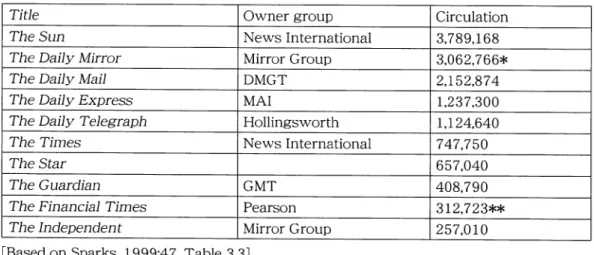
Table 1 provides the circulation figures for British daily papers in 1997. It is clear that, with the exception of The Star, the tabloids have by far the greatest readership in Britain, and that amongst the tabloids, it is the popular group that has the largest
circulation.
Table 1 Daily circulation figures for British newspapers (January - June 1997)
Title The Sun
The Daily Mirror The Daily Mail The Daily Express The Daily Telegraph The Times
The Star The Guardian The Financial Times The Independent Owner group News International Mirror Group DMGT MAI Hollingsworth News International GMT Pearson Mirror Group Circulation 3,789,168 3,062,766* 2,152,874 1,237,300 1,124,640 747,750 657,040 408,790 312,723** 257,010
[Based on Sparks, 1999:47, Table 3.3]
*includes the Scottish sister paper The Daily Record; ** includes around 120,000 for
international editions
3. Methodology
3.1 Corpus
a) Reporting period
The political meeting of the 2000 G8 world summit was held in Okinawa, Japan, from Friday the 21st to Sunday the 23rd of July. While the bulk of the reporting could be expected to be done during this short time, pre-meeting analysis and background and post-meeting analysis and summary could be expected in the pre- and post-summit peri ods. The newspapers were, therefore, also examined for two weeks before and after the summit. As Table 2 illustrates, no reporting was made before the 17th of July or after the 25th of July. This then constitutes the reporting period
b) Numbers of articles and visuals
There were a total of 19 articles (13 news stories, 6 editorials/ opinion pieces) and 18 visuals published on various aspects of the summit. Table 2 presents a breakdown of the numbers of articles and visuals by date and by paper.
Table 2 Number of articles and visuals in the corpus by date and paper (July 2000)
Date 17July 18J 19J 20J 21J 22J 23J 24J 25J Total Daily Express article 1 1+1 (ed) 1+1 (op) 1 2+1 (op) 9 visual 2 1 1+C 2 7 Daily Mail article 1+1 (op) 1 Hop) 4 visual 2 1 3 Mirror article 1+1 (op) 1 3 visual 4 collage 2 C 7 Sun article 1 2 3 visual 1 1 Total article 1 2 2 6 7 1 19 visual 2 1 8 6 1 18
C = cartoon; (ed) = editorial; (op) = opinion piece Note: the dailies were not published on Sunday 23rd July Over the reporting period, The Sun published three stories featuring the summit
and one photograph. Two of the stories were devoted exclusively to the summit. On July 24th the topic was subsidiary in an article dealing with Tony Blair s next election hopes. Blair's presence in Japan for the G8 summit was mentioned in a story on July 21st but, as the story contained nothing related to the summit, it was excluded from
analysis.
In crude terms, reporting in The Sun amounted to 357 words. That is, 357 words on
an international political event involving the worlds leading industrialised nations, where national leaders were gathered together dealing with global issues. This was the
least coverage given by the four papers. Not only were there fewer texts but the number of words involved was the least.
Over the reporting period, The Mirror published two stories featuring the summit, an editorial comment (Voice of the Mirror), a sequence of 2 photographs, a collage of 4
photos, and a cartoon. In crude terms, the reporting amounted to 569 words.
The Daily Mail published 2 stories, two opinion pieces and 3 visuals. Of the four papers, The Daily Express published the greatest number of stories and matched The Mirror in number of visuals. There were 9 stories and 7 visuals (6 photos and one
cartoon). To give a rough idea of the difference in amount of reporting between the papers that reported the most and the least, one article in The Daily Express (17July)
was 539 words long, which is more than the total word count for the reportage in The Sun.
3.2 News story structure
The focus for this study was an identification of which aspects of the summit the daily tabloid press chose to report. Aspects can refer to issues, people or places. The study required a methodology for identifying which aspects were reported, which of these were the most frequent and to what degree of detail or elaboration the reporting
was carried out. Content analysis was used as the basic framework (Newbold, 1998).
However, simply counting the number of occasions a topic, person or place is mentioned does not reflect adequately the complex way in which opinions, facts, background and evaluation are interwoven in news stories. News stories are quite different from the genres of factual reporting, scientific reports, or storytelling in face to face conversation. I turned to research into news story structure, particularly that of Allan Bell (1991,1994), for help in developing a finer-grained approach.
In the telling of face to face personal narratives, the temporal sequencing of events is generally in the order in which they occurred According to Labov (1972), a defining characteristic of narratives is the temporal sequencing of clauses; changes in the
sequences of clauses change the sequence of events. News stories until the late 19th
century followed a chronological development too. However, Schudson (1978), in his
investigation of newspaper story style, shows that an Inverted pyramid structure' with
a lead paragraph acting as a summary had become standard in American journalism by 1910. Current analysis shows this structure to be dominant in newspaper stories in many international situations (Bell, 1994; Van Dijk, 1988b).
For spot news (news concerned with natural disasters, crimes, accidents), the story structure follows a pattern in which the result is placed before the actions leading to it.
The outcome has priority over the action. This principle allows updating of stories to be made easily; new outcomes are placed first and previous actions move down the story structure. The driving force in the presentation of news events is not temporal
sequence but perceived news value. Hence the story moves 'backwards and forwards in time, picking out different actions on each cycle' (Bell, 1994:106). This principle makes the time structures of newspaper stories very complex, and at times difficult to follow.
Bell shows that diplomatic and political news has a similar structure driven by news value. The result is a complex story where information is recycled through the text. Van Dijk refers to this as the instalment method (1988a). An event is introduced and
then returned to several more times. The action or information is presented in general
first and described in increasing factual detail in a cyclical style, with more information
added at each stage. The main points are, therefore, concentrated at the beginning with decreasingly important detail coming later. The stories are cut from the bottom as they are updated, with new information added to the beginning.
In the inverted pyramid structure, the summary or abstract of the story is placed at the beginning in the lead paragraph. Here is located the focus, the main story. It often contains the orientation or scene setting - who the actors are, the 'who, what, when and where' of the story. Often a lot of information is packed in here. The lead also contains evaluation in order to establish the significance of the story and hence grab the reader's
attention. So in the lead there is a concentration of evaluation - this can continue but less intensely. Lexis is used which stresses the importance of the event. 'The lead paragraph is a nucleus of evaluation.... It forms the lens through which the remainder of the story is
viewed'(Bell, 1994:104). In personal narratives, evaluation is typically at the end. In
news stories, it is concentrated in the lead.
The headline is the abstract of the abstract. In the production of stories, the lead is where the story is located. According to Bell, the headline is not written by the journalist, but by a subeditor. It is added later. It is hence an abstract of the lead. It follows it rather than leads it. It is a focus of evaluation.
Newspaper story structure analysis was helpful to this study because it provided a framework for locating and identifying the main foci. Each focus was followed through its elaborations through the cyclical structure as the story unfolded. In the analysis, each focus of the reporting was evaluated in terms of the degree to which it was elaborated within the story.
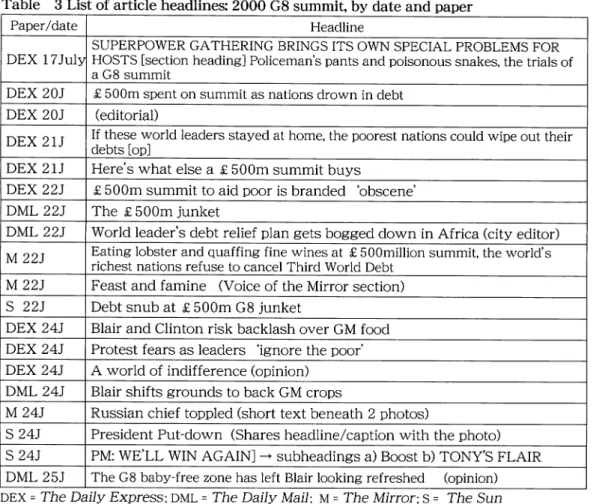
Table 3 lists the headlines of the 19 stories in chronological order. Table 3 List of article headlines: 2000 G8 summit, by date and paper
Paper/date DEX 17 July DEX 20J DEX 20J DEX 21J DEX 21J DEX 22J DML 22J DML 22J M22J M22J S 22J DEX 24J DEX 24J DEX 24J DML 24J M24J S24J S24J DML 25J Headline
SUPERPOWER GATHERING BRINGS ITS OWN SPECIAL PROBLEMS FOR
HOSTS [section heading] Policeman's pants and poisonous snakes, the trials of
a G8 summit
£ 500m spent on summit as nations drown in debt
(editorial)
If these world leaders stayed at home, the poorest nations could wipe out their
debts [op]
Here's what else a £ 500m summit buys
£ 500m summit to aid poor is branded 'obscene' The £ 500m junket
World leader's debt relief plan gets bogged down in Africa (city editor)
Eating lobster and quaffing fine wines at £ 500million summit, the world's richest nations refuse to cancel Third World Debt
Feast and famine (Voice of the Mirror section) Debt snub at £ 500m G8 junket
Blair and Clinton risk backlash over GM food
Protest fears as leaders 'ignore the poor'
A world of indifference (opinion) Blair shifts grounds to back GM crops
Russian chief toppled (short text beneath 2 photos)
President Put-down (Shares headline/caption with the photo) PM: WE'LL WIN AGAIN] -> subheadings a) Boost b) TONY'S FLAIR
The G8 baby-free zone has left Blair looking refreshed (opinion)
3.3 Visual analysis
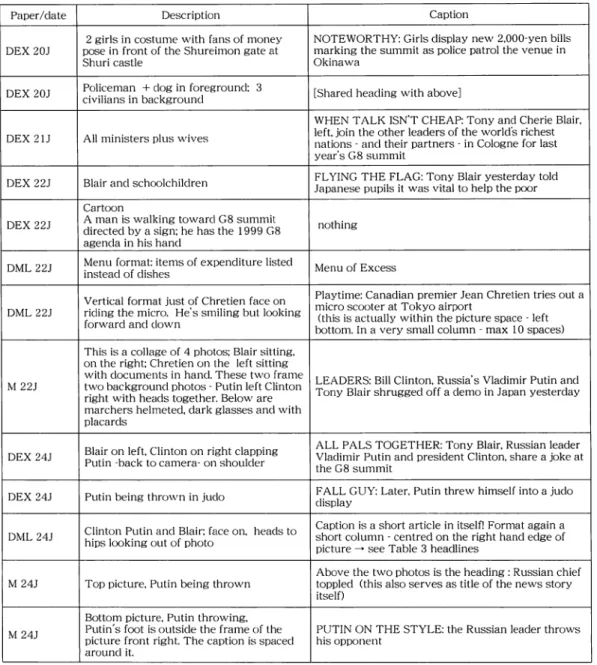
It was not intended to conduct a detailed analysis of the visual texts in this corpus (see Higgins [2001a] for a visual analysis of photographs from quality British press reporting of the 2000 G8 summit). Rather the focus was on the content of the visual
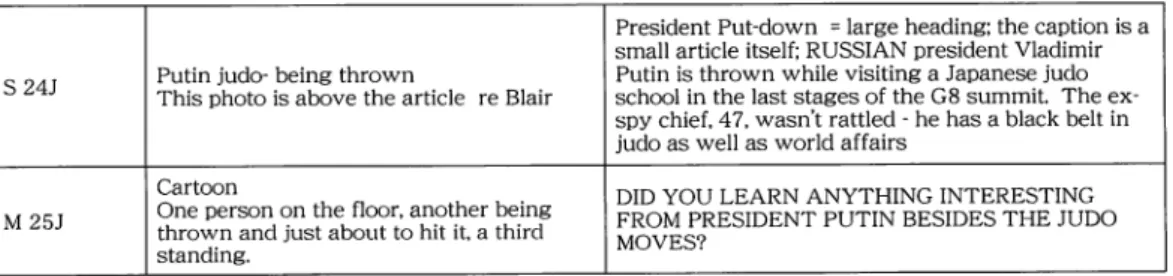
texts and the accompanying captions in terms of issues. Table 4 lists the visuals by their
captions and includes a brief description of their contents. The papers did not specify the
sources for the photographs.
Table 4 Profile of visuals in the corpus by date and paper (July 2000) Paper/date DEX 20J DEX 20J DEX 21J DEX 22J DEX 22J DML 22J DML 22J M22J DEX 24J DEX 24J DML 24J M24J M24J Description
2 girls in costume with fans of money pose in front of the Shureimon gate at Shuri castle
Policeman + dog in foreground; 3 civilians in background
All ministers plus wives
Blair and schoolchildren
Cartoon
A man is walking toward G8 summit directed by a sign; he has the 1999 G8 agenda in his hand
Menu format: items of expenditure listed instead of dishes
Vertical format just of Chretien face on riding the micro. He's smiling but looking forward and down
This is a collage of 4 photos; Blair sitting, on the right; Chretien on the left sitting with documents in hand. These two frame two background photos - Putin left Clinton
right with heads together. Below are
marchers helmeted, dark glasses and with placards
Blair on left, Clinton on right clapping Putin -back to camera- on shoulder
Putin being thrown in judo
Clinton Putin and Blair; face on, heads to hips looking out of photo
Top picture, Putin being thrown
Bottom picture. Putin throwing,
Putin's foot is outside the frame of the
picture front right. The caption is spaced around it.
Caption
NOTEWORTHY: Girls display new 2,000-yen bills marking the summit as police patrol the venue in Okinawa
[Shared heading with above]
WHEN TALK ISN'T CHEAP: Tony and Cherie Blair, left, join the other leaders of the worlds richest nations - and their partners - in Cologne for last
year's G8 summit
FLYING THE FLAG: Tony Blair yesterday told Japanese pupils it was vital to help the poor
nothing
Menu of Excess
Playtime: Canadian premier Jean Chretien tries out a micro scooter at Tokyo airport
(this is actually within the picture space - left bottom. In a very small column - max 10 spaces)
LEADERS: Bill Clinton, Russia's Vladimir Putin and Tony Blair shrugged off a demo in Japan yesterday
ALL PALS TOGETHER: Tony Blair, Russian leader Vladimir Putin and president Clinton, share a joke at
the G8 summit
FALL GUY: Later, Putin threw himself into a judo display
Caption is a short article in itself! Format again a short column - centred on the right hand edge of picture -»• see Table 3 headlines
Above the two photos is the heading : Russian chief toppled (this also serves as title of the news story itself)
PUTIN ON THE STYLE: the Russian leader throws
S24J
M25J
Putin judo- being thrown
This photo is above the article re Blair
Cartoon
One person on the floor, another being thrown and just about to hit it, a third
standing.
President Put-down = large heading; the caption is a small article itself; RUSSIAN president Vladimir Putin is thrown while visiting a Japanese judo school in the last stages of the G8 summit. The ex-spy chief, 47, wasn't rattled - he has a black belt in judo as well as world affairs
DID YOU LEARN ANYTHING INTERESTING FROM PRESIDENT PUTIN BESIDES THE JUDO
MOVES?
DEX = The Daily Express: DML = The Daily Mail; M = The Mirror; s = The Sun
4. Analysis
Analysis was conducted, as described in section 3.2 above, to identify what the focal issues of the reporting were and how these were elaborated. Table 5 provides a synopsis
of the issues.
Table 5 Main issues in the reporting of the 2000 G8 summit by the British tabloid
press
Issue
The cost of the summit
Debt reduction for poor countries Debating GM foods
Putin - as a sporting personality Blairs debt reduction talk failure
Protests and demonstrations
(terrorists, locals, follow up demos)
Appearing in headlines 7 4 2 2 1 leads 7 5 2 2 1 2 body only 2 1 1 4 visuals 2 -5 1 Degree of elaboration • high • high • medium • a few details • a few details • a few details
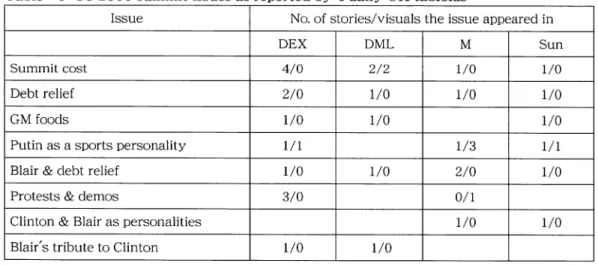
The accumulated results for all the stories were totaled (Table 5), thus providing an overview of the relative importance of issues in the corpus as a whole. However, if we are interested in the exposure of individual readers to information about the summit in their regular paper, we will want to know the relative importance of issues per paper. Therefore, Table 6 presents the issues as reported by each paper. It includes some minor
Table 6 G8 2000 summit issues as reported by 4 daily UK tabloids
Issue
Summit cost
Debt relief GM foods
Putin as a sports personality Blair & debt relief
Protests & demos
Clinton & Blair as personalities
Blair's tribute to Clinton
No. of stories/visuals the issue appeared in
DEX 4/0 2/0 1/0 1/1 1/0 3/0 1/0 DML 2/2 1/0 1/0 1/0 1/0 M 1/0 1/0 1/3 2/0 0/1 1/0 Sun 1/0 1/0 1/0 1/1 1/0 1/0 0/0 = stories/visuals 4.1 Issues
4.1.1 Issue 1: The cost of the summit
The cost of the summit was the issue which received the most coverage. It appeared in all four papers. It appeared in 7 leads, 7 headlines, 2 visuals and was mentioned in the body of 2 other stories. It was featured in three editorials/ opinion pieces. The issue was
reported throughout the period.
The issue was highly elaborated. What is immediately striking is the degree of detail that was reported. The second striking aspect is the highly charged negative evaluation made of the cost. The Daily Express editorial's (20J) comment that the combination of huge summit cost and the summit's theme of debt relief is like 'a sick joke', sums up the nature of the evaluation. The language chosen is powerful and appeals to the emotions. The third aspect of the reporting is the way the issues of cost, debt relief and poverty are interlinked Although here cost and debt relief are dealt with as separate issues, it is their constant interlinking in the headlines, leads and stories which creates the powerful
message in the reporting.
Throughout the corpus only one figure was given for the cost of the summit: the figure of £ 500 million. There was complete consensus on this figure, though no source was cited for it. The Sun (22J) simply reported the figure as a discovery - the cost 'emerged'. There was no questioning of the veracity of the figure. It was only in an opinion piece in The Daily Express (21J) that a question was raised about the cost accounting process for summits in general and, hence, the accuracy of published figures. However, this did not affect that papers policy of quoting the figure in its coverage.
The figure was repeatedly reported. It appeared in headlines, leads and the body of the texts. For instance, five of the 11 headlines from 17th - 22nd July incorporated it (Table 3). One of the effects of its appearance in so many headlines was that it was visually very prominent in the pages of these papers, since the four papers' tabloid style
made use of large lettering and/or heavy black lettering in their headlines. In the lead of The Sun of 22nd July, it was printed in bold capitals (£500MILLION). Repetition also occurred when the figure was cited in direct quotes from NGO representatives (M22J). The effect of this repetition and formatting was to constantly draw attention to the
figure.
The papers variously gave details of what the £500 million had been spent on. These details accounted for much of the reporting on the cost issue. A great number of details were supplied, especially by The Daily Express, but every paper gave several
examples of how the cost was broken down.
The details fell into the following categories: junketing by leaders, freebies (for journalists), security, building, prettifying the environment, and lavish food. Junket is defined (in the Pocket Oxford Dictionary, 1984) as: n. a feast; (US) a pleasure outing; (US) official's tour at public expense; v. to feast, make merry; (US) to hold a picnic or outing. In this corpus its use incorporates all these elements. All the papers employed the term. It appeared in one headline: 'The £500m junket' (DML, 22J). Junketing by world leaders was reported as including summit rituals, such as dinners and photos; The Daily Express (20J) called it a 'a massive photo session'. The number of aids the American, British and French leaders brought with them was reported. Their accommodation was described. The tenor of such reporting can be gauged by this extract from The Daily Express (22J):
'On the paradise holiday island, Mr Blair's 1 lth floor suite in a five-star hotel overlooks a bay in the South China seas with views of frolicking dolphins'.
One visual was used in this category. It is a full length photograph of Canadian premier Jean Chretien on a micro scooter at Tokyo airport (DML 22J). It would seem to be an innocuous picture; just a world leader trying out one of the latest children's toys. However, the photograph is 'fixed' by the surrounding written text and page format in a very specific way to turn it into a powerful image of junketing. The caption contains
the descriptive information given above, but it is prefaced by the single word 'Playtime'
followed by a colon (Table 4). The photo is placed within a box containing a group of texts, beneath the '£500m junket' headline, with the photo immediately below the
headline. On the right of the photograph there is a clever visual 'Menu of Excess', which
provides a breakdown of the summit costs laid out in menu format for a 6-course dinner. And on its left is a black box in which, in large white letters, is the following ironic text: 'Oh, what fun! Micro Scooting at the airport, banqueting on caviar and lobster and
five-star hotels for all. How leaders are blowing enough cash to wipe out Gambia's entire
debt'.
Freebies to journalists were illustrated by the fact that 3,000 of them received bags of souvenirs including a digital camera, tape recorder, clock, Hawaiian shirt, high-tech toothbrush and CD, and that they were given free food and alcohol.
Security costs were reported as including the deployment of 20,000 policemen from the mainland with their specially provided self-cooling underpants, 8 destroyers, 2,500 coastguards, 140 patrol vessels, 20 planes and police divers. Medical teams were said to be equipped to deal with chemical and biological weapon attacks.
It was reported that simultaneously blooming shrubs had been planted. The Daily
Express (20J) reported that a new conference centre had been built, and The Daily Mail (22J) that a replica of Clinton's birthplace had been built.
In addition to the accusations of junketing mentioned above, a considerable amount of detail was spent on descriptions of food. I have already mentioned The Daily Mail's
'Menu of Excess', where readers were informed that 10,000 bottles of wine were consumed, and 120 chefs served 40,000 meals. In the main article on the same page, The Daily Mail went into detail as follows: 'The politicians will tonight dine on caviar, crab, lobster and duck, washed down with a premier cru chablis, at a sumptuous official banquet at Shurijo Castle on the exotic island of Okinawa'. The Mirror headline of 22nd July reported that the world leaders were 'eating lobster and quaffing fine wines'. The focus on food, the reporting of the food in detail, and the selection of items that for British tabloid readers might be considered 'exotic', was part of a reporting strategy that negatively evaluated the summit through the placing in opposition of poverty, famine and debt relief on one hand and plenty on the other; the 'feast and famine' of The Mirror headline (22J).
The evaluation of the cost was overwhelmingly negative. The summit was declared to be 'the most expensive ever' (DEX 20J) and 'set to break all records for opulence, gluttony and greed' (DEX 21J op). It was seen as a sick joke (DEX 20J ed), an international scandal (DEX 20J) and shameful ( M 22J op). It was described as a junket, a holiday. One of the main strategies used in all the papers to underline this negative evaluation was to link the issue of cost with the issues of debt relief and poverty.
The cost was directly evaluated through the use of strong and emotive qualifiers. Adjectives like 'astonishing'(cost), 'staggering'(amount), 'astounding'(£ 500m), suggested disbelief at the cost, while adjectives, nouns and verb phrases were used for the expense: 'lavish', 'extravagance', 'opulence' 'a blow-out' 'to blow'; with words like 'obscene' being repeatedly used. The number of these emotive words and phrases was limited but they were repeated. Occurring in leads and one headline (DEX 22J), they were recycled through both the reporters' accounts and the direct citing of the comments of NGO representatives. The cost was also negatively evaluated through the linking of it with issues of poverty and debt relief. The NGO representatives were extensively quoted in this regard. A popular quote was from Ann Pettifor, Jubilee 2000 representative: 'This reminds me of Marie Antoinette dining at her table and when the poor of Paris banged at her door she said "let them eat cake'". Here we have the link between eating food and poverty made explicitly.
The cost of the 2000 summit was unfavourably compared to the cost of other summits, in particular to the 1998 summit in Birmingham, England. The latter was reported as having cost 100 times less than the Okinawa summit, or £6.5m. The Okinawa summit was also compared with events that were deemed to have been fiascoes, like the 2000 London Millennium Dome (quote from Jamie Drummond a Jubilee 2000 campaigner, [DEX 20J]; the losses incurred by the Dome being reported in the
There were few justifications for the cost of the summit. A Blair spokesman (DEX 22J) suggested that delegates have to meet somewhere and that the Japanese were proud of their island and wanted to present it in a good light. However, he hedged this with an unfavourable comparison with the much lower cost of the 1998 summit.
Another thrust of the reporting on the issue of cost was detailed speculation and suggestion for how otherwise the £ 500m could have been spent. There were a number of comments about the general waste of money and how it could have been saved. For instance, The Daily Express editorial of July 20th, suggested that video conferencing would have saved the expense. The whole tenor of the opinion piece in The Daily Express (21J) was that summits in general have outlived their value and usefulness. The headline of this piece made the point clearly: If these world leaders had stayed at home, the poorest nations could have wiped out their debts'.
The Daily Express (21J) devoted a whole article to itemising the ways the money could otherwise have been used, under a headline that proclaimed; 'Here's what else a £500m summit buys'. The suggestions in the various papers fell into a number of categories: education (could educate 12.5m kids [S 22J], put 12m children in poor countries into school [M 22J]), disease control (immunise 1.5m kids [S 21J], vaccinate against AIDS, bacterial pneumonia [DEX 21J]); fund 100,000 rural hospitals, fund midwifery kits [DEX 21J]; water provision (pay for clean water for 52 million people in rural Africa [DEX 21J]); improving living conditions (provide clothing for street kids; provide emergency shelters, provide mosquito nets [DEX 21J]), and paying off the debts of specific countries (pay off the total debt of Sao Tome and Principe, pay the combined annual debt repayments of Zambia, Uganda, Rwanda, Niger and Mozambique [DEX 21J]). 4.1.2 Issue 2: World leaders' failure to reduce world debt
This issue was the second most reported. It appeared in 5 leads, in 4 of which it was linked to cost, and featured in 4 headlines, in three of which it was linked to cost. It was extensively elaborated in the corpus and was reported on throughout the period.
As noted in section 4.1.1, reporting on the issue of cost, particularly on alternative ways the £ 500m could have otherwise been funded, provided a lot of details about the debts of individual countries. Thus the total debt of Sao Tome and Principe was reported as amounting to £ 500m (DEX 21J op); The Sun (22J) reported that the debts of 40 third word countries amounted to £ 140 billion, The Mirror (22J) that the outstanding debt was £ 60 billion. But in the news stories it was not the details of debts which were the
prime focus.
The focus of reporting was criticism of world leaders for failing to make progress on easing debt. 'They' generally meant world leaders, however, both Blair and Japan were singled out for criticism. Blair chaired the session on the debt issue which perhaps partly accounts for why his failure to get things moving was labelled his 'shame' by The Daily Mirror (22J). Section 4.1.5 below deals in detail with Blair's failure. Japan was targeted directly, as for instance in 'Japan is refusing to budge' (S 22J), in 'dragging their feet' (in this case along with France) (DML 22J), and in being cited along with Germany as
examples of rich countries who did not support Blair's attempts to speed up relief. Indirect criticism was through negative evaluation of the cost; Japan was the host. World leaders were also criticised as a group for junketing at the same time as they were not agreeing on debt relief measures. The Daily Express (20J op) for instance asked: will they feel they have done their bit for the poor by shaking hands with leaders of the"G22"\
'safely away from Okinawa' ?
In the early days of reporting there was criticism of the little that had been achieved on debt relief since Cologne (DML 22J op). The Daily Express (20J) reported that little of the £45 billion promised for debt relief to forty countries in 1999 had been delivered On July 22nd it reported that only $15 billion of the $100 billion agreed to be cancelled in Cologne is being written off, giving the reason as 'bureaucratic wrangling'. The Daily Mail (22J) also reported that only a third of the debt relief target set had been achieved. Although The Daily Express (20J) did criticise progress to date, it also reported Blair's optimism in London before he left for the summit that G8 leaders had a 'strong desire to sort out the debt crisis'. It also reported that 'others are optimistic of a breakthrough in
Okinawa'. But this was before Blair chaired the debt relief session on July 21st. After
the session, reporting focussed on the fact that little progress had been made in this
year's discussions. The Mirror (22J) reported that the meeting had failed to set up a
timetable on the issue. The Daily Mail (22J) reported that 9 countries had qualified for debt reduction and that they hoped 11 more would become eligible that year, but then immediately followed this with the negative reactions from debt relief campaigners saying this was inadequate. In its summing up of the summit (24J op) The Daily Express quoted debt relief campaigners as calling it a 'squandered summit' and concluded: 'The scale of poverty, aggravated by the cost of paying back debt, demands more than warm words and snail-like progress'.
Both The Sun and The Mirror criticised leaders for the failure of the debt relief talks but they reported no details of the discussions nor explanations. However, both The Daily Express and The Daily Mail did offer some explanatory comments. The former
(DEX 24J op) conceded that 'of course the issues are complex and there are indeed wicked
dictators and incompetents'. The latter (DML 25J op) argued that 'African leadership is as culpable as the G8 in a dead-locked process', citing the World Banks President that
'countries with the greatest debt problems also often have the weakest management',
that many countries in Africa cannot be trusted, that there is widespread corruption, and that there are political problems. It also reported (DML 22J) that one reason why Japan and France were dragging their feet was that they claim 'as the countries which are owed most, they face a much bigger bill than Britain if they wipe out debts.'
In reporting the debt relief issue, world leaders were reported as being 'accused',
and 'slammed' by critics. The papers quoted at length from NGO representatives. These
comments were overwhelmingly negative. They often combined the issues of cost, poverty and debt relief. An example is a quote from CAFOD representative Henry
Northover: 'To have a £ 500 million blow-out for the worlds most powerful men and
then to come up with very little different from last year is an affront to humanity (DEX
22J).
4.1.3. Issue 3: The debate about GM foods
This issue appeared in 2 leads, 2 headlines, as well as appearing in the body of one more story. The story did not break until 24th July and was only covered on that day.
Reporting covered the fact that British Premier Tony Blair had committed a U-turn
in his policy and was now backing President Clinton's stance praising GM technologies, and in doing so was opposing moves at home and by European leaders to take a more
cautious approach.
Both The Daily Express and The Daily Mail used the same phrase, 'standing shoulder to shoulder' with Clinton, to report the solidarity of the two leaders. Blair was
extensively quoted both indirectly and directly and Clinton to a lesser extent in both papers, providing rationales for their position. The arguments reported were: bio
technology would be a huge industry in the coming century and since Britain is a leader in this technology it is important that the GM debate 'proceed according to the facts and the science' (Blair in DEX 24J); Clinton argued that GM food is safe and that what is
important is to get food to as many people as possible at the lowest prices.
Blair's siding with Clinton against the European countries was reported as 'a stand off (DEX 24J), and risking 'backlash' (DEX 24J). It was The Daily Express which focussed more on Blair's position versus Europe, with The Daily Mail focussing more on the British situation. The Sun was ambiguous, claiming Blair 'risked a row' (24J), but without specifying with whom. The Daily Express reported that Blair and Clinton had blocked calls from European leaders for an international panel to draw up guidelines on regulating GM foods, and reported Blair 'accused' these leaders of being too cautious. However, The Daily Express also reported on the 'ferocious' opposition to GM food from green and consumer groups in the UK, and described his stance as being 'in the face of bitter opposition back home'. The Daily Mail framed its reporting by a focus on Blair's change in policy. The headline and the lead both identified his position as a policy shift or 'U-turn', claiming that his siding with Clinton was a shift to an earlier position
before his change to an opposition viewpoint earlier in February 2000. He was reported
as acknowledging 'running into trouble at home' with his current position.
The Daily Express reported that no decision was made at the summit on GM foods;
the final communique contained a vague statement about risks with food, and that in effect the summit leaders 'passed the GM issue off to scientists for the second consecutive year', 'in what threatens to become a ritual at the G8 summit' (24J).
4.1.4 Issue 4: Russian President Putin as a sports personality
Putin was the focus in 2 leads, 2 headlines and was reported on in the bodies of one
other story. He featured in 8 visuals. Of these, five (4 photographs and a cartoon)
focused solely on him and were concerned with his judo exploits during the summit. He appeared at a judo school in Okinawa where he took part in throwing and being thrown.
'HEADING FOR A FALL', 'PUTIN ON THE STYLE'[M 24J], 'Russian president Vladimir Putin was overthrown yesterday - by a boy' [M 24J]).
Details of his personal history were reported on: that he was a black belt, an ex-spy and 47 years old. The reporting described his activities as a sportsman rather than as a world leader, though the puns were made at the expense of his presidential status. Considering the small amount of total reporting on the summit in both The Sun and The Mirror, the amount they devoted to Putin (2 photographs, a text and a cartoon in The Mirror, one photograph and text in The Sun) was disproportionately large. This can perhaps be accounted for by the sporting nature of the coverage; The Sun did not mention him in a political context, while The Mirror only featured him with Clinton in a photo collage on July 22nd. Sport, in terms of coverage of events, results and personalities, is a large feature in both these popular dailies. In comparison, reporting (a photograph and a short final paragraph) on Putin's sporting activities in The Daily Express was a minor issue in the paper.
4.1.5 Issue 5: The British Prime Ministers failed attempt to get world leaders to agree
on reducing debt
This issue is closely related to that of debt relief, and could be seen as an elaboration of it. However, it appeared in a lead in The Sun and was dealt with by the other papers
(in the body of 4 stories) as a separate topic which received elaboration. The context is
that Blair led the G8 summit session on debt relief.
The Suns reporting on the issue is highly critical. It leads off on July 22nd with the
'failure' of Blair to persuade leaders to ease debts, and elaborates this as his making
'little progress' in his bid to help poor countries despite being backed by Clinton. The
Daily Mirror (22J) reports Blair's failure also, with the opinion section, Voice of the Mirror, on the same day evaluating this failure as shameful. But the paper does go on to report
Blair's frustration, claiming that he was 'furious' at the failure to speed up the relief
process. It mentioned the 25,000 messages he had received supporting debt relief and referred to his meeting with African leaders the previous day.
Both The Daily Mail and The Daily Express reported Blairs frustration with the situation rather than focussing on the issue as his personal failure. The Daily Mail (22J
op) reported that the British Labour Party, Jubilee 2000 and the World Bank were all
frustrated by the slow progress made on debt relief. It took a positive stance on Britain' s contribution to debt relief, mentioning that the British international development
budget had just increased by 6.2% and that Britain had been active in reducing debt in
Uganda and Mozambique. This opinion piece also provided background on reasons for
the slowness in dealing with debt relief (see section 4.1.2 for more details). The Daily
Express (22J) quoted Blair talking to Japanese schoolchildren about the need to help
poor countries especially in Africa with huge debts, and also reported the massive lobbying Blair had received.
4.1.6 Issue 6: Protests/demonstrations at the summit
Of the 19 stories, only three made reference to protests and demonstrations related to the summit. The issue appeared in two leads and one headline. One visual reported a demonstration. The issue was reported in only two of the papers.
Three sources of protests were identified. The Daily Express (17J) ran a background story on summit security in which it reported that police were 'battling' potential terrorists, disgruntled locals and anti-capitalist protestors. It provided details of security measures taken against terrorists (police divers, SDF military vessels, medical teams ready to deal with biological and chemical weapons; for more details see 4.1.1 above). It reported that tensions on Okinawa were high due to poor relations between the local population and the military who 'have had a base' there since the end of WW II, with the example provided of the molestation of a 14 year old in June 2000 by a US serviceman. A police spokesman was quoted as saying: 'There is a lot of hatred here among local people for the massive American military presence and for foreigners who will come from the mainland to host the conference'.
Regarding the third aspect, 'vowed' disruptions by 'left-wing anti-capitalist groups' , the paper suggested that the isolated venue would make'getting 100,000 troublemakers to the talks difficult'. On July 20th The Daily Express reported that demonstrations by drop-the debt campaigners would be waiting for world leaders in Okinawa. However, no details of the numbers involved or the locations of the demonstrations were specified. Nor was this followed up on subsequent days. In its final reporting on July 24th, The Daily Express published a story with a headline about future protest fears, in which Ann Pettifor of Jubilee 2000 was both directly and indirectly quoted warning of potential follow up protests at IMF and World Bank
meetings in Prague in September 2000.
In The Mirror (22J), the centre bottom photograph of a collage of four (the other three of world leaders) depicted white helmeted marchers, white cloths over their lower faces, some wearing black sunglasses, carrying banners (fragments of visible phrases include 'Okinawa summit'; 'remove bases', US/Japan and Sino-Russia.'). Heads and shoulders fill the frame with no context visible and hence the shot is very generic. There is no reference to this photograph in the paper's reporting other than the caption. The caption informs that it was a demo in Japan the previous day and provides a dismissive evaluation of the event: Clinton, Putin and Blair 'shrugged off a demo'. Other than this photo and comment, The Mirror did not mention protests or demonstrations in its
reporting.
4.1.7 Issue 7: Personal summit performances of Blair and Clinton
Both The Sun (24J) and The Daily Mail (24J) reported on the personal performances of Clinton and Blair through the voting of G8 delegates and summit observers: Blair was the most fashionable and Clinton the most humorous.
4.1.8 Other issues
Other topics reported on very briefly in the papers included a tribute to Clinton from
Blair (DEX 24J; DML 24J), and a mention in The Daily Mail (22J, op) that the issue of debt had diverted attention at the summit from the 'sherpa' promoted issues of the
global digital divide and restarting the trade round. 4.2 Summing up the summit
In this last section of the analysis of the issues, a brief summary of how the four papers summed up the summit is presented.
The Daily Express, in its final day of reporting (24J) summarised the summit
factually: 'The G8 nations ended their meeting with pledges to help poor countries cut their debts, fight diseases like Aids and harness the power of new technologies'. Earlier reporting (21J op) had called into question the very value of summits. Sarah Helm wrote that the 'summit's closing statements were precooked well before [world leaders] even arrived', that a pre-summit ('pre junket junket') meeting in April 2000 had finalised the details on internet crime ('one of the central issues in Okinawa'), and that all summit leaders had to do was 'sign up to the "conclusions" and then head off home for a rest before the next summit'. The final opinion piece on July 24th had the headline: 'A world of indifference', and concluded that 'despite the fine words little of substance was achieved'.
Early on its reporting, The Daily Mail (22J) assessed that despite the 'sherpas'
planned summit topics of the global digital divide and restarting the trade round, the
leaders 'find themselves marooned again with the debt problem'. At the end of the reporting, the paper (25J) reported Blair returning from Okinawa refreshed as if from a holiday. The paper's attitude to the summit decisions was sceptical. It suggested that Blairs report in Parliament of'the many momentous decisions' made at the summit 'reinforced the suspicion' that summits have become like weekend breaks. And once again the £ 500 million cost of the 'Okinawa beano' was brought up.
The Sun (24J) merely reported that before leaving the summit Blair and Clinton announced plans to 'boost the education of the world's poorest children by offering families a meal a day to send their kids to school' . It is interesting that a generic reference to poor children was selected for this summit summary.
The Mirror provided no summing up of the summit; reporting on the 24th was focussed on Putin as a sports personality.
5. Discussion
5.1 Amount of news
The small amount of news about the summit is the first noticeable aspect of the reporting of these four tabloid dailies. Since it is the tabloids which have the largest
readership among the British dailies, this means that the majority of the newspaper reading public read little about the 2000 G8 summit in Okinawa. It cannot be assumed
radio and TV news. However, Sparks' comments about stratified readership suggests
that readers of these tabloids would not get their news from another newspaper source such as the quality papers where there is more factual information and more background materials available for interpretation.
What was competing for news in these papers at the time was salacious, titillating,
local stories, home stories, and strong coverage of home news - at the time this was of
the leaks of Blairs memos, Jack Straws car misdemeanours, and attacks on Philip Gould (Blairs PR) for instance. Clearly this international event was not seen as very newsworthy, especially for The Sun and The Mirror.
The identification of issues shows what was deemed newsworthy. First there was a
focus on cost and debt presented in a way that was emotive, with use of strong evaluative language and choice of many examples related to children. An example of emotive language is this final remark from The Daily Mirror opinion piece of July 22nd : 'The bill for this junket is a scandalous £ 500 million. It is an obscenity which disgraces the so-called "civilised" Western world'. Issues were dealt with in the main simplistically and superficially. For instance, there was no explanation about the US/Japan/Okinawa triangular relationship involving the base issue and how that might have affected the amount spent in Okinawa. The issues of debt relief and summit cost were basically
inseparable in the reporting of these papers. The papers presented the two issues as two
sides of a coin: an 'orgy of extravagance' (DEX 20J) spent on infrastructure and
junketing, and a failure to produce concrete plans to relieve debt.
Second there was a focus on personalities: Blair and Clinton, and Putin as a
sportsman. This strategy illustrates what Fairclough has noted about The Mirror framing a political report in terms of personalities (1995). Third, issues were selected with a definite British interest. The GM foods debate, for instance, had featured in previous home news reporting and was linked to the British biotechnological industry. The British prime minister chaired the session on debt relief. This strategy has the effect of turning international news more into home news and making it more familiar to
readers.
It cannot be assumed that readers will accept what they read. However, there is evidence in the corpus that a sense of readership identity was being created with a definite reader's opinion being solicited. The Mirror (22J op) after opining that it was
shameful that Blair failed to persuade world leaders to cancel debts, went on to say:
'What will rankle more with Mirror readers is the spectacle of ' .
Despite these generalisations, there was a difference between the two mid market and the two popular papers in terms of the amount reported, and the issues focussed on,
as was illustrated in Table 6.
5.2 Issues not covered in the corpus
The analysis has shown what issues were focussed on, but what was missing? In a study of reportage on the summit in five British national daily quality newspapers ( The Guardian, The Daily Telegraph The Independent, The Times, The Financial Times) the
author identified the focal issues covered (Higgins, 2000b). There was a great deal more reported on in the quality papers: 77 texts - 45 written texts and 32 visuals. There was
overlap between the two sets of papers; summit cost, debt relief, GM foods, and Putin,
were covered in both. But there was a wider range of issues reported on by the quality papers. Issues covered only in the quality papers included anti-military base protests, Amerasians, IT, Star Wars, and the WTO. Of these, anti-military base protests were heavily reported in stories and visuals. This is the most obvious omission from the tabloid press reporting. There was, for instance, no reporting of the 27,000 strong peaceful human chain protest that took place on July 20th around Kadena air base. The tabloid press appear to have kept the summit topics at the international level and at the home news level. They appear to have left out virtually all news and discussion relating to Okinawa, except for referring to it as an exotic location and describing its sea, shrubs, hotels and poisonous snakes.
5.3 Evaluation strategies
In this section a number of evaluation strategies found in the corpus are listed. Examples are given of each. Most examples are taken from the issue on cost.
a) format - bold, capitals to highlight the figure of £ 500m
b) repetition - repeating the figure of £ 500 m throughout the story- to draw atten tion to it
c) the extensive use of adjectives to express disbelief (at the cost of the summit)
d) the extensive use of strong emotive adjectives and nouns to express extreme
disapproval - 'obscene', 'scandal', 'shameful', 'greed'
e) the use of adjectives used in a contrastive set to show disapproval; when talking
about accommodation costs as contributing to cost, 'entire' hotels and 'luxury' hotels are contrasted with 'handful' of visitors, implying a gap between need and
supply
f) use of strong verbal phrases to express disapproval of an action - 'blow a fortune on', 'snub'
g) use of metaphor and simile; likening or equivalencing the summit to a negative other; the summit = junket, is like a weekend in Swanage
h) evaluation is attributed to a source: direct quotation of disapproving comments by
NGO representatives
i) attributing an evaluative attitude to sources; 'dismayed' official
j) using the device of rhetorical question; the opinion piece writer in The Daily Ex
press of July 21st asks whether leaders and journalists feel shame about their junketing when discussing questions of debt and poverty, thereby implying that they should
k) informing readers how they should feel on an issue - 'what will rankle with Mir ror readers is '
6. Afterword
This study focussed on the reporting of issues in four British daily tabloid newspapers, two from the mid market and two from the popular subgroup. In focussing on issues and taking a content analysis approach supplemented by the insights from research in news story structure, the study was a macro level analysis. It is left to future research to carry out micro analyses of such topics as the representation of voice and the linguistic strategies involved in creating cohesion in headlines and leads.
Bibliography
Bell, A. (1991) The language of the news media. Oxford: Blackwell.
Bell, A. (1994) Telling stories. In D. Graddol & O. Boyd-Barrett (eds.) Media texts: Authors and readers. Clevedon: Multilingual Matters.
Broadbent, L. (1993) Backyard on the front page. The case of Nicaragua. In Glasgow Uni
versity
Media Group, Getting the Message. Routledge: London. Fairclough, N. (1995) Media Discourse. Arnold: London.
Higgins, J.M.D. (2001a) Analysing the visual in the British quality press: The case of Oki nawa protests and the 2000 G8 summit. Journal of the Faculty of Humanities,
University of Okinawa, 2, 83-98.
Higgins, J.M.D. (2001b) Reporting the 2000 G8 summit: Coverage in the British quality press. Annual Report, Regional Study Center, University of Okinawa, 22, 111-123. Newbold, C. (1998) Content analysis. In A. Hansen, S. Cottle, R. Negrine & C. Newbold
Mass communication research methods. Basingstoke: Macmillan.
Shudson, M. (1978) Discovering the news A social history of American newspapers New
York: Free Press.
Sparks, C. (1999) The Press. In J. Stokes & A. Reading (eds.) The Media in Britain. Cur rent debates and developments. London: Macmillan.
Van Dijk, T. A. (1988a) Making news: A study in the construction of reality. New York:
Free Press.
Van Dijk, T. A. (1988b) News analysis: Case studies of international and national news in the press. Hillsdale, NJ: Lawrence Erlbaum.