
東北海道に於ける本別層群と池田層(第三紀,鮮新世)の層位並びに花粉分析学的研究
21
0
0
全文
(2) Vol. 9, No. 1 Journal of Hokkaido Gakugei University July, 1958. Stratigraphical and Palynological Studies of the Honbetsn Group and tlie Ikeda Formation (Pliocene, Tertiary) in Eastern Hokkaido. Yoshio OKAXAKF Tlie Labaratory of Geology, the Kushiro Branch. of Hokkaido Gakugei University. w^^: : wsm^w^-^'Mm^^msM (S^B, ®i?). (oMsw^mft^'^w^ Preface. In Tokachi province of eastern Hokkaido, the Pliocene series, both the Honbetsu group and the Ikeda formation which are composed characteristically of pyrocl.astic rocks with interbedded layers of lignite are widely developed. Besides, the former is mapped partly ill the Kushiro coal-field, and also at few islated places of its circumference. Of their paleobotanical characteristics, however, little is known, furthermore the stratigraphical position of the Ikeda formation has not been fully solved until recently. Saying as to the plant fossils, no paper describing them has been published with the exception of the following few in the Ikeda formation ; Juglans sp., Redodendron sp., Salix sp., Menyanthes trifoliata L. (seed), and Stephanica sp. (seed). On the other hand an opinion concerning the age of the Ikeda formation was that it might be considered to be of early Pleistocene because of a considerable existence of the seed fossils of Menyanthes in lignite. Another opinion of the stratigraphical position of the Ikeda formation was that it might be included into a part of the Honbetsu group because of the similarity in lithologic character and their unknown relationship. The writer has been performing the pollen analysis of lignites in these complexes as well as the field survey of the type area since 1954. At the first he has established a standard succession of the Tkeda formation, and then has made a fundamental study of the pollen analysis of the lignite. Those in connection with the Ikeda formation has been already published in 1955—1957.1. 2- 3) The purpose of the present paper is firstly to establish a standard pollen diagram of the Pliocene series in eastern Hokkaido, with the exception of the Taiki formation which is a marine deposit, secondly to clarify whether pollen record is effective for stratigraphical study or not, and thirdly to deduce the age of the Ikeda formation, Before going further, the writer wishes to express his cordial thanks to Prof. Y. Sasa of Hokkaido University who has encouraged me and helped forward these investigations from the outset. He also desires to express his hearty thanks to Prof. T. Yamazaki of Saikyo University for his valuable suggestion. —230—.
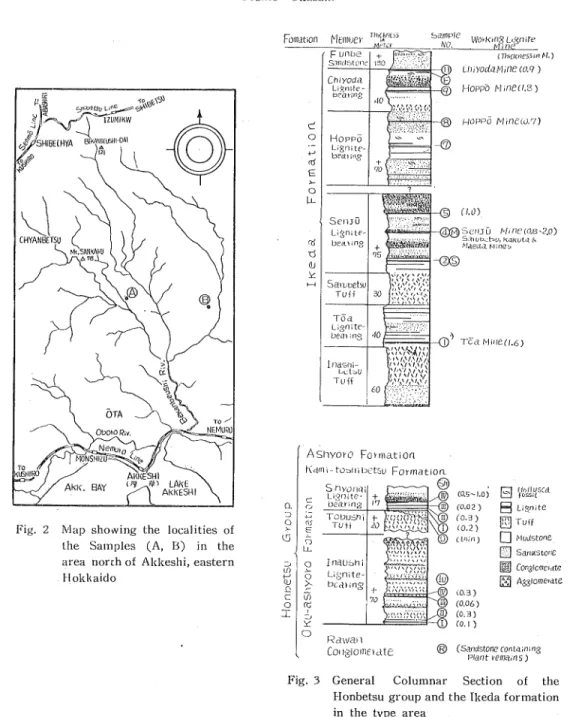
(3) Yoshio Okazaki. I. Geology in the Type Area. Honbetsu group The Honbetsu group is developed mostly in the northern area of Honbetsu-machi and Ashyoro-machi in Tokachi province. The type exposure is seen in the cuts along the Toshibetsu and the Ashyoro rivers, and also along the Honbetsu river. The stradgraphical study of the group at the area and also in the Kushiro coal-field was first made by Y. Sasa in 1940^ and 19535\ The standard sequence was recently presented by W. Hashimoto (1955)6^ at the area, while in the Kushiro coal-field, the division of the same gronp was proposed by S. Imanishi (1953)7) who surveyed the Tertiary system around Akan-machi in Kushiro province. According to W. Hashimoto's survey, the group at the type area is lithologically devided into three formations as follows :. (in ascending order) Ashyoro formation Alternation of tuff, tuffaceous sandstone and conglomerate, and wedded tuff 200—230m, .^.^^^_^ Unconformity -^^-^^~~-^—--- —.-.^....^.^/^^^-..-/./^-—. Kami-toshibetsu formation Very variable andestic deposits in lithologic character, alternation of agglomerate, sandstone, conglomerate, and tuff--------'--'-----------"-----250m. Unconformity ^./././——^^.^.^/^^^^^^/.^—.»-.^/./.^,. Oku-ashyoro formation Lignite bearing •••••• .................................................................... •••-900—l,400m.. The Oku-ashyoro formation, which is a lignite bearing one, is important for the presente rsearch, and attention, therefore, was focnssed on this formation. The formation is further subdivided into four members, based on his survey and its lithological character is given briefly as follows :. Shyonai lignite bearing member Alternation of dark-cloured tuffaceous sandstone ;ind muclstone, with intercalated lignite seams ................................................... ....•••••••.30m.. unconformity. Tobushi tuff member Pale. cocoa-coloured massive medium to coarse grained tuff ........................100m.. Inaushi lignite bearing member Alternation of dark grey-coloured sandstone and mudstone, and light-grey-to white-coloured tuff, sometimes intercalated with conglomerate and agglomerate ....•..........•.••.....••••••••••••••••••••••••••••••••••••••••••••••••••• ••••••270m.. Rawan conglomerate member dark grey-coloured medium grained conglomerate--"-'-"---"--------'--"-500—1,000m.. The lignite seams of the above two members are limited in extent ; Those of the —231.
(4) Stratigraphical and Palynological Studies of the Honbetsu Group and the Ikeda Formation. shyonai member are seen only in the river cuts near the Kamitoshibetsu station on the Abashiri line, and those of the Inaushi member along the Ashyoro and the Inaushi rivers, where those seams are, however, scarcely of .economic importance on accout of. their thinness. The lignite samples for the present research — pollen analysis — were taken from three members — Rawan, Inaushi, and Shyonai. The geological section at the sampling locality is shown ill figure 3. Ikeda formation The Ikeda formation has been first surveyed by S. Oishi, T. Watanabe, T. Nemoto, and Y. Sasa (1932, 1933, 1934),«- 9. 10) and more recently by S. Hashimoto (1954),9) W. Hashimoto (1955) ,u.i and the writer (1957) ,3.> especially the writer has established the geological sequence near Ikeda-machi in Tokachi province. The formaton is mapped widely in the southern part of the distributed area of the Honbetsu group, where Ikeda'machi stands in the centre, and the outcrop is limited in extent as it is hidden by the overlying terrace deposits. As type localities the writer has proposed the western area of Ikeda-machi ; the lower half is seen along the Nemuro main line for about 4 kilometers, extending from Sarubetsu to Inashibetsu, and the upper half along the Tokachi river eastward from Tokachi-gawa spa, where some working lignite mines stand as shown in figure 1. The following geological succession at the type locality is prepared by the .writer and the general column is shown in figure 3.. (in ascending order) (in meter) Funbe sandstone member ............................................................ •.•••....•••ISO. Chiyoda lignite bearing member ..•........••••.•....••••..........•••....•••••••••••••••••• 40 Hoppo lignite bearing member ..................................•....••.......;.••......••••• 70. Senju lignite bearing member-------'-'--'---""-"""---'-------'-----'-'---'"-----'--'"-- 75 Sarubetsu tuff member ........................................................................... 30. Toa lignite bearing member .................................................................. 40. Inashibetsu tuff member ................................•••••.....•.••••••....•••••••••••••••••• 50. The lignite seams of these members are found in an amazingly great number ; in many cases, however, they are thin, although occasionally a very limited number of them, that is only one or two seams per member, swell out to thickness of one or even two ineters. The main seams have been worked at many places in Tokachi province. The relationship between the Honbetsu group and the Ikeda formation had not been fully solved before W. Hashimoto's survey (1955)*. He has found the clear unconformity between the two at some points near the Senbiri railroad station on the Abashiri line, while according to the boring data at the Tea lignite mine where are the type localities of the two lowest members of the Ikeda formation, it is recognized that the base of the formation the Inashibetsu member rests unconformably upon the Taiki formation * Lecture entiled "Honbetsu group and The Ikeda formation" at the annual meeting of the Hokkaido branch of the Geological Society of Japan, Sapporo.. —232—.
(5) Yoshio Okazaki (Pliocene) instead of the Honbetsu group, and that this group might be not accumulated in its neighbourhood.. II. Materials and the Stations for Pollen Analysis The materials used in the present study were collected at the following 16 stations. (Table 1) and the distribution of these stations is indicated in figures 1 and 2. The 11 stations of them lie on their respective type localties of the Honbetsu group and the Ikeda formation presented by W. Hashimoto and the writer, while at the three stations, M, S, and F, the lignite samples were taken to examine whether correlation based on pollen record is possible : The first two from the Senju member and the latter one from the Chiyoda member, respectively apart from their respective type localities. Furthermore, those samples taken at the stations A and B, far from the others, are used to be correlated with the Pliocene series at the Type area. The two stations, A and B are situated far to the east in Kushiro province. In 1957, the writer surveyed the upper tributary of the Bekanbeushi river which pours into Lake Akkeshi lying about 40 kilometers east of the city of Kushiro. At that time he discovered some beds', with interbedded thin layers of lignite there. They consist chiefly of an alternation of tuff, tuffaceous mudstone and sandstone, and is covered unconformbly with the Kushiro formation (Pleistocene) wich occupies widely this district. They therefore seem to be Table 1. List of the stations No. of station. Lignite bearing member. Locality. 11. Chiyoda mine, west of Ikeda-machi. F. Funbe-yama north of Toshibetsu station, Nemuro line, Ikeda-machi. 9. Hoppu mine. 7. Chiyoda dam in the Tokachi river, east of Hoppo mine. 5. Senjii mine near Inashibetsu west of Ikeda-machi. Senjii mine. 2. Senju mine. 1. Hoppo. Ikeda. Maeda mine near Moyachi, Makubetsu-machi. 4. s. Chiyoda. Hoppo mine, east of Tokachi-gawa spa, Ikeda-machi. 8. M. Senju. Near Sarubetsu, Makubetsu-machi Toa mine near Sarubetsu, west of Ikeda-inachi. Toa. Sh. River cliff at Kami-toshibetsu station, Abashiri line, Ashyoro-machi. Shyonai. lu. River cliff near Naka-ashyoro, Ashyoro-machi. Inaushi. R. Road cut, 1.5km. west of Rawan, Ashyoro-machi. Rawan conglomerate. A. Fuppnshi tributary of Bekanbeushi riv., Akkeshimachi in Kushiro prov. Hirano tributary of Bekanbeushi riv., .Shibechyamachi in Kushiro prov.. B. Formation. — 233 —. )ku-ashyoro of the Honbetsu •roup).
(6) Stratigraphical and Palynological Studies of the Honbetsu Group and the Ikeda Formation. ABtenmi. i).. 11-TOSHIBET6U. Fig. 1 Map showing the localities of the Samples in Tokachi province, eastern Hokkaido. Pliocene in age. The sampling lignite horizon is marked in the geological cloumnar section (Fig. 3). The materials from each lignite seam were taken at about 20 centimeter's interval as is shown in the pollen diagram.. All the powdered materials were macerated with the Alkali solvent (KOH 10%) which is very simple in process and is the most effective for this lignite, and afterwards hydrofluoric acid was used for sandy and clayed samples.. III. Results of Pollen Analysis The results thus obtained are shown in the following table (Table 2). —234—.
(7) Yoshio Okazaki. Fomation Memucr. Tt},ant^. •ample ^n(,,,gL,gnire HO. "~ "Minp. MF^'I'. (TWlHSinM.). <[t> Lhivoda.hinew.t)) Hoppo Mine(f.S) yi-beisy L>'VB^=^<5^. ^><\r7\~~izwlKW. -@ HOPPO Nineu.7). ./AwtlWh E^M'iKlEIII.DAI. -@. (I.O) Se«j0 Hinews-z.o'i S.DUb^b.L', KWwtA ?* f-fiieiU. MifiL"-.. <D') TCd MiN£('1.6). Ashyoro Fomiation Kdnii-toaliibetsu Format ion S hyorit'i Li.on.tc-. bearing. Tobusni. Fig. 2 Map showing the localities of. the Samples (A, B) in the. Uj. TUtt. nJas .+7'. ^. inw^i. area north of Akkeshi, eastern. L.ynitebcdh'ng. Hokkaiclo. @. ^@ (ft5~1.0) (0.02). •li'W. |-j LiS.nite ^ Tu(f Q ML'dst:on£. {J3 Sarii(StOfl£ Con^cvetdte. ^. Q AgjlOHIErdte >;(\<v;?(V,yv. Kdwan Congloineiate. ® (Sandstonerontain.ng plant remains). Fig. 3 General Columnar Section of the Honbetsu group and the Tkeda formation in the type area. From among about fifty types of pollens and spares recognized in these lignites, tree pollens (AP : arboreal) were chosen to build pollen diagram, and to be disscussed in this paper.. Of non-tree pollens and spares (NAP : non-arboreal pollen), Sphagnum is predominating throughout, but discontinuously. Many spares of Peridophyta such as Osmunda, Equisetum, Polypodiaceae and Lycopodiaceae are also dominant. Such a dominance of spore should be noticed to infer the mode of the formation of lignite or the mother substance of lignite originated, but more deteiled discussion still remains for the future, while Gramineae, —235—.
(8) Stratigraphical and Palynological Studies of the Honbetsu Group and the Ikeda Formation Cyperacea. +. V3. 0. 0 CM " 0 —. 0 ^0 CO. <M ^ 0 -<. 00N0. 0 »- 0 0 o^i. M c^l v\ir\ c^l *<£). m. ^ CO 0 in 00 Q ^. c^i o tr\ v\. N — ^f <r\ oq ^r. Gramineai t*^ CT\ C^ 0^ 0\ IT\ OC. Sphagnun. Sspore. SNAP Ericacea. o\ '0 t-~. m c^i M \c. 0\. 0. \0 0\ N- — (M 0 —< ^ \C. ^. ^ W\ p'l ". \o CA co t^- m o q. • •„_ (T,. r-- co o co vo M co t"- co co c^ oo <tl a\. t-^ m cr\ ^ [^ y\. cr\. 0\ 0 0 C\ 0 "f lA in \0 ^ ^ M. F-- IT\ '-< C^ tA 0 ff\ 0-^ 00 t~~ ^0 CO E^- (M (^ CS). s. c^i »-« o>] in r~- in. vr\ a\ c- oo LT\ o. \0. Cs} iT\ ^ U\. 00 o\ r"-. c^ —i o. <^ c^ ts~- oo o"\ rr\ -. -. N ' -''. ^ — cr\M 1tf ^o. >A C\l C<^ N (^. CO E^ ^0 M C^ Csl. ^ 0^ ^ 0 t- 0 0 »-< \0 ^ ^0 T. m. vqooqoocsj^o. 1^ Cs] \0 '-< »"" ts-. rs-o ^ r^ CT\ h- ^h <o IA t^. rr\\0. voo^o^oo\o\c~^m. o\ o M ir\. ^rT\^<^-^t~~-\OCT\. u^ (M oo o\. •^" y\ u\ ff"\. 0 \0 CM C^ 0^ COt. Cs) T (T\ '—> N tTt f^i 0 ^0 t-- lf\ 1^ ^0 T-' " N -' Cl^. 0\ CT| 0. \0 0 in \0 -r-< CM. ir\csi— c^ooiMMON. 0. — " M CO. .^ 0\ N. IT\ 0 C^\. t-^, _( »-< t^. c^^oo\mcT\»-«t^^i. ^Csl\OCT\^\OU^O\. Lf\. N00" u^ ^. ^- 0 CM <N '-. m^. ir\ o\ co *<o o\ u-\ 00 ^0 E-- ^0 00 00. 0 VO 0\ 0\ 00 ^. ^. ^ C^I '-' <^\. Zelkova Castanea Ilex. if\ o\ \q. m. ^0. \0 Csi t"- C^\. 0 00 0. Corylus. t^. 0. K. •a. 0 -< 0 0-1. Salix Alnus. 0. 000 0 m 0. 0. u. G ra. f-t. Quercus Betula -ryptomena. r"-. 0. ^0. o ^-< m> o ^ rt -< <f'. 0. m co 0 -4. V3 00. IA \q d o^. N ^r ff-i o ^ ^-. N N C^l C^l CM *~« f-t ^ cs »-i t^. t^. 'r ^o. m co o\. L^f^ \o ^ t-- ir\o. 0. 0\. Larix. \0. ^-7-|< ^. LPi. 0. ir\ cs. l"^cd. r^-c^ Lno vo ^. <f. Cs~- ^0 IA. C<] <-» »~». \o -<. :>.). f^ r~<. m 0. Picea. ^o^t-~^-<M^oir\. 7\0 ^-O Lpi 1f <f. <»• in c<^ ^ t~-1~^- ^ \0t~~- Csl 0. 0. c^l c^i r^ m 0^1 m c<i. ^ a\ o\ o\ o\ o v\. •n. o\o\c^t^-voi^\otr\. '- *0 tT\ ^ f^ CM —". © Chiyod. N I~~ in C^i M. —O — ^0 M. 3\. Member. 00 Csl. N ^ \OU^ ^. <0 N t~- CO (M 0. -^ Sampli. M u^o ^r M. 0. n. r\p "^ M ff^O ^ 3\^0 00 ^ t^O ^f. 0. N. —<o\\o. 0. 0. C\OVOOO^CAN<^. 0 VO 00 0\ ^- ^ v\ co. 30. c-i c^ \q t~~- ^q c^i c^i u^. (^ cr\ oo '-'. M -. in en N -<. ^i. @. "). Cn tT\ LT\ LT\ M3. f"- c^\ N- ^o y\ 0 <^\ C^i 0 ^0. u-\. f^N—iO\^-<^-iO\r^ t^OCF\OOcn—IC-10. ype ^. <o <o \o o\. 0 N 0. <Q. N0\ — ^0 .<t. y\. t^C7\COO\Of<^0000 MOVOOOC^C^^t^-. ^- -i covo o^ eft. 'ollen. c- —i \r\ ^ y\ ^-. ^ N 00 \0. Mm CO 0 (^ ^. .n LT\ o^ o\ c^i ir\ ^ 31^. mOCM W 0. M "f C\> C\) ^ y\ F-. t^- U^ U\ *<0 t^- 0>. o c^i o —' o o. Pinus. ^ ^ ^\ <^\c^ —. ^. LT\ \0. —ON. rf\ \q <M m. c\l en. 0. C^ ^OU^OO 0 N. ^ LHi. en. m 0. V3. C^ CO GO CO f\ 0. 0 -< -< (^0 N. Taxodium. Abies. IPt ^ V\ Cst ^ co. -a\-f- tr\ oo ir\o\ ts~- — OOC^'<fC^t^-OC\0^. t~-. 0. \o r-< t^-, c<^ c^. co in. Glyptostrobus. Tsuga. o\ ys co. o m IA. oo o\ rs- M o\y\ CS} CS] r-( ^ <^ | 00. U^ V~\ ^\ —> ts~- ts~-. \T\ 0\ 00 IA \0 o\c^ oc^] in M3. <t< ^-. ^f \0". — \o — ^r ON. 00 CO CO. \o — d ^r. ^ oo oo \o in o c^i. M ts~-. U^ C^ [^- 0~\ t^. '—'. 0. ON" 3. t--—-f. o-\ o t^~- m 0 (--. 0M. 00 — 0. co. ir\ —i t"-. o\ 04 T-< 0 ^0. 0. t"-. o o m. yjc^ ^o t^ \o 'Ir o\ N -. C>) ". 0. ^ 0. ^0 0\ C^i. co m co cr\ o p^ M. h- ^0. C-). c<\ '—. Fag us. i^. -< N. "co. u\\o^o ^o. Carpinus Fraxinus. 0 ^ 0. C^ Cv) ^. t"-. Tilia Ulmus. \o '--> \o. 0. 0 M3 ^ y\. Juglans Pterocarya. ^f~. s-. M—. C^l <^\0 00 ^ '£1. (M\O ^ ^-; \ri \rr c<) a-\ r^l ^ '—. M oc^ ^o mc^t. <-• r^ v\ t^. C\l ^ C^i f^i '-• ^0. o\co{^<\om^<^'-<. \o in M ". ^-* 0 00 ^ 1^ T"«. ©. ©. @. Hoppo M.. M.. —236—. Senju M..
(9) Yoshio Okazaki Cyperaceae. +. 0 ^ 0 00. N —MM. Gramineae. ^; NAP. M <M. c^o\—<f^cq^qT~l,(^jCF\ •-•^Oh-h-^'C^O-lOOO M (r\ ^ r^i c^i c^l M. in, ir\ '— in M. 0\^-i*-<LTsf~-U^OOO^. r^ <o co t-- c^i. — — (^ en. 0. Ericacea. C?\0 ^ C^VO O^i 0. M. u^. 0 o\. ". 0 if — 0. u^ co. Juglans. Carpinus I'raxinus. Salix Alnus Fag us QuercuS Betula. 0 — — M. in 1~~ !»-; ^. "of'-.. q co t~~ 1~-. -' m o ^t-. CT\tfOU^»--i'^C^—<. OM"OC^~'-M Csl cr\ "t; mo p-\'-; ^o ^. •-OMM^N-^OO. cr\ W\ U\ -< 00. ^f f-. " 0. fT\ 0 <^\IT\0\ cs. 0 frl ^, F~;. ^0 Lf\ IPt M 00. <f ipi i^ ^ m. '^OOOO.^C^CS]»--<00. C^ M C^i C^. M cfSo ts- 0 ^0 ^ IPtU^ ^0 ^0 ^OM ^0 CO. ^ <^\ ^- IT\ (M V\ p~l -^^ ^ooo ^o r^ t^.. 0 00 C<~1 -<. o\oc^^oc^o^or^i. ^••^^•<r^t-(n^t-"(^ <o^\ocoo\c^ts-o\^t-. MOOMOC^CO'ftA^O cr\ r^r^»~irOiMf^—' <t-^0(^ir\oo~i^oo\Q. T ff~\ InN 0. c^c^c^^c^c^or^o^. y\ oo o\ o\ o\ c^] y\ 'o en co. ^<\i^^i_> mi\oc^^mMMt^.^-'c^^rc^'-. (\i. ^. ~^t--. 00 r^.. *^} LT\ LPt. 00. 0 -. 0. ^oo\^qoo<-;^qo^c^. 00»~"CM^-C^O—<^i c^i0\ tOiLnr^M^o^f. Finns. -< 0 O^Mm(NO. t~~. 0. Picea. Pollen. type. Sampli Member. LT\ CO t--. 000 LTi ^- C^ C^l ^. @ Seniu M.. M y\ c^ \o oo. '-' V) 00 -< \D C^ •t1 »-< f^ (N. CS tf- \0 ^f h- M 00. WO ^t- 0 ^0. ^ LTi —< 01 (U CS) ^. (N L^ (Mff^i (Y^. ITtC^iO VO CO C^ 00. ^ ff\0 0\ ^. 0 M. co co "f. q. u~\. LT\. -<0~00-0\ 0\ O'l. p ^ rsu r"- ^. -< C^O M3 0. ^ (^ <^i ^0 <0. C^'f^OO'O'fOON.f^ ^-,^-^t^l^l^l^^. tt'o\c?\or^(Noo'-«t^-. M^^C^t^O\Lntr\^. ^ocF\co^Otfr^M-<. © Tea M.. ^f. —< (N 0 ^ 0. <^\ IT\. 3 iU. Juglans Pterocarya. 0 0. Ulmus. <u. Tilia. K -g 0 -^. Carpinus. 8. Fraxinus. scr. Salix. 0 c <u. Alnus. s. Fagus. 1-< 4-1. 0 p^ ff~\ <u. "^ s. 0. Corylus. Quercus Betula ;ryptomena. Taxodium Larix. Larix Tauga. N. ^Q N o ^r. Glyptostrobus. Glyptostrobus. Abies. M. t-. 0. Cryptomeria. Taxodium. ft. s. co. Ulmus. Tilia. CO 0 ". 0 0 ^f. t^- C^i t"- — ^0. (Tt ^f ,-< o-\ -< t-. [^- ^ C^ ^~\ vf t^ 00. f^-. n 0. 00 1^ 00. 01 0\ 0\ 0\ VO. Ilex. LT\ LPt M3 '^. 00 00. 00. t^ \o ^ ^ ^ ts-. C^l t"- <^\ 00 fOi 0. ^ M ^ ^. LT\ -< Is- PT\ F-~. —<. Castenea. M IT; 00 ^0 r^ ^. L^. Ilex. 00 VO C^i. N N \0 N NO. Zelkova co. 0 0 M. Castanea. Pterocarya. SNAP. in, co o^ o *^o o\ \o. (<.'. t-x ^ 0 LT\ ^0 N<. *-< 00 <0 0 •-1 0. Sspore. MO<o<uS^cr\o.^r^ ^c^Lnc^tn^^voc^i. Zelkova. Corylus. Sphagnum. CM n. ^ CT\ F-- ^-< 0. Ericacea. +. •^'-<0000\OOC^f^i ^]^<^^T-<f^—1LT\0. — 0 0 LP, ^ 0\ Q 00. ^spore. Cyperaceae Gramineae. o '0 in. Sphagnum. '-ioo^or^\—<'^lo\Lr\^. C^OVOO\^->0<0^0 <N. Tsuga Pinus Picea Abies 3ollen :ype Sampli Member. 237—. 0. (^. 0 r^. (^ —<. LT\. 00 N. 0. en -< t- " —. CM ^ ^00 U^ 1r-< —. C^ f 0\ Cf) ff^ " f^ ^. -.0(^1'-.. N. V3 ^0. [T\ U\. \0 C^l U^. u^. 0. 0 0. 00 '-I 0 0 ^. 0 <f 0. IT; \0 1~». 0 00 Qv-i 00 '^T M2 [^ 00. r^^ 0 0 —. C^l Csi --• N M M. — *-< tT\ M. — U^N. OOCO 0\ 0 00 0\ 1A f^ CO --;'-< C\ 00 CO t^- N. C^l C^l. ^ en ^ —. oo --• M oo r-- '<r ^. o\ u^ ir\ \o vo ^ o 00 f^ LT) (A 0 ^ --;. f- c-i ^ o\ o in r^. IT\ ^ ^. CO 0-s 0 ^ fT\ M ^0 Q. — ^t- 0 ^f. <N <f u~\. 0. o\ co y\ o cr\ M ir\ <N ^ co ^ en ^-. 0 M F-- C^ E^. r>i. (^. ^ 0 f. N 00 ^ F'- 0^ f^i ^. ^ ^ 0 C^ 0~\ (N ir\ o E^. 0. ^0. 0. 0. V3 f ff\ Q. 0,. C^i ^ -. ^ ff~l ^0. 0. r^ oi m \o ^ o\. r^-^o ^o ^ ^-<. c~). C\Cf^t^ i^ T ^ 0"^ CNi M c^ —i ^- ^ oo. N <~.l in t~~ N f- lct4 M 00 \0. y\ 00. irS oo c") u~\ '-< M. ^-1 T-t C^ T~l. u^—< oo o\ ^ c^ ^rt. ir\ u^ rt c^i o\. *^p IT\ ^ C^\. \o ir\^ ini c^i *- o. o\ co 'I' c^. Lf\ 0 Lf\ l^i —' (M 0. \r\o ^\ y\ o\. •<•. p~s. y\. ^. <0 f- O^i ^ 'sD. M. *-> h- <o m ^ r^ ^. co \o IA in —. ^-. ^;at==i>—ii-<i—'o. 11111 tefcs >=<•-'. ^_ ^ ^- ^. r-, ^-11~-. 1111111. A w. Shyonai M.. 3 Inaushi M,. cri. §. (3 03 cd. M. 9 tr c (D ^. h.
(10) Stratigraphical and Palynological Studies of the Honbetsu Group and the Ikeda Formation. Cyperceae, Menyanthes, Compositae, Drosera, Caryophyllaceae, Myriophylum and others are scattered throughout and are less of importance except Menyanthes, the seed fossils of which are considerably contained in these lignites as already mentioned. The main types of these pollens and spares are figured in plate. Honbetsu group Oku-ashyoro formation a) Rawan conglomerate member The pollen contents in sandstone sample including plant remains are too poor to make the pollen diagram of trees, so the frequencies shown in table indicate the percentages to the total pollen (including non-tree pollens). Generally the member is characterized by the dominance of coniferous trees such as Pinus, Picea, Abies, and Tsuga, vyhile Alnus, and Fagus are comparatively in low percentage.. b) Tnaushi lignite bearing member Apart from Alnus, Picea is the most predominant species throughout ; Pinus, Tsuga, and Abies are also relatively abundant. Taxodiacea such as Taxodium, Glyptostrobus, and Cryptomeria, the presence of which is worth noting, is small in amount. Saying of broadleaved trees, Alnus is recorded in high propotion than any other, while Fagus and Quercus remain rather constant, but in low percentage. Other trees are scarce. After all, the member is marked by the preponderance of coniferous forest mixed with some deciduous trees.. c) Shyonai lignite bearing member After making the dominance of conifers at the beginning, the member begins upwards the mutual replacement, or even partly the equivalent of the dominance of the coniferous and the decictuous forests. Fagus is the most predominant species at the middle, but it declines in amount at the upper and the lower. Alnus, diminishing at the middle, also is abundant thoughout. Castenea, the extinct genus in this district, is identified in very small amount, while conifers such as Picea, Pinus, Tsuga, and Abies are sometimes dominant. Taxodiaceae is nearly the same in proportion as that of the Inaushi member. The member thus is devided into two stages in forest constition : The first half stage is of the coniferous forest and later on of the irregular succession of the two forests. Such a irregularity may be recognized as an effect of transitional unstable climate. Ikeda formation a) Toa lignite bearing member The member is characterized by the beginning of the steady rise in the frequencies of Fagus and Alnus; and by the decrease of conifers. This trend is clearly maintained to the following Sen ju member. In addition to the above genera, Quercus, Fraxinus, Betula, Ulmus, and Ericaceae are relatively abundant. Zelkova, the presence of which is noticeable, is very small in amount. b) Senjn lignite bearing member In the lower of the member, the constitution is exactly the same as that of the — 238—.
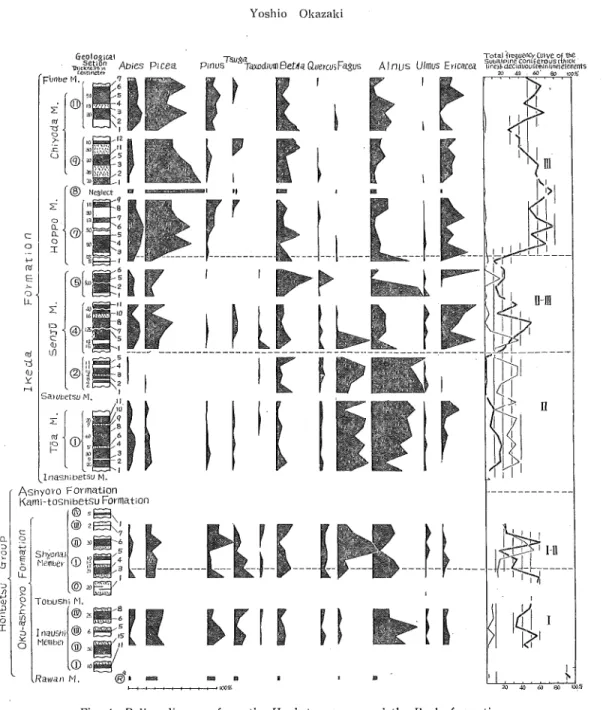
(11) Yoshio Okazaki. G-e.olo^iKi.l. ,SSSf5 Abies P.cea. ,Tsusa. TawdiumSeUii fluercusFa^us. I. Alnus Ulmus. I. Total -fre^uertCyCiftve of the subaipjneconiferouscthKK YiCQCfS. Tini)i..'d£Ciduotjs?inliW)£J£;TiffltS 40 . t0 63. Inashibetsu M.. Asnyoro Formation Kami-tosnibetsu Formation. 20 40 6) 80 W^. Fig. 4 Pollen diagram from the Honbetsu group and the Ikeda formation * diagram is shown the frequencies to VP (various pollen), but total frequency curve to SAP C arboreal pollen). underlying ; it is marked by that the prevalence of Fagus and Alnus, although Quercus as deciduous trees is relatively in low proportion, and the absence or very small amout of coniferous trees are remakable. F'rom the middle, conifers gradually increase upwrds, and the dominance of conifers alternates with that of deciduous trees more than once, but conifers, though great in amount, are rather comparatively small as compared with those in the Inaushi member and in the following stage. Betula and Ericaceae which were seen discontinuously in low percentage till the Tea member, begin to increase. Taxodiacea is —239—.
(12) Stt'atigraphical and Palynological Studies of the Honbetsu Group and the Ikeda Formation. still frequently found. Thus this member is sharply divided into two stages in forest community and therefore in climate : The lower maintains enough the trend of the prevailing deciduous forest, starting from the Tua member, and then the upper half is probably regarded as a transitional stage to the next coniferous forest one. The results from the stations S and M resemble greatly those from the lower and the upper respectively. Tsuga Quercus Abies p,cea Pinus Taxodium Betula'-~"Fagus Alnus""""""EriCa(~ffi(. r-oTa^1. fYe<nuency Ct^v<? c+ He subalpine con;feroustec iictuous forest eiments. £Z1. J> -f-T i^. ^. ^ \_. -Ja) w. 66 80 100. Pig. 5 Pollen diagrams at the Stations F, M, S (in Tokachi Province), A, and B (in Kushiro province). c) Hoppo lignite bearing member The member begins with a continuance of transitional forest like the Senjii member, and immediately in place of it, the dominanant stage of coniferous trees such as Abies, Pinus, and Tsuga, especially Picea which is the most predominating throughout, is recognized to start upwards. Betula and Ericaceas are relatively abundant. On the contrary, other broad-leaved trees but Alnus are rather rare, particularly an absence or very small quantity of Fagus and Quercus is an outstanding fact as the extinction of Taxodiaceae. Taxodiaceae such as Taxodium and Glyptostrobus except Cryptomeria which were hitherto seen frequently, is not to be found in the member at all and also in the overlying Chiyoda member. This fact is important from the view point of paleobotany and also of pollen stratigraphy. The same fact has been already found by T. Yamazaki, (1956),12) from his pollen analysis of the Pliocene lignite formation in Yamagata Pref... d) Chiyoda lignite bearing member The forest constitution shown in this member is almost similar to that of the underlying member ; it is marked by the conspicuous dominance of the coniferous forest and it is continuous through the whole, while at the station F, it is clearly in accordance with that of the member. e) Beds at the stations A, and B in Kushiro province Coniferous trees such as Picea and Abies are mostly dominant throughout, but Tsuga — 240 —.
(13) Yoshio Okazaki. and Finns remain rather low in frequency. Betula and Alnus sometimes are no less abundant than Picea, while deciduous trees such as Fagus and Quercus are almost rare. The rests are scarce and less of importance.. IV. Zoning Pollen Diagram Numerous researches concerning the vertical and the horizontal distribution of the subalpine coniferous and the deciduous (Fagus forest) forests in Japan have been made by many workers, especially T. Kira (1953a, 1953b)13. W has dercribed the present distribution of their forests in connection with climate. Thus it is a popular opinion that this district lies in the subalpine coniferous forest zone. Now, from the above reseacrhs and the pollen diagram, we recognize that Picea, Abies, Pinus Tsuga, and Taxodiaceae as conifers, Fagus and Quercus as deciduous trees, furthermore other broad-leaved trees, namsly Alnus, Bstula, Ulmus and Ericacea, are the most common and abundant species in occurrence through the whole, and that they are important to know the successive changes of the forest association. In addition to the above genera such as Fagus and Tsuga, Larix, Taxodium, Glyptos trobus, Cryptomeria, Castenea and Zelkova are the extinct genera in eastern Hokkaido at present. Judging from the existence of these warmth-demanding species, particularly from Fagus, which all flourish in a somewhat warmer condition than that of the present day in this district, we can allow a clear recognition of not only the existence of the deciduous forest here in Pliocene and accordingly that of a warmer climate, but also that of the subalpine coniferous forest like at the present. Thus a comparison of the frequency curve of total pollen derived from the coniferous forest zone with that from the deciduous one allows a recognition of the successive changes of these forest zones and also that in climate. So the frequencies of main genera belonging to both forest zones were respectively summed up. In this paper,* for instance, Picea, Abies, Pinus, and Tsuga as the coniferous forest zone element were chosen, and as the deciduous ones Fagus and Quercus. The frequency curves of the subalpine coniferous-deciduous forest elements thus obtained are shown at the right figure of the pollen diagram. In this way we find a movement of these two forests during the formation of these lignites. We have now proposed a series of numbered stages in floral composition and in climate, based on the frequency curve. I stage : The zone, which includes both the Rawan and the Inaushi members and also the lower of the Shyonai member of the Honbetsu group, is probably regarded as the stage of the lower part of the coniferous forest zone because of some deciduous trees * In this paper, Taxodiaceae and those which are relatively unimportant or distributed through both forest zones are conveniently omitted. Of Taxodiaceae, for instance, Cryptomeria is distributed in its present natural range from the middle part of the deciduous forest to the (montane) coniferous forest zone, and the others such as Taxodium and Glyplostrobus are the extinct genera in Japan, so they are not fully known in their distribution in connection with both forest zones. —241 —.
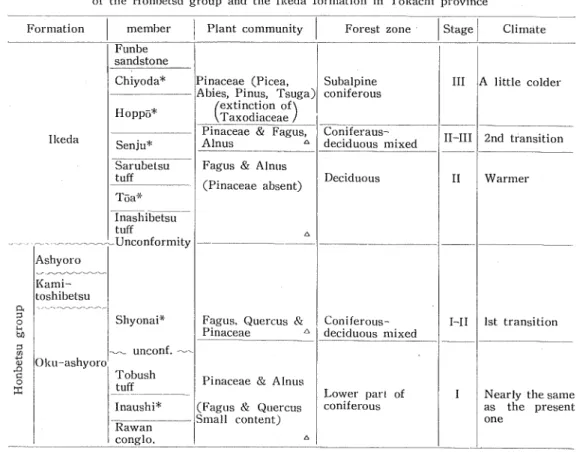
(14) Stratigraphical and Palynological Studies of the l-lonbetsu Group and the Ikecla Formation. mixed with the prevailing coniferous forest elements. The climate of the stage therefore seems to be nearly similar to that of the present day I-II stage : This stage corresponds with the Shyonai member except the lower belonging to I stage, and begins with the crossing of two pollen curves. It may be considered as a transitional stage between I stage and the next II stage, accordingly as the coniferousdeciduous mixed forest stage. Such a course of the curves which indicates the alternation of two forest types may be conditioned by unstable climate. II stage : It is a stage ranging from the base of the Tea member to the lower half of the overlying Senju member, repectively belonging to the Ikeda formation, and is characterized by the preponderance of the deciduous forest. This leads us to recognize the stage as a warmer one in climate than to-day by 3 or more degrees of latitude ; that is to say, the climate is quite similar to that in northen Honshu of the present day. II-III stage ; The stage ranging from the middle of the Senjii member up to the base of the Hoppo member may be regarded as the second trasitional zons between II and the next III stage, which correspond respectively with the deciduous forest zone and the coniferous forest zone. It therefore suggests an affinity with the first transitional stage (I-II) in floral composjtion or in climate. However we may be able to distinguish these stages by dint of both the abundance of Betula and Ericaceae, and the disappearance of Fagus and Quercus in I-II stage. Ill stage : The last stage III includes both the Hoppo member except the base and the whole upper-most Chiyoda one. From the diagram, it indicates undoubtedly to be placed in the subalpins coniferous forest zone. One of the most striking features at this stage, as compared with I stage or the others, is the extinction of Taxodiaceae except Cryptomeria as above mentioned. According to T. Yamazaki (1956), the extinction was due both to the cold and to the dried climate in those day. After all, we can recognize this stage as a warmth-decreasing one ; the climate in the Later Pliocene was nearly equal to that of the present day in this district or even a little colder. From the above consideration, it leads us to clarify fully the relationship of the geological siquence to our zonation and it is summerized in the following table. V. Correlation with the Pollen Records at Stations S, M, F, A, and B We now have another point to be considered : A question, whether the pollen record of lignite beds is effective for stratigraphical correlation or not, has been yet unsolved in Japan.. The sampling lignite seams at both the stations S and M correspond geologically to those of the Senju member at the two stations 2 and 4 respectively, while one at the station F to any lignite of the Chiyoda member. As previously mentioned, we can easily recognize that the diagrams at the three stations are correlated to those of the type stations 2, 4, —242—.
(15) Yoshio Okazald Table 3 Forest succession and climatic changes connected with the geological sequence of the Honbetsu group and the Ikeda formation in Tokachi province member | Plant community. Formation. Forest zone. Stage. Climate. Funbe sandstone. Chiyoda* Hoppo*. Ikeda. Subalpine Pinaceae (Picea, Abies, Pinus, Tsuga) coniferous /extinction of VTaxodiaceae. Senju*. Pinaceae & Fagus, Alnus a. Sarubetsu. Fagus & Alnus. tuff. Toa». (Pinaceae absent). Coniferausdeciduous mixed. Ill. II-III. Deciduous. A little colder. 2nd transition. Warmer. Inashibetsu. tuff. -Unconformity. |Ashyoro IKamiItoshibetsu Shyonai*. fl. G 0. E. |0ku-ashyoro. Fagus, Quercus & Pinaceae £. Coniferousdeciduous mixed. HI. 1st transition. ~- unconf.. Tobush. tuff. Inaushi* Rawan conglo.. Pinaceae & Alnus (Fagus & Quercus Small content). Lower par I of coniferous. Nearly the same as the present one. * lignite bearing, A shows the presence of Taxodiacea except Cryptomeria. .and 11 severally : The pollen diagram at the station S indicates the prevalence of deciduous trees and then at the end the total frequency curve of the coniferous forest elements is equivalent to that of the deciduous forest ones. At the station M, it shows the dominance of Ericaceae and Picea, and the total frequency of conifers is not beyond 45 percentage, while that of Fagus and Quercus are constant. In the diagram of the station F, conifers are dominant through the whole, but Taxodiaceae is disappeared, while Fagus and Quercus are scarce.. In this way the zoning which we have proposed is applicable to the diagrams at the stations apart from the type ones. Moreover, we may be able to infer that the records at the stations A and B in Kushiro province correspond together to I stage of our zonation and accordingly to the lower of the Honbetsu group. All of these diagrams are shown in figure 4.. VI. Correlation with the Results Without Hokkaido and the Age of the llteda Formation In Japan, concerning pollen analysis of the Pliocene lignite beds, a considerable mumber —243—.
(16) Stratigraphica] and Palynological Studies of the Honbetsu Group and the Ikeda Formation. of important researches have been already made by the follwing workers mostly since 1950 : T. Yamazaki (1937, 1957)12. is) on the Nokoro series in South Saghalien and the two lignite bearing formations—the Shimizu and the Izumikawa formations—in Yamagata Pref., J. Nakamura (1951, 1952) is. i7-> on the Nahari lignite in kochi Prof., and both the Mitani bed in Ehime Pref., and the Ananai bed in Kochi, Pref., Shikoku, M. Shimacla and N. Takahashi (1950, 1952)is, 19) on some lignites near Sendai city in Miyagi Pref., and some in Yamagata. Pref., S. Tokunaga (1954)20) on the Kamikita lignite in Aomori Pref., and K. Sohma (1956a, 1956b)21' 22) on the Fujitoge and the Izumi formations in Fuku shima Pref., and the two lignite bearing formations of the Sendai group around Sendai city in Miyagi Pref.. The full comparison of the above reseaches with those in this paper must still remain for the furture, for no pollen record of the Pliocene series in western Hokkaido has yet been published, which is a blank region between Honshu (Main island of Japan) and this district for it. However, some of these researches, especially that by T. Yamazaki is fairly correlated with the upper of the diagram in this paper, on two points of the climatic condition and the apperance or disapperance of Taxodiaceae : The Shimizu formation and the lower half of the Izumikawa formation in Yamagata Pref. correspond to our zonation II and probably II-III stages too, and the upper half to III stage. That is to say, the former were deposited in warm climate, and the latter was in cold one, and in the latter Taxodiacea such as Taxodium, Glyptostrobus, Sequoia, Metasequoia and Cunninghamia were extinct, but not in the former. In the same way, the results of the Sendai group by Sohma may correspond to our zonation I[, but the Upper most to our j. Furthermore, the researches in northern HonshCi by Shimada and Takahashi, may be correlated with II stage in the Present one too. S. Mild (1948, 1955)23- w> who studied who studied the plant remains in south-western Japan, has presented a similar opinion of the climatic changes during the same age : In the first half the climate was in warmer condition, after that it decreased and turned into cold climate. We thus are able to deduce undoubtly the Ikeda formation is of later Pliocene age. VII. Summary 1) The Pliocene series intercalating a great number of lignit seams—The Honbetsu group and the Ikeda formation are developed typically in the northern part in Tokachi province, eastern Hokkaido. But their paleobotanic characteristics and the stratigraphical position of the Ikeda formation are not known fully. 2) The writer has been performing a pollen analysis of this series as well as field survey since 1954. In the present paper the writer tried firstly to establish a standard pollen diagram of the series, secondly to eximine whether a pollen record gives a basis for geological correlation or not, and thirdly to deduce the age of the Ikeda formation. 3) Samples were taken at 11 stations of the type locality presented by W. Hashimoto —244—.
(17) Yoshio Okazaki. and the writer. Besides, those taken at 5 stations S, M, F, A, and B, were used for the second purpose (Table 1 & Figs. 1, 2 & 3). 4) From the analytic results obtained (Table 2, Figs. 3 and 4), we find the following interesting facts : a) The pollen grains of eight genera such as Tsuga, Larix, Taxodium, Glyptostrobus, Cryptomeria, Fagus, Zelkova and Castenea are extinct in eastern Hokkaido at present, b) Among them Taxodium and Glyptostrobus dtsappe.red in the upper of the Ikeda formation. This fact has also been observed by T. Yamazaki, in his study of the Pliocene series in Yamagata Pref., Honshu. c) Judging from the changes of forest vegetation, especialy from the assemble-ratio between conifers and deciduous trees such as Fagus and Quercus, the forest condition may be devided into three main (I, II, III) and two transition (I-II, II-III) stages as is shown in table 3 and figure 3. Therefore the climatic condition is also done so : 5) I stage : The lower part of the subalpine coniferous forest zone and near in climate to the present day in this district. I-II stage ; The coniferous-deciduous mixed forest zone and the first transitional climate.. II stage : The deciduous (Fagus) forest zone and a warmer climate. II-III stage : The deciduous-coniferous mixed forest zone and the second transitional climate. Ill stage : The coniferous forest zone and a warmth-decreasing or a little colder. 6) The connection of the geological sequence with forest succession or climatic changes is SLimmerized in table 3. 7) The pollen records at the stations, S, M, and F, apart from their respective type ones correspond fairly to the standard diagrams. Furthermore the two beds (at A and B stations) discovered by the writer, on the upper tributary of the Bekanbeushi river, Akkeshi-machi in Kushiro province, may be correlated with the lower of the Honbstsu group.. 8) The pollen record in this paper is fairly in accordance with some researches of the Pliocene series in northen Honshu, especially that in Yamagata pref. by T. Yamazaki, and also by Sohma. chiefly based on the mode of occurrence of Taxodiaceae and on the climatic condition. 9) And it is suggested by the above consideration that the Ikeda formation is Pliocene in age.. VIII. Literature 1) Y. Sasa, W. Hashimoto, Y. Okazaki and others (1955) : Geology near the Obihiro basin, Hokkaido (I), The strtigraphical succession of the Tertiary system (in Japanese), Jour. GeoL, vol. 61, no. 718.. 2) Y. Okazaki (1956) : Fundamental studies of pollen anfalysis on lignite (part II) (in Japanese). Jour. Hokkaido Gakugei Univ., vol. 7, no.2.. 3) Y. Okazaki (1957) : Geology of the Ikeda formation (Pliocene, Tertiary), eastern — 245 —.
(18) Stratigraphical and Palynological Studies of the Honbetsu Group and the Ikeda Formation. Hokkaido (in Japanese), Bull. Geol. Commit. Hokkaido, no. 35.. 4) Y. Sasa (1940) ; Stratigraphy of the Tertiary system in the Kushiro coal-field and a critical review of the opinions expressed (in Japanese), Jour. Hokkaido Coal Min. Assoc., no. 307—308.. 5) Y. Sasa (1953) : Kushiro coal field, Description of Hokkaido coal field (in Japanese), no. 2, Hokk. Branch, Jap. Coal M in. Assoc.. 6) W. Hashimoto (1955) : Geology and economic reservoir in Tokachi province (in Japanese), Tokachi Association for Encouraging and Carrying out General Development.. 7) S. Imanishi (1953) : On the geology in Akan district, Kushiro province, Hokkaido (in Japanese). Contr. Insit. Geol. Paleont. Tohoku Univ., no. 44.. 8) S, Oishi & T. Watanabe (1933) : Explanatory text of the geological mapof "Shik^ ibetsu-numa" (in Japanese), Geol. Surv. Soc. Hokkaido.. 9) T. Nemoto & S. Oishi (1933) : Explanatory text of the geological map of "Obihiro" (in Japanese), Geol. Surv. Soc. Hokkaido.. 10) T. Nemoto & Y. Sasa (1934) : Explanatory text of the geological map of "Taiki" (in Japanese), Geol. Surv. Soc. Hokkadio.. 11) S. Hashimoto (1954) : Explanatory text of the geologicl map of " Mikage " (in Japanese), Geol. Surv. Hokkaido.. 12) T. Yamazaki (1956) : Studies on the extinct period of Taxodiaceae in Japan (in Jananese), Sci. Rept. Saikyo Univ. Agric., no. 8.. 13) T. Kira (1953a) : Biogeography (in Japanese), New Geography Led, Asakawa Bk Co... 14) T. Kira (1953b) : Vegetation (in Japanese), Systematic Japanese Geogr. Kawaide Bk Co... 15) T. Yamazaki (1951) : Studies on the changes of the forest and the climate in Southern Saghalien and Hokkaido, based on Pollen analysis (in Japanese), Bull. Kyoto Univ. Forests, no. 21.. 16) J. Nakamura (1951) : Fossil pollen in the Nahari lignite, Kept. Kochi Univ. Natur. Sci. ,no. 1.. 17) J. Nakamura (1952) : Pollen analyses from two Pliocene beds in Shikoku, Kept. Kochi Univ. Nat. Sci., no. 2.. 18) M. Shimada (1950) : Pollen grains in lignite from the environment of the city of Sendai, Jour. Bot, vol. 63.. 19) M. Shimada & N. Takahashi (1952) : Pollen analysis of lignite, 11. Sci. Rept. Tohoku Univ., vol. 19. no. 1.. 20) S. Tokunaga (1954) : Palynological study on the Kamikita lignite, Aomori Prefecture in Japan (part I), Bull. Geol. Surv. Jap., vol. 5. no. 6. 21) K. Sohma (1957) : Pollenanalytische Untersuchungen der Pliozaenen Braunkohlen der Sendai-Gruppe, II. Dainenji Formation, Ecol. Rev., vol. 14. no. 13.. 22) K. Sohma (1957b) : Pollen analysis of the Pliocene and Miocene lignite from the Aizu basin and from the Kitakami river area, Ecol. Rev., vol. 14. no. 13, _ 246—.
(19) Yoshio Okazaki. 23) S. Mild (1948) : On the flora Since Pliocene observed in Kinki district and its vicinty (in Japanese), Miner. Geol. Ser. 9.. 24) S. Miki (1955) : Climatic changes since Pliocene, from the view point of the composition of plant remains (in Japanese), News Bull. INQNA. Jap. Branch, no. 11. Explanation of Plates. Plate I (Figures 1—4 magnified X 340, Otersx600) Fig. 1 Abies type, 129/1 (lu IV-8). Figs. 2-4 Picea types, 2 : 128. 2/< (Sh l^t),3 : 118,c( (T 117), 4 : 112.5/< (Sh 0-1). Fig. 5 Finns type, 75.6/1 (C 11-7). Figs. 6-7 Tsuga types 6 : 76AU (S. Maeda 4), 7 : 52x35.1/< (C 9-11). Fig. 8 Larix type, 82.2H (C 9-12). Figs. 9-12 Taxodium types, 9 : 32.0,u (S. Sarubetsu 2), 10 : 32.6/< (Sh 1-4), 11-12 : 29.2,u (S. Sarubetsu 3, Sh 0-1). Figs. 13-14 Glyptostrobus types, 29.2ft (S 5-6, S 4-10). Figs. 15-16 Cryptomeria types, 26n (S. 5-6, S. 4-10). Fig. 17 Betula type, 24.1,^ (S. Sarubetsu 5). Figs. 18-19 Quercus types, 18 : 27 X 17.5ft (S. Maeda 4), 19 : 33.6x17.5,^ (S. Sarubetsu 2). Figs. 20-21 Fagus types, 20 : 33.6/< (S-Sarubetsu 4), 21 : 29.2,^ (T 1-10). Fig. 22 Alnus type 2I.I/< (B 4). Fig. 23 Carpinus type 16.5/-1 (Sh 1-5). Fig. 24 Salix type 21x15," (Cll-7). Fig. 25 Pterocarya type 31.6A' (S. Maeda 4). Plate II (All figures magnified x 600) Figs. 1-3 Ulmus types, 1 : 243H (S. Sarubetsu 4), 2, 3 : 22.7,u (H 7-1). Fig. 4 Tilia type 37.4^ (S. Maeda 4). Fig. 5 Corylus type 22.7/1 (S 5-6). Figs. 6-8 Juglans types, 6 : 32.4/< (S. Maeda 1), 7-8 : 30.7,^ (S H-6, H. 7-1). Figs. 9-IO Ilex types, 9 : 21.1," (C 9-1), 10 : 27.6/< (lu IV-6). Fig. 11 Zelkova type? 30.7n (S 11-6). Fig. 12 Castenea type 19 X 10.4V (lu IV-6;. Figs. 13-14 Ericacea types, 13 : 293ft (B 1), 14 : 26ff (B 4). Fig. 15 Menyanthes type 39.0fi (T 1-5). Fig. 16 Drosera type 32.5/< (T 1-4). Figs. 17-19 Compositae types, 17 : 17.8^ (B 1), 18 : 55x35.7 (A 1), 19 : 19.5/< (H 7-6). Fig. 20 Caryophyllaceae type 17.8,u (lu H-15). Fig. 21 Cyperaceae type 29.3i" (S 2-2). Fig. 22 Gramineae type 26.0ft (S. Sarubetsu 4). Fig. 23 Equisetum type 39x29.3/1 (S 4-11). Figs. 24-26 Polypodiaceae types, 24 : 55x34.2," (Sh 0-1), 25 : 40.2x24.3,u (B 1), 26 : 45.5x32.4/< (S. Sarubetsu 2). Figs. 27-30 Lycopodiaceae types, 27-29 : 37.4H (S 4-7, Sh 1-4, S 4-7), 30 : 48.7,^ (S 4-10). Figs. 31-32 Osmundaceae types, 31 : 48.7x37.4/1 (S 4-1), 32 : 55.1,^ (Sh IV~1). Fig. 33 Tricolporatae type 26.8xl2,u (B4). Figs. 34-35 Stephanocolporatae types (S. Sarubetsu 1), 34 : 26.8,^, 35 : 24 f. Fig. 36 Sphagnum. type 26.8ft (B 4) (lu : Inanshi member, Sh : Shyonai memb., T : Tea memb., S : Senju memb., H : Hoppo memb., C : Chiyoda memb.,). 247-.
(20) Plate I. 20. 25.
(21) Plate [I. 36.
(22)
図


+2
関連したドキュメント
The inclusion of the cell shedding mechanism leads to modification of the boundary conditions employed in the model of Ward and King (199910) and it will be
(Construction of the strand of in- variants through enlargements (modifications ) of an idealistic filtration, and without using restriction to a hypersurface of maximal contact.) At
It is suggested by our method that most of the quadratic algebras for all St¨ ackel equivalence classes of 3D second order quantum superintegrable systems on conformally flat
[11] Karsai J., On the asymptotic behaviour of solution of second order linear differential equations with small damping, Acta Math. 61
Kilbas; Conditions of the existence of a classical solution of a Cauchy type problem for the diffusion equation with the Riemann-Liouville partial derivative, Differential Equations,
This paper develops a recursion formula for the conditional moments of the area under the absolute value of Brownian bridge given the local time at 0.. The method of power series
Answering a question of de la Harpe and Bridson in the Kourovka Notebook, we build the explicit embeddings of the additive group of rational numbers Q in a finitely generated group
Then it follows immediately from a suitable version of “Hensel’s Lemma” [cf., e.g., the argument of [4], Lemma 2.1] that S may be obtained, as the notation suggests, as the m A
