DOI: http://doi.org/10.14947/psychono.36.3
Trained visual art experts make more stable judgments of glossiness
Yusuke Tani
a,*, Ryo Nishijima
b, Takehiro Nagai
c, Kowa Koida
b,
Michiteru Kitazaki
band Shigeki Nakauchi
baKwansei Gakuin University, bToyohashi University of Technology,
cYamagata University
We investigated what visual artists learn during sketch training by comparing 3 groups (Experts, Trainees, and Novices). In 2 tasks (congruence detection and glossiness judgment), we manipulated the specular reflection com-ponent of bumpy glossy surface images by angular rotation and asked participants to compare original and modified versions. Effects of task order and type were not significant for Experts, while congruence detection improved the glossiness judgment of Novices and reduced that of Trainees. However, congruence detection did not differ by task order or group. Thus, although sketch training did not affect visual discrimination in figural congruence and gloss, it influenced the relationship between glossiness and highlight–shading congruence.
Keywords: sketch training, glossiness judgment, congruence detection, visual discrimination, expert, novice. Experts, such as athletes and artists, who have acquired
spe-cial knowledge and skills as a result of prolonged, concentrat-ed training, show distinctive performance. We examinconcentrat-ed whether the training they have experienced actually improved their sensitivity or perceptual performance, or if they had just mastered certain strategies or rules. Specifically, we compared visual artists to novices in two different tasks: the congruence detection task and glossiness judgment task. In this section, we briefly introduce and review perceptual changes caused by experience, theories about what artists have acquired, optics on the surface, and the perception of surface gloss.
Perceptual changes caused by experience
Perceptual learning relates to changes in perceptual status or
processes resulting from exposure to stimuli. Recent studies have revealed that perceptual learning can occur against the task-irrelevant stimulus (Sasaki, Náñez, & Watanabe, 2010; Seitz & Watanabe, 2005). Specifically, active movement plays an important role in perceptual learning regardless of whether it is aimed at the learned target or not. On the other hand,
per-ceptual expertise refers to the interaction between perper-ceptual
and learning mechanisms, and includes nonperceptual higher
order processes. Thus, perceptual expertise includes the con-cept of percon-ceptual learning (Dosher & Lu, 2005).
Theories about what artists acquired
Previous studies have argued that artists, such as painters, should differ from novices in terms of their way of viewing world (Cohen, 2005; Kim, Bae, Nho, & Lee, 2011; Schlewitt-Haynes, Earthman, & Burns, 2002; Vogt & Magnussen, 2007). There are two theories about the differences between artists and novices. One notion, which was argued by art critics, such as John Ruskin, was practiced by the French impressionists, such as Claude Monet, and is termed the “innocent eye”; ac-cording to this theory, artists can eliminate the effects of cog-nition and prior knowledge from their sight. Thus, the essence of drawing is dealing with what is seen as a mere color mosa-ic̶by removing the cognitions and the prior knowledge of the objects. Cohen and Bennett (1997) showed that the main reason for inaccurate drawing by novice adults is mispercep-tion of the object (see also Matthews & Adams, 2008; Taylor & Mitchell, 1997).
However, when a face image is flipped upside down to pre-vent visual processing for face perception (e.g., Thompson, 1980), drawing accuracy does not improve (Cohen, 2005). Further, the figurative artists are influenced by shape, size, and lightness constancy (Cohen & Jones, 2005; McManus, Loo, Chamberlain, Riley, & Brunswick, 2011; Ostrofsky, Kozbelt, & Copyright 2017. The Japanese Psychonomic Society. All rights reserved. * Corresponding author. Kwansei Gakuin University, 2–1
Gakuen, Sanda, Hyogo 669–1337, Japan. E-mail: tani.y@ kwansei.ac.jp
Seidel, 2012; Perdreau & Cavanagh, 2011, 2013a). That is, re-cent studies indicated that all artists’ sight should be consid-ered somewhat modulated; even trained artists cannot see their retinas (Perdreau & Cavanagh, 2011).
Nevertheless, artists can draw accurately, and the second theory argues that the knowledge of how to draw and associat-ed skills make this possible. According to Gombrich (1961), the psychological processes that reveal what one sees are also components of the visual system; therefore, it is impossible to remove the effects of cognition from perception and he con-cluded, “The innocent eye is a myth.” Rather, artists know that their sight is biased and can correct this because they pos-sess schemata that allow them to understand and judge the va-lidity of what is drawn faster than can people without such schemata (Kozbelt, Seidel, ElBassiouny, Mark, & Owen, 2010; Perdreau & Cavanagh, 2013b, 2014). Neuroimaging studies have also suggested the importance of knowledge to accurate drawing (Chamberlain et al., 2014; Seeley & Kozbelt, 2008; Solso, 2001).
Through sketch training, artists learn how to realistically express the shape and surface properties of an illuminated ob-ject using lines and tones on canvas. In this process, perceptu-al learning about the shading of a visuperceptu-al image, and awareness of the surface properties of an object can be advanced. This study compared expert visual designers with novices to inves-tigate the effects of sketch training on glossiness perception. Optics on the surface and the perception of them
Incident light is reflected, absorbed, and transmitted by ob-jects. Reflected light can be approximated as the sum of specu-lar and diffuse components (Shafer, 1985). Specuspecu-lar reflection is a mirror-like reflection, in which incident light is reflected into the angle equal to the incident angle. Although the specu-lar component usually spreads because of surface roughness (Figure 1), it is often localized and its perceived intensity de-pends on the light source position, intensity, surface reflec-tance, and viewing position. The spectrum of the specular
component is often independent of the spectral reflectance of a surface, and is perceived as being the same as that of incident light (Lee, Breneman, & Schulte, 1985). Generally, the specular component is perceived as highlights and ambient reflection, and highlights contribute to the perceived glossiness, orienta-tion, and curvature of a surface (Beck & Prazdny, 1981; Ber-zhanskaya, Swaminathan, Beck, & Mingolla, 2005; Fleming, Torralba, & Adelson, 2004; Koenderink & van Doorn, 1980; Tani et al., 2013). In contrast, the diffuse component is uni-formly reflected at many angles, and its intensity is indepen-dent of the viewing position. The spectrum of the diffuse com-ponent is influenced by the spectral characteristics of a surface and contributes to the object’s color.
The perceived glossiness of an object is related to the specu-lar component (ρs), the diffuse component (ρd), and the spread
of the specular lobe (α). The axes of the visual gloss space, contrast gloss, and distinctness of image gloss, are obtained by transforming them (Pellacini, Ferwerda, & Greenberg, 2000). Further, the gloss-selective neurons in monkeys’ inferior tem-poral cortex change their responses to this gloss space (Nishio, Goda, & Komatsu, 2012; Nishio, Shimokawa, Goda, & Komat-su, 2014).
If a highlight is in an inappropriate position in relation to the shading, it is perceived as a bright stain on a matte surface rather than a highlight (Kim, Marlow, & Anderson, 2011; Marlow, Kim, & Anderson, 2011). Anderson and Kim (2009) examined the effect of offsetting highlights relative to shadings on perceived glossiness. Participants compared images of a glossy surface and a modified version of it, and results showed that the probability of the original glossy version being select-ed as glossier was 100%, with the probability decreasing ridly as the rotation angle increased; specifically, these were ap-proximately 50% at 15°, and 10% at 30° (Anderson & Kim, 2009). Specifically, the relationship between highlights and shadings seems to be important for drawing glossy surfaces; thus, sketch training may improve artists’ abilities related to this. In this study, we hypothesize that pictures wherein the highlight and shading are congruent will appear glossier than pictures wherein the highlight and shading are incongruent.
The purpose of this study was to reveal the effect(s) of sketch training on cognitions of surface gloss. We focused on the acute sensitivity for glossiness or spatial congruence be-tween highlight and shading, which could be considered as the result of perceptual learning and acquisition of schemata̶ which we here term as perceptual expertise̶detailing how Figure 1. Schematic of the reflection.
highlight-shading congruency is closely related to the strength of glossiness. We executed two tasks: one was a congruence detection task (CD-task), which involved precise judgments of the congruence between bright and dark portions of a stimu-lus, and the other was a glossiness judgment task (GJ-task), which involved comparing and judging the glossiness of a stimulus. The former will reveal the visual acuity for or sensi-tivity to lower-level visual features, such as orientation. In con-trast, the properties of glossiness perception, which is a rela-tively higher level perceptual property, should be accessed in the GJ-task. We postulate that visual sensitivity for lower level visual features forms the basis of the perception of relatively higher level perceptual properties. Thus, if the experience of the CD-task temporarily changes visual perception for lower-level features, then their performance on the GJ-task will be influenced as well.
Experiment 1 Method
Participants. Our participants were classified into the fol-lowing three groups: “Novices,” “Trainees,” and “Experts.” Novices were 20 undergraduate and graduate students study-ing in science and engineerstudy-ing department, and none of them had previously experienced sketch training. Trainees were sev-en undergraduates of the College of Art, whose major were design and they had been learning to sketch for more than 6 years. Experts consisted of six professors of the College of Art, and two professional industrial and graphic designers. Most Novices had participated in visual psychological experiments; in contrast, none of the Trainees or Experts had. All partici-pants had normal or corrected-to-normal visual acuity and color vision. After the experimental procedure was explained and before the experiment started, they gave written informed consent. The Committee for Human Subject Studies of our university approved that this study was in accordance with the
Declaration of Helsinki.
Stimuli. The stimulus images were created as follows. Four filtered noise patterns were used as height maps to gener-ate the surface structure. They contained relatively high- and low-spatial frequency components (50–128 and 3–9 cycles per
image width), and the central orientations were set orthogo-nally to each other to maximize the orientation variety and difference between components. The higher components were attributed to local structures, and the lower to the global shape.
Figure 3. Schematic of the experimental procedure. This shows the time (t) sequence of one trial. The stimulus duration was randomly chosen from among 50, 100, 500, and 1,000 ms. After the stimuli disappeared, the participant answered by press-ing a correspondpress-ing key.
Figure 4. Results of Experiment 1. The left-hand column shows the percentages at which the original image was chosen as congruent by Experts (●), Trainees (▲), and Novices (■). The right-hand column shows the percentages at which the original image was chosen as the glossier image by Experts (○), Trainees (△), and Novices (□). The abscissa of the upper row shows the rotation angles of the glossy map, and that of the lower row shows the stimulus durations. Error bars show the 95% confidence intervals.
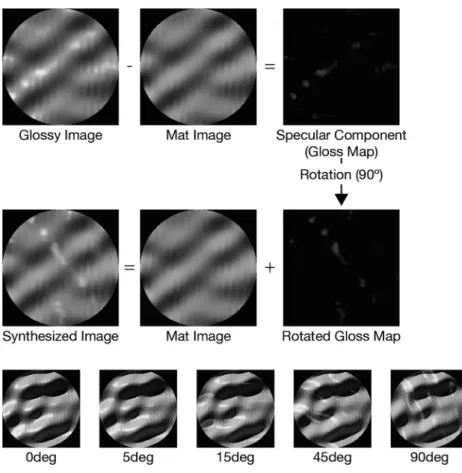
Each bumpy surface was rendered twice using LightWave (ver. 11): once as a glossy surface and once as a matte surface. The intensity of gloss was determined by the authors to be moderate to make the effect of offsetting obvious. To isolate specular highlights (the “gloss map”) from a glossy surface, the intensity map of the matte version was subtracted from that of the glossy version. After it was rotated circularly, the gloss map of each surface was added to the matte version. These procedures imitated those of Anderson and Kim (2009). The rotation angles were 0° (the original glossy surface), ±5°, ±15°, ±45°, and ±90°. Finally, for each level of surface ge-ometry, the mean, standard deviation, and skewness of lumi-nance of the original and modified versions were equated. We set four surface geometries and nine rotation angles, resulting in 36 stimuli (Figure 2). The luminance means of each geome-try level were 46.8–53.2 cd/m2, and the diameter of the stimuli
was 8° in the visual angle.
Apparatus. All Trainees and six Experts completed the experiment in the cargo space of a truck converted into a dark room for psychological experiment, while the others did so in the dark room of a building. During the experiment, the visual environments or possible influential factors, such as degree of lightness, were almost the same. The cathode ray tube monitor (TOTOKU CV722X, 60 Hz), personal computer (DELL Vostro430), keypad, chin rest, desk, and chair used in both en-vironments were the same. The monitor was viewed at a dis-tance of 57 cm.
Procedure. In the CD-task, meaningless stimuli, such as Gabor patches, might be suitable for the purpose described above; however, we chose to use the same stimuli as those of GJ-task, which were analogous to the drawn objects or surfac-es used in sketch training. One reason for this decision was that our participants were inexperienced with such meaning-less stimuli and the experimental setting. Further, in the con-text of task-relevant perceptual learning, the effects of learning are limited to the range of the learned parameters; however, we did not know the types and ranges of parameters learned through sketch training.
First, a fixation cross was presented at the center of a dark blank screen and the participants were instructed to focus on this cross until the stimuli were presented (300 ms). Two stim-uli were presented on the right and the left sides of the fixation cross for one of four designated durations: 50, 100, 500, and 1,000 ms. The distance between the centers of the stimuli was 10°. Two stimuli were made from the same surface geometry
but differed in rotation angle; one of them was always the original glossy image (0° rotation) and the other was a modi-fied version. In the CD-task, participants chose the image that contained congruent bright and dark portions, while in the GJ-task they chose the one that seemed glossier. After the stimuli disappeared, participants responded by pressing the corresponding button within 3 s, and were not given any feed-back (Figure 3). They completed two blocks, each of which contained one task comprising 256 trials and the order of the blocks was counterbalanced; four Experts, three Trainees, and 10 Novices completed the CD-task first, and the task order for the rest of the participants was inverted. (Hereafter, the task order is displayed as a superscript, such as “ExpertsCG”) An
in-terval more than 10 min separated the two blocks and instruc-tions about the following task were given just before the block started. During the interval, the participants talked to the ex-perimenter about task-irrelevant issues. The aim of this con-versation was to prevent participants from reviewing the task and to minimize the effects of the experience of the first task on the second task.
Results
The left panels of Figure 4 show the response rates for when the original image was congruent in the CD-task, and the right panels show the response rates for when the original im-age was glossier in GJ-task (hereafter, these rates are described as “original image percentages”). The upper panels show the averages for the original image percentage of all durations as functions of the rotation angle of the gloss map, and the lower two show the averages for the original image percentage of all rotation angles as functions of the stimulus duration. The original image percentage increased with rotation for all the groups; a similar, but slighter, trend was also apparent as dura-tion increased. The differences between groups were small in the CD-task and obvious in the GJ-task. Experts showed a higher original image percentage than did the other two groups at larger rotation angles and across all durations. Fur-ther, in almost all conditions, the original image percentage of the CD-task was higher than that in the GJ-task.
Examples of possible results in some conditions include Ex-perts showing higher original image percentage than others, especially at a short duration or small rotation angle because of their artistry, and the original image percentage for the CD-task being higher than that for the GJ-CD-task. To investigate these possible results, a five-way mixed-design analysis of
vari-ance was performed, with the between-subject factors were the degree of expertise (Expertise) and the order of task execution (Order), and the within-subject factors were the type of task (Type), stimulus duration (Duration), and the rotation angle of the gloss map (Rotation). The main effects of Type,
F(1, 29)=31.10, p<.001, ηp2=.517, Duration, F(3, 87)=33.90, p<.001, ηp2=.539, and Rotation, F(1.87, 54.31)=232.92, p<.001, ηp2=.889, were significant, while those of Expertise, F(2, 29)= 1.45, p>.250, ηp2=.091, and Order, F(1, 29)=0.00, p>.250, ηp2=.000, were not. The interactions of Expertise and Type, F(2, 29)=5.06, p=.013, ηp2=.259; Type and Rotation, F(2.21, 63.99)=17.86, p<.001, ηp2=.381; Duration and Rotation, F(6.26, 181.39)=6.71, p<.001, ηp2=.188; Expertise, Order, and Type, F(2, 29)=4.17, p=.026, ηp2=.223; and Expertise, Order, Type, and Rotation, F(4.42, 63.88)=5.54, p<.001, ηp2= .276, were significant, while the other interactions were not. Hereafter, we focus on the interactions relating to Duration and Expertise.
Effects of duration. As shown in Figure 5, floor and ceil-ing effects were observed at 5° and 90°, respectively. Duration-related interaction effects, other than interaction of Duration
and Rotation, were not significant, indicating that the effect of Duration did not vary according to Expertise, Type, or Order. The simple main effect of Duration was not significant at 5°,
F(3, 87)=0.52, p>.250, ηp2=.018. At 15°, F(3, 87)=25.67, p<.001, ηp2=.470, all the differences between the original im-age percentim-ages of each duration were significant, except those between 50 ms and 100 ms (p>.250, r=.420) and 500 ms and 1,000 ms (p=.116, r=.512). At 45°, F(3, 87)=21.13, p<.001,
ηp2=.421, the original image percentage of 50 ms was signifi-cantly lower than that of the other three duration levels (vs. 100 ms, p<.001, r=.710; vs. 500 ms, p<.001, r=.778; vs. 1,000 ms, p<.001, r=.756), and these did not vary statistically. At 90°, F(3, 87)=6.38, p<.001, ηp2=.180, all the differences of the original image percentage were not significant, except those between 50 ms and 500 ms (p=.016, r=.505) and 50 ms and 1000 ms (p=.043, r=.492).
On the other hand, the simple main effect of Rotation was more evident at all the duration levels: 50 ms, F(3, 87)=233.32,
p<.001, ηp2=.889; 100 ms, F(3, 87)=21.67, p<.001, ηp2=.428; 500 ms, F(3, 87)=619.82, p<.001, ηp2=.955; 1,000 ms, F(3, 87)= 778.67, p<.001, ηp2=.964. As shown in Figure 6, all the differ-Figure 5. The original image percentages for each
rota-tion angle. Expertise, Order, and Type results are pooled. Error bars show the 95% confidence intervals.
Figure 6. The original image percentages for each dura-tion. Expertise, Order, and Type results are pooled. Er-ror bars show the 95% confidence intervals.
Figure 7. The original image percentages of each participant group (left: Experts, middle: Trainees, right: Novices). In each panel, the ordinate shows the original image percentage in both tasks, and the abscissa shows the rotation angle. The filled symbols correspond to the task, and the open symbols to the GJ-task. Results of participants who completed the CD-task first are represented by the dark colored lines, and those of participants who completed the GJ-CD-task first are represented by the light colored lines. Error bars show the 95% confidence intervals.
ences between the original image percentages of each rotation angle were statistically significant except those between 5° and 15° at 50 ms (p=.092, r=.288), and 45° and 90° at 100 ms (p>.250, r=.313), at 500 ms (p>.250, r=.025), and at 1,000 ms (p>.250, r=.070).
Effects of Expertise. Although the main effect of Exper-tise was not significant, the interactions of ExperExper-tise and Type; Expertise, Type and Order; and Expertise, Type, Order, and Rotation were significant. Hereafter, the analyses of third-or-der interactions in each participant group and the difference between groups are described.
Results of Experts. The simple interaction effect of Type, Order, and Rotation was not significant, F(2.21, 63.99)=0.85,
p>.250, ηp2=.028. Further, no Type- or Order-related effects were significant: Type: F(1, 29)=1.07, p>.250, ηp2=.035; Or-der, F(1, 29)=0.39, p>.250, ηp2=.013; Type and Order, F(1, 29)=0.24, p>.250, ηp2=.008; Type and Rotation, F(2.21, 63.99)=2.16, p=.114, ηp2=.069; Order and Rotation, F(1.87, 54.31)=0.27, p>.250, ηp2=.009. Only the effect of Rotation
was significant, F(1.87, 54.31)=80.15, p<.001, ηp2=.734. Re-gardless of Type and Order, the original image percentages for 45° and 90° were not significantly different, and they were higher than those for 5° and 15°. Further, the original image percentage for 5° was significantly lower than that for 15° (Figure 7).
Results of Trainees. The simple interaction effect of Or-der, Type, and Rotation was significant, F(2.21, 63.99)=6.11,
p=.002, ηp2=.174. In the GJ-task, the original image percent-ages of TraineesCG were significantly lower than those of
Train-eesGC at 45° (p=.021, r=.828) and 90° (p=.034, r=.706).
Further, Rotation only influenced TraineesGC, such that their
original image percentage significantly increased with the ro-tation angle increasing (5° vs. 45°, p<.001, r=.947; 5° vs. 90°,
p<.001, r=.910; 15° vs. 45°, p<.001, r=.926; 15° vs. 90°, p=.001, r=.843).
In the CD-task, the rotation angles significantly influenced the original image percentages of TraineesCG and TraineesGC
and they did not vary by Order: Rotation, F(1.87, 108.62)=
Figure 8. The effects of Order. The upper panels show the results of the CD-task, and the lower panels show the results of the GJ-task. The left panels (dark lines) show the results of participants who completed the CD-task first, and the right panels (light lines) show those of participants who completed the GJ-task first. The circles represent the results of Experts, the tri-angles represent the results of Trainees, and the recttri-angles represent the results of Novices. Error bars show the 95% confi-dence intervals.
57.58, p<.001, ηp2=.498; Order, F(1, 58)=0.06, p>.250, ηp2=.001; Rotation and Order, F(1.87, 108.62)=0.80, p>.250, ηp2=.014. All the differences in the original image percentage were significant except those between 45° and 90°.
The interaction of Task and Rotation was significant for TraineesCG, F(2.21, 63.99)=13.69, p<.001, η
p2=.321, with the CD-task being significantly higher than the GJ-task at 15° (p=.024, r=.837), 45° (p<.001, r=930), and 90° (p<.001,
r=.869). However, it was not significant for TraineesGC, F(2.21,
63.99)=0.50, p>.250, ηp2=.017. Instead, the effects of Task and Rotation, respectively, were significant: Task, F(1, 29)= 5.35, p=.028, ηp2=.156; Rotation, F(1.87, 54.31)=42.47, p<.001, ηp2=.594 (Figure 7). These results suggest that com-pleting the CD-task first reduce the original image percentage of the GJ-task.
Results of Novices. The simple interaction effect of Order, Type, and Rotation was significant, F(2.21, 63.99)=5.24, p= .005, ηp2=.153. In both tasks, NovicesCG and NovicesGC were not statistically different at all the rotation angles: CD-task,
F(1.87, 108.62)=1.04, p>.250, ηp2=.018; GJ-task, F(1.87, 108.62)=3.07, p=.051, ηp2=.050. For NovicesCG, the original image percentages of both tasks did not differ at any rotation angles, F(2.37, 68.62)=0.59, p>.250, ηp2=.020; however, those of NovicesGC were significantly different except at 5°, F(2.37,
68.62)=13.88, p<.001, ηp2=.324; 5°, p=.159, r=.414; 15°, p=.016, r=.770; 45°, p<.001, r=.810; 90°, p<.001, r=.863.
In both tasks, the differences in the original image percentages for NovicesCG were significant except those between 45° and
90°. Further, NovicesGC showed the same trends, except that
they were significant between 5° and 15° in the GJ-task. Contrary to TraineesCG, NovicesCG showed higher original
image percentages on the GJ-task, especially for large rotation angles (Figure 7).
Comparison between groups. In the CD-task, no effect of Expertise was observed, F(2, 58)=1.29, p>.250, ηp2=.043. On the other hand, a significant interaction of Expertise, Order, and Rotation was observed in the GJ-task, F(3.75, 108.62)= 4.57, p=.002, ηp2=.136. The original image percentages of TraineesCG were significantly lower than were those of ExpertsCG
and NovicesCG, and the difference between ExpertsCG and
Nov-icesCG was not significant at 45° (TraineesCG vs. ExpertsCG, p=.015, r=.864; TraineesCG vs. NovicesCG, p=.042, r=.561;
ExpertsCG vs. NovicesCG, p>.250, r=.257) or at 90° (TraineesCG
vs. ExpertsCG, p=.029, r=.783; TraineesCG vs. NovicesCG, p=
.050, r=.531, ExpertsCG vs. NovicesCG, p>.250, r=.208). In
contrast, no differences were observed between ExpertsGC,
TraineesGC, and NovicesGC, F(2, 58)=1.45, p=.243, η p2=.048 (Figure 8).
Discussion
Even at 50 ms duration, the larger the rotation angle was, the higher the original image percentage became. Additionally, the interaction of Expertise and Duration was not significant,
F(6, 87)=0.27, p>.250, ηp2=.018. These results suggest that our participants, regardless of the degree of expertise, could to some extent perceive both congruence and surface gloss at a glance. In contrast, even at longer durations, small rotation angles resulted in low original image percentages. Further, the interaction of Expertise and Rotation, F(3.75, 54.31)=0.85,
p>.250, ηp2=.055, was not significant. These together results suggest that all participants needed a somewhat larger rotation angle to accurately judge congruence and glossiness.
No remarkable difference between the groups was observed in the CD-task. That is, sketch training does not improve the ability to judge the congruence between rendered highlights and shadings.
In the GJ-task, the original image percentages of NovicesGC
were lower than those of ExpertsGC and TraineesGC; however,
the differences were not statistically significant. In contrast, the original image percentages of TraineesCG were significantly
lower than those of ExpertsCG and NovicesCG. The original
im-age percentim-ages of the participantsGC should reflect purer sense
to gloss than those of the participantsCG. Considering our
hy-pothesis that the original image would be glossier than the modified version, it would seem that sketch training does not appear to make people more sensitive to the differences in sur-face gloss. In that case, what did sketch training bring to them? We considered it from the difference between Experts and the others.
The task order influenced Trainees and Novices. For Train-ees, completing the CD-task first negatively affected their original image percentages of the GJ-task and for Novices, it positively affected. On the other hand, Experts' original image percentages of the GJ-task were not affected by the task order, that is, their glossiness judgments seemed stable. This should be brought by prolonged sketch training.
We should add further investigation for the instability of Trainees and Novices. Completing the CD-task first might have shown Novices how to complete the GJ-task. The experi-mental procedure was designed to counter the possibility of
this artifact; however, some Novices mentioned that both tasks were relevant to their automatically answering that the con-gruent stimulus was glossier. If many NovicesCG adopted this
strategy in the GJ-task, whether they intended or not, the orig-inal image percentage of their GJ-task would not be regarded as an index of sense to gloss. Thus, in Experiment 2, we tested the possibility that completion of the CD-task might act as a clue to the GJ-task for novices was tested.
Experiment 2 Methods
In this experiment, we investigated whether the experience of the CD-task increased the original image percentage of the GJ-task of Novices or whether the difference between Novic-esCG and NovicesGC in the GJ-task was merely due to individual
differences. We asked 10 engineering students, five NovicesCG
and five NovicesGC in Experiment 1, to engage in both tasks
again.
The procedure, conditions, and the number of trials of Ex-periment 2 were the same as those of ExEx-periment 1, except for the task order. That is, participants who were assigned as Nov-icesCG in Experiment 1 were asked to perform the GJ-task as
the first task and the CD-task as the second task in Experi-ment 2, and vice versa. To visualize the effects of CD-task on
GJ-task, we compared the original image percentages of the GJ-task performed as the first task (GJFT) and performed as
the second task (GJST). For NovicesCG, the GJFT corresponded
to their result of Experiment 2, and the GJST corresponded to
their result of Experiment 1(Table 1). If the experience of the CD-task increased the original image percentage of the GJ-task, the original image percentage of the GJST would be higher
than the GJFT. On the other hand, if the difference between
NovicesCG and NovicesGC in the GJ-task of Experiment 1 was
merely due to individual differences, then the original image percentages of the GJFT and the GJST would be almost the
same, and the difference between NovicesCG and NovicesGC
would be evident.
Figure 9. The original image percentages of the GJFT and GJST. The upper panels show the results of NovicesCG and the lower
panels show the results of NoviceGC. The ordinates show the original image percentage and the abscissas show the rotation
angle. Error bars show the 95% confidence intervals.
Table 1.
Correspondence of participants and data.
Group Experiment 1 Experiment 2
1st task 2nd task 1st task 2nd task
NovicesCG CD GJST GJFT CD
NovicesGC GJFT CD CD GJST
Note. The names of the participants' group were derived
Results
The upper panels of Figure 9 show the original image per-centages of NovicesCG, and the lower panels show those of
NovicesGC. The differences between GJFT and GJST were
appar-ently larger in NovicesCG than in NovicesGC. On the other
hand, the difference between NovicesCG and NovicesGC was
ap-parently small.
We performed a mixed-design of analysis of variance, with the between-subject factor was the participant group (Group; NovicesCG/NovicesGC) and the within-subject factors were
Ro-tation, Duration, and Order. The main purpose of it was to in-vestigate the effects of Order, in other words, to compare the original image percentages of the GJST to those of the GJFT. The
main effect of Order, F(1,8)=7.62, p=.025, ηp2=.488, and the interaction between Order and Rotation, F(2.44, 19.53)=3.95,
p=.030, ηp2=.330, were significant and other Order-related interaction effects were not significant(interaction between Group and Order: F(1, 8)=0.87, p>.250, ηp2=.098; interac-tion between Durainterac-tion and Order: F(3, 24)=0.22, p>.250,
ηp2=.027; interaction between Group, Duration, and Order: F(3, 24)=1.62, p=.212, ηp2=.168; interaction between Group, Rotation, and Order: F(2.44, 19.53)=1.25, p>.250, ηp2=.135; interaction between Duration, Rotation, and Order: F(9, 72)=
1.50, p=.163, ηp2=.158; interaction between Group, Duration, Rotation, and Order: F(9, 72)=0.51, p>.250, ηp2=.060). The simple-main effect of Order was significant at the rotation angle of 15°, F(1, 32)=8.86, p=.006, ηp2=.525, and 45°, F(1, 32)= 8.08, p=.008, ηp2=.503. At these rotation angles, the original image percentage of the GJFT was significantly lower than that
of the GJST (Figure 10).
On the other hand, all of Group-related effect was not sig-nificant. (main effect: F(1, 8)=0.04, p>.250, ηp2=.005; inter-action between Group and Duration: F(3, 24)=1.21, p>.250,
ηp2=.131; interaction between Group and Rotation: F(3, 24)= 1.40, p>.250, ηp2=.149; interaction between Group and Or-der: F(1, 8)=0.87, p>.250, ηp2=.098; interaction between Group, Duration, and Rotation: F(8.06, 64.45)=1.48, p=.183,
ηp2=.156; interaction between Group, Duration, and Order: F(3, 24)=1.62, p=.212, ηp2=.168; interaction between Group, Rotation, and Order: F(2.44, 19.53)=1.25, p>.250, ηp2=.135; interaction between Group, Duration, Rotation, and Order:
F(9, 72)=0.51, p>.250, ηp2=.060). These results suggested that the differences of the original image percentages of Nov-icesCG and NovicesGC of the GJ-task were not sigificantl (Figure
10), and that those found in Experiment 1 could not attribute to the individual difference.
Figure 10. The effects of Order and Group. The upper panels show the effects of Order, or the difference between GJFT and GJST, and the lower panels show the effects of Group, or the difference between NovicesCG and NovicesGC. The left panel of each row shows the main effect, and the right panel of each row shows the interaction effect (top: interaction between Ro-tation and Order, bottom: interaction between Group and Order). The abscissas show the original image percentage and er-ror bars show the 95% confidence intervals.
Discussion
These results showed that the original image percentage of the GJ-task increased when it was performed second, especial-ly at middle level of the rotation angles. Although no partici-pant reported on the relevance of the two tasks in Experiment 2, these results suggested that Novices used their experience of the CD-task to answer the GJ-task.
General Discussion
In this study, we compared people who had experienced sketch training with those who had not. In Experiment 1, we found that Novices (engineering students) could detect the congruence of bright and dark regions at the same level as Ex-perts (professional designers) and Trainees (art students). This suggests that the visual ability to detect the congruence be-tween bright and dark regions in a figure is not improved by sketch training.
However, we also found a difference between groups on the GJ-task. Novices and Trainees, but not Experts, were signifi-cantly influenced by completing the CD-task first. Further, TraineesCG showed significantly lower original image
percent-ages than did ExpertsCG and NovicesCG, although TraineesGC
did not differ from these other two groups. We focused on this effect of task order and conclude that Experts’ stable glossi-ness judgment would be derived from sketch training.
Further, we hypothesized that Novices used the preceding CD-task experience as a clue to answer the GJ-task. We thus randomly divided the novice participants into NovicesCG or
NovicesGC; These groups had almost equal art experience and
they showed no significant difference on the results of the CD-task. Nevertheless, only for NovicesGC, the original image
per-centages of the GJ-task were lower than were those of the CD-task at the rotation angle of 15°, 45°, and 90°. It is natural that the sense to gloss is better reflected by the results of the GJ-task when it is performed as the first GJ-task than as the second task. In other words, for NovicesCG, we thought that the results
of the GJ-task would reflect not only their sensitivity to gloss but also other factors, such as taking a shortcut by using the first task as a clue (whether intended or not). We tested this in Experiment 2 and the results largely supported our expecta-tions.
Why was this facilitative effect not evident for the Trainees (art students)? Indeed, the data from TraineesCG showed the
opposite effect. Unfortunately, we could not clarify this, but, interviews with Trainees led us to speculate that this opposite
effect can be attributed to their developing abilities. According to them, teachers always said to them, “Look at the object as it is, ignoring your preconceptions, and draw it as you see it.” Thus, when the GJ-task was completed first, they could regard the original image as the glossier one using their ability. How-ever, if the CD-task was completed before the GJ-task, Train-ees might perceive a relationship between the figural congru-ence and glossiness, and would try to avoid noticing this congruence in the GJ-task, as it was a preconception; this, in turn, would reduce their original image percentage. The group tendency followed this interpretation, although the error bars of the GJ-task of TraineesCG were longer than were those of
TraineesGC (see Figure 7). This indicates that the within-group
deviation was larger in TraineesCG. Furthermore, their
devia-tion of the results of the CD-task was smaller. These results suggested that some participants were more affected by the ex-perience of the CD-task than were others. We speculate that this difference might relate to aspects of their personality, and would therefore be an interesting direction for research. Of course, if this interpretation is valid, it is unclear why the ef-fect did not occur for Experts̶prolonged sketch training ought to have made the relationship between the figural con-gruence and glossiness obvious, so identifying this should have been a matter of course for Experts. According to Ander-son(1982), there are two stages and one transition process in the process underlying the acquisition of cognitive skill; the declarative stage, knowledge compilation, and procedural stage. Considering this, Trainees should be at the knowledge compilation, the acquired declarative knowledge should be be-ing converted into a procedural form in their mind. On the other hand, Experts should be at the procedural stage, or au-tonomous stage called by Fitts (1964). This should be a reason why their original image percentages of the GJ-task showed the stability against the task order.
Additionally, if a different task, such as a “naturalness” judgment task, followed the CD-task, the effect of their previ-ous experience of the task might manifest in a different way. For instance, if the figural naturalness is proportional to the rotation angle, we might expect all groups to show the same trend: namely, higher original image percentages when the naturalness judgment task is performed as the second task than when it is performed as the first task. The reasons for this are that the original image percentages of the three groups would be almost the same and the fact that congruence de-fines figural naturalness. In other words, their visual ability to
detect the congruence between light and dark portions of the figure would not differ, meaning that their answers would be based on the congruence in the naturalness judgment task.
Thus, we conclude that sketch training allows visual artists to acquire an awareness of the surface gloss and highlight-shading congruence relationship and to instil it. This does not appear to be a form of perceptual learning, but rather a kind of perceptual expertise or schemata learning.
Acknowledgements
This study was supported by Grant-in-Aid for Scientific Re-search on Innovative Areas (No. 22135005). And this manu-script was reviewed by editage English reviewing service (Cac-tus Communications Inc.).
References
Anderson, B., L., & Kim, J. (2009). Image statistics do not ex-plain the perception of gloss and lightness. Journal of Vision,
9; 10, 1–17. doi: 10.1167/9.11.10
Anderson, J., R. (1982). Acquisition of cognitive skill.
Psycho-logical Review, 89, 369–406. doi: 10.1037/0033-295X.89.4.369
Beck, J., & Prazdny, S. (1981). Highlights and the perception of glossiness. Perception & Psychophysics, 30, 407–410. doi: 10.3758/BF03206160
Berzhanskaya, J., Swaminathan, G., Beck, J., & Mingolla, E. (2005). Remote effects of highlights on gloss perception.
Perception, 34, 565–575. doi: 10.1068/p5401
Chamberlain, R., McManus, I. C., Brunswick, N., Rankin, Q., Riley, H., & Kanai, R. (2014). Drawing on the right side of the brain: A voxel-based morphometry analysis of observa-tional drawing. NeuroImage, 96, 167–173. doi: 10.1016/j. neuroimage. 2014.03.062
Cohen, D. J. (2005). Look little, look often: The influence of gaze frequency on drawing accuracy. Perception &
Psycho-physics, 67, 997–1009. doi: 10.3758/BF03193626
Cohen, D. J., & Bennett, S. (1997). Why can’t most people draw what they see? Journal of Experimental Psychology: Human
Perception and Performance, 23, 609–621. doi: 10.1037/0096-
1523.23.3.609
Cohen, D. J., & Jones, H. E. (2005). How shape constancy relates to drawing accuracy? Psychology of Aesthetics, Creativity,
and the Arts, 2, 8–19. doi: 10.1037/1931-3896.2.1.8
Dosher, B. A., & Lu, Z. L. (2005). Perceptual learning in clear displays optimizes perceptual expertise: Learning the limiting process. Proceedings of the National Academy of Sciences of
the United States of America, 102, 5286–5290. doi: 10.1073/
pnas.0500492102
Fitts, P. M. (1964). Perceptual-motor skill learning. In A. W. Melton (Ed.), Categories of human learning. New York: Aca-demic Press.
Fleming, R. W., Torralba, A., & Adelson, E. H. (2004). Specu-lar reflections and the perception of shape. Journal of Vision,
4, 798–820. doi: 10.1167/4.9.10
Gombrich, E. H. (1961). Art and illusion: A study in the
psy-chology of pictorial representation. London, UK: Phaidon
Press.
Koenderink, J. J., & van Doorn, A. J. (1980). Photometric in-variants related to solid shape. Optica Acta, 27, 981–996. doi: 10.1080/713820338
Kim, K., Bae, J., Nho, N-W., & Lee, C. H. (2011). How do ex-perts and novices differ? Relation versus attribute and thinking versus feeling in language use. Psychology of
Aes-thetics, Creativity, and the Arts, 5, 379–388. doi: 10.1037/
a0024748
Kim, J., Marlow, P., & Anderson, B., L. (2011). The perception of gloss depends on highlight congruence with surface shading. Journal of Vision, 11; 4, 1–19. doi: 10.1167/11.9.4 Kozbelt, A., Seidel, A., ElBassiouny, A., Mark, Y., & Owen, D.
R. (2010). Visual selection contributes to artists’ advantages in realistic drawing. Psychology of Aesthetics, Creativity, and
the Arts, 4, 93–102. doi: 10.1037/a0017657
Lee, H., C., Breneman, E., J., & Schulte, C., P. (1985). Modeling light reflection for computer color vision. Pattern Analysis
and Machine Intelligence, 12, 402–409.
Marlow, P., Kim, J., & Anderson, B., L. (2011). The role of brightness and orientation congruence in the perception of surface gloss. Journal of Vision, 11; 16, 1–12. doi: 10.1167/11. 9.16
Matthews, W. J., & Adams, A. (2008). Another reason why adults find it hard to draw accurately. Perception, 37, 628– 630. doi: 10.1068/p5895
McManus, C., Loo, P-W., Chamberlain, R., Riley, H., & Bruns-wick, N. (2011). Does shape constancy relate to drawing ability? Two failures to replicate. Empirical Study of the Arts,
29, 191–208. doi: 10.2190/EM.29.2.d
Nishio, A., Goda, N., & Komatsu, H. (2012). Neural selectivity and representation of gloss in the monkey inferior temporal cortex. Journal of Neuroscience, 32, 10780–10793. doi: 10. 1523/JNEUROSCI.1095-12.2012
Nishio, A., Shimokawa, T., Goda, N., & Komatsu, H. (2014). Perceptual gloss parameters are encoded by population re-sponses in the monkey inferior temporal cortex. Journal of
Neuroscience, 34, 11143–11151. doi: 10.1523/JNEUROSCI.
1451-14.2014
Ostrofsky, J., Kozbelt, A., & Seidel, A. (2012). Perceptual con-stancies and visual selection as predictors of realistic draw-ing skill. Psychology of Aesthetics, Creativity, and the Arts, 6, 124–136. doi: 10.1037/a0026384
Pellacini, F., Ferwerda, J., A., & Greenberg, D., P. (2000). To-ward a psychophysically-based light reflection model for image synthesis. Proceedings of the 27th Annual Conference
on Computer Graphics and Interactive Techniques, 55–64.
Perdreau, F., & Cavanagh, P. (2011). Do artists see their retinas?
Frontiers in Human Neuroscience, 5: 1–10. doi: 10.3389/
fnhum.2011.00171
Perdreau, F., & Cavanagh, P. (2013a). Is artists’ perception more veridical? Frontiers in Neuroscience, 7: 1–11. doi: 10.3389/ fnins.2013.00006
Perdreau, F., & Cavanagh, P. (2013b). The artist’s advantage: Better integration of object information across eye move-ments. i-Perception, 4, 380–395. doi: 10.1068/i0574 Perdreau, F., & Cavanagh, P. (2014). Drawing skill is related to
the efficiency of encoding object structure. i-Perception, 5, 101–109. doi: 10.1068/i0635
Sasaki, Y., Náñez, J. E., & Watanabe, T. (2010). Advances in vi-sual perceptual learning and plasticity. Nature Reviews
Neu-roscience, 11, 53–60. doi: 10.1038/nrn2737
Schlewitt-Haynes, L. D., Earthman, M. S., & Burns, B. (2002). Seeing the world differently: An analysis of descriptions of visual experiences provided by visual artists and nonartists.
Creativity Research Journal, 14, 361–372. doi: 10.1207/
S15326934CRJ1434_7
Seeley, W. P., & Kozbelt, A. (2008). Art, artists, and perception: A model for premotor contributions to perceptual analysis and form recognition. Philosophical Psychology, 21, 149– 171. doi: 10.1080/09515080801976573
Seitz, A., & Watanabe, T. (2005). A unified model for percep-tual learning. Trends in Cognitive Sciences, 9, 329–334. doi: 10.1016/j.tics.2005.05.010
Shafer, S. A. (1985). Using color to separate reflection compo-nent. Color Research and Application, 10, 210–218. doi: 10. 1002/col.5080100409
Solso, R. L. (2001). Brain activities in a skilled versus a novice artist: An fMRI study. Leonardo, 34, 31–34. doi: 10.1162/ 002409401300052479
Tani, Y., Araki, K., Nagai, T., Koida, K., Nakauchi, S., & Kitazaki, M. (2013). Enhancement of glossiness perception by retinal-image motion: additional effect of head-yoked motion parallax.
PLoS ONE, 8: e54549, 1–8. Doi: 10.1371/journal.pone.0054549.
Taylor, L. M., & Mitchell, P. (1997). Judgments of apparent shape contaminated by knowledge of reality: Viewing circles oblique-ly. British Journal of Psychology, 88, 653–670. doi: 10.1111/ j.2044-8295.1997.tb02663.x
Thompson, P. (1980). Margaret Thatcher: A new illusion.
Per-ception, 9, 483–484. doi: 10.1068/p090483
Vogt, S., & Magnussen, S. (2007). Expertise in pictorial per-ception: eye-movement patterns and visual memory in art-ists and laymen. Perception, 36, 91–100. doi: 10.1068/p5262