A Molecular Variant of the Angiotensinogen Gene and Hypertension in
a Case-Control Study in Japanese
Takuji Kishimoto, Akihiko Suyama, Yoneatsu Osaki, Tetsuya Miyamoto, Atsusi Igarashi, Mikizoh Okamoto, Yoichi Kurosawa* and Soji Fukumoto†
Department of Hygiene, *Department of Public Health and †Department of Parasitology, Tottori University Faculty of Medicine, Yonago 683-0826 Japan
In order to examine the distribution of M235T (the substitution of threonine for methionine at position 235 codon) polymorphism genotypes of the angiotensinogen (AGT) gene and the relationship between M235T polymorphism of the AGT gene and hypertension, a descriptive study and a case-control study were performed among Japanese workers. The subjects were 2042 workers at an occupational site in Shimane Prefecture in Japan. The database was set up for the workers’ regular health exami-nation in 1998. The M235T polymorphism of the AGT gene for each worker was defined by the mutant allele specific amplification (MASA) method. The rates of M235M (MM), M235T (MT) and T235T (TT) genotypes were 3.9%, 30.7% and 65.5%, respectively. The odds ratios of MT and TT against MM for hypertension by univariate analysis were 0.77 (95% confidence interval (CI) 0.27–2.18) and 0.77 (95% CI 0.28–2.14), respec-tively. The odds ratios of MT and TT against MM for hypertension, adjusted for body mass index, fasting blood sugar, drinking habits, cigarette smoking and exercise in a logistic regression model, were 0.90 (95% CI 0.29–2.74) and 0.87 (95% CI 0.30–2.58), respectively. The data from this study suggests that there may be no relationship between the M235T polymorphism of the AGT gene and hypertension. Further prospective studies are needed to resolve this issue.
Key words: angiotensinogen; case-control study; genotype; hypertension; polymorphism
The angiotensinogen (AGT) gene variant, M235T (mutation to the threonine of the methi-onine in amino acid codon 235), was first re-ported in the pathogenesis of essential hyper-tension by Jeunemaitre et al. (1992). Essential hypertension is a multiple factorial disease that is complicated by the interaction of a genetic factor and an environmental factor (Soubrier et al., 1995). There have been many studies inves-tigating the hypothesis that this polymorphism, M235T, is one of the genetic factors of essential hypertension (Hata et al., 1994; Tiila-Riikka et
al., 1996; Borecki et al., 1997; Fu-Tien et al., 1997; Frossard et al., 1998); however, despite numerous studies the hypothesis remains con-troversial.
Most of the reports regarding the relationship between M235T and hypertension implemented a case-control study using hospital-based data that included a relatively small sample size. Thus, we carried out a descriptive study and a case-control study using population-based data with a large sample size in order to clarify the involvement of M235T in hypertension. Abbreviations: AGT, angiotensinogen; CI, confidence interval; DBP, diastolic blood pressure; MASA, mu-tant allele specific amplification; MM, genotype M235M; MT, genotype M235T; M235T, mutation to the threonine of the methionine in amino acid codon 235; OD, odds ratio; PCR, polymerase chain reaction; SBP, systolic blood pressure; TT, genotype T235T
Subjects and Methods Subjects
The research was approved by the ethics com-mittee of Tottori University Faculty of Medi-cine, and informed consent was obtained from 2042 workers in Shimane Prefecture in Japan who received their regular medical examination in 1998. The case-control study comprised a total of 402 individuals selected from the 2042 workers. The case and control individuals were matched by sex and age (difference within 2 years old). The following selection criteria for hypertensives, borderline and normotensive subjects were applied: (i) hypertensives, bor-derline and normotensive blood pressure as de-fined by systolic blood pressure (SBP) ≥ 160 mmHg and/or diastolic blood pressure (DBP) ≥ 95 mmHg, 140 mmHg ≤ SBP < 160 mmHg and/ or 90 mmHg ≤ DBP < 95 mmHg, and SBP < 140 mmHg and DBP < 90 mmHg, respectively; (ii) absence of secondary hypertension; and (iii) absence of renal disease or renal insufficiency. Various measurements and survey of smoking history
Body mass index (BMI) was calculated by the following formula: (weight kg)/(height m)2. The blood pressure was measured in the right upper arm with a standard sphygmomanometer in a sitting position. The 1st and 5th sound of
the Korotkoff sound were used as SBP and DBP, respectively. Measurement of the fasting blood sugar value was carried out using an enzymatic method (Hexokinase, G-6-PDH, Wako, Tokyo, Japan). Drinking habits, cigarette smoking and exercise were assessed using a questionnaire. Identification of polymorphism
Genome DNA was prepared from white blood cells with the use of a fully automatic nucleic acid extractor (MFX-2000, Toyobo Co., Ltd., Osaka, Japan). The mutant allele specific am-plification (MASA) method was used for the analysis of the polymorphism (Takeda et al., 1993). Four primers were designed. The nor-mal sense primer and antisense primer were AAGACTGGCTGCTCCCTGAT-3' and 5'-GCTGTCCACACTGGCTCCCG-3', respec-tively. The wild type primer and polymorphism primer including the mutation part were AAGACTGGCTGCTCCCTGAT-3' and 5'-AAGACTGGCTGCTCCCTGAC-3', respec-tively. Polymerase chain reaction (PCR) was performed in a TaKaRa PCR Thermal Cycler (Takara Co., Tokyo) with a 10 µL reaction volume containing 10 mmol/L Tris-HCl (pH 8.3), 50 mmol/L KCl, 25 µmol/L of each dNTP, 1.25 µmol/L sense primer, 1 µmol/L antisense primer, 2 µmol/L wild type primer, 2 µmol/L polymorphism primer, 0.1 U Ampli-Taq DNA polymerase (Perkin Elmer, Foster City, CA) and 1.5 mmol/L MgCl2. The initial denaturation for 3 min at 95˚C was followed by 35 cycles of denaturation for 30 s at 95˚C, anneal-ing for 30 s at 65˚C, and extension for 60 s at 72˚C. PCR products were electrophoresed in 6% polyacrylami-de gels on a Mopolyacrylami-del Cassette Electro-phoresis Unit “DPC” (Daiichi Pure Chemical Co., Ltd., Tokyo) and DNA was visualized by ethidium bromide staining.
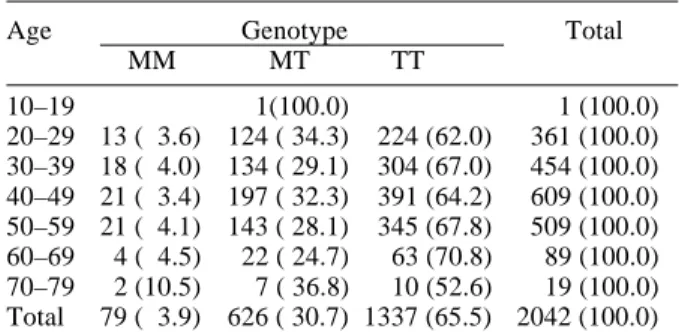
Table 1. Subjects related by angiotensinogen codon 235 genotypes by age
Age Genotype Total
MM MT TT 10–19 1(100.0) 1 (100.0) 20–29 13 ( 3.6) 124 ( 34.3) 224 (62.0) 361 (100.0) 30–39 18 ( 4.0) 134 ( 29.1) 304 (67.0) 454 (100.0) 40–49 21 ( 3.4) 197 ( 32.3) 391 (64.2) 609 (100.0) 50–59 21 ( 4.1) 143 ( 28.1) 345 (67.8) 509 (100.0) 60–69 4 ( 4.5) 22 ( 24.7) 63 (70.8) 89 (100.0) 70–79 2 (10.5) 7 ( 36.8) 10 (52.6) 19 (100.0) Total 79 ( 3.9) 626 ( 30.7) 1337 (65.5) 2042 (100.0) The percentage of individual genotypes by age is given in parentheses.
Table 3. Distribution and mean value of various indices by case and control
Control Case Total P value
Normotensive Hypertensive Genotype MM 7 ( 4) 9 ( 5) 16 ( 4) MT 66 ( 33) 65 ( 32) 131 ( 33) TT 128 ( 64) 127 ( 63) 255 ( 63) Total 201 (100) 201 (100) 402 (100) 0.877 BMI Mean ± SD 23.2 ± 2.9 24.8 ± 3.3 24.0 ± 3.2 0.000 Blood Sugar Mean ± SD (mg/dL) 102.6 ± 25.8 108.2 ± 22.6 105.4 ± 24.4 0.021 Drinking Never, sometimes 129 ( 64) 109 ( 54) 238 ( 59)
Everyday 72 ( 36) 92 ( 46) 164 ( 41)
Total 201 (100) 201 (100) 402 (100) 0.043
Smoking Never smoked or ex-smoker 141 ( 70) 129 ( 64) 270 ( 67)
Active smoker 60 ( 30) 72 ( 37) 132 ( 33)
Total 201 (100) 201 (100) 402 (100) 0.19
Exercise Many times 18 ( 9) 14 ( 7) 32 ( 8) Sometimes, never 183 ( 91) 187 ( 93) 370 ( 92)
Total 201 (100) 201 (100) 402 (100) 0.447
The percentages are given in parentheses.
BMI, body mass index; MM, M235M; MT, M235T; TT, T235T.
Statistical analysis
SPSS software (version 8.0, SPSS Japan Inc., Tokyo) was used for all statistical comparisons. The χ2 statistic was calculated to test the distri-bution trend of each index by genotype. Rela-tive risks were calculated by the logistic regres-sion analysis method.
Results
The proportions of the genotype found in this study for M235M (MM), M235T (MT) and T235T (TT) were 3.9%, 30.7% and 65.5%, re-spectively (Table 1). There was no statistically significant relationship between distribution of
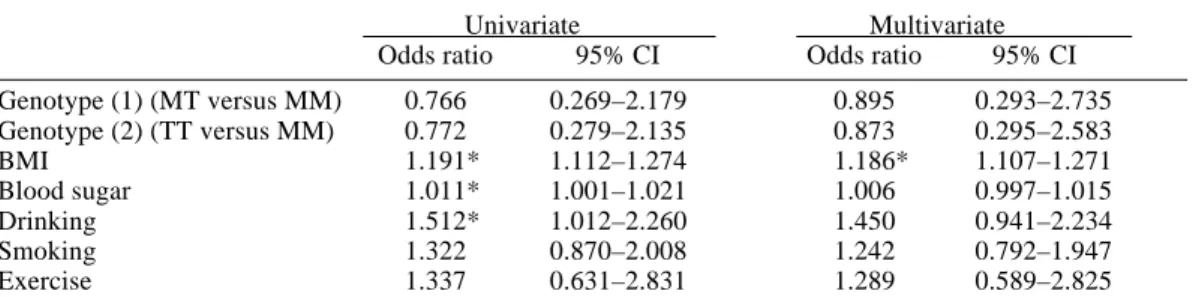
genotype and age. The allele frequency of 235T was 0.808. As shown in Table 2, there was no significant difference between the normoten-sive, borderline and hypertensive subjects in terms of the proportions of the genotypes. Table 3 shows the distribution of genotype, drinking habits, cigarette smoking and exercise, and the mean values of BMI and fasting blood sugar re-lated to case and control. The mean values of BMI and fasting blood sugar, and distribution of drinking habits in both case and control groups were statistically different from each other. In regard to the odds ratio (OD) for hy-pertension, the ODs of MT and TT against MM by univariate analysis were 0.77 [95% confi-dence interval (CI) 0.27–2.18] and 0.77 (95% CI 0.28–2.14) (Table 4). These ODs showed statistically higher trends in BMI, fasting blood Table 2. Subjects related by angiotensinogen codon 235 genotypes by blood pressure
SBP DBP Genotype Total (mmHg) (mmHg) MM MT TT Normotensive < 140 < 90 63 ( 79.7) 500 ( 79.9) 1046 ( 78.2) 1609 ( 78.8) Borderline ≥ 140, < 160 ≥ 90, < 95 7 ( 8.9) 61 ( 9.7) 164 ( 12.3) 232 ( 11.4) Hypertensive ≥ 160 ≥ 95 9 ( 11.4) 65 ( 10.4) 127 ( 9.5) 201 ( 9.8) Total 79 (100.0) 626 (100.0) 1337 (100.0) 2042 (100.0)
The percentage of individual normotensive, borderline and hypertensive is given in parentheses. DBP, diastolic blood pressure; MM, M235M; MT, M235T; TT, T235T; SBP, systolic blood pressure.
sugar and drinking habits. When the multiple risk factors of BMI, fasting blood sugar, drink-ing habits, cigarette smokdrink-ing and exercise were adjusted, the ODs of MT and TT against MM were 0.90 (95% CI 0.29–2.74) and 0.87 (95% CI 0.30–2.58), respectively, but these were not significant.
Discussion
In the population examined in this study, the frequency of the wild type MM was the lowest, while that of the mutant type TT was the high-est. There were no significant differences in the proportions of the genotypes among normo-tensive, borderline and hypertensive subjects. The odds ratios of MT and TT against MM for hypertension analyzed by correction using vari-ous factors were not significant, and there were no correlations (0.90 and 0.87, respectively).
The allele frequency in the population was higher than that of Caucasians (Jeunemaitre et al., 1992). This agreed with the results reported in several studies on investigation of the allele frequency in Japanese subjects (Iwai et al., 1994; Kamitani et al., 1994; Morise et al., 1995; Nishiuma et al., 1995; Sato et al., 1997). The allele frequency was 0.808 in the present study, and ranged from 0.604 to 0.860 in published studies. This is probably because there are re-gional differences in the genetic background of the native Japanese.
The relationship between this genetic poly-morphism and hypertension has been suggested
in studies performed in Japan and in other coun-tries (Jeunemaitre et al., 1992; Hata et al., 1994; Soubrier et al., 1995; Tiila-Riikka et al., 1996; Borecki et al., 1997; Fu-Tien et al., 1997; Frossard et al., 1998). Kato et al. (1999) were the first to cast doubt on this relationship. The different re-sults for the relationship between genotypes and hypertension may be caused by the possibility of bias in choosing controls, differences be-tween races, regional differences in genetic back-ground, differences in the age of subjects and multifactors of the examined disease, because most of the studies were hospital-based case-control studies in a small sample size (Singer et al., 1996).
To improve on the drawbacks of hospital-based case-control studies in a small sample size, we performed a population-based case-control study and obtained no correlations between genotypes and hypertension. This study was an improvement being performed in a population-based pattern, because a case-control study has many kinds of biases. It is very difficult to choose a suitable control group and it was considered necessary to evaluate the relationship by a cohort study which has few information biases compared to a case-control study.
In conclusion, there was no correlation be-tween the M235T polymorphism of the AGT gene and hypertension in a population-based case-control study corrected for various factors in Japanese subjects. We consider it necessary to investigate further by using the method of a cohort study.
Table 4. Hypertension risks estimates associated with angiotensinogen M235T gene polymorphism and risk factors based on a case-control study
Univariate Multivariate
Odds ratio 95% CI Odds ratio 95% CI
Genotype (1) (MT versus MM) 0.766 0.269–2.179 0.895 0.293–2.735 Genotype (2) (TT versus MM) 0.772 0.279–2.135 0.873 0.295–2.583 BMI 1.191* 1.112–1.274 1.186* 1.107–1.271 Blood sugar 1.011* 1.001–1.021 1.006 0.997–1.015 Drinking 1.512* 1.012–2.260 1.450 0.941–2.234 Smoking 1.322 0.870–2.008 1.242 0.792–1.947 Exercise 1.337 0.631–2.831 1.289 0.589–2.825 * P < 0.05.
Acknowledgments: This research was supported in part by a Grant-in-Aid (11470096) from the Ministry of Education, Japan.
References
1 Borecki IB, Province MA, Ludwig EH, Ellison RC, Folsom AR, Heiss G, et al. Associations of candidate loci angiotensinogen and angiotensin-converting enzyme with severe hypertension: the NHLBI family heart study. Am Epidemiol 1997; 7:13–21.
2 Frossard PM, Hill SH, Elshahat YI, Obineche EN, Bokhari AM, Lestringant GG, et al. Associ-ations of angiotensinogen gene mutAssoci-ations with hypertension and myocardial infarction in a gulf population. Clin Genet 1998;54:285–293. 3 Fu-Tien C, Kwan-Lih H, Chuen-Den T, Wei-Hon
H, Huey-Ming L, Tser-Haw C, et al. Molecular variant M235T of the angiotensinogen gene is asso-ciated with essential hypertension in Taiwanese. J Hypertension 1997;15:607–611.
4 Hata A, Namikawa C, Sasaki M, Sato K, Nakamura T, Tamura K, et al. Angiotensiogen as a risk factor for essential hypertension in Japan. J Clin Invest 1994;93:285–1287.
5 Iwai N, Ohmichi N, Nakamura Y, Mitsunami K, Kinoshita M. Molecular variants of the angio-tensinogen gene and hypertension in a Japanese population. Hypertens Res 1994;17:117–121. 6 Jeunemaitre X, Soubrier F, Kotelevsev YV,
Lifton RP, Williams CS, Charru A, et al. Molec-ular basis of human hypertension: role of angio-tensinogen. Cell 1992;71:169–180.
7 Kamitani A, Rakugi H, Higaki J, Yi Z, Mikami H, Miki T, et al. Association analysis of a poly-morphism of the angiotensinogen with essential hypertension in Japanese. J Hum Hypertens 1994;8:521–524.
8 Kato N, Sugiyama T, Morita H, Kurihara H, Yamori Y, Yazaki Y. Angiotensinogen gene and essential hypertension in the Japanese: extensive association study and meta-analysis on six report-ed studies. J Hypertension 1999;17:757–763. 9 Morise T, Takeuchi Y, Takeda R. Rapid
detec-tion and prevalence of the variants of the angio-tensinogen gene in patients with essential hyper-tension. J Intern Med 1995;237:175–180. 10 Nishiuma S, Kario K, Kayaba K, Nagio N,
Shimada K, Matsuo T, et al. Effect of the angio-tensinogen gene Met235 → Thr variant on blood
pressure and other cardiovascular risk factors in two Japanese populations. J Hypertension 1995; 13:717–722.
11 Sato N, Katsuya T, Rakugi H, Takami S, Nakata Y, Miki T, et al. Association of variants in criti-cal core promoter element of angiotensinogen gene with increased risk of essential hypertension in Japanese. Hypertension 1997;30:321–325. 12 Singer DRJ, Missouris CG, Jeffery S.
Angio-tensin converting enzyme gene polymorphism: what to do about all the confusion? Circulation 1996;94:236–239.
13 Soubrier F, Lathrop GM. The genetic basis of hypertension. Curr Opin Nephrol Hypertens 1995;4:177–181.
14 Takeda S, Ichii S, Nakamura Y. Detection of K-ras mutation in sputum by mutant-allele-specific amplification (MASA). Hum Mutation 1993;2: 112–117.
15 Tiila-Riikka K, Heikki K, Asko OR, Mauno L, Antti R, Y Antero K, et al. Variation at the angio-tensin-converting enzyme gene and angiotensi-nogen gene loci in relation to blood pressure. Hypertension 1996;28:1070–1075.
Received December 20, 2000; accepted January 10, 2001 Corresponding author: Prof. Takuji Kishimoto