STUDIES ON THE GROWTH HABIT AND ITS RELATIONS
TO THE MECHANISM OF YIELDING PROCESS
IN WINTER TYPE OF FABA BEAN
(Vicia
faba
L.)
K i y o s h i
KOGURE
CONTENTS
INTRODUCTION HISTORY OF CULTIVATION AND RESEARCH IN JAPAN AND
BACKGROUND OF THIS STUDY ... 1
CHAPTER l GENERAL GROWTH OF WINTER TYPE AND THE
PHYSlOLOGlCAL ROLE OF VARIOUS ORGANS ... 6
SECTION 1 GROWTH HABIT OF WINTER TYPE AND ITS RELATIONS
TO CHEMICAL COMPONENTS OF VARIOUS ORGANS ... 6 I. MATERIALS AND METHODS
2 RESULTS 3 DISCUSSION 4. SUMMARY
SECTION 2 PHYSIOLOGICAL ROLE OF VEGETATIVE AND REPRODUCTIVE ORGANS ... 11 1 MATERIALS AND METHODS
2 RESULTS 3. DISCUSSION 4 SUMMARY
SECTION 3 EFFECTS OF PLANTING DENSITY ON THE PLANT ARCHITECTURE,
DRY MATTER PRODUCTlON AND SEED YIELD ... 19 1 MATERIALS AND METHODS
2 RESULTS 3 . DISCUSSION 4. SUMMARY
...
CHAPTER II PHOTOSYNTHES~S AND RESPIRATION 29
SECTION 1 SIGNIFICANCE OF CARBON DIOXIDE EXCHANGE OF
LEAVES AND PODS ON lNDlVlDUAL PLANT ... 29 1 MATERIALS AND METHODS
2 RESULTS 3 DISCUSSION 4 SUMMARY
... SECTION 2 EFFECTS OF PLANTING DENSITY ON CARBON DIOXIDE EXCHANGE 39
1.
MATERIALS AND METHODS 2 RESULTS3. DISCUSSION 4 SUMMARY
CHAPTER Ill BEHAVIOR OF PHOTOSYNTHETIC PRODUCTS ASSOCIATED
WITH GROWTH AND SEED PRODUCTlON ... 45 SECTION 1 BEHAVIOR OF ' 4 ~ PHOTOSYNTHETlC PRODUCTS ... 45
1 MATERIALS AND METHODS 2. RESULTS
3 DISCUSSION 4 SUMMARY
SECTION 2 BEHAVIOR OF 1 4 c - ~ H 0 T 0 ~ ~ ~ ~ ~ ~ T E S SYNTHESIZED
IN FOUR SECTIONS OF THE SHOOT ... 52
1.
MATERIALS AND METHODS 2 RESULTS3 DISCUSSION 4 SUMMARY
SECTION 3 MUTUAL TRANSLOCATION OF ' ' ~ AMONG SHOOTS - ~... ~59 ~ ~ ~ ~ ~ ~ ~ ~ ~ ~ ~ ~
1. MATERIALS AND METHODS 2 RESULTS
3 DISCUSSION 4 SUMMARY
INTRODUCTION
HISTORY OF CULTIVATION AND RESEARCH IN JAPAN
AND BACKGROUND OF THIS STUDY
Until only four decades, faba bean (Vtcta faba L ) seed has been a very Important part of the diet of
many Japanese, appearing in various forms such a s main food item, subsidiary food ~ t e m s , protein curd, and fermented sauce and paste Today, this become a more important food fox many people throughout the developing countries
It appeared that the cultivation of most of the pulses in the Old World began a t about the same time a s those of cereal crops However, for faba beans there is controversy over the preclse center of origin and when it was first domesticated(32v152) In fact, lit man("^) wrote that out of many cultivated crops the problem of the origin of Vtcta faba was the most difficult There is some evidence of the existence of
this crop in the early Neolithic Age (ca 5,000 BC) in the Near East region but this has not yet been fully substantiated Evidence from the Bronze Age, however, showed that by 2,000 BC Vtcta faba was
already being cultivated throughout the entire Mediterranean basin, from Spaln in the west to the Levant in the east All the beans unearthed from this period have been of the small seed type (V faba L var
mtnor)
Zohary and ~ o p f ( " ~ ) and lit man("^) considered the progenitor of Vtcza faba to be V galtlea Plitm et Zoh and this may help in predicting the place of origin of this crop There is only scanty written evidence of the early cultivation of this beans in the East Asla reglon Folk tales mentioned thls crop plant in China about 100 BC and in Japan about 700 AD, but the flrst w r ~ t t e n description of this crop in China was not found until 1313 Other documents showed that the cultivation spread over the whole country in the early 15th century and that large seed types appeared by the end of the 16th century However, in India, which is en route from the Near East to the Far East, there are no written descriptions of the early cultivation of this crop despite the existence of old names for the crop in Kashmir and Punjab regions(88)
The first description of this crop seed in .Japan came from "Tashiki-Hen", a dictionary of plants published in 1631 T h e development of this crop in Japan took place in two or three stages First to appear was the small seed type (V faba var mtnor), followed by the large seed type (V faba var major), both
of which were introduced from China in the 16th century Many new varieties of long pod and medium seed type (V faba var medtum and equtna) came from England, France, and Spain in the late 1800's
This explains both the present existence of three types of this crop plant in Japan and the seed contamination problems, and the cross pollination by bees
T h e encyclopedia "Nogyou-Zensho" was published in 1697 and gave the first regular description of agriculture in Japan T h e author, Yasusada Miyazaki, traveled throughout the whole country of Japan
investigating the characteristics and peculiarities of many crops He pointed out that this crop plant was grown as a winter crop in rotation with rice a s summer crop on a moist and fertile soil, and that this crop was used a s human diet because the maturing time was shorter than that of wheat or barley
Most of the above observations could be applied to today's cultivation of this crop in Japan In fact, the cultural practices used by farmers up to the end of the World War I were essentially based on thls book Since then, however, many studies have been made on the characteristics and adaptability of this crop These studies were carried out by autoecological analysis of the relationship between plant growth and natural and artificial environmental conditions with the view of using the small and medium seed types as dry seed and the large seed types a s green seed
I
1st yeat1
2nd year1
. . .
Rlee ( e a r l y ) 3 G- .- I l l C,
faba beanjsmqll)Fig 1 Multiple cropping systems of paddy fields in Japan
0
Sowing @ Transplanting Harvesting(m
immature green, dry seed)----
Nursery 1 Tokushima, Shikoku,Field 2-4 Kagawa, Shikoku
5 Saga, Kyushu
On the other hand, this crop has been cultivated a s a winter crop in the multiple cropping system of paddy field a s shown in Fig 1 T h e development of the system as a whole has produced many local varieties a s well a s involving the nursery management and seedling transplantation techniques Experience gathered over a long period revealed that though this crop is a good crop for fertilizing the soil and for improving other soil properties during the season of its cultivation, it can only be grown once every four or five years if "sick soil" is to be avoided The most suitable crops for the intervening years are gramineous crops or rape T h e ideal summer crop to follow this crop is late-maturing rice; other rice varieties are suitable a s crops proceeding this crop
The multiple cropping system enables fuller use of both the soil fertility and the sun light energy For example, in Kagawa prefecture one field can produce good yields of this crop and hulled rice in the same year (Fig 1, System 2) Multiple cropping system incorporating this crop plant seems to constitute a profitable agricultural practice in the temperate and subtropical zones However, one problem associated with this system is that of soil moisture ~inuma(~')has pointed out that seasonal fluctuations in rainfall
resulted in agriculture being divided into humid zone and arid zone farmings T h e date of planting or cultivation is strongly dependent on the amount of rain fall within summer and/or winter seasons In view of the requirement for high soil moisture, it is difficult to envisage the route taken by this crop from its probable place of origin to the Far East Since much of Central Asia is too dry to allow its cultivation, this is also true for the related species in the section Faba of the genus which also require high moisture, unlike certain other Vtcza species in other sections such a s euvzcta, cracca and e r ~ u r n ( ' ~ ~ )
In 1888 the scientific agricultural society was established in Japan following the foundation of the Society of Botany and Zoology Since then, many pioneers have made efforts to promote scientific agriculture in Japan through agricultural education, research and compilation of agricultural statistics Accompanying the development of scientific agricultural research, many specialized academic societies were established between 1910 and 1930 in the areas of Genetics, Breeding, Crop science, Horticultural science, Soil science and Plant nutrition, Phytopathology, and Applied entomology
Although the history of Faba bean cultivation in
-
Produclion*
-
Import6
'
4
A - - x Yield per haJapan goes back to over 1200 years, cultural practices used by farmers were not clarified until 1697 by Miyazaki's book, "Nougyou-Zensho"
1 0
> the yield was about 1,400 kg/ha, it fell to about 1910 1920 1930 1940 1950 1960 1970Year 1,000 kg/ha after the end of the World War I1 -
-
Production together with the cropping area decreas- Fig 2 Statistics of faba beans in Japan
ed rapidly since 1933 and the amount imported was Farmers adopted these practices up to the end of - 1 5
3 the World War I when agricultural research had
.
i o
3
considerable effect on improving the old practic- "ms(") Figure 2 shows the statistics of faba bean 0 5!%
T) which were first officially recorded in 1905 Though
higher than the locally produced quantity since 1960, so that today's situation in Japan is similar to that in all developed countries However,this crop is one of the big six food legumes in the world, and China has by far the largest production, accounting for over half of total acreage and production(16'51 82'119,139151)
From 1911 to 1979, there have been 236 scientific reports on this crop in Japan T h e first study was carried out on the relationship between growth and soil reaction in 1912 (Table 1) The research history of each section can be summarized a s follows:
1 Research in subject areas of genetics, crop husbandry, soil and fertilization, and insect damage began during the period 1912 to 1930 This included studies on the confirmation of chromosome number, problems in practices of winter cropping, soil reaction, inoculation of root nodule bacteria, and weevils
2 In the next two decades, research developed in all subject areas except germination, virus disease, and seed quality and its processing During this period, there were many studies on the characteristics of flowering and seed maturing habit of Japanese cultivars of winter type, including pollen germination, photoperiodism, vernalization, and adaptabilities to the environmental factors, especially the wet injury and
its counterplan in agricultural practices Among the diseases, however, stem wilt began to cause severe damage of this crop, being closely related to winter cropping under wet conditions
3 T h e efforts of researchers have produced a lot of reports in the following ten years (1951-1960) which cont~ibuted to the progress being made on the importance of phosphorus fertilizer, herbicides, mixed cropping, and the relationship between the germination and color of seed coat Moreover, there were some valuable reports on the growth analysis, flowering and fruiting habit, and seeds, with reference to different producing regions or growing location^(^^^^^) These reports suggested the necessity of more research on the physiological analyses of the growth process which led to the initiation of this study
Since then, though the research on this crop plant decreased steadily together with the decrease in local-production, there have been some important studies on this crop These include studies on the karyotype analyses of Vtcta species(149), dry matter production, physiological analyses of growth process
including photosynthesis and respiration, and translocation of assimilated p r o d ~ ~ t s ('27p ~ ~ ~ ~ " ~ ~ ~ ~ ~ ~ ~ ~ ~ ~ ~ ~ ~ ~ ~ ~ ~ ~ ~ ~ ~ ~ ~ ' ~ ~ ~ ~
128p129,130*131*132.133), morphology and physiology of roots(136), and vlrus diseases
Table 1 Research history of faba bean in Japan
Despite the importance of this crop, its cultivation in Japan and perhaps in China has no good prospects It is due to the overlap between the time of the harvest of this crop and the transplanting of subsequent rice resulting in its early cultivation Moreover, it is very unfortunate that the reduction of winter cropping is spreading to warmer regions of Japan, despite the existence of favorable growing conditions There are prospects for processing the green seed(48), whole plant fractionation and utilization of structural
Number of Reports and Publications 1911- 1921- 1931- 1941- 1951- 1961- 1971- Total 1920 1930 1940 1950 1960 1970 1979 3 2 1 - 4 1 4 15 - - - - 9 - 2 11 - - 2 3 15 7 18 45 - - 2 3 17 7 - 29 - 2 5 7 22 3 1 40 1 1 4 2 7 2 1 18
-
- - - 7 8 7 22 - - 3 4 8 1 2 18 - 3 4 - 7 4 1 19 - --
- 9 3 7 19 4 8 21 19 105 36 43 236Section & Subject
Breeding & Genetics
Physiology , Ecology Germination Growing Process Flowering &
.
Maturing Crop HusbandrySoil & Fertilizer
{
VirusDisease
Danage Others Insect Damage Seed Quality &
Processing Total
c ~ m ~ o s i t i o n ( ~ ~ ~ ~ ~ , ~ ~ ) , in addition to the current uses as feed and green manure Consequently, the need for the evaluation of the local varieties(69p73r74.75) and introduction of exotic varieties, especially determinate ones, cannot be overemphasized Thus, though the cultivation and research of this crop plant has a long history, there still exist the need for more research to increase its production and consumption world wide(9,13.29,65,66,107)
In this study, the growth habit and its relations to the mechanism of dry matter production and seed yielding process in winter type of Japanese variety of faba bean was systematically analyzed Firstly, the general growth and physiological status were studied Also the physiological role of varlous organs and optimum population density for seed yielding process were discussed (CHAPTER I) Secondly, the characteristics of photosynthesis and respiration of individual plant and plant community were investigated (CHAPTER 11) Thirdly, the translocating pattern of photosynthates was studied by means of 'TOOn-feeding techniques (CHAPTER 111) and finally factors accounting for the determinate growth habit of Japanese cultivars of the winter type of faba bean plant were discussed
-6-
CHAPTER I
GENERAL GROWTH O F WINTER TYPE AND PHYSIOLOGICAL
ROLE O F VARIOUS ORGANS
CHAPTER I SECTION 1
GROWTH HABIT OF WINTER TYPE AND ITS RELATIONS TO
CHEMICAL COMPONENTS OF VARIOUS ORGANS
For many years this crop has gained much popularity in Japan a s mentioned in the introduction Faba bean features prominently in Japanese diets both as dry seed and green seed It 1s also used a s whole plant for feeds or green manures in agricultural practices On the other hand, this crop has been differentiated into many ecological types through the adaptation for long years, because this crop has an outstanding ecological adaptability to different agroclimatic conditions, and tolerating ability to both cold and soil moisture(65,75,126.127)
The physiological analysis of the growth process of this crop has been made systematically in last three decade@" In this section, therefore, investigation was made firstly in order to describe the general characteristics of growth process, and their relationships to chemical components of various organs of this crop growrr as a winter crop in warm region of ~ a ~ a n ( ~ ~ ~ ' ~ " ~ ~ ~ )
MATERIALS AND METHODS
The experiment was conducted in a non-heated glass house The seeds of the cultivar "Sanuki-nagasaya" were sown with the root nodule bacteria in pots on November 4 and grown two plants per pot T h e pots filled with paddy soil of precultivated rice a s a summer cropping T h e pots were received 5 5 kg N, 8 3 kg
PzOs, and 8 8 kg K 2 0 per 10a a s ammonium sulfate, calcium superphosphate, and potassium chloride, respectively, a s basal dressing At appropriate sampling times during the growing season, 4 to 6 plants were dug out from pots and washed After the morphological characteristics measurements, the plants were separated into leaf blade, stem plus petiole, root including root nodule, pod, and seed, and weighed These samples were dried in an oven at 90 C for 30 minutes and then at 70 C for 48 hours, weighed and ground finely with a Willey mill
Analyses were made for carbohydrate and nitrogen components T h e carbohydrates were extracted with water a t room temperature T h e reducing sugars were then determined directly, HCI hydrolyzed total soluble sugars and the insoluble portion of starch were determined by Micro-Bertrand method, and non-reducing sugar content was calculated After extracting the nitrogen components by trichloro-acetic acid, soluble (soluble-N) and insoluble (protein-N) portions were determined by Micro Kjeldahl method
RESULTS
Growing Process of Japanese Cultivar of Winter Type
T h e changes of dry weight with time in each organ are shown in Fig 3 In winter, though the growth of the shoot was not remarkable except for the increase in numbers of branched stem, the root growth was remarkably vigorous In spring, when we have longer days and increasingly high temperature, the shoot growth was accelerated Flowering and pod setting were observed on the primary shoots at the lowest two nodes of the main shoot which branched a t a very early stage of the growth in winter Flowering started at the early stage of growth in spring, when the plant height was only half of that of matured stage and the dry matter was also a little T h e first flower appeared at the 6th or 7th node in middle layer of each
primary shoot, then flowering progressed upwards as the number of nodes increased till 20 to 25
However, pod setting was generally restricted to the range of firstly-flowering node to 3 or 5 nodes and upper flowers almost aborted Therefore, the percentage of matured pods for total number of flowers was
very low compared with other grain T h e development of vegetative organs reached
maximum at green pod stage(93) which was about 30 days after the start of flowering and the following 30
to 40 days was necessary for seed maturity Consequently, as the growth of this crop plant progresses competition between the vegetative and reproductive organs goes on for fairly long period
o-• Leaf
0-^stern
T h e shoot/root ratio which was about 1 0 during the early growth stage, increased accompanying
,
A pod Flowering flowering to 1 5 and at maturing to 3 1 - 5 7 ,.----a
Seed M.st
suggesting that there is a complex but close@---a
RootI
\
relationship between shoot and undergroundI Y
I
!
C growth-
* 20-
C m-
a.
Changes in Chemical Components in Variousul
-
E Organs w ~ t h time
0, a,
3 Changes in the carbohydrate components in
P
n various organs are shown in Figs 4-1, 4-2, and
10
-.
4-3 Reducing sugar content of leaf blade was
D high during the early growth stage in mid-winter
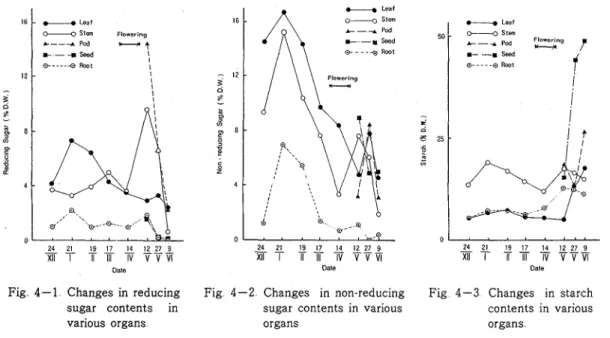
and then declined In the stem, it was generally high during the early growth to flowering stage, but became highest at the green pod stage In the root
0
24 21 19 17 14 12 27 9 including root nodules, however, it was generally low
Ti
'
VVm
and changed little throughout the growing seasonDate
Those of pods and seeds were high at the early F i g 3 Changes in dry weight of the tops and root
of faba bean plant stage of development and then both of them
other hand, the non-reducing sugar content in the vegetative organs was similarly high during the early growing stage in winter, then fell except a brief temporary rise at the green pod stage Changes in the non-reducing sugar content in both of pods and seeds were almost the same a s those in reducing sugar
The starch content in leaf blade and root was generally low and increased in the later growth stage In stem, though it was generally high, the change in contents before flowering and seed maturing stages were noteworthy Starch content in seed finally attained more than 45 per cent which was higher than those in the other sugar contents Consequently, the normal growth seemed to be supported by the physiological status; (1) the high carbohydrate content in vegetative organs during the stages of early growth in winter to early spring declined accompanying rapid progress in the development of both vegetative and rep~oductive organs, and (2) the temporary stored components in stem, root and later pod were translocated into seeds during the ~ipening stage
,'
.\
@'*..
-0..T
19 17 14 12 27 9 TiT
IV
V V W
Date-
Leaf Stem*--.
Pod c - a Seed e---* Rmt$
19 0 14 I222 T IIIm
v v VI Date c---. Leaf$
1:
19 17 14 g ? _ Z i T K V V V I DateFig 4-1 Changes in reducing Fig 4-2 Changes in non-reducing Fig 4-3 Changes in starch sugar contents in sugar contents in various contents in various
various organs organs organs
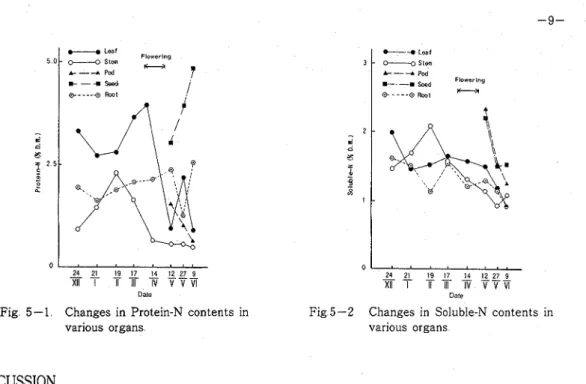
The changes in soluble-N and protein-N contents (mg/g dry w t ) in various organs are shown in Figs 5-1 and 5-2 Soluble-N contents were almost the same and changed little throughout the growlng season among each organ These were generally high in early growth stage and decl~ned gradually towards maturity On the contrary, protein-N contents fluctuated with growth and were different among organs T h e high value was found in leaf blade during the period from early growth to flowering and at the flower bud formation stage in stem The high value was also found in root including root nodules throughout the growing season As for the contents of protein-N in the reproductive organs, it declined in pod as development progressed, but rapidly increased in seed and finally attained about 5 0 % compared with the 1 5 % of soluble-N content Consequently, high nitrogen contents, especially the protein-N in the vegetative organs during the vegetative growth stage and in the underground organs throughout the growing season seemed to support the normal growth and seed production
Date
Fig 5-1 Changes in Protein-N contents in various organs
I
L - 8Leaf 3 O---g Stem A----r Pod )---
Seed Q - . - . @ h t-
4 24 2 19 17 14 12 27 9-
XI1 I T 7ii TV V W
Fig 5-2 Changes in Soluble-N contents in various organs
DISCUSSION
It is generally known that the growth process of crop plant is closely related to the surrounding meteolorog~cal factors(13,43.44.93.9991011110011331255150~ In this experiment, the results seemed to substantiate this
fact and the close relationship between the growth process and the physiological status
In winter, the shoot growth was not remarkable except the branching(lZ5), but the root growth was considerably vigorous T h e high carbohydrate and nitrogen contents a t this stage seemed to be closely related to the cold r e s i s t a n ~ e ( ~ ~ " ~ " ~ ~ ~ ) and to the development of new branched shoots, roots, and root nodules ~ a k a ( ~ ~ * ' ~ ' ) reported that the chlorophyll content in the leaf, the osmotic pressure value of various organs, and the respiration of the shoot were very high at this stage In early spring, this crop, which has vigorous vegetative and reproductive growth occurring simultaneously, had a special characteristics to require a large amount of chemical components, and was reflected in the rapid decline in previously stored carbohydrate during the former growth stage These phenomena have been confirmed in defoliation(125z131)
and treatments
After the pod setting in later spring, though the plant morphology had been established and large amounts of photosynthetic products synthesized, the total sink demands gradually exceeded the source supply Considerable amounts of the assimilated products stored previously were, therefore, remobilized from vegetative organs and pods into seeds during seed filling stage Similar fluctuations in carbohydrate contents of the vegetative organs and pods have been reported during the development of soybean seed(I4l), and potato tuber(''') Moreover, the starch was resynthesized from the remobilized sugars in seed a s in the seed of other grain legumes(23356) In addition, the results suggested that the consumption of large amounts of carbon is necessary to provide the energy and carbon skeletons for growth and developrne-
nt(104,147)
The root nodules were first found about one month after germination and developed gradually, and the bacteroid differentiated from bacteria in root nodule(24) even in cold winter In early spring, high nitrogen
content, especially protein-N in the underground organs, suggested high nitrogen fixation in root nodule continued until the time of senescence and its collapse during pod and seed ripening stage(143) However, it has been known that very large amounts of carbon are consumed in the root nodule formation and nitrogen f i x a t i ~ n ( ' ~ ~ " ~ ~ ) Therefore, small amounts of carbonaceous and nitrogenous components seemed to remain in the lower nodes, resulting in a few numbers of matured pods concentrically a t several nodes in middle layer of shoot(30~43p44,62~64~7021072108~125~131), and none at upper nodes It was also considered that this podding habit was A special characteristic of Japanese cultivars of winter type of this crop plant(698r5)
T h e results suggest that: (1) Physiological and metabolic activities are considerably vigorous throughout the growing process, (2) T h e physiological role played by the vigorous plant organs changes at podding, (3) T h e stored carbonaceous and nitrogenous components in stem and root before flowering and pod setting, promote the rapid growth and development during subsequent periods and finally contribute to pod and seed formation, (4) In addition to such physiological characteristics, the productivity seems to be limited by the shortage of assimilated products throughout the growing season, (5) These physiological processes seem to explain the determinate growth habit and the necessity for high yielding Japanese cultivar of this crop
SUMMARY
This investigation was undertaken to obtain information concerning the relationship between the growth habit and the carbohydrate and nitrogen contents of the shoot and underground organs during the entire growing period T h e results obtained are summarized as follows:
(1) In winter, shoot growth was not remarkable but root growth was more vigorous Flowering and podding in spring surpassed the latter, and this was followed by vigorous activity of shoots and roots, and nitrogen fixation by root nodules at maturation
(2) T h e carbohydrate and nitrogen contents of the shoot were high at the early stage of growth, then decreased with accompanying flowering, however, a temporary increase occurred during the pod developing stage
(3) In the roots, the variations of carbohydrate content were essentially the same a s the growth of shoots Though the changes in nitrogen content were related to the activity of bacteroid and senescence of root nodules, high nitrogen contents, especially protein-N, were found at almost all growth stages
From the results, it may be concluded that the physiological role of the leaf as an assimilatory organ was closely related to the growth of the plant, and that the stem, root, and pod played the role of temporary storage organs for the chemical components of the seeds
CHAPTER I SECTION 2
PHYSIOLOGICAL ROLE OF VEGETATIVE AND REPRODUCTIVE ORGANS
Faba bean plants, in common with many other grain legume crop plants, generally produce more flowers than mature pods(5~6~15829~31,91~10r) T h e following reasons have been proposed to account for this phenomenon; the insufficiency of available N, P, and K elements and water, the failure of pollination, and mainly the shortage of specific growth substances and carbonaceous components(69~73~74875*122) This crop plant has the following characteristics: (1) vigorous vegetative and reproductive growth occur simultaneously after flowering, (2) the function of leaf blades a s assimilatory organ is closely related to the growth of the plants, (3) the stems, roots, and pods play the role of a temporary storage organs for the chemical components in seeds
T h e objective of this investigation is to examine the characteristics mentioned above in the various organs of four sections of shoot based on the pod bearing habit T h e effects of partial defoliation at three growth stages on plant growth, the dry matter production, and the physiological status were undertaken in this experirnent(131)
MATERIALS AND METHODS
The seeds of cultivar "Sanuki-nagasaya" were sown in nursery beds on November 2 and the seedlings were transplanted in the field on December 2 planting distance was 36 cm in the row and 76 c m between rows Fertilizer application was made as follows: 27kg ammonium sulfate, 45kg calcium superphosphate, and 18kg potassium sulfate per 10a and plowed down
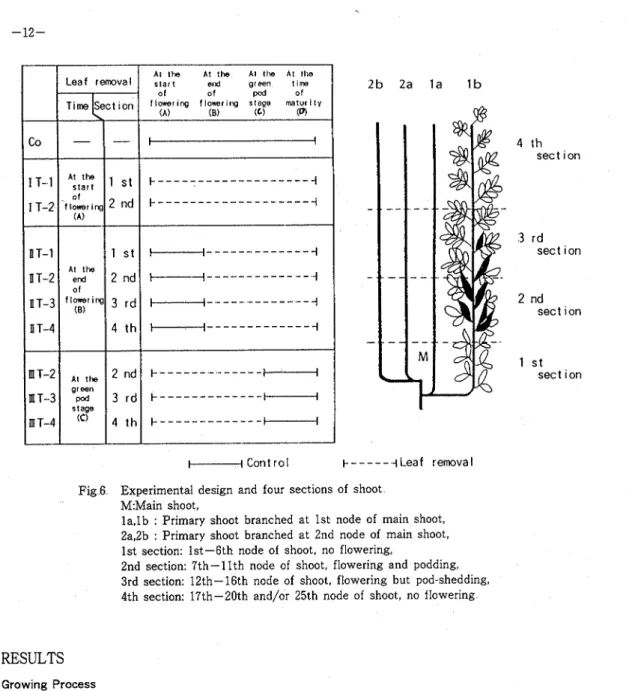
Four primary branches per plant were used for this experiment and the others including main axis were cut off With regard to the pod bearing habit of this crop plant, the primary branch generally produces 20 to 25 nodes and bears pods in a definite section So, the stems could be distinguished into the following four sections by node order:
(1) no flowering, 1st to 6th node order (1st section), (2) first flowering and pod bearing, 7th to 11th nodes order (2nd section), (3) flowering but generally pod shedding, 12th to 16th node order (3rd section), and (4) no flowering, upside node order (4th section) Treatments were operated with leaflet removal for each section a t the start(1 T), end of flowering (I1 T), and green pod stage (111 T ) As shown in Fig 6, plants were subjected to ten treatments including control
Plants were sampled four times (A: the start of flowering, B: the end of flowering, C: the green pod stage, D: the time of maturity) T h e sampling techniques and the experimental details of chemical analysis were almost the same a s described in Chapter I, Section 1 The chlorophyll was extracted with 85 % acetone and determined by the photoelectric colorimetric method for total chlorophyll T h e dry matter productivity was measured on the leaf blades of the control plants grown in a pot by the twin-leaf method
4 th s e c t ion
:3 rd s e c t ion At the At the At tlut At t11e
start ecd green time
o f of pod of f l o w r i c g f l o w r i n g stage maturity (A) (8) Cc) (0,
+---
k 4 k t-4 -i --.+ i 1-1 i Co IT-1 I T-2 UT-1 I T - 2 n-r-3 U T-4 2 nd s e c t i onm
T-4 1 s t s e c t ion L e a f r e t m v a l~i~~
sect
ion1
-4 Cont rot t - - - . + L e a f removal
- A"" start ..f,:&riw (A)
Aidh
01 I l m r i n g (0)Fig 6 Experimental design and four sections of shoot M:Main shoot,
l a , l b : Primary shoot branched at 1st node of main shoot, 2a,2b : Primary shoot branched a t 2nd node of main shoot, 1st section: 1st-6th node of shoot, no flowering,
2nd section: 7th-11th node of shoot, flowering and podding, 3rd section: 12th-16th node of shoot, flowering but pod-shedding, 4th section: 17th-20th and/or 25th node of shoot, no flowering
-
1 S f 2 nd 1 s t 2 nd 3 4 t hRESULTS
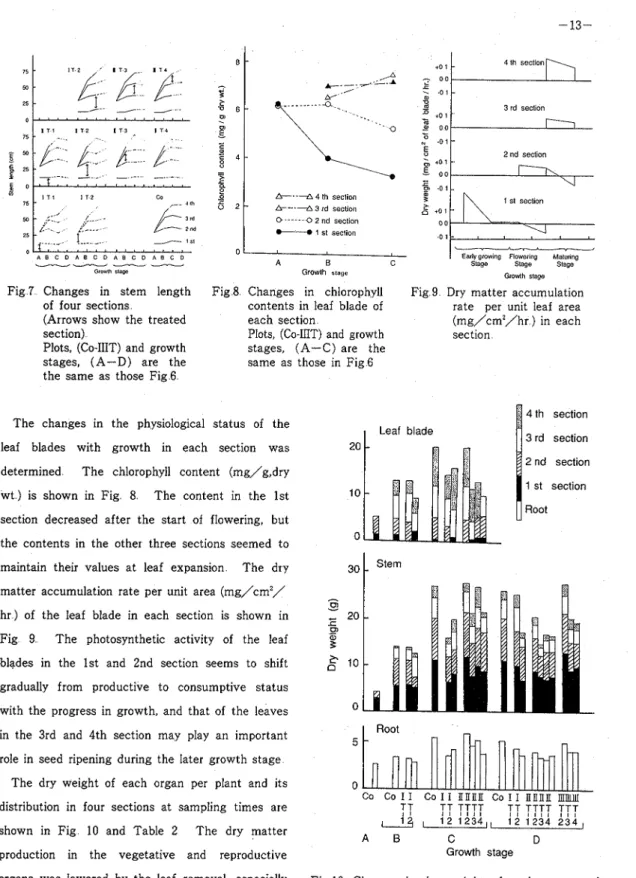
Growing ProcessT h e changes in stem length in each treatment are shown in Fig 7 T h e elongation of stems was retarded by the leaf removal at the start of flowering, but the stem length of the plants treated at the later stage was similar to that of the control plants Moreover, the treatment partially disturbed the stem elongation of the section which was vigorously lengthening at that time The node number per stem at the time of maturity, was 24 in the control plants On the other hand, plants treated at the start of flowering produced 24 nodes in the 1st section's leaf removal, but 21 nodes in the 2nd section's treatment And afterwards, one, two, and three nodes were reduced by the 2nd, 3rd, and 4th section's treatments at the end of flowering, respectively, and one node was reduced by the 3rd and 4th section's treatments at the green pod stage
, , , , , , , ,
I
, , M . ,$.. . - - i. .-
L - - - -F:"
--
2nd 25 - .. .-.!
..-.--
/ i s , 0 A B C 0 A 8 C 0 A 8 C 0 A 8 C 0Fig 7 Changes in stem length of four sections
(Arrows show the treated section)
Plots, (Co-IIIT) and growth stages, (A-D) are the the same as those Fig 6
k - - d 4 th seclion
&--4 3 rd sectton
I
0 - - - 0-
2 nd section1 st seclion
Growth stage Fig 8 Changes in chlorophyll
contents in leaf blade of each section
Plots, (Co-IIIT) and growth stages, (A-C) are the same as those in Fig 6
6
1
2 nd sectionEarlygrawlng Flowering Maturlng Stage Stage Stags
Growth stage
Fig 9 Dry matter accumulation rate per unit leaf area (mg/cm2/hr ) in each section
maintain their values at leaf expansion T h e dry 30
1
stern matter accumulation rate per unit area (mg/cm2/0)
-
h r ) of the leaf blade in each section is shown in 20
P
Fig 9. T h e photosynthetic activity of the leaf a, 3 blades in the 1st and 2nd section seems to shift
,$
10 gradually from productive to consumptive statuswith the progress in growth, and that of the leaves 0
$ 4 th section 3 rd section The changes in the physiological status of the
20 leaf blades with growth in each section was
in the 3rd and 4th section may play an important
5 role in seed ripening during the later growth stage
The dry weight of each organ per plant and its 0
c o co I I
co
I I IIIIUIIco
I In n n n
~ I U I I Idistribution in four sections at sampling times are
T?
?? ???f
TT ?TTT TTT
&
,
1 2 1 2 3 4 , , 1 2 1 2 3 4 2 3 4 ,shown in Fig 10 and Table 2 The dry matter
A B C D
2 nd section determined T h e chlorophyll content (mg/g,dry
10 I st section
w t ) is shown in Fig. 8. T h e content in the 1st
Root
section decreased after the start of flowering, but -
the contents in the other three sections seemed to 0
&
production in the vegetative and reproductive Growth stage
organs was lowered by the leaf removal, especially Fig 10 Changes in dry weight of each organ and in the upper section' treatment With regard to the distribution in each section (per plant)
plots, (Co-IIIT) and growth stage, (A-D) the leaf blades, stems, and roots, the leaf removal are the same as those in Fig 6
Table 2 Effects of leaf removal on the flower, pod, and seed Plots, (Co-IIIT) are the same a s those in Fig 6
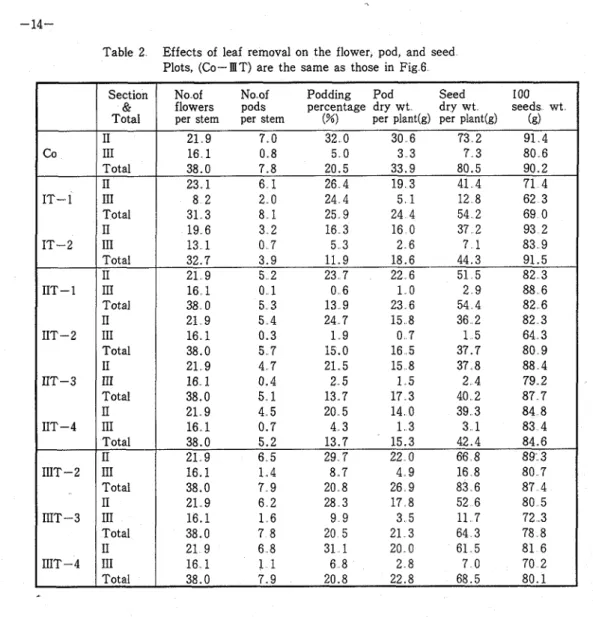
at the start of flowering retarded the dry matter accumulation at the green pod stage and the treatments at the end of flowering accelerated the dry matter degradation towards the time of maturity On the other hand, the dry weight of pods was considerably lowered by the leaf removal in each treatment Leaf removal of the start (I T ) and end of flowering (I1 T ) reduced seed weight remarkably Moreover, among the four sections, the seed weight was influenced significantly by the upper three section's leaf removal at the end of flowering and by the upper two sections' treatments a t the green pod stage Although the seed development a s shown by the 100-seed-weight was also retarded by the leaf removal, the results revealed more severe effects in later treatments T h e podding percentages were generally lowered by the treatments, especially a t the end of flowering
No of Noof Podding Pod Seed I00
flowers pods percentage dry w t dry w t seeds wt per stem per stem (%) per plant(g) per plant(g) (g)
21 9 7 0 32 0 30 6 73 2 91 4 16 1 0 8 5 0 3 3 7 3 80 6 38.0 7.8 20.5 33.9 80.5 90.2 23 1 6 1 26 4 19 3 41 4 71 4 8 2 2 0 24 4 5 1 12 8 62 3 31 3 8 1 25 9 24 4 54 2 69 0 19 6 3 2 16 3 16 0 37 2 93 2 13 1 0 7 5 3 2 6 7 1 83 9 32.7 3.9 11.9 18.6 44.3 91.5 21 9 5 2 23 7 22 6 51 5 82 3 16 1 0 1 0 6 1 0 2 9 88 6 38 0 5 3 13 9 23 6 54 4 82 6 21 9 5 4 24 7 15 8 36 2 82 3 16 1 0.3 1 9 0 7 1 5 64 3 38.0 5 7 15.0 16 5 37.7 80 9 21 9 4 7 21.5 15 8 37 8 88 4 16 1 0.4 2 5 1 5 2 4 79 2 38.0 5 1 13 7 17 3 40 2 87 7 21 9 4 5 20 5 14 0 39 3 84 8 16 1 0.7 4 3 1 3 3 1 83 4 38.0 5.2 13.7 15.3 42.4 84.6 21 9 6 5 29 7 22 0 66 8 89 3 16.1 1 4 8.7 4 9 16 8 80 7 38.0 7 9 20 8 26 9 83 6 87 4 21 9 6 2 28 3 17 8 52 6 80 5 16.1 1 6 9 9 3 5 11 7 72 3 38.0 7 8 20 5 21 3 64 3 78 8 21 9 6 8 31 1 20 0 61 5 81 6 16 1 1 1 6 8 2 8 7 0 70 2 38.0 7.9 20.8 22.8 68.5 80.1 Co IT- 1 IT-2 IIT- 1 IIT-2 IIT-3 IIT-4 IIIT-2 IIIT-3 IIIT-4 Chemical Components
T h e chemical components in various organs were examined in the materials treated at the end of flowering (I1 T ) with the exception of the 1st section's treatment The results of carbohydrate content
Section & Total I1 I11 Total I1 I11 Total I1 I11 Total I1 111 Total I1 111 Total I1 111 Total I1 I11 Total I1 I11 Total I1 111 Total I1 I11 Total
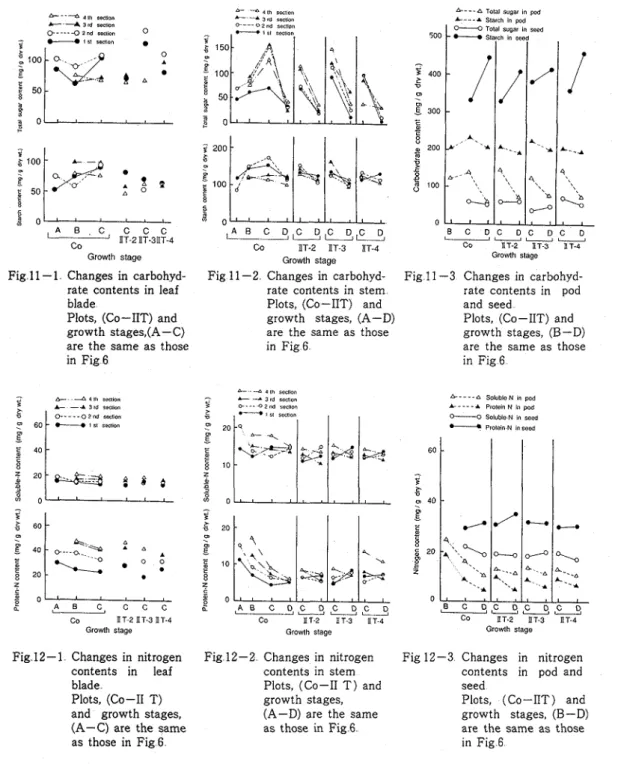
(mg/g,dry w t ) are shown in Figs 11-1, 11-2, and 11-3 In the leaf blades of the control plants, the total sugar was generally high in the lower two sections (1st and 2nd section) and the starch content increased towards the green pod stage in each section On the contrary, in the treated plants, though the total sugar contents varied, the starch contents were lower than those of the control plants in each section T h e sugar and starch contents in stems were high at the green pod stage in the control plants Similar trend was observed in all the four sections; the total sugar content was considerably high in the upper three
A - - - n Total sugar ,n pwl
&---a Starch in pod
cnn
I
?la1 Sugar in seedA B C C C C A B C q I C D I I C D,,C D,
9
B C,
C
D C Du
e Co I I T 2 IT-3UT-4 m n~ 9 nT 1 "7.4 Co UT-2 1 T 3 I T - 4 Growth stage Growth stage".,
us-'. " 5 . Q " Growlh stage Fig 11-
1 Changes in carbohyd-rate contents in leaf blade
Plots, (Co-IIT) and growth stages,(A-C) are the same a s those in Fig 6
g A c , c c c
CO U T Z U T . 3 n T - 4 Growth stage
Fig 12- 1 Changes in nitrogen contents in leaf blade
Plots, (Co-I1 T) and growth stages, (A-C) are the same a s those in Fig 6
Fig 11 -2 Changes in carbohyd- rate contents in stem Plots, (Co-IIT) and growth stages, (A-D) are the same as those in Fig 6
Growlh stage
Fig 12-2 Changes in nitrogen contents in stem Plots, (Co-I1 T ) and growth stages, (A-D) are the same a s those in Fig 6
Fig 11 -3 Changes in carbohyd- rate contents in pod and seed
Plots, (Co-IIT) and growth stages, (B-D) are the same a s those in Fig 6
& - - - - A S o l ~ b l o N rn pod
L - - - - A Proleln N in pod
0-0Soluble N m seed
Protein N ~n seed
Fig 12-3 Changes in nitrogen contents in pod and seed
Plots, (Co-IIT) and growth stages, (B-D) are the same a s those in Fig 6
sections (2nd, 3rd, and 4th section) and the starch content was high in the lower two sections (1st and 2nd section) In the treated plants, the accumulation of the total sugars at the green pod stage was inhibited, especially in the treated section Similar results were obtained on the starch content, especially in the 2nd section With regards to the carbohydrate content in pods and seeds, though the leaf removal slightly reduced it, the reduction of the starch content in seeds was distinct in the plants treated in 2nd and 3rd section
T h e nitrogen content is shown in Figs 12-1, 12-2, and 12-3 In general, the soluble-N or protein-N in leaf blades and stems gradually decreased a s the growth progressed, and the contents were high in the order, 4th, 3rd, Znd, and 1st section In the treated plants, the content in leaf blades and stems was approximately the same as the control plants except for the low soluble-N value in stems of all treatments at the green pod stage and the high protein-N value in stems of 4th section's treatment T h e nitrogen content in pods and seeds of the treated plants, the slightly low soluble-N value in pods was observed of all treatments and the high protein-N value in seeds of the 2nd and 3rd section's treatment
DISCUSSION
The present investigation was undertaken to obtain some information concerning the role or the physiological status of the leaf blades and four sections of the stem based on the pod bearing habit The results of this experiment revealed differences in the production and distribution of photoassimilates between treated (leaf removal) and non-treated (control) plants Can we realize the growth of plants treated with leaf removal to be normal? Therefore, I will discuss two flanks of leaf blades attached to or detached from the stem
T h e effects of leaf removal on the vegetative and the reproductive growth were distinct accompanying the growing process The leaf removal at the start of flowering caused a definite retardation in the development of vegetative organs as reported by Sugiyama et a1 (Iz5) Kuzunetsov et a1 ('I) indicated that the topping of fodder beans should be carried out 30 to 40 days before the harvesting time In this experiment, the treatment a t the end of flowering coincided with the experiment of Kuzunetsov et al(81), prevented the accumulation of dry matter and chemical components, and reduced the podding percentage Furthe~more, the leaf removal at the green pod stage caused the reduction of seed yield These results show that (1) the normal growth of this crop plant consists of the simultaneous development of both vegetative and the reproductive organs, (2) the reduction of the leaf area undoubtedly accounted for the flower-dropping and pod-shedding, and seed abortion, (3) the effective assimilating sections of the leaf blades and stems stepwisely rely on from the lower to upper parts
Although this assumption supported the time trends of the chlorophyll content and photosynthetic activity of leaf blades in each section, the 2nd section's leaf blades had an outstanding feature of continuous physiological longevity Many investigations have been reported about the defoliation experiments with corn(4r18p114), castor bean(61), soybean(27*28,78*148), and faba bean(81.125) These results indicated that defoliation was an unfavorable condition for the plant growth or yield Generally, in partial defoliation trials, the lower leaves which expanded earlier had a close relationship to the development of the vegetative organs Also,
the removal of upper leaf of the soybean plants severely reduced the seed y i e ~ d ( ~ ' , ~ ~ ) , but the corn plants the grain production was greatly reduced when the middle leaves were removed('89114)
Fig 13
5 0 1 , o-- a IIT-2 (Seed
D- - IIT-3
Growth stage
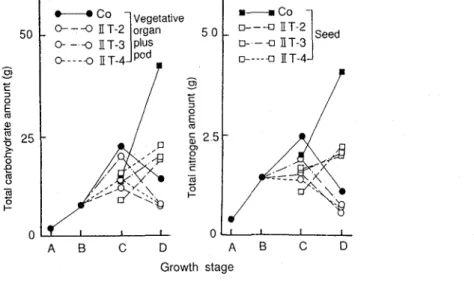
Changes in total carbohydrate and nitrogen amounts in the vegetative organs plus pod and seed (per plant)
Plots, (Co-IIT) and growth stages, (A-D) are the same as those in Fig 6
Table 3 Effects of leaf removal on the relative growth rate (RGR, g/g/wk )
Plots, (Co-IIT) are the same as those in Fig 6
With regard to the responses of the remaining leaf blades after the leaf removal, though reduction in starch was found, there were insignificant changes in the carbohydrate and nitrogen contents with a slight increase in reducing sugar The stems adjacent to the section where the leaf was removed had a remarkable reduction in carbohydrate contents, especially the non-reducing sugars Furutani et a1(2728) reported that the defoliation in soybean plants resulted in the reduction of yield and that more deleterious effects occurred during the flowering to the mid-ripening stage when the starch contents were low in the stems The results of McAlister et al(") also indicated that leaf removal reduced starch and sugar contents in the stems Therefore, the results may emphasize that the compensation ability of the remaining leaf blades is not always vigorous
At the start of flowering
C
At the end of flowering4
At the green pod stageCO IT-1 IT-2 IIT-1 IIT-2 IIT-3 IIT-4
0 437 0 448 0 457
-
- - - 0 348 0 272 0 336 0 336 0 249 0 349 0 298-18-
On the other hand, a s pointed out in Chapter I, Section 1 the stems, root, and pods played the role a s a temporary storage organs for the chemical components in seeds With this assumption, it is conceived that low seed production and chemical components were attributed to the reduction in vegetative organs by the leaf removal Furthermore, in this experiment, it was clear that the leaf damage caused the degradation of the physiological activity not only as a whole, but also the treated section of stem T h e degradations of the amounts of total carbohydrate and nitrogen in the vegetative organs, pods or seeds of the treated plants and the dspression of the relative growth rate (RGR) due to the leaf removal further support the explanations mentioned above (Fig 13, Table 3) Therefore, it seems that the function of the leaf blades is distinguished by the node orders, and that the 2nd section's leaf blades adjacent to the pod bearing node order situate a s a key source of photosynthates Accordingly, these growth characteristics are very important for the normal growth of this crop plant
SUMMARY
T h e present investigation was undertaken to obtain some information concerning the physiological status of the vegetative organs in four sections of the shoot based on the pod bearing habit T h e leaf removal was operated in four sections at the start and the end of flowering and the green pod stage T h e effects on the growth, dry matter production, and chemical components are summarlzed as follows:
(1) T h e leaf removal at the onset of flowering inhibited stem elongation and the development of the vegetative organs, and subsequently the reproductive organs The treatment at the end of flowering reduced the podding percentage and the accumulation of dry matter in the vegetative organs, especially in the 2nd section, and prevented the translocation of synthesized matter into seeds The treatment at the green pod stage caused the reduction of the seed yield
(2) T h e effects of leaf removal on the chemical components were examined for the plants t ~ e a t e d at the end of flowering T h e starch contents in remaining leaf blades and the total sugar contents in stems were lowered by the treatment, especially the non-reducing sugar contents in stems of the section adjacent to the treatment T h e starch contents in seeds were reduced by the treatments at the 2nd and 3rd sections But the nitrogen contents in all organs were approximately the same as those of the control plants
Based on the results obtained in this experiment, it may be concluded that the role or the physiolog~cal status of the vegetative organs rely on the section from lower to upper accompanying plant growth, and the leaf blades of the 2nd section are very important for the normal growing process
CHAPTER I SECTION
3
EFFECTS O F PLANTING DENSITY ON THE PLANT ARCHITECTURE,
DRY MATTER PRODUCTION, AND SEED YIELD
In general, the seed yield of food legumes can be divided into the following four components; the number of stems bearing pod, number of pods per stem, number of seeds per pod, and size or weight of one seed Many investigations have reported that the growth of this crop plant showed a high degree of plasticity and these yield components were all variable under various conditions such as soil 12@, soil light intensity or
hadi in^('.^^.'^^),
and defoliation (81,891258131) In practice, according to the increase of plant density, it will be sure these conditions interact with each other and subsequently have complicated effects on the yieldAlthough there have been many reports on plant density(34v359102,109,111p116), research on the performance of this crop in a competitive environment has received little attention T h e objectives of the studies in this section are the effects of plant density on growth and seed production, and the nature of the competition and implications on dry matter partitioning into seed In this experiment, the plant spacing was varied both between and within rows(132)
MATERIALS AND METHODS
The seeds of cultivar "Sanuki-nagasaya", were sown in the field on November 10 and the seedlings were grown as one plant per hill Though the trials were consisted of four densities designed as shown in Table 4, the three densities high, medium, and low were used to compare the detailed analyses of the growth Fertilizer application was made as basal dressing: 27 kg ammonium sulfate, 45 kg calcium superphosphate, and 18 kg potassium sulfate per 10a and were plowed down
Table 4 Experimental design of planting density
Plants were sampled five times (A: the early growing stage, B: the start of flowering, C: the end of flowering, D: the green pod stage, E: the time of maturity) A t the appropriate sampling time, the tops were clipped a t every 10 cm height above the g r ~ u n d ( ~ ~ , ' ~ ) and the roots were dug out in 25 cm depth and washed Then the tops of every layers were separated into leaf blade, stem plus petiole, pod, and seed, and dried in an oven A t the same time, the leaf area was estimated by means of the blue print method
Density
Low Medium High Very high
No of plants Biological space Row width Hill distance per sq meter per plant
cm cm cd
72 36 3 8 2592
36 36 7 6 1296
36 18 15 2 648
T h e chlorophyll was extracted with 80 % acetone and total chlorophyll content(mg/cd) was determined by the photoelectric colorimetric method With regard to the light transmission in the field, the relative light intensity was calculated from the readings taken with Toshiba Lux-meter No 5
RESULTS
Growing Process
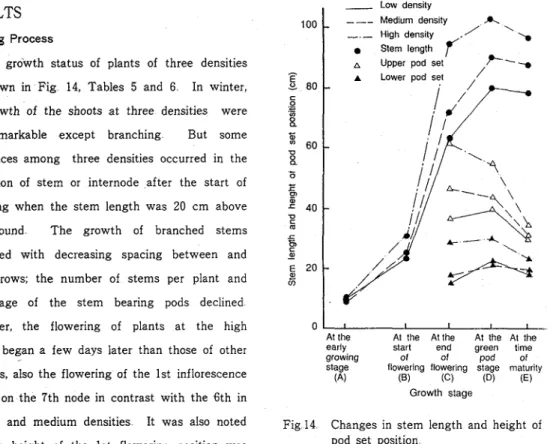
T h e growth status of plants of three densities are shown in Fig 14, Tables 5 and 6 In winter, the growth of the shoots a t three densities were not remarkable except branching But some differences among three densities occurred in the elongation of stem or internode after the start of flowering when the stem length was 20 cm above the ground T h e growth of branched stems decreased with decreasing spacing between and within rows; the number of stems per plant and percentage of the stem bearing pods declined
-
Low dens~ly--- Med~um dens~ty
-- -
.
H ~ g h dens~ly ,/ AStem length
t/
A Upper pod set
Moreover, the flowering of plants at the h ~ g h
o
I I I At the At the At the At the At the density began a few days later than those of other early start end green tlmegrowlng of of pod of stage Ilowerlng flower~ng stage maturlty densities, also the flowering of the 1st inflorescence (A) (B) (C) (D) (E) started on the 7th node in contrast with the 6th in Growth stage
the low and medium densities It was also noted ~i~ 14 changes in stem length and height of
that the height of the 1st flowering position was pod set position
raised and the range of pod setting became wide in the high density It followed the reduction in the number of nodes bearing pods in the high density because of the shedding of immature pod at the upper nodes However, the nodal position of mature pod was unaffected by the plant density
Table 5 Effects of density on the flower, pod, and seed
*per plant No of stem*l) No of stems bearing pods*2) % of the stem bearing pods 2)/1) No of flowers*3) No of pods a t muturity*4) Podding percenta e % 4 9 3 ) Pod length cm No of seeds per pod 100 seed w t g
Low Medium High
density density density
10 4 8 2 7 4 7.8 5 6 4 6 75 0 68 3 62 2 156 6 160 5 150 0 26 8 18 8 13 8 17 1 11 7 9 2 10 6 9 8 10 7 3 6 3 7 3 8 85 2 85 3 85 7
Table 6 Effects of density on the internodal length
T h e mutual shading of leaves inc~eased as the growth progressed, started early in the high population density, and a part of lower leaves were defoliated The number of flowers per plant was approximately the same in three densities, but the pod number per plant and the podding percentage were considerably lowered with increase in plant density However, there were little differences among three densities for the pod length, the seed number per pod, and 100-seed-weight
Dry Matter Production
Height above the ground (a)
80
-
100 60 - 80 40 - 60 20 - 40 0-
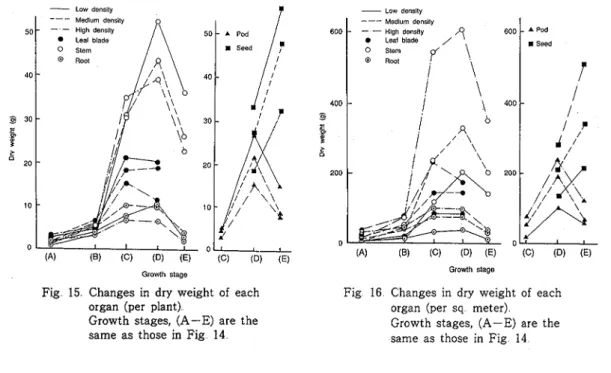
20The changes in dry weight of each organ per plant and per unit area
(d)
basis are shown in Figs 15 Low density (m> - 4 9 5 8 6 2 3.2 Medium density (cm> 4 5 6 1 6 4 7 3 3.3and 16, respectively With regard to the vegetative organs, the dry weight of leaf blade and stem attained High density (cm> 5 2 7 0 7 0 7 3 4.0
maximum value at the end of flowering and at the green pod stage, respectively, but that of root was high during the end of flowering to the green pod stage The dry weight of pod was maximum a the green pod stage and then decreased, but that of seed increased rapidly towards maturity Within the range of densities used in this experiment, after the flowering period at when much mutual shading occurred, the dry weight per plant decreased consistently a s the density increased Contrary to the above results, on the basis of per square meter, the dry matter productivity was consistently high with increasing density
Growth stage
Fig 15 Changes in dry weight of each organ (per plant)
Growth stages, (A-E) are the same a s those in Fig 14
- LOW densily --- Medium density - - High denslly Leal blade /
3
0 Stem @ Roo1'
P
\
i
\
Growth stageFig 16 Changes in d a weight of each organ (per sq meter)
Growth stages, (A-E) are the same as those in Fig 14
0 Per
0 Per plant
sq meter Whole plant
T h e dry weight of the whole plant and seed including very high density trial at the time of maturity is shown
Fig 17 Effect of density on dry matter then, the leaves in lower portions began to defoliate and production a t time of maturity
the green leaves distribution was restricted to the upper
a Per plant
]
Seed in Fig 17 Those per plant were lowered with increas-
Per sq meter
ing density, especially in the very high density But the
portions This fact was revealed earlier and clearer with increasing density T h e pods were distributed in
100
-
E 50 o,-
n@
\
b' 0wide range due to the increase of internodal length
loo0 dry weight per square meter became high In regular
order of low, medium, and high denstty, but was agatn depressed severely when the denslty was beyond the
"E
', range of this experimental "hlgh"
-
'0°
5
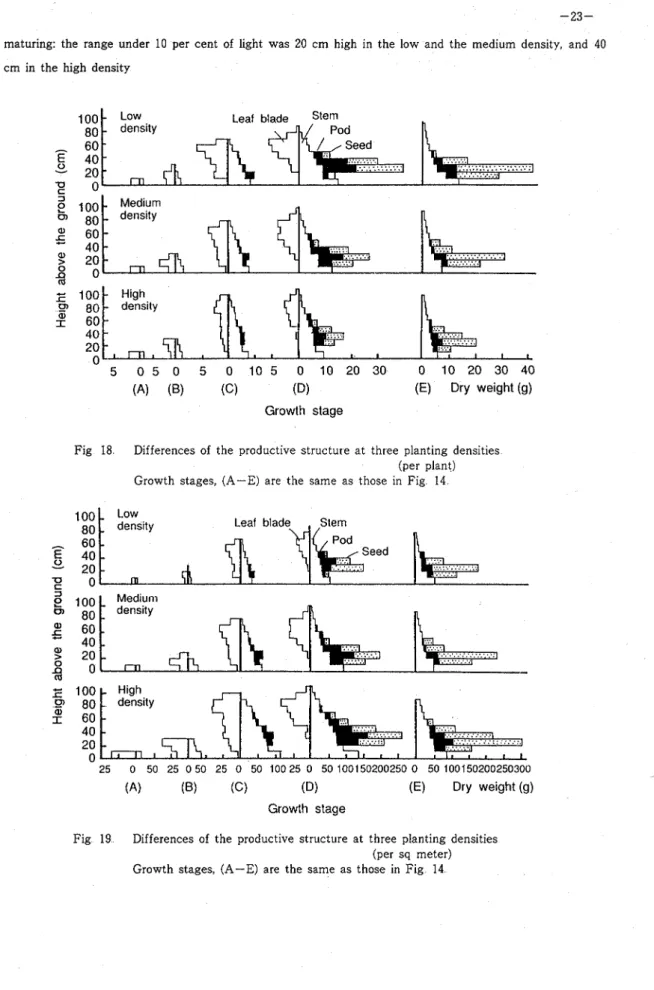
Figures 18 and 19 show the dtfferences of the2
stratifying productive structure every 10 at cm three clip plant method dens~ties In general, obtained the by vertical distributions of photosynthetic and non-photosy-Profile of Photosynthetic System
The differences in the vertical distribution of leaf area per plant and per square meter are shown in Figs 20 and 21 As for the leaf distribution pattern of individual plants, the leaf, which was distributed mainly in the middle layers at the early growth stage, was stepwisely found in the upper part a s the growth progressed At high plant density, the maximum area per 10 cm layer was about 1,000 cd at the end of flowering, then declined rapidly But this was not found in the low and the medium densities The leaf area per square meter, however, distributed higher in the order of high, medium, and low density at the
4 8 16 32 0
nthetic system are the typical of broad leaf p ~ a n t s ( ~ ~ * ~ ~ )
No of plant per sq meter (Log scale)
Low Medlum Htgh Very h~gh T h e leaves distribution were similar at almost all the
dens~ty density dens~ty dens~fy
layers in three densities till the end of flowering After
end of flowering
T h e leaf area indices (LAI) as shown in Fig 22, increased with the growth and attained a maximum at the end of flowering in each plant density After then, however, the LA1 in low and medium densities of which the maximum values were 1 7 and 5 0, respectively, maintained until the green pod stage, but that in high density decreased from 9 1 to 5 0 during from the end of flowering to the green pod stage
The profile of relative light intensities within canopies measured at three growth stages are shown in Fig 23 Although the relative light intensity at the ground level was above 20 per cent a t the start of flowering, but decreased along with the vigorous development of the vegetative organs, and became almost zero in the high and the medium plant densities at the end of flowering At this time, the leaf-layer under 10 per cent of natural daylight intensity was at the first 10 cm above the ground in the medium density,
maturing: the range under 10 per cent of light was 20 cm high in the low and the medium density, and 40 cm in the high density
L 3
-
Medium o, 80-
density 60-
5 40-
... ... .... ... ... . . . al ... . . . ... ... > 20-
... ... 0 100 80-
605
4 0 --
202
100 High I 40 , 20 t 1 . I I 1 1 5 0 5 0 5 0 1 0 5 0 10 20 30 0 10 20 30 40(A) ('3) (C) (D) (E) Dry weight (9)
-
LOw Leaf blade Stem-
density-
-
Growth stage
2
0 'Fig 18 Differences of the productive structure at three planting densities (per plant) Growth stages, (A-E) are the same as those in Fig 14
3 Medium
g
'
density E 100-
High p 80 -. density 40-
25 0 50 25 0 5 0 25 0 50 10025 0 50100150200250 0 50100150200250300(A) (B) ( c ) (Dl (E) Dry weight (9)
Growth stage
Fig 19 Differences of the productive structure at three planting densities (per sq meter) Growth stages, (A-E) are the same a s those in Fig 14
5 0 10 5 0 1 5 1 0 5 0 1 5 1 0 5 0
Leaf area (X 1 00crn2 )
(A) (B) (C) (D)
Growth stage
Fig 20 Differences of the vertical distribution of leaf area (per plant)
Growth stages, (A-D) are the same as those in Fig 14 Dotted lines show the biological space
density 50 0 %' density
f
50 1 0 0 5 0 1 5 1 0 0 5 0 Leaf area ( X I 04crnZ ) ( 8 ) (C) Growth stageFig 21 Differences of the vertical distribution of leaf area (per sq meter)
I
- Low density(B) (C) (D) (E)
Growth stage
Relative light intensity (%)
Fig 22 Changes in the leaf area index of Fig 23 Profile of the relative light intensity witihin three planting densities canopies at three growth stages
Growth stages, (A-E) are the same Growth stages, (B-D) are the same as those in
a s those in Fig 14 Fig 14
DISCUSSION
Dantuma et a1(13,'4) stated that the development and performance of the canopy are concerned with total dry matter productivity and its partition between reproductive and vegetative growth In a plant density trial, any analysis on the nature of the competition must take a serious view of the biological space of individual plant It is very important to consider how changing the planting rate or the plant arrangement correctly reveal the interrelationship between the growth and the plant number per unit area from the view point of whether the plant growth is uniform or not In faba bean, Hodgson et a1(34n35), Picard et a1(lo9), and ~iepma("" have been revealed that the characteristics associated with the seed production had a close relation with the planting rate, but not with the planting arrangement, especially in the row width Thus, in this experiment, though the row width in the low density was different from other densities, the results could be persuaded on the identical effects of the plant density
Present results were in agreement with the results of other reports on this crop plant(34335,102*10g,116) and on soybean plant(83); the high density promoted the elongation of stem or internodal length, retarded the increase of the stem or node numbers, decreased the development of the reproductive organs, and had little effect on the seed size and/or weight or the seed number per pod With regard to the elongation of stem or internodal length, Nagase et a1(98) pointed out that though soybean plants had usually a short internode in the upper and the lower layers, a long internode usually found in the middle layer transferred to the lower layer with increasing density Such a phytosociological phenomenon was also recognized on this crop plant by increasing density
With regard to the characteristics of leaves, this crop plant has usually 20 to 25 compound leaves per shoot and this compound leaf consists of two leaflets at the lower 6 or 7 nodes and 3 to 7 leaflets a t upward node order In this experiment, the leaf area per leaflet and chlorophyll content per unit leaf area at every 10 cm leaf layer are shown in Fig 24 Though single leaf area was approximately among three densities, a rather small leaf on the upper and lower layers, and a large leaf in the middle layer, especially on the flowering nodes T h e chlorophyll content, however, was similar among the each layer and three