An Agro-Environmental Study of the Vietnamese
Part of the Mekong Delta
by Hayao FUKUI*
Introduction
In the foregoing papers, Takaya proposed seven physiographic divisions for the
Viet-namese part of the Mekong Delta, and Kaida discussed the hydrographic conditions of each division (Takaya 1974 and Kaida 1974). In this paper, a regional division of the Delta is presented from the agricultural point of view. For each division, an attempt is made at explaining how the physiography and hydrography have resulted in the present agriculture. And taking into account the possibility of water control in the future, which was dealt with in Kaida's paper, the prospects of more intensified agriculture is discussed for each agricultural region.
1. Agricultural Regional Division
Since rice is the most predominant crop in the delta agriculture, different types of the rice cultivation were used as the criteria for establishing the agricultural regional division. Rice is cultivated by either broadcasting, double-transplanting or single-transplanting method. In the northwestern part of the Delta, rice is nearly exclusively cultivated by the first method. This broadcast rice area includes backswamps along the Mekong and Bassac Rivers where typical floating rice is grown. This area roughly corresponds to one of the physiographic divisions proposed by Takaya, the Flood Plain. Besides the floating rice area, the broadcasting method is also dominant in the area between the Bassac River and the Gulf of Siam. In this area, the varieties of rice cultivated are not necessarily the floating rice. A large part of this area and the Trans-Bassac Horst, as named by Takaya, overlaps each other. Since this non-floating but broadcast rice area was more recently reclaimed than the typical floating rice area, the fonner is called the Newly-Developed Broadcast Rice Area (NEWBRO) while the latter the Traditional Floating Rice Area (TRAFLO).
The double-transplanting method is common in the area surrounded by the line con-necting Can Tho, Phung Hiep, Vinh Long and Sa Dec. This area forms the main portion of the Modern Delta. In the rest of this physiographic division, the double-transplanting is presently uncommon and, instead, the double cropping of rice is becoming more
popular. According to the village elders, however, the double-transplanting used to be widely practiced in the past. The Double-Transplanted Rice Area (DUBTRA) includes such areas where the practice has been replaced by the double cropping in addition to the areas where it is continueing.
In the rest of the Delta, the single-transplanting method is dominant. This area can be sub-divided into two parts. One is the area where rice is grown under the typical rain-fed condition. Following the intense dryness during the dry season, the scarce rain water during the early rainy season is effectively used for the nursery. Transplanting proceeds from lower to higher places as water becomes available. This type of rain-fed cultivation ofrice has been practiced on the Coastal Flat, a physiographic sub-unit within the Coastal Complex, from the ancient times. The area forms the forth agricultural region, the Tradi-tional Single-Transplanted Rice Area (TRASIN).
The rest of the single-transplanting area is characterized by that rice cultivation starts with the cutting of tall perennial grasses with a big scythe. Vigorous growth of the grasses is the result of the permanently moist condition. The timing of the grass-cutting is deter-mined by such factors as salinity and/or toxicity of the soil rather than the water condi-tion itself. After cutting the grasses big seedlings are transplanted often without plowing. This type of rice cultivation is found in the Lagoonal Trough in the Coastal Complex and in a large portion of the Broad Depression, both of which were reclaimed rather recently. Therefore, these areas are together called the Newly-Developed Single-Transplanted Rice Area (NEWSIN).
2. The Traditional Floating Rice Area (TRAFLO) and Newly-Developed Broadcast Rice Area (NEWBRO)
2-1. Why broadcasting?
2-1-1. The description of the broadcasting method
Seeds are broadcast after the first rain in April or May. The rice plant grows under the non water-logged condition until the inundation starts in late August or early September. The inundation is quite deep, more than one meter in TRAFLO but not necessarily so deep in NEWBRO in normal years. The rice ripens when water begins to recede and is harvested in the early dry season. Thus, the broadcast rice spends the earlier half of its life under the upland condition and the latter half under the water-logged condition.
The broadcast rice in TRAFLO and NEWBRO is commonly called "floating rice", but the morphological and physiological characteristics of the floating rice are not neces-sarily observed for the varieties in NEWBRO where the inundation is much shallower than in TRAFLO. In spite of the difference in varietal characteristics of rice between the two areas, the cultivation techniques are basically identical as described above.
2-1-2. The environmental factors allowing the broadcasting method
Besides in TRAFLO and NEWBRO, the broadcasting method is sometimes observed in TRASIN but never in DUBTRA or in NEWSIN. The water regime of the latter two areas is characterized by the moist condition during the dry season and the prolonged
inundation in the rainy season. Such a water regime promotes vigorous growth of
peren-nial weeds, mainly ofcyperus and scirpus. The continuous inundation with stagnant water
in the early rainy season prohibits germination of the rice seeds. In addition, luxurient perennial weeds are too big an obstacle for the young seedling to overcome.
Though the land is typically flat in TRAFLO and NEWBRO there are some patches which are moist throughout the year and are left uncultivated. Perennial weeds descri-bed above thrive in these local depressions. Within the main broadcasing field, the weed patches cover only a small acreage due to the efforts of the peasants in the past. How-ever, in the marginal part of the broadcasting area adjacent to NEWSIN or DUBTRA, cyperus still invade the rice field.
It can be concluded that the intense desiccation during the dry season and the non-inundated moist condition during the early rainy season are the requisites for the broad-casting method.
2-1-3. The environmental factors prohibiting the transplanting method
In TRASIN, the rice cultivation entirely depends on rainfall. But this does not mean that the moisture condition of every patch of one farmer's land is homogeneous at any time of the year. On the contrary, the moisture condition differs greatly from one patch to another particularly during the early rainy season. The moisture condition of a patch at a time depends on:
(a) soil texture affecting permeability, (b) slight differences in relative elevation,
(c) proximity to the non-paddy land which serves as the catchment area to the adjacent cultivated field, and
(d) farmers' preferential supply of water to a certain patch or patches.
Where water can most easily be collected, the nursery is prepared. Transplanting takes place from the lower to the upper field. Rice is grown by the broadcasting method in the upper most field that is non-inundated but moist enough for the broadcast seed to
germi-nate and start growth. Ifthe farmer waits until enough water for transplanting is
ob-tained, the plant may suffer from drought or salt-injury in the later stages of growth. Thus, the shortage of water during the early rainy season is considered to be the primary factor prohibiting the transplanting method in TRASIN.
In TRAFLO and NEWBRO, flatness of the land mades it difficult to collect the rain water to a particular patch of the paddy field. If the farmers wait until the time they have enough water, that is usually in August or September, transplanting could be done but the rice seedling may not be able to withstand the rapid rise in the level of the flood water which comes soon after in some years. Should water be available in the early rainy season, the broadcasting method would likely be replaced by transplanting. This is the case in
the Central Plain of Thailand. (Fukui 1973 and 1974) Thus, the shortage of water IS
the primary factor prohibiting transplanting in TRAFLO and NEWBRO, too. 2-2. Development pattern in the past
2-2-1. The pattern of the settlement
+
o ~Villages 5krn
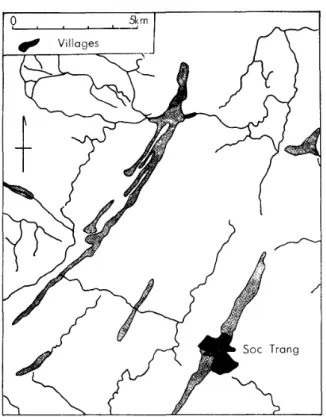
Fig. 1 An example of the village pattern in TRAFLO
levees that is safe from the annual inundation. The levees develop along the Mekong and Bassac Rivers and other major water channels which run more or less parallel to them. In the lower reaches within TRAFLO, some distributaries branch off southwestwardly approximately at a right angle to the Bassac River. The levees formed along these branch streams too bear similar settlements. Thus, the villages in TRAFLO form a continuous ribbon-shape. (Fig. I)
In TRAFLO, the portion of the levees suitable for homesteads is sometimes quite wide, up to 200 meters. In the most parts of the deltaic plain which are subject to seasonal inundation, the number of tree species is limited, but there is no such restriction in the village compound of TRAFLO. Fruit trees can be grown successfully without making raised beds. Various vegetables are also found at the same level of land as the houses. In the most cases, the floor of the house is raised by about one meter in order to avoid short floods which may occur once in a decade or so. On a whole, the villages in TRAFLO appear quite well established and comfortable.
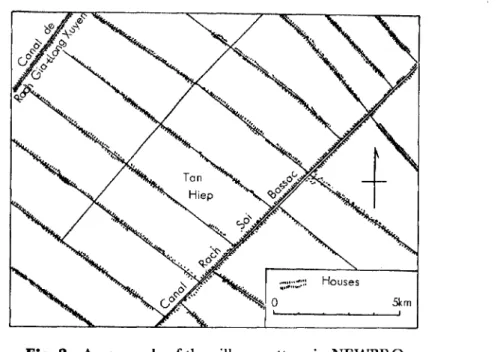
In NEWBRO, there is no levee or any other naturally elevated terrains which are not subject to the seasonal inundation. Houses are found only on the man-made banks along the canals. (Fig. 2) The species oftrees around the homestead are very limited in number. All of them are useful trees planted by the early settlers who migrated there after the canals had been excavated. Most of the canals, except a few major ones, were built during the French period. Fruit trees, vegetables and other field crops require raised beds.
The settlement patterns in TRAFLO and NEWBRO as described above may imply that (a) the elevated ground along the perennial water flow is the only suitable place for the people to live,
(b) the distance from the living place to the paddy field rather than the soil and/or other physical conditions of the paddy field is the primary factor limiting the opening of land, and
Fig. 2 An example of the village pattern inNEWBRO
(c) TRAFLO has been inhabited since quite a long time ago, while NEWBRO was extensively reclaimed only after the canal excavation.
2-2-2. The process of the land reclamation
The field opened at the earliest stage of the development in TRAFLO are supposed to be those adjacent to the houses on the levee. The paddy field seems to have gradually expanded away from the levee, and today the farthest paddy field is more than ten kilo-meters from the cultivator's house. Though the topography of the backswamp of TRAFLO can be described as typically flat,micro-relieffeatures are present. Local depres-sions remain uncultivated because of the permanently moist condition as described in the previous pages. During the early period of development, it is unlikely that the whole sur-face of the land was planted with rice.
The extent of the waste land of the local depressions was gradually narrowed by drain-age and weeding to small low elevation patches often along the natural draindrain-age channels which were utilized for drainage. At present, TRAFLO is characterized by the presence of natural drainage channels and the absence of artificial canals.
In NEWBRO, the canals for drainage were excavated geometrically disregarding the natural drainage channels. The short distributaries branching off from the Bassac River were artificially extended to the Gulf of Siam as the main canals. These main canals runn-ing parallel to each other are connected by secondary canals. Attempts to reduce the patches of perennial weeds have been made also in this area by utilizing the canals rather than the natural drainage channels. But, yet, a substantial acreage still remains unculti-vated in NEWBRO. The abandoned natural channels are dying away. Some of them are remaining as the undrainable weed patches.
2-3. The recent developments
2-3-1. The extension of the past trend
Measures to reclaim the waste patches present within the already-raclaimed paddy land are still going on in both TRAFLO and NEWBRO. In some places of TRAFLO, a new canal is being dug for draining the depressions. In NEWBRO, the effort is mainly in the form of the individual or communal work: connecting the depressions to the main canal by ditches.
Apart from the acreage expansion by reclaiming the weed patches, the paddy acreage can be substantially increased by reclaiming the frontier area of NEWBRO. However this land which, when reclaimed, would become a part of NEWBRO has a serious
draw-back ofstrong soil acidity.Itis not certain whether all such lands could or could not be
re-claimed with the present technology. However, it is certain that the ever-increasing popu-lation pressure would push more and more people to the frontier, though this trend is seriously hindered by the war situation. Nevertheless, it should be remembered that NEWBRO is still the area where the great potential for production increase would be expected by the acreage expansion. This implies that the intensification of rice cultiva-tion on the existing farm land is not necessarily acceptable to the peasants in NEWBRO. 2-3-2. The new trends
There are two noticiable new trends of change in agriculture ofTRAFLO. One is the introduction of so-called high-yielding varieties of rice since 1967. In Vietnam, they are called"Th~n-Nong"rice or TN rice
(t$JJHffi).
The other is the crop diversification. Both of them are enthusiastically encouraged by the extension workers.The most usual way of adoption of TN rice in TRAFLO is as follows. The first TN crop is grown during the earlier half of the rainy season. Pump irrigation is indispensable to supplement the rain water because of the intense desiccation of soil during the dry season and the lower rainfall in TRAFLO compared to other parts of the Delta. Even for the new cultivation pattern, broadcasting is preferred to transplanting. This is because the former requires less irrigation water, saving on fuel. The crop matures before the start of unavoid-able inundation in September. But, in some years, in 1974 for instance, the inundation commenced at the end of August. Some TN rice was damaged by the deep water. Even when the crop is not fully submerged, harvesting poses many problems every year. Reap-ing under the knee-high water is certainly a toil. The harvested paddy must be carried by boat to the highest portion of the levee which is the only place free from inundation. There is not enough space on the levee for drying and threshing, since these operations used to be done on paddy fields which are dry at the time of harvest of the traditional
floating rice.Itis often seen that the harvested TN rice occupies a part of the road surface
in late August.
During the highest flood period in September and October, the land is left idle under deep inundation. When the water begins to recede, the second TN crop is grown again by
broadcasting in most cases. Ifnecessary, the pump is used to drain the excessive water.
Later, the pump is used again for irrigation since there is virtually no rain during the dry season.
The pumps are owned by the individual peasant. In many cases, the pumps are of 4-5 Hp size and can irrigate only a few hectares. But bigger pumps are also used. They are installed by a well-to-do member of the village who sells the water to the neighbours. The pumps are placed along the permanent water channels. The pumped-up water is lead to the paddy field by small ditches dug through the crowded village. When the levee is not too high, ditches are sometimes dug in order to extend the permanent water channel into the farther-located paddy field. Water is pumped up at the dead end of such ditches.
Even in 1974, the acreage of TN rice is still very limited and they are found only along the water courses from which water can be pumped up throughout the year. As stated previously, the settlement pattern of TRAFLO is of ribbon-shape along the levees. TN rice is planted in the field immediately behind the village compound. In many cases, the fields planted to TN rice are on the natural levee and in the transient zone to the back-swamp. The way of adoption of TN rice in TRAFLO is the replacement of one crop of floating rice for two crops of TN rice. All the peasants who adopted TN rice grow it twice a year or even thrice in a few cases. Though the average yield of a single crop of TN rice is higher than that of the floating variety, TN rice might not have been adopted so rapidly if the way of adoption was one of replacing the traditional variety with a single crop of TN rice. The superior characteristics of the TN rice which are recognized by those who have accepted it are the suitability to the double cropping, that is, non-sensitivity to pho-toperiodism and the short growth duration without sacrificing the yield. The indigenous non-photo sensitive varieties have a drawback in this last point.
The physical obstacles to a further spread of this type of double cropping in TRAFLO are,
(a) the distance from the streams with the perennial flow,
(b) the earlier inundation on the lower-situated backswamp, and (c) the lack of places suitable for threshing and drying.
The first obstable can be overcome to some extent by using more powerful pumps. But the ultimate solution is the excavation of canals which is obviously beyond the capacity of the communal effort.
The second obstacle could be surmounted by earlier planting and earlier harvesting. To do that, sowing should be done prior to the first rain. Significant increase of fuel con-sumption is unavoidable.
The third one could be easily solved. The space for the threshing ground could be created in the village compound sacrificing fruit trees and vegetables. The method of drying by hanging the stalked paddy on a pole, as in Japan, may be introduced.
Thus, the physical obstacles to a further spread of TN rice could, to a substantial extent, be overcome by individual or communal efforts. The realization of further spread in the immediate future depends on the economic situation, that is, the balance between the price of product and the cost of production consisting mainly of those of pumps and fuel oil. However, for the total dissemination of TN rice, construction of a canal network is indispensable.
diversifi-cation, which means planting of field crops such as maize, sorghum and groundnuts in the paddy field during the early half of the rainy season. Rice seed is broadcast either be-fore or after the harvest of these crops. In the former case, rice is sown between the rows without tillage.
This type of crop diversification is being practiced on the soil of coarser texture. This means that it is practiced only on the levees and the sand bars. In the backswamp, very heavy texture and poor structure of soil deter the successful growth of the upland crops.
On the lighter-textured soil, the crops aresu~jectto drought due to the low water-holding
capacity. The places where the secondary crops are being grown are, in most cases, sui-table for double cropping of TN rice with pump irrigation. Exceptions are areas of very coarse-textured soils on the sand bars. In these areas, excessive permeability discourages pump irrigation.
Thus, it can be concluded that the crop diversification of this type in TRAFLO will not expand significantly because (a) it is possible only on the lighter-textured soils, and (b) it is in competition with the double cropping of TN rice.
The very heavy texture of soil is not an absolute deterrant for the field crops. On the raised beds surrounded by the polder, various kinds of vegetables and upland crops can successfully be cultivated even where the soil is extremely heavy. The examples are found elsewhere in the Mekong Delta and in the Chao Phraya Delta in Thailand as well. (Fukui 1973 and 1974) This type of garden culture requires an extremely large input of labor for breaking soil clods by hand. However, such large input are justified since the raised bed is used permanently once it is built, and various kinds of high-value crops are cultivated one after another with year-round irrigation.
In the case of growing field crops in the paddy field in TRAFLO, the land has to be prepared each year just for one season and the lack of irrigation limits the crops only to drought-resistant ones which are usually of low price. Thus, in practical terms, significant expansion of crop diversification on the heavy-textured paddy soils can not be expected in the near future.
Contrary to TRAFLO, there are no noticeable changes in agriculture in NEWBRO. Crop diversification as seen in some parts of TRAFLO is totally lacking in NEWBRO because of the heavy clay texture of its soils. Double cropping of TN rice with pump irri-gation is still exceptional and is observed only under special circumstances such as experi-mental installation of a pump by a public agency and settlements of the North Vietnamese refugees in smaller land units.
The double cropping of TN rice is potentially possible in the fields adjacent to the canals in NEWBRO. A few examples of it mentioned above indicate that the socio-eco-nomic rather than the environmental conditions are limiting the spread of this practice. As stated in the previous section, the uncultivated waste patches still occupy a substantial acreage in NEWBRO. The reclamation of them seems to be the most important operation requiring priority in labor and capital allocations.
Itcan be concluded that the expansional development is still going on in NEWBRO
until the former becomes so difficult that the latter brings greater returns than does the former. When that time which is not too far in future comes, construction of a more refined networks of canals will be required for the double cropping of TN rice to spread more extensively, as the average distance between the existing canals often too far to be covered by pump irrigation.
3. Double-Transplanting Rice Area (DUBTRA)
3-1. Why double-transplanting?
3-1-1. Description of the double-transplanting method
The first nursery is prepared at the beginning of the rainy season. !his is a dry nursery. The seed is sown into a hole made on the dry field. After sowing, the hole is covered with either soil where the soil is coarse or ash where it is clayey. The first nursery is usually made along the water channel so that it can be irrigated with a basket or a pump. The nursery is kept non-water-Iogged until the seedlings are removed for the second nursery in6-8 weeks. No tillering takes place in the first nursery.
The second nursery is established in the lowest-lying field which is inundated earlisest. The seedlings from the first nursery are transplanted in the wet field in August. The plants produce numerous tillers while they are in the second nersery under the water-logged condition. Big hills ca. one meter high with numerous tillers are uprooted for the second time in about two months. The tillers are separated away. A few tillers per hill are re-transplanted in the final field. Prior to the re-transplanting, the field is cleaned of the perennial weeds with a big scythe, but plowing and harrowing are often omitted.
3-1-2. Soil fertility, water depth and weeds as the reasons for the double-transplanting The soil rich in organic matter and nitrogen is often considered to be a reason for this peculiar way of rice cultivation. (Thai-Cong-Tung 1971, and Joint Development Group 1969) The double-transplanting is also found in the Chieng Mai and Chieng Rai basins of Thailand, and it is reported that the practice is closely related to the high inherent soil fertility. XUAN in Vietnam and WATABE in Thailand agree that the double-transplanting has an effect of supressing the excessive vegetative growth caused by the high soil fertility. (Xuan 1974, and Watabe 1967)
During the field trip in 1974, the writer asked the farmers in DUBTRA what would happen if they grow rice by the usual single-transplanting method. Many replied that too many tillers by the single-transplanting would adversely affect the yield. This reply could be interpreted as that if a plant transplanted in June remains in the same field with-out re-transplanting, the excessive growth lowers the yield. If the wet-type nursery is prepared in July or August, the seedlings that are to be obtained in September would be similar both in size and quality to those by the double-transplanting method. If trans-planting of a big seedling in September is a sole requisite for suppressing the excessive vegetative growth, a delayed single-transplanting of one-and-a half months old seedling would do as well as the double-transplanting of three-and-a half months old seedling. The absence of the former practice may be due to conditions that prevent wet nursery
preparation in July or August. A high soil fertility alone does not explain the neccessity of the double-transplanting.
The practice of double- transplan ting is sometimes explained in relation to water depth; broadcasting in the deepest, double-transplanting in the medium, and single-transplating in the shallow flood areas. Ifone takes the water depth at the peak flood period and examines its relation to the geographical distribution of the three different methods of rice cultivation, he may find a certain correlation between them. However, the correlation does not necessarily mean that the maximum water depth directly determines the differ-ent cultivation methods. As stated in section 2-1, for example, broadcasting is not directly related to deep inundation. Generally speaking, inundation, deep or shallow, occurs in September to October after the rice plant has established itself well. The critical period for the crop's success or failure is the first half of the rainy season during which the crop mainly depends on the rainfall. Therefore, should the water condition at all be related to double-transplanting, it should be the water condition before September that is really meaningful. It is difficult to consider that the maximum water depth in October is directly related to the double-transplanting.
Some people regard the vigorous growth of weed as a reason for the double-transplant-ing. According to them, the competition between weeds and the rice plant is so severe in DUBTRA that an old and big seedling is required. The weeds of DUBTRA consist mainly of the perennial species ofscirpusandcyperus. They thrive vigorously during the early half of the rainy season and form a dense vegetation, over one meter high. Just prior to the second transplanting in September, they are cut near the ground level with a big scythe. Once cut, they take some time to re-establish as they are not necessarily of the quick starting type. Fast growing annuals such as rice can grow without much difficulty though, in the long run, the perennials will certainly outdo the annuals. But, the annuals can reach maturity before that occurs. Thus, the competition against the weeds in DUBTRA is not so severe as it may seem from the very dense vegetation of weeds as long as the rice plant does not remain in the same field for a long time. In the broadcast rice area border-ing DUBTRA and NEWSIN, the degree of soil desiccation durborder-ing the dry season is intermediate allowing the survival of some perennial weeds. In such areas, the broad-cast rice which remains in the same field for more than 8 months suffers from the weed problem. In conculusion, the weed problem in DUBTRA can be solved by shortening the growth period of rice in the weed infested field and this is being realized by means of late transplanting. As explained previously, late transplanting does not always need the double-transplanting method.
Of the three factors discussed above, anyone of them could hardly be considered to be decisive for adoption of the double-transplanting system. The problems caused by high soil fertility and/or the vigorous growth of perennial weeds could be solved by late transplanting of big seedlings. But to clarify the relationship between the late transplant-ing and the double-transplanttransplant-ing, some other explanation must be sought.
3-1-3. Topography and the water condition as the reasons for double-transplanting DUBTRA's topography is quite distinct from that of the other areas. It is characterized
by the mosaic pattern of the levees and backswamps. Micro-relief is a common feature within farm units. This kind of topography is seldom observed outside DUBTRA. This suggests that the topography would be one of the important reasons for the practice of double-transplanting method.
In DUBTRA, the lowest-lying part of one farmer's land becomes water-logged and ready for transplanting at the time of the full moon in mid-August. Thereafter, the acre-age ofland ready for transplanting gradually increases and around the end of September the last patch is inundated. Accordingly, transplanting proceeds from the lower to the higher places within a time span of more than one month.
In the case of the single-transplanting method, the plant does not produce tillers while
it is in the nursery. Ifit is left in the nursery for a long period, the seedling becomes tall
and weak. Supposing that a farmer prepares his nursery on the first day of August, the seedlings will be about one month old in early September and two months old in late September. The former might be too young to withstand the deep water and the latter too old to produce a good yield. Therefore, he must made a few nurseries at different times so that the seedlings of different ages are available at any time in September.
In the case of the double-transplanting method, the plant produces numerous tillers while it grows in the second nursery. The longer it is left there, the more tillers it produces, but if sufficient space is available around the plant seedling will not become tall and weak. After a certain period in the second nursery, the seedlings are ready to be re-transplanted at any time. This is a great advantage of the double-transplanting method.
In NEWSIN, the growth of the perennial weeds is as vigorous as in DUBTRA. The soils may also be quite fertile at least in the non-toxic portion. Yet only the single-trans-planting method is found there. This is due to flatness of the land, which allows the simultaneous inundation. Seedlings as big as those from the second nursery in the double-transplanting practice are obtained from the common wet-type nursery and the trans-planting of them finishes within a short time span.
The reasons for the double-transplanting method can be summarized as follows. First, because of very high soil fertility, and the moisture regime allowing the survival of the perennial weeds, early planting leading to longer growth duration in the same patch of the field has to be avoided. Late transplanting and hence shorter growth duration is possible by both double-transplanting and single-transplanting. However, due to uneven topog-raphy, transplanting has to proceed from the lower to the higher places over a long time span. The double-transplanting method which can provide with healthy seedlings for transplanting over a long time span is more suitable than the single-transplanting for such circumstances.
3-2. An easy adoption of TN rice 3-2-1. Changes before TN rice
Compared to the different areas of the delta, DUBTRA is the area where intensifica-tion of agriculture had been progressing most significantly even before the introducintensifica-tion of TN rice in late 1960's. The prominent features of the intensified agriculture in DUBTRA are (a) the shift from single cropping of double-transplanted rice to double cropping of
rice, and (b) the expansion of orchards and vegetable gardens.
The additional inputs required for the double cropping of rice III DUBTRA are
re-latively small. First, in the case of the double-transplanting method, the most part of one's farm land is left idle during the early rainy season. This vacant land used to be planted to upland crops such as sweet potatoes. Second, the water condition is such that the sup-plemental pump irrigation is sufficient to support short-term varieties grown in the early rainy season. During the early rainy season, mature rice plants standing in one patch of the paddy field and huge seedlings in the next plot is a common sight. The former is the first crop which will be harvested before the inundation becomes too deep and the latter the seedlings in the second nursery to be re-transplanted to the field as the second crop after the first crop is harvested.
In some places in DUBTRA, the combination of one short-term variety with one ordi-nary variety for double-transplanting has given way to double cropping of two short-term varieties both grown by the usual single-transplanting method. This became possible by leveling of the land and empoldering in order to relieve the inconveniences caused by the uneven topography.
As explained by Kaida (Kaida 1974), empoldering renders the land adjacent to the water courses in DUBTRA suitable for orchards and vegetable gardens. The increased demand for fruits and vegetables by the urban population seems to be a main driving force for the development of the empoldered gardens. The development of war situations in the Central Highlands, the traditional supply area of these products to the Saigon market, has enhanced the expansion of garden crops in DUBTRA.
3-2-2. Spread of TN rice
One of the factors which used to discourage the shift from the single to the double cropping ofrice was inferior yields of the local short-term varieties. Therefore, TN rice was welcome by those farmers who had been growing two crops of rice, one by planting a short-term variety and the other by the traditional double-transplanting method. Fur-thermore, the superior characteristic of TN rice, that is, the short growth period and yet a good yielder, was attractive enough to the traditional single cropping farmers to practice
double cropping. Itis a matter of course that TN rice was quickly adopted by those who
had been growing two crops of the short-term varieties.
Thus, the adoption of TN rice in DUBTRA was an easy process, and this was always connected with the double cropping of rice. This connection with double cropping is a common phenomenon found in both TRAFLO and DUBTRA. The province-wise percentage of the acreage planted to TN rice shows the highest dissemination rate in DUBTRA. (Fig. 3)
3-2-3. Future prospect
Both the dissemination of TN rice and the development of the garden culture in DUB-TRA were initiated by the ordinary peasants. This was possible because the land levelling and empoldering as well as the purchase of the low-lift pumps were within the reach of them. The mosaic pattern of the levees and backswamps indicates that any patch of the land in DUBTRA is not so far away from the permanent water channel for the low-lift
Percentage of acreage planted to TN rice
•
Over 60%CD
501gonmnn
50·60©
Can Tho9
40·50C0
long Xuyen~
30·40 (0 Roc G,a[[[l
2030(§
My Tho0
.... 10·200
Co Mau0
.. lessthan 10Fig. 3 Province-wise distribution of the acreage planted toTN rice in the Delta, 1972-73 (Directorate of Agricultural Economics, 1973)
pump to cover. Therefore, the double cropping of rice, which in DUBTRA, is the syno-nym of the adoption of TN rice, will further spread and, sooner or later, cover the most acreage.
4. The Traditional Single-Transplanted Rice Area (TRASIN)
4-1. Development pattern in the past
The Beach Ridges in the Coastal Complex region was best suited as the village site of the early settlers who lived a subsistence life. The Beach Ridges are sandy-textured, well drained and free from the spring tide. Various trees and vegetables can be grown without making raised beds. The village scenery is very similar to that on the river levees in
TRAFLO. (Fig. 4) The difference between the two is that the villagers on the Beach
Ridges obtain their drinking water from wells, while the permanent water flow is the source of water in TRAFLO. Presently, the inhabitants of the well-established villages on the Beach Ridges are dominantly Cambodians. Their ancestors are supposed to be the earliest migrants to TRASIN. The Vietnamese and some Chinese, the later comers,
Fig. 4 An example of the village pattern in TRASIN
occupy less suitable places along the tidal creeks and the artificial canals. Sometimes, scattered houses show a dotted pattern in the Coastal Flat. They are not situated along the water channels.
Itis likely that the cultivation of rice first started around the Beach Ridges and
gradu-ally expanded towards the lower portion. The lower portions may suffer from the spring tide. But, even around the Beach Ridges, the fossil salt accumulated in soil affects the rice plant. Therefore, the amount of water actually needed is more than that physiologically required by rice plant. This means that planting must be postponed until the field is
com-pletely inundated so that the salt is diluted. Ifthe field suffers from water shortage or
from high tides, the salt injury would devastate the crop. As both can occur at the end of the rainy season, the crop must be harvested at the earlist possible date. Thus, the rain-fed condition and the salt problem in TRASIN limit the growing period. Early to medium varieties are being grown once a year. Although the growing season is limited in TRASIN the favorable rainfall pattern within the rainy season in the coastal area assures quite a good harvest for the traditional single cropped rice.
4-2. Future prospects
The short growing period of rice in TRASIN indicates that the adoption of TN rice is possible only by replacing one crop of a local variety for one crop of TN rice. The water condition of TRASIN may permit the cultivation of TN rice. For wide dissemination of TN rice, however, the replacement should guarantee significantly greater profit to the individual grower. TRASIN is the only place where the recent adopters hesitate to
con-tinue the cultivation of TN rice. This is because TN needs costly fertilizers to produce good yields and even after adopting it, the farmer can get only one crop of rice per year. Unlike in TRAFLO and DUBTRA, the adoption of TN rice in TRASIN does not make double cropping of rice possible. This explains the relatively low percentage of the TN rice acreage in this area. (Fig. 3)
As discussed above, the balance between the fertilizer cost and the price of rice seems a main determinant of the rate of the dissemination of TN rice in TRASIN. Even when TN rice is adopted, the traditional agricultural calendar will remain basically unchanged.
5. The Newly-Developed Single-Transplanted Rice Area (NEWSIN)
5-1. Development pattern in the past
NEWSIN is a frontier area of the Vietnamese part of the Mekong Delta. A large por-tion of it is still uncultivated. Land reclamapor-tion has started only recently in this part of the Delta. The backwardness of NEWSIN can be explained from its environmental con-ditions.
(a) The places suitable for village sites are very limited. Presently, the villages are found along the natural creeks and the artificial canals. The land level is only slightly higher than the surrounding fields. To make it worse, the water in the creeks and canals is salty at least in some period of the year.
(b) The permanently inundated condition has resulted in the accumulation of a great amount of organic matter. Toxic substances and insufficient oxygen supply deter the healthy growth of rice. Therefore, the land has to be reclaimed by drainage, but the excavation of the drainage canal is often beyond the reach of the individuals.
(c) When drained, strong soil acidity may appear, which may discourage further recla-mation.
(d) The drainge canals may lead high tides into farther inlands unless prevented by gates. Salinity and soil toxicity differ substantially from one place to another within NEWSIN. They are the major factors that have affected the rate of reclamation already achieved. The areas close to the main stream of the Mekong and Bassac is under the influence of the fluvial effects of the rivers. Therefore, both salinity and soil toxicity are much less pronounced. These areas are considered to have been reclaimed at a relatively early dates within NEWSIN.
Where the creeks and the canals are directly connected to the sea instead of the major rivers, salt intrusion is a severe handicap. Gates must be constructed and maintained with
great care to satisfy all the parties concerned. Ifthey are not, the individual farmers build
low dikes along the canals.
In the western part of NEWS IN facing the Gulf of Siam, the salt intrusion is not as severe a problem as in the part facing the South China Sea because of a much lower tidal fluctuation. But, heavier precipitation has resulted in greater accumulation of organic matter. Generally speaking, soil acidity also seems to increase as one moves to the west.
They are consist mainly ofscirpus and cyperus but some of them are different species from those in DUBTRA depending on the degree of salinity and acidity. The agricultural calendar in NEWSIN starts with the cutting of these weeds with a big scythe. But, the planting has to wait till the rain water lessen the salinity and/or acidity. The end of the rice growing season is also limited by the same cause. Therefore, the rice cultivation in NEWSIN is highly seasonal though the water condition itself might allow the year-round cultivation of rice.
5-2. Future prospect
As stated in the foregoing section, the area closer to the major rivers suffers little from either salinity or acidity. If the salt intrusion is prevented effectively, double or even triple cropping ofrice is possible. This is because
(a) the original water condition in NEWSIN is that of a perennial inundation, and (b) the water control is an easy matter thanks to the great range of the dai y fluctuation of the water level in the canals and creeks due to tidal effect.
In such an area, double cropping of rice would have existed even before the introduc-tion of TN rice. But it has become more feasible and profitable by adopting TN rice. As a result, dissemination of TN rice and the increase of the acreage under multiple crop-ping show a parallel increase. As the salinity problem could be relieved substantially by the construction of gates and/or dikes, the area under multiple cropping of rice should increase in the near future. Though NEWSIN is the area which was most recently re-claimed, the potential for productivity is great at least in some parts of it.
In the western part of NEWSIN, however, the heavier rainfall, the smaller range of tidal fluctuation, and the stronger acidity are deterring the rate of reclamation. Even where the land has already been reclaimed, intensification of rice cultivation as practiced in the other part of NEWSIN will be extremely difficult. Therefore, an entirely different type of land use suited to the water condition in the area and yet inaffected by the soil toxicity should be searched for. Fish or shrimp culture may be one of the alternatives. But its feasibility is yet to be studied.
6. SUlDlDary and Inferrences
6-1. Three cores of the Delta development
Looking back the past development pattern of the Delta as a whole, it is noticed that the suitable physical condition as a place to live rather than the land suitability for agri-cultural production should have been the primary requisite for the earliest settlers. In the deltaic plain under the monsoonal climate, the mimmal requisites for comfortable living are
(a) an elevated place free from the seasonal inundation, and (b) availability of water for the domestic use.
These two conditions in each of the five rice cultural regions are summarized as below. Considerig the lack of a powerful central government in the pre-industrial age, it ap-pears natural that the first three regions emerged as the cores of the delta development.
Rice cultural regions Elevated place Source of domestic water TRAFLO DUBTRA TRASIN NEWBRO NEWSIN
Natural (river levees) do
Natural (beach ridges) Man-made
do
River water. Fresh throughout the year. do
Wells. Mostly fresh.
Canal water. Fresh throughout the year.
Creeks &canals. Salty for some periodof the year.
The reclamation of the last two regions must have been postponed until the excavation
of the main drainage canals was made possible by the central or colonial government.
Once the canals were dug, however, the expansion of the arable land was left to the im-migrated peasants.
6-2. Environmental conditions as the determinants of the traditional agriculture
The peasants in the three core regions and, later, those in the other two regions as well,
Table 1 A chart summarizing the relationship between environmental conditions and agriculture in the Vietnamese part ofthe Mekong delta
i simultaneous inundation
r
salt intrusion lson toxicity short growing period g r a d r n : a : :I
fertility one crop by double-transplanting one crop ofnon-floating rice rising rate of flood water one crop of floating rice monsoon cUmale . - b=_IO_po_gm_P_h_y -. I I
intense desiccation permanently moist during dl..-se_aso_n micro-rellef c:-ir
tlon I broadcasting I transplanting
~rain-fed
r
fossil salt short growing period drainage poldering canal poldering degree of salinityand soil toxicity prevention of salt intrusionmultiple one crop uncultivated cropping of rice
of rice
including
TN
I
multi-cropping reclamation fish ofTN of paddy culture ? poldering TN vacancy of land during early rainy season double-cropping ofTNand local rice multi-cropping ofTNand fruit& vegetable gardens canal network pump end of reclamation labor multi-cropping of rice throughout the year with local rice during peak flood period extensional development TRAFLO
t
pumpI
TN doubl..cropping ofTNalong levees ! L: C()YoI<!ble~
I::",110
network increased low-flow double-cropping ofTN. no crop during peak flood period favorable Bleratio singlecrop of TNwithout changesin traditional agricultural calendar single crop ofTNin limited areadeveloped their ways of rice cultivation adapted to a given environment. As the physical environments differ significantly among the regions, different traditional ways of rice culture have resulted. The relationship between the traditional way of rice culture and the major physical condition determining it is summarized in Table 1.
In the early days, when the extent of virgin land for development was unlimited, the traditional way of rice cultivation was not necessarily aimed at maximizing productivity per unit land. Rather, it was a way to maximize productivity per unit labor. The expan-sional development by means of the traditional rice culture in this sense is still continuing in NEWBRO and NEWSIN.
When the land becomes scarce, the traditional agriculture began to move toward maximization ofland productivity by a more intensive land use. The gradual shift from a subsistence to a commercialized agriculture with the betterment of the systems of trans-portation also accelerated the intensification of agriculture. The intensive way of rice cul-ture first took a form of introduction of the double cropping of rice in DUBTRA. The environmental conditions of DUBTRA were such that the additional input required for the double cropping of rice was primarily in the form of a labor, inputs from the indu-strial sector being very limited. This was the trend in DUBTRA during the last decade.
In TRAFLO, one of the three cores of the delta development, the extent of virgin land is almost nil. Yet, double-cropping of rice started only a few years ago. This is because under the TRAFLO condition which makes pump irrigation indispensable, the addition-al inputs oflabor addition-alone is not enough for the double-cropping to start. In TRASIN which is also crowded, double-cropping is impossible even with pump irrigation. Therefore the only way to increase land productivity is to increase the yield of a single crop. Generally speaking, the intensive land use by means of the double-cropping is spreading more quickly than the yield improvement of a single crop by the fertilizer application.
As summarized in Table 1, the Delta can be divided into two parts according to the water regime during the dry season. One of them is the area under the permanently moist
condition. Such condition is atypical in the continental part of Southeast Asia.Itis rather
similar to that of the coastal plain of the insular Southeast Asia under the tropical rain-forest climate. Consequently the way of rice culture in NEWSIN and DUBTRA is also specific and shared many features in common with that in the rainforest climate regions. Examples are vigorous growth of perennial weeds and a big scythe to cut them down, non-plowing and non-harrowing prior to transplanting, non existence of the broadcast-ing method, the practice of a dry nursery bed, and so on.
These things suggest that the labor productivity of rice cultivation under the perma-nently moist condition is inferior to that under an environment with a distinct dry period, which is a prerequisite for the extensive broadcasting method. However, when the land productivity becomes more important than the labor productivity due to scarcity of virgin lands and accute population pressure, an inversion of the land suitability for the agri-cultural purpose may occur. As mentioned previously and summarized in Table 1, the potential for the intensified agriculture is greater in DUBTRA and NEWSIN than in the other regions.
6-3. The dissemination of TN rice
The double-cropping of rice was much encouraged by the introduction of TN rice. TN rice is appreciated by the adoptors not simply because it is a high yielder but because it is a suitable variety for double cropping. Whether TN rice can produce such high yields as demonstrated under experimental conditions is of secondary importance. (Fukui 1971). I t is interesting to note that the intensification of rice culture usually took place in the
form of double cropping whereverit was possible rather than yield increase of a single
crop. Where double cropping is impossible due to an obstacle that can not be overcome by any human manipulation such as low temperature in Japan, the intensification means the improvement of yield of a single crop, for which the so-called "package" including high-yielding varieties, fertilizers and other inputs might be required. However, if the dissemination of high-yielding varieties is always connected with double cropping, as is seen in Vietnam, Thailand, Malaysia, Indonesia and perhaps in other countries in the tropics, the dropping of fertilizer from "the package" will not necessarily deter the rate of dissemination. This explains well the dissemination trends in many countries of Southeast Asia. (Fukui 1973 and 1974)
6-4. A future projection
On the one hand, the different local environmental conditions have been and are the determinant of the different development patterns in the Vietnamese part of the Mekong Delta. They are likely to affect also the future development. On the other hand, though the different conditions may determine the pattern of development, the driving force of the changing agriculture has been, is, and will be the socio-economic factors such as the population pressure. Taking account of these two aspects, a projection of the future agriculatural development in the Delta has been presented. As seen in Table 1, some of the requisites for further development can not be met by the individual peasant. The con-struction of the canal networks and the gates for preventing the salt intrusion should be undertaken by the government, and these are almost all the government has to do. Once the infrastructures are developed, the environmental conditions of the Delta are so favorable that the peasants will improve their agricultural patterns and technique and thus intensifying their rice culture within economic limits. Therefore, the economic and social conditions in general would profoundly affect the actual progress of the agricultural development.
6-5. Impact of the International Mekong Project
The huge storage dams planned by the International Mekong Project will not affect the agricultural development of the Vietnamese part of the Delta as much as expected by some people. The reasons are as follows.
(a) The traditional rice culture in the Delta is basically one of a rain-fed cultivation.Itis
true that some river water comes into the paddy field, but it occurs in September or later when all the fields have been saturated with rain water. Thus, the rice culture is not de-pending on the river water so heavily as believed by many.
(b) The flood prevention by the Project will lower the maximum inundation depth in the areas along the main rivers. But it is yet uncertain whether the unavoidable
inunda-tion could or could not totally be eliminated. Irrespective of efficiency or inefficiency of the dams for the flood prevention, the spread of the double-cropping of rice can be ex-pected in the Delta.
Itwas only recently that the river water began to be utilized for agricultural purposes.
The double-cropping of rice in TRAFLO and the garden culture of fruits and vegetables in DUBTRA are the examples. Both the practices will expand in the near future. An increase of the low-flow of the Mekong and Bassac upon completion of the dams upstream will certainly benefit them.
AcknowledgeDlents
The study became possible through the authorization by the Mekong Committee of ESCAP, and the National Mekong Committee and the Ministry of Agriculture of the Government of the Republic of Vietnam.
The writer very much appreciates the generous cooperation of the Vietnamese officials during his field trip in the summer of 1974. They include Dr. Thai Cong Tung, Messrs. Le Canh Tuc, Phan Hun Trinh, Nguyen Van Nhon, and Tran Dan Haung.
He is grateful to Drs. Takaya-Yoshikazu and Kaida-Yoshihiro who enlighted and constantly encouraged him during the field trip. Many thanks also go to Dr. Kyuma-Kazutake and Mr. ]. Handawela who kindly read through the manuscript and gave the valuable suggestions.
References
1) Directorate ofAgricultural Economics. 1973. Agricultural Statistics Yearbook, 1972. Saigon.
2) Fukui, H. 1971. "Environmental Determinants Affecting the Potential Dissemination of High-Yielding Varieties of Rice-A Case Study of the Chao Phraya River Basin of Thailand," Ag-riculture and Economic Development,Vol. 1, pp. 49-81. japan Economic Research Center. Tokyo. (1972) Also appeared in Southeast Asian Studies, Vol. 9, No.3. (1971)
3) Fukui, H. 1973. Environmental Determinants Affecting the Potential Productivity ofRice-A Case Study of the Chao Phraya River Basin of Thailand-. A thesis submitted to the Graduate School of Kyoto University for the doctoral degree in agriculture.
4) Fukui, H. 1974. "Present and Future of Rice Cultivation in Thailand," in Ishii Y. (ed.), Taikoku -Hitotsu no Inasaku Shakai-. (in japanese) Sohbun-sha. Tokyo. (in print)
5) joint Development Group. 1969. The Postwar Development ofthe Republic of Vietnam; Policies and Programs.Postwar Planning Group (Saigon) and Development and Resources Corporation (New York).
6) Kaida, Y. 1974. "Hydrography of Rice Land in the Vietnamese Part of the Mekong Delta," Southeast Asian Studies, Vol. 12, No.2. Kyoto.
7) Thai Cong Tung. 1971. Natural Environment and Land Use in South Vietnam. 3rd ed. Agricultural Research Institute, Ministry of Agriculture, Saigon.
8) Takaya, Y. 1974, "A Physiographic Classification of Rice Land in the Mekong Delta," Southeast Asian Studies,Vol. 12, No.2. Kyoto.
9) Watabe, T. 1967. Glutinous Rice in Northern Thailand. The Center for Southeast Asian Studies, Kyoto University. Kyoto.