Materials in University Business English
Courses
著者
久世 恭子
著者別名
Kyoko KUZE
journal or
publication title
Journal of business administration
volume
96
page range
41-52
year
2020-11
URL
http://id.nii.ac.jp/1060/00012158/
Creative Commons : 表示 - 非営利 - 改変禁止 http://creativecommons.org/licenses/by-nc-nd/3.0/deed.jaAn Examination of the Role of Authentic
Materials in University Business English
Courses
Kyoko KUZE 1. Introduction
2. Using authentic materials in business English courses 2.1 Using literary works in ESP
2.2 Using movies in language learning 3. The study 3.1 The course 3.2 The material 3.3 Procedure 3.4 Data collection 4. Results
4.1 Students’ impressions of the use of the material
4.2 Students’ perceptions about the material’s effectiveness 4.3 Students’ perceptions about the material’s difficulty 5. Discussion
6. Conclusion
1. Introduction
In the context of teaching business English, instructions have primarily focused on the learners’ acquisition of the relevant language skills that would be required in their workplaces, and thus the learners usually practice some specific types of communication in the textbooks, such as speaking with colleagues or writing email messages. Although these practices are essential especially to learners at basic levels, many argue that authentic materials could offer an opportunity to observe and practice the real use of business English. Sato (2019) points out the importance of the use of authentic materials in the context of teaching business English and, moreover, proposes that these materials should include literary works or movies based on literary works. He states, “Especially in the context of higher education, the use of authentic English materials, including English literature works and movies in a broad sense, could be considered valuable” (p. 139).
role of authentic materials in university business English courses in which a movie adapted from a literary work was used. The paper first reviews the arguments concerning the use of literary works in English for specific purposes (ESP)-oriented courses and the benefits of using movies in language learning in general; it then analyzes students’ perceptions of the material and classroom activities. Based on an analysis of the results of the questionnaire survey, this paper discusses the value of authentic materials in university business English courses. Though the paper is written from the perspective of improved teaching of business English in higher education, the study is also expected to contribute to a recently increasing interest in empirical research on the role of literature in natural classroom settings(1).
2. Using authentic materials in business English courses
This section first reviews the discussions about using authentic materials with a focus on literary works in the context of teaching ESP because business English is thought to be a typical kind of ESP alongside English for medical or for science and engineering purposes. In addition, as the authentic material in this paper is a movie based on a literary work, special attention must be paid to the role of literary works in ESP. The paper then shifts to background research on the benefits of using movies in language learning in general and previous case studies.
2.1 Using literary works in ESP
It is often difficult to find an interface between literary works and ESP. Noguchi (2013) states that these two text types seem to have nothing in common in terms of communication; literature is written for the general public with characteristics of uniqueness and creativity while ESP is for people who have some specific interest and it consists of pattered expressions. Hirvela (1990) even points out that “the terms literature and ESP are mutually exclusive” (p. 237) from the historical viewpoint of language teaching. Reading literature was once the main purpose of learning the language but acquiring ESP is the motivation for many learners these days.
On the other hand, some argue that the concept of ESP should be taken in a broader sense (e.g., Hutchinson & Water, 1987; Hirvela, 1990). Hirvela (1990) introduces the “trends toward using literature in teaching ESP” referring to Hutchinson & Water (1987), who reexamined the relationship between ESP and its materials. They conclude that “ESP is not a particular kind of language or methodology, nor does it consist of a special type of teaching material” (p. 19). Furthermore, Widdowson (1983) argues, “The purposes of ESP are arranged along a scale of specificity with training at one end and education at
the other” (p. 10). Hirvela (1990) summarizes this novel theory in Widdowson (1983) as follows:
Especially relevant are his distinctions between conformity and creativity; goal-oriented and process-oriented teaching; competence and capacity; narrow-angle and wide-angle course design; and the key concept of a scale of specificity, upon which ESP course objectives and materials are designed and arranged in accordance with course objectives. A brief review of these points can help in preparing a collective means through which to examine literature with respect to ESP. (p. 241).
Reflecting these arguments, several practices of incorporating literature into the ESP teaching have been recently reported. Hirvela (1990), who claims that literature, if carefully selected and judiciously applied in accordance with the overall aims of ESP, can assist in the pursuit of the broader-based objectives in wide-angle ESP courses (p. 243), illustrates the ESP course for students majoring in engineering at the college level using a science fiction short stories, and concludes that “literary texts, when used creatively within the standard, learner-centered objectives of ESP, provide ESP teachers and students with a valuable dimension of language learning not available in orthodox ESP methodologies” (p. 243). Kelly & Krishnan (1995) also report the results of the implementation of “Fiction Talk” in their ESP courses for engineering students, and show evidence that “students have improved both in their presentation of the book review and in their ability to examine and talk about a literary text” (p. 84). Kuze (2018) illustrates the ESP course for medical students using a novel with medical themes and its movie so that the students can foster personal and vocational growth as well as learning specific vocabulary and expressions effectively.
In addition to the cases of the ESP teaching, there is a example of incorporating literature into a course for business majors. Inspired by a course at Harvard Business School and Badaracco (2006), Igawa (2020) designed a graduation seminar in an international economics department at a Japanese university. In the seminar, the students learned about the concept of leadership by reading eight dramas and fictions, including Death of a Salesman and Things Fall Apart, had discussion in class, and wrote essays individually. About the benefits of using literature for these undergraduate students, the instructor explains that “by reading Literature, students can expand their sphere of experience. Circumstances are created in which students can relate new experiences gained in reading to their own experiences” (Igawa, 2020, p. 92).
In this way, the role of literature or literary materials seems to have been reconsidered in the sphere of teaching ESP, presumably in accordance with changes in the conceptualization of ESP and also in the redefinition of literary materials(2).
2.2 Using movies in language learning
The benefits of using movies in language education have been widely shared among researchers and practitioners; for example, Paran and Robinson (2019) state, “Because films are so accessible to learners, they are ideal for homework tasks ― from short, focused viewing tasks to longer, creative tasks where learners create their own filmed reactions to the work that they are studying” (p. 118). In the context of teaching English as a foreign language (EFL) in Japan, a movie is a useful medium to promote learners’ communication skills, including their listening skills, and to facilitate their cultural understanding of the place where their target language is spoken. In particular, if a movie is used with a specific purpose of learning a language, it makes it possible for learners to observe the characters interacting with each other in the supposed situations on the screen. The experience of learning a language visually and aurally simultaneously may bring them not only efficiency but also a kind of pleasure in the learning that they can hardly get from learning with paper or print.
3. The study
This study was conducted by the author of this paper in business English courses for second-year students who belonged to the Faculty of Business Administration at a Japanese university in 2019. In this section, an explanation about the course, the material, the procedure, and data collection will be given in turn.
3.1. The course
All the business English courses for second-year students at the faculty were in the compulsory elective subject system in which the students were required to take four out of seven courses in their direction. The general purpose of these courses is to develop students’ communication skills in supposed business settings and the content of each course such as business reading and business writing was announced before the students decided their courses. The courses that this paper focused on were planned to use movies. Two identical courses were offered both in the spring semester and fall semester.
Japanese while there were a few international students who spoke Chinese or Vietnamese as their first languages. Their English proficiency level varied widely, ranging from TOEIC scores of 350 to 800. The average number of students in a class was approximately 35.
3.2 The material
The movie “The Remains of the Day” was used in these courses as the main material. This movie was adapted from the novel with the same title written by a Nobel Prize winner Kazuo Ishiguro in 1988. The idea of using this movie in university business English courses was originally proposed in Sato (2019), who explained his leading motive for choosing the material as follows:
I chose this material not because I am personally interested in the story, but because the author recently won the Nobel Prize in Literature (in 2017). Because of this worldwide popularity, the story must be relatively attention-grabbing to students. Besides, in this movie, there are a number of business communication scenes included, such as a job interview, lodging a complaint, politico-economic debate and small talk. (pp. 140-141)
It is true that the movie describes the half of the life of Mr. Stevens, a butler working in Darlington Hall in England, so the audience naturally watches him working for his employer, working with his colleagues, and engaging with his profession, although it might be thought that university students in Japan sometimes have difficulty building personal connections between the characters in the settings and themselves.
In addition to this movie, some pages of the novel, The Remains of the Day, were read in the spring semester, and a vocabulary book for business terminology was used in the fall semester.
3.3 Procedure
In class, the students were first required to take a vocabulary test on the pages of the novel in accordance with the movie scenes in the spring and with the pages of the business vocabulary book in fall.
In the movie session, a two-page worksheet was given to the students every week and all the activities on the movie were completed using the worksheet. To write worksheets, the instructor chose 11 topics beforehand that were directly connected to the movie scene they watched each week, such as “Business Introduction” and “Stating an Opinion.” The students typically held discussions in pair or small groups as the pre-viewing activity, in which they
answered several questions relevant to the movie scene, such as, “Compare the linguistic features of formal and informal writing in English.”
The main section of the class involved watching the specified scene of the movie for several minutes and listening to the lines in English. The students needed to fill in missing words or phrases from the script of the scene on the worksheet so they could learn business vocabulary and expressions in a realistic situation. After demonstrating their understanding of the characters’ lines and the overall meaning of the story, they were told to answer comprehension questions that were a mixture of literal and interpretive questions. When this part was done as homework, the students submitted the answers to the online learning system and participated in group discussion in the following week. They also engaged in some further study such as continuing the conversation between the characters. Furthermore, some creative tasks were built into the lesson plans; for instance, each student wrote a letter to their present employer on what happened during the journey from the viewpoint of Mr. Stevens, a main character.
3.4 Data collection
The students in the four courses using the movie (two in the spring semester and two in the fall semester) were asked to complete a questionnaire written in Japanese in the last class of each course. The questionnaire was written by the author of this paper with reference to questionnaire forms in the relevant research field, as seen in Kuze (2015), to evaluate the role of the authentic materials from the viewpoints of students’ general impressions of having the authentic material, their feelings about the effectiveness of the material, and their difficulty in language learning. The following three questions were asked:
1) What do you think about the use of authentic materials in your business English course? Why do you think so?
2) Do you think this kind of material is effective in improving your English skills? Why?
3) Do you think that the material was difficult? In what area?
The students were asked to answer those questions using the Likert scales(3).
To show the reasons for their responses in Questions 1 and 2, or areas in Question 3, the students could choose more than one answers from multiple answer options or write themselves. After answering questions, they were requested to provide their comments on the materials, classroom activities, and instructions.
4. Results
This section shows the results of the questionnaire and the analysis of students’ responses.
4.1 Students’ impressions of the use of the material
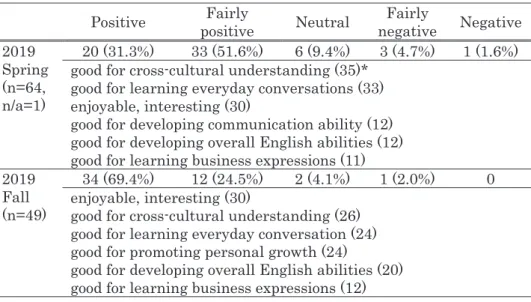
Table 1 shows that more than 80 percent of the students had “positive” or “fairly positive” impressions of the use of the authentic material in both semesters, affirming that the material promoted their cultural understanding and learning of everyday conversations and that it was enjoyable. The students reacted more positively to the course in the fall semester, when 24 students wrote that the material promoted personal growth and 12 noted it was useful for learning business expressions.
The difference in the number of positive answers between the spring semester and the fall could possibly be caused by the different kinds of supplementary materials. In the fall semester alone, a business vocabulary book, which could be helpful to increase students’ vocabulary in TOEIC tests, was used as supplementary material, and the students took a test based on that book every week, whereas a part of the original work of The Remains of the Day was used for the vocabulary test in the spring.
Table 1 Students’ impressions of the use of the material
Positive positive Fairly Neutral negative Negative Fairly 2019
Spring (n=64, n/a=1)
20 (31.3%) 33 (51.6%) 6 (9.4%) 3 (4.7%) 1 (1.6%) good for cross-cultural understanding (35)*
good for learning everyday conversations (33) enjoyable, interesting (30)
good for developing communication ability (12) good for developing overall English abilities (12) good for learning business expressions (11) 2019
Fall (n=49)
34 (69.4%) 12 (24.5%) 2 (4.1%) 1 (2.0%) 0 enjoyable, interesting (30)
good for cross-cultural understanding (26) good for learning everyday conversation (24) good for promoting personal growth (24)
good for developing overall English abilities (20) good for learning business expressions (12)
* Numbers in parentheses indicate the number of responses.
4.2 Students’ perceptions about the material’s effectiveness
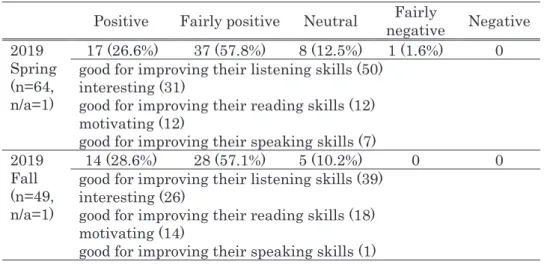
As shown in Table 2, the total number of positive answers in the spring semester is not very different from that in Table 1 and it indicates 84.4% of the
students thought this material was effective to develop their English skills. However, in the fall semester, as many as 28 students chose “fairly positive” not “positive,” whereas 34 responded “positive” in Table 1. It may reveal that more than a half of students thought that using this material in business English courses was good but they were not fully convinced of the effectiveness of the material in language learning. There were also several students who chose “neutral” regarding the effectiveness of the material. The main reasons for the positive answers were that the material is good for improving their listening skills, and more than a half of the students in both semesters thought the material was interesting, which maybe led them to active participation in learning.
Table 2 Students’ perceptions about the material’s effectiveness Positive Fairly positive Neutral negative Negative Fairly 2019
Spring (n=64, n/a=1)
17 (26.6%) 37 (57.8%) 8 (12.5%) 1 (1.6%) 0 good for improving their listening skills (50)
interesting (31)
good for improving their reading skills (12) motivating (12)
good for improving their speaking skills (7) 2019
Fall (n=49, n/a=1)
14 (28.6%) 28 (57.1%) 5 (10.2%) 0 0 good for improving their listening skills (39)
interesting (26)
good for improving their reading skills (18) motivating (14)
good for improving their speaking skills (1) 4.3 Students’ perceptions about the material’s difficulty
Table 3 Students’ perceptions about the material’s difficulty
Difficult difficult Fairly Neutral difficult Fairly Negative 2019 Spring (n=64, n/a=4) 15 (23.4%) 32 (50.0%) 12 (18.8%) 1 (1.6%) 0 listening (39)
understanding the meanings of the lines (24) interpretations (20)
understanding the historical and cultural background (18) 2019 Fall (n=49, n/a=2) 4 (8.2%) 21 (42.9%) 11 (22.4%) 9 (18.4%) 2 (4.1%) listening (26)
understanding the meanings of the lines (15)
understanding the historical and cultural background (13) interpretations (5)
Regarding the difficulty of the material, as shown in Table 3, the majority of the responses found it “fairly difficult” in both semesters. “Listening” was at the top of the area in which they found difficulty; while most students stated the material was good for improving their listening skills in Table 2.
Other areas where they found difficulty were in the literal understanding of the meanings of the lines, interpretations of the lines, and understanding the historical and cultural background. All of them might be challenging features, when literature or materials based on literary texts are used in the EFL classrooms.
The students were also asked to write their comments about the material, activities, and instructions, in the last part of the questionnaire. A large number of students gave favorable comments; for example, they really enjoyed watching this movie in class and at the same time, they learned many important things as a person and fostered their critical thinking skills. They also learned a lot about the culture and historical background of the time, which might have motivated them to study English. One of the students suggested that they usually had only a limited chance to read literature in the curriculum of the business department, so they sometimes crave literature-related materials. On the other hand, several students in each semester stated that they prefer new movies with a business motif in modern society.
5. Discussion
The responses to the questionnaires show that the majority of the students had positive views toward the use of this material. Thus, they accepted a movie based on a literary work in university business English courses, noting that it was interesting and promoted their cultural understanding and fostered the personal growth as well as helped them to learn business concepts and expressions.
From the instructor’s perspective, the students were deeply involved in the movie and classroom activities: listening to the lines, answering both literal and comprehensive questions, and having group discussions. However, there should be more emphasis on developing speaking skills using the lines in the movie, since only a few students agreed with the effectiveness of the material on developing speaking skills.
A comparison of the results in the spring and fall suggests that using a vocabulary book for business terminology as supplementary material is preferred. Although the movie describing a specific situation has some pedagogical value, the lack of vocabulary and expressions that are needed in modern or informal business situations should be addressed in additional materials.
Finally, the literary features that this movie has obviously contributed to the appreciable results of the implementation of classroom practices. Even though learning with a movie based on a literary work is challenging for some students, most of students could engage in a variety of interpretive and creative activities along with the movie. These students reported that the material was useful not only for learning business concepts and expressions but also for promoting their cultural understanding and personal growth. In particular, answering questions that may elicit different opinions from peer learners is unique to literary materials. Consequently, it can be argued that all the properties of the materials are crucial for activities these courses offer and beneficial for meaningful interactions between learners.
6. Conclusion
This study has discussed the role of authentic materials in university business English courses. Although these kinds of authentic materials, which are adapted from literary works, have not been readily accepted in business English courses or ESP teaching in general, this case shows an example of the practices in which learners learned business concepts and expressions in a realistic situation, and at the same time, promoted the cultural understanding and personal growth. The analysis of the questionnaire suggests that learners evaluated highly the movie and regarded it as interesting and meaningful material. Therefore, it is concluded that these kinds of authentic materials can play a significant role in business English courses in higher education.
______________________________
(1) Paran (2008) points out the necessity of empirical studies in this area. He explains,
“We should realise that a consideration of the large number of papers of this type results in an understanding of what it is that teachers actually do in their classrooms, and of the issues that are at the forefront of the concerns of the teaching profession” (p. 470).
(2) Literature, which had been relegated to a marginal role in language teaching,
resurged in the 1980s mainly in the UK. Paran (2006) states, “the return of literature was under a different guise from before, with a focus on the linguistic aspects of literature” (p. 1).
(3) According to Dӧrnyei (2003), “Likert scales consist of a series of statements all of
which are related to a particular target (which can be, among others, an individual person, a group of people, an institution, or a concept); respondents are asked to indicate the extent to which they agree or disagree with these items by marking (e.g., circling) one of the responses ranging from ‘strongly agree’ to ‘strongly disagree’”(p. 37).
References
Badaracco, Jr. J. L. (2006). Questions of character: Illuminating the heart of leadership through literature. Boston, MA: Harvard Business Review Press.
Dӧrnyei, Z. (2003). Questionnaires in second language research. Mahwah, NJ : Lawrence Erlbaum Associates.
Hirvela, A. (1990). ESP and literature: A reassessment. English for Specific Purposes 9: 237-252.
Hutchinson, T. & Waters, A. (1987). English for specific purposes. Cambridge: Cambridge University Press.
Igawa, J. (2020). Borrowing books from Harvard: An initial evaluation of the adaptation of a Harvard Business School Course for undergraduate international business majors in a Japanese university. The Papers and Proceedings of Economics 160: 91-104.
Kelly, R. K. & Krishnan, L. A. (1995). “Fiction talk” in the ESP classroom. English for Specific Purposes. 14 (1): 77-86.
Kuze, K. (2015). Using short stories in university composition classrooms. In M. Teranishi, Y. Saito, and K. Wales (eds.), Literature and language learning in the EFL classroom (pp.182-196). Basingstoke, UK: Palgrave Macmillan.
Kuze, K. (2018). ESP to bungaku tekusuto: eigo kyouiku ni okeru setten wo sagashite [ESP and literary texts: An interface in the EFL classroom]. JAILA Journal 4: 2-19.
Noguchi, J. (2013). Bungaku tekisuto eno ESP apurochi no ouyou [Application of ESP to literary texts. In Yoshimura, Yasuda, Ishimoto, Saito, Sakamoto, Teranishi, and Yukishige (eds.), Literature as inspiration in the Enlgish language classroom (pp.9-19). Tokyo: Eihosha.
Paran, A. (2006). The stories of literature and language teaching. In Paran, A. (ed.), Literature in language teaching and learning. Alexandria, VA: TESOL.
Paran, A. (2008). The role of literature in instructed foreign language learning and teaching: An evidence-based survey. Language Teaching 41 (4): 465-496.
Paran, A. & Robinson, P. (2016). Literature: Into the classroom. Oxford: Oxford University Press.
Sato, Y. (2019). Exploring the possibility of using authentic English materials in requisite English classes in the Faculty of Business Administration. Journal of Business Administration 93: 139-150.
Widdowson, H. G. (1983). Learning purpose and language use. Oxford: Oxford University Press.