I
“Strong in the Rain”: Fukushima and ChernobylThe purpose of this paper is to carefully dis-cuss the problem of nuclear power generation from the viewpoint of the economics of risk and uncertainty. In recent times, we have expe-rienced the two major nuclear plant crises ─ Chernobyl in 1986 and Fukushima in 2011. Those crises have repeatedly reminded us of the dangers of reactor explosions and their conse-quences such as radioactive soil, polluted areas and abandoned towns. It is quite unfortunate, however, that risk-economic studies in nuclear power generation have been amazingly rare al-though the economic theory of risk and uncertainty have been developed well since Daniel Bernoulli, J.M. Keynes and Frank H. Knight. Presumably, this paper is a bit ambi-tious attempt to fill in such a regrettable gap.
Kenji Miyazawa (1896-1933) is a very popular Japanese writer who spent his whole life in Iwate Prefecture, one of the stricken areas of the 2011 Great East Japan Disaster. Out of his famous poem “Strong in the Rain,” let us write down some leading sentences of Miyazawa (1931):
“ Strong in the rain. Strong in the wind.
Strong against the summer heat and winter snow.”
In 11 March 2011, Japan experienced a tre-mendous trauma; a massive earthquake , followed by a big Tsunami and a tragic nuclear disaster. As is seen in Miyazawa’s poet, some of the Japanese people might be strong in the rain and the wind, and also strong against the
sum-A Risk Economic
Approach to Nuclear
Power Generation
Are We Really “Strong in the Rain”?
Yasuhiro Sakai
Shiga University / Professor Emeritus Articles
3) See Oliphant (2016).
4) For the economic thought of risk and uncertainty with a focus on the expected utility theory, see Sakai (1982,1991,2010).
1) Birmingham and McNeill (2011), well-known report-age writers, have offered the reader many interesting sto-ries concerning the relation between Kenji Miyamoto and the Fukushima disaster.
2) For a detailed discussion on the relation between risks and daily lives, see Sakai(1991, 2006). Also see Ta-mer heat and winter snow. We must point out, however, that the 2011 East Japan Earthquake demonstrated the scale of the disaster which was perhaps beyond the bounds of Miyamoto’ imagination. What was once regarded as un-thinkable is now a un-thinkable reality.1)
George A. Bonnano (2011), a noted journal-ist, wondered how much trauma Japan could take in the Fukushima nuclear disaster, and wrote the following impressive report in the Newsweek, a world-famous journal: “First Ja-pan was hit by a triple whammy. The country of 127 million has just endured one of the larg-est earthquakes in recorded history, followed by a shockingly voracious tsunami. ... If only the damage had stopped there. When the deadly combo of earthquake and tsunami breached the protective barriers and engulfed one of Japan’s oldest nuclear power plants, a nuclear nightmare began, one that at this point has shown no clear signs of ending.” (Bonanno (2011), p. 8) 2)
Five years have passed since the Fukushima nuclear accident. As McCurry (2016) has not-ed, those five years on, cleanup of Fukushima’s reactor remains a far distant goal. Interestingly enough, perhaps to the ears of non-Japanese people, Fukushima might sound like Hiroshi-ma, the place in which the first atomic bomb was dropped over a great number of innocent residents. It is recalled that another nuclear ac-cident, even worse than the Fukushima disaster, took place in Chernobyl, the Ukrainian Soviet Republic, on 26 April 1986. When Japan still struggled with its nuclear disaster, Robin McK-ie (2011), a noted British reporter, returned to the scene of the 1986 reactor explosion and found many evils such as radioactive soil, aban-doned towns, and polluted lakes. Another five
years have passed. On the 30th anniversary of the nuclear accident, we can still eyewitness many traces of the Chernobyl disaster. Sur-rounde d by barb e d wire, completely abandoned by men, the Chernobyl exclusion zone may be regarded as a sort of hell. Author-ities are said to make reconstruction plans beyond the 21st century.3)
The contents of this paper are as follows, Section 2 will discuss the role of risk and/or uncertainty in economics. Section 3 will deal with the traditional expected utility theory un-der risk and its economic applications. In Section 4, we will attempt to adopt a risk-eco-nomic approach to nuclear power generation, with a comparison of the two opposing views, the pros and cons of “the peaceful use of nucle-ar energy.” Section 5 will turn to the world on true uncertainty, with a discussion of the selec-tion problem of appropriate projects. Final remarks will be made in Section 5.
II
The Place of Risk andUncertainty in Economics
2-1. Individual Decision Making under Risk: The General Frame-work
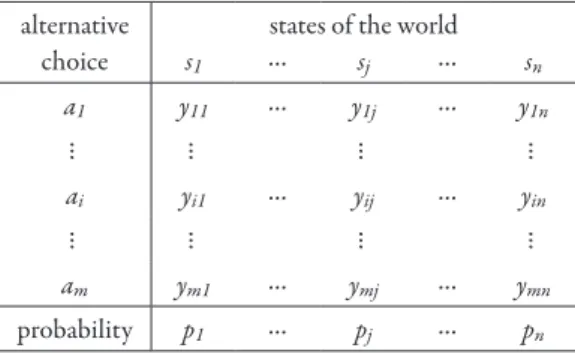
Let us consider the problem of individual de-cision making in the presence of risk. Its general framework may be depicted in Table 1. The set of possible choices is denoted by the row (a1, ..., ai, ..., am), and the set of possible
states of the world by the column (s1, ..., sj, ...,
sn).4)
Let us take a look at Table 1. When the indi-vidual has chosen a specific choice ai, and when
the nature reveals a specific state sj, we will have
5) The general framework of individual decision mak-ing under risk and uncertainty, was systematically dis-cussed by Sakai (1982).
element yij (i = 1,.., m ; j = 1,..., n). All the
combinations of those elements form the out-come matrix (yij). The probability that any
particular state sj actually occurs is denoted by
pj. Note that pj ≧ 1 for each j and Σjpj = 1.
When we face the payoff matrix as shown in Table 1, we have to do the best possible judg-ment subject to the technological and informational constraints. Which is a better allocation for the thermal power plant, in the city or in the country? Let us introduce a par-ticular form of judging criterion. Presumably, the most popular criterion is provided by the expected utility rule, which was first introduced into human science very long time ago by Dan-iel Bernoulli (1738).5)
For any i = 1,..., m, let us define the expected utility level of a choice ai as EUi = ∑j pj U (yij ).
Then we can state the expected utility rule as one by which we select the act yielding the maximum value among those expected utilities EU1,..., EUi,..., EUm . Therefore, we find the
following formula:
Max iEUi = Max i {∑jpjU(yij)}. (1)
2-2 The Allocation Problem of a Power Plant
As an interesting application of the general framework of individual decision making, let us consider the allocation problem of a thermal power plant. In order to meet additional elec-tricity demand, suppose that we are going to construct a new thermal power plant. As is seen in Table 2, assume that there are two allo-cation choices available: the densely populated city or the depopulated country. The thermal power plant is not an absolutely safe facility and may break down because of an accident. There are two states of the worlds: The state of non-accident and the one of accident, with the rate of accident being p.
The construction of a thermal power plant in the city instead of the country represents the case of “high return and high cost”. On the one hand, if no accidents occur at all, residents can enjoy the benefit of a shorter distance from the power supply site to the power demand place : the transportation cost would be less. We as-sume that the payoff of the pair (the city, non-accident) is as great as 2 (see Table 2). On the other hand, the thermal power plant may
pro-Table 1 The individual decision making under risk: The general framework
Table 2 The allocation problem of a thermal power plant: The city or the country?
alternative states of the world
choice s1 … sj … sn a1 y11 … y1j … y1n … … … … ai yi1 … yij … yin … … … … am ym1 … ymj … ymn probability p1 … pj … pn
alternative states of the world choice non-accident accident
the city 2 –2
the country 1 –1
6) As of 2017, Kikuo Iwata serves as one of the vice pres-idents, the Bank of Japan. Time flies like an arrow! du c e a ir p o l l uti o n an d n o i s e in th e
neighborhood. Moreover, if an accident occurs in the crowded city, the resulting damage would be very serious. Hence the payoff of the pair (the city, accident) must be a negative val-ue, say (–2).
The construction of a thermal power plant in the sparsely populated countryside will give us a different story: In fact, we will enter the world of “low return and low cost”. In the case of non-accident, the net benefit will surely be positive yet small because the power transmis-sion to the consumption area will not be so expensive: The payoff is assumed to be 1. In the case of accident, the resulting damage would be relatively small: The payoff is (–1).
We are ready to apply the expected utility rule to the allocation problem of a power plant. The levels of expected utility attainable from the power plant in the city and in the country are respectively given as follows:
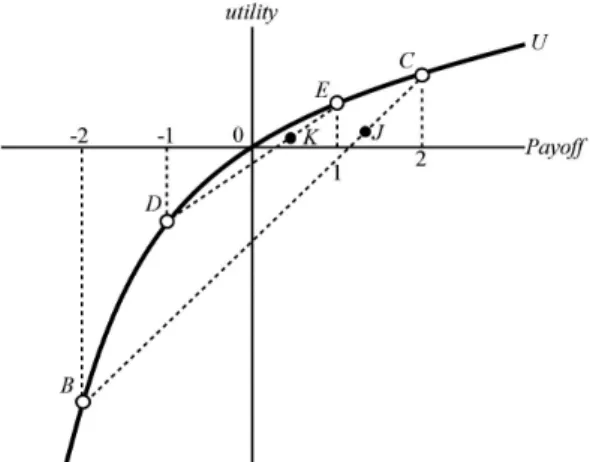
EU (city) = (1–p) U (2) + pU (–2), (2) EU (country) = (1–p ) U (1) + pU (–1). (3) The allocation problem of a thermal power plant is depicted in Figure 1. For the sake of presentation, let us intentionally put p = 1/5, which is a larger value than usual. Then the point J on the line segment BC, and the point K on the line segment DE respectively indicate the value of EU(city) and EU(country). Note that BJ : JC = DK : KE = 4 : 1. Since J is locat-ed higher than K, we can conclude that the city is a better plant cite than the city. Needless to say, the opposite conclusion would come if K is located higher than J, which is another possible conclusion under other circumstances.
III
Nuclear Power Generation:Economic and
Psychological Factors
3-1. The Two Opposite Views: Pro and Con
We are now in a position to discuss the prob-lem of nuclear power generation, which is a very sensitive and even political issue and has been more or less neglected in the literature. For instance, around 40 years ago, Kikuo Iwata (1981), then a rising star in Japanese economics profession, frankly remarked with embarrass-ment: “I have so often been asked: ‘What do modern economists think of nuclear power generation? What on earth are they doing right now?’ Alas, modern economists gave up the idea of raising such an question per se. This might represent a sort of academic sabotage by irresponsible persons.” (Iwata (1981)) 6)
Iwata was not the only person to be blamed for keeping us from the problem of nuclear power generation. While Diamond and Roth-schild (1978) was an excellent collection of
Fig. 1 A graphical interpretation of the allocation choice of a thermal power plant
7) See Sakai (2004, 2006). While Arrow (1970) was a monumental work in the economics of risk and uncer-tainty, he did not discuss the economics of nuclear ener-gy.
influential papers in the field of risk and uncer-tainty, none of the selected papers did not seriously discuss the possibility of nuclear pow-er accidents. I myself was also to be blamed in my earlier papers (see Sakai (1982)), but later could successfully deal with the issue of nuclear power generation from the viewpoint of risk and uncertainty.7)
There are two opposing views on the efficien-cy and safety of nuclear power generation: the positive view and the negative view. Before the Great East Japan Earthquake took place in 2011, the majority of the Japanese took the pos-itive view. In fact, many people believed in the “myth of absolute efficiency and absolute safe-ty”.
The second negative view was initially taken by a limited number of scientists including Takagi (1986) and Koide (2011). It has become more popular since the 2011 Fukushima disas-ter. The myth of absolute safety is now almost gone. The question whether and to what ex-tent a nuclear power plant is economical, however, remains a very controversial one, re-quiring the collection of more reliable data as well as more interdisciplinary analyses. Not only economic factors but also psychological and cultural factors must be taken into consid-eration.
Let us suppose that there are three types of power generation; nuclear, thermal or hydro. We start our inquiry with the positive view. Table 3 indicates the list of the technical cost of power generation, which was officially an-nounced by the Japanese Ministry of Economy, Trade and Industry in 2010, just one year be-fore the Fukushima Disaster. According to this METI data, nuclear power is the most eco-nomical among the three (exactly, 5 to 6 yen
for kilo watt hour), followed by Thermal, and Hydro the most expensive. Since METI has been strong and influential in the Japanese so-ciety, the conclusion that nuclear is the best type of power generation has been more or less trusted by the majority of people for a long time.
Let us turn to the negative view. Professor Kenichi Ohshima (2011), an independent and energetic researcher, has conducted a more comprehensive inquiry than METI, having come to an entirely opposite conclusion. His method of analysis and acquired data can clear-ly be seen in Table 4. According to his opinion, the real cost of nuclear power genera-tion should be the sum of the direct technical cost a la METI, the policy cost, and possibly the environmental cost. The policy cost is cal-culated as the sum total of all R & D expenditures and the site location expenditures including all subsidies necessary for the site promotion to the local residents. The environ-mental cost includes all expenditures associated with environmental damage caused by the con-struction of power generation facilities. Among those costs, Ohshima characteristically emphasized the importance of the policy cost, which was quite outside what the METI peo-ple had calculated , and succeeded in making
Table 3 The technical cost of power generation (officially announced): The positive view by the METI (2010)
Type of power generation Power generation cost (¥/kWh )
Nuclear 5 ~ 6
Thermal 7 ~ 8
Table 4 to show his own list of the comprehen-sive cost for each type of power generation.
As can immediately be seen in Table 4, the introduction of the new policy cost was quite effective in the calculation of the comprehen-sive cost of power generation. In fact, the total cost of nuclear power generation was calculat-ed as 10.25 yen for kWh, which clearly excecalculat-edcalculat-ed the thermal power (9.91¥/kWh) and the hydro power (7.19 ¥/kWh).
As Ohshima himself has noticed, the list of direct and policy costs enumerated in Table 4 is certainly less than perfect. Indeed, there re-main still missing items that must be taken into account for the sustainable operation after the construction of power plants. One of those missing items is what we may call the backend cost, which mainly consists of the expenditure necessary for reprocessing and safekeeping ra-dioactive wastes. And still another item to be mentioned is the expenditure needed to care-fully handle the phase-out process of nuclear power. Remarkably, such a phase-out process may be involved in a series of many difficult and long processes that no one may exactly foresee. Besides, if any radioactive leakage oc-curs, then many residents will have to be evacuated from the local area; the resulting ex-penditures for economical and mental compensations, hospitals, and possibly civil tri-als would be incalculably huge.
3-2. Psychological Factors: Their Effects on Payoff Matrixes and Probabilities
Let us now introduce several non-economic and psychological factors into our model anal-ysis of power generation. For simplicity, there are only two choices of the type of power plants: namely, thermal and nuclear. Besides, there are also two opposite views on the analy-sis ─ the positive view and the negative view. Those views can easily be modeled in Table 5: the positive view in the Upper Panel (A) and the negative view in the Lower Panel (B).
Let us begin to take a look at Panel (A). We would naturally expect that the rate of accident differs between the two types of power plants. Let us respectively denote the accident rate of a thermal power plant and the one of a nuclear power plant by p and q . According to the offi-cial view of the government authority, “going nuclear" is much safer than "going thermal," so that q is much lower than p, perhaps near zero . We suppose that p = 1/5 and q = 1/10. It is needless to say that local residents and liberal scientists may have serious objections against such an optimistic view.
We assume that the thermal power plant gives all the persons concerned (both the opti-mists and the pessiopti-mists) the solid payoff 2 if no accidents occur, and the small loss (–1) if an accident occurs. Besides, we also assume that
Table 4 The comprehensive cost of power generation
(independently reevaluated): The negative view by K. Ohshima (2011) Type of power generation Direct cost R & D cost Site subsidyPolicy cost Total cost
Nuclear 8.53 1.46 0.26 10.25
Thermal 9.87 0.01 0.03 9.91
the reliability of the thermal power plant, the rate of accident p is largely objective and com-monly shared by all the persons; therefore, there are no special psychological factors work-ing behind.
The difference of positions between the opti-mists and the pessiopti-mists appear when the reliability question of nuclear energy is on the agenda. According to the optimists or the peo-ple having the positive view, “going nuclear” is much more efficient than “going thermal”. Af-ter all, they are all strong believers of the “myth of nuclear energy”; the rate of nuclear accident may be regarded as substantially zero. It is the reliability question of nuclear energy is on the agenda. According to the optimists or the peo-ple having the positive view, “going nuclear” is much more efficient than “going thermal”. Af-ter all, they are all strong believers of the “myth of nuclear energy”; the rate of nuclear accident
may be regarded as substantially zero. It is as-sumed here that the nuclear power guarantees 4 unit of money, a handsome amount of gain, in the case of non-accident, whereas it may yield (–2), a manageable amount of loss, in the case of accident.
The whole situations would be drastically change if the local people decide to take the negative or critical view. In a sense, “the wind against nuclear” would blow strongly. The people are no longer believers in the nuclear myth, but are really concerned with the “nucle-ar enigma” which can be neither measurable nor predictable. As is seen in Panel (B), there are strong psychological and cultural factors working behind. Although a nuclear power plant can yield 2 unit of money when no acci-dents take place, it will cause a huge and perhaps non-measurable amount of loss shown by minus (4+α) unit when an accident occurs. Presumably, the “plusαfactor” represents the non-measurable dimensions of unknown and dreadful damages.
IV
A Generalization of theExpected Utility Theory: J.M. Keynes and
Frank Knight
In the above, we have intensively discussed the effects of psychological factors on decision making under risk. How to deal with those factors is really a controversial question. Since there are the two opposing views of nuclear power generation, it seems clear that a mere ap-plication of the traditional expected utility theory a la Daniel Bernoulli does not work at all. In the history of economic thought, there are several economists who had serious doubts
Table 5 The two opposite views of nuclear power generation: How to deal with psychological factors
(A) The positive view Type of power generation
Payoff (probability) Psychological factors non-accident accident Thermal (1–2 p) –1 (p) none Nuclear (1–4q) (–2q) (q is near zero)absolute safety (B) The negative view
Type of power generation
Payoff (probability) Psychological factors non-accident accident Thermal 2 (1–p) –1 (p) none Nuclear 2
8) Also see Kahneman, Slovic & Tversky (1982), Michel-Kerjan & Slovic (2010). Akerlof & Shiller (2009) is an interesting book which deals with the question how hu-man psychology drives the economy and why it matters for the market economy.
about the applicability of the traditional Ber-noulli principle. Among those economists are J. M. Keynes and Frank Knight. Keynes (1936) once remarked: “Human decisions affecting the future, whether personal or political or eco-nomic, cannot depend on strict mathematical expectation, since such calculation does not ex-ist.” (Keynes (1936), pp.162-163) It would be high time for us to establish a more ambitious theory ─ a sort of generalized expected utility theory a la Keynes and Knight ─ by appropri-ately incorporating psychological and cultural factors into our theoretical framework.
In what follows, let us adopt a generalized expected theory. Within such an expanded framework, the utility function U is no longer a function of one variable x such that U = U (x), but a more complicated function of a variable x and a parameter β so that U = U (x; β). The new parameter β measures the degree of hu-man sentiments, which may go in both ways ─ negative or positive. Presumably, the presence of fear or unknown risk would shift a person’s utility curve downward, whereas the optimistic sentiments such as animal spirits would shift the curve upward. When we evaluate the fre-quency of risky events, what matters is not the objective probability p per se, but rather its subjectively weighted value ω(p) filtered through a certain subjective filter ω. On the one hand, when the local residents feel uneasy about unknown and dreadful risks associated with nuclear generation, they may not totally trust the officially announced accident rate, so that the weighted value ω(p) tends to be higher than p per se. On the other hand, as far as they believe in the myth of absolute safety, they tend to regard the accident rate p as near zero.
It should be noted that our generalized ex-pected utility theory is even more general than the prospect theory of Kahneman and Tversky (1979). While they have newly introduced “the weighted filter of probabilities” into the tradi-tional expected theory, we go even beyond their approach in that we take account of “the possibility of lower or upper shifts in the utility function.” After all, there should be many oth-er ways in which we can extend any existing theory.8)
We are now in a position to get back to Table 2 in which the two opposite views of nuclear generation are presented in the form of tables. First of all, according to the positive view, the weighted values WV of the two power plants ─ thermal and nuclear ─ are provided in the following manner:
WV (thermal) = ω(1–p) U(2 ; β)
+ ω(p) U (–1 ; β), (4) WV (nuclear) = ω*(1–q) U(4 ; β*)
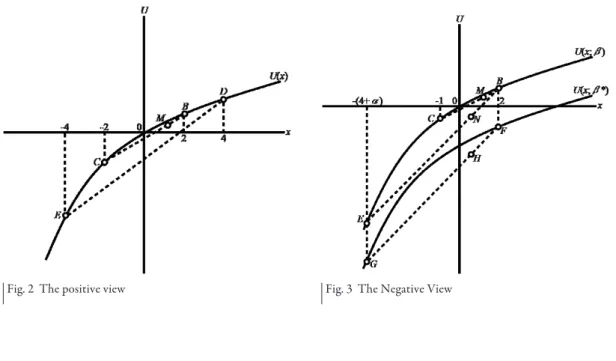
+ ω*(q) U (–2 ; β*). (5) Fig. 2 evidently demonstrates the positive view indicated by Panel (A). For the sake of graphical convenience, we put p = 1/5, which is definitely larger than the real value. Since no special psychological factors are considered for the thermal power generation, no special atten-tions of the weighted filter of probabilities are necessary, so that we should have ω(p) = p for any p. Therefore, for the case of the thermal power generation, Eq. (5) may be simplified as follows:
WV (thermal) = (4/5) U(2 ; β)
The case of nuclear power generation re-quires a different treatment from the one of thermal power generation. While the weight-ed probability filters should be considerweight-ed here, the myth of absolute safety leads to the simplification of q = 0. Hence for the case of nuclear generation, if we note that ω*(1) = 1 and ω*(0) = 0, Eq. (6) may be overly simplified as follows:
WV (nuclear) = ω*(1) U (4 ; β*)
+ ω*(0) U (–2 ; β*) = U (4 ; β*). (5*) According to the positive view, the midpoint M lying on the line segment BC stands for the value of WV (thermal), whereas the end point D on the line segment DE indicates the value of WV (nuclear). Because the point D is locat-ed higher than the point M, the value of WV (nuclear) is greater than the one of WV (ther-mal). Therefore, the optimists can tell us that “going nuclear” is the best policy conceivable.
Now let us turn to the negative view, which is graphically presented in Fig. 3. This figure is apparently more complicated than Fig. 2, and thus requires a more careful analysis than be-fore. As far as the thermal power generation, there should be no fundamental difference be-tween the negative and positive views. Hence as before, the midpoint M on the line segment BC indicates the value of WV (thermal). When we are dealing with the nuclear power generation, however, the negative view is defi-nitely at variance with the positive view. The critical people do not believe in the myth of nuclear energy. Even if no nuclear accidents occur, the payoff we can obtain is no longer four unit , but merely two unit; which is the same amount of money we can get from the thermal power generation. Besides, the nuclear accident ratio q is no longer near zero , but rather may be substantially larger than p, the thermal accidental ratio.
9) For K n i g ht on tr ue u ncer t a i nt y, see Sa k a i (2015,2016).
At this stage, we must not forget the fact that the pessimists have extraordinary fears against nuclear energy such that their utility curves are no longer stable but may shift downward. If the utility curve shifts downward from U (x, β) to U (x, β*) under the heavy stress, then the value of WV (nuclear) is no longer indicated by the midpoint N, but rather the midpoint H on the shifted curve. It is noted that as the point H lies in the fourth quadrant, WV (nu-clear) is forced to take on a negative value. In short, we may enter into the world where nu-clear generation per se is a negative asset.
To sum up, a risk economic approach in-volves a fundamentally difficult problem. First, human attitude toward nuclear generation dif-fers from person to person: there exist a variety of optimists and pessimists. Second, the utility curve per se may not be stable, but possibly shift upward or downward. Third, the official opinion for the reliability of nuclear generation may not necessarily supported by the local peo-ple. Honestly speaking, there remains still a long way to go in this field.
V
Selection of AppropriateProjects in the World of True Uncertainty
Paul Slovic (1987), a famous psychologist, once reported the results of his empirical re-search on many risk perceptions of the American people. He classified many conceiv-able items into just two items, unknown risk and dreadful risk. According to his research, nuclear power plant is regarded as both highly unknown and highly dreadful risks. Psycho-logically speaking, it is the most dangerous thing the people want to avoid. Although
mine accident represents highly dreadful risk, its danger is rather known to all the people. The risk of microwave is highly unknown but not so dreadful. Finally, bicycle is the most fa-miliar and the most risk-free good.8)
In his well-known book (1921), Frank Knight (1921) emphasized the role of uncertainty in the working of the market economy. Accord-ing to Knight, risk is a measurable concept in the sense that it can be represented by the nor-mal or other specific distribution functions. Uncertainty, however, is radically different from risk since the former is no longer measur-able at all. The notions of psychological risks including unknown and dreadful risks are very closely related to the one of non-measurable uncertainty. We might to add that it is this true uncertainty, but not risk, which may form the basis of a valid theory of nuclear generation from the economic-psychological viewpoint.9)
The myth of nuclear energy is now vanished among the people. Let us go with Knight’s ar-gument. Then we are ready to investigate the selection problem of power generation with special reference to with non-measurable un-certainty. One thing is certain. The direct application of the traditional expected utility theory would not be appropriate. In the world of true uncertainty, risks may not be measur-able, so that many formulas of mathematical probabilities are now worthless. In order to conduct our analysis further, it is necessary to introduce some forms of selection rules. There might be the plain average rule, or the very ag-gressive maximax rule. We do think, however, that the more prudent maximin rule is the best selection rule when the people face unknown and dreadful risks.
10) For the maxmin rule, see Sakai (2004).
Let us discuss the maximin rule in greater de-tail. It requires the people for playing safe in uncertain situations. We must first think of the worst possible scenario for every project ,and proceed next find the best one out of those worst scenarios. Suppose that there are m projects, a1,..., am ,and n states of the world,
s1,..., sn. Note that no probabilities pj are
associ-ated with the state sj. Further let yij be the
payoff we can get when the project i is taken and the state j is realized. More mathematical-ly, let us define the worst scenario Ni for the
project i as Ni = Minj {yi1, ..., yij ,...,yin}. Then
the maxmin rule requires that the project yield-ing the maximum value of Ni must be
chosen:10)
Maxi Ni = Maxi Minj {yij}. (6)
Now, let us get back to Table 2. We are deal-ing with the selection problem of power generation types, thermal or nuclear. In the world of true uncertainty, numerical probabili-ties become meaningless, so that the accident rates such as p, 1–p, q and 1–q should not be referred at all. If we side with the positive view, as is seen in Panel (A), the payoff of the ther-mal power takes on the minimum value (–1) when an accident occur, whereas the one of the nuclear power, the minimum (–2) also in the case of accident. While those two values are both negative, (–1) is larger than (–2). There-fore, according to the minmax rule of decision making, the thermal power generation is better than the nuclear. Presumably, a stronger argu-ment would be applied to the negative view. As in Panel (B), while the payoff of the thermal power takes on the minimum value (–1) when an accident occurs, the one of the nuclear is
the minimum (–(4+α)) also in the case of acci-dent. Between those two values, (–1) is clearly a much better value. This shows the superiori-ty of the thermal power over the nuclear.
It is noted that the above argument is totally dependent on the reliability of the minmax rule of decision making. In the world of non-measurable uncertainty, the people are involved in many risks of unknown and/or dreadful types. As common sense tells us, the principle of “safety first” constitutes one of the golden rules in human life.
VI
Concluding RemarksLouis Pasteur (1822-1895), a renowned French chemist and microbiologist, once re-marked: “Chance favors the prepared mind.” This maxim is important and persuasive when we are eager to discover hidden laws in the field of natural science. Its applicability may be somehow limited, however, if we take a look at the history of human disasters. Even if we fo-cus on nuclear disasters in modern times, there are too numerous to list. Among them are the Three Mile nuclear accident (1979), the Cher-nobyl nuclear accident (1986), the Great Hanshin-Awaji earthquake (1995), and the Great East Japan disaster (2011). It is fair to say that when those disasters stroke the regions , the local people were not prepared at all.
Torahiko Terada (1934), a legendary Japanese scientist and essayist, noted that a natural disas-ter unexpectedly struck the people who were so busy in their daily lives and conveniently forgot the past experience of disasters. There-fore, in line with Pasteur’s famous sentence aforementioned, we might say the following: “Disaster strikes the forgetful minds.”
As we repeatedly noted, it is quite unfortu-nate that risk-economic studies in nuclear power generation have been extremely rare so far. In closing this paper, we would like to point out one important exception. In his out-standing book, E.F. Schumacher (1973) was brave enough to regard the problem of nuclear energy as the one to choose the way to salva-tion or damnasalva-tion.
In spite of Schumacher’s warning, the main stream economics has consistently ignored the important problem of nuclear energy under uncertainty. It is recalled that Schumacher was once a research associate under J.M. Keynes. Moreover, we would like to point out that Schumacher’s view of nuclear energy as incal-culable danger is in line with Knight’s notion of non-measurable uncertainty.
This paper may be just one step forward to-ward a more systematic approach to nuclear power generation. No doubt, so many un-solved problems remain. They will be left for future research.
【Acknowledgment】
Financial support from the Japanese Minis-try of Education, Culture, Sports, Science and Technology through Grant-in-Aid for Scientif-ic Research (C) No.16K03837 is gratefully acknowledged. All remaining errors are solely my responsibility.
References
⦿ Akerlof, G.A. and Shiller, R.J. (2009) Animal Spirits: How Human Psychology Drives the Economy, and Why It Matters for Global Capitalism, Princeton University
Press.
⦿ Arrow, K.J. (1970) Essays in the Theory of Risk-Bearing,
Amsterdam: North-Holland.
⦿ Beck, U. (1986) Risikogesellschaft: Auf dem Weg in eine andere Moderne, Frankfurt am Main, Suhrpamp, in
German.
⦿ Bernoulli, D. (1738) “Specimen theoriae novae de men-sura sortes,” Commentarii Academiae Scientiarum Im-prials Petropolitanae, Vol. 5: pp.175-192, in Latin.
Eng-lish translation (1954) by Sommer, L., “Exposition of a new theory on the measurement of risk,” Econometrica,
Vol.22, pp.23-36.
⦿ Bonanno, G.A. (2011) “Japan: Too much trauma?”,
Newsweek, April 18, 2011, pp.8-9.
⦿ Diamond, P. and Rothschild, M. (eds.) (1978), Uncer-tainty in Economics: Readings and Exercises, New York,
Academic Press.
⦿ Iwata, K. (1981) “What are modern economists doing now?,” The Science of Thought, Vol.10, in Japanese.
⦿ Kahneman, D. and Tversky, A. (1979) “Prospect theory: An analysis of decision under risk,” Econometrica, Vol.
47.
⦿ Kahneman, D. , Slovic, P., and Tversky, A. (eds.) (1982)
Judgment under Uncertainty: Heuristics and Biases,
Cambridge University Press.
⦿ Keynes, J.M. (1936) The General Theory of Employment, Interest and Money, London: Macmillan.
⦿ Knight, F.H. (1921) Risk, Uncertainty and Prof it,
Houghton Mifflin Company.
⦿ Koide, H. (2011) The Lie and Enigma of Nuclear Power Generation, Huso Publishing Company.
⦿ McCurry, J. (2016) “Five years on, cleanup of Fukushi-ma’s reactor remains a distant goal,” The Guardian.
⦿ McKie, R. (2011) “Chernobyl 25 years on: a poisoned landscape”, The Japan Times, April 2, 2011. (Adapted
from The Observer.)
⦿ Michel-Kerjan, E. and Slovic, P. (eds.) (2010) The Irra-tional Economist: Making Decisions in a Dangerous World, New York: Public Affairs.
⦿ Miyazawa, K. (1931) “Strong in the Rain,” private note-book, in Japanese. English translation by Japan Medical Association contained in Nabeshima, N. (ed.) The Ga-lactic Realm of Kenji Miyazawa, Ryukoku University
Press, 2011.
⦿ Oliphant, R. (2016) “Chernobyl disaster: On the 30th anniversary of the nuclear accident, authorities plan for the next century,” The Telegraph.
⦿ Ohshima, K. (2011) Cost of Nuclear Power Generation,
Iwanami Publishing Company, in Japanese.
⦿ Sakai, Y. (1982) The Economics of Uncertainty, Tokyo:
⦿ Sakai, Y. (1991) Risk and Information: Towards a New Economics, Tokyo: Keio Publishing Company, in
Japa-nese.
⦿ Sakai, Y. (2004) Risk, Environment, and Economy,
To-kyo: Keiso Publishing Conmany, in Japanese.
⦿ Sakai, Y. (2006) Risk Society: A Pluralistic View ,
To-kyo: Iwanami Publishing Company, in Japanese.
⦿ Sakai, Y. (2010) Economic Thought of Risk and Uncer-tainty, Kyoto: Minerva Publishing Company, in
Japa-nese.
⦿ Sakai, Y. (2015) J.M. Keynes versus Frank Knight: Com-paring the Two Economic Giants in the Age of Uncer-tainty, Kyoto: Minerva Publishing Company, in
Japa-nese.
⦿ Sakai, Y. (2016) “J.M. Keynes versus F.H. Knight on un-certainty: reflections on the miracle year of 1921,” Evolu-tionary and Institutional Economics Review, Vol. 13, No.
1, pp.1-21.
⦿ Schumacher, E.F. (1973) Small is Beautiful: Economics as if People Mattered, London: Blond & Briggs Ltd.
⦿ Slovic, P. (1987) “Perception of risk,” Science, Vol. 236.
⦿ Takagi, J. (1986) Nuclear Power Accident: Will it Take Place in Japan? Iwanami Publishing Company.
⦿ Taleb, N. N. (2007) The Black Swan: The Impact of the Highly Improbable, New York: Random House
Pub-lishing Group.
⦿ Terada, T. (1934) “Natural disaster and national de-fense,” Tokyo: Keizai-Ohrai Journal, in Japanese.
A Risk Economic Approach to Nuclear Power Generation
Are We Really “Strong in the Rain”?
Yasuhiro Sakai
This paper aims to discuss the problem of nu-clear power generation from the viewpoint of the economics of risk and uncertainty. Al-though we have experienced the two major nuclear disasters, Chernobyl and Fukushima, in recent times, it is quite unfortunate that risk-economic studies in nuclear power generation have been extremely rare so far. This may show intentional neglect in the academic circle. The purpose of this paper is to duly mend such a re-grettable tendency. Before 11 March 2011, there were many people who more or less believed in the myth of absolute safety. The Great East Ja-pan Earthquake, however, has completely changed their concept of risk for nuclear power generation, thus requiring the need to take a new risk-economic approach to nuclear energy. As saying goes, we can learn new lessons in old teachings: we have to reexamine the econom-ics of J.M. Keynes and Frank Knight. There are many possibilities for future research.
Keywords: Risk, uncertainty, nuclear power generation, Keynes, Knight