18 2014.04 日立評論
Innovate With Information
̶
The Role of IT in Social and Business Innovation
̶
社会イノベーションを加速するグローバル
IT
ソリューションfeature articles
Mary Ann Gallo Douglas Howatt
Raw data becomes more useful as its connections, clusters, and context are revealed. Data generated by business, humans, and even machines is groomed into content and ultimately into information and insight. The Hitachi Data Systems strategy integrates layers of technologies and solutions with industry-focused applications to help organizations fi nd, evolve, use, and cultivate value from information. Ascending regional organizations and 82% of Fortune Global 100 companies
use Hitachi Data Systems (HDS) solutions and services to develop data into information that they use for innovations large and small. Medical organizations use Hitachi technologies to connect disparate data to make faster diagnoses. Retailers turn customer data into new revenue opportunities. Government agencies connect information globally to make the world safer. Hitachi is proud that its technologies help to form the fabric of business and of society the world over.
1. INFORMATION FUELS INNOVATION
INNOVATION is the essential engine of positive change, and information is its fuel. Intelligent innovation lets you lead your market, grow your company, and change the world. Hitachi Data Systems Corporation helps you store, manage, access, search, and correlate your information across diff erent sources. And Hitachi is the trusted partner who helps you innovate with information to make a diff erence in your world.
Hitachi contributes to business and to society by helping its customers convert huge stores of data into information they can use to innovate. Useful innovation ranges from a simple improvement in an internal procedure, to a dramatically diff erent product that changes everything.
2. INFORMATION
Data, the building block of information, is everywhere. It is everywhere you can think of: your smartphones, your cars, and the Internet. And it is everywhere that you have not thought of: cash registers, trains, factories, farms, and your doctor’s offi ce. Big data is one of the most important revolutions since the Internet.
Big data is a collection of several diff erent kinds of data
and information (see Fig. 1). It is business information that comes out of companies’ processes and procedures. Like your company’s accounting records. It is human information that we generate when we communicate with each other. Like Twitter*¹, Facebook*², or email. It is also machine data that the world’s infrastructure systems produce. Like security cameras and equipment sensors.
Big data is made possible by the combination of three
Three kinds of data drive the big data phenomenon
Business process Human Machine Video Sensors Satellite imaging Medical imaging Web logs Email Documents Social OLTP 1× 10× 100× M2M log file Recording
Fig. 1│What Is Big Data?
Today, data is created by an ever-growing number of devices and processes.
OLTP: online transaction processing, M2M: machine-to-machine
*1 Twitter is a trademark or registered trademark of Twitter, Inc. *2 Facebook is a trademark or registered trademark of Facebook, Inc.
19
featur
e ar
ticles
Vol.96 No.04 248–249 社会イノベーションを加速するグローバルITソリューション
emerging factors. Th e fi rst is the massive increase in the amount of data generated in the world. Th e second is the advancement of technologies that let every kind of data be analyzed into information in huge volumes at high speed and low cost. Th e third factor is the value within big data’s information, which draws the people and companies who need to perform better and better by all available means.
With all of these forces in action, it is no surprise that big data is growing not only in size but in importance. In companies today, big data is mostly the analysis of business data and social Internet data for insights that help sales and marketing. Business captures data and then analyzes it for useful information: Data in, insight out. Insight can increase the customer base and revenue. Insight can help companies cut costs and be more effi cient and profi table.
Of course, companies have been capturing and analyzing data for years. But not at this scale and not across such a wide variety of sources. What is new today is the sheer volume and variety of data that companies now need to analyze. Also new is the speed at which information is being generated and demanded by companies that need those insights.
Saint Elizabeth hospital in Canada works with Hitachi solutions to make health information available to mobile and remote clinicians and patients. With accurate and complete information at their fi ngertips, Saint Elizabeth’s medical experts spend less time on paperwork and more time on patient care. Th eir interactions not only became more personal, they became more professional and eff ective too. Data migration and mission-critical performance are improved with HDS modular storage hardware enabled by sophisticated HDS software that includes Hitachi Dynamic Provisioning and Hitachi Replication Manager. Th e collection of technologies is tuned and the hospital staff is educated by HDS services groups.
HDS also works with a 300-store regional electronics retailer in Europe who uses SAP HANA*³ and Hitachi systems to understand customer behaviors on their websites and in their stores. Th ey mine this data to respond more quickly to trends so that marketing and inventory meet fast-moving customer interests. Th eir Hitachi solution is based on Hitachi Unifi ed Compute Platform, which has strong data analysis capabilities and is optimized
for the SAP HANA platform for “scale out” capabilities. Th e solution includes Hitachi Compute Blade, Hitachi Virtual Storage Platform, and Hitachi Command Suite software.
3. INNOVATION
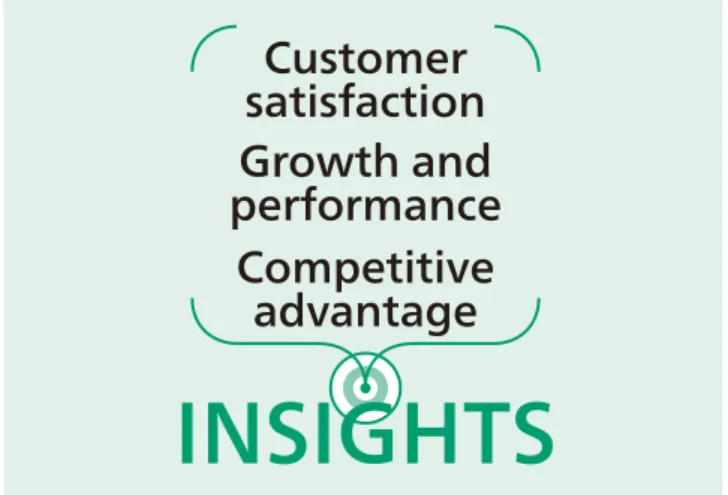
Without fresh thinking and new approaches, an endeavor stagnates and is soon passed by. Innovation is not only the mandate of businesses and customers, it is the foundation of any organization’s future. With the right information in the right places, company experts can make the right decisions to uncover new opportunities. Hitachi helps business discover, analyze, and use data for new competitive advantage (see Fig. 2).
Of course, innovation is vital to business and society. A study by the European Commission (EC) on disruptive innovation in the European Union (EU) transportation and logistics industry fi nds that information and communication technology is “one of the most important technological innovations ... to improve effi ciency and eff ectiveness and even gain competitive advantage.” Th e EC fi nds that information technology is “a key enabler of innovation” and is responsible for the industry’s trends of new services, new competitors, and new alliances. Hitachi has seen this same eff ect among its customers in many other industries.
When people can extract information and insight from their data, they create the ultimate value: useful innovation. To build the path for information development, Hitachi focuses on analytics, integration, intelligence, and big data solutions. Th e fundamentals include the ability to combine
Customer
satisfaction
Growth and
performance
Competitive
advantage
INSIGHTS
Fig. 2│Technology Drives Business Value.Technology that stores, manages and analyzes data helps businesses perform better.
*3 SAP HANA is the trademark or registered trademark of SAP AG in Germany and in several other countries.
20 2014.04 日立評論
structured and unstructured data sources, manage that data as it scales in realtime, analyze data to gain valuable insights, and correlate information from multiple sources. Hitachi information solutions use the single, virtualized Hitachi platform for all data types to ensure seamless access, protection, and management of all information assets.
Australia’s Saint Ignatius’ College uses Hitachi technology to expand its innovative digital education. Th e college strives to teach each student to manage and understand information in its many digital forms. HDS helps to make their curriculum possible, with support for their information infrastructure and ready access to video, multimedia, and other information-rich applications. When students are prepared for today’s world, they help to create tomorrow’s. Th e college’s data infrastructure supports a virtual desktop capability, using HDS modular storage systems and Hitachi Device Manager and Hitachi Tuning Manager software.
Illumination Mac Guff is a movie studio in Paris that creates movies such as Th e Lorax. Using Hitachi technologies, they have developed an agile information management system to support hundreds of artists and render 90 Tbyte of computer graphics. Th e system lets creativity fl ow faster in order to make the movies closer to the artists’ original innovative vision. To create this high-performance network storage platform, Hitachi NAS Platform uses massive computing parallelism and Hitachi NAS Replication software. It creates tremendous system performance and scalability, with up to 8 Pbyte of usable capacity.
4. SOCIAL GOOD
Why are all of us in business? Is it for profi t, for a sense of worth, for discovery? It is for all of these reasons, but most importantly it is to make a diff erence. Our families, our neighbors, and our society depend on innovation to improve the human condition.
For over 100 years, the Hitachi corporate credo has been “contributing to society through the development of superior, original technology and products.” We are all connected. People. Companies. Society. Our planet. Hitachi applies its vast expertise to build community infrastructures that are more intelligent and environ-mentally conscious. An advanced social infrastructure
helps families and communities now and for generations. Hitachi calls this the Social Innovation Business.
Hitachi sees social innovation in all of our communities, markets, and global regions. In our communities, our information technology is used for a wide variety of benefi ts including the well-being of all us. Th e Shanghai University of Traditional Chinese Medicine uses one of the HDS cloud solutions to manage the massive amounts of data it generates with its thoroughly modern information infrastructure. Most of the data comes from its smartcard program, its office automation system, its library management system, its public database platform, and its simulated hospital system.
After a successful implementation by HDS Global Services, the university runs all important data on a cloud storage platform that includes Hitachi Virtual Storage Platform, Hitachi Unifi ed Storage, and Hitachi Universal Volume Manager. Teachers and students report that they are more satisfi ed with the system, and the effi ciency of the university’s information system. As a result applications have been enhanced dramatically. Students now make better use of school information resources with better access to library materials, online class selection, and so forth.
In addition to education, Hitachi sees signifi cant use of its information technology in healthcare. Seattle Children’s Hospital uses information as the lifeblood of its hospital and nine research centers, and has earned international recognition for innovative pediatric medical research. Th e organization has developed an innovative virtual desktop infrastructure to support the information needs of its many users in many diff erent locations. Th e system reliably delivers accurate information to staff , doctors and researchers anytime, anywhere. Seattle Children’s installed Hitachi Virtual Storage Platform as the centralized storage solution in its primary data center. A portion of this centralized storage uses a dual-node Hitachi NAS Platform cluster to support two forms of data – block and fi le – in a single platform.
Perhaps the most important community need is for the basics of life. Water management has become a deciding factor in communities’ response to an emerging global crisis: the availability of clean water. Not only is water vital to human life, it is necessary for almost all aspects of the global economy, including health, food production,
21
featur
e ar
ticles
Vol.96 No.04 250–251 社会イノベーションを加速するグローバルITソリューション
sanitation, energy, industry, and environmental sustainability. United Nations statistics show that water scarcity already aff ects almost every continent and more than 40% of the people on our planet.
Hitachi technologies are used by communities and industries to fi nd new, effi cient means to treat and manage water for the benefi t of all of us. For example, Australia’s Western Water authority runs an ambitious and innovative program with 150,000 smart meters across the state of Victoria. With water management becoming more critical in the face of the region’s growing population and the desert climate, the smart use of water has become important. With enormous stores of data collected, Western Water develops information to educate the state’s inhabitants on how to use water more carefully in preparation for recurring droughts. Th e authority uses Hitachi Unifi ed Storage for high-density storage, a vital feature for a database that grows by 40 Tbyte each year.
5. I.T. INTEGRATION FOR INNOVATION
Th e Hitachi vision is to create a better world through social innovation technologies. Th e HDS strategy (see
Fig. 3) to achieve this centers on integrating infrastructure, content, and information layers with vertical industry applications to help you turn your data into valuable business insights.
Hitachi understands big data today and the big data that will evolve tomorrow, because it builds the machines that
create it. Hitachi applies decades of expertise in vertical industries to give you realtime information, useful analytics and decisions, and automated and integrated technologies. Th e infrastructure layer is where IT professionals have focused historically. HDS off ers a complete suite of innovative, reliable and virtualized infrastructure technologies that free data from its physical hardware or media. Th e resulting data mobility lets you nondisruptively migrate data – even big data – from system to system, from location to location.
Today, unstructured data is growing dramatically and IT professionals are scrambling to manage it. In the content layer, HDS frees data from the applications that created it so that you can easily index, search, access, and govern it forever.
Th e future of IT lies in the information layer where data is transformed into information and insight. It may be structured or unstructured, historical or realtime, and it may reside in any location. It may be a new diagnosis or a faster route to market. Understanding and delivering value from your big data creates new and meaningful opportunity.
6. YOUR INNOVATION
Around the world and in all aspects of life, Hitachi technologies, services, and expertise are used by innovators to make a diff erence in the world. Innovation is possible when the right people have the right information. With good information and inspired innovation you can help people in organizations, companies, and industries near you and around the world.
Hitachi is ready to do its part to help you do your part. Innovate With Information.
Mary Ann Gallo
Worldwide marketing department of Hitachi Data Systems Corporation. She is currently vice president of global communications.
Douglas Howatt
Worldwide marketing department of Hitachi Data Systems Corporation. He is currently in the marketing communications department as managing editor.
ABOUT THE AUTHORS
・ Business intelligence
・ Big data
・ Analytics
・ Integration
・ Search, discover and integrate independent of applications
・ On demand content
・ Archiving as a service
・ Vtrtualization, mobility
・ Integrated management
・ Data center convergence
・ Infrastructure on demand
Single virtualization platform for infrastructure, content and information
Infrastructure Content/Data
Information/ Applications
Fig. 3│Hitachi Data Systems Integrated Strategy.
By developing and integrating solutions in these areas, HDS helps business succeed and society to innovate.