Journal of the Operations Research Society of Japan
Vol. 42, No. 4, December 1999
ON M/G/I QUEUES WITH THE FIRST TV CUSTOMERS OF EACH BUSY PERIOD RECEIVING EXCEPTIONAL SERVICES
Yutaka Baba
Yokohama National University
(Received January 6, 1999; Final July 28, 1999)
Abstract This paper studies generalized M/G/1 queues in which the first N customers of each busy period receive exceptional services. Applying the supplementary variable approach, we derive the recursion formulas to obtain the generating function of the stationary queue length distribution given that n customers have been served since the beginning of current busy period. Furthermore, we present a computationally tractable scheme which recursively determines the moments of the queue length distribution and the sojourn time distribution. Special cases are treated in detail. Numerical examples are also provided.
1. Introduction
In this paper, we consider a single server queueing system where the service time of each customer depends on the number of customers served before him/her in the current busy period. Customers arrive according to a Poisson process with rate A. The service discipline is FCFS (first come first served). In each busy period, let Bn (n
>
0) be the service time when n customers have been served since the beginning of current busy period. We assume that Bn (n>
0) are mutually independent but may have different distribution function & ( X ) ( n>
0). Furthermore, we assume that Bn(x) = B d x ) for n>
N. Such queueing systems are called the first N exceptional services model.Such queueing systems are immediately applicable to many fields such as computer systems, telecommunication systems and production systems. For example, nice applicable examples in the modern computer systems are introduced by Li et al. [2].
Several researchers have studied queueing systems in which the service time of a customer depends on the number of customers served in the current busy period. Welch [4] studied a generalized M / G / 1 queueing system in which the first customer of each busy period receives exceptional service. If we set N = 1, Welch's model is considered as a special case of our model. Li et al. [2] studied an M / M / l queueing system in which the service rates depend on the number of customers served since the beginning of current busy period. They obtained the Laplace transform of busy period and some performance measures. For the first N exceptional service model, they also derived a closed formula for the generating function of the stationary queue length distribution. Recently Igaki et al. [l] studied an M/G/1 queueing system in which the service time distribution depends on the number of customers served since the beginning of current busy period for the case that N may be infinity. They obtained the transform results for the system idle probability a t time t , the busy period,
M/G/l Queues with Exceptional Services 491
at time t . However, they did not obtain the definite scheme for computing the moments of the stationary queue length distribution and the sojourn time distribution.
In this paper, by restricting N to finite, we derive the recursion formulas to obtain the generating function of the stationary queue length distribution given that n customers have been served since the beginning of current busy period by applying the supplementary ,
variable approach. Furthermore, we present a computationally tractable scheme which recursively determines the moments of the queue length distribution and the sojourn time distribution.
This paper is constructed as follows. We describe the model and introduce notation in Section 2. In Section 3, we derive a set of Laplace-Stieltjes transform equations using supplementary variable approach. In Section 4, we give some system state probabilities to obtain the moments of the queue length distribution and the sojourn time distribution. In Section 5, we derive the numerical algorithm procedure for the generating function of the stationary queue length distribution. Special cases for N = 1 , 2 , 3 a r e treated in de- tail, yielding explicit formulas for the generating functions of the stationary queue length distribution in Section 6. Numerical examples are also provided for some special cases in Section 7.
2. Model and Notation
Consider the generalized M / G / l queues in which the service time distribution depends on the number of customers served since the beginning of current busy period. We assume that customers arrive at a single server queueing system according to a Poisson process with intensity A. These arriving customers are served under the FCFS discipline, where the customers will be served in order of their arrivals to the system. Let Bn(x) denote the service time distribution function when n customers have been served since the begin- ning of current busy period. The Laplace-Stieltjes transform (LST) of Bn(x) is defined by B 3 9 )
r
e ' " ~ ~ ( d x ) . Furthermore, we assume that the service time distribution becomes stable after some customers have been served in the current busy period. That is, there is a positive integer N>
1 such that Bn (X) = BN (X) for n2
N. Let L(^) be the number of customers in the system including the one in the server a t time t. Let M ( t ) be the number of customers served since the beginning of current busy period at time t. If the server is idle at time t, M ( t ) is defined to be 0. Furthermore, let B i t ) be the remaining service time if there are some customers in system at timet.
We further need the following not ation for our subsequent analysis.3. Supplementary Variable Approach
In this section, we obtain Laplace-Stieltjes transforms (LST), PG(9)
=
lim P^, (9, t) (i>
t-+m
492 I? Baba
Suppose that there are no customers in system at t = 0, that is, L(0) = 0 and M(0) = 0.
Since the service times are generally distributed, the process {L(t), Ad@)} does not form a Markov process. To make our system Markovian) we use the supplementary variable ap- proach. Using the remaining service time as a supplementary variable, the joint distribution of the queue length, the number of customers served since the beginning of current busy period and the remaining service time at time t 7 that is, {L(t)) M ( t ) , q t ) } forms a Markov bserving the system state at time t and t
+
A t and taking the limit of At-+
0, we have the following partial differential difference equations.Assume that the system is stable. We discuss the stability condition later. Let p. lim p0 (t)
t+00
and pi,, ( X ) lim pij{x, t ) (i = 1 , 2 , . . . ; j = 0, . . .
,
N ) . Taking the limit o f t-+
oo, we obtaintÑ>
dpo (t)
the following equilibrium results from (1)-(7) using lirn = 0 and lirn 9p,j{x, t ) = 0
t-roo dt t + d t
dPi.0 (a-) -
M/G/l Queues with Exceptional Services
Taking the LST1s of ( 9 ) - ( 1 4 ) , we have
4. System State Probability
In this section, we give po, pi,O(O) ( 1
<:
i
5
N ) and pi,, ( 0 ) ( 1<
i5
N ) to obtain themoments of the queue length distribution and the sojourn time distribution in Section 5. 4.1. pi,o ( l
5
iW)
in terms of p0We express pi,o(O) ( 1
<
i<:
N) in terms of po. Substituting 0 = A into ( 1 5 ) and ( 1 6 ) , wehave
Differentiating ( 1 5 ) and ( 1 6 ) n
+
1 times and inserting0
= A, we have-
("
+
1 )~:,r'
( A ) = A ~ ~ B ~ ( " + ~ ) ( A ) ( 2 3 )- ( n + l ) P , T ) ( A ) = * $ " ( A ) ( i = 2 , 3 ,
. . . ) .
( 2 4 )Using ( 2 3 ) and ( 2 4 ) , we have
From ( 2 1 ) ) ( 2 2 ) and ( 2 5 ) ) we can express pm ( 1
5
i5
N ) in terms of p. as4.2. pl,,(O) ( 1
5
j5
N) in terms of p.We now express p1,,{Q) ( 1
<. <:
N ) in terms of po. Substituting 6 = A into ( 1 7 ) and ( 1 8 ) ,494 Y. Baba
Differentiating (17) and (18) n
+
1 times and substituting Q = A, we haveUsing (26)-(30), we can calculate pi,j (0) ( j = 1 , 2 , . . .
,
N - 1; i = 1,2, . . .,
N - j) in termsof p0 by the following numerical algorithm. A l g o r i t h m
for j = 1 t o N - 1 d o f o r i = l t o N - j d o
Hence, p l j (0) ( j = 1 , 2 , . . .
,
N - 1) can be obtained from (31). Finally, we havefrom (8). It immediately follows that we can express pi,,- (0) ( j = 1 , 2 , . . .
,
N) in terms of p. from (26), (31) and ( 3 2 ) .4.3. G e n e r a t i n g functions
We define the following generating functions.
Using (15)-(20), we have
( A - h - O ) Q : ( z , Q ) = pi,,-i(0)
1
B:
(0) - q j (z) ( j = l , 2, . . .,
N - l) (36)Substituting Q = A - \z into (35)-(37), we have
M/G/l Queues with Exceptional Services
Rearranging (40), we have
Furthermore, substituting 0 = 0 into (35)-(37), we obtain
4.4. Determination of p.
Substituting z = 1 into (38) and (39), we have
Next, differentiating (38) and (39), and substituting z = 1, we have
Using L'Hospita17s rule in (41), we have
(1)
( l ) = lim qN (2) = VN-#) - p i , ~ - i ( O ) - plJv(o)
z + ~ l
+
AB?(O)Furthermore, using LIHospital's rule in (42)-(44), we finally obtain
Since (0) ( j == 0, . . .
,
N - 1) are expressed in terms of po, we can express Q; ( 1 , O )( j = 0, . . .
,
TV) in terms of p0 using (45)-(52). From the normalization condition,we have PO. Therefore, the system state probabilities immediately follow.
Remark 4.1 It follows from (49) that this queueing system is stable if and only if 1
+
\B$)(o)>
0, that is, AE(BN)<
1.5. Moments of Queue Length and Sojourn Time
496 Y. Baba
length distribution and the sojourn time distribution in steady state. We assume in this paper that the sojourn time is defined as the time between the arrival epoch and the end of the service time of an arbitrary customer.
5.1. Moments of queue length
We define the generating function of the steady state queue length distribution as
where L denotes the steady state queue length. Differentiating (54) n times with respect to z and substituting z = 1, it is shown that nth factorial moment of L is given as
N
E[L(L - 1)
- .
(L - n+
l ) ]=
~ ( " ) ( l ) = (^")(l, 0). (55)j=o
Hence, to obtain the n t h factorial moment of L, it suffices to calculate ~ ~ " ( 1 ~ 0 ) ( j =
0 , . . .
,
N). Since po,plj(0) ( j = 0 , . . .,
N ) and qj(l) ( j = 0, . . .,
N ) explicitly follow from the previous section, we have the following tractable numerical algorithm to calculate Q : ( 1 , O )end
M/G/l Queues with Exceptional Services begin Qf1(1,0) = ---kQ",-l) (l, 0) k k + 1 -
(
m)
[qpl
(l)+
(l)] ( - A ) B$'"'-")'
+ m=2 (0) end5.2. Moments of sojourn time
Let S and S*(@) be the steady state sojourn time of an arbitrary customer and its LST, respectively. Since the arrival process is Poissonian and the service discipline is FCFS, the distribution of L and S are related by
Hence, we have
E[L(L - l) . . . (L - n
+
l ) ] = ~ ( ~ ) ( l ) = ( - l ) n A n ~ * ( n ) ( ~ ) = AnE(Sn). (63)We obtain from (63) that the n t h moment of S can be calculated from the n t h factorial moment of L.
6. Special Cases
In this section we derive explicit formulas for the generating function of the stationary queue length distribution, R(& and the LST of sojourn time distribution, S*(@), for the special cases that N equals 1, 2 and 3. Substituting z = 1 - A / @ in (62), we have
Hence, if the explicit formula for R(z) is found, then we have the explicit formula for
S*
(0) from (64).(1) N = 1
498 Y. Baba
Remark 6.1 The queueing system for N = 1 coincides with the queueing system studied by Welch [4] and the explicit formulas of R(z) and
S*
(6) coincide with the results in Welch [4] and Takagi [3].(2) N = 2
where
1 - AE(B2)
1
+
A{E(Bo) - E(B2)}+
A{1- B;(A)}{E(Bi) - E(B2)}where
M/G/1 Queues with Exceptional Services
7. Numerical Examples
In this section, we present numerical examples to demonstrate the numerical algorithm derived in Section 5.
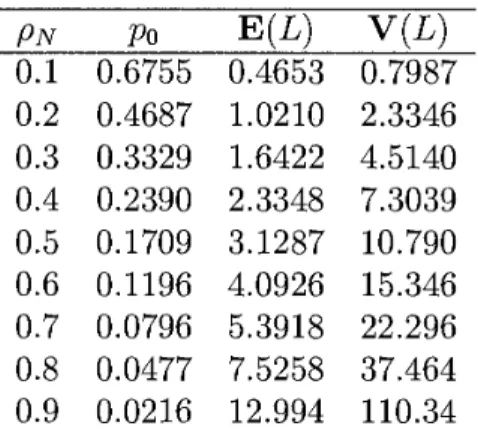
In Table 1 and Table 2 , we show the system idle probability, po, the mean queue length,
E(L), and the variance of queue length, V(L), for an M / M / 1 queue and an M / D / l queue
with N = 3, respectively. For both queueing systems, we assume that the arrival rate is A = 1. We also assume that the relations among mean service times given that n customers have been served since the beginning of current busy period are
Furthermore, we define p^
=
AE(BN). From Remark 4.1, p^ is less than unity if and onlyif the queueing system is stable.
Table 1. System idle probability po, mean queue length E(L) and variance of queue length V ( L ) for an M / M / 1 queue with N = 3
Table 2. System idle probability po, mean queue length E ( L ) and variance of queue length V ( L ) for an M I D I 1 queue with N = 3
Numerical examples in Table 1 and Table 2 show the following interesting result. If p^
is same for both an M / M / 1 queue and an M I D I 1 queue, E(£ and V(£ for an M / M / 1
queue are larger than those for an M I D I 1 queue. However, for same ON, the system idle probability p0 for an M / M / l queue is larger than that for an M / D / l queue. This is a
Y. Baba
References
[l] N. Igaki, U. Sumita and M. Kowada: On a generalized M / G / l queue with service degradation/enforcement. Journal of the Operatzons Research Soczety of Japan, 41
(1998) 415-429.
[2] H. Li, Y. Zhu, P. Yang and S. Madhavapeddy: On M/M/l queues with a smart machine. Queuezng Systems? 24 (1996) 23-36.
[3] H. Takagi: Queuezng Analyszs, A Foundatzon of Performance Evaluatzon, Vol. l :
Vacation and Priorzty Systems (Elsevier Science Publishers B. V., Amsterdam? 1991). [4] P. D. Welch: On a generalized M/G/l queueing process in which the first customer of
each busy period receives exceptional service. Operatzons Research l 12 (1964) 736- 752.
Yutaka Baba
Department of Mathematics Education Faculty of Education and Human Sciences Yokohama National University
79-2 l Tokiwadai? Hodogaya-ku, Yokohama Kanagawa 240-8501 l Japan