Title
CATWAVES Prediction of Linear and Nonlinear Wave
Motion in Unbounded Coastal Domains
Author(s)
Tsutsui, Shigeaki
Citation
琉球大学工学部紀要(61): 9-35
Issue Date
2001-03
URL
http://hdl.handle.net/20.500.12000/2221
Prediction ofLinear and NonlinearWave Motion
in Unbounded Coastal Domains
Shigeaki TSUTSUI*
Abstract
The CATWAVES is a package of Fortran programs, based on the finite element method, for linear and nonlinear wave
analyses in unbounded coastal domains. This package consists of three procedures: (I) the finite element mesh generation
routines for preprocessing, (II) the finite element analysis routines ofwave motion and (III) the graphics routbes for post
processing. The model equation ofwave motion implemented in CATWAVES is a variant of the mild-slope equation and
combines the linear dispersion with weak nonlinearity. The boundary conditions applicable to the model are wave reflection
along the shorelines and the boundary ofcoastal structures, discontinuous changes in water depth, such as occur in reef
coasts, and the radiation condition at infinity. Initially, the CATWAVES imposes, on the user, preparation oftwo data filesfor the mesh generation routine, i.e., bathymetric and finite element mesh data. After preparation ofthese data, the system
successively creates the input/output data files and leads to die final results together with high-quality graphics.Keywords: Nonlinear wave evolution, Wave height distribution, Open problem, Model wave equation, Mild-slope equation,
Finite element method, Mesh generation.
1. Introduction
The CATWAVES - Computer-Aided Testing of WAVES - is the system of linear and nonlinear wave analyses based on the finite element method and is a package of Fortran programs.
The linear analysis of wave motion in unbounded coastal domains is fundamental for environmental assessment ofinfluence due to the changes in wave conditions in planning all sorts of coastal facilities. The nonlinear analysis ofwaves in shallow water, on the contrary, becomes significant especially in nonlinear wave evolution, for example, the harbor resonance with long waves.
In many analyses ofwave motion based on the finite element
method, the requirement ofan enormous amount ofinput data is a serious shortcoming. Success of the method depends, to a
large degree, on preprocessing, i.e., how easily the user can prepare
the bathymetric data and create the finite element, mesh over the model region. Visualization of the numerical results is also significant to understand the wave phenomena in the regions of the problem. With these in mind, therefore, this set of Fortran
programs consists of three main procedures: (I) the mesh
genera-Reccivcd 25 December 2000.
' Dept. of Civil Engineering and Architecture, Faculty of Engineering.
Part of the paper was presented at the Centre for Water Research. University of western Australia. 1988. and in Proc. Coastal Eng., JSCE. Vol.46., 1999.
tion for preprocessing, (II) the linear and nonlinear finite element solution routines and (III) the post-processor to visualize the numerical results.
This document describes the programing structure of the system and demonstrates how to simulate linear and nonlinear wave motion in the near shore regions and to predict wave height distribution together with graphic results.
The CATWAVES was firsdydeveloped CTsutsui, 1989), during the author's stay at die Centre for Water Research, University of
Western Australia, from September 1988 to June 1989. In the
original codes, however, there might be some parts to be improved,
especially, in the treatment ofthe radiation condition at infinity
so as to develope the model for nonlinear wave evolution, in
saving the computer storage, and in the method of numerical solution for the large and sparse system of algebraic equations. These have been revised in the past decade {c.g., Sulaiman et al.,
1994; Tsutsui era!., 1993,1996,1998;Tsutsui, 1995,1999,2000).
The chief features ofthe function ofCATWAVES are as follows:
Interface
• All the routines work on any computer's operation system
because there is no machine-dependent statement/command. As the data input interface, then, the user ofCAPWAVES can interactively input data necessary for computation, according
10 TSUTSUI: CATWAVES, Prediction of Linear and Nonlinear Wave Motion in Unbounded Coastal Domains Mesh generation routine
• The mesh generation routines for bathymetry and the finite element analysis are available.
• In the finite clement mesh generation, an algorithm of renumbering ofnode numbers, similar to a widely-used Cuthill 8c McKee (1969) ordering, is introduced to reduce the variable-band width ofthe coefficient matrix of the linear system. • After interpolation of the nodal water depth with the aide of
the bathymetric mesh data, the finite element mesh is set up. • The change of reflection coefficients along the shorelines and
the boundary ofcoastal structures is also available.
• The mesh generation routine, ifnecessary, creates the nonlinear finite clement mesh, i.e., 6-nodes triangular elements, in specified regions.
Finite element solution routine
• The finice element method in terms ofa new infinite element
(Tsutsui, 1999,2000) is implemented, the numerical results
ofwhich have the same accuracy with that by the coupling method (Chen & MEi, 1975; Mei, 1983).
• In order to save the computer storage, the algorithm of the
finite element solution routine has been revised so that nonzero elements in the coefficient matrix are stored.
Graphics routine
• Three types ofgraphics are available, i.e., the plane view, the cross section and the bird's-eye view (perspective projection) both for the bathymetric and wave data.
• Two kinds ofvector data for graphics are generated. The first vector data are for coding a graphics routine by the user. As an example, there is a viewer, CATFIG, written in the C-language
and works with Mac OS*. The second vector data are written
in the PostScript" language (Kohlet, 1997) to get graphics
with high-quality.
• The procedure for cross section, however, generates only the
data available for commercial-base software.
2. Background and Structure
2.1 Overview
The CATWAVES implements the finite element approxima
tion for surface gravity wave motion governed by the mild-slope
equation (Berkoff, 1972) for linear waves. Furthermore, the
mathematical model implemented for nonlinear wave analysis
CTsutsui, et al., 1996, 1998) combines the foil linear dispersion
with weak nonlinearity, i.e., it is a variant ofthe mild-slope equa
tion with weak nonlinear terms (See Appendix).
These model equations are capable of simulating wave
refraction, diffraction and reflection for two types of ocean
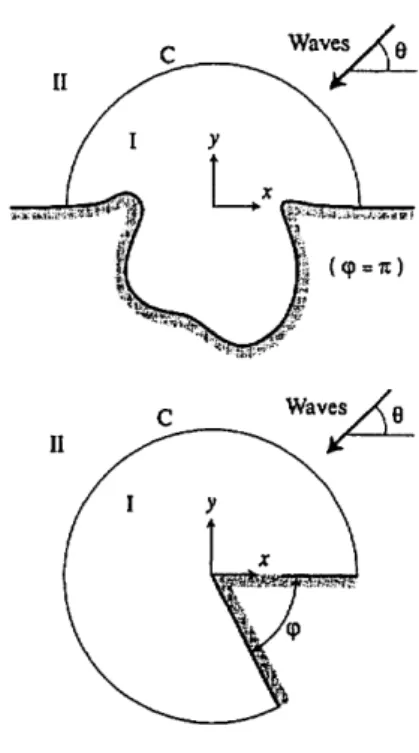
topography, as shown in Figure 1, i.e.,
t Mac OS is the Macintosh operation system ofApple Computer, Inc.
tt PostScript is a trademark ofAdobe Systems, Inc.
(1} Coastal harbor model (0 < Cp < 71).
(2} Islands model.
Figure l.Two types ofocean topography handled by CATWAVES.
• waves approaching a coastal harbor and
• waves approaching islands in the open ocean.
Additionally, the CATWAVES can handle wave motion in a
region where the discontinuity ofwater depth occurs. Therefore,
the boundary conditions handled in the model are:
• wave reflection along the shorelines and the boundary ofcoastal structures,
• water depth discontinuity, such as step-like changes in
reef coasts, and
• the Sommerfeld radiation condition at infinity.
For linear and nonlinear wave analyses, the numerical method
in terms ofthe infinite element for the exterior region (Tsutsui,
1999,2000) is newly developed to handle the boundary condition
at infinity. As the results, the finite element methodology, in this
case, governs all the regions ofthe problem. The coupling method
is also applied only to the linear wave analysis.
Note that phenomena of wave breaking of progressive waves
near the shorelines and of standing wave-type breaking in front of the coastal structures are not considered because the decision ofbreaker zones and/or breaking points is at this time very difficult. If possible, the treatment of wave breaking is straightforward (Tsutsui, 1993;Sulaiman,etal., 1994).
2.2 Background to the Numerical Model
The essential requirements for the finite element analysis in CATWAVES are:
• For the harbor model, there must be a straight coastline in the far field, along which the positive x-axis being set up, and the
angle q> formed by die two straight coastlines in the far field is
within the range from 0 to 7C, as shown in Figure 1 (1).
• Therefore, the CATWAVES can handle the unbounded
domain where there exists a semi-infinite breakwater or a wedge-shaped coast, such as results of reclamation.
• All the bathymetric changes must be located near the coordinate origin, as shown in Figure 1 (1).
• For die islands model, similarly, islands must be located near the coordinate origin, as shown in Figure 1 (2).
• The wave field should be divided into two regions - (I) an interior region and (II) an exterior region - by the arc or the circle denoted by C in Figure 1.
• The coastal topography and the water depth must change only in the interior region (I) that is the wave field of the finite element model.
• On the contrary, the water depth in the exterior region (II) is assumed to be constant, where the infinite element is applied and/or die series solution ofthe coupling method is formulated. • Two kinds of the method, therefore, are adopted to impose
the boundary condition at infinity.
(1) The interior and exterior regions are totally dealt widi the finite and infinite elements.
(2) The interior finite element solution and the exterior series solution are coupled on the temporary boundary C.
In appendix, the model equation of wave motion and the
sequence of equations to be solved are described briefly. The user
of CATWAVES is assumed to be familiar with the model equations, such as the mild-slope equation, and the finite element
methodology (Zienkiewicz, et al., 1977,1989). As such, no more explanation of either is included here.
2.3 Model Structure
The structure of CATWAVES is composed of three parts; (I) mesh generation,
(II) finite element solution and (III) graphics routines.
All the programs are coded in Fortran and there is no machine-depended statement/command. The flow of procedures and
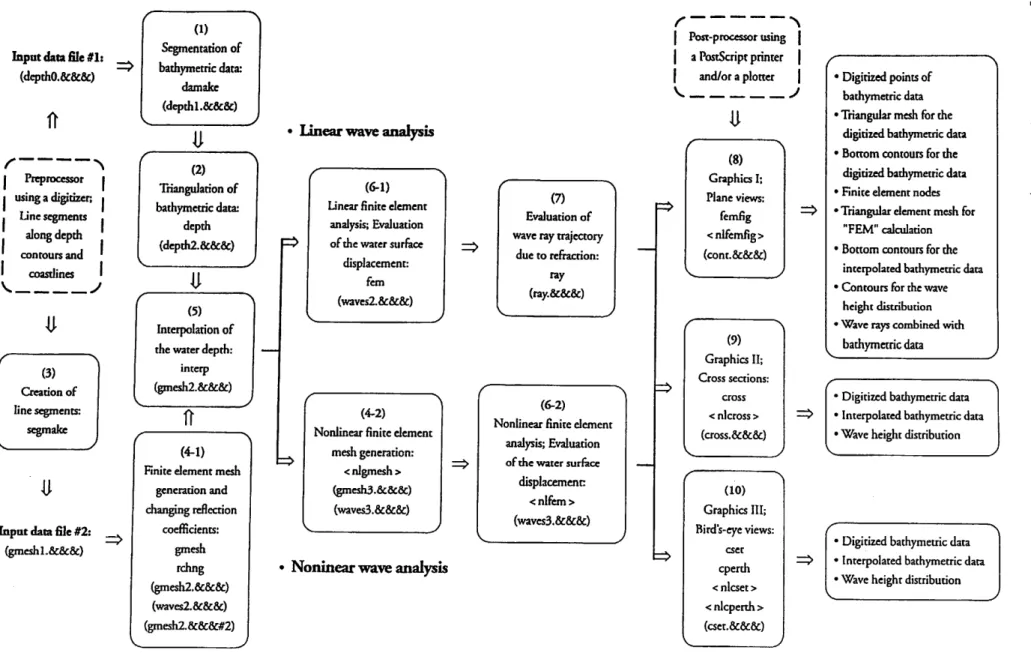
input/output (I/O) data files arc shown in Figure 2.
• The user is required to create two kinds of initial data files:
"depthO.&&&" for Routine 1 and "gmesh 1.&&&" for
Routine 4-1, where die characters "&&&" denote the part of the file name defined by die user.• For this purpose, you should prepare data for line segments along die coastlines and depth contours by using a preprocessor. • The programs coded in Fortran in each routine are defined as the routine name plus "m.f' for the main program and n.f' for the subprogram.
• Since the data files with ".&&&" except for the two initial data files will automatically be created in each routine, use them as the input data files in the succeeding process. • Internal OPEN/CLOSE statements are used for the definition
of I/O data files and hence the logical unit numbers (31,32,
..., 91, 92,...) used in die routines must be fixed.
• The I/O data file names shown in the parentheses, "depthO", "depth 1", "depth2", "gmeshl", ngmesh2", Bgmesh3", "waves2", "waves3", "ray", "cont", "cross" and "cset'Vare
arbitrary but they might be fixed for convenience ofintroducing all the procedures with the aide of an example.
• All the routines work interactively so that you can input necessary data, such as I/O date file names and variables, according to the instructions appearing on the screen. • Considering the problem concerned, however, you should
specify the dimensional parameters that declare the array's dimensional size in the main program.
• Routines necessary for the nonlinear wave analysis are shown in the angle brackets in Figure 2.
(I) Mesh Generation Routine
In order to easily prepare the badiymetric data and create die finite element mesh over the model region, the CATWAVES incorporates with an automatic triangular element mesh generation system (e.g., Lo, 1985).
For the linear wave analysis
• There are two kinds of triangular mesh for bathymetric and finite element regions.
• BauSymetric data are set up on the triangular element mesh by Routines 1 and 2, "damake" and "depuV.
• Routine "segmakc" in (3) creates line segments useful for the mesh generation data file "grneshl.&&£&".
• The triangular finite element mesh for the wave field is
generated by Routine "gmesh" in (4-1).
• If necessary, die reflection coefficients along die shorelines and the boundary of coastal structures can be changed widi the
aide of Routine "rchng" in (4-1).
• The water depth at each triangular element node is linearly
interpolated, by Routine "interp" in (5), from the digitized
badiymetric data already saved in the file "dcpth2.&&&".
For the nonlinear wave analysis
• According to the users request, Routine "gmesh" in (4-1) generates the new file "gmcsh2.&&" that has information
Input data file #1 (depthO,&&&)
ft
1 1 /**"~ — — —— «> 1 Preprocessor ■ using a digitizer, . Line segments afont* rl^nfh . cuuiig ucpui' contours and
1 1 coastlines V. J (3) Creation of Itne segments: segmake V JInput data file #2: (gmeshl.&&&) (1) Segmentation of bathymetric data: damake (depthl.&&&)
u
r s \ (2) Triangulation of bathymetric data: depth (depth2.&&&)1
U
(5) Interpolation of the water depth:interp (gmesh2.&&&)
—s -—•
(4-1) Finite element mesh
generation and changing reflection coefficients: gmesh rchng (gmesh2.&&&) (waves2.&&&) (gmesh2.&&)
J
linear wave analysis
Linear finite element analysis; Evaluation
ofthe water surface displacement:
fern
(waves2.&&&)
(4-2)
Nonlinear finite element mesh generation:
< nlgmesh >
(gmesh3.&&&)
(waves3.&&&:)
Noninear wave analysis
(7)
Evaluation of wave ray trajectory
due to refraction:
ray
(6-2)
Nonlinear finite element analysis; Evaluation ofthe water surface
displacement: <nlfem> (wavcs3.&&&) r -\ I Post-processor using | | a PostScript printer | | and/or a plotter | V, /
u
(8) Graphics I; Plane views: femfig <nlfemfig> (cont.&&&) (9) Graphics II; Cross sections: cross < nlcross > (cross.&&&) (10) Graphics III; Bird's-eye views: cset cperth < nlcset > < nlcperth > • Digitized points of bathymetric data• Triangular mesh for the digitized bathymetric data
• Bottom contours for the digitized bathymetric data • Finite element nodes • Triangular element mesh for
"FEMM calculation • Bottom contours for die
interpolated bathymetric data • Contours for the wave
height distribution • Wave rays combined with
bathymetric data
Digitized bathymetric data Interpolated bathymetric data
Wave height distribution
Digitized bathymetric data Interpolated bathymetric data Wave height distribution
(I) Mesh generation and 00 Finite element solution routines.
Figure 2. Structure of CATWAVES.
of the generated linear element mesh and is used to create the
nonlinear finite element mesh.
• This is Routine "nlgmesh" in (4.2) that generates the 6-nodes triangular element mesh in the specified region for the nonlinear
wave analysis.
(II) Finite Element Solution Routine
There are two main routines for the wave analysis:
• Routines "fem" and "nlfem" in (6) for linear and nonlinear
wave analyse are the main components of CATWAVES and
evaluate the water surface displacement at all the nodes of
triangular mesh.
• Based on the digitized bathymetry, Routine "ray" in (7) evaluates the wave ray trajectory due to refraction, the results ofwhich can be combined with bathymetric data in graphics routines.
(III) Graphics Routine
In order to visualize all the numerical results, vector data both for bathymetry and the wave height are generated with the post
processors, Routines 8,9 and 10. The routines with "nl" in their
names are for the numerical results ofthe nonlinear wave analysis. • For plane views, Routines "femfig" and "nlfemfig" in (8)
generate vector data describing the digitized points, finite
element nodes, triangular element mesh, contours for bathy
metry and wave height distribution, and wave rays. • Data for the cross section ofbathymetry and wave height distri
bution are created by Routines "cross" and "nlcross" in (9). • Routines "cset", "cperth", "nlcset" and "nlcperth" in (10) are
for getting bird's-eye views (perspective projection).
There are two kinds of vector data generated by the graphics routines 8 and 10.
• The first data are for convenience of providing for a plotting routine. A viewer for graphics, CATFIG, is presented. This is written in the C-language and works with Mac OS. • The second data are written in the PostScript language, which
should be handled by commercial-base graphics software and produce hi-qualicy graphics.
3. General Rules for Mesh Generation 3.1 Overview
Since the system of triangular element mesh generation plays
a significant role in handling bathymetric data and finite element grids, the general rules behind mesh generation is described. With the aide of segmentation of coastlines and depth contours, the finite element mesh in CATWAVES consists ofthe typical five line segments, including three particular mesh patterns, and the
central mesh.
3.2 Segmentation Processes
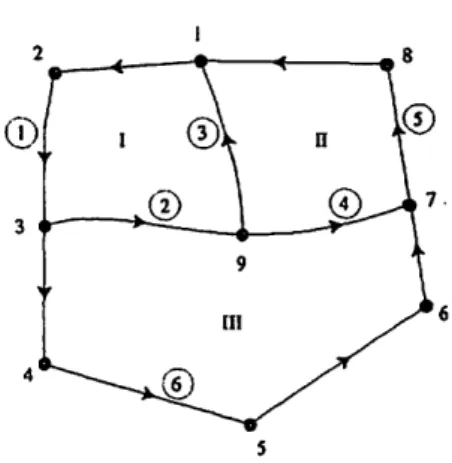
1. Divide, in general, the bathymetry and the wave field of the
finite element model into several subregions by line segments,
as shown in Figure 3. This process is normally essential because
Figure 3. Division of the wave field into three subregions.
of the following reasons. For bathymetric data
• In digitizing bathymetry, the data spacing depends on the density ofdepth contours and, therefore, you should digitize the shorelines and depth contours so as to get their smooth lines in graphics.
For the finite element mesh
• The computational accuracy of the water surface displace ment is directly affected by the element mesh size that must be decided according to the local wave length. For example, the mesh size recommended is about 1/15-1/20 ofthe local wave length. Therefore, you should vary the element mesh size locally.
• Dividing the wave field such that there are nearly the same number ofnodes in each subregion, you can save computing time.
2. The line segments are specified by the beginning and ending nodes, defined by the intersection of these line segments and by additional nodes.
3. Number all the nodes, line segments and subregions. For example, in Figure 3, the wave field is divided into three
subregions (I, II and III) by six line segments, (l)-(6), with
the beginning and ending nodes 1,3,7 and 9. Notes:
• The important premise in the numbering of nodes is that the nodes along line segments for the exterior boundary should be numbered anti-clockwise. For example, the line
segment (1) is defined by the nodes 1-2-3.
• This means that, by following the boundary line segment, the particular subregion ofinterest, e.g., the region I in Figure
3, is always on the left-hand side.
• An exception to this rule is numbering of nodes on the
interior common line segments for the subregions, i.e., (2),(3) and (4) in Figure 3. Since unidirectional numbering both
for the right and left subregions is impossible, the directionof numbering is arbitrary only in this case.
4. Define each subregion as a region surrounded by a set ofthese
line segments. It is important that me first line segment be a line on which the nodes are numbered anti-clockwiseaccording14 TSUTSUI: CATWAVES, Prediction of Linear and Nonlinear Wave Motion in Unbounded Coastal Domains
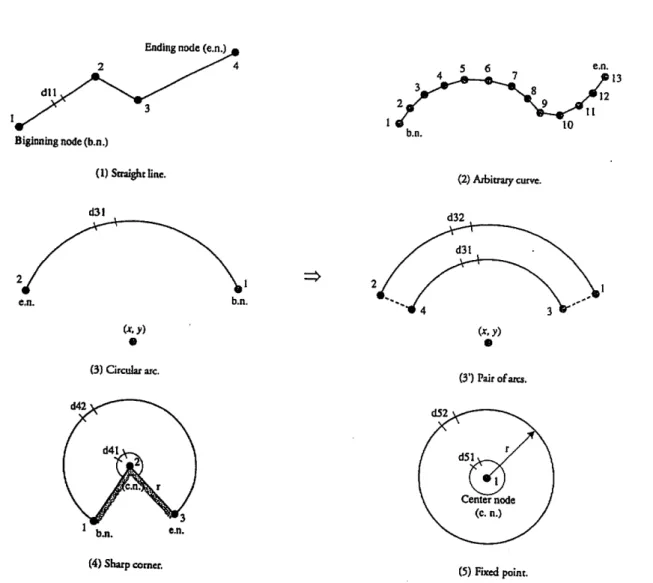
Table 1. Five types of line segments and data structure.
Types Index (is) Data structure etc. (See Figure 4)
Straight line Arbitrary curve Circular arc Sharp corner Fixed point 1* 2* 3* 4" 5*
Beginning and ending nodes, (if necessary, intermediate nodes), spacing on a line. Beginning, intermediate and ending nodes.
Beginning and ending nodes, center coordinate, spacing on an arc.
(A pair ofarcs is made by two arcs between which the mesh is generated, as shown in Figure 5.)
Beginning, center and ending nodes, radius of an outer arc, spacing on an inner and outer arcs.
CFhe refine mesh is progressively generated around a sharp corner, as shown in Figure 6.) Center node, radius of an outer circle, spacing on an inner and outer arcs.
(The radiarory mesh is generated from a fixed point, as shown in Figure 7.)
Ending node (e.n.)
dll Biginningnode(b.n.) (1) Straight line. ix.y) (3) Circular arc. d42 (5) Fixed point.
. Five types ofline segments used in the finite clement mesh generation routine.
to thepremise3 above. For example, ifthe nodes are numbered
in the direction ofthe arrows in Figure 3, the subregion II
should be defined as (4)-(5)-(3) or (5)-(3)-(4).
5. Ifbathymetric discontinuity exists, such as step-like disconti
nuity ofthe waterdepth, you should divide the wave field into
subregions by the line segments along discontinuity and
number the subregions from deeper to shallower ones.
3.3 Five Types ofLine Segments
Figure 5. Pair of arcs between which the mesh is
generated.
Figure 6. Mesh generation around a sharp coner. Figure 7. Mesh generation about a fixed point.
Figure 4, are used in the finite elemenc mesh generation routine. The index "is", a two-digit integer number, is used to define the type and the physical characteristic of each line segment. The type ofa line segment is classified by the number from 1 to 5t as defined in Table 1. The first row of "is", * inTable 1, is an indicator specifying the physical characteristic of a line segment. The following rules are defined:
1. Straight lines, arbitrary curves, circular arcs and sharp corners (in Figure 4 (4), lines 1-2-3 only) may be real boundaries, such as coasdines. In this case, let the first row ofindex "is" be "0" and specify the reflection coefficient along them. 2. If bathymetric discontinuity exists, let the first row of index
"is" be "1".
3. For the other cases, the first row should be a number except for "0"and"l".
4. The spacing, dl 1, d31,.... is used to decide the additional intermediate nodes on each line segment.
3.4 Three Kinds of Particular Mesh
Figures 5-7 show particular mesh generated between a pair of arcs, around a sharp corner and about a fixed point.
3.5 Central Mesh Generation
In the central subregion except for three kinds of particular mesh given in Figures 5-7, the equilateral triangular mesh is
generated as much as possible. The reason is that, in the finite
element analysis, the numerical error for the equilateral triangular
element is the minimum among those for all types oftriangles
with the same size.
4. Procedures in CATWAVES 4.1 Overview
The best way to understand how to use CATWAVES is to
examine it with the aide ofan example. This chapter is intended
to introduce all the procedures according to Figure 2, and describe
the I/O data files, variables, dimensional declarators and the data
form in each routine.
The frame for introducing each routine in CATWAVES is as
follows:
1. Main routine: Name of the main program.
2. Subroutine: Name of the subprogram.
3. I/O data files: Name of I/O data files and their concents.
4. Variable: Name ofvariables in the routine.
5. Dimensional declarators: Dimensional size of the array and its meaning.
The user of CATWAVES should specify the I/O date files and, if necessary, the variables according to the instructions appearing on the screen. The dimensional declarator should be defined by the PARAMETER statement in the main program. The termination with error messages will be caused when the dimensional space is not enough. In all the routines the spacial and time units are meter and second, respectively.
4.2 Procedures
■ Routine 1: Segmentation ofBathymetric Data
Purpose
This process is preparation for setting up the bathymetric data and therefore collects raw bathymetric data for each subregion, along the shorelines and depth contours.
Segmentation Processes
You have to digitized bathymetric data along the shorelines and depth contours in the following way:
1. Divide the wave field into several subregions.
2. Number all nodes. At this point, the nodes are intersections of
line segments and other necessary points. 3. Number all lbe segments and subregions. 4. Define line segments.
5. Define subregions by a set ofthese line segments.
6. Digitize depth data on line segments with suitable spacing. 7. Digitize interior depth data in each subregion with spacing
suitable for interpolation of depth contours.
8. Save data for line segments and subregions in "filer and save
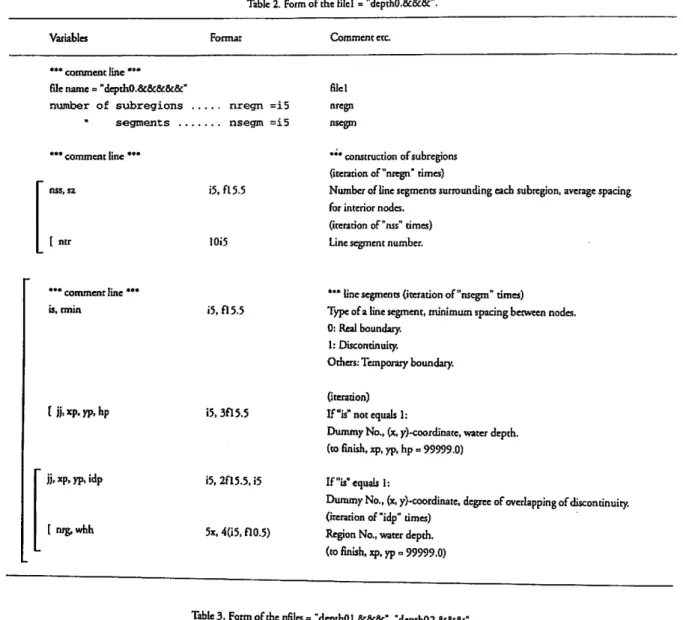
interior depth data in "pfile", according to the bathymetric data form, defined in Tables 2 and 3.Procedure
16 TSUTSUI: CATWAVES, Prediction of Linear and Nonlinear Wave Motion in Unbounded Coastal Domains Table 2. Form of thefilel = "depthO.&&&"
Variables
*** comment line **• File name = "depthO.&&&&&H number of subregions . " segments ... Format .... nregn =i5 =i5 Comment ecc. filel nregn nsegm " comment line' ass, sz [ ntr i5,fl5.5 10i5 *** construction ofsubregions
(iteration of "nregn" times}
Number of line segments surrounding each subregion, average spacing
for interior nodes. (iteration of "nss" times)
Line segment number.
**• comment line'
is, rmin i5. fl5.5
*** line segments (iteration of "nsegm" times)
Type ofa line segment, minimum spacing between nodes.
0: Real boundary. 1: Discontinuity.
Others: Temporary boundary.
jj, xp, yp, idp [ nrg,whh 15, 3fl5.5 i5,2fl5.5,i5 5x, 4(i5. fl0.5) (iteration) If "is" not equals 1:
Dummy No., (x, y)-coordinatc, water depth, (to finish, xp, yp, hp = 99999.0)
If "is" equals 1:
Dummy No., (x, y)-coordinate, degree ofoverlapping ofdiscontinuity,
(iteration of "idp" times) Region No., water depth,
(to finish, xp, yp = 99999.0)
Table 3. Form of the pfiles = "depth01.&&&", "depthO2.&&&"
Variables *** comment line' *** comment line' [ xp,yp,hp Format 5x,3fl5.5 Comment etc. (iteration)
(x, y)-coordinare, water depth.
(to finish, xp, yp, hp •» 99999.0)
2. Subroutine damakef
3. I/O data files
•fiiel = "depthO.&&&": Input file where data for line
segments and subregions have already been stored.
• pfile . "depth01.&&&", "depthO2.&&&",.... Input Hle(s)
where digitized interior bathjrmetric data in each
subregion have already- been stored.
• file2 = "depthl.&&&": Output filewhere the digitizedpoints
ofbathymetric data will be stored.
4. Variable
nfend Number ofpfile(s).
5. Dimensional declarators
mr
Maximum number ofsubregions.
ms Maximum number of line segments, mn 1 Maximum number of boundary nodes.mn2
Maximum number of interior nodes in each
sub-region.
Since, in general, interior depth data along the depth contour
lines and necessary points could be stored separately in some
files, this routine ask the user to input the number of"pfiles" and
The forms of input data files are defined in Tables 2 and 3. Notice that:
• The bracket means the range of iteration and the iteration count is in the comment column.
• The line segments surrounding each subregion must be closed. • For the bathymetric data, the type of line segments is an arbitrary line, hence the index "is" is a single-digit integer number, i.e., "0"," I",..., only to define physical characteristics (Refer to 3.3).
• Data on line segments are selected by checking whether the distance of adjacent nodes is greater than "rmin".
• For a bathymetric point necessary for segmentation, set the dummy number jj be "99999" and therefore the point is selected even if the distance is less than "rmin".
• Similarly, interior points for each subregion are selected accord ing to the spacing "sz". This routine excludes the unnecessary points that do not belong to any subregion.
B Routine 2: Triangulation of Bathymetric Data
Purpose
This routine generates the triangular mesh for digitized bathymetric nodes. Details of bathymetry are finally furnished
on the set of triangular elements. Procedure
1. Main routine: depthm.f 2. Subroutine: depth.f 3. I/O data files
• filel = "depthl .&&&": Input file where the digitized points ofbathymetric data have already been stored. • file2 = "deprh2.Sc&&": Output file where, after triangulation,
details of bathymetric data will be stored.
4. Dimensional declarators
Maximum number ofsubregions. Maximum number ofline segments. Maximum number ofelements.
Maximum number of nodes.
Maximum number of boundary nodes.
Maximum number of interior nodes in each
sub-Waves mr ms mn mnl mn2 region.
Example of a Harbor Model
Here, consider an example ofan artificial harbor model with a
submerged breakwater in front ofthe harbor mouth, as shown in
Figure 8 (1). In the semicircular region ofthe harbor, the water
depth decreases uniformly from 20m to 10m, as shown in the
cross section A-A. There is discontinuity along the submerged
breakwater where the water depth changes abrupdy from 20m
to 10m. Forsimplicity, let thewater depth in the remainingregion
be constant, say, 20m. It is assumed that there is the vertical wall
along the shorelines. The reflection coefficients along shorelines,
as shown in Figure 8 (1), are assumed to be 1.0, 0.5 and 0.3.
Figure 8 (2) shows the coordinate system and the shape
ofcoast-20.0m Submerged ,-breakwater "" 1.0 hd = 10.0m (1) Artificial harbour.
(2) Coordinate system and bathymetry.
(3) Segmentation ofbathymetric data. Figure 8. An artificial harbor model.
18
TSUTSUI : CATWAVES, Prediction of Linear and Nonlinear Wave Motion in Unbounded Coastal Domains
lines for bathymetry that covers the harbor model to interpolate
the nodal water depth.
The bathymetry is divided into three subregions, as shown in Figure 8 (3):
(I) the offshore region,
(II) the region on the submerged breakwater and (III) the region in the harbor.
The nodes and line segments are set up. The cross in all the subregions denotes internal points thatassumed to be on the depth contour lines. Notice that, in this example, the wave field on the
submerged breakwater is subdivided along the depth discontinu ous line (6).
■ Routine 3: Creation of line Segments
Purpose
This routine creates line segments (straight and arbitrary lines) with desired spacing. The results can be used in the input data file, "gmcshl.&&&", for finite element mesh generation. Notes that:
• You have to use the coastlines and particular depth contour tines with suitable spacing as the line segments for finite element mesh generation.
♦ The graphics routine "cross" helps you to generate raw bachymetric data useful for this purpose (Refer to Notes in Routine 9: Graphics II- Cross Sections).
Procedure
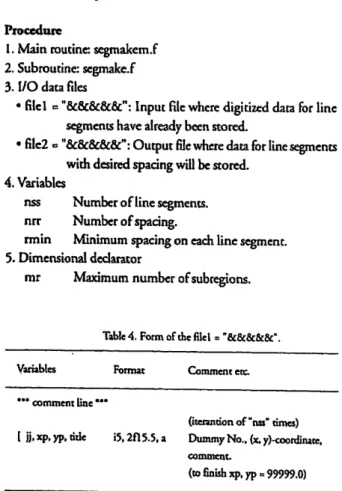
1. Main routine: segmakem.f 2. Subroutine: scgmake.f 3. I/O data files
• file1 = "6:8c&&6c": Input file where digitized data for line
segments have already been stored.
• filc2 = "&&&&&": Output file where data for line segments
with desired spacing will be stored. 4. Variables
nss Number ofline segments.
nrr Number ofspacing.
rmin Minimum spacing on each line segment. 5. Dimensional declarator
mr Maximum number ofsubregions.
Table 4. Form ofthe filet = "&&&&&".
Variables Format Comment etc
••* comment line ***
(iteiantion of "nss* times)
I jj. xp, yp, tide i5.2H5.5, a Dummy No., (x. y)-coo«linate,
comment.
(to finish xp,yp = 99999.0)
The form ofinput data for creation ofline segments is defined in Table 4. The bracket means the range of iteration and the
iteration count is in the comment column.
■ Routine 4: Finite Element Mesh Generation and Changing Reflection Coefficients
Purpose
The procedure presents two kinds of routine for generating the linear and nonlinear finite element mesh and also the routine for changing reflection coefficients along the shorelines and the boundary ofcoastal structures.
(1) Finite Element Mesh Generation
This routine generates the triangular element mesh over the wave field of the finite element model and provides you with capabilities of:
(a) changing the element mesh size in each subregion and (b) making the variable-band width ofthe coefficient matrix
of the system oflinear equations small. Remark that:
• The first demand (a) is realistic and, to do so, the wave field must be divided into subregions.
• The second one (b) comes from computational problems. Since the coefficient matrix of the system is sparse, the smaller the variable-band width of the coefficient matrix, saves the computer storage and, as a result, computing time. This task is accomplished by the procedure: renumbering ofnode numbers included in CATWAVES.
• The algorithm of renumbering of node numbers is similar to a widely-used Cuthill & McKee (1969) ordering, to reduce the variable-band width.
• Details of the generated finite element mesh are prepared for interpolation of the nodal water depth in Routine 5. Segmentation Processes
As described in Chapter 3: GeneralRulesfir Mesh Generation, the segmentation processes for finite element mesh generation
are:
1. Divide the wave field into several subregions.
2. Number all nodes. At this point, the nodes are intersections of
line segments and other necessary points.
3. Number all line segments and subregions.
4. Define line segments.
5. Define subregions by a set of these line segments. 6. Decide spacing on line segments.
7. Decide elements mesh sizes required for subregions. 8. After preparation, save data in "filel", according to the data
form ofthe finite element mesh, defined in Table 5. Reflection Coefficients
Among the five line segments, straight lines, arbitrary curves,
circular arcs and sharp corners may be boundaries along which
you have to specify reflection coefficients, according co the
following rules:
1. Reflection coefficients at all boundary nodes should be given
in advance.
2. Intermediate nodes are automatically created for straight lines,
circular arcs and sharp corners.
3. Reflection coefficients at these additional nodes on the
boundaries are evaluated as the same value ofthe former node,
e.g., in Figure 4, • for a straight line:
the value at the node 1 along the line 1-2, the value at the node 2 along the line 2-3, die value at die node 3 along the line 3-4, • for a circular arc the value at the node 1, • for a sharp corner: the value at the node 2.
4. For arbitrary curves, you should input reflection coefficients at
all the nodes. However, ifsome of the reflection coefficients
are successively the same, it is enough co input the value only
at the beginning node (Refer to Table 5). (4.1) Procedure for linear Mesh Generation
1. Main routine: gmeshm.f 2. Subroutine: gmesh.f 3. I/O data files
• filel »Mgmeshl.&&&": Input file where data for line segments and subregions have already been stored.
• file2 = "gmesh2.&&&": Output file where details of the
generated linear element mesh will be stored.
• file3 = "waves2.&&&": Output file where details of the
reflection coefficient will be stored.
• file4 »"gmesh2.&&": Output file where detail informa tion of the generated linear element mesh will be stored. This file will be created according to the user's request to generate nonlinear finite element mesh. 4. Variables
hO Constant water depth in the exterior region (in meters),
irenum Parameter for renumbering of node numbers; 0: No renumbering.
1: Renumbering to reduce the variable-band width of the coefficient matrix of the linear system, imesh Parameter for output the file4 = "gmesh2.&&";
0: No output (default). 1: Output.
5. Dimensional declarators
mr Maximum number ofsubregions.
ms Maximum number ofline segments.
mm Maximum number ofelements.
mn Maximum number of nodes.
mnl Maximum number ofboundary nodes.
mn2 Maximum number of interior nodes in each
sub-region.
mk
Maximum number of nodes on straight lines and
curves.
mi
Maximum number of layers in the three kinds of
particularly generated mesh, i.e., a pair ofarcs, a
sharp corner and a fixed point.The form of input data for finite element mesh generation is
defined in Table 5. Noce that:
• The bracket means the range of iteration and the iteration
count is in the comment column.
• Exclude the number ofsubregions defined by "pair ofarcs",
"sharp corner" and "fixed point" from the input number of
subregions, "nsubr".• Similarly, exclude the number of nodes on arbitrary curves
from the input numbers of nodes, "ninpt", "nbinpt" and
"ndinpt".
• In order to satisfy the assumption in Chapter I: Background andStructure for the finite element method, the outer segment mat separates the interior region from the exterior region should
be:
(1) a semi-ring for a harbor model or a ring for an islands
model, and
(2) the first line segment should be an arc or a circle. • To obtain a circle; let the beginning and ending nodes ofan
arc be the same node.
• The line segments surrounding each subregion must be dosed. (4.2) Procedure for Nonlinear Mesh Generation
Before running this routine, the user should prepare the mesh
and wave data files, i.e., "gmesh2.&&&", l1waves2.&&&" and
"gmesh2.&&", by the linear mesh generation routine "gmesh" in (4-1) and interpolate the nodal water depth in terms of Routine "interp" in (5).
1. Main routine: nlgmeshm.f 2. Subroutine: nlgmesh.f 3. I/O data files
• filel ="gmesh2.&&&": Input file where details of the generated linear element mesh and die nodal water depth have already been stored.
• file2 = "gmesh2.&&": Input file where detail information of the generated linear element mesh have already been stored.
• file3 = "waves2.&&&": Input file where details of the reflection coefficient for the linear wave analysis have already been stored.
• file4 = "gmesh3.&&&": Output file where details of the generated element mesh and the nodal water depth
for die nonlinear wave analysis will be stored. • file5 = "waves3.5c&&": Output file where details of the
reflection coefficient for the nonlinear wave analysis will be stored.
4. Variables
he Critical water depth (in meters); the region with the water depdi shallower than this value is assumed to be the region ofthe nonlinear wave analysis.
20 TSUTSUI: CATWAVES. Prediction of Linear and Nonlinear Wave Motion in Unbounded Coastal Domains
Table 5. Form of the filel = "gmeshl.&&&".
Variables Format Comment etc.
**• comment line ***
file name = "gmesh 1 .&&&&&" file 1
number of subregions nsubr =i5 nsubr
* input nodes ninpt =i5 ninpt
" input boundary nodes nbinpt =i5 nbinpt
* input discontinuity nodes . . ndinpt =i5 ndinpt
" segments nsegm =i5 nsegm
* pairs of arcs nparc =i5 nparc
" sharp corners nscor =i5 nscor
* fixed points nfpts =i5 nfpts
*** comment line "** (iteration of "ninpt" times)
I jj, wx, wy i5,2fl 5.5 Dummy No., (x, y)-coordinatc.
*** comment line If nbinpt > 0: (iteration of "nbinpt" times)
{ jj, ibw.wrc 2i5, ft0.5 Dummy No., boundary node, reflection coefficient.
•** comment line *** Ifndinpt > 0: (iteration of "ndinpt" times)
I jj» idw 2i5 Dummy No., discontinuity node.
•** comment line "* [f nparc > 0: (iteration of "nparc" times)
[ kpaicl, kparc2 2i5 Line segment numbers ofa pair ofarcs.
•M comment line — «• construction ofsubregions
(iteration of "nsubr" times)
nss'sz i5,fl5.5 Number ofline segments surrounding each subregion,
element mesh size. (iteration of "nss" times)
* ntr t0i5 Line segment number.
*'* line segments (iteration of "nsegm" times)
"•(DstraightUnes- ~ comment line
*5 Type ofa line segment.
nel'dl l
'5. fl0.5
Number ofnodes, spacing on a line.
(iteration of "nel" times)
1 ndl
10.5
Node number.
•" (2) arbitrary curves ••• ... commem ^
'5 Type ofa line segment.
nd21 ;e17 d • •Beginning node.i
(iteration)
I M. xp. yp. re i5i 3fl5 5 Dummjr ^^ fc y).coordinate) (£f neccssaiy> ^^
(to finish, xp, yp = 99999.0)
'5 Ending node.
*** (3) circular ares'" ...comment line..
, , '* Type ofa line segment.
nd31tnd32,x30,y30,d31 2i5 ?fin sw,nw.j r • •Beginning and ending nodes, center coordinate, spacing on an arc.j j. .
•-(4) sharp corners ••• ... ..
comment line
15 ._
... ,., ,_ l5 Type of a line segment
nd41,nd42.nd43.r4.d4l,d42 3i5 3nosjo. atiw.j n • •Beginning, center and ending nodes, radius of an outer arc,. , spacing on an inner and outer arcs.
*"• (5) fixed points —
comment line
Hl5.Ad51.d52
lm,
Typeofa.inesegment.
w 3HV3 center node, radim ofan outer circle, spacing on an inner and outer circles.
5. Dimensional declarators
mr Maximum number ofsubregions.
mm Maximum number ofelements,
mn Maximum number ofnodes,
mn 1 Maximum number ofboundary nodes.
mn2 Maximum number of interior nodes in each
sub-region.
(2) Changing Reflection Coefficients Along Boundaries After generation of the finite element mesh, Routine "rchng" in (4-1) can change the reflection coefficients along the shorelines and the boundary of the coastal structures. Notice however that to modify the reflection coefficients in the file "waves3.Bc&&"
for nonlinear wave analysis, you should make new file "waves2. &&&" by using this routine and later create the nonlinear finite
element mesh with the aide of Routine "nlgmesh" in (4-2). Procedure
1. Main routine: rchngm.f
2. Subroutine: rchng.f 3. I/O data files
• filel = "gmeshl.&&&": Input file where data for line segments and subregions have already been stored. New reflection coefficients to be modified should be
specified in this file.
• file2 a "gmesh2.&&&": Input file where details of the generated linear element mesh have already been
stored.
• file3 = "waves2.&&&": Input file where details of the
reflection coefficient have already been stored.
• file4 = "waves2.&&&": Output file where details of the modified reflection coefficient will now be stored.
4. Dimensional declarators
ms Maximum number of line segments.
mn Maximum number of nodes.
mn 1 Maximum number of boundary nodes.
mn2
Maximum number of interior nodes in each
sub-mk
region.
Maximum number of nodes on straight lines and
curves.
Note that data for new nodal reflection coefficients desired
should be specified in "filel" and the modified reflection coeffi
cients will be stored in the new file "file4". Example of the Harbor Model
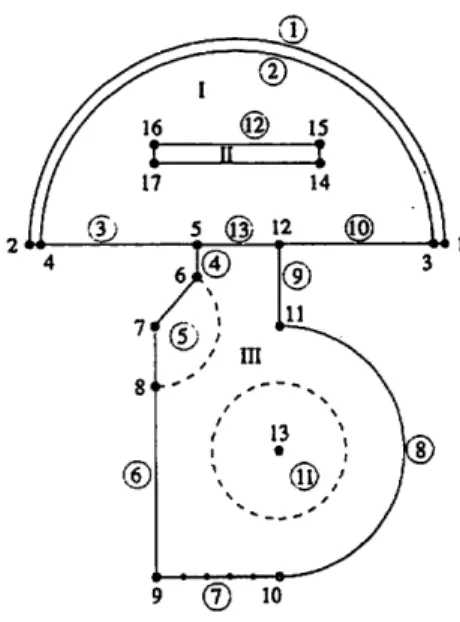
Consider the artificial harbor model, as was shown in Figure 8
(I). Figure 9 shows the result ofsegmentation of the wave field;
the nodes, line segments and subregions being numbered.
According to the fourth note in Procedurefor Linear Mesh
Generation, the outer region is the semi-ring defined by a pair of
arcs. To illustrate all line segments defined in CATWAVES, there
is an arbitrary curve between the nodes 9 and 10, a sharp corner
along the shoreline 6-7-8, and a fixed point about the node 13.
10
Figure 9. Segmentation of the wave field.
The others are straight lines.
As was seen in Figure 8 (1), the reflection coefficients are assumed to be:
1.0 along lines 2-4-5 and 1-3-12,
0.5 along lines 5-6-7-8-9-10 and 11-12, and
0.3 along the arc 10-11.
Note that the shape ofthe subregion on the submerged breakwater divided by the depth discontinuous line (12) is identical with die
corresponding region of bathymetry in Figure 8 (3).
B Routine 5: Interpolation ofthe Water Depth Purpose
So far, the bathymetric data file "depth2.&&&" and the finite
element mesh data file tfgmesh2.&&&" have been created.
Referring to the bathymetric data, diis routine completes the mesh
data by linearly interpolating the nodal water depth.Procedure
1. Main routine: interpm.f 2. Subroutine: interp.f
3. I/O data files
• filel o "depth2.&&&": Input file where, after triangulation,
details ofbathymetric data have already been stored.
• file2 = Mgmesh2.&&&": Input/output file where details of
the generated linear clement mesh have already been
stored. After interpolation, the nodal water depth will
be added. 4. Dimensional declarators
mr Maximum number ofsubregions.
mm Maximum number of elements,
mn Maximum number of nodes,
22 TSUTSU1 : CATWAVES, Prediction of Linear and Nonlinear Wave Motion in Unbounded Coastal Domains ■ Routine 6: Finite Element Analysis - Evaluation of Water
Surface Displacement -Purpose
This routine evaluates the water surface displacement at all the finite clement nodes based on the finite clement method in
terms of the infinite clement (Tsutsui, 1999, 2000) and the
coupling method (Chen and Mei, 1975; Mei, 1983). (6.1) Procedure for the Linear Wave Analysis 1. Main routine: fcmm.f
2. Subroutine: fcm.f 3. I/O data files
• filcl - "gmcsh2.&&&": Input file where details of the generated linear clement mesh and the nodal water depth have already been stored.
• fllc2 = "wavcs2.&&&": Input/output file where details of the reflection coefficient have already been stored. After calculation, the water surface displacement at all the nodes will be added.
4. Variables
T Wave period (in seconds).
thi Incident angle ofwaves (in degrees), measured anti clockwise from die positive x-axis, as in figure 1. 5. Dimensional declarators
mr Maximum number of subregions.
mm Maximum number of elements.
mn Maximum number ofnodes.
mnl Maximum number of boundary nodes.
mn2 Maximum number of nodes on the exterior arc or the exterior circle; This value is an index to the variable-band width of the sparse coefficient matrix of the linear system.
mn3 Maximum number of nonzero elements in the coefficient matrix of the linear system; Since the coefficient matrix is sparse and symmetric, nonzero elements in the right-upper triangular matrix arc stored in the one-dimensional array. An estimated value ofmn3 is about 0.01 Xmn(mn+l)/2. 6. Solution of the sparse linear systems
Since, in the linear wave analysis, the coefficient matrix ofthe system oflinear algebraic equations is ofsparse and symmetric, the so-called skyline method is implemented to solve the system.
The numerical results of the water surface displacement,
normalized by die incident wave amplitude, are complex values and the wave profile is sinusoidal. So that the nodal wave height
relative to die incident wave amplitude is evaluated by taking the absolute value of the water surface displacement.
(6.2) Procedure for the NonlinearWave Analysis
1. Main routine: nlfemm.f 2. Subroutine: nlfem.f 3. I/O data files
• filel = "gmesh3.&&&": Input file where details of the
generated nonlinear element mesh and the nodal water depth have already been stored.
• file2 = "waves3.&&&": Input/output file where details of the reflection coefficient have already been stored. After nonlinear evaluation, the water surface displacement at all the nodes will be added.
4. Variables
T Wave period (in seconds),
thi Incident angle ofwaves (in degrees), measured anti clockwise from the positive x-axis, as in Figure 1.
nf Number of Fourier modes.
aO Offshore incident wave amplitude (in meters). 5. Dimensional declarators
mnf Maximum number of Fourier modes.
mr Maximum number ofsubregions.
mm Maximum number of elements.
mn Maximum number of nodes.
mn 1 Maximum number of boundary nodes.
mn2 Maximum number of nodes on die exterior arc or the exterior circle.
mn3 Maximum number of nonzero elements in the coefficient matrix of the linear system; An estima ted value of mn3 is about 0.02X mn(mn+l)/2. mn4 Maximum number ofunknowns in the final coupled
system (= mnf Xmn)
mn5 Maximum number of nonzero elements in the coefficient matrix ofthe final coupled system (= mnf Xmnfxmn3)
mn6 Maximum dimensional size of the one-dimensional array where all the values of entries (fill-in) in the process ofGaussian elimination are stored. Note that the required space, mn6, for LU decomposition is a few times the number of nonzero elements, mn5-6. Solution of the sparse nonlinear systems
The model equation for nonlinear waves leads, after quasi-lincarization of die nonlinear terms, to the system of nonlinear algebraic equations, i.e., the unknown water surface displacement appears in the coefficient matrix of die system. The system is the coupled system of Fourier components specified and then the coefficient matrix is sparse, large and numerically unsymmetric but has the symmetric structure.
There may be some methodologies for solving this nonlinear system. Typical methods are (1) the direct iteration and (2) the numerical integration of the system ofordinary differential equa tions derived from the original system, in the manner similar to
die incremental method in the structural analysis (Zienkiewicz, et al., 1989) (See Appendix). To the method (1), the simple itera tive method and the Newton method are available. To die mediod (2), on the contrary, die predictor-corrector method, the backward Eulcr method and the Runge-Kutta-type mediod arc available. In all the cases, however, we should solve die unsymmetric system
of linear equations with the parameter of the incident wave
There exists a number of popular and powerful iterative
methods for solving linear systems, e.g., GMRES (Saad, el. al.,
1986), CGS (Sonnevdd, 1989) and Bi-CGSTAB (van dcrVorst!
1992; Tsucsui, et al., 1998c). The numerical values of the coeffi
cient matrix, however, are of complex due to the boundary
conditions imposed at infinity and therefore suitable precondi
tioned for the methods above and convergence properties areunknown.
In this package, therefore, the direct methods for sparse matrices
in terms ofsparse matrix techniques (Doff, et al., 1986) are worth
implementing for the key to solution. Among the public domainsoftware, Howell code MA28 (Duff, 1979) and/or the Y12M
(Zlatev, et al., 1981) are recommend to solve the system ofsparse unsymmetric linear equations. These are written in Fortran and available from netlib*, although the users obtaining MA28 in this way are still requested to sign a license agreement.Similar to the linear wave analysis, the numerical results of the water surface displacement, normalized by the incident wave amplitude, are complex values. However, the wave profile is not sinusoidal so that, after calculating the wave profile base on the
definition (See Appendix), the nodal wave height is evaluated as
the height between the maximum wave crest and the minimumwave trough.
Notice that the routine for the nonlinear wave analysis,
"nlfemm", covers the linear wave analysis, too, and therefore the
user can work with this routine both for linear and nonlinear wave motion.B Routine 7: Evaluation of Wave Ray Trajectory due to
Refraction Purpose
By using the digitized bathymetric data, this routine generates line segments ofthe wave ray trajectory due to refraction. In order
to visualize them combining with bathymetric data, you can use
the graphics routine 8: Graphics I - Plane Views.
Procedure
1. Main routine: raym.f 2. Subroutine: ray.f 3. I/O data files
• file 1 = "depth2.&&&:": Input file where, after triangulation, details of bathymetric data have already been stored. • file2 = "ray.&&&": Output file where data for line segments
of wave ray trajectory will be stored. 4. Variables
hO Constant water depth in the exterior region (in meters).
t netlib is the site of distribution of mathematical software via electronic mail in the Bell Research Labs.
T
Wave period (in seconds).
thi
Incident angle ofwaves, measured anti-clockwise
from the positive x-axis (in degrees),
nray Number ofwave rays,
xr, yr Starting points ofthe wave rays in (x, y)-coordinate
(in meters). 5. Attribute file for variables
• Attribute file = "&&&&&": Input file where all the variables
have already been stored. 6. Dimensional declarators
mr Maximum number ofsubregions.
mm Maximum number of elements,
mn Maximum number ofnodes.
ran 1 Maximum number ofboundary nodes. mr3 Maximum number ofwave rays.
Notes:
• Ifyou have not run this routine yet, the attribute file specifying
the variables necessary for computation will not exist. However,
you can interactively input the variables according to the instructions that appear on the screen, and save them in thespecific file.
• The routine traces a wave ray and when the wave reaches to the shoreline, quits computing.
B Routine 8: Graphics I - Plane Views
Purpose
As the post-processor, the graphics routine plots digitized nodes,
finite element nodes, triangular element mesh, contour lines and
wave rays.
Options
For ndata = 1; Digitized bathymetric raw data ("depthl.&&&"): • job b I: Digitized nodes.
For ndata = 2; Digitized bathymetric data ("depth2.&&&"): • job = 2: Triangular mesh.
• job = 3: Depth contours.
For ndata = 3; Interpolated bathymetric data and the wave height ("gmcsh2.&&&" and "wavcs2.&&&"): • job «s 4: Finite element nodes.
• job = 5: Triangular element mesh. • job = 6: Depth contours.
• job = 7: Contours for wave height distribution. Procedure
1. Main routine: fcmfigm.f 2. Subroutine: femfig.f 3. I/O data files (a) For ndata = 1:
• ftlel n "depthl.&&&": Input file where the digitized points of bathymetric data have already been stored. • file4 = "&&&&&": Output file where vector data for figures
24 TSUTSUI: CATWAVES, Prediction of Linear and Nonlinear Wave Motion in Unbounded Coastal Domains
(b) For ndata = 2:
• filel n "depth2.&&&": Input file where, after triangulation, details ofbathymetric data have already been scored. • file3 => "ray.&&&": Input file where data for line segments
ofwave ray trajectory have already been stored. • fi!c4 = "&&&&&": Output file where vector data for figures
will be stored.
• filc5 = "cont.fic&fic": Output file where line segments for contours will be stored and used for bird's-eye views in Routine tO.
(c) For ndata o 3:
• filcl n. "gmcsh2.&&&": Input file where details of the generated linear element mesh and the nodal water depth have already been scored.
• file2 « "wavcs2.&&&": Input file where the wave data have
already been stored.
• filc3 = "ray.flc8c&": Input file where data for line segments ofwave ray trajectory have already been stored. • file4 ■ "&&&&&": Output file where vector data for figures
will be stored.
• file5 = "cont.&&&": Output file where line segments for
contours will be stored and used for bird's-eye views in Routine 10.
4. Variables • For general use:
ndata Type of input data (1,2 and 3).
job
Option number (1,2,3,..., and 7).
isgn Index for data output of contours;0: No output (default).
1: Output when the user wish to use the contour lines of the water depth and/or the wave height distribution for birds-eye views.
iray
Index for combining wave ray trajectory due to
refraction with bathymetric data, only for the cases
of ndata » 2, job = 3 and ndata = 3, job = 6;
0: No combining (default). 1: Combining,
ibound 0: No drawing boundaries. 1: Drawing boundaries (default), ilabel 0: No labeling.
1: Labeling (default),
icoord 0: No drawing the coordinate origin.
1: Drawing the coordinate origin (default).• For the contours:
mch 1
Number ofcontours for the water depth.
mch2
Number ofcontours for the wave height,
hight
Values ofcontours for the water depth (in meters)
and wave height.
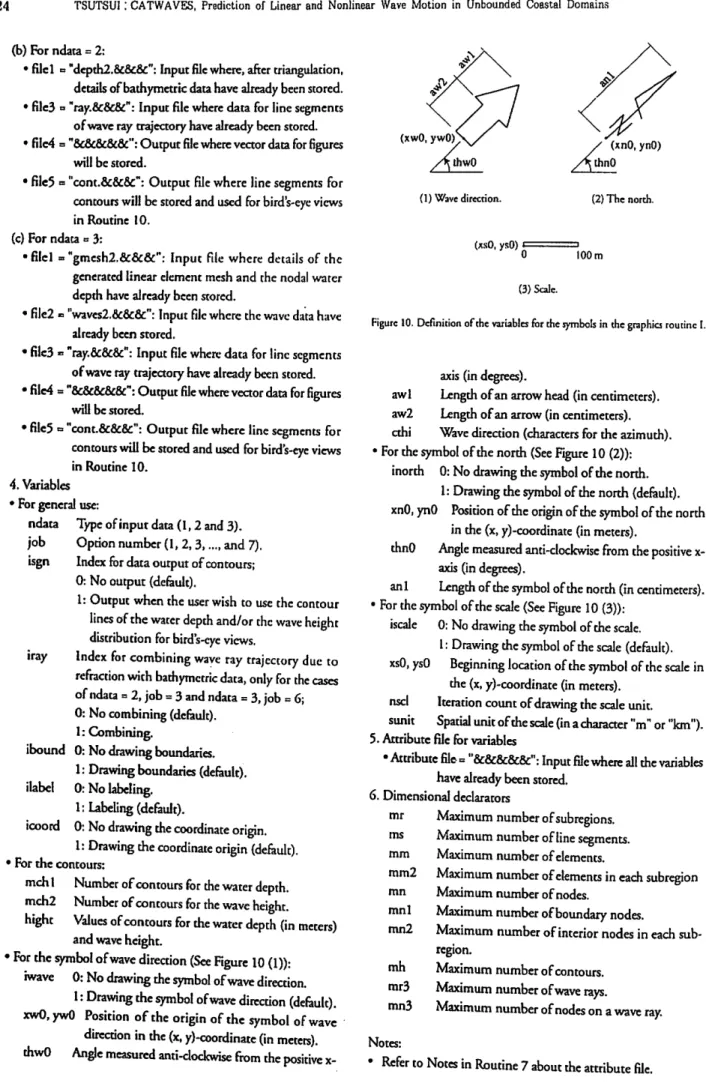
• For the symbol ofwave direction (See Figure 10 (1)):
iwave 0: No drawing the symbol ofwave direction.
1: Drawing the symbol ofwave direction (default).
xwO.ywO Position of the origin of the symbol of wave
direction in the (x, y)-coordinate On meters).
thwO
Angle measured anti-clockwise from the positive
x-(xwO, ywO) / jthwO (1) Wave direction. (xsO, ysO) (2) The north. 0 100 m (3) Scale.
Figure 10. Definition of the variables for the symbols in the graphics routine I.
axis (in degrees).
awl Length ofan arrow head (in centimeters). aw2 Length ofan arrow (in centimeters),
cthi Wave direction (characters for the azimuth).
• For the symbol ofthe north (See Figure 10 (2)):
inorth 0: No drawing the symbol of the north.
1: Drawing the symbol of the north (default). xnO, ynO Position ofthe origin of the symbol ofthe north
in the (x, y)-coordinate (in meters).
thnO
Angle measured anti-clockwise from the positive
x-axis (in degrees),
an 1 Length of the symbol ofthe north (in centimeters). • For the symbol ofthe scale (See Figure 10 (3)):
iscale 0: No drawing the symbol of the scale. 1: Drawing the symbol of the scale (default). xsO, ysO Beginning location of the symbol of the scale in
the (x, y)-coordinate (in meters),
nscl
Iteration count ofdrawing the scale unit,
sunk
Spatial unit ofthe scale (in a character "m" or "km").
5. Attribute file for variables• Attribute file = "&&&&&": Input file where all the variables
have already been stored.6. Dimensional declarators
mr Maximum number ofsubregions. ms Maximum number ofline segments, mm Maximum number ofelements.
mm2
Maximum number ofelements in each subregion
mn Maximum number of nodes,
mnl Maximum number ofboundary nodes.
mn2
Maximum number of interior nodes in each
sub-region.
mh
Maximum number ofcontours.
mr3
Maximum number ofwave rays.
mn3
Maximum number ofnodes on a wave ray.
Notes:Table 6. Form of vector data for plane figures.
Variables Format and comment etc.
• Drawing line:
1. lw, Ip T, 2i3
u, xp, yp. d, xp, yp [, d. xp, yp,...] V, 2f7.3. 'd'. 2f7.3 [, •d',2f7.3.
lw: Line width
!p: Line pattern (fixed to be 0 for solid line) (xp, yp): (x, y)-coordinat
"u" denotes pen up and "d", pen down. • Drawing comment and title
c, nc, xp, yp, wh, we, run, rise, slant 'c', i3, 2f7.3, 5f7.2
title
nc: Character size
(xp, yp): (x, y)-coordinate
(wh, we): Height and width ofcharacters (run, rise): (x, y)-vector of incline of the tide slant: Slant of characters
title: Characters
• Ending:
end 'end'
End of data
• The variables for the symbols and their origins shown by ° are defined in Figure 10.
• For the numerical results of the nonlinear wave analysis, use Routine "nlfemfig" and the I/O data files "gmesh3.&&&" and "waves3.&&&". Variables and dimensional declarators and so on are the same with those in Routine "femfig". Form ofVector Data
There are two kinds of vector data generated by this routine: • The first vector data arc for convenience of providing for a plotting routine. The form ofvector data is defined in Table 6. As was noticed before, the bracket means the range ofiteration. • A viewer, CATF1G, is presented for this data. It is written in
the C-language and works with Mac OS.
• The second vector data file, written in the PostScript language, is for commercial-base software that can deal with PS-file. This file is automatically generated and has the characters ".PS" at the end of the vector data file name.
Note that, in the following examples of the three graphics routines, the results for the linear wave analysis are firsdy presented and later the results of the nonlinear wave analysis will be shown.
Examples of Graphics I
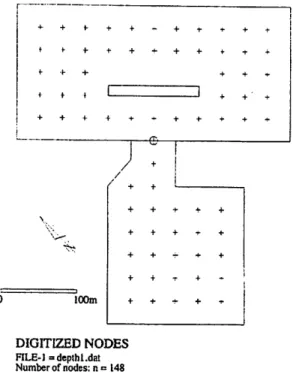
For the artificial harbor model demonstrated before, you can obtain the following graphic results according to the options. • Job = 1: Figure 11 shows the digitized nodes in case of the
100m + + -r + + + + -r + + + * + •* DIGITIZED NODES FILE-1= depthl.dat Number of nodes: n = 148
Figure 11. Disttized points representing bathymetric nodes (job = 1).
/ \
z
\N\i
100mz
z
z
\
\
A
A
~ \ DIGITIZED GRIDS OF WATER DEPTHFILE-1 = depth2.dat Number of elements: m = 225 Number of nodes: n = 143
Figure 12. Triangular mesh generated over the digitized bathymetric data (job = 2).
parameters ibound = 1, ilabel = 1, and icoord = 1. The line segments showing coastlines and temporary boundaries such as along the submerged breakwater are drawn by the solid line
and the interior points, by the cross. The cross with a circle
denotes the coordinate origin. Using this figure, you can check
26 TSUTSUI '. CATWAVES, Prediction of Linear and Nonlinear Wave Motion in Unbounded Coastal Domains
100m
CONTOURS: WATER DEPTH (Digitized) FILE-l=deplh2.dat
figure 13. Depth contours generated from the bathymerric data (job = 3).
Sharp corner
Fixed point
Figure 15. Three kinds ofparticularly generated mesh in CATWAVES; (1) the pair ofarcs, (2) the sharp corner and (3) the fixed point.
nfinSX
SSXKmGSSSSffiSSXKaCSSSSOSSa^
100m
FINITE ELEMENT NODES
RLE-l=gmeshidat Number of elements: m o 4537 Number of nodes: n » 2386
FINITE ELEMENT GRIDS
FILE-l=gmesh2.dat
Number of elements: m=4537 Number of nodes: n » 2386
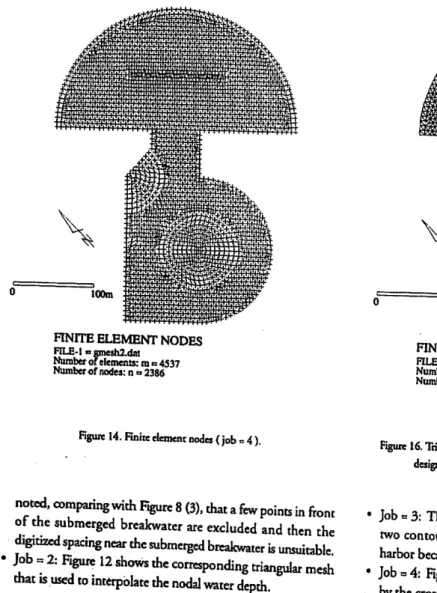
Figure 14. Finite element nodes (job = 4).
noted, comparingwith Figure 8 (3), that a fewpoints in front
of the submerged breakwater are excluded and then the
digitized spacing near the submerged breakwater is unsuitable.
Job = 2: Figure 12 shows the corresponding triangular mesh
that is used to interpolate the nodal water depth.
Figure 16. Triangular dement mesh for the linear finite element analysis,
designed for waves with the period of 10 sees. (job - 5).
Job = 3: The depth contours are shown in Figure 13. Only
two contour lines (10, 20m), in this case, are drawn in the
harbor because the sea bottom is flat in the other regions.
Job = 4: Figure 14 shows the finite element nodes indicated
CONTOURS: WATER DEPTH (Interpolated)
FILE-l = gmesh2.dat
Offshore water depth: hO = 20.00 in
Figure 17. Depth contours for the interpolated bathymetric data (job = 6 ).
CONTOURS: WAVE HEIGHT DISTRIBUTION FILE-l = gmesh2.dat
FILE-2 a waves2.dat Wave period: T = 10.00 sec Incident angle: THI = N45E
Job = 5: Figure 15 shows three kinds ofparticularly generated mesh in this example, defined in Chapter 2: GeneralRulesfir Mesh Generation. The triangular element mesh for the linear finite element analysis is shown in Figure 16. Note that the central mesh regions I-III in Figure 9, except for three particular mesh shown in Figure 15, are formed by nearly equilateral triangles. This mesh is designed for waves with the period of 10 seconds. The element mesh size is about 1/15-1/18 of the local wave length in the semicircular region ofthe harbor and
1/20 in the other regions.
Job = 6: The depth contours for interpolated bathymetric data
are shown in Figure 17, where there are two contour lines in the harbor. The contour line for 10m water depth is correct but that for 20m water depth is wrong because it should be a
straight line. The reason ofobtaining the zigzaz contour comes
from the fact that the corresponding region is not subdivided along the depth contours. This is an example of unsuitable subdivision of the bathymetric region of interest. Therefore, this indicates that in order to get correct depth contour lines,
the wave field of interest should be subdivided by using the
depth contour lines and the shorelines.
Job = 7: Figure 18 shows the comparison of the contours for
the wave height distribution ofthe linear wave analysis in terms of (1) the infinite element and (2) the coupling method. When the wave height relative to the incident wave height is greaterthan or equals 1.0, the contours are drawn by the solid line
and when less than 1.0, by the broken line. The interval ofthe
contours is 0.2. The thick arrow shows the direction ofwave
incidence. Though there existsa little discrepancy chiefly nearby
the harbor mouth, these results are agree well with each other.
(1) Evaluated in terms ofthe infinit element.
CONTOURS: WAVE HEIGHT DISTRIBUTION FILE-l = groesh2.dat
FILE-2 *» wavesldat Wave period: T = 10.00 sec Incident angle: TH1=N45E
(2) Evaluated in terms of the coupling method.
28 TSUTSUI : CATWAVES, Prediction of Linear and Nonlinear Wave Motion in Unbounded Coastal Domains
/ / /// >' / / //■■'' .■ /
/
////////////
//
/ / / / / / / / / / / / / / / / •-'-•■ -~ 100mCONTOURS: WATER DEPTH (Digitized)
FILE-1 =dcpth2.dat
(1) Combined with batymecric data (job = 3).
CONTOURS: WATER DEPTH (Interpolated)
RLE.legmesh2.da!Offshore water depth: hO = 20.00 m
(2) Combined with generated element mesh data (job = 6). Figure 19. Wave rays on the two lands ofdepth contours.
The partial standing waves formed in front of the straight shoreline (y = 0) and the submerged breakwater are clearly seen. With the aide ofpartial wave reflection by the submerged breakwater, the wave field in the harbor seems to become calm compared with the normal condition ofwave incidence. • Jobs = 3, 6: As the further illustration of graphics, Figure 19
shows an example of combination of the wave ray trajectory due to refraction with the depth contours obtained from (1) bathymetric data and (2) the generated element mesh data. The angle ofwave incidence, in this case, is 45 degrees. Wave rays are refracted at the edge of the submerged breakwater and when reaches to the shoreline, stop propagation. Combination of the wave ray trajectory with bathymetric data, Figure 19 (I), is usual for checking incidence ofwaves. On the contrary,
combination with generated element mesh is sometime
valuable for investigation ofwave rays together with the wave height distribution.
■ Routine 9: Graphics II - Cross Sections Purpose
This routine generates data for the values ofwater depth and wave height at any specified point and their cross sections, which
are available for commercial-base software. Options
For digitized bathymetric data ("depth2.&&&"):
• job = 1: Evaluation of the water depth at any point.
• job = 2: Cross section of the water depth along the
specified line.
For interpolated barliymetric data and the wave height
("gmesh2.&&&" and "waves2.&&&"):
• job = 3: Evaluation ofthe water depth and wave height
at any point.• job = 4: Cross section of the water depth and wave height along the specified line.
Procedure
1. Main routine: crossm.f 2. Subroutine: cross.f
3. I/O data files
(a) For jobs = 1 and 2:
• filel = "depth2.&&&": Input filewhere, after triangulation,
details ofbathymetric data have already been stored.
• file3 = "cross.&&:&": Output file where evaluated values of
water depth will be stored.
(b) For jobs = 3 and 4:
• filel = "gmesh2.&&&": Input file where details of the
generated linear element mesh and die nodal water
depth have already been stored.
• file2 = "waves2.&&&11: Input file where the wave data have
already been stored.