・Research Note ・
Stages of Democratization
of Central
Tibetan Administration
Mild Enoki
Introduction
The formal name of the Tibetan government-in-exile, headed by the 14th Dalai Lama1 who is both its spiritual and temporal leader, is the Central Tibetan Administration
(CTA). The Dalai Lama took refuge in India in 1959.2 Even in exile, CTA has succeeded in upholding its administrative functioning that was prevalent in Tibet before Chinese occupation. CTA was first established in Mussoorie, Uttaranchal on April 29, 1959, but was later shifted to Dharamsala, Himachal Pradesh in northwest India on May 1, 1960
and remains there till date.
At present, not a single country in the world has recognized Tibet as an independent state. In practice, however, CTA functions as a governmental organ. International societies are also involved in negotiating, exchanging and even extending their assistance towards this exiled government. Moreover, Tibetans both inside and outside Tibet regard CTA as their sole legal government.
Ever since CTA came into existence in refuge, and for the past 46 years, democratization of Tibet has been the sole aim of CTA. At present, application of CTA's ideology and statutory law is extended to Tibetans who live outside Tibet. These established laws and institutions are expected to apply also to Tibetans living inside Tibet when the exiled
榎 木 美 樹Miki Enoki
Author: Affiliated with Central Institute of Higher Deemed Studies, Deemed University, Sarnath, Varanasi, India
Subject: Sociology
Articles:"Buddhist Community in Contemporary India: A Case Study of Nagpur City", The Collection of lndian Philosophy and Buddhist Thought Theories, commemorative edition of professor Esho Mikogami, The Ryukoku University of Indian and Buddhist Studies, 2004. pp.177-215.
"
The Present Situation of Women and Children in Bangladesh", The Collection of Economic Theories of the Ryukoku University, Volume 42, No. 5, The Ryukoku University, 2004, pp.1-18.
Tibetans join the Tibetan homeland.
According to "Tibetan Demographic Survey3", the exiled Tibetan population reached 122,078 from the initial estimated population of 80,000 in 1959. The largest group of exiled Tibetans live in Asia, for example in India (85,147), Nepal (13,720) and Bhutan (1,584) [Planning Council 2000: 7].
The present study attempts to investigate the characteristics of democratization of Tibet which is enshrined by CTA. For this purpose, I consider the outline of practical reforms in Tibetan society in exile and examine the factors that have pushed democratization forward. The diasporic condition, especially landlessness and withdrawal of Tibet's aim for independence, has made the people turn towards democratization. The efforts of CTA for the accomplishment of democratization have shown that democratization can be achieved even without the state.
In the first section, I examine the concept of democratization in CTA. In the second section, I outline the process of introduction of democracy in exiled Tibetan community and institutions which are responsible for implementing democratization. In the third section, I try to illustrate the characteristics of democratization that CTA aims at. In the fourth and fifth sections, I try to study the progress of democratization from the political dimension. In the sixth section, I discuss the challenges for democratization.
There are two ways to represent Tibetan characters using the English alphabet, namely, the linguistically accurate way and the simple way of pronunciation. People who learn the Tibetan language can understand both ways, so I adopt the latter in this paper.
1. Democracy and Democratization in CTA
1-1. Definition of Democracy and Democratization
Democracy is not only a form of government. It is also a type of state as well as an order of society [Asirvatham 1995: 440]. Democracy refers to the rule by the people who have sovereign power of the state and the principle of individual equality and freedom [World Book Inc. 1995: 120]. The definition "government of the people, by the people, for the people" described by United States President Abraham Lincoln is generally used [ibid.: 120; Asirvatham ibid: 447]. Thus, the base of the ideology of democracy is the rule of majority.
Although the characteristics of democracy vary from one country to another, certain basic features-free election, majority rule and minority rights, political parties, control on power, constitutional government and private organizations-are more or less the same in all democratic nations [World Book Inc. op. cit.: 121-122]. More concretely, there are said to be 18 tools of democracy: ballot, citizenship, civil rights, constitution, due process of law, election, freedom, habeascorpus, initiative and referendum, jury, majority rule, plebiscite, political party, recall, trial, voting, voting machine, and women's suffrage. Even though all these tools may not be required, most of them are applied in a democratic
system [ibid.: 124].
According to a sociological point of view, as long as a certain political system in a state claims to be democratic, the term democracy is used to legitimate almost every kind of arrangement of political power [Marshall 1998: 146-147].
Democratization is the process of practice of democracy when a certain political system shifts from the previous polity to a new polity that expands the freedom of citizens. The goal in this process is the establishment of democracy.
1-2. Contemporary Conditions of Democracy and Democratization in Asia
If we look at the conditions of democracy and democratization in contemporary Asia, we see that they are full of diversity. In India, the world's largest democratic country, the government focuses upon discussion, dialogue and active participation of political parties. In Bangladesh, a moderate Muslim country which has passed through independence twice, democracy means regular, free, fair election and peaceful transfer of government. People's Republic of China (PRC) has partly introduced a free economic system as a part of democratization.
Here, I want to draw comparisons between the democratization which CTA carries out and that of other governments in exile. A similar example to CTA is the East Turkistan government-in-exile. The Uighur people invaded by the PRC were dispersed all over the world. They established a government-in-exile in Washington on September 14, 2004 [Official website of East Turkistan government-in-exile]. Since the purpose of the government-in-exile is the establishment of independence (Constitution, Article 9), there is no reference to the concrete target and contents of democracy or democratization, though the constitution incorporates clauses regarding respect towards democracy and human rights in general and implementation of democratic election. Its main activities include the appeal for legitimacy of East Turkistan as a state, criticism against the Chinese government and call for awareness of the issues among the international community.
There is also the example of National Coalition Government of the Union of Burma (NCGUB) in Myanmar: an exiled regime seeking democratization. However, in this case, the political power in opposition in the mainland and the exiled regime are compatriots. In Myanmar, where a military regime has continued since 1962, there is confrontation between State Peace and Development Council (SPDC)4 in power and National League of Council (NLD), the largest opposition party. Under such circumstances, NCGUB was inaugurated in Rockville in the state of Maryland, USA, in 1990 with the support of NLD and ethnic minorities against the SPDC. NCGUB, as does NLD, advocates democratization of Myanmar respecting the election result in 1990, transfer of political power based on this result, prohibition of control over the activities of opposition members using military power, protection of human rights including the rights of ethnic minorities, maintenance of federal government, solution to ethnic conflicts, and establishment of
freedom of speech and expression [Official website of NCGUB].
CTA fundamentally differs from the above mentioned case of East Turkistan since the Tibetan government-in-exile was established after loss of the country due to annexation. With an exiled formation it developed the elements for realizing the importance of democratization as other states had embarked upon. In other words, CTA transformed drastically from a feaudal society to a democratically governed society. In regard to the above-mentioned democratic tools, CTA undertakes some of those items (see Section 2). In this sense, CTA is committed to the application of democracy as it functions in other countries. The realization of democracy was enhanced and CTA was prepared to apply every mechanism in making the process of democratization fruitful
1-3. Theory of Democratization
The concept of democratization flourished from South European countries in the mid 1970s and later spread to the rest of the world. In a theoretical analysis of democratization, O'Donnell and Schumitter examined the process of transition based upon case studies of Southern Europe and South Africa. It was a pioneering paper on the transitional process of democratization [O'Donnell and Schumitter 1986] . Huntington applied the analytical framework of O'Donnell and Schumitter to Asia, the Soviet Union and East European countries [Huntington 1991]. The consolidation process of democracy, however, was not given any importance.
Lintz and Stepan studied the political fluctuations of countries in the 1990s especially those newly born democratic systems facing difficult problems, and discussed the conditions of consolidation and its process [Lintz and Stepan 1996]. In their argument, they attempted to present a systematic theoretical framework for a transitional democratic set-up and endorse it as a consistent framework within which the concept of consolidation could be studied. They focused upon the feature of the old regime and the concept of
"
stateness" as "two macro factors". The first factor, in addition to the type model of 3
old non-democratic regimes, the "post-totalitarian regime" was put forward and focused upon as a mode of political participation which enhances the democratization process and specifies the structural link [ibid.: 40-55]. The second factor has already been highlighted in "polyarchy" by Dahl [Dahl 1971] and also in participation orientated democratization by Rustow [Rustow 1970]. Lintz and Stepan clarified the concept of "stateness" that illuminates the complexity among the state, nation(s) and democratization, and also discussed the consolidation of democracy in multi-ethnic nations [ibid.: 16-37].
The problem of stateness concerns the basis of democratization of Tibetan society in exile. According to Lintz and Stepan, the sovereign state is a prerequisite condition for democracy; therefore, neither democratization nor democracy can be achieved when this condition is lacking, as in the case of Hong Kong [ibid.: 18-19], which enjoys only apparent political liberty since decisive power is in the hands of PRC. Thus, creating a democratic subsystem in a non-democratic state becomes impossible. Moreover, according to their
definition, India's democracy which emerged under British imperialism was not a full-fledged democracy until India attained independence [ibid.: 19-24]. In terms of these discussions, since Tibet is not a sovereign state at present, and CTA does not possess the territory where her people live, it lacks the decisive condition from the viewpoint of nation-state.
Since Tibet has established a government-in-exile outside the motherland, it is closer to the condition of Taiwan rather than Hong Kong. Taiwan claims to be a sovereign state, separated from PRC mainland [ibid.: 18-19]. Although the issue of stateness for Taiwan is significant [ibid.: XV], there is no specification about why Taiwan is a sovereign state. The issue of whether Tibet is independent or not has not been resolved till date. The exiled government claims independence as their legitimate right. But the problem of stateness for Tibet remains awkward, since its "condition" will be met when it gains independence, as it happened in the case of India. Those activities and policies in the society which are not defined as part of democracy, according to Lintz and Stepan, might suddenly be regarded as democratic features, as it happened when India gained independence.
The issue of Tibet can be described as an "undefined space" in international politics according to a sovereign state dominant perspective, and it could be difficult to define by the concepts mentioned above. Besides, the fact that Tibetans are divided into Tibet proper and society-in-exile makes the situation more complex. Therefore, in this paper, my argument starts with analyzing those activities which people believe to be democratization in the society-in-exile. I consider how Tibetan exiled society is undergoing a process to achieve democracy, namely democratization, and discuss the efforts by CTA.
2. The Step towards Democracy for Tibetans-in-exile
In this section, I outline the step towards democratization which has been practiced in India. Before this step, Tibetan society was described as "feudal" [Grunfeld 1996: 9] and
"
medieval" [ibid.: 33].
The first trial of democratization for the Tibetans was attempted gradually. It was divided into 3 steps. First, a framework of democracy was established through the introduction of a parliamentary democracy system and drafting of a constitution (the first half of 1960s). Next, the function of CTA was clearly and concretely written in a document in regard to the provision of a charter (1990-1991). Finally, as the latest development, a system of directly electing the executive chief was introduced (2001). These steps were irreversible processes which expanded the opportunity of political participation by the Tibetan people.
Incidentally, in this paper, while using the expression "CTA performed -", I also employ another expression "the 14th Dalai Lama performed -". This is not meant to praise the wisdom and distinguished services of the Dalai Lama. The Tibetan public, being the beneficiary of policies, are wholeheartedly devoted to the Dalai Lama (this point will be
explained
in detail in Section
4-1-1).
The people
often feel that the policies
are the decisions
of the 14th
Dalai Lama, even though the concrete executive
organ comes under CTA.
I employ
such expression
when I try to describe
this kind of feeling, because
anything
conducted
by CTA equally means that it is conducted
by the Dalai Lama. Moreover,
since the Dalai Lama is both the spiritual and temporal leader at present, his remarks
actually
affect
legislature
and administration.
No enforcement
of either policy
or document
is possible
if it is not approved
by him.
However,
the influence
of individual
attitudes
clouding
the opinion
of others, especially
in politics,
does not complement
democratic
perspectives.
Therefore,
for the democratization
of CTA, it is very significant
to know how to control
the power of the Dalai Lama as the
chief of state and also to transform the system
by engaging
the people to make possible
their political
determination.
2-1. The First Step (First Half of the 1960s)
After the 14th
Dalai Lama took refuge in India, Commission
of Tibetan People's
Deputies (CTPD)5, which constituted the parliament, was established as the first
implementation
of policy.
This was the very first trial for the Tibetan people to elect the
representatives
for CTPD. Aristocratic
and hereditary
influence
had no significance
in
this election.
Followed
by this, the assembly
annulled
all hereditary
titles and prerogatives
granted to small groups
of people
under the old system.
Moreover,
the assembly
abolished
the traditional
bi-polar system of appointing
monks and lay officials
to each position6
[TPPRC 1998: 277]. Right of vote was given to those above the age of 18 [Assembly
of
Tibetan People's
Deputies
2005: 14] and eligibility
of candidate
was given
to those above
25 years of age, both with irrespective
of sex [ibid.:
31]. On September
2, 1960, members
of the first Tibetan Parliament
were sworn in. This was the first concrete
step towards
democratization
of the Tibetan community.
In 1961, the Dalai Lama circulated
a draft democratic
constitution
for future Tibet.
Based on this, he promulgated
the Constitution
of Future Tibet on March 10, 1963.
2-2. The Second Step (1990 to 1991)
The parliamentary system for establishment of democratic norms was further
strengthened
because
31 years had passed since the Tibetans
became diasporas
[TPPRC
op. cit.: 262-267].
This was initiated following
the speech
by the 1456
Dalai Lama at the
10th
ATPD (Assembly
for Tibetan People's
Deputies).
As a result, large scale structural
reforms
of democratic
organizations
were conducted
through the discussions
in 10th
and
11th
ATPD.
At this stage,
crucial
elements
which determined
the current
system,
such as the charter,
composition
of the parliament,
political
retirement
of the Dalai Lama, future vision
of free
Tibet, and so on, were decided
upon.
rather than relying
upon the Dalai Lama. There
was in fact not much
change
in terms of the
authority
of the Dalai Lama. However,
the charter did enshrine
a provision
that even if he
seeks
political
retirement
he must bring it to the notice of parliament.
Although the Dalai
Lama has the power to decide and transform any policy matter, he has not applied this
authority
so far simply
because
of the fact that it would
go against
the values
of democracy.
Thus the mandate
of the people
or of the representatives
is given
immense
importance.
This
is seen as change not only in the system
but also in the people's
psychology.
The changes were as follows.
The constitution
needed to be revised for the entire
democratic
set-up since
it was meant for implementation
under a condition
of exile,
whereas
it was prepared in the form of a constitution
in view of an independent
country,
and its
total implementation
was not possible
[ibid.:
262 and 270]. The Constitution
Redrafting
Committee
was instituted
in 1990.
At the beginning
of 1991,
the draft of Charter of Rights
was circulated
to the people for suggestion
from all the Tibetan communities
in exile. The
committee
made the last draft in accordance
with feedback
and suggestion.
After the draft
was submitted
to the 11th
ATPD, it was approved
by both ATPD and the Dalai Lama.
Finally, the charter became
a clear guideline
for democratization
as a supreme
legitimate
law which supervised
the function of CTA. The charter clearly
and concretely
mentions
the governance
of exile administration
and model of a future free Tibet in regard to the
principle
of the constitution.
As the parliamentary
system
functioned
successfully,
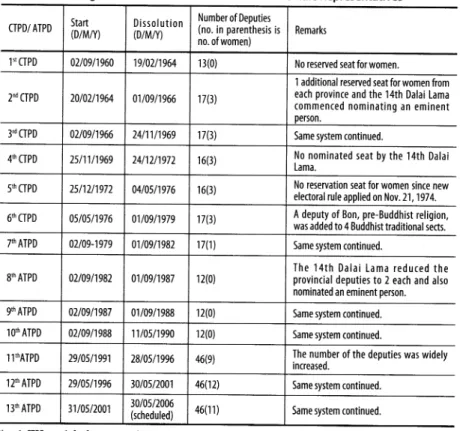
the number of seats for deputies
was increased
from 12 to 46, and the electoral
system
was also moderated
[see
Table 2].
Regarding
the self-denial
of Dalai Lama's
power,
he himself formally
raised the issue
at the 10th
and 11th
ATPD [TPPRC op. cit.:
263, 267 and 271]. It was however,
rejected
by
the assembly
[TPPRC 2003: 40]. Thus, the executive
power by the Dalai Lama continues
to be vested
in him at present,
though it is to be exercised
"in accordance
with the provisions
of the Charter" [ibid.:
54].
2-3. The Third Step (2001)
As a revolutionary
event for implementing
democratization,
direct electoral
system
for Kalon Tripa (executive
chief or chief minister)
was introduced
in 2001. This was seen
as a great development
in the practice
of democracy
compared
with the earlier process
of
appointing
Kalon
Tripa through Kalons
(ministers)
[ibid.:
45].
The electoral
process of Kalon Tripa is divided
into 2 phases, preliminary
and final,
which are held in Tibetan settlements
simultaneously
in one day. Firstly
in the preliminary
election,
Tibetan diaspora
in all over the world must submit
their choice
of name for Kalon
Tripa, irrespective
of sex, lay or ordained.
Central Election
Commission
(CEC) analyzes
the result through each Local Election Commission
(LEC). 6 nominees
are short-listed
as candidates
for Kalon Tripa. After the results come out, CEC confirms
whether the
nominees are willing to stand as candidates
or not. After this confirmation,
the name
and background
of the candidates
are announced
by CEC and circulated
to each Tibetan
settlement by LEC. Final election contest is held among the short-listed candidates. The person who receives the highest vote will be elected for Kalon Tripa for a 5-year term.
2-4. Present System
The political system of CTA is a parliamentary cabinet system [see Tablell For the structure of CTA, see Figure 1.
2-4-1. Kashag (Cabinet)
The Kashag is the supreme executive body of CTA and exercises the ultimate authority which is vested in the 14th Dalai Lama. The Kashag consults on the problems of the entire Tibetan community in exile and makes decisions with the 14th Dalai Lama.
The members of the Kashag are Kalons headed by Kalon Tripa. Kalon Tripa appoints a maximum of 7 Kalons and submits the list to ATPD [Assembly of Tibetan People's
Table 1 Political System of CTA after 1991
Deputies op. cit.: 14]. The assembly discusses the list accordingly and gives approval with a two-third majority.
Cabinet reshuffle has been conducted several times since 2001. The process of the reshuffle is as follows. Firstly Kalon Tripa proposes the plan and secondly the ATPD approves it with more than 50% of majority among the attendance. At present, Kashag is composed 4 members, including Kalon Tripa. The slogan of Kashag is "Truth , Non-violence and Genuine Democracy".
2-4-2. ATPD (Assembly of Tibetan People's Deputies)
ATPD is the highest organ of CTA instituted in 1960 [see Table 2]. It is headed by a Chair and a Vice-chair who are elected from the deputies. The sessions of the assembly are held twice every year. When the assembly is not in session, annual internal congress is Table 2 The Change in the Number of CTPD/ATPD and Female Representatives
Note 1. CTPD stands for Commission of Tibetan People's Deputies. 2. ATPD stands for Assembly of Tibetan People's Deputies. [Source: Excerpts from Parliamentary Secretariat of CTA]
handled by a standing committee of 12 members. For other members, therefore, there is no need to be permanently stationed at Dharamsala. The details of the 12 members of the standing committee are as follows: 2 from each province of Tibet, 1 from each religious denomination, and 1 who is nominated by the 14th Dalai Lama.
A budget is drawn up by a bottom rise formula through 5 organizations to the legislative. All the Tibetan settlement offices in exile present their annual requirement of budget to their respective departments and sections. These budgets along with the concerned departmental budgets are then submitted before the Department of Finance. The department scrutinizes and verifies the budget and then bring it before the Kashag after which it is submitted to the budget committee of ATPD. The said committee consists of 6 members which are nominated by the Standing Committee of ATPD. Finally the approval of budget is discussed during the budget session in parliament which is generally held in March every year. Decision of the budget is made by parliament deliberations and
the new fiscal year budget is carried out from April 1.
The budgets earmarked for the year 2006-2007 are as follows: promotion of awareness of the issue of Tibet (32%), welfare service (22%), education (15%), running cost of administration (10%), health (9%), religion and cultural activities (7%), and others (5%). The total outlay is about Rs. 882 million [Department of Finance 2005: 18].
The major sources of revenue are: contribution from the 14th Dalai Lama (25%), funds raised by the Kashag (25%), voluntary contributions collected through the Green Book (34%), administrative charge levied on aid (10%), and others (6%) [ibid.: 16-17].
The contributions based on the Green Book which constitute about one third of the specific gravity of a source of revenue are a kind of tax which the Tibetans pay to CTA voluntarily. Any man or woman, who is above 6 years of age and considers himself/herself to be part of a Tibetan community in exile, is encouraged to pay the CTA a yearly minimum of Rs. 58 and 4% of growth salary in the case of persons who have constant income. A Tibetan paying this contribution is acknowledged by the Green Book which approves him or her as a responsible Tibetan. This notebook serves as a required document for election registration. Although formal investigation about the number of Green Book holders and tax due has not been conducted until now, the person in charge of the Department of Finance estimates that about 90% of the Tibetans who reside in India, Nepal and Bhutan are voluntarily paying this contribution.
Assistance from a foreign country is usually invested directly through the project proposal which each department has planned and released. That is, a supporting organization gets to know about a project proposal through the website of CTA, publication and persons concerned. If they are interested, the supporting organizations come in contact with the concerned departments, discuss the parameters and provide the fund. In that case, 1% of the assistance fund is secured to the annual revenue of CTA as an administration charge. This amount constitutes 10% of the source of revenue.
2-4-3. Supreme Justice Commission
The Supreme Justice Commission is the highest judicial organ of CTA. Although the framework of the judicial system in the society in exile has been drafted in the constitution in 1963, it did not came into existence till 1990, as law and order constituted by each and every host country had to be given priority.
The members of the Commission consist of 1 Chief Justice Commissioner and 2 other Justice Commissioners. These 3 members are nominated by the 14th Dalai Lama and approved by ATPD. As long as two-third majority of the ATPD does not deny the members, the list made by the Dalai Lama will be confirmed and his approval is also sought for the resignation of the said members.
3. Characteristics of Democratization 3-1. Direct Election of the Executive Chief
Direct election of the Executive Chief was an attempt to maintain the equal relationship between the legislature and the executive. It was based on the idea that they will not be equal if the person in charge of the executive, a minister, is elected from the legislature, a member of parliament.
Before this system, the nominee by the 14th Dalai Lama became Kalon Tripa in the same way as other Kalons. Under this system, the authority of the Kalon Tripa as opposed to the other Kalons was minimal. Moreover, Kalons hardly had a sense of responsibility towards the parliament and the people. They simply had the pride of being a Kalon nominated by the Dalai Lama.
After 2001, Kalon Tripa has been elected directly by the people. The nominees for the Kalon selected by Kalon Tripa are laid before the ATPD for approval. Listed Kalons take oath in case there is any objection against a particular nominee. Secret ballot is carried out among the representatives if a reason for objection is given. Disapproval is decided when more than 50% of the attendants vote for objection.
Since the new system has been introduced, each Kalon has obligation towards Kalon Tripa. At the same time, approval from ATPD is required in the process of deciding a
Kalon, so that the legitimate role of Kalon towards ATPD can be determined. 3-2. Non-party System
Since the representative of ATPD is elected from provincial and denominational backgrounds, it is regarded that there is no need for a party system in politics-in-exile. In the Tibetan society in exile in India, there are organizations which are established with a certain ideological background, such as Tibetan Youth Congress, Tibetan Women's Association, National Democratic Party of Tibet, and so on. The definition of these organizations, however, is NGO but they are also termed as political parties.
of ATPD under the present system. Thus, it is perceived that the active interaction between executive and legislature can be possible without a party system since the ATPD acts critically against the suggestion or supervision by Kalons, as if it plays the role of an opposition party when and if such situations arise.
3-3. Practice of Non-violence
Democracy embodies a moral principle and no government has a right to be called democratic if it does not bring out the best in human beings [Asirvatham op. cit.: 447]. Moral principles are the ground for decision making processes and enhance initiatives in any social, political, economic or cultural dimension. In this sense, moral principles among the concerned people are important for democracy to materialize. Unlike forms of democratization in other countries, moral principles are emphasized very much in the case of CTA.
For Tibetans, the most important part of their moral principles is Buddhism and its values.7 Democratization of Tibet is based upon the principle of non-violence and peace, though it also upholds the traditional values of Tibet and the reality of present circumstances [TPPRC 1998, op. cit.: 272].
The principle of non-violence is based on the principle of interdependence of cause and effect, which is deeply rooted in the world-view of Mahayana Buddhism. According to this tradition, every phenomenon in this world is part of the relationship of interdependence, and this understanding leads to the principle of non-violence [ibid.: X]. The idea of non-violence can be an absolute ideology to overcome violence and injustice through love and compassion [ibid.: 89-93]. Without the practice of non-violence, only a negative chain of actions will be brought about in human relationships. Politics, too, is not an exception. Therefore, the principle of non-violence is not merely a religious tenet but a practical method.
3-4. Democratization from the Top
As I have described above, key factors, such as establishment of parliamentary system, proclamation of the constitution, introduction of direct election of Kalon Tripa, establishment of independent judicial organ and gradual shift towards secularism, were proposed and initiated by the 14th Dalai Lama. Unlike other process of democratization applied in different countries that eventually provides political freedom and awareness, democratization in exiled Tibet has been awarded by the leader himself. In this sense, the structure of authority is quite centralized.
Sweeping reforms will not be possible if there is no "enforcement" made by the Dalai Lama. The people's faith in him is unimaginably strong and absolute (I will discuss this point in Section 4-1-1 in detail).
Moreover, it is important to note here that Tibet's original social order has been irreversibly altered by the influence of Chinese communism and the upheavals of 1959 [Grunfeld op. cit.: 8]. The drastic change in the situation in exile in which the old system
failed to function ironically worked as a factor to ensure reforms in the social attitude (I will discuss this point in detail in Section 4-1-2).
4. The Factors for the Progress of Democratization
In this section, I examine the factors that affect the promotion of democratization. They are 3 internal factors (from 4-1 to 4-3 in this chapter) and 1 external factor (4-4).
4-1. Exile: Landlessness 4-1-1. Formation of Tibetan-ness
The formation of national consciousness creates an identity of Tibetan-ness and gives an impression of unity among the community. This unity is further strengthened by the leadership of the 14th Dalai Lama as a religious symbol.
Next, I would like to discuss the issue of self-identity developed by individuals. Tibetan refugees had to live together in camps or settlements, irrespective of tribal differences. They had to work together as pioneers since most of the land provided by the host country was uncultivated land. This resulted in an emergence of consciousness as a community.
A notable example that illustrates this point was the creation of so-called "common language" and "national costume". For instance, in Dharamsala, the Lhasa dialect came to be spoken as the common Tibetan language that merged 3 main regions in Tibet . Regarding clothes, an arranged style of Lhasa became the popular fashion, especially in the case of women's costume. Of course, it is needless to say that neither the original languages nor costumes were denied. Moreover, even in the case of other settlements which comprised of specific tribes, the language of Dharamsala is at least understood and all of their devotion is oriented towards the Dalai Lama.
At the beginning of his life in exile, the 14th Dalai Lama visited various places for pilgrimage in India and inspected the refugee camps. He presented a long-term plan he had conceived in front of the Tibetan refugees, in which the reconstruction of society in exile and the struggle for Tibet's independence would be combined. He also expressed his sympathy towards the hardship that every single person experienced and their hopes of returning to Tibet [Avedon 1997: 78, 82, 89]. Through such interaction, each individual felt directly connected with the Dalai Lama psychologically since he took upon himself the agony and hope for return to the motherland.
Here, I want to examine the significance of Dalai Lama's presence for the Tibetan people. Most Tibetans are more anxious about Dalai Lama's safety than their own. Many people say that they went into exile because the Dalai Lama had taken refuge in India in early days of the mass flow of them. It is common even today that a person departs for death with great satisfaction after having audience with the Dalai Lama [Avedon ibid.: 78-79], and people are very excited simply to have an audience with him [ibid.: 185]. For the Tibetans, Dalai Lama is the symbol of both nation and religion. Even the present day
young generation, who have never been to the Tibetan mainland, feel fortunate to see the Dalai Lama not only in pictures but also in person.
This kind of attitude is not easy to understand for a person, including myself, who has received a modern education based on secularism, especially the post-war education of Japan. Such phenomena might appear as fanaticism, blind faith or brainwashing. As I have already described, however, exiled Tibetans have constructed a direct psychological
connection with the Dalai Lama. It was precisely because "the holiest presence" (Gongsa Chenpo in Tibetan, one of the names the Tibetans use to address the Dalai Lama) took an initiative towards democratization that the people were able to unite beyond their original identities.
As I will mention in Section 5-2, when Tibet made a decision to withdraw her independence, Tibetans in exile reached agreement because the Dalai Lama had finally proposed and explained it to the people. Although there was big controversy among the communities in exile, it did not develop into division of the nation.
Irrespective of people's wish, the Dalai Lama's wish or word is the ultimate decision which is obliged by the Tibetan masses. Recently, the 14th Dalai Lama criticized Tibetans
residing in Tibet for wearing animal skins as a part of fashion, during the Kalachakra initiation held in January 2006 in India. Few days later, Tibetans inside Tibet responded in a practical demonstration by burning those clothes as a gesture of respect towards his words and to protect those endangered species.
4-1-2. Democracy, one and the only option
Defection and loss of the motherland has led to the formation of national consciousness and theoretical introduction of democracy. In this section, I discuss the introduction of democracy, ideal environment, state of refugee and landlessness.
After the Tibetans had recovered from the harsh experience of foreign invasion, they were prepared to undertake a structural change. The democratization process started in the year 1960 shortly after they went into exile. The changes were especially remarkable in the monastic estates.
In the past, Dalai Lama's initiatives for social reform and modernization executed in Tibet were obstructed by the monastic estates and the people [Shakabpa 1984: 264, 265, 289]. The monastic estates had dominated the Tibetan polity, leading to Tibet being described as an "Ecclesiastical State" [Stein 1972: 138]. But Chinese invasion of Tibet paved the way for even the monastic institution to realize the importance of democracy. Many of the monks who took refuge in India have re-established their monastery and some of them have even become members of parliament in the community in exile. These monks frankly admit the importance of democratization.
Before 1959, the source of power and wealth was land. More than 50% of the land was owned by the ruling group, namely monasteries, lay nobilities, and the Lhasa government [Grunfeld op. cit.: 9-10]. These lands were given by the Lhasa government to both
monasteries
and noble families
to serve the government
in return [ibid.:
10]. The estate
owner was given certain authority
to administer
the villages
in the estate. It is necessary
to
note here that the Tibetan people
became
subjected
to their landlord
because
of their need
for land. It was the only way for them to survive.
While the loss of land meant the loss of
living, it also meant release
from land. Thus, the Tibetan people were mentally prepared
to pursue reform through democratic
practices
whilst living in exile.
4-2. Tradition of Majority Rule
There was originally
a tradition in Tibet that majority
rule is ideal. In the Tibetan epic
poem, decisions
are always
submitted
to a gathering of the "people"
[Stein op. cit.: 130].
According
to Stein, the Tibetan epic poem is a good mirror of society,
though it certainly
idealizes
it and the institutions
it describes
are not all historical
[ibid.:
130]. The "people"
in it were not necessarily
always
from the common
folk but could have been "from noble
clans to beggars"
[ibid.:
130]. Moreover,
the first monarch was elected
by his peers, and
enthronement
in Tibetan means "to be elected
to the throne" [ibid.:
130].
In Gaden Phodrang,
the power of the Dalai Lama is absolute
in theory,
but in practice,
he does not exercise
his authority
without consultation
[Shakabpa
op. cit.:
21]. The Kashag,
one of the consultative
bodies, consists
of 4 members
and the decision
should be made
unanimously
[ibid.:
150]. Furthermore,
even the village
headman
and the leader of a tribe
were elected
at least in the eighteenth
century [Stein op. cit.: 127]. Thus, Tibetan people
have relied upon the concept
of majority
view since early times.
4-3. The Rise of Young Generation: Politicization of Young Generation and
the Role of NGO
Among the exiled
Tibetans, the youth took concrete
steps in promoting
awareness
of
the significance
of modern political
education
along with religious
practice.
It is believed
that the Tibetan people
were oriented towards
religion
rather than politics
which resulted
in a foreign invasion of their land [Avedon
op. cit.: 100]. Tibetans born in Tibet never
thought of such implications.
These young men have initiated
various organizations
with different
ideals to express
political
as well as social
opinions.
The Tibetan Youth Congress
became the forerunner.
On October
7, 1970,
the Congress
held a conference
in order to construct
a union of exiled
youths and to call for more aggressive
struggle
for Tibetan freedom. 300 youths in exile
gathered and sat in front of the cabinet members
of that time. The youth asked the cabinet
point-blank
about
the blunder
of the previous
cabinet
which allowed
the Chinese
invasion,
favouritism
in the present administration,
misuse
of funds, and so on [ibid.:
110].
Young men's ideological
development
is viewed as significant
to NGOs which work
as a forum for discussion
and opinion
exchange
regarding
the prospective
vision of Tibet.
Moreover,
these NGO projects
specify
candidates
at the time of elections.
It is impossible
in reality for someone
in the younger
age group to get votes in an election
as an individual
candidate without support from NGOs since his/her political and social achievements are insufficient.
4-4. Unsuccessful Negotiation with Chinese Leadership
An external factor which coincided with the development of democratization was the unsuccessful negotiation with the Chinese leadership from the 1970s to the 1980s.
As explained in detail in the following section, a fact-finding delegation from Dharamsala to PRC was sent 3 times since 1979 to seek direct negotiation with Beijing. At the European Parliament on June 15, 1988, the 14th Dalai Lama presented Strasburg a proposal which declared the withdrawal of Tibet's independence and sought for genuine autonomy within the framework of PRC as the most realistic approach towards a peaceful solution of the Tibetan issue. 3 months later, the embassy of PRC in Delhi gave an indirect reply to the proposal and expressed interest in negotiation. But finally, direct dialogue did not materialize since the conditions of both sides did not match. As a result, the dialogue did not succeed, except that there was an exchange of official letters. The situation was the same in the second year, too, and a mood of apathy began to pervade.
In such situation, in the 10th ATPD in 1990, the 14th Dalai Lama looked back upon the Tibetan society in exile over the past 31 years and made a speech regarding the necessity of strengthening democracy [TPPRC 1998, op. cit.: 262-267].In this way, as I described in Section 2, the second step of democratization had started in 1991. Incidentally, the negotiation with PRC could not take place after 1993 and relations came to a deadlock till September 2002.
Experience of negotiations not progressing has made the Tibetans, especially those people who serve in the legislation and executive body, recognize the necessity for further democratization in spite of calling for a decision to abandon the idea of independence. Emphasis was placed upon the question of whether Tibet would pursue independence or genuine autonomy within the Chinese framework. At the same time, moderations were made in the democratic set-up of CTA as the second and third steps.
5. Dynamism of Tibetan Politics (After 1959)
5-1. From Gaden Phodrang to CTA
The government-in-exile
established
in India in 1959
succeeded
the Gaden Phodrang
(Lhasa
government)
politically.
This meant that the previous
system
was not competent
to
secure
autonomy
of its motherland.
Since 1642, the administrative
structure of Gaden Phodrang was characterized
as
follows:
the state was dominated
by monks, power of the decision-making
body and the
executive
body in the government
was divided
and administration
decentralized
[Rahul
1969: 49-50]. The strong point of this organization
was that it prevented
a dictatorship
from developing
and reduced
dishonesty
to a minimum
since
a mutual monitoring
function
was at work [Avedon op. cit.: 16; Shakabpa op. cit.: 150-151]. Conversely, effectiveness of responsibility was absent and determination was delayed [Shakabpa op. cit.: 150], since it was difficult to achieve centralization and factionalism gained power [Avedon op. cit.: 18]. As Tibet remained isolated until the twentieth century, it can be said that the organization succeeded in maintaining the country's isolation. But this isolation proved responsible for foreign invasion.
CTA carried out structural reform of the government with the following features. This can be understood as an attempt at overcoming the weak points of the previous government. First, the government became free from the domination of monks. From an ideological point of view, this was adoption of secularism and from a policy point of view, control of power. The power of monks in Gaden Phodrang, namely the Dalai Lama, regent, and monk official, was declared and restricted by basic laws in the constitution and charter.
Although the Dalai Lama is still the sovereign of the state at present, his status will be changed into a position of having only executive rights in the religious field [TPPRC 1998, op. cit.: 280-281; Samdong Rinpoche 1996: 36]. A regency will be elected by the parliament just as it was elected during the time of Gadeng Phodrang. Unlike the time of Gadeng Phodrang when the power was centralized on one regent who was a monk, the council of regency will constitute 3 members including one chief regent in the new system [Assemble of Tibetan People's Deputies 2005: 19]. Regarding the monk official, the traditional dual system where ordained and noble officials shared a post in the government with equal power is abolished. Under the new system, the person who is elected will be a member of parliament and the person who has passed the entrance examination of the government or has certain professional skills will be a government officer. Therefore, in some cases, an officer might be a monk, but it will no longer be the custom that a monk will be an officer.
Next, the assignments are made clear with specific limitations and independence. By this, a member of parliament and Executive Chief will have responsibility towards the people and a minister towards the Executive Chief. From this point of view, as I mentioned in Section 3-2, legislation is able to play an opposition party-role to the executive. This characteristic is also related to control over factionalism, which is the third feature.
The fourth feature is centralization. The diasporic situation and being without a territory made the continuation of all systems in connection with land almost impossible. The manorial system was not an exception to this either. As I mentioned in Section 4-1-2, the dual structure of authority of Tibet is centralized and at the same time decentralized. The fact that its one aspect, namely decentralization, has disappeared, meant that there would be unification of the structure. Centralization remained as a result of disappearance of the estate system, which was the necessary condition of the decentralized system in Tibet. Therefore, the concept of centralized administration was undertaken as this was the only option that could be applied during that time. The government-in-exile had a centralized character from the beginning of its establishment. Thus, any policy and reform, which the
government-in-exile carried out, were top-down types.
5-2. From Independence to Autonomy: Middle-Way Approach
In contemporary Tibetan politics, worldwide attention has been attracted to the 14th Dalai Lama's struggle in exile8 and his proposal of negotiation and dialogue, rather than the independence of Tibet.
The 14th Dalai Lama had declared independence of Tibet at the beginning and established the government-in-exile. Hence, the government-in-exile initiated more emphasis on the promotion of awareness regarding the illegal annexation of Tibet and urged for international support for the independence of Tibet. Later, in 1987, the Dalai Lama presented the Strasbourg proposal which intended to discover a compromise between Tibet and PRC.
Somehow, before this proposal was made public, the Tibetan government-in-exile (TGIE) was able to initiate a negotiation process with PRC in 1979, but could not find a solution. Therefore, it can be said that this proposal was made in desperation. Beijing, in regard to this proposal, issued a statement that PRC would not accept Tibet's "independence,
semi-independence or independence in disguised form" and if these conditions were accepted by TGIE then they would hold direct talks with the Dalai Lama. However, the situation became very complicated, and after 1993, not only direct negotiation but also all interaction came to an end. Mutual distrust grew between them. Beijing suspected that a plan for "independence" was hidden under the proposal of genuine autonomy. On the other
hand, Dharamsala was uncertain about the reaction from Beijing.
It was in this context that Dharamsala advocated that the Strasbourg proposal should be made a concrete policy. In 1997, an opinion poll was conducted to find out whether or not a referendum was required. As a result, more than 64% of the Tibetans in exile opined against holding a referendum [DIIR 2005: 5]. As an outcome of this exercise, it was decided that either the Strasbourg proposal would be regarded as a middle-way approach, or the decision of the Dalai Lama would be the policy. The 12th ATPD passed a resolution supporting this policy in September 18, 1997. This was thus a democratic procedure to undertake the Middle Way Approach policy.
In due course of time, the name "Tibetan Government-in-exile" was replaced by Central Tibetan Administration (CTA). Originally, Government of India encouraged the application of CTA to the ex-Lhasa government when they first came into exile. Since 1951, India has been consistent in maintaining the position that "Tibet is a part of China", therefore, it did not recognize the struggle of TGIE for independence. Dharamsala also understood Delhi's position and has used CTA for all matters of correspondence. Sometimes for media and Tibet support groups, they believe the usage of TGIE is more potential in promoting awareness or issues concerned with Tibet. Otherwise, administratively, CTA is addressed to this exiled Tibetan Government for any kind of formal approach. The name CTA became popular as the Middle Way Approach was adopted. The use of the
name CTA also gives an indication that a mutual solution is sought between Tibet and PRC rather than creating more suspicion. The position of CTA simply reflects demands for more autonomy, rather than demands for an independent state, as the name TGIE suggests. Therefore, it can be said that this view is also supported by India which is the largest country providing political asylum to Tibetans.
Direct negotiation resumed suddenly in September 2002. 9 years of silence between Dharamsala and Beijing was broken initially upon the persuasion of Dharamsala. Since then and till February 2006, 5 rounds of delegation talks have taken place.
It is generally viewed that if the Tibetan issue can be mutually resolved by Tibet and China, it will benefit India. The dialogue has resumed, but there is still hope and striving for independence among the Tibetan community. It is thought by the people, who voted in the 1997 opinion poll to follow whatever decision the Dalai Lama takes, that the Dalai Lama will again pursue independence in view of the changing international situation, especially with PRC. Besides, the public opinion of Tibetans-in-exile might have changed, since it is now nearly 10 years after the poll.
The establishment of democracy will be further strengthened if CTA's Middle Way Approach can give priority to people's benefits over political demands [DIIR 2005: 7] and build up a system which can reflect the will of the people.
6. Challenge for Democratization in Tibetan Society 6-1. Possibility of Disorder
First, there is the fact that reformation of the people's consciousness is not catching up with the idea of democratization. The attitude that a political decision can be made by oneself has not become rooted among the public. This reflects that people are familiar with what is "followed" and "taught", and have the tendency to leave decision making to others. Centralized reform has not improved these negative sides of the people but has rather promoted them. The most remarkable example of this is observed in the time of election. Some people still believe that the criterion of being a representative of ATPD is being a high ranking person in the previous system. The old conventions still clasp the thinking of the people. Even today, a relative of an ex-Minister or a member of a distinguished family wins the election without having contributed much to the society. The situation was not so different when the first election was held in 1960 [Avedon op. cit.: 107].
If the people can understand the concept of CTA, it will also mean that they recognize the constitution and charter. The constitution in 1963 and the charter in 1991 are the most important documents for democratization. However, in some cases these two documents are not even kept in the settlement office where the majority of the people live. For individuals, therefore, except for those persons who are educated, there is hardly an opportunity to know the contents of those documents, though they have heard about the existence of such documents.
Extension of rights without awareness of the people brings about only abuse of rights. Each Tibetan is required to become politically aware without depending on others in order to avoid "mobcracy".
6-2. Malfunctioning of Administration
Next, it is required to attain the equality of information and opportunity. Although the system has become more transparent compared with the system of Gaden Phodrang, it can hardly be said that opacity and nepotism no longer exist in present government agencies.
There is opacity within the internal structure of the institution, for example. Although
"
transparency" and "accountability" are supposed to be part of the policy of Kashag,
basic information about its job does not even reach the CTA staff. For instance, there is a spokesperson in every department of CTA who is responsible for disseminating information about the department to concerned people. The existence of such a spokesperson is hardly known even among the staff Such basic information is available only for high officials, and not for all the staff On the other hand, this could be a reflection of the attitude of high officials who regard all information as "secret and classified". There is even criticism of those high officials, expressed by young officials, as having "arrogant bureaucratic attitude".
Young officials have pointed out that certain information is limited and shared secretly among relatives of the concerned people. For instance, if there happens to be a scholarship vacancy for Tibetan refugees, the information is passed firstly to the family and friend circle of a CTA staff. Moreover, in case of recruitment for any institution of CTA, such as a post for a low rank position, information does not become public. It is transmitted to a specific individual through a member of staff involved in the related post. Usually, the person is a relative or friend of the member of staff In India, where there is a shortage of jobs, it may be that a scrutinizing procedure is difficult since there are applications beyond anticipation. Or it might be argued that the member of staff gives the information to a known person because it is a kind of recommendatory job. From the viewpoint of democracy, however,
there should be equal opportunities and there is still room for further improvement. 6-3. Loophole in the Centralization Policy
Furthermore, although it is only a part, there is resistance to the centralized tendency of CTA's policy including democratization. The tendency is observed especially in settlements which did not receive assistance from CTA and had resettled by their own initiative.
Since these settlements have their own traditional rules and customs, CTA's attitude of centralization is seen as forceful. Although this does not necessarily mean that they are opposed to democratization itself, dissatisfaction often arises due to the disproportionate measures of CTA.
Democracy respects majority rule as well as minority rights. A test for the establishment of genuine democracy is whether or not a system can be created to respect the will of the settlements to advocate self-governance. In other words, it can be seen as a touchstone for
democratization that CTA aims at. Conclusion
"In this paper, I have highlighted that Tibetan democratization begun when the Tibetans lost their territory and their psychological transformation due to not being bounded to any territory paved the way for democratization. It is not possible to theoretically describe democratization by CTA simply by calling it "limited" or "inadequate" democratization. However, once Tibet becomes sovereign, the issues like "restrictive democratization" and
"
non-democratization" will certainly be affected. If Tibet is granted self-governance,
Tibetans will explore the possibility of political freedom of democracy within the framework of"PRC."This will also enhance the exiled Tibetans to practice certain aspects democracy such as election, rule of law etc., which they have achieved in the process of democratization.
"In the context of changes brought about by the post Cold War times and globalization, the concept of human security existing beyond the boundary of sovereign states emerged in the 1990s. Since individual rights and freedom are protected, the paradigm has shifted from the state to individual human consciousness [ Commission on Human"Security"2003 ]. As a result, the importance of national sovereignty has relatively declined. In this sense, democratization in Tibetan society in exile can be termed as conceptual democratization which ensures individual rights as a primary concern.
"
While the systematic framework for democratization has been"set-up, there is still a huge space for the improvement of consciousness of democracy not only for the CTA staff but also for the Tibetans in general, so that all Tibetans can reap the fruits of democratization. 46 years have passed since the adoption of democracy, but still the quality of democracy has not reached its height.
Notes
1) Dalai Lama reigns over the top most position in Tibetan Buddhism. In Tibetan Bud-" dhism, it is believed that reincarnation and nirvana (ultimate stage of mental peace; a kind of heaven) exist. Based on this ideology, Dalai Lama is believed to be the embodiment of bodhisatva of compassion, chenrezig in Tibetan language, who protects Tibet [Dalai Lama 2002: 11-12]. Bodhisatva is one who stays in this world refusing to enter nirvana in order to help other people. The present Dalai Lama, Tenzin Gyatso (1935-present), is the 14th
" Dalai Lama. Regarding the function of the Dalai Lama, see Section 2-2, 4-1-1, and 5-1. 2) In October 1949, the Army of Communist Party subdued entire China. Radio Beijing
announced that Tibet was a part of China and that the People's Liberation Army would march into Tibet to liberate the Tibetans from foreign imperialists [Shakabpa 1984: 299]. On September 9, 1951, the Chinese Liberation army arrived in Lhasa, the capital of Tibet [ibid.: 304]. On March 10, 1959, Tibetan people staged a massive revolt against Chinese
oppression. The revolt was a spontaneous outpouring of support from the Tibetan masses.
The situation became progressively worse, and as a result, the Dalai Lama took refuge in
India on March 17, 1959. [Dalai Lama 1992: 219; Grunfeld 1996: 142].
3) The CTA administered Planning Commission, formerly known as Planning Council,
car-ried out the first Tibetan Demographic Survey (TDS) of Tibetan community in-exile in
1998. This survey was seen as the first trial of TDS in the history of Tibet.
4) SPDC was reorganized in November 1997 by State Law and Order Restoration Council
(SLORC) which was established in September 1988.
5) The formal name of the assembly at present is Assembly of Tibetan People's Deputies
(ATPD) after the 7th ATPD was sworn in on September 2, 1979.
6) See Section 5-1.
7) Most Tibetans are Buddhist, though there are Tibetan Muslims in Tibetan community. It
is believed that Tibetan Muslims consist 0.02% of the total population of Tibet.
8) He was awarded the Nobel Peace Prize in 1989 for his non-violent fight for freedom and
efforts towards inter-religious understanding [Bruck 2004: 41].
Bibliography
Asirvatham, E., (revised by Misra,K.K.),1995, Political Theory. New Delhi: S. Chand&
Com-pany Ltd.
Assembly of Tibetan People's Deputies, 2005, Exile Tibetan People's Charter (Tsan Chol Bod Mii
Ca Tbrim). Dharamsala: Gagal Offset.•\
,2005, Exile Tibetan People's Electoral Rule (Tsan Choi Bod Mii Os Dui Drig Gashi).
Dharamsala: Gagal Offset.
Avedon,J.F.,1997 (first published in 1979), In Exile From the Land of Snows: The Dalai Lama
and Tibet Since The Chinese Conquest. New Delhi: Rekha Printers Pvt. Ltd.
Bruck, M.V., 2004, "Tibet, the`Hidden Countr''', in Dagmar Bernstorff and Hubertus von
Welck (eds.) Exile As Challenge: The Tibetan Diaspora, New Delhi: Orient Longman Pvt.
Ltd., pp. 11-44.
Commission on Human Security, 2003, Human Security Now: Protecting and Enpowering People.
New York: United Nations.
Dahl.,Robert,1971, Polyarchy: Participation and Opposition, Yale University Press, New Haven
and London.
Dalai Lama, The fourteenth,1992 (1962), My Land and My People: Memoirs of The Dalai Lama
of Tibet. London: Potala Corporation •\
,The fourteenth,1998,Five Point Peace Plan For Tibet 〓Strasbourg Proposal june
15, 1998. Dharamsala: Office of Information and International Relations of CTA.•\
,The fourteenth, 2002 (1990), Freedom in Exile: The Autobiography of the Dalai Lama
of Tibet. London: Abacus Book.
Ap-proach: A Framework for Resolving the Issue of Tibet. Dharamsala: DIIR of CTA.
Department of Finance, 2005, Budget of Exiled Tibetan Government 2006-2007 (Tsan Chol Bod
Shung Gi Ngon Tsis). Dharamsala: Department of Finance of CTA.
Grunfeld, A.T., 1996 (1987), The Making of Modern Tibet. Armonk: An East Gate Book.
Huntington, Samuel P., 1991, The Third Wave: Democratization in the Late Twentieth Century.
Norman: University of Oklahoma Press.
Lintz, Juan J. and Stepan, Alfred, 1996, Problems of Democratic Transition and Consolidation:
Southern Europe, South America, and Post-Communist Europe. Baltimore: The Johns Hopkins
University Press.
Marshall, G. (ed.), 1998,A Dictionary of Sociology. New York: Oxford University Press .
O'Donnell, Guillerrno, and Schumitter, Philippe C., 1986, Transitions from Authoritarian Rule:
Tentative Conclusions about Uncertain Democracies. Baltimore: The John Hopkins University
Press.
Planning Council, 2000, Tibetan Demographic Survey 1998. Dharamsala: Central Tibetan
Ad-ministration.
Rahul, R., 1969, The Government and Politics of Tibet. Delhi: Vikas Publications.
Rustow., Dankwart, 1970, "Transitions to Democracy. Toward a Dynamic Model," Comparative
Politics, 2 (1970), pp. 337-363.
Samdhong Rinpoche, 1996, Tibet: Future Vision, Tibetan Parliamentary and Policy Research
Centre (TPPRC), New Delhi.
Shakabpa, T.W.D., 1984, Tibet: A Political History. New Delhi: Potala Publications.
Stein., R.A., 1972, Tibetan Civilization, Faber and Faber Ltd., London.
Tibetan Parliamentary and Policy Research Centre (TPPRC), 1998, The Political Philosophy of
His Holiness the XIV Dalai Lama: Selected Speeches and Writings. New Delhi: TPPRC.•\
, 2003, Tibet's Parliament In Exile. New Delhi: TPPRC.
World Book Inc. 1995, The World Book Encyclopedia Volume S. Chicago: World Book Inc.
Reference Website
Central Tibetan Administration ( http:// www. tibet .net ).
East Turkistan government-in-exile ( http:// www. eastturkistan-gov . org )
Liaison Office of His Holiness the Dalai Lama in Japan (http:// www. tibethouse. jp ). National Coalition Government of the Union of Burma (NCGUB)(http:// www. ncgub. net )